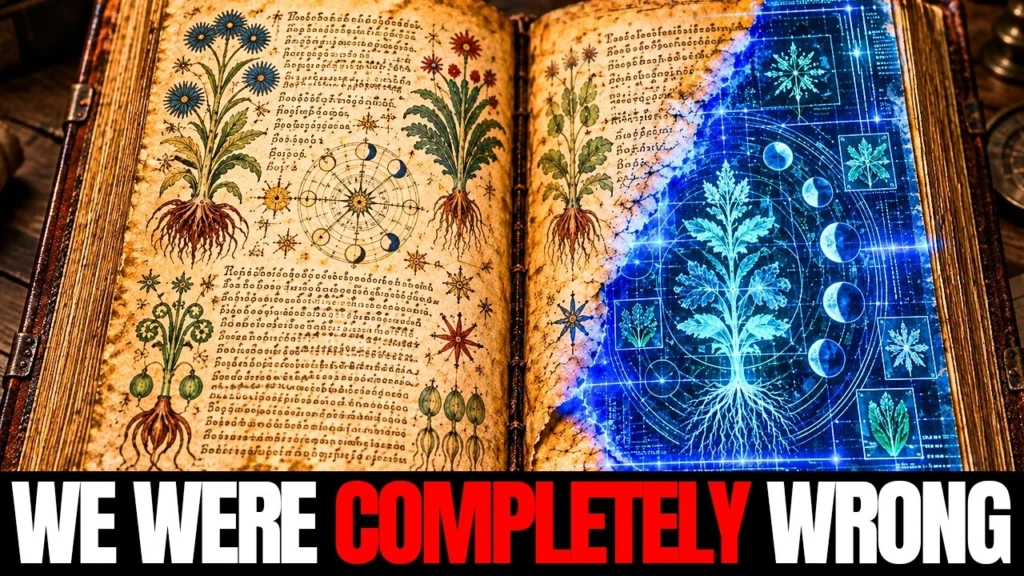
 In a climate controlled vault at Yale University’s BCA rare book and manuscript library, cataloged as MS 408, there’s a book that nobody has been able to read for 600 years.
Not for lack of trying.
William Freriedman, the man who broke Japan’s wartime purple cipher, considered one of the greatest cryp analysts in American history.
Dual worked on it for years.
He got nowhere.
Teams from both world wars took runs at it.
The National Security Agency dedicated resources to it.
computational linguists, professional codereakers, amateur obsessives spread across every decade of the 20th and 21st centuries.
All of them walked away with a theory and none of them with a translation.
In 2026, a research effort tried the thing that 600 years of human study had never done.
It gave the entire statistical record, every measurement, every linguistic analysis, every structural finding ever published on the manuscript to AI systems at once with one cold instruction.
Don’t try to translate it.
describe what kind of thing it is.
My name is Marcus Reed and what I’m going to walk you through is what those tools found when they looked at the Voinich manuscript not as a puzzle to be solved but as a text to be characterized.
Why the initial findings looked like good news.
Why the deeper findings complicated that completely.
What a 2025 peer-reviewed paper added that changed the shape of the debate.
And why the conclusion the AI reached is the most honest thing anyone has said about this book in six centuries.
the physical object.
First, 240 pages of calf skinin vellum bound into a book slightly smaller than a standard sheet of printer paper.
Every page is covered in a flowing, confident script that runs left to right in neat lines with paragraph breaks and what appear to be headings.
Whoever wrote this knew exactly what they were doing with a pen.
The writing is not hesitant or exploratory.
It flows the way a person writes who has been writing in the script for years.
The trouble is that the script matches no known alphabet, living or dead.
Approximately 25 core characters repeat across roughly 37,000 words.
And in 600 years of analysis, not one of those characters has been successfully tied to a sound or a meaning.
Every attempt to map the script onto a known language has either stalled at statistical plausibility or collapsed entirely when taken to the level of producing readable sentences.
The illustrations make it stranger.
The first section is botanical.
Page after page of plants painted in careful systematic detail, the kind of illustration a medieval herbalist would produce.
The plants don’t match any identifiable species.
A few bear resemblance to real plants in general form, enough to suggest the artist knew what a plant looked like, but the specific specimens don’t correspond to anything in the botanical record.
The next section contains astronomical charts, circular diagrams ringed with stars and zodiac figures.
After that, human figures standing in green pools connected to each other by tubes and pipes in arrangements that have been described as pharmaceutical, cosmological, and anatomical depending on who’s looking.
The book ends with nine large circular maps and a run of short paragraphs, each tagged with a small star that read structurally like a list of recipes or instructions.
It is a complete, organized, illustrated reference work in a language nobody can identify on subjects nobody can definitively characterize.
The book first appears in the documented record around the year 1600 at the court of Emperor Rudolph II in Prague, who reportedly paid a substantial sum for it.
In 1912, a book dealer named Wilfrid Voyage bought it from a Jesuit college near Rome and gave it his name.
He spent the last 18 years of his life trying to read it.
He didn’t get further than anyone else.
For a long time, the simplest way to handle the Voinich manuscript was to call it a hoax, an elaborate fake sold to a gullible emperor.
meaningless by design.
That explanation had the advantage of requiring no further investigation.
Then in 2009, that door was partially closed.
A team led by Greg Hajins at the University of Arizona took four small samples from the vellum and put them through an accelerator mass spectrometer, the most precise radiocarbon dating method available.
The calf skin dated to between 1404 and 1438.
That makes it older than the Gutenberg Bible.
Whatever this is, real coded language, elaborate cipher, sophisticated hoax, or something without a category yet.
Someone went to the considerable expense of producing 240 pages of it on real highquality animal skin in the early 15th century.
That’s not something you do carelessly.
That’s a project.
The question that survives the radiocarbon dating is the one it doesn’t answer.
What is actually on those pages? That’s what the AI analysis was pointed at, not decipherment, characterization, and the first thing the tools found was unexpected.
Not because it was mysterious, but because it looked almost conclusive.
Language leaves statistical fingerprints.
This is not a vague observation, and it is one of the most welldocumented regularities in linguistics, and it holds across every human language ever measured.
The clearest fingerprint is called Zip’s law.
In any human language, the frequency of words follows a specific mathematical relationship.
The most common word appears roughly twice as often as the second most common, three times as often as the third, and so on down the line in a smooth, predictable curve.
It happens in English, it happens in Mandarin, it happens in Latin, it happens in languages that have been dead for a thousand years and that we can read because we have enough text to measure.
Random gibberish text produced by a process that has no underlying structure doesn’t follow this curve.
Random text produces a flatter, noisier distribution.
The voinage text follows ZIP’s law almost perfectly.
In 2013, two physicists, Marcelo Montamuro at the University of Manchester and Damian Zanet in Argentina published an information theory analysis of the full manuscript.
They found that specific vocabulary clusters inside specific sections in a way that tracks with real content.
The words that dominate the botanical pages fade out in the astronomical pages where a different vocabulary takes over.
That’s what happens in a real book where different chapters are about different things.
The words of one chapter differ from the next because the subject matter differs.
The voinage manuscript does this.
Whatever it contains, it contains something different in each section.
And the word distribution reflects it.
Every AI analysis run on this text, including the most recent computational work, has confirmed these findings.
The manuscript behaves like a text that means something.
The statistical fingerprint of language is there.
That should have been the breakthrough.
It wasn’t because the moment the analysis went deeper from the statistical shape of the text to the internal rules governing the words themselves, the picture changed.
In a real language, letters move around.
In English, the letter A can come before B as in able or after it as in cab.
Every natural language has this kind of flexibility because human speech is irregular and the writing systems that encode it reflect that irregularity.
Languages have exceptions.
They have words that break the pattern.
They accumulate the messiness of being evolved rather than designed.
The Voinich manuscript doesn’t do this.
In 2022, Masmilliano Zata presented an analysis at the International Conference on the Voinich manuscript at the University of Malta.
His finding was specific.
97% of the words in the manuscript follow one rigid template.
He called it a slot alphabet.
Picture a sequence of numbered positions.
Certain characters are permitted only in position one, others only in position four, others only at the end.
A character can be followed by one from the same slot or a later one, but almost never by an earlier one.
The whole system locks characters into place with a discipline that no natural language replicates.
No natural language on Earth is built like this.
Human writing is full of exceptions because human speech is messy.
What Zetera found reads like something assembled by a rule rather than evolved from speech.
One word at a time, always following the same order, never breaking the pattern once.
The conditional entropy measurement adds another layer.
Conditional entropy is a measure of how predictable the next character in a text is given the preceding characters.
The lower the entropy, the more machine-like the text.
The less variation it contains, the more it repeats.
Voinish text comes in approximately 0.
8 points below the range of any natural language it’s been compared against.
The characters are far too orderly, far too predictable to be ordinary speech written down.
And then there’s the repetition.
The same word appears two, three, sometimes four times in a row on the same line throughout the manuscript.
The word most commonly transliterated as Diane does this constantly.
Try constructing a sentence in any natural language where the same word fires three times consecutively.
It doesn’t happen in ordinary speech.
It happens on nearly every page of the Voyage manuscript.
So the statistics say this is a language.
The internal structure says this is a machine.
These two findings flatly contradict each other.
And that contradiction is where the AI analysis found itself with nowhere comfortable to go.
If following the evidence in the order it arrives, the ZIP’s law confirmation, the semantic clustering, then the slot alphabet that breaks every natural language rule is the kind of investigation your feed needs.
Subscribe now.
Because what came next in the analysis was an attempt to identify which language sits underneath the voinage text.
And the answer that came back pointed somewhere nobody expected.
For most of the manuscript’s documented history, the guesses about what language might underly it reached for the familiar.
Latin under a cipher, medieval German, some lost Italian dialect.
The geography of the manuscript’s known history.
Rudolph II’s court in Prague, a Jesuit college near Rome, pointed towards central Europe, and researchers followed that geography towards central European languages.
In 2016, two computer scientists at the University of Alberta, Bradley Hower and Gregor’s Condra, decided to stop guessing and let an algorithm choose.
They trained a language identification system on the Universal Declaration of Human Rights, which exists in hundreds of translations.
The same document in hundreds of languages gives you a clean, comparable data set for teaching a system what each language looks like.
Then they fed in the voinage text and asked a simple question.
Out of 380 languages in the training set, which one does this look most like? They expected Arabic.
The algorithm’s answer was Hebrew, not a marginal lean.
The system returned Hebrew as its top result, and Hower and Condra then applied a specific test.
They treated each Voyic word as an anagram, a scrambled version of a Hebrew word, and unscrambled it.
More than 80% of the results were real entries in a Hebrew dictionary.
The short dense character of voinage words fits this hypothesis in a specific technical way.
Hebrew is an abjad, a script that primarily writes consonants and omits vowels producing the kind of short vowel-like words the manuscript is packed with.
A 15th century book covered in Europeanl looking plants and zodiac figures, its cold statistical profile pointing toward a smitic language.
Power and Condrack were careful about what they had.
In their published paper, they stated explicitly that the result could be a real clue about the underlying language, or it could be a mathematical artifact.
The luck of anagrams landing on real Hebrew entries by coincidence when the word shapes happen to fit.
Other researchers pushed back in the Hebrew hypothesis has never produced a full readable translation from any section of the manuscript.
The AI analysis registered the finding the same way Hower and Contract did.
cautious.
The evidence tilts toward a smitic structure underlying a Europeanlook script.
It cannot demonstrate that any specific sentence means anything.
And that inability to demonstrate meaning is what reopened the oldest explanation in the file.
The one that requires no hidden language and no sophisticated cipher.
The one that needs only a patient scribe with a particular trick.
If following the analysis through the Hebrew finding and [snorts] toward what it couldn’t rule out is the kind of evidence first work your feed should have more of, subscribe now because the hoax theories about the Voinich manuscript are not fringe ideas filed under conspiracy.
Two of them have been published in peer-reviewed cryptologology journals in the past 6 years and one of them from 2025 is the most unsettling finding yet.
In 2019 and 2020, two German researchers Torstston Tim and Andreas Sher published a paper in the journal Cryptologia, laying out a specific mechanism for how a medieval scribe could have produced every measurable property of the voinage text without encoding any message at all.
Their method is called self-citation.
The scribe writes a word.
To make the next one, they look back at a word already written on the page and copy it with a small change, a character added, a slot swapped, a beginning modified.
Then they do it again and again, always riffing off what’s already written on the page in front of them.
Never pulling from a vocabulary or a language, just iterating on what’s already there.
Run that process across 240 pages, and you get everything the Voinish manuscript has.
The words cluster and repeat because each one is a near copy of the last.
The structure stays rigid because the scribe is following a private habit instead of a grammar.
The entropy stays low because the text is feeding on itself.
The slot alphabet rule emerges naturally because the iterations are always working off the same template.
The word repetitions, the same word three times in a row, appear because copying the previous word with no change is the simplest possible iteration.
It would follow Zip’s law.
It would show semantic clustering by section because the scribe could seed each new section with a slightly different starting word, producing a different local vocabulary that the copying loop then propagates.
It would pass every statistical test for being a language and it would say nothing at all.
This is not a new idea that Tim and Sher invented.
married Imperio, a codereaker at the American National Security Agency, described essentially the same trick in a 1978 monograph.
She noted that a scribe inventing fake text would naturally begin repeating and modifying nearby words because inventing thousands of original nonsense syllables from scratch is genuinely difficult and copying what’s already in front of you is easy.
The Tim Scher paper put this observation into a formal computational model and demonstrated that it could reproduce the Voinish manuscript’s specific statistical signature.
Then in 2025, Michael Gresko, an independent researcher and science journalist, published a peer-reviewed study in the same journal, Cryptologia, introducing what he called the Naibbe cipher.
Named after a 14th century Italian card game, the Naibbe cipher is a substitution method that uses an ordinary deck of playing cards and a pair of dice to encrypt Latin or Italian text.
The operator assigns card values to letter substitutions and uses dice rolls to introduce controlled variation in the output.
The result is encrypted text that is not random.
It preserves the structural properties of the underlying Latin or Italian while making the content completely unreadable to anyone who doesn’t have the card deck in the key.
Greskco ran the cipher’s output through the same statistical tests applied to the voinage manuscript.
Word frequency distribution slot structure analysis, conditional entropy, ZIP’s law compliance.
The NAB cipher output match the Voinich manuscript statistical profile with striking precision.
What makes the naive finding significant is that the cipher is historically attested.
Playing cards and dice existed and were used across 15th century Europe, exactly the period the vellum dates from.
A person in 1420 who wanted to encrypt a Latin or Italian text using materials available in any merchant’s household could have produced this.
The resulting text would look to any subsequent analysis like an unknown language with consistent internal structure.
It would defeat crypalists for centuries and it would do so without requiring any exotic technology, lost civilization or recovered knowledge.
Just a card deck, some dice and a key that was never written down.
The 2022 paper by Gascal and Bowen added another layer, a computational study demonstrating that voyekes is statistically similar to samples of text that human subjects produced when asked to write meaningless text following simple madeup rules.
The paper’s title was direct gibberish.
After all, none of these findings prove the manuscript is a hoax.
a real language encoded with exceptional discipline would pass the same tests.
What they demonstrate is that the statistical properties of the voinage text, the properties that once looked like proof of meaningful content are not sufficient to distinguish a real message from a sophisticated empty system.
The AI analysis held all of this simultaneously.
And it found something in the physical evidence that complicated both sides of the debate at once.
In 2020, Lisa Fagan Davis, a manuscript scholar who directs the Medieval Academy of America, published a study of the Voyage Manuscript’s handwriting.
She approached it the way a paleographer approaches any medieval document, ignoring the meaning entirely and focusing on the physical execution of the characters.
the microscopic habits and quirks that reveal the person holding the pen.
She found five separate scribes.
Each one has small consistent patterns in how they shape the same characters, the particular angle of a stroke, the pressure at the end of a loop, the way a specific letter closes.
These are the kinds of involuntary habits that distinguish one person’s writing from another, even when they’re producing the same script.
And all five scribes are writing in the same impossible voinage script, following the same rigid slot rules without hesitation, without correction, without the exploratory marks of someone learning as they go.
That finding matters in a specific way for the hoax question.
A single person producing nonsense text can be imagined relatively easily.
One skilled scribe following a private system, copying and modifying his way through 240 pages of calfskin.
The self-citation model works cleanly for one person.
Five people all writing fluently in the same invented system, following the same grammar of slots without being told what to do at each step.
That means somebody taught this.
More than one person knew the system well enough to write it at speed, without stopping, without error.
That’s either a trained team working from a real cipher system or a trained team executing an elaborate hoax with enough participants to require organized transmission of the method.
Both explanations are uncomfortable in different directions.
Then in 2024, Davis went further.
A decade earlier, several pages of the manuscript had been scanned with multisspectral imaging, a technique that captures wavelengths of light beyond what the human eye can process, revealing ink that has faded below visible detection.
The imaging surfaced faded letters in the margins.
Roman letters, our alphabet, ordinary medieval handwriting, most likely from an early reader who was sitting with the book and trying to match the voinage script to familiar sounds.
Someone had worked this book the same way we are working it now.
hundreds of years ago got no further, left their notes in the margins in fading ink, and the notes themselves became invisible until a multisspectral camera caught them in the 21st century.
We know some of the names of people who tried.
Johannes Marcus Marcy, a physician in Prague, owned the manuscript in the 1660s and wanted it read badly enough that he shipped it across Europe to Athanasius Kerser, the most celebrated scholar of his day, who had claimed to crack Egyptian hieroglyphs.
Kerscher worked on the Voish manuscript.
The manuscript beat him too, and apparently he never responded to Marcy’s letter about it.
The manuscript has now defeated four centuries of documented attempts, including at least one person who left traces of their effort in fading ink that we only recovered 350 years later.
Here is what the AI analysis of the complete statistical record shows.
Stated plainly, the Voinish manuscript follows Zip’s law in its word frequency distribution, the fingerprint of structured language confirmed across multiple independent analyses.
It shows semantic clustering by section with the vocabulary of each section differing from the others in a way that tracks with what’s illustrated on those pages.
These are properties of text that mean something.
At the same time, 97% of its words follow a rigid slot template found in no natural language.
Its conditional entropy sits approximately 0.
8 points below any natural language measured.
The same word appears three and four times consecutively on the same line repeatedly throughout the manuscript.
A self-citation process was demonstrated computationally to produce these exact properties without encoding any message.
A historically attested cipher using cards and dice published in a peer-reviewed journal in 2025 produces text with the same statistical profile from encrypted nonsense.
Five scribes wrote it all fluently in the same system following the same rules.
Faded Roman letters in the margins show someone sitting with this book centuries ago trying to read it the same way we are now.
The AI can measure the discipline.
It can confirm that whatever system produced this book, it was followed exactly consistently across 240 pages by multiple people without error.
What it cannot determine and what no analysis in 600 years has been able to determine is whether that discipline was carrying a message or whether it was perfecting the illusion of one so completely that no instrument yet built can tell the difference.
My name is Marcus Reid.
If sitting with a question that’s been genuinely open for six centuries is what you come here for, you know what to