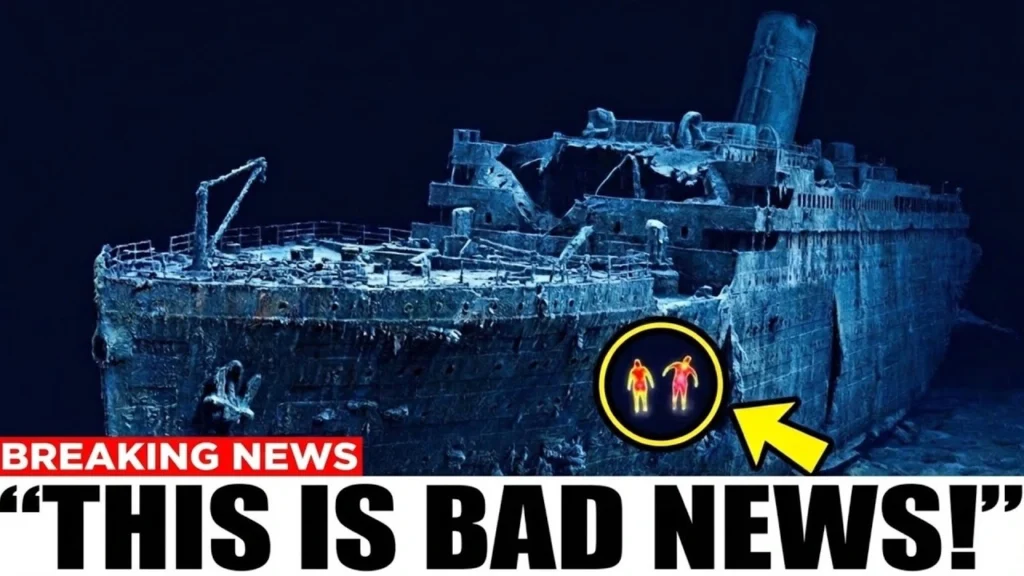

For 114 years, the world has pictured more than 1,500 people lying in the dark beside the wreck of the Titanic.
But when cameras finally reached the ocean floor, the explorers found something no one had prepared for.
The ship rests 12,000 500 ft down where sunlight has never reached and the pressure is about 380 times stronger than at the surface.
Robert Ballard, the oceanographer who found the wreck in 1985, remembered how the hull towered over his tiny submarine.
In his words, he never looked down at the Titanic.
He looked up at it.
In 1986, something broke 74 years of silence.
A small robot camera called Jason Junior slipped into the wreck and sank through the hollow shaft where the grand staircase once stood into spaces no living person had seen since April 1912.
When the videotapes were released, the world saw a chandelier still hanging in the blackness.
And out on the seabed, the cameras photographed something so haunting that experts have argued for years over what it really shows.
This was not another postcard shot of the rusted bow.
This was the place where the passengers came to rest, where shoes and luggage still lie exactly where they settled in the mud, and where more than 1,500 lives ended in freezing water.
What the cameras found and what they never found changes how we picture that night.
And the closer the robots looked, the more disturbing the answer became.
I’m Ambrose Weild and here’s how strange that argument gets.
One of the men who has spent the most hours at this wreck insists there is nothing human down there at all, while a government archaeologist looked at the same seabed and said the opposite.
They They both be right.
If you’ve ever seen those photos of shoes on the seabed and wondered what actually happened to the people who wore them, you’re going to get the full answer.
And the road to that answer starts with a secret the United States Navy kept for decades.
For 73 years after the sinking, nobody could even find the Titanic.
In 1981, an American expedition led by Jack Grimm searched the North Atlantic and came home believing it had spotted one of her propellers.
It hadn’t found the ship.
Then, in 1985, the breakthrough came from a mission that was never really about the Titanic at all.
Ballard was a commander in the US Navy, as well as a scientist at the Woods Hole Oceanographic Institution, and when he asked for money to hunt for the wreck, the Navy offered him a deal.
First, he had to survey two American nuclear submarines lost in the 1960s, the USS Thresher and the USS Scorpion, without the Soviets noticing.
The Titanic search was his cover story.
When the discovery made headlines, a Navy spokesman told the New York Times the military had only paid for the trip because it wanted to test new underwater equipment.
That part of the story stayed under wraps for years, and Ballard has said there are other Navy missions he still isn’t allowed to talk about.
By the time the submarine work was finished, Ballard had just 12 days left at sea.
But mapping the Scorpion had taught him something.
A ship that breaks apart on its way to the bottom leaves a long trail of debris behind it, and a trail is far easier to spot than a hull.
So, his team, working with partners from the French Ocean Institute IFREMER, went looking for the wreckage trail first.
On the 1st of September, 1985, a camera sled called Argo, towed behind the research ship Knorr, sent up a grainy image of a ship’s boiler lying on the seabed.
The Titanic had been found, and the very first pictures proved that the official record had been wrong for 73 years.
Both inquiries in 1912 concluded that the ship went down in one piece.
Survivors who described her tearing apart were set aside, and the scream of metal they heard was blamed on exploding boilers.
But the wreck showed the bow and the stern lying 1,970 ft apart, facing opposite directions.
The survivors had been telling the truth.
Therefore, the obvious next question was what else everyone had gotten wrong, and the answers were inside the ship.
Getting inside was a far harder problem.
The research submarine Alvin could carry three people to the bottom, but it was much too big to push into collapsed rooms, where one snag on a twisted beam could trap it 2 and 1/2 miles down.
So, engineers at Woods Hole built something small enough to go where Alvin couldn’t.
Jason Jr.
rode on the front of the submarine and swam out on a tether, a setup one reporter at the time compared to a sea turtle on a leash.
Ballard had his own nickname for it.
He called it the swimming eyeball, and it was an experiment.
The robot had been built partly to test whether fiber optic cable could carry signals in the deep ocean at all, and now it was about to fly into the most famous shipwreck in the world.
In the summer of 1986, Ballard’s team made 11 dives in Alvin.
Every one of them began with a fall of roughly 2 and 1/2 hours through total darkness, and the robot didn’t always cooperate.
According to the New York Times, the team managed to send Jason out only a few times.
When Alvin’s lights finally found the hull, it was covered in long orange drips of rust hanging from every rail and porthole like icicles.
Nobody had a name for them, so Ballard coined one.
He called them rusticles.
At the time, they looked like decoration.
Decades later, scientists discovered that they were alive and that they were feeding on the ship.
Keep that in mind because we’ll come back to it at the end.
Then Ballard parked the submarine on the deck of the Titanic itself and from that perch, Jason Jr.
went in.
The way inside was the opening where the forward grand staircase used to be.
The centerpiece of first class, once crowned by a dome of glass and wrought iron.
The dome was gone.
So was the staircase.
As the little robot lowered itself down the shaft, the crew watched an empty cavernous drop open beneath it where the steps and the iron balustrades should have been.
Where did a whole staircase go? Ballard’s first theory was that wood-boring creatures had eaten the woodwork.
Years later, the filmmaker James Cameron, who would eventually make 33 dives to this wreck, offered a different idea.
As the bow plunged, water rushing through the ship may have lifted the staircase up and out through the shattered dome.
Pieces of the ship’s staircases have since turned up scattered across the seabed, but in the middle of all that emptiness, the lights picked out something that had no business surviving.
A chandelier crusted with growth still hanging from the ceiling and swaying slowly in the current.
The bow had fallen 2 and 1/2 miles to the bottom and a hanging light fixture came through the trip intact.
That fragile glass makes what happened to the people on board even harder to take and it comes down to one of the grimmest pieces of chemistry in the ocean.
Those same dives caught other things, too.
Out in the debris field, they photographed a bronze statue of the goddess Diana that had once stood on the fireplace mantle of the first class lounge.
It was torn away when the lounge ripped open during the sinking and after 1986, that statue dropped out of sight for the next 38 years.
Nearby, a a robotic arm reached for one of the ship’s safes and tried to pull the door open.
It wouldn’t budge.
The team had to leave it on the seabed, and what was inside that safe would become one of the most hyped moments in Titanic history.
We’ll open it in a few minutes, but the robots that came next went much deeper than Jason Jr.
ever could.
And what they found changed the timeline of that night.
In 2001, Cameron came back with two robots of his own, nicknamed Jake and Elwood after the Blues Brothers.
His brother, Mike Cameron, built them through his engineering firm because the kind of robot they needed didn’t exist yet.
The secret was the tether.
Older robots dragged their cables behind them, and those cables snagged the moment they turned a corner around wreckage.
Jake and Elwood paid out their own tiny fiber optic line as they moved, so they could thread through corridors, cabins, and stairwells.
The team flew them from two Russian Mir submarines launched from the research ship Keldysh and made 12 dives in pairs.
The crew learned about the September 11 attacks while they were out over the wreck, and the robots nearly didn’t make it home.
On one dive, Elwood became trapped inside the Titanic, and the crew spent several tense attempts trying to get it back out.
For a while, it looked like the wreck was going to keep it.
But the expedition came home with about 900 hours of video, and some of it rewrote the story.
In the first-class dining saloon, the tall leaded glass windows were still standing in their frames.
Then they reached the Marconi room, where the ship’s two young wireless operators had spent the night calling for help.
The switches on their equipment were still set exactly where the men had left them.
Those positions show that they cut the power when they abandoned their as the water came rushing up the deck outside.
Cameron’s cameras even found the transformer the pair had repaired the night before the sinking.
That was the last thing anyone did in that room and it sat untouched for 89 years.
The newest evidence goes even further.
In 2023, a deep sea mapping team photographed the wreck more than 700,000 times from every angle and stitched the images into a full-size digital copy.
When researchers studied it for a 2025 National Geographic documentary, they found a valve lying on the stern deck still set in the open position.
That valve means steam was still flowing to the ship’s electrical generators.
Survivors always said the lights stayed on almost until the end and now there’s physical proof of how.
A team of engineers led by Joseph Bell stayed below feeding the furnaces to keep power running while passengers made for the lifeboats.
The same study ran a computer simulation of the collision and found the fatal damage may have been a line of punctures, each about the size of a sheet of paper.
That sounds far too small to sink a ship that size, but Simon Benson, a lecturer in naval architecture at Newcastle University, explained why it was enough.
The holes ran along a long stretch of hull.
So water came in slowly through all of them at once until the compartments filled and spilled over the top into the next ones.
Those watertight compartments were the reason people called her unsinkable and the sea filled them one after another, which brings us back to that safe.
The year after Alvin’s arm failed to open it, a French expedition recovered a safe from the seabed and researchers who followed the artifact say it was the same one.
On the 28th of October, 1987, it was opened on live television in Paris.
The actor Telly Savalas hosted in a tuxedo with armed guards and a panel of experts standing by.
And after all that build-up, the back of the safe had rusted away.
Between the safe and a leather satchel opened the same night, the hall came to some coins, some soggy paper money, and a few pieces of jewelry.
The locked box held almost nothing.
What happened to the people aboard was a far bigger story, and the evidence for it had been out on the open seabed the whole time, and it took decades for anyone to say out loud what it meant.
If you want stories like this told from the real record, the dives, the photographs, and the court filings, subscribe to the channel now, because every video here is built the same way.
Now, back to the seabed.
More than 1,000 500 people died when the Titanic sank.
Days later, a cable ship from Halifax called the Mackay-Bennett sailed out to bring them home.
She carried all the embalming fluid in the city, about 100 coffins, 100 tons of ice, and 12 tons of iron bars to weigh down the bodies she would have to bury at sea.
When she reached the area, the crew had to stop work at nightfall with the water still dotted with bodies.
Over the next week, they pulled 306 people from the sea.
They buried 116 of them at sea because the embalming supplies ran out.
Most of those sea burials were crew members and third-class passengers, recognized by their clothing, while the wealthier dead were more likely to be carried home.
Among those they brought home was the band leader Wallace Hartley, found with his instrument still strapped to him.
One of the bodies was a little boy nobody could identify.
The sailors were so shaken that they used reward money to pay for his burial themselves and fixed a brass plaque to his coffin, engraved with two words, “Our Babe”.
He was later identified as Sidney Leslie Goodwin.
He was 19 months old and his entire family had died with him.
Every ship in the search put together recovered fewer than 340 bodies.
That leaves more than 1,100 people who were never found.
Some floated away in their life jackets and were carried off by a storm that blew in after the sinking, but many went to the bottom with the ship and Ballard put it bluntly.
When those bodies went down, he said, they stayed down.
So, when the cameras finally reached the seabed, the explorers expected to find them.
What they found were shoes.
In 1986, Ballard saw pairs of shoes lying in the mud side by side, exactly the way a person’s feet would rest.
Among them were the shoes of what looked like a mother and a baby.
There was no flesh and no bone anywhere near them.
Years later, looking at a photo of a pair of boots on the deck near the stern, he told a reporter that there used to be bodies in those shoes and that the leather was perfectly preserved.
So, where did the people go? The answer is a two-step process and both steps are grim.
First, the scavengers came.
Deep-sea creatures stripped away the soft tissue.
Then, the water itself finished the job.
The Titanic lies below what oceanographers call the calcium carbonate compensation depth, where the seawater dissolves calcium-rich material instead of preserving it.
Ballard explained it this way.
Once the critters eat and expose the bones, the bones dissolve.
The shoes survived for a different reason.
The tannin used to tan the leather appears to have kept bacteria away.
So, the shoes stayed right where the feet had been.
You might push back on that.
Archaeologists have found bones on plenty of old shipwrecks and searchers recovered human remains from the Air France jet that crashed into the deep Atlantic in 2009.
But, those older wrecks mostly sit in shallower water, above the depth where bone starts to dissolve.
And the Air France jet had been on the bottom for only a few years when searchers reached it.
At the Titanic’s depth, a century is more than enough time for bones to disappear completely.
That brings us to the photograph.
In 2004, an expedition led by Ballard and the US ocean agency NOAA photographed a coat and a pair of boots resting in the sediment, arranged the way they would be if someone had come to rest there wearing them.
In 2012, James Delgado, a maritime archaeologist working for NOAA, looked at that image and said that as an archaeologist, he would call it human remains.
He believed forensic traces of that person were very likely buried in the sediment underneath.
Cameron disagreed.
After all his dives, he said he had seen pairs of shoes which strongly suggested a body had been there at one point, but he had seen zero human remains.
Two serious experts looked at that coat and those boots and came to opposite conclusions.
And there’s a third possibility that’s more unsettling than either one.
Lori Johnston, a microbiologist who joined Cameron’s 2001 expedition, has argued that remains could still exist inside the wreck itself or out in the debris field in pockets where there’s very little oxygen.
Think about what that would mean.
There are parts of that ship no robot has ever reached, and they may be holding the one thing a century of cameras has never shown us.
Nobody has gone looking, and the fight over whether anyone should look ended up in a federal courtroom.
In 2020, RMS Titanic Inc.
, the company that holds the salvage rights, planned to retrieve the ship’s Marconi wireless set, the very equipment those young operators used that night.
To reach it, an unmanned submersible would have to slip through a skylight or cut into the corroded roof above the radio room, then use a suction dredge to clear the silt and robotic arms to cut the cables.
A federal judge approved the idea, but the US government went to court to stop it.
Its lawyers argued that the agreement with Britain recognizing the wreck as a memorial exists to keep the hull, the artifacts, and any human remains undisturbed.
The company answered that after roughly 200 dives, someone would have noticed remains by now.
Archaeologists backing the government said there must be remains and pointed to the whale bones found at similar depths and the human remains recovered from that Air France crash.
So, the people who know this wreck best can’t agree on whether it is still a grave in the most literal sense.
And the site is wrapped in so much secrecy that even its treasures go missing.
Remember that bronze statue of Diana? The company says its location stayed unknown for decades because of a tradition of secrecy around the wreck until its 2024 expedition found the statue again, still standing upright in the debris field.
Every visit carries a cost, too, and in June 2023, that cost became human.
A tourist submersible called Titan imploded on its way down to the wreck and all five people aboard were killed.
One of them was Paul-Henri Nargeolet, the company’s director of underwater research, who had piloted the French submarine Nautile on dives to this very wreck.
Even the visits that go perfectly do damage.
Henrietta Mann, a scientist at Dalhousie University in Halifax, the same city that sent out the Mackay-Bennett, says every submersible speeds up the decay because its propellers stir up bacteria and hand them fresh steel to colonize.
Here’s where I land on it.
Cutting into that radio room to put a telegraph in a museum isn’t worth the risk of disturbing whatever may still be inside.
But, I can’t pretend the cameras are innocent, either.
Because every dive stirs up more of the bacteria that are eating the ship.
The honest position is that we’re documenting a grave that is disappearing, and it’s disappearing faster than anyone hoped.
That’s because of what the rusticles turned out to be.
In 2010, Mann and her colleagues identified a brand new species of bacteria living inside them, and named it Halomonas titanicae.
Each rusticle is a colony, a spongy structure with channels running through it, built by at least 27 strains of bacteria working together to eat the iron in the hull and turn it into rust.
Some grow as tall as a person.
Mann points out that the Titanic is about 50,000 tons of steel, and the bacteria are working through all of it.
Nobody even knows whether they arrived with the ship or found her after she sank.
Back in 1995, Mann predicted the Titanic had about 30 years left.
We are now past that deadline.
The ship is still there, but it’s losing pieces fast.
The 2024 expedition found that a large section of the famous railing around the bow, still standing in 2022, had fallen away.
So, think about what lasts longest at the bottom of the North Atlantic.
The bones were the first thing to go.
The steel is going now, eaten by bacteria one rusticle at a time.
And the tanned leather that kept those shoes intact has already outlasted both.
Which means the last trace of the people who died that night may not be the ship at all.
It may be their shoes, still lying in pairs in the dark, exactly where they came to rest.
I’m Ambrose Wilde.
There are more shipwrecks down there with stories the official record got wrong.
And if you subscribe, I’ll take you down to the next one.