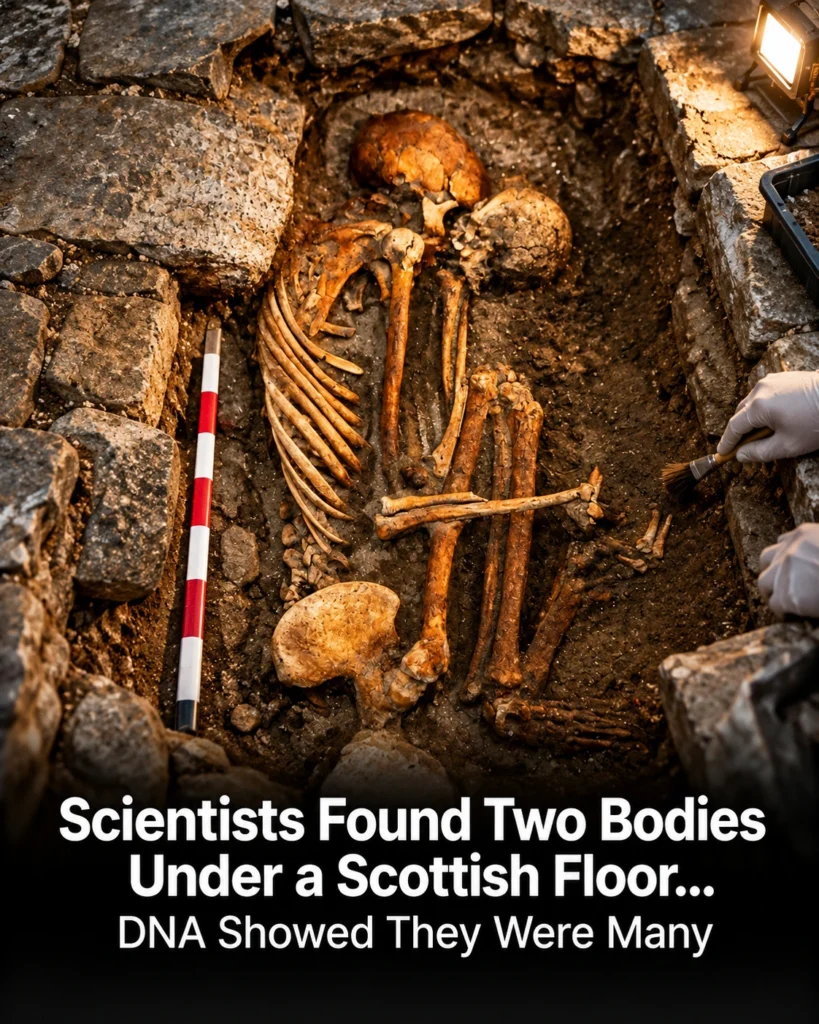
Two bodies curled beneath the floor of a house on a windswept Scottish island.
Buried in the gentle knees-to-chest pose of people laid to rest with care 3,000 years ago.
For decades, everyone assumed they were exactly what they looked like, two individuals, a man and a woman resting under their own home.
Then, scientists recovered the genetic code locked in their bones, and the count was wrong.
These were not two people at all.
The DNA says otherwise.
The place is called Cladh Hallan, and it sits on the island of South Uist, far out in the Outer Hebrides islands off the western coast of Scotland.
It is a bleak and beautiful place, a low sweep of grass and sand and wind, with the gray Atlantic Ocean never far away.
And beneath the turf there, archaeologists uncovered the remains of a line of ancient roundhouses, circular homes of stone and earth built more than 3,000 years ago in the age we call the Bronze Age.
To picture the place is to picture the edge of the world.
There are almost no trees, only grass bent flat by a wind that rarely stops, a pale ribbon of sand, and beyond it the cold gray water stretching away to the horizon.
The people who lived here were farmers and herders, raising barley and keeping animals on thin soil in homes dug partly into the ground for warmth against the Atlantic gales.
It was a hard life in a thin place, and the houses they built were sturdy and round and snug, made to hold heat and keep out the weather.
It is close to the last corner of the earth where you would expect to stumble onto one of the great riddles of the ancient dead.
The houses themselves were a fine discovery, but it was what lay underneath them that would stun the world.
Because when the diggers cut down through the floors, they found human bodies deliberately buried inside the homes.
Not in a graveyard, not out in a field, right there, under the living space, beneath the feet of the people who had slept and cooked and raised their children in those rooms.
The excavation that uncovered all this ran at the very start of this century, led by a team of British archaeologists working slowly through the sand.
They found a whole line of these joined roundhouses, and more than one body tucked beneath them.
There was a young child.
There was a small infant.
And there were the two that would become famous, the crouched adults laid under separate houses in the same line.
From the beginning, it was clear that burying the dead inside the home was no accident here.
It was a custom, something these people did on purpose, again and again.
Two of these buried bodies were extraordinary.
One appeared to be a man, laid on his side in a tight crouch, his knees drawn up and his arms folded in.
The other appeared to be a woman, placed in the very same careful pose nearby.
They looked, at first glance, like a simple and rather touching pair.
Two ancestors kept close, tucked under the floor of the family home, so they would never truly leave.
But almost at once, something about them did not add up.
And the first clue was about time itself.
When the bones were dated, the results came back strange.
The bodies had been buried around 3,000 years ago.
But the people themselves, judging by their bones, had died centuries before that.
These were not freshly deceased relatives slipped under the floor.
They were old when they were buried.
Someone had kept them above ground for hundreds of years before finally laying them to rest.
And that raised a question that only grew stranger the longer anyone looked at it.
How do you keep a human body in the cold, wet air of a Scottish island for three or four or five centuries without it rotting away to nothing? The answer the scientists reached was itself a shock.
These bodies had been mummified.
Not with the oils and wrappings of ancient Egypt, but with the island’s own strange chemistry.
The researchers believed the bodies had been placed soon after death into a peat bog, one of the wet, acidic, airless marshes that cover so much of that landscape.
A bog like that halts decay almost completely, tanning flesh and bone the way it tans leather.
The bodies were left just long enough for the bog to do its work and lock them in.
And then, the evidence suggests, they were pulled back out, now preserved, now permanent, and kept by the living.
The clue to all of this was hidden in the microscopic structure of the bones.
When a body decays in the normal way, bacteria from inside it begin to eat into the bone within days, leaving a telltale pattern of tiny damage.
In these bodies, that bacterial damage had started and then suddenly stopped, frozen at a very early stage.
Something had halted the decay almost as soon as it began.
The most likely something in that landscape was a peat bog, its cold, acidic, airless water the perfect natural preservative.
The researchers even worked out roughly how long the bodies had soaked.
Long enough for the bog to seize them and lock them in, but not so long that it dissolved their bones entirely, which the fierce island acid would eventually have done.
The timing had been controlled.
Someone knew exactly when to take them back out.
Sit for a moment with how strange that is.
These were not bodies hidden away and forgotten.
They were preserved on purpose and then kept in and around the homes of the living for something like 300 to 600 years before they were finally buried.
That is longer than many a modern nation has existed.
Generation [snorts] after generation would have been born, grown old, and died while these same preserved bodies remained among them.
Handed down like heirlooms, a permanent presence at the heart of a family that kept changing around them.
Before I tell you what the code finally revealed, I want you to choose a side.
Here are two bodies mummified in a bog, kept for centuries, and then buried with care beneath a family home.
What do you think they are? Two preserved ancestors? A real man and a real woman held onto by their descendants and finally put to rest exactly as they appear? Or something stranger? Something that was never quite what it looked like at all.
Two kept ancestors or something else entirely.
Decide now.
Write it in the comments before the answer and let us see who turns out to be right.
For a while, the preserved ancestor idea was the natural reading and it was remarkable enough on its own.
The very notion that Bronze Age people in Britain had deliberately mummified their dead was new and startling.
Egypt had its mummies.
The frozen peaks and the dry deserts have theirs.
But damp, green, rain-soaked Britain was the last place anyone expected to find a people who preserved their dead on purpose and kept them close.
So the first and biggest story was simply this.
Here was proof that the practice of making mummies had reached the far northern islands of Scotland 3,000 years ago, carried out by farmers and herders in roundhouses at the edge of the sea.
That alone rewrote a chapter of British prehistory.
The bodies under the floor became famous as the first clear evidence of mummification ever found in the British Isles.
And it turned out not to be a lone oddity.
Since these bodies were studied, researchers have gone back to other Bronze Age skeletons from across Britain and tested their bones for the same early halted pattern of decay.
A surprising number showed the very same signs.
The practice of preserving the dead, it seems, was not some strange local habit of one island.
It may have been widespread across Bronze Age Britain.
A whole lost tradition of making mummies in the damp green north that we had simply never thought to look for because we assumed that mummies belonged to deserts and to kings.
And the idea that families had kept these preserved ancestors for generations fit everything researchers understood about that world.
In a society without writing, the dead were powerful.
They were proof of who you were, of whose land this was, of which family had the right to dwell here and farm here and bury their own beneath this floor.
A preserved ancestor, kept and visible, was a kind of living title deed, a physical anchor tying a family to its home and its ground.
Keeping the dead close made perfect sense.
It is worth understanding just how much weight the dead carried in a world with no documents and no deeds.
There were no written records to prove that your family had farmed this patch of ground for generations.
There was no court to settle who owned what.
In a society like that, the ancestors themselves became the proof.
To be able to point to your own preserved forebears resting beneath your floor was to make a silent and powerful argument.
“We were here before you.
This ground remembers us.
These bodies are our claim, and you cannot wish them away”.
The dead did not only comfort the living, they defended them.
But the bodies held a secret that no amount of careful digging could reveal, because it was written at a level the eye cannot see.
To read it, the scientists would have to go inside the bone itself, into the fragile strands of genetic code that still survived there, and ask a question so odd that at first no one even thought to ask it.
Not who were these people, but how many of them were there? The investigation began with the man and with a detail that should have been impossible.
As the researchers examined his skeleton closely, they noticed that his different parts did not seem to belong together.
His lower jaw did not fit neatly with the rest of his skull.
The bones had a mismatched quality, as if they had come from more than one body.
So, they did something no one had thought necessary before.
They dated the separate parts of him one by one, and they drew genetic material from several points across the single buried skeleton.
It was patient, almost forensic work.
They studied how the bones fit together, or failed to, at the joints.
They measured the wear and the weathering on different parts, which should have matched closely if the pieces had all come from one body and one burial.
They compared the fine chemistry of separate bones.
And they sampled the genetic code at more than one point along the skeleton, asking whether every part carried the same maternal signature, the line that passes down unchanged from a mother to all her children.
If this was truly one person, every sample would tell the very same story.
The scientists fully expected that it would.
For centuries, this had looked like one crouched man under a floor.
And what the code revealed turned the quiet burial into one of the strangest discoveries in all of archaeology.
The first finding was the man, >> >> and he was not a man.
He was several.
The skeleton that had been buried as a single individual was, in truth, assembled from the body parts of at least three different people.
The torso came from one man.
The skull and neck came from a second.
The lower jaw came from a third.
Three separate human beings who had died at different times had been taken apart and then carefully put back together into the shape of one person, arranged in that peaceful crouch, and buried as though he had always been whole.
And the parts had not come from the same moment in time.
When the separate pieces of him were dated, they turned out to have died generations apart.
The man whose torso this was had been gone for centuries before the jaw that now sat beneath his skull had even been laid in its own bog.
Someone had reached back across hundreds of years of preserved remains and selected from among them the makings of a single body.
The second finding was the woman, and she was stranger still.
When the scientists examined her, the genetic code and the physical bones told a tangled story.
Her skull, it appeared, had belonged to a man.
Her torso had belonged to a woman.
Other parts traced to yet another individual.
The body laid to rest as a single woman was, like the man beside her, a composite, a patchwork assembled from the remains of more than one person, and not even all of them the same sex.
The careful couple under the floor were not a couple.
They were two human mosaics, each built from pieces of several different dead.
The third finding was about time, and it closed the circle.
The parts that made up each body had not died together.
Some of the pieces were centuries older than others.
Whoever built these bodies had been working with a collection of preserved remains gathered across many generations, choosing a torso from one era, a skull from another, a jaw from a third, and fitting them together like the parts of a single figure out of carefully kept pieces of the long gone.
These were not bodies that had decayed and been muddled by accident.
They had been composed deliberately out of carefully kept pieces of the long dead.
So, what does a discovery like this actually change? It rewrites what we thought a body even meant to these people.
We tend to assume that a grave holds a person, one life, one body laid down whole.
The builders of these mummies did not think that way at all.
To them, a preserved body was not a sealed individual.
It was material, something that could be kept, divided, combined, and rebuilt into a new figure that served the living.
They took the bones of several ancestors and merged them into one.
And then, they buried that one beneath their home as if it were a single honored forebear.
And the most likely reason why is as clever as it is unsettling.
Think again about what a preserved ancestor was for.
It was a claim.
It said, “This family, this bloodline, belongs to this land”.
Now imagine you could not simply inherit one ancestor, but build the perfect one.
By combining the remains of several different family lines into a single body, a community could create an ancestor who embodied all of those lineages at once.
A merger in flesh and bone of several claims to the land fused into one unquestionable figure under the floor.
The composite was not a mistake.
It may have been the whole point, a way of knitting different families and their rights together into a single rooted ancestor that no one could dispute.
There is a second lesson here, quieter, but just as important.
And it is a warning about how we read the ancient dead everywhere, not only on one Scottish island.
For as long as archaeology has existed, we have assumed that one grave holds one person.
We lift a skeleton, we give it an age and a sex, and we write it down as an individual.
Cladh Hallan shows how wrong that simple assumption can be.
If these two bodies had been found 100 years ago, before anyone could read the code in bone, they would have been recorded forever as one man and one woman, and no one would ever have known the truth.
It makes you wonder how many other ancient bodies, in how many other museum drawers, are quietly more than one person.
Their secrets still sealed inside them, waiting for a test that has not yet been run.
Earlier, I asked you to choose.
Two kept ancestors, or something else entirely.
If you said something else, the DNA is on your side.
There was no simple man and no simple woman, only two bodies built from the carefully preserved pieces of many.
And if you said two kept ancestors, you were in good company, because that is exactly what the finest archaeologists believed when they first lifted these bodies from beneath the floor.
And these island people reach toward us across the centuries in a way that is hard to shake.
We like to imagine that the deep past was simpler than our own time, that ancient farmers at the edge of the sea had small, plain ideas about life and death.
The bodies at Cladh Hallan say otherwise.
Here were people with a vision of the dead so sophisticated, so symbolic, so strange, that we are still struggling to fully understand it 3,000 years later.
They did not just bury their dead, they preserved them, kept them, studied them, chose among them, and built from them, treating the human body as something that could carry meaning long after the person inside it was gone.
That is a genuinely alien way to think.
And yet, it is not a primitive one.
It took real knowledge to mummify a body in a bog and know the exact moment to stop.
It took memory to keep the dead for centuries and recall whose pieces were whose.
And it took a strange, powerful kind of imagination to look at the scattered remains of many ancestors and see in them the raw material for a single new one.
These were not simple people fumbling in the dark.
They were thinkers working out their own deep answers to the oldest questions we have about death and family and belonging with ideas entirely their own.
But the answer only opens a deeper door and this one is still wide open.
>> >> We can say that these bodies were composites built from many.
We still cannot say exactly why these particular people were chosen or whose hands fitted the pieces together or what was spoken over them when they were finally laid beneath the floor.
Were the chosen parts the remains of great and remembered figures deliberately joined to concentrate their power? Or were the builders simply working with whatever preserved pieces had survived the centuries? Tell me what you think was in the minds of the people who built a single ancestor out of many.
Two bodies curled beneath the floor of a house on a windswept Scottish island.
A man and a woman, it seemed, preserved and kept and lovingly laid to rest 3,000 years ago.
The DNA says otherwise.
They were never a man and a woman at all, but two figures assembled from the carefully kept pieces of many different people fitted together by hands that saw in the human body not an ending, but something that could be kept and shaped and made to speak for the living long after its first owners were gone.
Discovery continues.
Thanks for watching.
If this story stayed with you, subscribe and turn on notifications.
We cover DNA mysteries, ancient forensics, and the cases history tried to forget.


