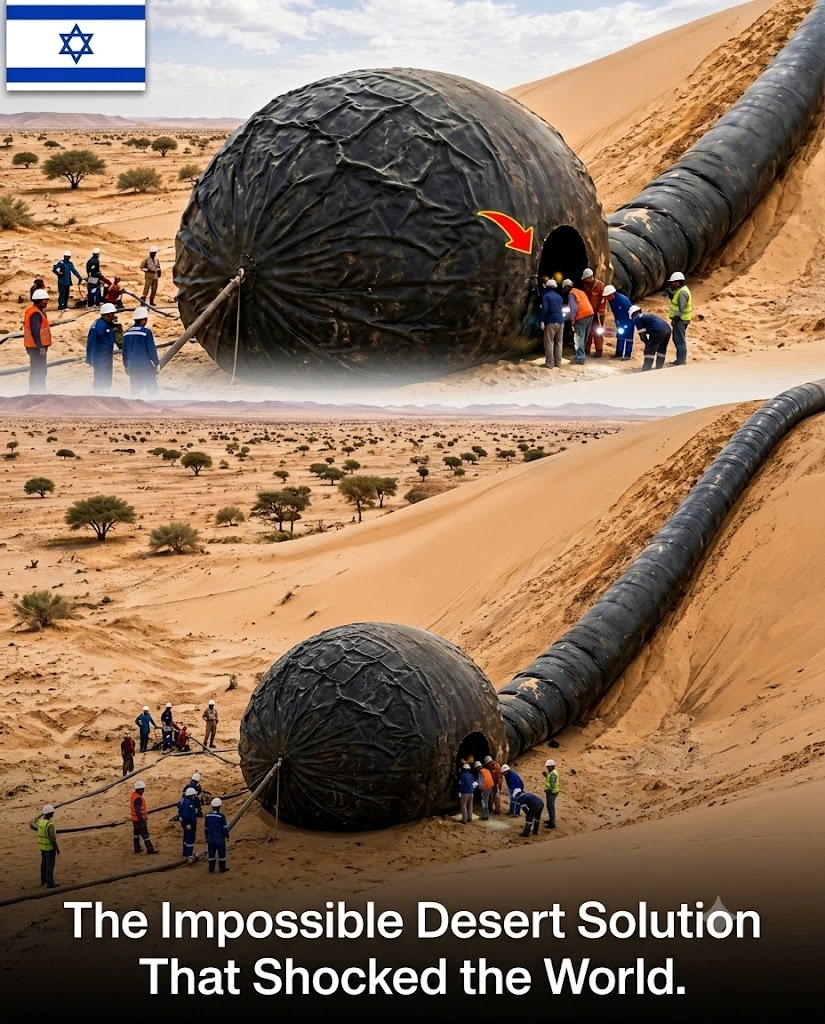
The Negev Desert covers more than half of Israel’s territory.
Its landscape includes rocky plateaus, dry valleys, and regions where annual rainfall is too limited to support conventional agriculture without irrigation.
Summer temperatures frequently exceed 40 degrees Celsius, while sudden storms can send precious rainwater rushing across hardened ground.
For generations, these conditions made large-scale farming extraordinarily difficult.
Yet Israel’s agricultural researchers saw the desert as an engineering challenge rather than an entirely unusable landscape.
One early experiment involved planting trees.
Beginning in the 1960s, extensive afforestation efforts helped establish Yatir Forest, one of Israel’s largest planted forests.
Millions of trees were introduced into an environment receiving relatively little rainfall.
Contrary to the idea that desert forests inevitably fail, Yatir survived and became an important site for ecological research.
Scientists from the Weizmann Institute of Science studied how its trees exchanged carbon, water, and energy with the atmosphere.
Their findings revealed a complicated relationship.
The forest absorbed atmospheric carbon dioxide, but its dark canopy also absorbed more sunlight than the surrounding pale desert surface.
This reduced the land’s reflectivity, a property scientists call albedo.
Consequently, the forest’s climate effects could not be judged by carbon absorption alone.
The research demonstrated that transforming dry landscapes requires understanding the entire environmental system.
Another breakthrough came from a much smaller observation.
Israeli engineer Simcha Blass recognized that delivering small quantities of water directly to plant roots could dramatically reduce waste.
Instead of flooding fields or spraying water into hot air, irrigation could be controlled through narrow pipes and carefully positioned emitters.
Working with Kibbutz Hatzerim, Blass helped develop the technology that became modern drip irrigation.
The principle was simple.
Plants needed water near their roots, not across every exposed centimeter of soil.
Drip irrigation reduced evaporation and allowed farmers to control moisture and nutrients with remarkable precision.
This technology became central to agriculture in arid regions around the world.
But efficient irrigation did not solve every problem.
The Negev still faced severe freshwater limitations.
Researchers therefore began investigating another resource hidden beneath the desert.
Deep underground, ancient aquifers contained substantial quantities of mineral-rich water.
Some groundwater emerged warm and contained enough dissolved salts to make conventional agricultural use difficult.
Applying excessively saline water to ordinary crops could damage roots and gradually increase soil salinity.
Desalination offered one possible solution, but it required energy and created concentrated waste brine that needed careful management.
Researchers began exploring a different approach.
Rather than making every water source suitable for conventional crops, they investigated organisms capable of tolerating the water’s existing chemistry.
This opened the door to desert aquaculture.
Certain fish species, including tilapia and barramundi, can tolerate varying degrees of salinity under appropriate conditions.
Their suitability depends on the precise mineral composition, temperature, and management of the water.
By controlling those conditions, aquaculture facilities can raise fish far from natural lakes or coastlines.
The idea seems contradictory.
Fish farming in a desert sounds like an extravagant use of scarce water.
Yet modern recirculating aquaculture systems can reuse much of their water rather than constantly replacing it.
Inside these facilities, water moves through filtration and biological treatment equipment.
Mechanical filters remove solid waste and uneaten feed.
Beneficial microorganisms then transform toxic ammonia released by fish into nitrite and subsequently nitrate.
This biological process is called nitrification.
Properly managed, it helps maintain water quality and protects the fish.
The resulting nutrient-rich water can also become useful for plants.
In integrated aquaculture and agriculture systems, carefully treated fish-farm effluent can supply some of the nutrients required for crop growth.
However, salinity, pathogens, and nutrient concentrations must be controlled before the water is used for irrigation.
The principle is nevertheless powerful.
A waste stream from one agricultural activity can become an input for another.
That same philosophy helped shape Israel’s broader approach to water management.
As the country’s population expanded, municipal wastewater became an increasingly important potential resource.
Instead of treating sewage only for disposal, engineers developed systems to recover water for agricultural use.
One of the most significant projects is the Shafdan wastewater treatment system, which serves the greater Tel Aviv metropolitan region.
Following treatment, water undergoes additional purification through soil aquifer treatment.
In this process, treated wastewater infiltrates specially managed sandy basins.
As it moves through the subsurface, physical, chemical, and biological processes provide additional treatment.
The recovered water can then be transported for agricultural irrigation.
This approach helped Israel achieve one of the world’s highest rates of wastewater reuse.
A substantial share of treated municipal wastewater is directed toward agriculture, reducing pressure on freshwater supplies.
The implications for desert farming are considerable.
Crops no longer have to depend exclusively on unpredictable rainfall or limited freshwater reserves.
With suitable treatment and monitoring, water originally used in homes and cities can support agricultural production elsewhere.
But water reuse is only one component of the Negev’s agricultural transformation.
Farmers have also developed techniques for growing crops under carefully controlled moisture conditions.
Jojoba, a shrub valued for the liquid wax extracted from its seeds, is cultivated in arid environments.
Greenhouses and irrigation systems support vegetables, fruits, and other high-value crops.
The Negev has also developed a wine industry, demonstrating that grapes can be cultivated successfully in selected desert locations.
Controlled water stress can influence grape development and fruit composition.
However, excessive salinity or drought can reduce yields and damage vines, so successful cultivation depends on careful management rather than simply withholding water.
The same attention to precision appears throughout desert agriculture.
Farmers monitor soil moisture, irrigation schedules, plant nutrition, and environmental conditions to make limited resources more productive.
Yet the technology supporting these systems introduces another challenge.
Pumping, water treatment, cooling, and controlled-environment agriculture all require energy.
The Negev’s intense sunlight offers an important opportunity.
At Ashalim, large solar-energy installations demonstrate different methods of generating electricity in desert conditions.
One particularly distinctive facility uses thousands of computer-controlled mirrors to concentrate sunlight onto a receiver positioned high above the ground.
The concentrated solar energy produces heat that can be used to generate steam and drive a turbine.
Unlike photovoltaic panels, which convert sunlight directly into electricity, concentrated solar thermal systems first convert solar radiation into heat.
The technology illustrates how an environmental challenge can become an energy resource.
Other projects explore floating photovoltaic panels installed on reservoirs.
These systems generate electricity while shading portions of the water surface.
Under suitable conditions, the shade can reduce evaporation, while proximity to water may help moderate panel temperatures.
The effectiveness depends on reservoir conditions, system design, and local climate.
Still, the concept reflects a broader strategy of using one installation to provide several benefits.
Beyond large infrastructure projects, researchers are also studying biological partnerships already adapted to dry environments.
Desert truffles offer an intriguing example.
These fungi form relationships with the roots of certain plants, including members of the genus Helianthemum.
The plants provide carbohydrates produced through photosynthesis.
In return, fungal networks can improve access to soil nutrients and influence water uptake.
Scientists have investigated ways to cultivate these valuable fungi under controlled conditions.
Such research demonstrates that desert agriculture does not always require forcing unfamiliar crops into hostile environments.
Sometimes the more effective approach is to understand organisms that have already evolved to survive there.
Similar principles are being explored internationally.
In Australia, the Sundrop Farms project near Port Augusta has demonstrated commercial greenhouse production using desalinated seawater and solar-energy technology.
Other arid-region experiments investigate brackish-water aquaculture, controlled-environment farming, and integrated water reuse.
These projects differ in design, economics, and environmental impact.
They are not evidence that every desert can easily become fertile farmland.
Large-scale transformation still requires investment, infrastructure, careful groundwater management, and protection against soil degradation.
But they demonstrate that agricultural productivity does not depend on rainfall alone.
The Negev’s experience is especially important because it challenges a familiar assumption.
Land that appears barren may contain resources that conventional farming systems cannot use directly.
Saline groundwater may support carefully selected aquaculture.
Treated wastewater may supply irrigation.
Fish-farm nutrients may help feed plants.
Intense sunlight may generate electricity.
And naturally adapted organisms may offer new agricultural opportunities.
None of these solutions eliminates the desert’s limitations.
Each introduces its own costs, environmental risks, and technical requirements.
The achievement lies in managing those limitations through interconnected systems rather than expecting one invention to solve everything.
The Negev has not become an endless green landscape, nor has its natural ecosystem been replaced by farmland.
Much of it remains desert.
But selected areas now support productive agriculture through technologies that would have seemed extraordinary only a few generations ago.
And that distinction reveals the deeper lesson.
The objective was never simply to defeat the desert.
It was to discover how food production could operate within its constraints.
The same landscape that once appeared to offer too little water and too much sunlight became a testing ground for new approaches to both.
As water scarcity intensifies in many parts of the world, those lessons are becoming increasingly relevant.
The most important question may no longer be how much fertile land humanity has left.
It may be how intelligently we can use the resources already available, including those we once considered waste.


