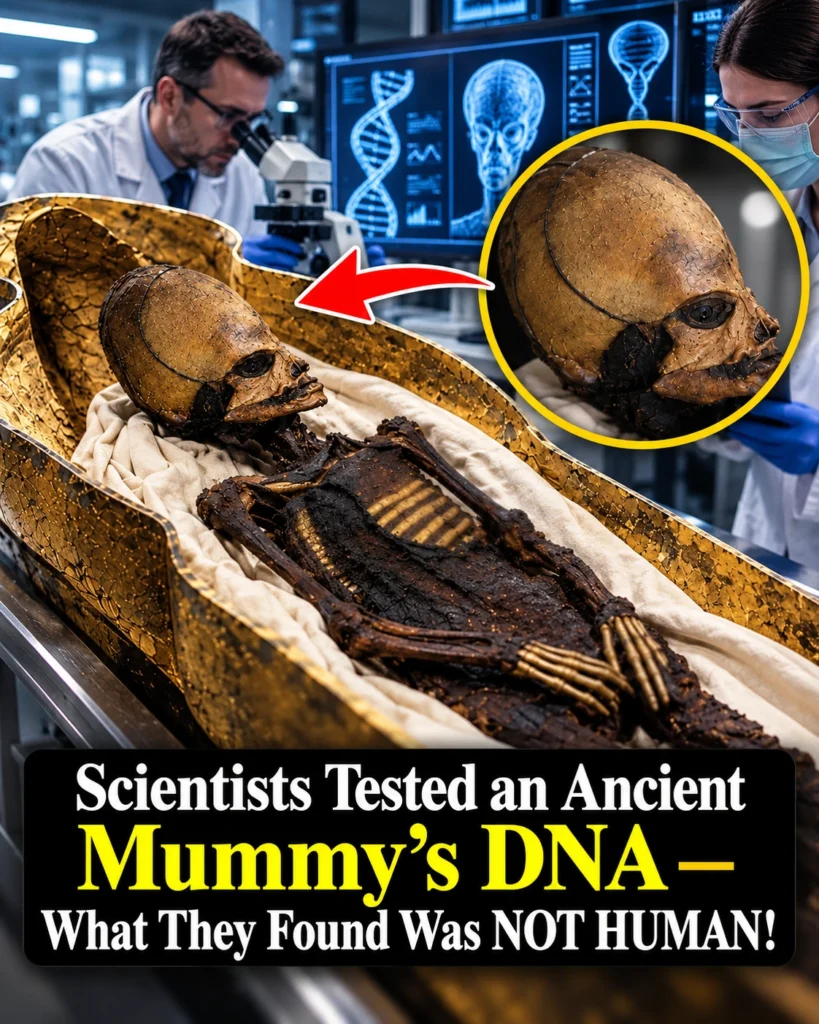
For more than a hundred years, museums, hospitals, and university labs all over the world have been opening up hundreds of coffins labeled as human mummies.
But once CT scanners and DNA sequencing got involved, they started turning up things the old catalog cards never warned anyone about.
In at least four cases looked into over the last 20 years, whatever lay inside those wrappings wasn’t quite a human body.
And one of them pushed scientists to record a branch of humanity nobody had ever documented before.
So what were those coffins really hiding? That’s exactly what we’re going to find out.
I’m Ambrose Wilde, and I’ll tell you right now that one of those so-called human mummies turned out to be a lump of mud and grain wrapped up and shaped like a sleeping baby sitting in a museum for more than half a century before anyone looked inside.
But that story doesn’t start in a hospital scanner.
It starts with a simple question, which is what a mummy actually is, because the answer is a lot wider than most people picture.
When you hear the word, you probably see gold masks, painted coffins, and the pharaohs Tutankhamun, Ramesses II, kings sealed into tombs with their treasure.
That’s one kind.
Technically, though, a mummy is any body, human or animal, where the skin and organs have survived long after death.
Sometimes that happens on purpose through rituals, oils, salts, and resins.
And sometimes it happens completely by accident because the place where the body ended up was so cold, so airless, or so dry that the usual decay never got started.
That accidental kind is older than you’d think.
The oldest mummified human remains ever found aren’t Egyptian at all.
They belonged to a severed head roughly 6,000 years old dug up in 1936.
And even in Egypt, some of the earliest mummies weren’t made by priests.
One of the most famous sits in the British Museum in London and is known by a nickname, Ginger, because of the reddish hair still on his scalp.
He was buried around 3,400 BC at a site called Gebelain in a shallow grave of hot dry sand that pulled the moisture out of his body before anything could rot it.
Archaeologists dug him up in 1896 and the museum has had him on display since 1901.
Then, in 2012, a CT scan showed something nobody had noticed in more than a century of looking at him.
There was a narrow wound in his upper back where a blade had gone through his shoulder blade and into his chest.
Ginger was a young man, probably somewhere between 18 and 23, and he’d been stabbed from behind.
So, for well over a hundred years, people had been staring at Ginger without knowing how he died.
And that’s the theme of everything you’re about to hear.
Old labels, old catalogs, and old assumptions.
Sitting quietly on a shelf until a modern machine finally gets a look inside.
With Ginger, the scanner turned up a murder.
In the cases ahead, it turns up things that were never people at all and one of them ends with a genome that redraws part of the human family tree.
Haifa, Israel, June Shugonio, Twotw Senchugo.
The world was in the middle of a pandemic, the hospitals were stretched thin, and in a radiology department at the Rambam Healthcare Campus, a group of people in masks were gathered around a CT scanner for a patient who’d been dead for a very long time.
Actually, two patients.
Both of them had come from the National Maritime Museum in Haifa where they’d been sitting in the collection for more than 50 years.
The reason they were there at all was the pandemic.
With the city’s museums closed to visitors, the staff suddenly had something they almost never get, which was time.
Adi Shellah, who runs the Haifa Museum’s Education Center, and Ron Hillel, the collections registrar, decided to use it to go back through the objects whose paperwork had never really added up.
The problem with a lot of museum collections is that the older entries were written decades ago by people who didn’t record things the way curators do today.
An object would come in, someone would write a line in a ledger, and that line would quietly become the official story for decades.
According to those old records, both of these little wrapped figures held mummified human hearts.
Nobody could say for sure.
So, the director general of the city’s six museums, Yotam Yakir, asked Rambam for help, and the hospital agreed to put the two mummies through the same CT machine it uses on living patients.
The first one was the strange one.
It was about 45 cm long, around 18 in, wrapped like an infant, and still lying in its own small wooden coffin with a little face that made it look like a sleeping baby.
The scan was run by Dr. Marcia Javitt, the hospital’s head of radiology, and the mood in the control room dropped almost as soon as the first images came up.
According to the accounts from that day, you could tell what the images were showing just from the way people reacted to the screen.
There were no bones in there.
There was no skull, no rib cage, no heart.
Follow-up tests confirmed it.
The baby-shaped mummy had never been alive.
What was inside was grain and mud.
That’s not a typo, by the way.
It was what Egyptologists call a corn mummy, and corn here is the old English word for grain, the wheat and barley that kept the whole of Egypt fed.
These figures were made of earth mixed with seed, molded into a human shape, and wrapped like a body to represent Osiris, the god of the dead and the afterlife.
During the festivals held in his honor, the figures were soaked with water so the grain inside would sprout.
Think about what that looked like to the people who made it.
A body buried with new green life pushing out of it.
For them, that was Osiris coming back to life.
And the museum’s own paperwork had it down as a human heart.
The researchers dated it to somewhere between 2,500 and 3,000 years old.
So, the first mummy wasn’t human, but the second one was where the day got really interesting because there was a real body inside the second one.
Only it wasn’t a human body.
It was smaller, about 25 cm, around 10 in long.
And when it went through the scanner, one of the technicians started pointing things out on the screen.
Bones, feathers, a wing, a spinal column.
It was a bird.
And most likely a falcon.
In Egypt, the falcon belonged to Horus, the falcon-headed son of Osiris and Isis, the god of the sky and the protector of the king.
So, the two little mummies on that table, one made of grain and one made of feathers, were really a matched set, a father and his son.
The scans showed how well the desert had done its work.
The bird’s tissue had dried out so completely that it had gone dense, a bit like beef jerky, and the marrow had vanished from inside its bones, leaving them as hollow tubes.
Its neck was broken, but the dry skin was cracked in the same place, which suggested the damage came long after death.
Its heart and windpipe seemed to still be inside it, while some of its other organs were missing, which is common in animal mummies.
And then there was the detail nobody could explain.
The falcon had no left leg.
Dr. Jabit put it about as plainly as anyone could.
She said, “It’s missing its left leg.
Nobody knows why”.
I mean, somebody took the time to dry this bird, wrap it, and send it into the afterlife as an offering to a god, and they did it with one leg gone.
Was it hurt before it died? Was the leg removed on purpose? Nobody knows.
And the bird isn’t telling.
What the team could say was that these were genuine ancient objects, not modern fakes, and not recent mix-ups, and that the Egyptians who made them had a very specific reason.
They buried animals and sacred figures like these beside their dead as protection for the soul on its journey into the afterlife.
The museum planned carbon-14 testing on both pieces before putting them in a special exhibition.
But, the question that had sat on that shelf for half a century had its answer.
Was this human? No, on both counts.
Now, those two little figures are only a small part of this story because the case that made more noise than almost any other started in the driest desert on Earth, the Atacama Desert, northern Chile, 2003.
According to the most common version of the story, a man searching an abandoned town called La Noria found something small near the town’s old church.
Inside was a tiny skeleton, about 15 cm long, roughly 6 in, about the length of a dollar bill.
It had a long, angled skull that rose to a ridged peak, huge, slanted eye sockets, and a detail that stopped everyone who examined it.
It had only 10 pairs of ribs.
A typical person has 12.
The skeleton came to be known as Ata.
It passed from owner to owner, ended up in the hands of a private collector in Spain, who had bought it on the black market for antiques, and very quickly turned into a celebrity.
You can probably guess why.
Give people a tiny body with a cone-shaped head and giant eyes, and the word alien shows up almost immediately.
Ata became the star of UFO documentaries, and in 2013, she was featured in one called Sirius, which held her up as possible evidence that something from another world had come here.
And you can see why people got carried away.
This wasn’t just small and strangely shaped.
The people who studied her x-rays said her bones looked far too developed for her size.
A pediatric radiologist from Stanford, Ralph Lachman, found that her bones were as calcified as those of a child around 6 to 8 years old, even though the whole skeleton was barely the length of your hand.
So, now you had fewer ribs than a human, a skull no human seems to have, and bones that seem to belong to a child several years older than the body could possibly be.
If you wanted something that looked like it didn’t fit, Ata was it.
But, the man who finally settled the question was Stanford Professor Garry Nolan.
He’d heard about Ata and told a friend that if there was any DNA in the bones, he could analyze it.
With the owner’s permission, a small sample of bone marrow had been taken from one of her ribs, and Nolan’s team went to work.
His early analysis in 2013 already showed human DNA, but the full study took a team of about 10 scientists roughly 5 years.
And it was published in the journal Genome Research in March 2018, led by Sanchita Bhattacharya of the University of California, San Francisco, with Nolan and the UCSF Professor Atul Butte as senior authors.
And here’s the moment that probably made a few UFO fans hold their breath.
When the team first ran the numbers, around 8% of Ata’s DNA wouldn’t match the human genome.
An 8% mismatch is exactly the kind of figure that ends up on a thumbnail.
But, the reason was a lot less exciting.
The sample had degraded.
And once the researchers ran a more careful analysis, up to 98% of it matched.
The rest was damage, not anything from another planet.
So, what was Ata? She was human.
And she was female.
Her DNA pointed to South American ancestry, most likely Chilean.
And she wasn’t ancient at all.
Her DNA was so intact that the researchers put the skeleton at only about 40 years old.
Which means the famous Atacama mummy was probably younger than a lot of the people arguing about her online.
The team found mutations in seven genes that alone or together are linked to bone deformities, facial malformations, and dwarfism, along with 64 unusual mutations tied to the skeleton, including two new variants in the genes that build collagen.
Bute said they were pretty confident that, in his words, “multiple things went wrong”.
Several mutations seem to have hit at once, and they were concentrated in the parts of the genome that control how bones grow.
That also explained the strange bones.
The same set of mutations seems to have pushed her bones to age far, faster than the rest of her.
Which is why a body the size of a fetus could have bones that looked years older.
But, Acharya suggested that with that many problems, Ata probably didn’t survive long, if she was born alive at all.
Nolan put it more bluntly.
“Everybody is born with mutations,” he said.
“And this person just happened to roll snake eyes”.
So, the alien was really a little girl from Chile who never got a chance at life.
Which, if you think about it, is a much sadder story than the one on the UFO channels.
Nolan even said that maybe she needs to be returned to Chile and given the burial she deserves.
That’s how this case really ended, with a scientist suggesting that someone finally lay a child to rest.
Keep that in mind, because the strangest DNA result in this whole story is still ahead of us, and it came from people who were completely real.
But first, if Atacama was a misunderstanding, the next case is something different, because not every shocking mummy story is an honest mistake.
Peru, 2017.
A set of strange mummified bodies was delivered to the Incan Institute in Cusco, an organization devoted to archaeological research on the Inca and the cultures around them.
The bodies were said to have come from the desert near Nazca, home to the famous lines in the sand, and to have been pulled out of a tomb by looters in 2015.
The best known of them was nicknamed Maria.
She was covered in a pale powdery coating.
She had an elongated skull, no visible ears or nose, and each of her hands had only three long fingers.
Thierry Jamin, the president of the institute, went as far as suggesting publicly that she could be a hybrid between humans and some kind of alien race.
That’s when it really took off.
Videos about the bodies went up on a paranormal streaming site called Gaia, and claims about laboratory results started circulating online, saying that the DNA was highly unusual and not human at all.
One researcher on the project, Konstantin Korotkov, told Russian television that the bodies had 23 pairs of chromosomes like us, but anatomy that wasn’t human, and was quoted saying, “They could be extraterrestrials or bio robots”.
So, yeah, not great for anyone trying to keep this calm.
Reporters who went looking for him at the universities he was linked to couldn’t find any record of him there.
And for a while, a lot of people took the whole thing very seriously.
Then the experts started speaking up and Andrew Nelson, an anthropology professor at the University of Western Ontario, was one of the first.
He looked at the images and said, “One of the bodies looked like a typical Nazca mummy sitting in the usual flexed position and that its hands and feet might be pieces of real ancient mummies that had been altered and painted over with that white coating”.
Guido Lombardi, a forensic scientist at Cayetano Heredia University in Lima, said he found it repulsive that anyone would dehumanize the bodies of people who had died and around a dozen Peruvian mummy specialists put out a statement saying the whole affair had broken a long list of national and international rules on human remains.
But the story kept spreading anyway.
Six years later, the story came roaring back.
On September 12, 2023, the Mexican journalist and UFO researcher Jaime Maussan stood in front of Mexico’s Congress during a hearing on UFOs and showed lawmakers small bodies he said were more than 700 years old and had been found near the Nazca Lines.
A month later, in October 2023, customs agents in Peru seized a shipment of similar figures that was headed to a buyer in Mexico and this time forensic experts from Peru’s prosecutor’s office got to examine them up close.
On the 12th of January 2024, at a press conference held by Peru’s Ministry of Culture, the forensic archaeologist Flavio Estrada of the Institute of Legal Medicine laid out what they’d found.
The little three-fingered bodies were dolls.
They had been put together from human and animal bones, all of them from this planet, held in place with modern synthetic glue.
They weren’t extraterrestrial, he said.
They weren’t a hybrid and in his words, “They are not a new species”.
He called the claims around them pseudoscience and he added a point that a lot of Peruvians had been waiting for someone to say out loud.
The people who built Machu Picchu and drew the Nazca Lines didn’t need any help from aliens to do it.
And that’s an important thing to keep in mind before we go any further.
Not every non-human mummy you see online is a scientific discovery.
Some of them are put together on purpose, for money or for attention, or for the kind of fame that follows anyone who claims to have found something world-changing.
In this case, someone took the remains of real people and real animals and turned them into props.
So, is there any case at all of a mummy that’s truly not like us, or at least so genetically different that it changes what we know about our own species? There is, and the answer didn’t come from a dealer, a hidden tomb, or a press conference about aliens.
It came from the Sahara.
Before we get there, though, it’s worth pausing for a second because after hearing about grain babies, a one-legged falcon, a misdiagnosed child, and a box of glued-together dolls, it would be easy to decide the whole subject is nonsense.
It isn’t.
There really are genetic discoveries involving mummies that have surprised the scientists who made them.
They come from slow, careful DNA work in specialized labs, checked by other scientists before anyone is allowed to publish, which is a lot less exciting to look at than a three-fingered hand, and a lot more reliable.
And the most striking case of the last few years has a name, Takarkori, southwestern Libya, in the Tadrart Acacus Mountains.
There’s a rock shelter out there called Takarkori.
And getting to it today means crossing some of the harshest desert on the planet in a 4×4.
Sand and bare rock stretch off in every direction, and it’s about as far from a green, living place as you can imagine.
But it wasn’t always like this.
Between about 14,500 and 5,000 years ago, during a stretch that scientists call the African Humid Period, the monsoon rains pushed much farther north than they do today, and the Sahara turned green.
It became a savanna with rivers, grasslands, lakes, and patches of woodland.
Closer to what you’d see in parts of Kenya now than to the sand sea we know.
Hippos and crocodiles lived in the water.
Giraffes and elephants moved across the grass.
And people lived there, too.
They fished, they hunted, and over time they began to herd animals.
At Takarkori itself, archaeologists found pottery holding some of the earliest traces of dairy use anywhere in Africa, along with rock art showing scenes of hunting and herding.
It was an ordinary human life in a place where today almost nothing grows.
Between 2003 and 2006, a team led by the archaeologist Savino di Lernia of Sapienza University in Rome excavated the shelter.
On just the second day of digging, they brushed back the sand and found a jawbone.
In the end, they uncovered the remains of 15 people, all of them women and children, buried at the site over more than 4,000 years, between roughly 8,900 and 4,800 years ago.
And two of those women, both thought to be in their 40s when they died, had been naturally mummified by the dry conditions of the shelter.
Their remains held together by the desert air for about 7,000 years.
That detail turned out to matter enormously decades later.
Getting ancient DNA out of a desert is extremely difficult.
Heat breaks genetic material down fast, which is why it survives so rarely in bones from hot places like deserts and rainforests.
A cool, shaded rock shelter gives it a slightly better chance.
Earlier studies had only managed to read the women’s mitochondrial DNA, the small piece passed down from mother to child, and for years the attempts to go further simply failed.
But, as the techniques improved, a team at the Max Planck Institute for Evolutionary Anthropology in Germany finally pulled complete nuclear genomes from the teeth and bones of those two women.
The paleogeneticist who led the work, Nada Salem, said, “The preservation was beyond what we hoped for”.
The study came out on the 2nd of April 2025 in Nature, one of the most respected scientific journals there is, and it caught almost everyone off guard.
When the researchers compared the two women against nearly 800 modern genomes and more than 100 ancient ones from Africa, Europe, and Asia, their DNA didn’t fit any population anyone had sequenced before.
The bulk of their ancestry came from a North African lineage nobody knew existed, one that is now extinct in its original form.
And before you start thinking about aliens again, relax.
These were human beings, Homo sapiens, the same species as you and me.
But, they came from a branch of the human family that seems to have split away from the ancestors of sub-Saharan Africans roughly 50,000 years ago, around the same time the lineages that would spread out of Africa and across the rest of the world were splitting off, too.
And then, for tens of thousands of years, that branch stayed mostly on its own.
Salem described it as a deep-rooted genetic lineage that had been isolated for a very long time.
Picture the family tree of every human alive.
We’ve known about most of its big branches for a long time.
This was like finding a whole limb nobody had drawn on the chart, one that grew off quietly on its own for tens of thousands of years and barely touched the rest of the tree.
Their closest known relatives were Ice Age foragers who lived about 15,000 years ago in a cave called Taforalt in Morocco.
Far to the west and thousands of years earlier, rather than anyone living south of the desert.
And here’s the part almost nobody saw coming.
For a long time, scientists believed the Green Sahara had worked like a great corridor, a highway of grass and water that let people from north and south of the desert meet, mix, and trade genes.
The Takarkori women didn’t support that at all.
The genetic evidence showed very little flow between sub-Saharan and North African populations during the whole green period.
Salem put it directly.
She said, “Our research challenges previous assumptions about North African population history.
That changes how we understand one of the big turning points in North Africa.
Herding reached the region around 6,400 years ago, and it was long assumed that a wave of newcomers brought their animals and their genes with them.
But the Takarkori genomes show no matching rush of outside DNA.
So the herders’ know-how seems to have spread mostly through people trading ideas with their neighbors, rather than through a mass migration.
In other words, the animals and the skills traveled a long way across the Green Sahara, while the families at places like Takarkori mostly stayed where they were and learned from the people next door.
There was one more surprise hidden in those two genomes.
The women carried traces of Neanderthal DNA, about 0.
15%.
That’s roughly 10 times less than what people living outside Africa carry today, but it’s still more than you find in sub-Saharan Africans.
So at some point in the deep past, this lineage picked up a little Neanderthal ancestry, most likely from the gene flow that came along with the movements out of Africa, and then went back to living largely on its own.
Now, to be fair, that doesn’t answer everything.
The researchers are still trying to pin down exactly when and how this branch broke away, and what happened to its people over the thousands of years that followed.
Two genomes can only tell you so much, but for the first time, there’s solid genetic evidence, published, checked by other scientists, and open for anyone to test, that a whole human population lived in the heart of the Sahara, cut off from its neighbors for an enormous stretch of time, and that science had no idea it existed.
And this is the part I find most remarkable.
That lost lineage didn’t vanish without a trace.
It no longer exists in its pure form, but according to the researchers, its ancestry is still a central part of the DNA of people living across North Africa today.
So, the women of Takarkori weren’t aliens, they weren’t hybrids, and they weren’t a pile of animal bones glued into a doll.
They were ancestors.
Millions of people alive right now carry a piece of that hidden branch inside them.
And none of us knew it was there until two women, preserved by the same dry sand that had swallowed their green world, held onto their story long enough for a lab in Germany to finally read it.
I’m Ambrose Wilde, and if you want more stories like this one, where the real answer turns out stranger than the rumor, stick with the channel, because there are plenty more mysteries like this on the way.