He said that continuing the war would mean the ann…
He said that continuing the war would mean the annihilation of the Japanese race.
He said that he had thought carefully about the sacrifice of the soldiers who had died.
Said that he had thought about the mothers and fathers of those soldiers.
He said that he had thought about the mothers and fathers of the children in the cities that were still standing.
He said that he was reminded of the situation of his grandfather, the emperor Magi, at the time of the triple intervention in 1895.
The emperor Magi had been forced to bear the unbearable and had done so in order that his people might live.
Said that he had reached the same decision that the empire would accept the Potam declaration.
said in a voice that was now quieter than it had been at the start that he was prepared to make the announcement himself in his own voice on the radio to his subjects so that they would know that this was his own decision and not the decision of any minister or any general.
When he stopped, he removed his glasses.
He wiped his eyes with the back of his hand.
He put the glasses back on.
He looked at the table in front of the men.
Nami was weeping.
He was making no sound.
His shoulders were shaking.
He did not lift his head.
Umu was weeping.
Toyota was weeping.
Togo had his eyes closed.
Suzuki was standing at attention with tears running down his face.
Yonai was looking at the ceiling.
The emperor stood.
He stepped down from the platform.
He walked to the door through which he had entered.
Chamberlain followed him.
The two of them left the room and the door closed behind them and for perhaps another full minute no one moved.
Suzuki turned to face the ministers.
His majesty’s wishes are known, he said.
It is for us now to give effect to them.
He walked out of the room.
The others followed.
They emerged into the corridor.
Corridor was cool compared to the conference room.
Several of them stopped and put their hands against the concrete wall to steady themselves.
None of them yet knew that the war was not in fact over.
They believed it was.
They believed that once the emperor had spoken, the machinery of state would carry out his wishes and the guns would fall silent.
They believed this because it was what they had been taught to believe.
They believed it because the alternative was unthinkable.
They were wrong because 6 km away in a barracks near the war ministry, a 33-year-old major named Kenji Hatanaka had already begun to make plans of his own.
Hatanaka had been in the war ministry for the last several years.
He was a staff officer in the military affairs section.
He was young.
He was small.
He was extraordinarily intelligent.
He had the face, according to those who knew him, of a boy who had never fully grown up.
He had also over the previous three days become convinced that the emperor was being deceived by traitorous advisers.
He did not blame the emperor.
He blamed Keedo.
He blamed he blamed Togo.
He believed that these men working with the peace faction had manipulated the emperor into a decision that the emperor did not truly wish to make.
He believed that if he could reach the emperor and speak to him alone, the emperor would reverse the decision.
He believed also that if the recording of the emperor’s surrender address could be destroyed before it was broadcasted, the surrender could be prevented.
72 hours from the 10th of August through the 13th, Hatanaka moved through the corridors of the ministry, recruiting other young officers to his cause.
He was not senior.
He had no formal authority.
But he had a gift for persuasion.
And he had a certainty of purpose that in a time of collapse can be more powerful than rank.
He convinced Lieutenant Colonel Masataka Ida.
He convinced Lieutenant Colonel Jiro Shiaki.
He convinced a small group of captains and mages in the guard’s division.
The night of the 13th of August, he went to see war minister Anne.
Nami received him in his private residence.
It was after 11 at night.
Nami was in a summer kimono.
He had been drinking moderately from a small cup of s alone.
Hatanaka bowed low.
He explained his plan.
Said that the guard’s division could be persuaded to seize the imperial palace.
He said that the recording of the emperor’s address once made could be found and destroyed.
Said that with the recording gone and with the palace secured, a new government could be formed.
A government committed to continuing the war.
He said at the end that he had come to ask for the war minister’s blessing.
An arami looked at him for a long time.
He did not respond immediately.
He picked up his sake cup.
He turned it slowly between his fingers.
He set it down.
He did not say yes.
He did not say no.
said one sentence.
He said, “Do what you think is right”.
Tanaka bowed low.
He interpreted this as an endorsement.
He left the residence.
He returned to his fellow conspirators and he told them that the war minister had given his blessing.
He was wrong.
The historical record assembled painstakingly in the years that followed by the surviving witnesses and by the historian Suyoshi Hagawa makes clear what Anami actually intended by his answer.
He had not endorsed the coup.
He had also not forbidden it.
He had chosen the one path that allowed him to remain in his own eyes.
Loyal both to the emperor whose decision he could not obey in his heart and to the young officers whose motives he understood too well to condemn.
He had chosen ambiguity he had chosen silence.
He had chosen to let Hatanaka act without giving him permission because Anami himself could not bring himself to act and could not bring himself to prevent someone else from acting.
was in the end the choice of a man who had already decided to die.
Late on the night of the 14th of August, shortly before midnight, the emperor recorded his address in a small room on the second floor of the Imperial Household Ministry building that survived the bombing raids.
Missions from NHK, the national broadcaster, set up their equipment.
Emperor read the text of the Imperial rescript on the termination of the war.
His voice was formal.
He used the classical court language that most of his subjects would not fully understand when they heard it.
Text had been written by scholars and revised through the day by the cabinet contained the phrase that would echo for the rest of the 20th century in the memory of every Japanese person alive that day.
War situation the emperor said has developed not necessarily to Japan’s advantage was in the history of understatement without equal.
He recorded the message twice.
The first recording was judged too soft and the second was made immediately afterward on two separate lacquer discs in case one was damaged.
The discs were placed in metal cases.
The cases were wrapped in cloth carried by hand to the private quarters of a court chamberlain named Yoshihiro Tokugawa in a small building within the palace grounds.
And there they were hidden.
Tokugawa placed them in a small office safe beneath a stack of official papers.
He locked the safe.
He would spend the next 12 hours of his life protecting its contents.
At midnight on the 14th of August, Hatanaka and his fellow conspirators put their plan into motion.
Went first to the headquarters of the First Imperial Guards Division.
Commander was Lieutenant General Teeshi Mori.
He was 51 years old.
He was a professional soldier.
He was at that hour meeting with his brother-in-law, Lieutenant Colonel Mishinori Shiishi, who had been visiting from Osaka.
Hatanaka entered the office with three other officers.
Among them was Colonel Toyojiro Werhara.
Werhara had a katana at his side.
Hatanaka demanded that Mori issue orders mobilizing the guards division to seize the palace and prevent the broadcast of the surrender rescript.
He said that the fate of the nation was at stake.
He said that Mory’s cooperation was essential.
Mory refused.
He refused calmly.
He said that he could not act without orders from his superiors.
He said that he would need to consult with the Eastern District Army headquarters.
He offered to accompany Hatanaka there.
Hatanaka understood that this was a stalling tactic.
He looked at Wara.
Wara understood.
Wara drew his katana.
Struck Shiri first because Shirishi was closest to the door.
The blow killed him almost instantly.
Mory rose from his chair.
He said something that no one alive today can quote with certainty.
Patnika drew his Namboo pistol from his holster and fired twice into Mory’s chest.
Mory fell where Hara stepped forward and with a single stroke removed the general’s head, took the seal of the guard’s division from Mor’s desk, pressed it against a document that Hatanaka had prepared in advance.
The document was strategic order number 584.
commanded the guards division to seize the imperial palace and to hold it against all comers, bore the seal of a man who had been dead for less than five minutes.
The guards division receiving orders that bore the seal of their commanding general obeyed.
By 1 in the morning on the 15th of August, the Imperial Palace was surrounded and occupied soldiers who believed they were acting on the orders of their commander and who did not know that their commander was lying on the floor of his own office with his head separated from his body.
Inside the palace, Hatanaka and Shiaki led a search party.
They searched the private quarters of the empress.
He searched the emperor’s offices.
They searched the residences of the Chamberlains.
They went from building to building, from room to room, looking for the two lacquer discs on which the surrender address had been recorded.
Tokugawa, the chamberlain, had by this time realized what was happening.
He removed the discs from the safe.
He wrapped them in his wife’s underclo because he judged correctly.
Soldiers searching for state documents would not pour through the intimate garments of a court lady.
He placed the wrapped discs at the bottom of a laundry basket.
He covered them with more clothes.
He carried the basket to a small storage room off a service corridor.
He put the basket on a shelf.
He walked away.
Hatanaka’s men searched the room where the recording had been made.
They did not find the discs.
They searched the office of the chief chamberlain.
They did not find the discs.
They searched the palace kitchens.
They did not find the discs.
They cut the telephone lines from the emperor’s quarters.
isolated the emperor from the outside world, but they could not find what they were looking for, and time was moving against them.
3:00 in the morning, in his private residence, 6 km away, war minister Karachica Anami rose from the futon on which he had been resting fully dressed.
He walked into his study.
He knelt on the tatami mat before a low writing desk.
He removed a short sword from a lacquered wooden box, the sword that had been given to him by his father.
kept it for 40 years.
He wrote two farewell notes.
First was addressed to the emperor.
It was a simple apology, formal and brief.
Second was written vertically down a sheet of thick paper in bold brush strokes.
Contained only 23 characters, rendered into English.
They read, “After being granted immeasurable favor by the emperor in death, I have nothing to say”.
He signed both notes.
He set them on the desk.
He removed his uniform tunic.
He opened his kimono.
He picked up the sword.
His brother-in-law, Lieutenant Colonel Masahiko Teeshittita, was in the next room.
He had been keeping vigil.
He had known since the previous evening what an army intended to do.
He had not tried to prevent it.
He had understood.
An army performed the ritual cut.
He did it correctly.
He drew the blade across his abdomen from left to right.
He did not permit himself to make a sound.
He then drew the blade upward from his throat to the base of his ear.
He set the sword down.
He waited.
He had refused a kaishakunin, an assistant who would end his suffering with a single stroke.
He had chosen to die slowly.
This was traditional.
Was also some believed a form of penance.
He had failed his country.
He would not permit himself an easy death.
He remained conscious for nearly 2 hours.
Approximately 5 in the morning, Teeshittita entered the study.
He found an still breathing, still conscious, still bleeding.
An arami looked at him.
Anami did not speak.
Teeshitta did not need to be.
He picked up the sword.
He performed the final stroke.
Approximately the same hour the coup was collapsing.
General Shizuichi Tanaka, commander of the Eastern District Army, had learned of the seizure of the palace shortly after 2:00 in the morning.
He drove to the palace himself.
He entered the grounds.
He confronted the officers of the guards division.
He informed them that the orders they had received were forged, that General Mory was dead, that they had been deceived, and that they were to withdraw immediately and returned to their barracks.
Soldiers, most of whom had not known what they were participating in, obeyed him without resistance.
Hatanaka and Shiaki were still inside the palace when the withdrawal began.
They realized what had happened.
They knew in that moment that they had failed.
Shizaki went to a small area near the palace moat, drew his sword, stabbed himself in the abdomen, and then shot himself in the head with his service pistol.
Hatanaka took his motorcycle.
He drove out through the palace gate into the empty pre-dawn streets.
He rode to the plaza in front of the palace.
He stopped his motorcycle in the middle of the open ground.
He took a bundle of leaflets from his coat and scattered them on the pavement.
Leaflets contained his final political statement.
called on the Japanese people to reject the surrender and continue the war.
He drew his pistol.
He placed it against his forehead.
Fired once, he was 33 years old.
He had in the small breast pocket of his uniform jacket, a folded piece of rice paper on which he had written a death poem in the traditional style.
It read in translation, “I have nothing to regret now that the dark clouds have vanished from the reign of the emperor”.
He was mistaken.
The clouds had not vanished.
The clouds were only beginning.
6 hours later, at noon on the 15th of August, 1945, every radio in Japan carried the same broadcast.
In villages and cities, in factories and rice patties, hospitals and schools, in prisoner of war camps, and on military bases in the mountains of Kyushu, where 2 million soldiers still stood ready to defend their homeland.
The first time in the 2,600year history of the imperial line, according to the traditional reckoning, the voice of the emperor was heard by his subjects.
The reception was poor.
The classical court language was difficult.
Many who heard it did not fully understand what was being said, but everyone understood the tone.
Everyone understood the ceremony.
Everyone understood that the man speaking was the emperor and that whatever he was saying, it was the end of something.
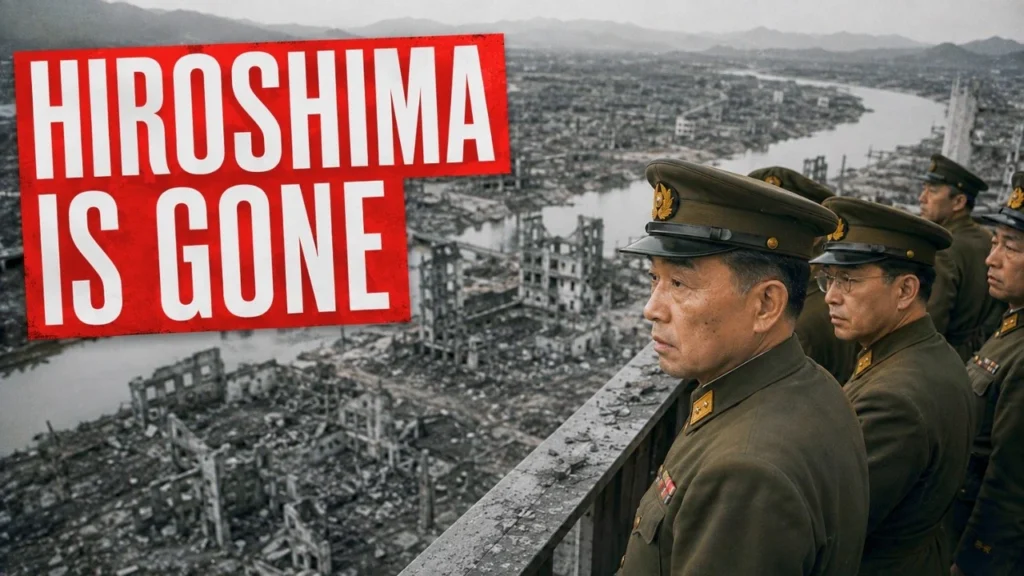
In the courtyard of a broken city hall in what had once been Hiroshima, a small group of survivors gathered around a radio that had been salvaged from the ruins.
They listened.
Most of them were still bandaged.
Most of them had lost members of their families.
Few of them wept.
Most of them did not.
They had used up their tears in the nine days since the flash.
The broadcast ended.
An old man in the group stood up.
He was perhaps 70.
He had lost his wife and his daughter and both of his grandchildren on the 6th of August.
He looked around at the faces of the others.
He looked at what was left of the city.
He looked at the sky which was clear and blue and empty of any threat for the first time in as long as any of them could remember.
He did not say anything.
He walked out of the courtyard street and he walked in the direction of the mountains and no one knows what became of him.
By the end of 1945, the number of dead from the two bombings would be counted at approximately 140,000 in Hiroshima and 74,000 in Nagasaki.
Among them were tens of thousands of Korean forced laborers who had been brought to Japan to work in the war industries and a small number of American, British, and Dutch prisoners of war who had been held in camps near the two cities.
Those numbers would continue to rise slowly year after year for the rest of the century as survivors died of radiation induced cancers that would not appear in their bodies for decades.
2nd of September aboard the American battleship Missouri in Tokyo Bay, Foreign Minister Mamoru Shigamitsu, walking on the wooden leg he had worn since a Korean nationalist threw a bomb at him in Shanghai in 1932, signed the formal instrument of surrender on behalf of the Japanese government.
General Umezu, who had wept in the underground bunker 3 weeks earlier, signed on behalf of the Imperial General Staff.
The war was over.
question that had begun that morning at Ichigaya and a young signals officer had picked up a telephone and heard nothing on the other end.
That question would remain and it would echo forward through the rest of the 20th century and into our own century and into whatever centuries come after.
Did the Japanese high command say when they realized Hiroshima had vanished? The answer in the end was that they said many things.
They said it was propaganda.
They said it was impossible.
They said it did not change the strategic calculation.
They said Japan would fight to the last man.
They said they would preserve the honor of the dead.
They said one man cannot ask another to bear what cannot be born.
They said finally that they would bear it.
And they said above all what men in the presence of the unimaginable have always said nothing.
They stood in a hot underground room and they wept and they wiped their faces with handkerchiefs.
And one of them went home and killed himself with a sword his father had given him.
And another one rode a motorcycle into an empty plaza and shot himself in the forehead.
And a third one signed a piece of paper on the deck of an enemy warship in the bay of his ruined capital.
fourth one lived a long life and never spoke of what he had seen or heard or done in those nine days and took the answer with him to his grave.
If Kenji Hatanaka had found the two lacer discs in the basket in the storage room off the service corridor, we do not know how many more cities would have vanished.
We do not know how many more men would have been asked to bear what could not be born.
We do not know how many more mothers would have walked down empty streets carrying children who no longer moved.
We know only that on the 6th of August in 1945, at 15 minutes and 17 seconds past 8 in the morning, the city stopped existing.
And in the 16 hours that followed, and in the 9 days after that, six men in a hot underground room in Tokyo made the decisions that determined whether their nation and possibly the world as we now know it would live or die.
They chose life.
They did not choose it easily.
They did not choose it willingly.
They did not choose it with a clear conscience or a certain heart.
In the end, the emperor spoke and the room fell silent and the great long argument of a hundred years came to its conclusion.
He chose it.
And every person alive today in every country on earth lives in the shadow of that choice.