He had known at some level below the conscious tha…
He had known at some level below the conscious that his country was losing a race the outcome of which he alone could fully comprehend.
Now he was being ordered to travel to Hiroshima to confirm what he already knew.
He carried with him a leather bag.
In the bag was a Loritzen electroscope, a small instrument for measuring radiation of the kind that Nisha had built himself in his laboratory before the fire.
As one of the few pieces of equipment he had left, wrapped it carefully in cloth.
He held it on his lap during the train ride.
He did not put it in the overhead rack.
He watched the countryside pass outside the window.
And he thought about what he had done wrong.
He thought about the calculations he had made in 1943, which had told him that a critical mass of uranium 235 would be somewhere between 10 and 30 kg.
He thought about how he had reported this to the army, and how the army had asked him how long it would take to produce that much material, and how he had said 10 years.
He thought about how the army had at that moment lost interest.
He thought about how the Americans had done it in three.
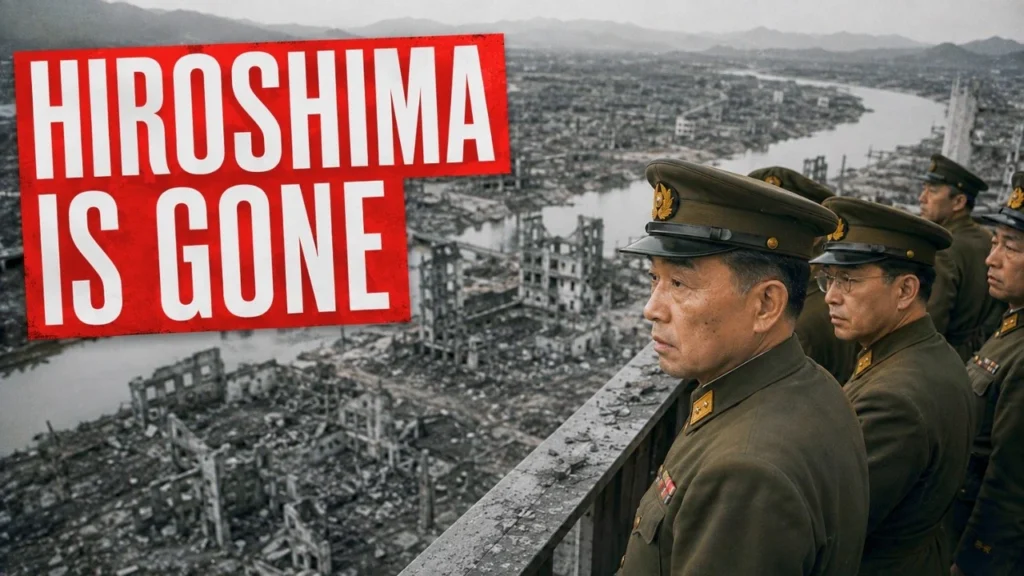
At Hiroshima, he was met by an officer from Arisua’s team and driven to a temporary command post that had been established at the edge of the destruction zone.
Shown samples, melted roof tiles, a wristwatch stopped at 8:15.
Soldier’s helmet with a hole burned through the top.
He examined these things.
He did not need to.
He knew what he was looking at.
He took out the electroscope.
He walked into the ruins.
He held the instrument at waist height and began to walk in a slow circle.
The needle moved.
It moved further.
It moved until it reached the far end of its scale, and it stayed there.
Sheena looked at the needle.
He looked at the ruins.
He looked at the sky where the mushroom cloud had drifted away and been replaced by a clear afternoon.
He turned to the officer who was accompanying him.
He said the words that he had been ordered by his own conscience to say and that no one in the Japanese government wanted to hear.
This is an atomic bomb.
He said there is no doubt.
That evening he wrote in his diary a single line.
The line has been preserved in the archives of the Reichen Institute.
Reads in translation, “The thing that I feared has come to pass”.
Next morning, the 8th of August, he sent his conclusion by Cable to the Imperial General Staff in Tokyo.
Cable arrived at the Ichigaya bunker at a little after 3 in the afternoon.
It was read first by a duty officer, then by a staff colonel, then by General Umizu himself.
Umezu read it twice.
He set it down on his desk.
He said nothing for a long time.
Then he ordered that the cable be delivered to the war minister, the prime minister, and to the foreign minister without delay.
At the same hour in Moscow, 5,000 kilometers away, Ambassador Naotake Sato was being summoned to the office of foreign minister Molotov.
Satau was 72 years old.
He had been requesting a meeting with Molotov for 6 weeks.
Every request had been refused.
Every request had been met with the same polite formula.
Minister is unavailable.
The minister is out of the city.
The minister will contact you when his schedule permits.
Now suddenly the minister was available.
Sat was told to come immediately.
Told to bring no aids, he walked into Molotov’s office at 5:00 in the afternoon Moscow time.
Molotov did not bow back for to sit.
Sat.
Molotov read from a paper he read in Russian.
Translator rendered the words into Japanese.
The Soviet Union declared effective at midnight a state of war with the Empire of Japan.
Satto listened.
He did not react.
When Molotov had finished reading that, Sato asked in a level voice whether he might be permitted to send a cable to his government.
Molotov said that all outgoing communications from the Japanese embassy had already been cut.
Sato nodded.
He bowed again.
He walked out of the room.
He would never see Molotov again.
He walked back to the embassy through the streets of a city that was celebrating, though he did not yet know what it was celebrating.
He passed young women in some addresses.
He passed old men playing chess in the parks.
He passed the great empty spaces of a capital that had 3 months earlier defeated Nazi Germany and that was now preparing to end another war on the other side of the world.
He did not look at any of them.
He walked with his hands folded behind his back and he thought about his wife and he thought about the country that he was no longer sure would exist in a month.
10 minutes past midnight on the 9th of August.
Manchurian time 1,577,225 Soviet soldiers crossed the border into Japanese-held Manuria.
They came in three fronts under the overall command of Marshall Alexander Vasilfki.
They brought with them 5,500 tanks.
They brought with them 3,700 aircraft, crossed a border that had been quiet for years, and they moved so fast that the Quanung army, once the pride of the Imperial Army, had no time to form a defensive line.
The news reached Tokyo at 4:00 in the morning.
It was delivered to the prime minister at his residence.
Suzuki read the cable in his dressing gown.
He read it twice.
Then he called for his car.
He drove through the still dark streets of the capital to the foreign ministry.
where Togo was already awake, already reading the same cable, already understanding what it meant.
Two men sat across from each other in Togo’s office.
Neither of them spoke for several minutes.
Then Togo said what both of them knew.
“It is over,” Suzuki nodded.
He said the diplomatic strategy had failed.
He said the last hope of a negotiated peace through Soviet mediation had died at midnight on a border 5,000 km away.
He said that the big six would have to meet that morning and that they would have to make a decision and that the decision could no longer be delayed.
Togo said one thing more.
He said that they should call the emperor’s lord keeper of the privy seal kidi immediately because if the big six could not agree and Togo believed they would not then there was only one other person in the country who could break the deadlock and that person could only be brought into the conversation with Keo’s help.
Suzuki agreed.
They both understood what they were proposing.
They were proposing to ask the emperor to make a political decision which the emperor had never done and which the constitution did not permit him to do.
They were proposing to break 60 years of tradition and to violate the Maji constitution in order to save what could still be saved of the country that constitution had been written to govern.
Zuki left the foreign ministry at 6:00 in the morning.
He drove to the imperial palace.
He met with Kido in the emperor’s private chambers before the emperor was awake.
He told Keedo what had happened at midnight in Manuria.
He told Keedo what Nisha had confirmed the day before in Hiroshima.
He told Keedo that the big six would meet at 11 and that the meeting would fail and that when it failed, they would need the emperor’s voice.
Quido listened.
He was 66 years old.
He had been the emperor’s closest political adviser for 5 years.
He knew what he was being asked to do.
He said one word.
Yes.
At 11:00 in the morning on the 9th of August, the Supreme Council for the direction of the war convened in the underground bunker beneath the prime minister’s residence.
The big six took their seats around a long table, Suzuki at the head, Togo to his right, Anami across from Togo, next to Anami, Tojoda at the far end.
The room was small, hot, there was no ventilation.
The men had all been awake since before dawn.
They were all wearing formal uniforms.
Suzuki opened the meeting.
He said that the situation had changed twice in the last 3 days.
Said that they had to decide that morning whether to accept the potam declaration.
Pogo spoke first.
He argued for immediate acceptance with a single condition that the position of the emperor be preserved.
Yonai supported him.
Nami spoke next.
He argued for continued resistance.
He said that acceptance would betray the memory of the dead.
said that Japan still had 2 million soldiers in the field.
He said that the atomic bomb, while terrible, changed nothing fundamental.
He said that if Japan must accept surrender, it must be with four conditions.
Preservation of the emperor, self-d disarmament, self-conduct of any war crimes trials, no allied occupation of the home islands.
Um supported him.
Yoda supported him.
The vote was 3 to three.
They argued for an hour.
They argued for 2 hours.
The room grew hotter.
The formal uniforms grew heavier.
No one changed his position.
At 11:30, an aid entered the room.
He walked to Suzuki.
He handed him a piece of paper.
Suzuki read it.
He read it again.
He looked up at the men around the table.
Second atomic bomb, he said.
A city called Nagazaki.
30 minutes ago.
No one spoke.
Umeizu, who had said just 3 days earlier that the Americans could not possibly have more than one such weapon, looked down at his hands.
Hyoda, who had agreed with Umizu, looked at an arami.
An arami looked at no one, he looked at the far wall.
He did not move for a very long time.
And then, without saying a word, without lifting his eyes, he reached for his water glass, and he drank, and he set the glass back down, and the meeting continued.
None of them yet knew that the bomb had not been meant for Nagasaki.
None of them knew that the primary target had been the city of Kakura, and that at 9:44 in the morning, a B-29 called Boxcar had flown three times over Kakura, looking for the aiming point, and that the smoke from a conventional raid on nearby Yahhata the night before had drifted north and obscured the target.
None of them knew that the pilot, Major Charles Sweeney, had turned to his secondary target only when his fuel had run low, and that he had dropped the bomb through a small break in the clouds over the Urukami Valley, 3 km north of the intended aiming point in central Nagazaki.
None of them knew that the fate of Nagasaki and the direction of their own meeting had been decided by the weather over a city they had barely considered.
In Nagasaki at 11:02 that morning, a Catholic doctor named Takashi Nagai had been sitting at his desk in the radiology department of Nagasaki Medical College.
Was 37 years old.
He specialized in the use of radiation for medical diagnosis.
He was working on a paper when the flash came.
He was thrown across the room and he regained consciousness.
He was bleeding from a wound to the temple.
He walked out into the ruins of the hospital.
He began to treat the survivors, would work without rest for 3 days.
On the fourth day, he would walk back to what remained of his home.
His wife had been at home when the bomb fell.
He would find her among the ashes of the kitchen.
He would identify her by her rosary, which had fused into the bones of her hand.
He would carry the rosary in his pocket for the rest of his life, which would not be long, die of radiation induced leukemia 6 years later.
He was one of 74,000 people who would die from the second bomb by the end of the year.
Back in the bunker beneath the prime minister’s residence, the big six argued through the afternoon.
They argued through the evening.
The vote remained 3 to 3.
Broke for a full cabinet meeting at 2:00 in the afternoon.
Full cabinet also could not agree.
They reconvened at 6:00.
Still 3:3.
They reconvened at 10:00.
Still 3 to 3.
At 11:50 in the evening, Suzuki called a recess.
He told the men to prepare to reassemble in 1 hour.
He told them that they would go to the imperial palace.
He told them that they would meet with the emperor.
He did not tell them, though several of them suspected that he had already arranged Keo for the meeting to end in a way that had never been permitted to end before.
10 minutes to midnight on the 9th of August 1945.
Six men in formal uniforms walked out of the bunker under the prime minister’s residence and got into a small convoy of black cars.
They drove through the streets of a blackedout capital toward the Imperial Palace.
They did not know it yet, but the longest night of their lives was about to begin.
Convoy of black cars arrived at the Fukuage Gardens gate of the Imperial Palace at 11 minutes before midnight.
Six men got out in silence.
They were led by palace attendants through the darkened grounds.
Palace itself, most of it, had been destroyed by American incendurary bombs on the 25th of May.
The emperor no longer lived in the main residence.
He lived and worked and slept in a reinforced concrete bunker built into the hillside beneath the Fukage gardens called the Ounco.
It was 18 m underground.
Men walked down a narrow flight of stone steps into a small entrance hall and then down a second flight into the bunker itself.
Air grew warmer as they descended.
It was August.
There was no functional air conditioning.
The concrete walls held the heat of the summer day and gave it back slowly through the night.
At the time they entered the conference room, the temperature was above 90°, and the humidity was such that their formal uniforms had begun to darken at the collar and under the arms.
The room was small, perhaps 5 m by 7.
The walls were plain, ceiling was low.
At one end of the room was a small raised platform, and on the platform stood a folding screen of gold leaf, and in front of the screen was a simple wooden chair.
The emperor was not yet in the room.
The six ministers took their places on either side of a long narrow table.
Suzuki at the near end, the others in order of rank stood at attention.
They did not speak.
Behind them, along the wall, stood the additional attendees who had been summoned.
President of the privy council, Baron Hanuma Kichiro, chief cabinet secretary, several senior staff officers.
In total, perhaps 15 men in a room that was uncomfortable for eight.
2 minutes before midnight, a chamberlain entered from a side door.
Everyone bowed.
The emperor followed the chamberlain into the room.
He was wearing the uniform of a general Isimo of the Imperial Army.
Glasses were slightly fogged from the change in temperature.
He carried nothing in his hands.
He walked to the platform and he stepped up onto it and he sat down in the wooden chair, placed his hands on his knees.
He looked at the men in front of him.
He did not speak.
Suzuki, the prime minister, took one step forward.
He bowed.
In a voice that trembled slightly at the beginning, and then steadied, he explained why they had come.
He said that the Supreme Council had been unable to reach a decision.
He said that the situation of the empire was such that the decision could not be delayed.
He said that they had come therefore to seek the divine judgment of the emperor.
The word he used was sided.
It meant a sacred decision.
It meant an intervention by the throne into the ordinary business of government.
It was a word that had not been used in this way in living memory.
It was not permitted by the Maji Constitution.
It was a violation of everything that Suzuki and every man in the room had been taught about the proper functioning of the Japanese state.
Suzuki said it and then he stepped back.
The emperor did not respond immediately.
He asked in a quiet voice that the arguments of both sides be presented.
Togo spoke first.
He argued for acceptance of the potam terms with a single condition regarding the position of the emperor.
He was calm.
He was brief.
He had been rehearsing his argument in his head for two days.
An army spoke second.
He argued for the four conditions.
He spoke with more emotion than Togo.
He spoke about the dead.
Spoke about honor.
He spoke about the 2 million soldiers who still waited to defend the homeland.
He said at one point that the army was ready to die to the last man.
His voice cracked when he said it.
He did not look at the emperor when he said it.
He looked at the table.
Um spoke.
He agreed with an army.
Toyota spoke.
He agreed with an arami.
Yonai spoke.
Aaron Hinanuma from behind the ministers asked several sharp questions.
He asked Anami whether the army could actually defend the homeland if the Americans continued to drop atomic bombs.
Anami said that they could.
Hunanuma asked how and Aami did not have an answer.
Hiakma asked Togo whether the Americans would accept the condition regarding the emperor.
Togo said that he did not know but that it was the only condition worth requesting because it was the only condition that touched on the survival of the nation itself.
Clock on the wall passed midnight.
It passed 1:00 in the morning.
The room grew hotter.
Some of the men began to wipe their faces with handkerchiefs.
Army did not.
He stood at attention.
Water ran down his neck and into his collar.
Move.
At 2:00 in the morning, Suzuki stood again.
He walked around the table until he was directly in front of the platform.
He bowed.
He raised his head.
He spoke.
The opinions of the ministers are divided, he said.
Situation does not permit further delay.
I ask, therefore, the greatest humility, his majesty be pleased to indicate his own wishes.
He bowed again.
He stepped back.
There was a silence in the room.
Silence lasted by the account of one man who was present for perhaps 12 seconds.
Felt to everyone in the room like an hour.
The emperor raised one hand and adjusted his glasses.
Then he began to speak.
His voice was soft.
He did not raise it.
Every man in the room leaned forward without moving his body without appearing to lean.
In the way that men lean toward a voice they know they must not miss.
He said that he had listened to the arguments of both sides.
He said that he understood the position of the military.
He said that he understood the position of the ministers who sought peace.
He said that he could no longer bear to see his people suffer.