…
He came home with a letter of commendation for his work in the anti-ubmarine division.
Years later, Carter wrote about something he knew from that war.
At Queenstown in Ireland, the Americans had a very small naval establishment ashore.
Two American destroyer tenders kept the destroyers there running, working from the water.
Carter wrote that the repairs those two ships turned out changed a lot of doubters into enthusiasts.
Between the wars, his career took him almost everywhere.
Brazil with the naval mission there.
Anapapolis teaching engineering command of the cruiser Marblehead in China waters.
The naval station at Guantanamo Bay.
command of a submarine squadron and the submarine base at Pearl Harbor.
In January of 1941, Carter became chief of staff to Rear Admiral Walter S.
Anderson, commander of the battleships of the battle force.
When that command changed, Spruent wrote, Carter was most insistent on staying at sea in the Pacific and on being sent wherever the fighting was.
He got his wish in the fall of 1942.
He went to the South Pacific and took charge of building up the advanced naval bases there, construction battalions, supply depots, hospitals, ammunition dumps, peers, and deciding where to put the floating dry docks.
After a reorganization and a tour in the Illusions, he was back at Pearl Harbor.
In October of 1943, he was handed a new assignment, organized service squadron 10.
The mission was written down plainly, a mobile base.
It would furnish general stores, provisions, fuel, ammunition, maintenance, repair, and salvage, and whatever else was needed to an advanced fleet anchorage in the central Pacific.
Carter admitted there was no formula for how big a thing like that needed to be.
There was not enough experience to go on, so he made his estimates generous.
They were not generous enough.
The staff of the destroyer force wanted four destroyer tenders.
Pacific Fleet headquarters could see three at the most and approved two to start.
Within a month of going into service, the squadron had three.
A month after that, four.
By May of 1945, it had nine.
Three repair ships were requested.
Two were assigned.
By May of 1945, the squadron had 17 repair ships of all types.
Service squadron 10 was commissioned in January of 1944.
By then, Carter had talked his way into a billet with that transport group headed west.
At 59, Captain Carter was finally close to the war.
Majuro Lagoon.
February 4th, 1944.
Captain Carter’s first headquarters in Majuro was a battleship with a crushed bow.
On February 1st, 3 days before the carriers came in, maneuvering in total darkness, the battleship Washington had rammed the battleship Indiana.
About 60 ft of Washington’s bow plating was crumpled.
Both ships came into Majuro the next morning, February 2nd.
While crews cut away the torn metal and shored up her bulkheads for the long trip to a Navyyard, Washington served as the squadron’s temporary office.
A few officers were borrowed to handle communications and operations, and the servicing of the fleet began.
Carter called those first days ragged and hectic.
There were not enough boats.
There were not enough tugs.
A ship could be assigned a numbered birth, and the boat sent out to it would have no chart to find it with.
After dark, it was worse.
So Carter took boats wherever he could find them.
Every boat belonging to the transports in the lagoon was commandeered.
Those boats became the start of the squadron’s boat pool.
50 boats, three officers, 150 men, and always a few boats broken down.
The ammunition came in on ships that had been headed for Tarowa and were ordered to Majuro instead.
Reineer, Monaloa, Lassen, Sang.
The senior captain among those ammunition ships was put in charge of issuing it.
Carter recorded what happened next.
About the time that captain had figured out the births and the order of the work, his ship sailed.
The next senior captain took over and started again from the beginning.
repair help was thin.
The repair ship Vestal and the battle damage repair ship Fyon were the only ones there, and both were busy getting Washington and Indiana ready to leave.
Food held.
The provision ship bridge was emptied fast.
Carter noted that nobody went hungry.
Fuel held, too.
There was enough of it in enough oilers to handle the job in the time available.
Carter added a single line about the men who did it.
The oiler crews, he wrote, got very little of the rest they badly needed.
On February 11th, 1944, Washington sailed for Hawaii.
The squadron’s office moved onto a tanker with a landing ship tied up alongside to give the staff a place to sleep.
Communications from there were poor.
For a few days, the work slowed down.
All of it served one purpose.
The carriers would be supplied out here so they would not have to steam back to Pearl Harbor between strikes.
That February, the order that would send Carter himself home was still 18 months away.
On February 12th, Spruent sailed.
Before he left, Carter made him a promise.
When the fleet came back, it would get its servicing with more system, more order, and more speed.
On February 13th, the destroyer Tender Prairie arrived with the squadron staff from Pearl Harbor.
The whole staff was 16 officers.
And the squadron supply officer was not even there.
He was in San Diego fitting out the first concrete supply barges.
The survey ship Bowitch went to work on the lagoon.
Her people surveyed the entire anchorage, numbered the births, set out better navigation marks, and ran off charts by the hundreds.
Every ship, tug, barge, and boat got one.
There is a common picture of the floating base in the central Pacific.
A complete harbor made of ships already waiting in the lagoon when the fleet arrived.
The squadron’s own record tells a rougher story.
It started in the office of a damaged battleship.
They moved to a tanker with a landing ship for a bunk house.
It ran on borrowed boats before the charts existed.
Carter called his staff together.
They went over what had worked in that first servicing, what had not, and what was coming.
Then the squadron adopted a motto.
If we’ve got it, you can have it.
Carter wrote that they meant it literally.
It did not mean if they had some to spare.
In the months that followed, the squadron took guns off its own ships to replace guns damaged on the combat ships.
During the Mariana’s campaign, every pair of socks in its store rooms went to the fighting units.
And for about 3 weeks or more, the squadron’s messes, the commander’s own included, used something Carter described as colored putty in place of butter.
The real butter had gone to the fast carriers, the boat pool, the oiler crews who barely rested, the men eating colored putty so the carriers could have butter.
If this is the first time you have heard about these men, the like on this video is for them.
Now back to Majuro.
Captain Carter had made his promise to Spruence.
Now he had to wait for the fleet to come back.
Majuro, February 11th, 1944.
Vice Admiral Spruent’s fuel left Majuro a day before he did.
That day, five fleet oilers stood out of the lagoon.
Simmeron, Casascia, Guadalupe, Platt, Sabine.
Two cruisers, a destroyer, and two destroyer escorts went with them.
On February 12th, the fast carriers followed.
nine carriers, six fast battleships, 10 cruisers, 28 destroyers.
Spruent moved his flag from the heavy cruiser Indianapolis to the new battleship New Jersey.
He had just been selected for his fourth star.
On February 14th, 1944, about 640 mi northeast of Trou, the fleet met the Oilers and took on fuel for the runin.
Then the oilers turned away for Quadrilain.
Commercial tankers were waiting there to fill them up again so they could meet the fleet on its way back out.
At Tru, the Japanese had already seen something coming.
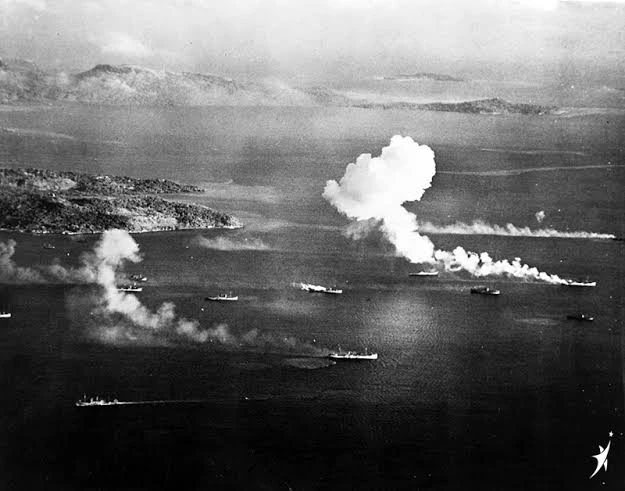
On February 4th, 1944, American reconnaissance planes flying from Bugenville had photographed the lagoon.
Commander Chikataka Nakajima of the Imperial Japanese Navy served on the staffs of Japan’s second, third, and combined fleets through the war.
After the surrender, American officers asked him when the Japanese fleet had abandoned Tru and why.
Nakajima said the people at Tru had spotted an American scouting plane.
He remembered the date as February 3rd.
He said the staff decided they had better leave.
The battleships Yamato and Nagato went west to Palao within a day or two.
On February 10th, 1944, the battleship Mousashi carried Admiral Minichi Koga, commanderin-chief of the combined fleet, home to Japan.
Commander Goro Matsura was a staff officer with Japan’s 22nd Air Flotilla.
The strategic bombing surveys summary of his interrogation says American raids on the Gilberts and Marshals had warned Japanese bomber strength there down so far that daily air searches had to be cut back hard.
That the summary says is how American carriers achieved surprise in raid after raid.
about TR itself.
Matsura told his interrogators that a Japanese scouting plane had been shot down.
When it failed to come back, they concluded an American task force was on its way.
By the morning of February 17th, the big warships were gone from the lagoon.
The Navy’s history command counts what was left.
two light cruisers, eight destroyers, and about 50 auxiliaries, cargo ships, merchant ships, and patrol and service craft.
Nakajima’s testimony does not say why so many of those ships stayed.
Back in Majuro, Captain Carter was carrying a secret.
He was the only man in his squadron who knew where the fleet had gone.
He wrote later that he had thought about a great many unpleasant things that could happen during the attack.
His staff kept working.
They wrote up a bulletin for the fleet’s return, fueling schedules, provisioning, ammunition, which destroyers would tie up alongside which tenders, births for ships that needed anti-aircraft practice, the beaches where men could swim, and the islands that were off limits.
At Trrook, after two weeks on high alert, the defenders had just been allowed to stand down.
Captain Carter kept the secret and kept his staff writing.
90 nautical miles northeast of Trrook, February 17th, 1944.
Rear Admiral Mark Mitcher, commanding the fast carriers, began launching about an hour and a half before dawn.
The first wave carried no bombs.
72 Hellcat fighters went in by themselves.
Their job was to take the sky over troop away from the Japanese before a single bomber arrived.
The Navy’s history command credits the idea to Mitch.
The Japanese got about 45 fighters into the air only minutes before the Hellcats showed up.
About 45 more got off the ground while the fight was on.
More than 30 were shot down.
About 40 more were wrecked on the ground.
All but four of the Hellcats made it back to their carriers.
Right behind the fighters came 18 Avengers.
They dropped incendiaries and cluster fragmentation bombs across the areas where Japanese planes were parked.
Meanwhile, the light carriers were launching one after another on a staggered schedule.
The result was a nearly steady stream of American strike planes over troop all morning.
By the Navy’s history commands count, there were 30 separate strikes that day.
Many of them went after the ships in the lagoon.
The commander of bombing squadron 10.
James Ramage, who would later become a rear admiral, is credited with sinking the merchant tanker Hoyo Maru.
By afternoon, no Japanese fighters were coming up to meet the Americans.
When the raid began, there had been roughly 365 Japanese aircraft at Trou.
About 100 of them came through it.
Out beyond the reef, some Japanese ships were trying to run.
Vice Admiral Spruent decided he wanted to finish them with his own guns.
The waters northwest of Trrook, February 17th, 1944.
Vice Admiral Spruent led the sweep around the atal himself.
With him were the battleships New Jersey and Iowa, the heavy cruisers Minneapolis and New Orleans, and four destroyers.
Out there, they found a group of Japanese ships that had slipped out before the attack and had not gotten far enough away.
The training cruiser Couttorii, the armed merchant cruiser Akagi Maru, the destroyers Mikaz and Noaki, a small mind sweeping twler.
Spruent wanted this fight for his surface ships.
Mitcher called the planes off.
Mikaz fired a spread of torpedoes at the two battleships.
Planes overhead radioed a warning.
New Jersey turned and the torpedoes passed just ahead of her.
According to the Navy’s own history command, Spruent’s comment was short.
That would have been embarrassing.
Iowa’s 16-in guns found Couturi.
The heavy cruisers closed in on Micaz.
Working together, the surface group finished both ships.
Milwaukee got away.
New Jersey and Iowa fired after her at extreme range.
And the Navy’s history command says that last salvo at about 22 miles is believed to be the longest range shot ever fired at an enemy ship.
Inside the lagoon, Lieutenant James E.
Bridges of Torpedo Squadron 6 flying from Intrepid put his attack into the ammunition ship Aikoku Maru.
The ship blew up.
Lieutenant Bridges and his two crewmen did not come back.
On the evening of February 17th, a handful of Japanese torpedo planes fitted with radar came after the carriers.
Late that night, one of them got through.
The torpedo hit Intrepid on the starboard quarter 15 ft below the water line.
Several compartments flooded.
Her rudder jammed hard to port.
Captain Thomas L.
Brag kept her on course by racing his port engine and idling the starboard one.
Most of her crew came through the hit.
11 men did not.
Between midnight and dawn on February 18th, 1944, 12 Avengers from Torpedo Squadron 10, flying off Enterprise went over the lagoon in the dark.
The Navy’s history command calls it the first night bombing attack on shipping ever flown from an American carrier.
In 25 runs, they scored 13 direct hits and seven near misses.
That was about a third of all the hits on ships the whole force scored in 2 days.
At dawn on February 18th, the planes went back in.
Airfields, hangers, ammunition dumps, fuel tanks.
About 17,000 tons of stored Japanese fuel went up in smoke that morning.
Lieutenant Junior Grade DF Baxter flew his King Fisher float plane from the heavy cruiser Baltimore straight into the lagoon.
He picked up an Essex Hellcat pilot who had been shot down earlier that morning while nine Hellcats held a Japanese destroyer off.
Out at sea, the submarine Sea Raven pulled the entire three-man crew of a Yorktown Avenger out of the water.
The Navy’s summary does not give those three names.
Somebody’s family knows them.
In Majuro, the news came in over the radio.
The task force was striking troop.
Ships were going down.
Planes were being shot out of the sky.
Carter wrote that the whole squadron was thrilled.
For the one man in his squadron who had known the target all along, he used two words, thrilled and relieved.
Eight of the nine American carriers came through the raid untouched.
The American dead are counted at between 35 and 40 depending on the source.
Vice Admiral Spruent turned the fleet away from Trrook.
He did not turn it toward Pearl Harbor.
One ship had to go.
Around February 19th, 2 days after the torpedo hit, strong winds began swinging intrepid back and forth.
At times, her bow pointed toward Tokyo.
Captain Sprag said later, “Right then, I wasn’t interested in going in that direction”.
His crew rigged a sail out of hatch covers and scraps of canvas.
It swung the carrier around and held her on course.
On February 24th, 1944, Captain Sprag brought Intrepid into Pearl Harbor, 500 m northeast of Tr.
February 19th, 1944.
Vice Admiral Spruent’s fleet met its oilers again.
When the fueling was done, the Oilers headed back to Majuro.
The carriers did not.
Mitcher reorganized his task groups and took them northwest toward the Maranas.
Before the run-in, his destroyers topped off their tanks from the bigger ships some 430 mi north of where the Oilers had met them.
On the island of Tinian, Commander Goro Matsura was serving with the 22nd Air Flotilla.
He later told American interrogators what his side saw.
On the afternoon of February 21st, 1944, they found an American task force about 300 m east of Tinian.
They sent 20 torpedo planes after it.
They lost 15.
4 days earlier that fleet had been off troop.
On February 22nd, American carrier planes struck Saipan.
On February 24th, the destroyers fueled from the big ships again and the force turned east.
On February 26th, 1944, the carriers came into Majuro.
They came back to Carter’s lagoon, not to Pearl Harbor.
Carter wrote that his promise to Spruuence was kept.
In 17 months, the Navy would send him home.
This time, the fleet was expected.
Patrol boats met the ships at the entrance and handed each one the bulletin and the new anchorage chart.
Destroyers knew which tender to go alongside.
Ships knew their births.
Carter wrote that the servicing was still far from perfect.
This time though there was a system and the men giving the service and the men receiving it both knew the when and the how of it.
Spruce was pleased.
Carter recorded that the admiral could see the work was imperfect and understood it would get better with experience, study, and equipment.
Spruent was satisfied enough to say he saw no reason for the fast carrier force to go back to Pearl Harbor anymore.
Carter wrote that the fast carrier force as a force never did go back to Pearl Harbor for the rest of the war.
Individual ships still went back from time to time.
The force itself stayed in the forward areas and took its servicing from service squadron 10 strike after strike as it kept moving west.
In Tokyo after the war, Commander Nakajima described the other side of that ledger.
He told his interrogators that the Japanese fleet had serious difficulty because of the oilers and freighters lost at Tru and at Palao.
And even before those losses, he said Japan was already short of tankers.
The interrogators asked Nakajima one more question about the Americans.
His answer comes at the end of this story.
On March 12th, 1944, Admiral Chester Nimttz, commanderin-chief of the Pacific Fleet, made the decision to bypass Troop Spruent received his fourth star right after the raid.
By the summer of 1945, the squadron Carter had started in the office of a damaged battleship would count 609 ships.
From then on, Admiral Spruent’s fleet took its fuel wherever Carter’s squadron dropped anchor.
June 1st, 1944.
Captain Carter became Commodore Carter that day.
By then, his squadron had its first floating dry dock at work.
ARD13 was the first floating dry dock sent into the Central Pacific Drive.
Her commanding officer was Lieutenant Commander WL Travis.
About 85% of her crew had never operated a dock.
Most of them had never been to sea.
The crew went through an intensive course in the terms, the station duties, and the seammanship the job demanded.
8 days after the dock arrived, she lifted her first ship, a destroyer.
A smaller dock, AFD16, had lost its commanding officer to illness.
It was put under Travis, too.
The two docks worked side by side as a team, and Carter wrote that the record of ARD13 from then to the end of the war was splendid.
The cargo ship Vega came in loaded with pontoons and fittings along with a detail of CBS trained to put them together.
In 21 straight days, they put 20 barges into service.
The shore-based barge unit had not finished one.
The barge crews built little cabins on the sterns out of scrap lumber and pieces of canvas and practically lived aboard.
Later came the big concrete barges known as crockery ships.
Some had bakeries and butcher shops aboard.
They carried more than 7,000 different items.
Many of them served an average of 600 ships in a typical month.
Carter noted they were so fragile that a bump from a good-sized boat could crack aside.
One was lost in a storm.
Fresh water turned into its own supply line.
For more than a year, several new tankers did nothing but haul pure water to wherever the fleet was anchored.
During the Eoima operation alone, the ships took on 22 million gallons.
The squadron moved as the fleet moved.
Majuro, Ani Wettook, Ulithi, Lee.
There is an old assumption about ships like these.
The supply ships stayed back where it was safe.
Ulithi Atal, November 20th, 1944.
That morning, the fleet oiler Mrs.
Sinoa was riding at anchor in the lagoon.
A Japanese-manned torpedo, a Kiten, launched from a Japanese submarine, found her.
A post-war inquiry concluded she was the first ship ever sunk by a Kiten.
Most of her crew got off.
Between 60 and 63 of her men did not.
Carter’s Legion of Merit covers those months.
The citation notes the submarine attack on the anchorage at Ulythy and it credits him with miracles of battle damage repairs.
His distinguished service medal citation goes further back.
It names the services his squadron gave the fast carrier forces in their raids on Tru.
By the summer of 1945, the fleet was striking the Japanese home islands.
In July of 1945, the Navy sent for Commodore Carter.
July 31st, 1945.
Commodore Carter was detached from Service Squadron 10 that day.
Spruent wrote about it years later.
Just before the end of the war, Carter was ordered to Washington for a medical survey.
Admiral Nimttz and others in the Pacific objected.
Spruent called their protests vehement.
The doctors found Carter physically fit.
Carter asked to be sent back to the Pacific.
The war ended before anyone acted on his request.
In October of 1945, he reported for duty with the Navy’s board of medals and awards.
The officer whose own mess had given up its butter for the carriers now spent his days on awards for other men.
He was released from active duty in December of 1946.
He went on to the retired list as a rear admiral in February of 1947.
In May of 1949, the Navy called him back.
Secretary of the Navy Dan Kimble later explained why Carter was chosen to write the history of the Pacific Fleet supply afloat.
It was his experience commanding service squadron 10.
Carter wrote that the project began with a request from the president of the Naval War College.
He built the book out of war diaries, ship logs, operation plans, and action reports.
He left out most of the footnotes.
He explained that very few readers ever look at them, and he spelled out what he wanted people to take from it.
“Naval warfare,” he wrote, is not all blazing combat.
The book came out in 1953 with an introduction by Admiral Spruent.
Spruce wrote that what Service Squadron 10 accomplished was something all Americans could be proud of.
He also wrote that most Americans knew little or nothing about it.
I have read a lot of Navy histories, and I have never read another one where the commander counted his own butter among the things he gave away.
Carter spent his last years in uniform making sure somebody wrote it all down.
Rear Admiral Warl Reed Carter died on July 21st, 1975.
He was 90 years old.
He had been born at sea.
Truck Lagoon, now called Chuk, April 2018.
Researchers from the University of Delaware and the Scripps Institution of Oceanography went into the lagoon.
Divers had been visiting the wrecks there since the 1960s.
In all that time, nobody had found an American aircraft from the raid inside the lagoon.
Working with Project Recover, over four missions ending in December of 2019, the teams found three.
Two Dauntless dive bombers and one Avenger flown from Enterprise and Intrepid.
They are tied to seven Americans still listed as missing in action.
Seven men.
Their names are in the record.
Their families may be watching.
The fuel for the final run into Trou in February of 1944 had been pumped aboard from Oilers 640 mi out.
At the peak of the war, about one man in every six in the United States Navy served in the service force.
Oilers, tenders, tugs, barges, floating dry docks.
If your father or grandfather was one of them, write his name, his rating, and his ship in the comments.
If he flew from one of the carriers those ships kept at sea, write his name down, too.
The men who remember those ships are almost gone.
Their ship’s names do not have to go with them.
And if you are listening tonight, put your hometown in the comments as well.
Tokyo, October 21st, 1945.
Captain Steedman Teller of the United States Navy questioned Commander Nakajima.
He asked about the Japanese staff’s estimate of America’s ability to launch one operation after another.
Nakajima said his staff could not estimate when the Americans would be ready to move after the marshals.
Then he explained why.
We didn’t know where you were going.
November 21st, 1944, the Formosa Strait.
Just before 3:00 in the morning, an American submarine commander named Eli Reich fired six torpedoes at a Japanese battleship.
He hit her.
Then he watched his radar and waited for the target to slow down.
It did not slow down.
It kept making 16 knots and a submarine running underwater cannot catch anything making 16 knots.
In 4 years of war, no Allied submarine had sunk one.
Reich had taken his shot.
He had hit her and she was leaving.
27 days earlier, that same ship had been off the island of Samar.
She had spent that morning firing 14-in shells at a formation of six American escort carriers.
The task unit called Taffy 3 under Rear Admiral Clifton Sprag.
A destroyer named Hoell.
Commander Leon Kintberger commanding turned and ran straight at her.
Hoel was sunk by gunfire before the morning was over.
The ship’s name was Congo.
She had been in commission for 31 years.
She was the last capital ship Japan ever bought from a foreign yard, laid down in England before the First World War, and she had outlived almost everything built alongside her.
The boat coming up behind her was named Sea Lion.
She was the second submarine to carry that name.
The Japanese had already destroyed the first one.
November 21st, 1944, 20 minutes past midnight.
Enson Daniel Brooks was the radar officer aboard the submarine Sea Lion, and nothing that follows happens without him.
The man on the radar reported a contact at 44,000 yd, 25 mi.
Reich was asleep in his bunk.
They woke him and he came up to the conning tower.
He did not believe it.
The set was rated to 25,000 yards on a large warship.
44,000 was almost double that.
Reich’s first thought was that they were painting the north point of Formosa, which is a large object at roughly the right distance and does not move.
Brooks held his ground.
He told his commanding officer it was a contact.
Reich gave the order to close it.
Then he went back down to his cabin.
He came up again 15 or 20 minutes later.
The returns faded in and out as they closed.
At 30,000 yd, the smear began to break apart, and individual echoes came up out of it.
By 48 minutes past midnight, there were four large ones on the screen in a line with smaller ones around them.
Reich read it as two battleships and two cruisers.
What he had found was the first striking force of the Imperial Japanese Navy under Vice Admiral Teo Kurita going home.
Yamato, Nagato, Congo, a light cruiser, and four destroyers.
Three battleships going back to the yards in Japan to repair what had been done to them off the Philippines a month earlier.
These were not stragglers.
Yamato was the heaviest warship afloat anywhere in the world.
Nagato had been the flagship of the combined fleet at the start of the war.
Congo was the fastest capital ship Japan had, 30 knots.
They were in the Formosa Strait because of a minefield.
A barrier ran from the northern tip of Formosa up along the Ryukus toward the home islands, and the Japanese staff believed no American submarine could get through it or past it.
The route they picked was the one the mines were supposed to protect.
None of that was on Reich’s screen.
What was on his screen was four large echoes and a course.
He ordered battle stations.
Some weeks earlier, the boat had carried a war correspondent from CBS.
When the man left her at midway, he left behind a sound recorder, and the crew had kept it.
American submarines did not record their attacks.
There was no reason to and no equipment for it.
When the word went through the boat that night, one of the crew took the microphone, hung it next to the intercom speaker in the conning tower and let it run.
Nobody stopped it.
Then Eli Rich called down to the engine rooms and told them he wanted everything they had.
The boat he was standing in was the second one to carry that name.
December 10th, 1941.
Kaviti Navy Yard on Manila Bay.
Early afternoon, Chief Electrician’s mate Sterling Foster was working in the after engine room of the first USS Sea Lion.
Three other men were down there with him.
Chief Electricians mate Melvin Okonnell, machinists mate First Class Ernest Ogulvie, electricians mate thirdclass Valentine Paul.
That boat was USS Sea Lion Hull number 195, a Sargo class submarine commissioned in 1939.
She was tied up at the Caviti Navy Yard outside Manila in the middle of a routine overhaul.
Kaviti was the only place west of Pearl Harbor where the United States Navy could do heavy work on a ship.
230 submarine torpedoes were stored there.
More than 50 twin engine Japanese bombers came over the yard that afternoon in two waves above the ceiling of all nine of the 3-in anti-aircraft guns that were supposed to protect it.
There was no fighter opposition.
The Navy’s own account of the raid describes the bombing as leisurely and accurate.
Sea Lion took two direct hits.
The first landed on the after part of the conning tower and went off outside the pressure hull.
The second cut through a ballast tank through the hull and detonated in the after engine room.
Foster, Okonnell, Ogulvie, and Paul were killed where they stood.
Water came in through the hole in her side and rolled her over to starboard.
The yard around her was burning, and there was nothing left in it that could put a submarine back together.
On Christmas Day 1941, the United States Navy blew up its own submarine at the pier.
Sea Lion never fired a torpedo at an enemy ship.
A fifth man from her crew did not come home either.
Chief Machinist’s mate, Howard FTH, was taken prisoner when the Japanese occupied the yard the following month, and he died in a camp.
The submarine mored alongside her was Seadragon.
Fragments off the first bomb killed one of her crew and wounded five more.
And then the fire on Sea Lion started coming toward her and she was tied up and could not move.
A lighter loaded with torpedoes was made fast alongside both of them.
The submarine rescue vessel Pigeon was in the same nest of five ships.
Her commanding officer, Commander Richard Haw, had steam at the throttle and towing tackle rigged before the first bomb fell.
He took Pigeon back in alongside a burning dock and hauled Seadragon out stern first.
The citation for the Navy cross he was given for that afternoon notes that he did it without the use of steering equipment.
Pigeon received the first presidential unit citation awarded to any ship of the United States Navy in the war.
The difference between the two boats was Commander Haw.
One of Sea Lion’s officers that morning was a young man named Eli Thomas Reich.
By his own account, he was not aboard when the bombs came down.
He had left her minutes before and was sitting down to lunch on another ship in the harbor.
He got out of Manila a few weeks later on a submarine.
Naval Academy, class of 1935, submarine school 1939.
After Manila, he made war patrols in Stingray and in Leon.
Three years of the war went by with Eli Reich carrying out other men’s orders.
On the 31st of October 1943 at the Electric Boat Company yard in Groten, Connecticut, a new Balo class submarine went down the ways into the Tempame’s River.
She was sponsored by Mrs.
Emory Land, the wife of the admiral who ran the war shipping administration.
The Navy gave her the same name, Sea Lion, Hull number 315.
She was commissioned on the 8th of March, 1944, assigned to Submarine Division 222 and given to Lieutenant Commander Eli Reich.
It was the first command of his life.
He took her out twice that year and came back from both patrols with a Navy cross.
On the second one, he shot his torpedo room empty and had to put into Saipan in the middle of the run for more.
There was a custom in American submarines that had nothing to do with regulations.
When a torpedo went into the tube, somebody wrote a name on the head of it.
Usually, it was a wife.
Often, it was a girl back home.
Sometimes it was the name of a factory worker who had sold more war bonds than anybody else on the line that month.
Nobody kept a record of the names.
They went into the water and that was the end of them.
On the 31st of October 1944, Eli Reich took Sea Lion out of Pearl Harbor for her third war patrol.
It was one year to the day since she had been launched.
10 days out in the East China Sea, something got crossed between the torpedo officer in the Conning tower and the torpedo men back aft.
Instead of closing the firing circuit on an empty tube, they closed it on a loaded one.
The torpedo left the boat.
It took the outer door of the tube with it.
There was nothing left between the ocean and the inside of the submarine except the inner door and Sea Lion was in shallow water.


