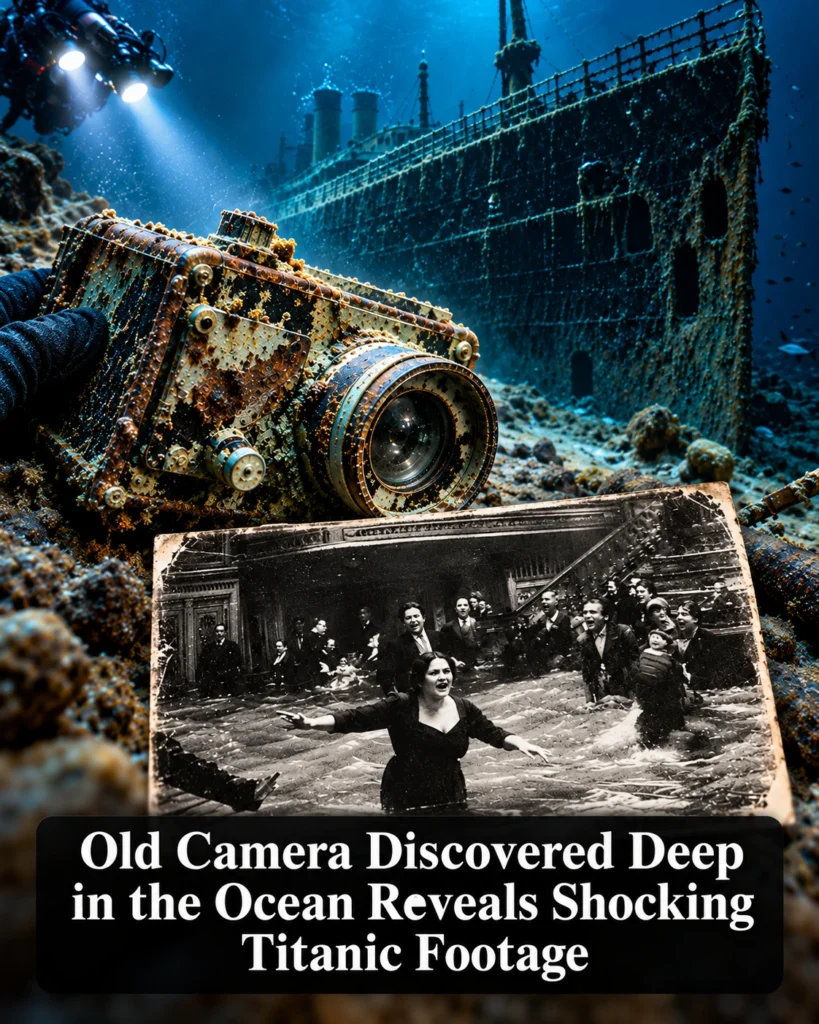
Shocking pictures of the Titanic came up from the bottom of the ocean along with pieces of an old camera and almost everyone knows the disaster behind them.
Even though more than 100 years have passed since she went down, that night still grabs people and still gets to them all over the world.
So today I’ve gathered rare images for you from before the sinking and after it of the liner that met her end in April 1912.
Let’s go through them one at a time.
I’m Ambrose Wilde and the first image on the list isn’t a photograph at all.
It’s a grainy black and white video picture glowing on a monitor aboard a research ship in the middle of the North Atlantic a little before 2:20 in the morning on September 1st, 1985.
Out of the dark, a big round shape slid onto the screen.
It was one of the Titanic’s boilers and the crew couldn’t help noticing the time on the clock.
It was almost exactly the time of night the ship had gone under 73 years earlier.
The camera that caught it was called Argo.
It was an unmanned sled towed behind the research vessel Knorr and dragged along just above the seafloor sending live pictures up a cable to the ship around the clock.
It could work as deep as 20,000 ft.
Seven people took turns keeping the sled and the ship in step and watching that feed for anything that didn’t look like mud.
A second sled called Angus was built to take still photographs.
Before any of that, a French team led by Jean Louis Michel had spent 5 weeks sweeping the area with sonar from their ship Le Suroît going back and forth across the search zone like they were mowing a lawn.
They came up with nothing worth chasing.
So in the end, the job fell to a camera and to the American oceanographer running it, Robert Ballard.
His window was tiny.
The search was squeezed into the time left over after a separate job for the United States Navy.
And Ballard had just 12 days for the Titanic.
Even after that boiler appeared, the team only got four more days on the site before stormy weather drove them home.
The wreck turned out to be lying about 12,500 ft down, roughly 350 nautical miles off Newfoundland.
And here’s a detail that changes how you look at that night in 1985.
Argo wasn’t the first camera to reach that patch of seabed.
Pieces of other cameras were already down there, lying in the mud with the wreckage, and they’d been there since 1912.
We’ll get to what was found beside one of them, but the story of the Titanic’s pictures really starts with the one camera that made it off the ship in time.
The Titanic’s sheer size would later become the reason she couldn’t swing clear of one iceberg.
But in 1909, when work on her began at the Harland and Wolff Yard in Belfast, size was the whole point.
She was the second of the White Star Line’s huge Olympic class liners built to carry passengers, cargo, and mail across the Atlantic.
When she was finished in 1912, she was the largest ship in the world, more than 850 ft long.
She left Southampton on April 10th, 1912, called at Cherbourg in France and Queenstown in Ireland, and then headed out into the open Atlantic.
When she pulled away from Queenstown, there were 1,320 passengers and 892 crew on board, 2,212 people in all.
Over the next few days, her wireless operators took in seven separate warnings about drifting ice.
She kept running fast anyway, at about 22 knots, and Captain Smith didn’t slow her down.
At 11:39 on the night of April 14th, the lookout Frederick Fleet picked up the phone to the bridge.
His first words were a question.
Is there anyone there? Then came the warning.
Iceberg right ahead.
The ship started to turn and about a minute later she was scraping along the ice.
By 2:20 the next morning she was gone about 2 hours and 40 minutes after the collision.
Around 1,500 people died.
The Carpathia had been 58 miles away when she first heard the Titanic calling for help.
She arrived roughly an hour and a half after the sinking and by 9:15 that morning she’d pulled 710 survivors out of the lifeboats.
There had only ever been 20 boats with room for 1,178 people on a ship carrying more than 2,200.
For the next 73 years nobody could say exactly where the Titanic was lying and nobody had seen her since that night.
All anyone had left of her were the pictures taken in her first few days at sea.
The most precious images of the ship were taken on board though by a young man who very nearly stayed on all the way to New York.
Francis Browne was born in Ireland in 1880.
In April 1912 he was a Jesuit in training still 3 years away from being ordained a priest.
His parents had died when he was young and he’d been raised by his uncle Robert Browne the Bishop of Cloyne.
That uncle gave him a present that spring the trip of a lifetime a ticket on the most talked about ship in the world from Southampton to Queenstown about 2 days on board.
And the young man packed a camera.
He used it constantly out on the open decks inside the ship and in his own first class cabin.
On April 10th the first day he photographed passengers out on A deck.
He took the only known photograph of the ship’s wireless room with a junior operator Harold Bride in the shot.
He photographed the crew, and those turned out to be the last known pictures of many of them, including the man in command, Captain Edward Smith.
Somewhere along the way, Brown got friendly with a wealthy American couple, and they made him an offer.
They’d buy him a ticket for the rest of the crossing to America.
Brown couldn’t just say yes.
As a Jesuit, he needed permission.
So, he sent a message to his superior asking for it.
When the ship anchored off Queenstown on April 11th, the answer was waiting for him.
“Get off that ship”.
He did, and he’s said to have kept that message for the rest of his life.
As the Titanic left the Irish coast behind, Brown photographed her going.
So did Kate Odell, another passenger who’d got off at Queenstown.
Some of those frames may well be the last pictures ever taken of the ship above water.
Brown’s camera went ashore with him.
Other cameras stayed aboard with film still inside them, and that’s [clears throat] exactly where this story is going to end up.
When the news broke, Brown’s photographs were suddenly the last record of a ship that no longer existed, and they ran in newspapers right around the globe.
Then he went on to a life you’d never guess from those pictures.
He joined the British Army as a chaplain in 1916 and served with the Irish Guards in the First World War.
He was wounded five times and gassed, and he was awarded the Military Cross and Bar, and the Croix de Guerre.
His commanding officer, Field Marshal Alexander, called him the bravest man he ever met.
He never put the camera down.
Kodak gave him free film for life in 1933, and over the years he took commissions from the National Museum of Ireland, the British Museum, and even the Church of England.
By the time he died in 1960 at the age of 80, he’d left behind about 42,000 negatives stored on cellulose nitrate, a film base so flammable it’s dangerous just to keep around.
And then, for about 25 years, nobody touched them.
In 1985, the same year Argo found the wreck, a Jesuit named Eddie O’Donnell opened a tin trunk and found Brown’s negatives sitting inside.
Think about the timing of that for a second.
In the same year, the last pictures of the Titanic afloat came out of a box in Ireland and the first pictures of her on the bottom came up a cable in the Atlantic.
O’Donnell has since put together more than 20 books of Brown’s work and the Titanic pictures are why most people know his name at all.
Brown got off the ship because his superior told him to.
Another passenger stayed aboard until the very end, lived through it, and spent the rest of his life paying for the way he did it.
Masabumi Hosono was the only Japanese passenger on the Titanic.
He was born in October 1870 in Niigata, studied at the Tokyo Higher Commercial School, and went on to a career in government, working for Japan’s Transport Ministry and becoming a railway director in 1908.
In 1910, the ministry sent him to Russia to study the Russian State Railway System.
Two years later, he was finally heading home and he boarded the Titanic at Southampton with a second class ticket.
Hosono was 42 that night.
When the ship began to go down, he found the boats being filled with women and children first and men who tried to climb in were being held back, in some cases at gunpoint.
He was torn between the fear of shame and the plain instinct to survive.
Then, as one lifeboat was being lowered, there was room for two more people.
A man jumped in.
Hosono hesitated and then he followed him.
In his own words, a ship’s officer urged him into the boat and he helped row it away from the sinking ship.
Hours later, at about 8:00 in the morning, the Carpathia took them all aboard.
He wrote all of it down while the Carpathia was steaming toward New York.
He wrote it in Japanese as a letter to his wife on the Titanic’s own stationery.
As far as anyone knows, it’s the only account of the sinking written on the ship’s letterhead.
But for Hosono, getting into that boat was where the trouble began.
Back home, the Japanese press called him a coward.
A man had lived while women and children drowned, and nobody was in a forgiving mood.
Abroad, it was worse.
Archibald Archibald Gracie, another survivor, described him as a stowaway in lifeboat 10.
A seaman named Edward Buley told the United States Senate inquiry that Hosono and another man had dressed up as women to get into a boat.
Newspapers even put him in lifeboat 13, a boat he was never in.
He lost his job in 1914.
The ministry did take him back part-time, and he kept working there until he died in 1939.
But in his own house, the Titanic was a subject nobody was allowed to bring up.
Then, in 1997, the year the film Titanic packed out cinemas, his letter surfaced.
A researcher named Matt Taylor found it among Hosono’s belongings while he was putting together an exhibition in Japan, and he convinced the family to let it be made public.
Michael Findlay of the Titanic International Society called it one of the most expressive and detailed accounts of the panic on board.
Hosono’s grandson, Haruomi Hosono, a leading member of the band Yellow Magic Orchestra, said he was extremely relieved and that the family’s honor had been restored.
So, it took 85 years, a letter in a drawer, and a Hollywood movie for a man to be forgiven for climbing into a boat that had room in it.
Hosono’s boat had space in it.
Elsewhere on deck, the rule of women and children first was splitting families right down the middle.
A 7-year-old girl in second class watched it happen to hers.
Eva Hart was born in Ilford in Essex in January 1905.
In April 1912, her parents, Benjamin and Esther, took her aboard at Southampton as second class passengers.
Her mother hated the ship before it ever left port.
The story goes that she thought calling any ship unsinkable was an insult to God, so she made a strange arrangement.
She slept during the day, and at night she sat up in the cabin fully dressed waiting.
When the ship struck, Eva’s father got the family up to the boat deck and put Eva and her mother into lifeboat number 14.
Before he stepped back, he said one thing to his daughter, “Be a good girl and hold Mommy’s hand”.
That was the last time she ever saw him.
Benjamin Hart died in the sinking, and if his body was ever found, it was never identified.
The Carpathia picked Eva and her mother up the next morning and brought them into New York on April 18th.
From there they went back to England without him.
Eva grew up to have a remarkable life.
She worked as a professional singer in Australia, became an organizer for the Conservative Party, and served as a magistrate.
During the Second World War, she organized entertainment for the troops and handed out emergency supplies after the Blitz.
But she never let the Titanic go.
In 1994, she published her autobiography, Shadow of the Titanic, A Survivor’s Story.
She blamed the White Star Line for sailing with too few lifeboats.
She came to say the ship broke in half before it sank, though at first she described it going down whole, and the wreck on the seafloor would back her later version up.
And she was certain the nearest ship that night, the Californian, had been far closer than people thought.
Less than 10 miles away, she said, not the 19 miles that had long been accepted.
Close enough that the rockets she watched go up should have brought help.
When salvage crews started bringing objects up from the wreck in 1987, Eva had words for them.
Fortune hunters, vultures, pirates, and grave robbers.
To her, the wreck was the grave of 1,500 people.
Her objection is going to come back in a very particular way, next to a blanket on the seafloor.
But that’s getting ahead of the story.
Eva Hart died of cancer at a London hospice on February 14th, 1996.
She was 91.
She’d only ever seen the iceberg as a shape in the dark.
But two days after the sinking, a man on a ship heading for the wreck site pointed a camera right at one.
On April 16th, 1912, the cable ship Mackay-Bennett was on its way to the place where the Titanic went down.
One of the men on board was John Snow Jr.
, the chief embalmer for a Nova Scotia undertaking firm, John Snow & Company.
And the reason he was on that ship needs no explaining.
On the way out, Snow photographed an iceberg.
He mounted the print and wrote one word on it, Titanic.
The berg in his picture has a shape some people say looks like an elephant.
The print is tiny, about 5 in by 3, and the Snow family held onto it for decades until a collector bought it from them in the early 1990s.
When it went to auction in Wiltshire in 2024, it was expected to fetch somewhere between $5,000 and $8,500.
Nobody can prove it’s the one.
Henry Aldridge & Son, the auction house selling it, said so plainly.
Nobody can say for sure, and Snow’s picture isn’t the only candidate.
Experts have argued for years over two other photographs of two different icebergs.
Captain de Carteret of the Minia, another ship sent out to recover the dead, owned a photo of what looks like the same berg Snow photographed.
According to De Carteret, it was the only iceberg anywhere near the spot where the Titanic sank, and that’s a big part of why people take these pictures seriously.
If that’s the right iceberg, it wasn’t especially big for its kind.
It was about 328 ft long, less than half the length of the Titanic, and it weighed about 926 million pounds.
Most of that bulk was underwater, which is exactly what made it so hard to see.
It most likely came from Greenland, where it broke off a glacier some 3,000 to 4,000 years ago, long before anyone had built a steamship.
It started its drift toward the Atlantic after 1910, and within 2 years it was sitting in the Titanic’s path.
And it didn’t outlast her by much.
After the collision, it kept drifting, carried into warmer water, and by 1913 it had melted away completely.
A block of ice drifted for thousands of years, and the only thing anybody remembers it for is roughly 1 minute on a Sunday night in April.
The iceberg sank the Titanic.
Who lived and who died that night was sorted out on board, and the kind of ticket you held had a lot to do with it.
After the disaster, the British inquiry did something simple and useful.
It counted.
Of the 144 women traveling first class, 140 were saved.
In second class, 80 women out of 93 survived.
In third class, only 76 women out of 165 made it, fewer than half.
Put as percentages, that’s about 97% of first class women saved against about 46% in third.
The children’s numbers are worse.
The inquiry listed every child in second class as saved.
In first class, it listed every child as saved, too, though one little girl, Lorraine Allison, was in fact lost.
In third class, only 27 children out of 79 came through.
And the men? In first class, 57 out of 175 survived.
In second class, just 14 men out of 175 came home.
In third class, it was 75 out of 462.
Put those side by side and you get something that’s hard to sit with.
A child in third class had about the same chance of seeing the morning as a grown man in first class, roughly one in three.
Why did third class fare so badly? One third class survivor, Margaret Murphy, said that before steerage passengers ever had a chance, sailors fastened the doors and stairways leading up from their part of the ship.
The record suggests some gates were locked and guarded by crew, possibly to stop a rush on the boats, though that account has always been disputed.
The 1997 film shows third class passengers locked in below decks.
The real evidence is messier than the movie.
But one steward who looked after third class later admitted that those passengers were hardly let up onto the boat deck until near the very end.
And afterwards, almost nobody was asking them.
Third class passengers were barely called to give evidence.
In Washington, the Senate inquiry spent time on questions like what the iceberg was made of.
And one of the ship’s officers, Harold Lowe, told the senators it was ice.
Meanwhile, one New York paper run a long story about the millionaire John Jacob Astor, and only near the end mentioned that 1,800 other people had died as well.
Third class barely made it into the coverage at all.
There’s one man who was responsible for every one of those passengers, first class to third.
He was on the bridge that night, and Brown had photographed him only days before.
Edward Smith was born on January 27th, 1850 on Well Street in Hanley, Staffordshire.
At 17, he started an apprenticeship at sea aboard a ship called the Senator Webber.
In March 1880, he joined the White Star Line as fourth officer of the Celtic and he worked his way up from there.
By 1912, he’d sailed about 2 million miles for the company and commanded 13 of its ships.
Passengers loved him.
Plenty of them would only sail on a ship he commanded and wealthy travelers liked him so much he picked up a nickname, the Millionaire’s Captain.
In 1907, he gave an interview about his career and his summary is still quoted.
“When anyone asks how I can best describe my experience in nearly 40 years at sea,” he said, “I merely say uneventful”.
There’s a story that the Titanic’s maiden voyage was meant to be his last before he retired.
It might be true, but the sources for it are thin and nobody has ever pinned it down.
What we do know is what happened on April 15th.
Captain Smith went down with his ship and his body was never recovered.
He’d married Sarah Eleanor Pennington in 1887 and their daughter, Helen Melville Smith, was born in 1898.
In July 1914, a statue of Smith was unveiled in the museum gardens in Beacon Park, Lichfield and Helen was the one who unveiled it.
The sculptor was Kathleen Scott, the widow of the polar explorer Robert Falcon Scott.
Back in Hanley, there are plaques to him as well.
Smith trusted the ship under his feet and so did everyone else.
Whether she deserved that trust came down to things much smaller than a captain, like the metal pins that held her together.
The Titanic was a floating luxury hotel with a swimming pool, a gymnasium and grand staircases that drew wealthy travelers from both sides of the Atlantic and she picked up a reputation for being unsinkable.
Her hull was made of steel plates joined by rivets.
Through the middle of the ship, which made up about 60% of the hull, the plates were held with triple rows of mild steel rivets.
But at the bow and the stern, where the curves made the work harder, they used double rows of wrought iron rivets instead.
Wrought iron is weaker than steel.
And researchers later found that many of those rivets carried a high level of slag, leftover waste from making the iron, which made them more brittle and more likely to snap, especially in freezing cold.
Some of those iron rivets may have been close to their stress limits before the ship ever met the ice.
Below the waterline, she was split into watertight compartments.
The design let her stay afloat with any two of them flooded, or with certain combinations of three or four up front.
She also had a double bottom covering about 90% of her length.
But the walls between those compartments weren’t sealed at the top.
Once enough of them filled, water could spill over from one into the next, like an ice cube tray tipped on its end.
On the night of April 14th, six compartments were flooding.
Thomas Andrews, the shipbuilder’s man on board, reportedly said that with the first five open to the sea, she was doomed.
The flooding ran through the forepeak tank, the three forward cargo holds, boiler room number six, and part of boiler room number five.
With that much of the bow open, she couldn’t stay up.
There’s an old picture in a lot of heads of the iceberg slicing one long gash down the Titanic’s side.
The evidence points somewhere else, to plates bending and rivets popping under the strain, opening narrow gaps all along the hull that the sea simply poured through.
So, the ship that was supposed to be the greatest achievement in the history of ocean travel became shorthand for disaster instead.
And that brings us back down to the debris field and to the old camera.
When salvage crews started diving on the wreck in 1987, Eva Hart called them grave robbers.
They kept going anyway, and over the years they brought up things a photographer would recognize in a heartbeat: a tripod, a developing tray, parts of a camera that nobody has been able to put a make to.
They were found together, wrapped up in a blanket.
Nobody knows who they belonged to.
Somebody on that ship wrapped them up with care, and whether that happened on the first day of the voyage or in the last hour, nobody can say.
Another find came up in 1993, a trunk belonging to a man named Howard Irwin, who wasn’t even on the Titanic.
His friend Henry Sutehall, traveling in third class, had been carrying Irwin’s luggage for him.
>> [clears throat] >> Inside was an envelope from a photography firm in Salt Lake City, the C.
R.
Savage Company.
Whether Sutehall carried a camera of his own, nobody has been able to show.
And then there’s the sliver.
On a different dive, in a different spot, a small strip of nitrate film came up out of the mud.
It has faint markings on it, and they could be the traces of an exposed and developed negative.
Could be.
Whether a real picture survives on it, a face, a deck chair, somebody’s last look at their trip, nobody has confirmed.
Finding out would take more imaging and more analysis than anyone has done so far.
Remember what Brown’s negatives were stored on? The same kind of film.
He spent about 25 years in a tin trunk in Ireland, and came out as one of the great photographic records of the 20th century.
That sliver spent decades more than 2 miles down in freezing salt water, in the dark, next to the ship itself.
Meanwhile, the cameras keep going down.
In the summer of 2022, the deep-sea mapping company Magellan spent more than 200 hours surveying the wreck and took 700,000 images, enough to stitch the whole Titanic together as one full-size 3D model.
The Titanic analyst Park Stephenson called it one of the first major steps toward evidence-based research on the ship, and he put the gap plainly.
There are still questions, basic questions, that need to be answered about the ship.
So, here’s what the cameras have given us.
In 1912, one camera walked off the ship at Queenstown and gave the world its last pictures of the Titanic afloat.
In 1985, a camera on a sled found her boiler at almost the same time of night she went under.
And lying in the mud between those two moments, there was an old camera kit wrapped in a blanket and a strip of film that might still be holding one more picture of the Titanic that nobody alive has ever seen.
I’m Ambrose Wilde, and if you’d like more stories like this one about the things the ocean has kept and the things it’s slowly giving back, there are plenty more of them coming here on the channel.


