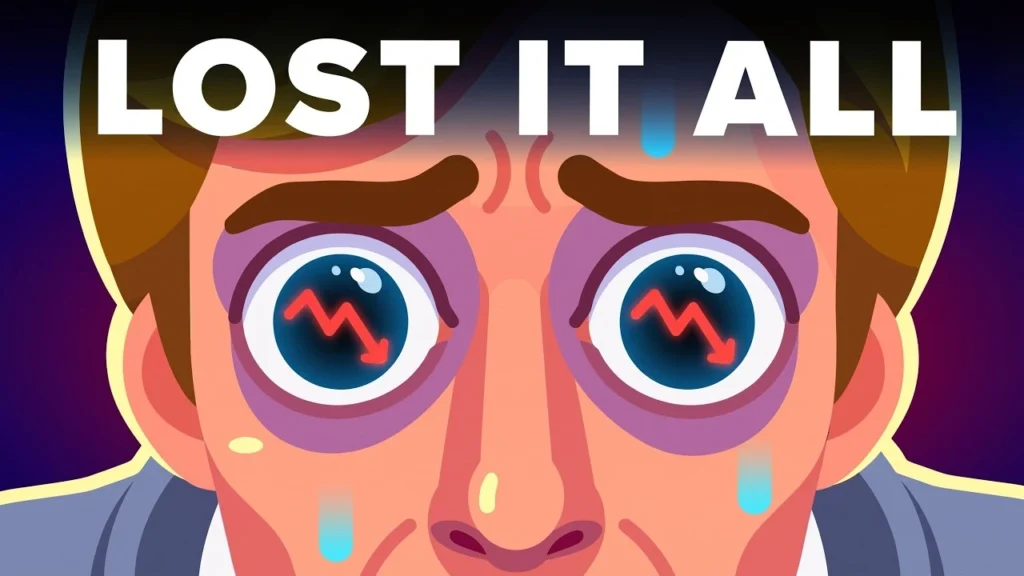
How a Young AI Investor Reportedly Lost $35 Billion in Two Weeks — and Exposed Wall Street’s Biggest Risk

At just 24 years old, Leopold Aschenbrenner appeared to have achieved something extraordinary.
The former OpenAI researcher had built a reputation as one of Silicon Valley’s most outspoken thinkers about artificial intelligence.
His investment firm, Situational Awareness, reportedly grew from approximately $225 million in initial capital to a portfolio with exposure approaching $45 billion.
Then, according to the account presented in a ColdFusion documentary, roughly $35 billion in portfolio value disappeared within two weeks.
The timing made the story even more remarkable.
As financial markets turned against his investments, Aschenbrenner was preparing for his wedding in Carmel, California.
The celebration brought together friends, family, and prominent figures from the technology industry.
Behind the festivities, however, an enormous financial crisis was reportedly unfolding.
Major banks were demanding additional collateral, and positions that had generated spectacular gains were suddenly collapsing.
The episode offers a striking illustration of how quickly leverage can transform investment success into financial disaster.
But understanding what happened requires examining the extraordinary rise that preceded the reported losses.
Aschenbrenner was born in Germany and demonstrated unusual academic ability from an early age.
He entered Columbia University as a teenager and graduated in 2021 at just 19.
His early professional experience included work connected to the effective altruism movement and later a position at OpenAI.
At OpenAI, he joined the superalignment team, which focused on challenges associated with controlling increasingly capable artificial intelligence systems.
His employment ended in April 2024 following a dispute involving information shared outside the company.
Aschenbrenner subsequently described concerns he had raised about the security of advanced AI research.
OpenAI offered a different explanation for his dismissal.
The disagreement attracted attention, but his next move proved far more consequential.
In June 2024, Aschenbrenner published a lengthy essay titled Situational Awareness: The Decade Ahead.
The document argued that artificial general intelligence could emerge around 2027.
He predicted that increasingly capable AI systems would require enormous investments in computing infrastructure, electricity, and advanced semiconductor manufacturing.
The essay circulated widely among technology executives, investors, and researchers.
Some readers considered his forecasts unusually insightful.
Others argued that he had assembled existing industry expectations into a compelling narrative rather than introduced fundamentally new ideas.
Regardless of the disagreement, the essay established his reputation.
Aschenbrenner subsequently launched an investment fund bearing the same name.
Its strategy was built around a straightforward proposition.
If artificial intelligence was advancing faster than financial markets anticipated, companies supplying the infrastructure would become dramatically more valuable.
The fund therefore concentrated on businesses associated with semiconductors, computing capacity, and energy-intensive AI development.
The documentary identifies companies such as SK Hynix, CoreWeave, and Nebius among its investments.
It also describes short positions in established software businesses, including Adobe and Salesforce.
The logic was that AI infrastructure suppliers would benefit from growing demand while some traditional software companies might face disruption.
For a time, the strategy reportedly delivered extraordinary returns.
Rising enthusiasm for AI infrastructure pushed related shares higher, rewarding investors positioned for rapid expansion.
But there was a hidden weakness.
Although the portfolio contained both long and short positions, those trades depended heavily on the same underlying assumption.
Artificial intelligence had to advance rapidly, infrastructure spending had to remain strong, and established software companies had to experience meaningful disruption.
If those expectations changed simultaneously, both sides of the portfolio could lose money.
The documentary describes exactly that scenario unfolding during July 2026.
Investors reportedly became concerned that increasingly efficient AI models could reduce demand for expensive computing infrastructure.
Several major holdings declined sharply.
Meanwhile, software companies that the fund had bet against recovered.
The resulting losses were magnified by leverage.
Leverage allows investors to control assets worth considerably more than the capital they personally contribute.
For example, a fund with $1 billion in equity might use borrowed money to hold $4 billion in investments.
A 10% decline in those assets would produce a $400 million loss.
That represents 40% of the fund’s original equity, before financing costs and other adjustments.
Leverage can therefore multiply profits during favorable conditions.
It also magnifies losses when markets move in the opposite direction.
According to the documentary, Aschenbrenner’s fund operated with approximately four times leverage.
That exposure made the portfolio especially vulnerable to sudden price changes.
As asset values declined, lenders reportedly demanded additional collateral.
These demands are commonly known as margin calls.
If a borrower cannot provide the required funds, lenders may force the sale of investments to reduce their exposure.
Such sales can create further difficulties.
Large positions may have to be liquidated rapidly, sometimes at substantial discounts.
The documentary alleges that approximately $16 billion in publicly traded holdings were sold through a transaction involving Citadel.
It also reports that the fund retained a substantial private investment in Anthropic.
These specific transaction details require confirmation from reliable financial reporting and regulatory disclosures.
Another important distinction concerns the widely repeated $35 billion figure.
A decline in gross portfolio exposure is not necessarily equivalent to an investor losing the same amount of equity capital.
Borrowed money, short positions, derivatives, and changes in asset values can make these figures dramatically different.
Consequently, the headline figure should not automatically be interpreted as $35 billion in cash belonging to the fund’s investors disappearing.
Nevertheless, the financial mechanism described illustrates a genuine danger.
An investment thesis can ultimately prove correct while the investor following it still suffers catastrophic losses.
Timing matters.
Liquidity matters.
And the ability to survive temporary market declines can matter more than the accuracy of a long-term prediction.
Consider an investor who correctly anticipates that AI infrastructure will become enormously valuable over the next decade.
If the investor uses excessive leverage, a temporary market correction could force liquidation before those gains materialize.
The eventual success of the prediction would offer little consolation.
This is why experienced investment managers devote enormous attention to risk management.
A portfolio must be designed not only around expected returns but also around unexpected outcomes.
One important concept is the Kelly criterion, a mathematical framework for determining how much capital to risk when an investor believes an opportunity offers an advantage.
Aggressive application of the formula can produce substantial theoretical growth.
But its results depend upon accurate assumptions about probabilities and returns.
When those assumptions are uncertain, smaller positions can offer greater resilience.
The documentary references hedge fund manager Cliff Asness emphasizing the danger of betting too aggressively.
That principle extends beyond hedge funds.
Even highly informed investors cannot know exactly when technological developments will translate into corporate profits.
Artificial intelligence remains particularly difficult to forecast.
Progress in model capabilities does not guarantee immediate commercial adoption.
Businesses must consider reliability, cost, security, regulation, and integration with existing systems.
New technologies can create enormous economic value without rewarding every company associated with their development.
Similarly, a company supplying essential infrastructure may experience declining share prices if investors previously expected even faster growth.
Financial markets respond not only to technological progress but also to the difference between expectations and reality.
Aschenbrenner’s reported experience illustrates this distinction.
His confidence in AI’s long-term potential may be sincere and intellectually grounded.
But conviction about a technological transformation does not eliminate uncertainty about market timing.
The documentary also describes his continued investment activity after the alleged crisis.
Rather than abandoning his thesis, he reportedly committed substantial additional capital to private technology investments.
Such behavior can be interpreted as continued confidence.
It can also raise questions about whether previous losses meaningfully changed his approach to risk.
Without comprehensive financial disclosures, outside observers cannot determine the full condition of his fund or the personal consequences of the reported events.
The broader lesson, however, is clear.
Artificial intelligence may transform entire industries, but predicting that transformation is not the same as constructing a sustainable investment strategy.
Markets can move against even well-researched positions.
Borrowed capital can turn temporary volatility into permanent losses.
And diversification provides limited protection when supposedly different investments depend on one shared assumption.
The most successful investors are not necessarily those who make the boldest predictions.
They are often those who preserve enough capital to remain invested when uncertainty becomes unavoidable.
Aschenbrenner’s story, as presented in the documentary, is ultimately about the difference between seeing a possible future and surviving the journey toward it.
The AI revolution may continue producing extraordinary opportunities.
But no technological forecast, however persuasive, can remove the fundamental financial risks of leverage, concentration, and imperfect timing.
And in markets where billions can change hands within hours, the most expensive mistake may be believing that being right about the future means nothing can go wrong today.