Valley of the Kings, January 1907.
In a cramped little tomb, excavators found a gold-covered coffin whose face someone had torn off on purpose, and a skeleton inside that nobody could name.
More than a hundred years later, scientists claim they finally solved who it was using tests on the bones, and the answer was locked inside its own DNA all along.
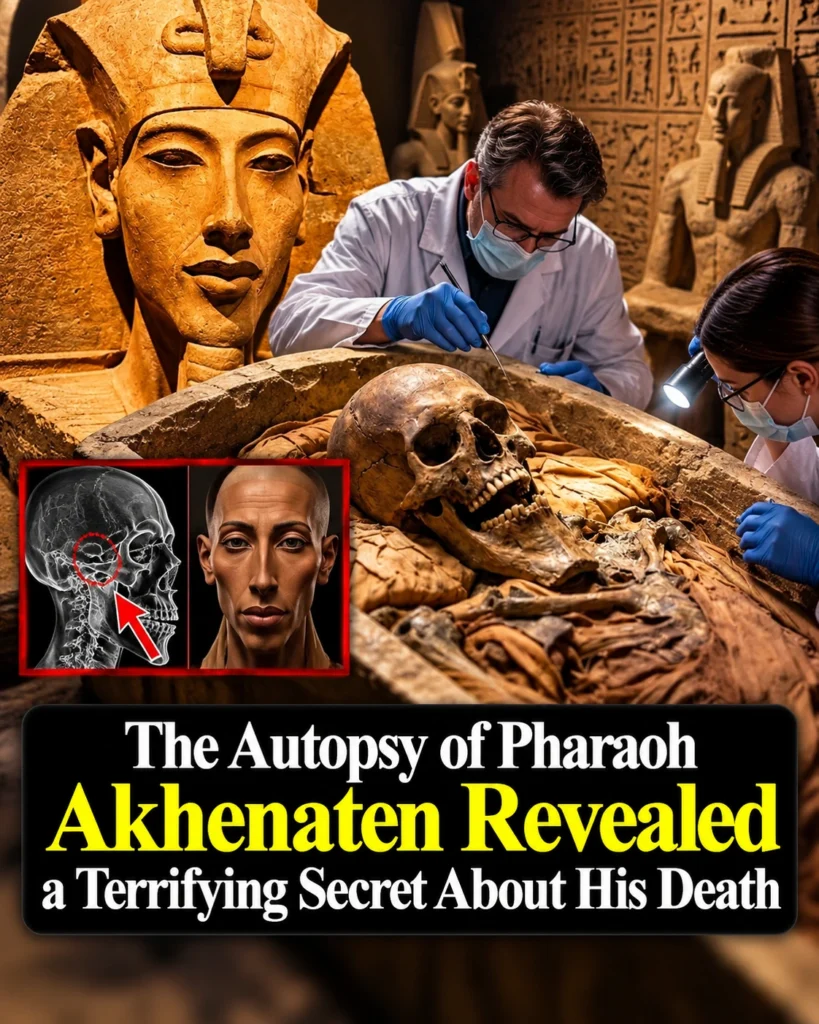
This is the autopsy of Akhenaten.
I’m Ambrose Wild, and what makes this case so unsettling is that the same genetic test that put a name on that skeleton also exposed who the mother of his only famous son really was.
And that answer is the part Egyptologists still find hard to talk about.
For more than a century, the bones from that tomb were measured, argued over, and measured again.
Some experts thought they belonged to a woman.
Others said a young man in his twenties.
Others said a man close to forty.
Each new study seemed to cancel out the last one, and the skeleton sat in a museum in Cairo with a question mark next to it.
Then a team of geneticists and radiologists published a result that turned the argument on its head, and it told us something about this pharaoh’s family that nobody was fully ready for.
It was around 1353 BC, and a young man named Amenhotep was taking the throne of Egypt as Amenhotep the Fourth.
On paper, there was nothing unusual about him.
He was the son of Amenhotep the Third and Queen Tiye, and he belonged to the Eighteenth Dynasty, the family of kings that had made Egypt the richest power of its age.
The temples were full, the treasury was full, and the priests of the god Amun in Thebes had grown so wealthy that their influence came close to the king’s own.
But within a few years, the new king did something no pharaoh before him had dared to try.
He turned his back on the gods, the whole crowded family of Egyptian deities that people had prayed to for well over a thousand years.
Amun, Osiris, Isis, and the rest.
In their place, he raised up a single god, the Aten, the shining disc of the sun itself.
And in the fifth year of his reign, he changed his own name to match.
The new name, Akhenaten, is usually translated as effective for the Aten, the one who serves the sun disc.
Put that in plain terms.
This is a civilization whose calendar, temples, festivals, and funerals all ran on the old gods, and one man decided, more or less by himself, that they were finished.
On top of that, he presented himself as the only person who could speak directly to his new god.
If you wanted to reach the Aten, you went through the king and his family.
Historians have argued for a long time about how much of this was faith and how much was politics, and the answer is probably both.
The people who lost the most were the priests of Amun, the one group in Egypt rich enough and organized enough to challenge a pharaoh.
By cutting off their god, Akhenaten cut off their power and pulled religion and government into his own hands at the same time.
Then he went a step further.
He abandoned Thebes, the old royal city, and ordered a brand new capital built from nothing on an empty stretch of desert along the east bank of the Nile, about 400 km to the north.
He called it Akhetaten, the horizon of the Aten.
Today, we know the site as Amarna.
>> [snorts] >> To mark its borders, he had great inscriptions carved into the cliffs around it, the boundary stelae.
Construction started around year five of his reign, and to get it done fast, his builders used small standard stone blocks, about 27 by 27 by 54 cm.
By around year nine, a city of palaces, offices, and open-air temples stood where there had been sand.
The temples had no roofs, by the way, because the Aten was the sun, and you can’t worship the sun from inside a dark room.
And it wasn’t just the religion that changed.
The art changed, too, in a way that still makes people do a double take.
Early in his reign, Akhenaten was carved the traditional way, the same strong, idealized pharaoh you see on every other temple wall.
Then the portrait started to shift.
Now the king had a long, narrow face, a heavy jaw, thin arms, a sagging belly, wide hips, and what looked like breasts.
Nobody had shown a ruler of Egypt like this before, and for a long time, nobody knew what to make of it.
Keep that strange body in mind, because the question of whether it was real comes back later, and the answer surprised a lot of people.
Meanwhile, outside the new city, the empire was fraying.
A cache of clay tablets known today as the Amarna letters, 382 diplomatic and scribal texts in all, preserves the foreign mail of the period.
Around 60 of them come from just one man, Rib-Hadda, the ruler of the city of Byblos, begging Egypt again and again for help against his enemies.
Mostly, that help never came.
Akhenaten died around 1336 BC after a reign of about 17 years.
And what happened next shows how much Egypt had hated his revolution.
Within a generation, the country did everything it could to make him disappear.
His capital was abandoned, and the young king who followed him, a boy named Tutankhaten, changed his name to Tutankhamun, swapping the Aten in his name for Amun, the very god Akhenaten had tried to erase.
Later rulers went further.
Horemheb started tearing down the temples of the Aten and reusing their blocks inside temples to Amun.
Under the kings who came after him, the stone of Amarna itself was hauled away and built into other places, including the city of Hermopolis.
Then came the king lists.
When Seti the first had the official list of Egypt’s rulers carved, Akhenaten wasn’t on it.
Neither was Tutankhamun or the two shadowy rulers in between or Ay, the king who came right after Tutankhamun.
On that list, Amenhotep the third is followed directly by Horemheb as if the whole Amarna period had never happened.
And when later officials did have to mention those years, they avoided his name.
They called him the enemy of Akhetaten.
In some records, he’s simply that criminal.
So, the king who tried to wipe out the old gods ended up wiped out himself by the people who brought them back.
For more than 3,000 years, his body was gone or at least everyone assumed it was.
That brings us back to the Valley of the Kings and to an Englishman named Edward Ayrton.
Ayrton was digging for Theodore Davis, a wealthy American who was paying for excavations in the valley.
On the 6th of January, 1907, Ayrton’s crew uncovered the entrance to a small tomb that would later be given the number KV 55.
3 days later, on January 9, Ayrton went inside with Davis, Joseph Lindon Smith, and Arthur Weigall.
What they found was a mess and a very strange one.
Water had been getting into the tomb and much of what was inside had rotted or collapsed.
There were gilded panels from a large funerary shrine and the text on them said that Akhenaten had made it for his mother, Queen Tiye.
There were four canopic jars, the containers that held a mummy’s internal organs, sitting in a niche above the coffin, but the inscriptions that should have named their owner had been cut away.
There were four small magical bricks, the kind placed in a tomb to protect the dead, and two of them carried one of Akhenaten’s own royal names.
And then there was the coffin.
It was covered in gold, beautiful work, but the gold face had been torn away, and the cartouche, the oval ring where the owner’s name would be written, had been scraped out.
Inside lay a mummy that the damp had reduced almost entirely to bones.
So, think about what the excavators were looking at.
A coffin with no face and no name, organ jars with no name, a shrine made for a queen, and bricks naming a king that Egypt had tried to forget.
Someone, long ago, had gone into that tomb and made very sure that whoever was lying there couldn’t be identified.
The question was who? And it would not get a confident answer for more than a hundred years.
The coffin didn’t even stay in one piece.
At some point between a restoration in 1914 and an inventory in 1931, the gold foil from the bottom half of it went missing.
For decades, it was only a rumor that it had ended up in Europe until photographs published in an Egyptology journal showed it sitting in the State Museum of Egyptian Art in Munich.
That’s how badly this burial was treated, first in ancient times and then again in the 20th century.
The first person to examine the bones was the anatomist Grafton Elliot Smith, and in 1907, he decided they belonged to a man of about 25.
That pushed back against one early idea that the body was a woman, perhaps even Queen Tiye herself, because of the shrine and a pelvis some observers thought looked female.
But it also created a new problem because the history didn’t fit.
Akhenaten had ruled for about 17 years.
If he died at 25, he would have been crowned at around eight.
Later anatomists didn’t settle it.
Douglas Derry and Ronald Harrison both landed around 25 or 26.
A study in the late 1980s pushed the age up to about 35 based partly on the teeth.
In the early 2000s, the bio-archaeologist Joyce Filer said early 20s.
Meanwhile, the coffin got even more confusing.
The Egyptologist George Daressy had noticed that it had been altered, and today it’s widely accepted that the coffin and those canopic jars were originally made for a woman named Kiya, one of Akhenaten’s secondary wives, and later reworked for a king.
So, the body in KV 55 was lying in a coffin that had never been meant for him.
That’s why another name kept coming up.
In 1931, the Egyptologist Rex Engelbach suggested that the bones might belong to Smenkhkare, a ruler who seems to have reigned very briefly around the end of Akhenaten’s life.
Smenkhkare is one of the most frustrating figures in Egyptian history.
We have his name, a few objects, and almost nothing else.
Some scholars think he was Akhenaten’s brother, others a son.
A young man in his 20s fit Smenkhkare much better than Akhenaten.
And for most of the 20th century, the skeleton stayed exactly where it was, a body with two possible names and no way to choose between them.
But while that argument was going in circles, another one was running right beside it.
Because if this really was Akhenaten, what about the body in those portraits? The most famous of those images are the colossal statues from the Gempaaten, a temple Akhenaten built for the Aten at Karnak in Thebes.
In them, the king towers over you with a long face, a rounded stomach, and hips as wide as a pregnant woman’s.
And people kept asking the obvious question, what if the sculptors were simply showing him the way he looked? That question produced a whole shelf of medical theories.
Elliot Smith suggested a hormone disorder called Froehlich syndrome.
Later, some researchers proposed Marfan syndrome, a genetic condition that makes the limbs and fingers unusually long and can damage the heart.
Others suggested Klinefelter syndrome, where a man carries an extra X chromosome and can develop wider hips and breast tissue.
There were even theories about a tumor on the pituitary gland changing the way his body stored fat, but every one of those diagnoses had the same weakness.
They were built on carvings, not on a body.
And Egyptian royal art was religion and politics carved in stone, made to say something about the king rather than a photograph of his face.
To test any of those ideas, you’d need a body you could trust was his and a way to look inside it.
Neither existed yet, and in the meantime, the most famous member of the family was about to make the mystery much more personal.
In November 1922, the British archaeologist Howard Carter, working for Lord Carnarvon, opened the most famous tomb ever found, the tomb of Tutankhamun.
Gold masks, gilded shrines, chariots and thrones turned a minor boy king into the best-known pharaoh on Earth.
But when Carter’s team finally reached the king himself, the body didn’t match the treasure.
The anatomist Douglas Derry, the same man who would study the KV55 bones, examined the mummy in November 1925 and estimated that Tutankhamun had died at about 18.
CT scans in 2005 put it at 19 based on how far his bones had matured and on his wisdom teeth.
He had become king as a child no older than 10.
Those same 2005 scans also knocked down one of the oldest rumors about him.
One popular theory had treated bone fragments inside his skull as a sign that he was murdered with a blow to the head.
The CT showed that the fragments had shifted after death, so that version of a murder fell apart.
And as scientists looked closer, they found a young man who’d been fighting his own body.
The genetic team reported that his left foot was clubbed and that two of the bones in that foot showed a condition where bone tissue dies because it isn’t getting enough blood.
A small cleft palate had also turned up on the scans, and then there were the walking sticks.
Carter’s team had pulled about 130 canes and staffs out of the tomb.
Some researchers point to signs of wear on them as proof he really needed them.
Others say a walking stick was simply a symbol of rank.
Either way, that’s a lot of canes for a teenager.
The DNA work found something else, too.
Tutankhamun’s body carried genetic traces of Plasmodium falciparum, the parasite behind the most dangerous form of malaria, and he seems to have been infected more than once.
The team concluded that the likeliest explanation for his death at 19 was a combination of that malaria, the dying bone in his foot, and a fracture in his leg, which leaves you with a nagging question.
This was a boy raised in the richest palace on Earth with the best food, the best doctors, and every comfort ancient Egypt could buy.
So, why was his body so fragile? The answer turned out to be connected to that skeleton in KV55 and to the woman who gave birth to him.
But before science could get there, there was a long stretch where the explanations got a little wild.
With no hard evidence either way, the family of Akhenaten became a magnet for theories.
One of the most famous claims that the king wasn’t human at all, that his long skull and strange body were proof he came from somewhere else, and you’ll still find that idea all over conspiracy channels.
Others talked about curses, about the old gods punishing a royal family that had dared to abandon them.
I know how that sounds, but when nobody can test anything, almost any story can sound possible.
More careful scholars offered calmer explanations.
Maybe the strange art was only an artistic style with no medical meaning at all.
That was reasonable, but it couldn’t tell you who was in KV55.
And it couldn’t tell you why Tutankhamun’s body was falling apart.
To settle any of this, someone was going to have to get inside the bones.
That someone turned out to be a team in Cairo working under Zahi Hawass, then the head of Egypt’s Supreme Council of Antiquities.
The genetic work was led by Yehia Gad and Somaia Ismail of Egypt’s National Research Center, with Carsten Pusch of the University of Tuebingen in Germany and Albert Zink of Bolzano, Italy as consultants.
They set up two DNA labs, one in the basement of the Egyptian Museum in Cairo and one at the Faculty of Medicine at Cairo University.
Getting DNA out of a 3,000-year-old Egyptian mummy is brutally hard.
Heat breaks genetic material down.
The embalmers coated the bodies in resins and salts, and plenty of people have handled these mummies since they were found, every one of them leaving their own DNA behind.
So, the team took their samples from deep inside the bones, where the material would be best protected.
Even then, it was a slog.
When they first extracted Tutankhamun’s DNA, the solution came out murky black, and it took them 6 months to clean out whatever was contaminating it.
In the end, they studied 11 mummies: Tutankhamun and 10 people suspected of being his close relatives.
Four already had secure identities: Tutankhamun himself, his supposed grandfather Amenhotep III, and an older couple named Yuya and Thuya, the parents of Queen Tiye.
The rest were mysteries, including the KV55 skeleton and two women found together in another tomb, known only as the elder lady and the younger lady.
To work out who was related to whom, the team compared the Y chromosome, which passes from father to son, and then eight short stretches of DNA that vary from person to person, the same basic idea as a paternity test.
The results came out in February 2010 in the Journal of the American Medical Association.
And they were startling.
According to the team, there was better than a 99.
99% probability that Amenhotep III was the father of the KV55 man, and that the KV55 man was the father of Tutankhamun.
So, the mystery skeleton was the son of a king and the father of a king.
The elder lady was identified by comparison with Yuya and Thuya as their daughter, Queen Tiye herself.
That’s exactly the family tree you’d expect if the body in KV55 was Akhenaten.
CT scans also suggested this man had died somewhere between 35 and 45, much older than the young man of the early studies, and much closer to what the history demands.
Putting the genetics, the age, and the objects in the tomb together, the team concluded that he was most probably Akhenaten.
Smenkhkare couldn’t be fully ruled out, but for the first time, the heretic king seemed to have a body.
If that had been the whole story, it would have been a satisfying ending.
But, the same tests also identified the woman lying next to Queen Tiye.
The younger lady had been found in 1898 by the French archaeologist Victor Loret in a small side chamber of the tomb of Amenhotep II lying beside two other mummies.
She was probably somewhere in her late 20s or early 30s when she died.
And when the DNA came back, it showed that she was Tutankhamun’s mother.
It showed something else, too.
She was a daughter of the same royal couple as the KV55 man, which made her his full sister.
In other words, if that man is Akhenaten, then Tutankhamun’s mother was Akhenaten’s own sister.
The account of the results published in National Geographic put it with no softening at all.
Akhenaten, it said, had conceived a son with his own sister, and her body has its own horror story.
The left side of the younger lady’s face is torn open, a gaping wound across her mouth and cheek that also destroyed part of her jaw.
A York led examination in 2003 and later CT scans concluded that the injury happened before she died and that it was probably what killed her, the result of a heavy object striking her face.
Nobody agrees on the cause.
Hawass suggested an accidental kick from an animal.
Others have proposed a chariot accident, an axe, or deliberate violence.
Whatever it was, the mother of Egypt’s most famous king seems to have died from one terrible blow to the face and we still don’t know who or what delivered it.
Now, a marriage between brother and sister sounds shocking to us and it should.
But in the Egyptian royal family, it wasn’t unheard of.
Kings sometimes married their sisters and the reasoning was religious as much as political.
The pharaoh was treated as a living god on Earth and keeping the royal line inside the family was meant to keep that divine blood pure.
Letting outsiders in would have meant diluting it.
The trouble is what that does to children.
When close relatives have babies together, generation after generation, the odds go up sharply that a child inherits two copies of the same harmful recessive gene, one from each parent.
Problems that would normally stay hidden start to show up and the research team believed that’s exactly what they were seeing in Tutankhamun.
The clubbed foot, the dying bone, the cleft palate, the weakness that let malaria take hold.
Several of the other royal mummies showed similar problems, cleft palates, clubbed feet, and flat feet among them.
The same account put it in one line.
The incest, it said, planted the seed of their son’s early death.
So, Tutankhamun’s bad luck started long before any fever.
In a very real sense, his body carried the cost of his family’s beliefs before he was born.
And there’s an even sadder detail in his tomb.
Carter’s team found two tiny mummified fetuses there, one at least seven months along, the other smaller and more fragile.
The genetic study suggested both may have been Tutankhamun’s own children.
If that’s right, the bloodline that was supposed to stay pure didn’t make it past him.
The same study also answered the question about Akhenaten’s strange body.
The scans found no sign of Marfan syndrome in the royal mummies and no inherited condition that would explain the long faces, the wide hips, and the breasts in the Amarna art, which brings the explanation back to religion.
The Aten was imagined as the creator of all life, a mother and a father in one.
Many Egyptologists now think Akhenaten had himself shown with both male and female features on purpose as the earthly image of that god, able to create and nourish life on his own.
In other words, the art was a sermon about his god, and that fits a king who wanted to be the only link between his people and the sun.
So, is that the case closed? Plenty of scientists would say no.
And this is the part most retellings leave out.
Ian Barnes, a molecular paleobiologist at Royal Holloway, University of London, warned that the method the team used is very hard to protect from contamination and that with these short stretches of DNA, modern DNA from all those handlers can end up looking ancient.
He and his colleagues had already calculated that DNA in a tomb at around 30° C might survive only a few centuries, a tiny fraction of 3,000 years.
Eileen Lorenzen, of the Natural History Museum in Copenhagen, wrote to the journal to challenge the study and said there was almost no information about how the samples were taken and protected.
You’d think a 99.
99% result would end the argument.
It didn’t, and the most famous family tree in ancient history is still being fought over in the letters pages.
The age is still a problem, too.
The 35 to 45 estimate fits Akhenaten, but other examinations of the same bones have come out far younger, around 20, and there’s a genetic snag.
A brother of Tutankhamun’s father would share many of the same markers.
So, a body that looks like his father could, in principle, be his uncle.
That’s the opening the Smenkhkare camp has used ever since.
And researchers like Juan Belmonte still argue that Smenkhkare is the more likely name.
There’s another loose end, too.
The 2010 team thought a mummy from a different tomb might be Tutankhamun’s queen and described her as most likely his half-sister.
But genetic research also suggests the KV 55 man cannot be the grandfather of those two tiny babies on their mother’s side.
That doesn’t prove who he was.
It does show how fragile the neat version of this family tree really is.
Even the sister marriage has been questioned.
The Egyptologists Aidan Dodson and Marc Gabolde, who accept the genetic matches, have argued that the same pattern could come from three generations of cousins marrying cousins, rather than one marriage between a brother and a sister.
And who the younger lady really was is still open.
Some have suggested Nefertiti.
But Nefertiti is never called the daughter of a king in any inscription.
And a short text painted in red ochre in a quarry at Dayr Abu Hinnis, about 10 km north of Amarna, names her as the king’s great wife as late as year 16 of his reign, one of the last years of his life.
So, the woman who bore Tutankhamun was most likely a different wife, a sister whose name we may never know.
So, where does that leave the KV 55 skeleton? Most researchers still accept that it’s probably Akhenaten because the genetics, the tomb objects, and the family relationships make a stronger case together than any single alternative.
But nobody serious calls it certain.
What the evidence does tell us is dark enough.
Here was a king who tore apart a thousand-year-old religion because he believed that he alone stood between Egypt and the sun.
He was struck from the king lists.
His city was broken up for building stone, and if the KV 55 body is his, his name was scraped off the very coffin he lay in.
A coffin made for someone else.
And the family he was so determined to keep divine by keeping it closed seems to have paid for it in its own blood.
The son he had with his own sister walked with a clubbed foot and died at 19.
And the two tiny babies buried in that son’s tomb were very possibly all he left behind.
The revolution of one god didn’t fall to an army.
It ran out inside the family that started it.
I’m Ambrose Weild.
And if you want more stories like this one, where the bones tell a darker truth than the legends, stay with the channel because there are a lot more of them on the way.


