Valley of the Kings, Egypt, January 1907.
Excavators open the way into a chamber under the rock.
It’s dark inside and the air is heavy and damp.
Their light reaches the walls and the first thing they see is a gilded coffin.
It’s magnificent, but the face on the lid is gone.
Someone hacked it off on purpose and cut out the name so nobody would know who lay inside.
In the corner sat magical bricks naming Akhenaten, the pharaoh Egypt tried to forget for 3,000 years.
In the coffin lay a skeleton ruined by time and water, but still there.
Whose bones they were, nobody could say, not that day, not 10 years later, not 50.
For over a century, experts measured, argued, and published answers that clashed.
Then, in 2010, genetics stepped in and the result was so unexpected, it changed far more than an argument about a skeleton.
It changed what we knew about the private life of one of the most powerful families of the ancient world.
I’m Ambrose Wild and the test that put a name to those bones also showed that the boy king, Tutankhamun, was born to a brother and his sister.
That turned out to be only the first uncomfortable thing hiding in this family.
So, how does a king end up with his face cut off his own coffin? The answer starts more than 3,000 years before anybody picked up a shovel in that valley, around 1353 BC, when a young man called Amenhotep the fourth took the throne of Egypt.
On paper, nothing about him looked dangerous.
He was the son of Amenhotep the third and Queen Tiye.
He belonged to the 18th dynasty and he was simply stepping into the seat his family had held for generations.
Egypt, at that point, worshipped dozens of gods.
Amun, Osiris, Isis, Horus, and many more had their own temples, their own priests, and their own share of the country’s wealth.
Religion wasn’t a private matter.
Temples owned farmland, collected taxes, stored grain, and gave work to thousands of people.
And the richest of them all belonged to Amun, the great god of Thebes, whose priests had grown so powerful that they sat right next to the king as a second center of power with land, money, and interests of their own.
That’s the system the new pharaoh went after.
Within a few years, he lifted one god above all the rest, the Aten, the disk of the sun drawn with long rays reaching down to the earth.
In his third year, he started building a huge temple to it at Karnak, right on Amun’s doorstep.
It was called the Gem pa Aten, and its open court is thought to have covered roughly 130 by 216 m with walls about 7 m high.
To build that fast, his masons switched to a new kind of stone block called a talatat, about 27 by 27 by 54 cm.
Everyone cut to the same size, so crews could set them quickly.
Remember those little blocks? Because they come back at the very end of this story.
There was one more change, and it mattered more than the temple.
In the new faith, the person who stood between the Aten and everybody else was the king himself.
The old priests were cut out of the loop.
In his fifth year, Amenhotep dropped his own name, which honored Amun, and became Akhenaten, usually translated as effective for the Aten.
After that, the words turned into action.
Worship of the old gods was pushed out.
Temple income was steered toward the Aten, and work crews went from monument to monument chiseling Amun’s name off the walls.
Imagine the leader of a modern superpower waking up one morning and announcing that every religion in the country is cancelled and that from now on there is one faith, the one he just invented, with him as its only spokesman.
That’s roughly what Akhenaten did.
It would take a few decades and a king called Seti the first before stonemasons went back and carved Amun’s name into those walls again, but Akhenaten wasn’t finished.
He also wanted a new home for his god, so he left Thebes, the old royal and religious heart of the country, and on a stretch of desert beside the Nile, about 350 km south of where Cairo stands today, he ordered a new capital built from scratch.
There was nothing there before him.
He called it Akhetaten, the horizon of the Aten.
Today we know the site as Amarna.
By his sixth year the court had moved in.
Within a few short years, palaces with painted floors, offices, houses, and enormous temples without roofs went up on empty ground.
Because the Aten was the sun and you don’t worship the sun in a dark room.
At its peak, somewhere between 20,000 and 30,000 people lived there.
A new class of officials grew up around the king, people who owed everything to him personally, while the old families back in Thebes watched their influence drain away.
When archaeologists dug through the city in the 20th century, they found the workshop of a sculptor named Thutmose and inside it the painted bust of Nefertiti, Akhenaten’s queen.
It’s in Berlin today and it’s probably the most famous face to survive from ancient Egypt.
That’s the Amarna everybody pictures, sunlit temples, an artist’s studio, a beautiful queen.
But the city has another side and it only showed up when archaeologists went looking for the people who actually built it.
South of the city, out in the desert, a surveyor stumbled on a cemetery that nobody had recorded.
The Amarna project team dug more than 200 graves there, and what they found was the opposite of the royal paintings.
There were only 20 coffins.
Most of the dead had simply been rolled up in mats made of sticks with a few beads and almost nothing else, and the graves were marked with heaps of stones.
These were the ordinary people of the sun king’s city.
Their bones told the rest.
More than three quarters of the adults studied in detail had arthritis in their limbs or their spines, and about two-thirds had at least one broken bone.
Crushed and fractured vertebrae turned up again and again.
The children were stunted.
Some of them showed signs of scurvy and rickets, and their teeth carried the grooves that come from going hungry.
Researchers from the University of Arkansas estimated that a third of the people who lived there died before they turned 15, and that malnutrition held children’s growth back by as much as 2 years.
A big part of the reason was the city itself.
Akhenaten wanted it finished fast, and the building blocks his workers hauled around all day weighed something like 70 kg each.
The bioarchaeologist Jerry Rose summed up what the skeletons showed in four words, “Something [snorts] seems to be amiss”.
One of his students, Ashley Shedna, put it more plainly.
It wasn’t quite the happy place that Akhenaten was making it out to be.
So, yeah, life in Akhetaten wasn’t much fun if you were the one carrying the stone.
And then there was the king himself, or at least the version of him on the walls.
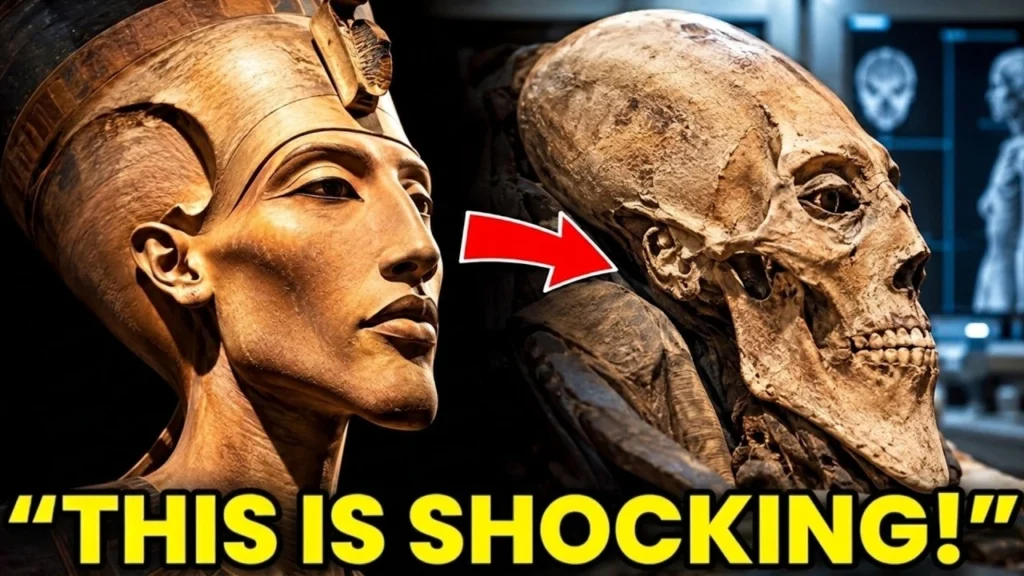
Statues and carvings of Akhenaten don’t look like anything Egypt made before him or after.
He has a long, narrow face, a thin neck, a heavy jaw, a swollen belly, wide hips, and what look like breasts.
The giant statues that once lined the court of the Gem Aten at Karnak show him that way at full scale, as if his body were half male and half female.
Later kings knocked those statues over and simply left them lying where they fell.
Today, people still argue about what those images mean.
One camp says Akhenaten really did look strange and that he suffered from some inherited condition.
The other says the artists were told to show him like that on purpose, as a living picture of the Aten, a god who gave life to every living thing.
But the answer to that question was never going to come out of the statues.
It was sitting in a set of bones.
Akhenaten ruled for about 17 years.
Wine jar labels found at Amarna carry dates up to his 17th year and then they stop.
He died around 1,336 BC.
And then he started to disappear.
That sounds impossible for a pharaoh, but that’s exactly what happened.
Within a generation, Egypt was walking away from everything he had built.
The boy who took the throne after him, Tutankhaten, changed his name to Tutankhamun, putting Amun right back where Akhenaten had cut him out.
Amarna emptied and over time its stone was carted away and reused.
The pharaoh Horemheb pulled down the Gem Aten and the other sun temples at Karnak and stuffed their blocks inside his own gateways as fill.
Later, Ramesses II packed more of them into a gateway at Luxor.
The paperwork followed the buildings.
Seti I had Akhenaten left off the official lists of kings, so that the line jumped straight over him as if he had never ruled.
When officials had to mention him at all, they didn’t use his name.
They called him the enemy or that criminal, and it worked.
For thousands of years, almost nothing was known about him.
He only came back into view in the late 19th century when Amarna was rediscovered.
Around 1,887, local villagers digging in the ruins started pulling out clay tablets and selling them on the antiquities market.
They were diplomatic letters sent to Akhenaten and his father by foreign kings and governors, written in cuneiform, and 382 of those tablets are known today.
Some of them aren’t flattering.
Tushratta, the king of Mitanni, complained that Akhenaten had sent him statues of wood plated with gold when his father had promised solid gold.
“You have sent plated ones of wood,” he wrote.
Once historians knew he had existed, ruled, and died as king, one question wouldn’t go away.
Where was his body? In the winter of 1907, a rich American named Theodore Davis was paying for excavations in the Valley of the Kings.
Davis wasn’t a scholar.
He was a wealthy collector who funded tomb hunting for the thrill of the find, and his team worked in a narrow ravine packed with royal tombs, some robbed in ancient times, others still hidden under the rubble.
On 6 January, his archaeologist Edward Ayrton found the entrance to a new tomb.
Three days later, Ayrton went in together with Davis, Joseph Lindon Smith, and Arthur Weigall.
Today, the tomb is known by its catalog number KV 55.
It was small, far plainer than anything you’d expect for royalty, and it was in terrible shape.
Water had worked its way in over the centuries, and the damp had rotted much of what was inside.
But what survived was strange enough to keep people arguing for the next 100 years.
The first thing that caught their eye was a big gilded wooden shrine.
Its inscription said Akhenaten had made it for his mother, Queen Tiye, but somebody had gone over the text and erased Akhenaten’s names, carving in his father’s names instead.
Davis was convinced he had found Tiye herself, and he even published the tomb as the tomb of Queen Tiye.
Then there was the coffin.
It was gilded and inlaid, clearly made for someone of very high rank, and its face had been deliberately destroyed along with the royal name on it.
For an Egyptian, that was a terrible thing to do to the dead.
The face and the name were how the dead person stayed themselves in the afterlife.
So, wiping them out was a way to erase that person from the world of the dead as well as the world of the living.
Next to the coffin stood four canopic jars, the containers for the dead person’s organs.
They had been made for a woman named Kiya, one of Akhenaten’s secondary wives, and their inscriptions had been scrubbed off, too.
Somebody had even added little royal cobras to the lids, as if to turn them into a king’s jars.
And then there were the four magical bricks set around the room for protection.
Two of them still carried the name Neferkheperure, one of the names Akhenaten ruled under.
It was one of the only direct clues linking this room to the king Egypt had worked so hard to forget.
And lying in the coffin was a body.
The skull had come away from the rest of the skeleton, and a vulture pectoral, a royal ornament made to sit on the chest, had been wrapped around it.
The bones were dark and brittle, and parts of them crumbled as they were lifted out.
But [snorts] there was enough left to try to work out who had been buried there.
And that’s when the confusion started.
The early guess was a woman, which fit Davis’s idea that he’d found Queen Tiye.
That didn’t survive the first proper examination.
That same year, the anatomist Grafton Elliot Smith looked at the bones and said they belonged to a man, and a young one, about 25.
Later, Douglas Derry and Ronald Harrison came up with 25 or 26.
Joyce Filer, examining the bones in the early 2000s, put him in his early 20s.
That’s where the trouble starts.
Akhenaten ruled for about 17 years and came to the throne as an adult, so he should have been well into his 30s when he died.
A man of 25 is far too young.
So, a different name went on the table.
In 1931, the Egyptologist Rex Engelbach suggested the bones belonged to Smenkhkare, one of the most mysterious figures of the whole period.
He seems to have ruled very briefly, somewhere between Akhenaten and Tutankhamun.
And so little is known about him that historians still argue over who he was, whether he ever ruled on his own, and how he fit into the family.
The argument dragged on for decades.
The skeleton was measured, photographed, and measured again.
Some experts said Akhenaten, others said Smenkhkare.
John Harris put the age closer to 35 in the late 1980s, and others pushed it back down toward 20.
The studies kept coming out with opposite answers.
While that argument went round in circles, a second one was running right next to it, about Akhenaten’s body.
His statues look so unusual that in the 20th century, doctors started diagnosing him from the artwork.
Elliot Smith himself floated a hormone disorder called Froehlich’s syndrome.
Others suggested Marfan syndrome, a condition that stretches the limbs and changes the proportions of the body.
Others pointed to Klinefelter syndrome, where a man can develop female features, or to a tumor on the pituitary gland.
They all shared one weakness.
They were built on carvings, not on a body, and Egyptian royal art was never a photograph.
Pharaohs were shown the way they wanted to be seen.
When CT scans were finally run on the royal mummies of that family, none of those diagnoses held up.
The scans found no sign of Marfan syndrome and no inherited disease that could explain the way Akhenaten was drawn.
So, most Egyptologists settled on the other answer.
The king had chosen that look on purpose to show himself as something that joined male and female like the god he served.
Even so, the bigger question was still open.
Who was buried in KV 55? The way to find out ran through the family.
Historians had long suspected that Akhenaten had fathered one of the most famous kings in history.
If the nameless skeleton really was Akhenaten, then the DNA should show a direct line between him and that boy.
That boy was Tutankhamun.
In November 1922, the British archaeologist Howard Carter, working for Lord Carnarvon, found his tomb in the same valley, almost untouched since the day it was sealed.
The gold mask, the shrines, the chariots, and the thrones made headlines all over the world.
And when Carnarvon died a few months later, the newspapers had their curse of the pharaoh.
People still repeat that legend.
But the king himself was far more interesting than the curse.
Tutankhamun came to the throne at around eight or nine and died at about 19.
In November 1925, the anatomist Douglas Derry spent nine days examining the body and put his age at 18.
A CT scan in 2005 refined that to 19, found a small cleft palate, and spotted a break in the left leg that nobody had noticed before.
Later work found that his left foot was clubbed and that part of the bone in it had died, with new bone growing around the damage, which means he lived with it.
His tomb held about 130 walking sticks, whole or in pieces.
Some researchers think he needed them to get around.
Others think a king’s staff was a symbol of rank and point out that his sandals are worn evenly on both feet.
And the DNA found in his body, the parasite behind the deadliest form of malaria, Plasmodium falciparum, and showed he’d been infected more than once.
So, why was a young king with the best doctors and the best food in Egypt in such poor shape? Was it bad luck, or did the cause lie inside his own family? The answer came from a lab.
In February 2010, a team led by Zahi Hawass published its results in the Journal of the American Medical Association.
The DNA work was run by Yehia Gad and Somaia Ismail.
The scans by Ashraf Saleem and Sahar Saleem, with outside help from geneticists including Carsten Pusch and Albert Zink.
They built two DNA labs for the job, one in the basement of the Egyptian Museum in Cairo and one at Cairo University’s Medical School.
Getting DNA out of a body more than 3,000 years old is brutally hard.
Heat breaks genetic material down.
The resins and oils the embalmers poured over the bodies damage it further.
And centuries of damp keep chewing it into smaller and smaller pieces.
On top of that, everyone who ever handled a mummy with bare hands left their own DNA behind.
So, the team took samples from deep inside the bones where contamination was least likely.
Tutankhamun’s first extracts came out a murky black and it took six months of cleaning before they had something they could use.
They tested 11 royal mummies.
The Y chromosome linked three of them in an unbroken male line, Amenhotep III, the man from KV 55, and Tutankhamun.
Then they compared eight stretches of DNA that vary from person to person.
Crime labs normally use about 10.
The result put the odds at better than 99.
99% that Amenhotep III was the father of the KV55 man, and that the KV55 man was the father of Tutankhamun.
The same tests showed that the KV55 man’s mother was Queen Tiye, whose mummy they identified at the same time.
Her hair had already been matched to a lock of hair that was buried in Tutankhamun’s tomb.
So, the boy king had been laid to rest with something of his grandmother.
And the new CT scans changed his age.
His spine showed wear, and his knees showed arthritis, which pointed to a man closer to 40 than 25.
Put that next to the bricks with his name, the reworked coffin, and the erased inscriptions, and the team called it almost certain.
The man in KV55 was most probably Akhenaten, but the genetics weren’t done.
In another royal tomb, lay a mummy known only as the Younger Lady, a woman whose face had been badly smashed, and for a long time nobody knew who she was.
The DNA showed she was Tutankhamun’s mother.
It also showed something else.
She was a daughter of Amenhotep III and Queen Tiye, which made her the full sister of the man in KV55.
Tutankhamun’s mother and father were brother and sister.
To us, that’s shocking.
To an Egyptian royal family, it was something close to policy.
The king was a living god, and his blood was sacred.
Letting an outsider into that line meant diluting it, and marriage between brother and sister was one way to keep it pure.
The gods themselves had done it.
Osiris and Isis were brother and sister as well as husband and wife, and the pharaohs were following their example.
This was a system that ran for generations, and to the people inside it, it looked like the only right way to live.
The trouble is what it does to children.
When close relatives have children, the chances go up sharply that a child gets two copies of the same harmful gene, one from each parent.
Hawass put it bluntly in National Geographic.
In this case, he wrote, “It planted the seed of their son’s early death”.
That doesn’t mean everyone of Tutankhamun’s problems came from his parents.
Malaria has nothing to do with who your mother and father were, and some of his supposed conditions are still argued over.
But, the overall picture is grim.
A young king with a damaged foot, a weak frame, and repeated malaria turns out to be the son of a brother and sister from a family where those marriages ran back generation after generation.
And here’s the detail that makes it more disturbing.
Akhenaten’s own daughters are part of this story, too.
He had six daughters with Nefertiti, and a seventh with Kiya.
Two little girls called Meritaten Tasherit and Ankhesenpaaten Tasherit.
Meritaten the younger and Ankhesenpaaten the younger show up in the record, and they’re usually taken to be the children of two of those princesses.
Who fathered them is a matter of real debate.
Akhenaten himself is one of the names put forward.
Others point to the short-lived king Smenkhkare, or argue the girls never existed at all, and that their names were carved over texts that once named Kiya’s daughter.
Nobody can prove it either way.
In the royal tomb at Amarna, there’s a scene of Akhenaten and Nefertiti weeping over the body of a young woman, possibly their daughter Meketaten, while a nurse holds a baby nearby.
Meketaten died around the 14th year of the reign, most likely in a plague that swept through the family.
Ankhesenpaaten is the one we can follow.
As a teenager, she married her half-brother Tutankhaten, and the two of them changed their names to honor Amun again.
She became Ankhesenamun.
They had no surviving children.
In Tutankhamun’s treasury, Carter found two tiny coffin sets covered in gold, each holding a baby girl.
Derry estimated one at no more than five months of pregnancy and the other at about seven.
A CT scan in 2008 put them at about 25 and 37 weeks.
DNA showed both were very likely Tutankhamun’s daughters and their mother was probably Ankh-es-en-amun, though that part isn’t confirmed.
Neither of them ever took a breath.
So, it happened again.
A brother and sister born into a family that had married inward for generations tried to produce an heir and both children died before birth.
When Tutankhamun died, there was no son to follow him and Hittite records preserve what may be his widow’s own words.
An Egyptian queen, most often identified as Ankh-es-en-amun, wrote to the Hittite king Suppiluliuma.
“My husband died.
A son I have not”.
She asked for one of his sons to marry and wrote that she would never pick a servant of hers to be her husband.
The prince, Zananza, was sent.
He never made it past the Egyptian border.
The new king, Ay, denied that Egypt had murdered him.
The Hittites attacked Egyptian towns in Syria and the sick prisoners they brought home started an epidemic that killed Suppiluliuma himself.
With Tutankhamun and his two daughters, one of the most famous royal families in history and one of the saddest came to an end.
The DNA also changed the old argument about Akhenaten’s looks.
He may well have had some unusual features that ran in the family and his artists may have pushed them much further to turn his body into a religious statement, but nobody can settle it completely because there’s still no body that every expert accepts as his.
The 2010 study showed that the man in KV45 was Tutankhamun’s father with very high odds.
It didn’t convince everyone that he was Akhenaten.
In June 2010, the researcher Erline Lorenzen challenged it in a letter to the same journal.
And other scholars disputed the identification, too.
The age is still the sticking point.
The CT scans said 35 to 45.
Eugene Strouhal, who examined the bones in 1998, argued for a much younger man.
And the DNA of Tutankhamun’s two baby girls threw up a fresh problem because it suggests the KV55 man cannot be their mother’s father.
That’s why some researchers, like Juan Belmonte, still lean towards Smenkhkare.
Even the 2010 team admitted Smenkhkare can’t be completely ruled out.
So, almost every clue points at one man, but nobody can quite close the file.
There’s an irony buried in all of this.
Egypt tried to wipe Akhenaten out about as thoroughly as it could.
His temples at Karnak were pulled down block by block.
And those small talatat blocks from the start of this story were packed inside the gateways of the kings who hated him.
That’s exactly what saved them.
Shut away inside the stone, tens of thousands of blocks survived, many still carrying his carved and painted scenes.
Archaeologists have been pulling them out, photographing them, and fitting the pictures back together piece by piece.
The walls that were built to bury him ended up keeping his face.
So, the coffin from 1907 still has no face, and the name on it is still scratched away.
But the bones inside it gave up the family’s secret anyway.
A king who made himself the only voice of his god, and a royal line that married brother to sister until it ran out of children.
Maybe that man really was Akhenaten.
Or maybe the last answer is still lying somewhere among the royal mummies waiting for the next test.
I’m Ambrose Wild, and if stories like this one are your kind of history, there are plenty more ancient mysteries where the bones tell the truth, and I’ll keep bringing them to you.


