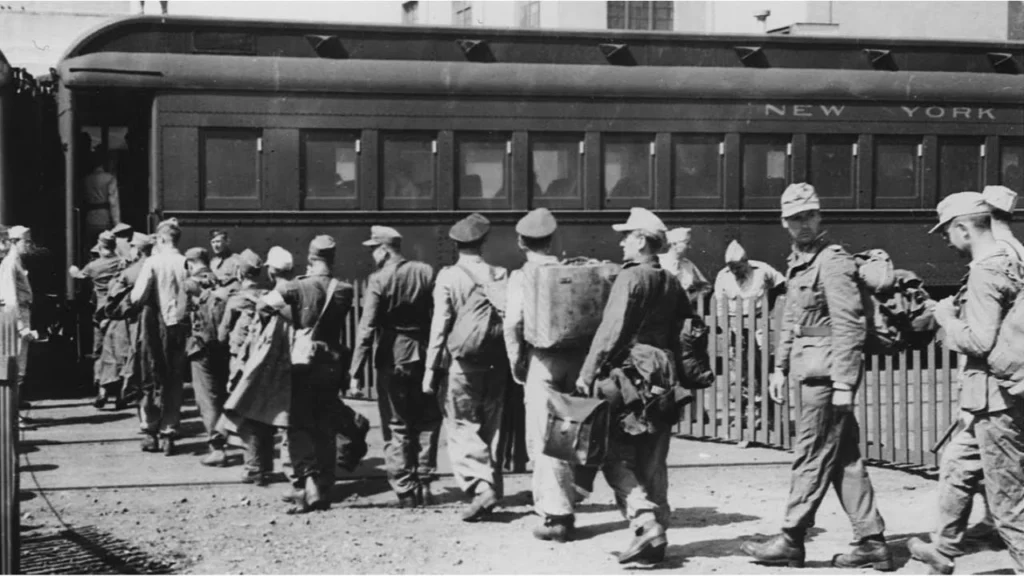
And in the middle was the vast majority, perhaps 8…
And in the middle was the vast majority, perhaps 80% of the total population, the grays.
This was the average German soldier.
He was not a political fanatic, but he wasn’t an active anti-Nazi either.
He was a product of his time, shaped by years of propaganda, bound by a soldier’s oath and loyalty to his comrades.
He was tired, disillusioned, and above all, wanted to survive the war and go home.
The Americans realized this group, the undecided, wavering middle, was the true ideological battleground.
The plan was put into motion with military precision.
Across the country, the blacks were quietly pulled from the general population, often in pre-dawn raids.
They were put on trains and shipped to a handful of special highsecurity facilities.
Camp Alva, Oklahoma, became the primary destination for the most hardened Nazis.
Surrounded by extra layers of barbed wire and guards, it became a prison for the ideologically incurable.
A place where Germany’s most fervent fanatics could be isolated from the men they sought to control.
The whites, meanwhile, were gathered in their own protected camps, like Camp Rustin, Louisiana, safe from retaliation.
With the blacks and whites removed, the atmosphere in the dozens of remaining gray camps began to change.
The constant suffocating fear dissipated.
The shadow government was broken.
For the first time, the average German prisoner could speak, read, and think without looking over his shoulder.
The Americans had surgically removed the cancer.
And now, in the sterile environment they had created, they would see what might grow in its place.
In the newly reconfigured gray camps, the primary enemy was no longer a Nazi enforcer.
It was a more insidious foe, profound, soulc crushing boredom.
The days were long, the work was seasonal, and the future was a blank wall.
The American camp commandants, now free to act without the threat of internal Nazi disruption, embraced a new permissive strategy.
They would not force a new ideology on the prisoners.
They would simply create an environment where the prisoners could build something for themselves.
And they did.
Eager to combat the monotony, the Germans began to organize.
Using the script they earned from their labor, they bought musical instruments from Sears robot cataloges or received them from the YMCA.
Soon camp orchestras were formed.
Their renditions of Beethoven and Brahms drifting over the Alabama pines and Texas plains.
Theater troops staged elaborate productions of Gerta and Schiller, building their own sets and sewing their own costumes.
Art studios flourished with prisoners painting landscapes of their strange new surroundings.
More significantly, they began to publish their own newspapers.
At Camp Hearn, Texas, a paper called Dpiegel, the mirror appeared.
At Fort Deans, Massachusetts, it was Debbuka, the bridge.
The most famous Deer Roof, the call was published out of Fort Kernney, Rhode Island.
At first, they were simple camp newsletters filled with sports scores and announcements.
But slowly, carefully, they began to feature essays, poetry, and debates about Germany’s future.
But the most remarkable development was the spontaneous creation of camp universities.
Among the prisoners were hundreds of Germany’s educated elite, engineers, scientists, lawyers, and university professors.
With nothing but time on their hands, they began to teach.
In mess halls and recreation rooms, they drew complex equations on chalkboards and lectured to classrooms of their fellow soldiers.
The curriculum was vast and ambitious.
Prisoners could study advanced mathematics, physics, chemistry, and engineering.
But the most popular courses were more practical.
English language classes filled up instantly.
And then there were the more subtle subjects.
courses on American history, the US Constitution, and civics, often taught by German prisoners who held doctorates in the very same fields.
From the outside, it looked like a brilliant decentralized stroke of genius by the American camp commanders.
By simply providing the space, the books often donated by American universities, and the hands-off attitude, they had turned idle hands into active minds.
From the prisoners’s perspective, [snorts] it was a triumph of German organization and intellect, a way to better themselves and prepare for life after the war.
They were taking control of their own destinies.
By encouraging this intellectual and cultural rebirth, the Americans were subtly winning the war for the minds of the gray majority.
This was not re-education through force, but transformation through self-discovery.
But this blossoming of culture and learning was not a series of isolated fortunate accidents.
It was not simply the result of a few clever commandons finding a way to keep their prisoners busy.
unknown to the prisoners, unknown to the American public, and even unknown to most of the camp guards themselves.
This entire effort, the segregation of the quote unquote blacks, the encouragement of camp newspapers, the careful selection of university textbooks, was part of a much larger and far more secret design.
The whole enterprise was being meticulously guided by a small clandestine group in Washington.
A group with a goal that went far beyond simply managing prisoners of war.
This intellectual flowering was not a happy accident.
The camp orchestras, the university classes, the lively debates, none of it was spontaneous.
It was the result of a deliberate, secret, and breathtakingly ambitious psychological warfare program run from a small, unassuming office in Washington, DC.
This was the work of the Special Projects Division, a clandestine unit within the Provost Marshall General’s Office.
Its architects were not career soldiers.
They were a hand-picked team of Ivy League academics, sociologists, and most importantly, German-born intellectuals who had fled the rise of Nazism.
Men who understood the German psyche better than any American general.
Their leader, Major Maxwell S.
Mcnite, a Cornell educated lawyer, was given a mission that went far beyond simply managing prisoners.
His objective was to use the P camps as a laboratory to identify and cultivate a select group of prisoners who could become the future democratic leaders of a post Hitler Germany.
The operation was a masterclass in subtlety.
The division understood that overt propaganda would fail.
Instead, they waged a war of ideas by controlling the intellectual environment.
They took charge of the books being sent to the camps.
Shipments from the YMCA and American universities were secretly vetted.
Books by Nazi authors and philosophers were quietly removed.
In their place, the division inserted the works of German writers banned by the Third Reich, Thomas Man, Stefan Zvig, Eric Maria Remark.
They added American authors like Ernest Hemingway and John Steinbeck.
and most strategically simple clear books on the US Constitution and the principles of American democracy.
A German soldier looking for something to read would find not mine comp but a copy of of mice and men.
Their most sophisticated tool was the camp newspaper.
The division secretly funded and orchestrated the creation of derof the call.
They identified talented anti-Nazi prisoners like Alfred Andersh and Hans Verer Richter and gave them the resources to publish.
To the average prisoner, Deruf was a paper written by their own comrades.
It discussed literature, art, and the future of Germany.
But every article was carefully crafted to promote democratic ideals, individualism, and personal responsibility.
It was a Trojan horse delivering a new political philosophy wrapped in the familiar guise of German culture.
The humane treatment and abundance of food had cracked the foundation of Nazi ideology.
The special projects division was now systematically dismantling the rest of the structure brick by brick with ideas.
This intellectual war was waged quietly with books and newspapers, slowly eroding the certainties the prisoners had carried with them.
across the Atlantic.
But in the spring of 1945, as the Third Reich collapsed in a storm of fire and steel across Europe, the men of the Special Projects Division knew the time for subtlety was over.
The intellectual groundwork had been laid.
It was now time to deploy their most powerful and most shocking tool of persuasion.
On May 8th, 1945, the Teletypes clattered with the news they had all been waiting for.
The war in Europe was over.
A strange complex quiet fell over the camps.
For the German prisoners, it was a moment of profound relief mixed with anxiety and a deep, weary exhaustion.
The intellectual debates in the camp newspapers subsided.
The university classes began to wind down.
The future, once a distant abstraction, was now imminent.
They had survived.
Soon they would go home.
But in the days that followed, the expected orders to pack did not come.
Instead, a new cryptic directive was posted on every camp bulletin board.
All prisoners, without exception, were to report to the camp assembly hall or movie theater at a designated time.
Attendance was mandatory.
The men filed in shuffling with a mixture of curiosity and unease.
They were veterans, and they knew an order this unusual meant something significant.
They took their seats on hard wooden benches, the air thick with anticipation.
The doors were closed, the lights went down.
The projector in the back of the room began to wor its beam cutting through the darkness.
This was not a Hollywood film.
The first images flickered onto the screen.
They were raw, grainy, and unsteady.
There was no musical score, only the ambient sounds of the recording, the crunch of boots on gravel, distant muffled shouts, the hum of machinery.
The footage was from places they had only heard of in Allied radio broadcasts, names they had dismissed as enemy propaganda.
Binvald, Dau, Bergen, Bellson.
The first reaction was a low murmur of denial rippling through the hall.
Felong fake propaganda.
It had to be.
These were actors, they whispered.
These were staged scenes, clever tricks from the masters of Hollywood.
They had been warned this would happen.
But the film kept rolling.
An American bulldozer, its engine groaning, pushed a mountain not of earth, but of emaciated skeletal bodies into a vast pit.
The camera lingered on German civilians forced by Allied commanders to walk through the camps, their faces masks of horror and disbelief.
It showed American GIS, hardened combat troops turning away to vomit.
And then came the evidence that could not be faked.
The endless piles of personal effects.
Mountains of shoes from men’s heavy work boots to a single tiny child’s sandal.
A hill of eyeglasses, their lenses glinting in the pale light.
Bales of human hair shorn from the heads of the condemned, and the ovens, their iron doors hanging open, silently testifying to their function.
The whispers in the hall died.
The denial faltered, then collapsed into a profound, suffocating silence.
The only sounds were the worring of the projector and the ragged breathing of a thousand men in the dark.
Then the silence was broken, not by a shout, but by a choked guttural heave from the back of the room.
The sound of a man being violently sick.
Another followed.
Soon the sound was punctuated by the open, unrestrained weeping of men who had endured Stalenrad and Elamagne without shedding a tear.
Hardened NCOs, men who had maintained their discipline through years of captivity, now sat with their faces in their hands, their bodies shaking with sobs.
For thousands of these soldiers, this was not just a film.
It was the moment of final irreversible collapse.
Every pillar of their worldview, the righteousness of their cause, the nobility of their leaders, the superiority of their ideology was pulverized in the space of 30 minutes.
The abundance of the PX had made them doubt.
The books and debates had made them think, but this this raw, undeniable truth obliterated everything.
The war for Europe had ended on a battlefield.
For these men, the war for their souls ended here.
In a darkened room thousands of miles from home, the foundation of their identity was gone, replaced by a terrible, burning question.
It was no longer about what they had fought for.
It was about what they had been fighting to protect.
The journey home began in 1946.
The same Liberty ships that had carried them west now prepared to ferry them east, back to a world they no longer recognized.
On a pier in Newport News, Virginia, the corporal who had arrived in Alabama 3 years earlier, stood waiting to board.
He was no longer the defiant soldier of the Africa Corps.
He was a changed man.
In his foot locker, he carried not just worn uniforms and a few books, but the heavy conflicting memories of his time in America, the memory of a hot meal with meat, the taste of a Coca-Cola, the crack of a baseball bat in a nearby town, and the indelible searing images from a darkened theater, the mountains of shoes, the open doors of the ovens.
He, like nearly 400,000 others, was returning to a country in ruins, carrying the knowledge that the lies he had been told were far greater than he could have ever imagined.
His story was not an accident.
It was the intended result of a quiet, audacious experiment.
The secret re-education program, a psychological campaign waged with books, newspapers, and carefully managed truths, proved to be a stunning, unheralded success.
What had begun as a desperate attempt to solve a logistical crisis had ended as one of the most effective instruments of post-war policy.
The men that the special projects division had identified and cultivated, the grays who had been separated from the hardline blacks and given the tools for self-discovery, returned to a shattered Germany.
But they did not return as defeated soldiers.
They returned as a new political class.
Alfred Andersh and Hans Verer Richter, the prisoner editors of the camp newspaper Deruf, would go on to found group 47, the most important literary movement in post-war Germany.
Hundreds of others whose names are lost to history became mayors of rebuilt towns, publishers of new democratic newspapers, union leaders, and entrepreneurs.
They were the seeds of a new society planted in the unlikely soil of American prison camps.
They became the architects and administrators of the new democratic West Germany.
The very nation that in a turn of history no one could have predicted in 1943 would become the bedrock of the western alliance.
A bullwark against the Soviet Union in the long cold war to come.
The United States had set out to warehouse an enemy army.
It ended up forging a new generation of leaders for its future ally.
America’s most effective weapon against the Third Reich was one it never fired.
An idea planted in the minds of its captured enemies.


