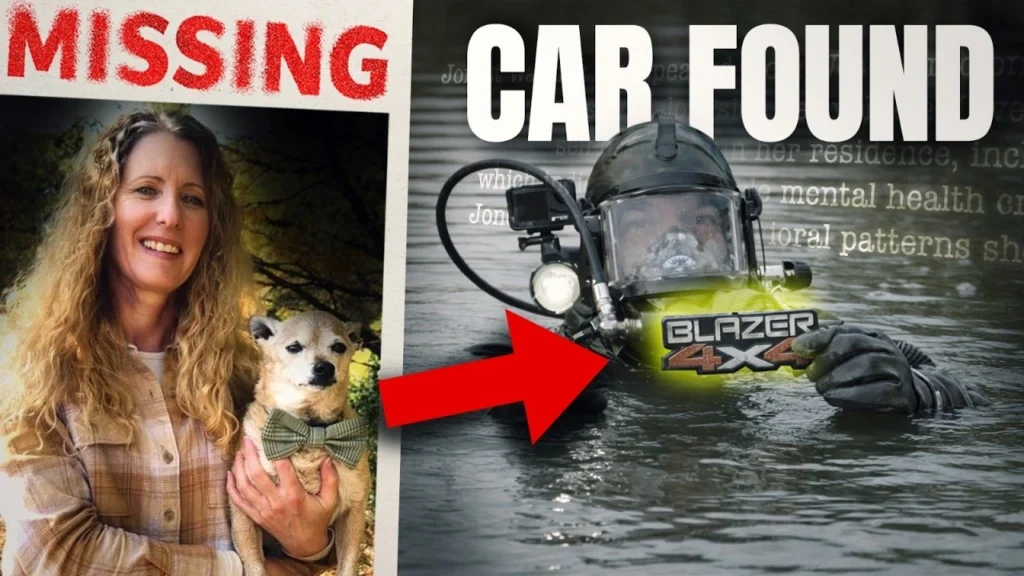
Missing: She Vanished With Her Dog, and Two Years Later, Her Twin Is Still Searching
The sonar image rose out of the murky water of the Red River: two tires, an axle, the outline of a vehicle lying upside down on the bottom. “That’s a vehicle,” Jared said. “That is 100 percent a vehicle.”
For a moment, everyone on the boat believed the search for Jonette was over.
A Woman and Her Dog
Jonette lived in a quiet subdivision in West Fargo, North Dakota. When she disappeared, she took her dog, Scooby, and her silver Nissan Rogue. West Fargo police and her family asked the public for help, and her loved ones spent weeks driving around, checking parking lots and searching for her car. Her twin sister, Janelle, never stopped looking.
Two years later, Jared and Cade of the search group Adventure With a Purpose came to West Fargo, working alongside a local searcher named Bill, to look for Jonette and her car in the water.
Before starting any search, Jared tries to understand a person’s patterns. In Jonette’s case, what her sister found inside the home was troubling. There were signs in the bathroom that Jonette may have been hurting herself, along with towels left in the bathtub with water in it and a Bible lying open nearby. She had also recently been upset with her church.
There was another important clue. According to her sister, Jonette only ever left her phone at home when she was going to the park. She always took her purse and phone to the store. This time, she left both her phone and her purse behind. She took only her wallet, and Scooby.
To Jared, that pattern ruled out many typical accident scenarios. Whatever she was doing, it seemed like something quick, and something that involved her dog. Still, the team started where they always do: at “ground zero,” near her home.
The Ponds Near Home
The first pond in her subdivision was more than six feet deep, enough to hide a car. The team moved on to Lynnwood Park, one of the places Jonette liked to walk, and to a river access point to the northwest. There, the sonar caught something interesting in nearly 13 feet of water: a squarish object on the bottom. Jared was excited at first. “I think I have a car in here,” he said. But on a second pass, the object was only about three feet wide. It was a tree. Jared refused to leave until he had scanned it again, and it was the same: a tree.
The river access was only four feet deep. A pond at Riverside Park was about seven feet deep, but the bottom was clean all the way to the grass. The high school pond, the closest to Jonette’s house, was only three to four feet deep throughout. If she had a medical emergency near home, that was where she might have ended up, but the water was too shallow to hide a car.
As evening fell, the team stopped for dinner and made a plan. The next day they would finish the remaining ponds near her home, check a section with a broken fence, and then move to the boat ramps farther north.
The Second Morning
They started at about 8:30 the next morning. The first pond, just five or six houses from Jonette’s home, was about six feet deep. Jared explained the sonar display: they were roughly 54 feet from the bank, scanning 75 feet in each direction. He was hoping for a case like Jan Shoop, a woman his team found in just six and a half feet of water in a Florida subdivision pond. Similar neighborhoods across the country have produced similar discoveries.
Suddenly, something appeared just inches below the surface. “What is that?” Nothing should have been there. Up close, it looked like a tree tangled in rocks. They scanned again from the shore side, and the boat practically sat on top of the object. Jared threw a magnet on it to be sure. It was a hollow concrete drainage pipe, surrounded by trees and debris, just a foot below the surface. “That’s a perfect example,” Jared said. Something only 12 inches underwater can be completely invisible.
They worked the rest of the ponds in the subdivision. One was 8.8 feet deep in places, but its drainage areas were set far back from the roads, designed so that a car would have to work hard to get into them. The corners near the houses were hard to reach, and the houses had always been there. Another was only five feet deep at its deepest. A pond behind a hair salon looked promising at six to seven feet deep, but the scan showed nothing.
By 10:30, they had cleared four or five ponds in about two hours.
The Church and the River
Jared and Bill stopped to think. The fenced section was out of the question, because the damage to the fence was bent the wrong way for a car to have gone through. And two bodies of water near Jonette’s church kept coming back to them. She had been upset with the church. She had a Bible open in the bathroom. Churches had played a role in other cases they had worked.
Near the church, they found a boat ramp right on the route between her house and the church, an easy place to drive into, and a spot Jonette would have known from her walks. The water dropped to 17 feet within about ten feet in one area nearby. But at the ramp itself, the sonar ball read about five feet. If her car were there, it would be right in front of them and impossible to miss. It wasn’t.
That left a bigger question. Where was Jonette’s special spot? She had been walking at Lynnwood Park, but she seemed to be exploring farther north, to parks outside her usual five-mile area. She didn’t go to dog parks. She loved the river and the trees.
The team considered two possibilities. If it was a medical emergency, the farther parks made no sense, because they were too far from help. But the evidence in the bathroom, the fact that she left her purse and phone behind, and that she took only her wallet, pointed to something else. Jared had seen that pattern before: people in crisis sometimes take only their most important documents and leave everything else behind. The team set aside the accident theory and turned to the boat ramps up north.
A Car in the Red River
At the south boat ramp at Island Park, the water quickly reached 14 feet. The sonar picked up what looked like a dock, about the length of a car. Then another shape appeared, farther upstream than Jared would have expected, in the current of the river.
“That almost looks like a car that’s upside down,” he said.
On the live sonar, it was unmistakable. There were tires, an axle, and the outline of a vehicle resting on its roof. It seemed too tall for a regular car but not quite a truck, more like an SUV or crossover. Jonette drove a Nissan Rogue.
The team compared the image with photos of a Rogue. The back windows were much larger than the front ones, just like a Rogue. They could almost make out the small third window at the rear. The wheel placement and the length of the hood matched. So did the sharp, hatchback-style rear. The object measured about 14 feet long, and a Nissan Rogue is about 15.3 feet. “I think the windows is what seals the deal,” someone said. “I think we found her.”
They marked it with a buoy, and Jared suited up to dive.
Underwater, he circled the vehicle again and again. It was stuck deep in the silt. It looked old. The longer he stayed down, the more the people waiting on the boat began to lose hope. If it were Jonette’s car, it should have been easy to identify, with a silver Nissan badge.
When he surfaced, he had the answer. “Not our car. Sorry.”
It was a Chevy Blazer 4×4, probably from the late 1980s or early 1990s. There were no license plates and no emblems he could find. It looked black, but the bottom half, below the trim line, was red all the way around. At first he thought the red might be repair work, and he had planned to ask Janelle about it. But the color went around the whole vehicle. And when he felt along the rear window, there was no center divider. That’s when he knew for certain it wasn’t Jonette’s car.
All the windows were broken out. The driver’s door looked as if it had been partly open. The front was buried in silt and somewhat mangled, and he couldn’t reach the passenger side. He could not confirm whether anyone was inside. He guessed it had been in the river for five to ten years.
How did it get there? Possibly it rolled down the hill and drifted downstream, or someone used an old road nearby, put it in neutral, and let it roll into the river.
The area carried other tragedies, too. Not long before, a 14-year-old girl named Jaylen Walker had been found stabbed to death along the Red River, and her community was still calling for justice.
Calling the Police
Jared got a call from Sergeant Travis Bird of the Fargo Police Department. He explained where the Blazer was, what he had seen, and that he could not clear it of a possible victim. The sergeant said he would contact the police dive team.
Meanwhile, about 100 yards downstream, the sonar picked up another shape, square and about five feet tall. Something red was lying near the bank, and Jared wondered if it might be a memorial for a vehicle. He threw a magnet on it. It wouldn’t stick. There were no windows and no wheels. It was some kind of concrete structure, not a car.
An officer named Tim arrived to take the team’s information for the report. Jared told him the Blazer was certainly a vehicle, because he had put his own hands on it. If police pulled it out that day, the team would love to watch. If not, they would already be gone. They still had more locations to check.
The Last Ramps
At MB Johnson Park, on the Minnesota side of the river, the banks were steep, and Jared warned that most of it was only about five and a half feet deep. Near a bend, the water got deeper, and something appeared under the surface. For a moment, Jared thought he might have another vehicle. “Nissan Rogue, I hope so.” He scanned it from different angles. It was only the shape of the bank.
The final stop was Trefoil Park, a newer park on the North Dakota side with a steep boat ramp near the falls. Jared wondered if this was the new place Jonette had been going without telling her sister. But the water there was only two and a half to three feet deep. Jared had hoped for a deep hole below the falls. There wasn’t one.
Later, news reports confirmed that the Blazer pulled from the Red River was not connected to Jonette’s case. After examining it, police said it appeared to have been in the river for a long time, with no evidence that anyone had been inside. West Fargo police continued investigating her disappearance separately.
Still Searching
“This is a real frustrating case,” Jared admitted. When they arrived, they had truly believed they would find Jonette and Scooby on the first day. On the second day, they moved to the river with renewed hope. But all they found was a decades-old Blazer.
So the team did what it always does when a search ends without answers. They published the video and shared their search map, with every location they checked and Jared’s notes, so others could continue. Some viewers ask why they post unsolved cases. The answer is that unsolved videos have led to solved cases. A local fisherman might notice something with the sonar on his boat. Someone with a sonar ball might check a small pond. Someone flying a drone on a perfect, clear day might spot a car underwater.
Jared asked anyone in the area to use the map, think logically, and send tips about places worth checking, but not to chase every tiny pond that no car could reach. He also asked people with the right equipment to search near Leaf Lake, close to an address where Jonette used to live. Other search teams have looked there before, but, as Jared put it, there’s a saying in this work: a place hasn’t been searched until you’ve searched it yourself.
He admitted that recently, a case he had worked years earlier was solved, and the person was found just a few feet from where he had searched. “If you miss it by an inch, you miss it by a mile,” he said. Every case, he added, teaches them something.
Jonette and her dog, Scooby, are still missing. Her twin sister Janelle, her daughter Amber, and the rest of her family are still waiting and hoping someone can help bring her home.
Anyone with information about Jonette’s disappearance is asked to contact the West Fargo Police Department.