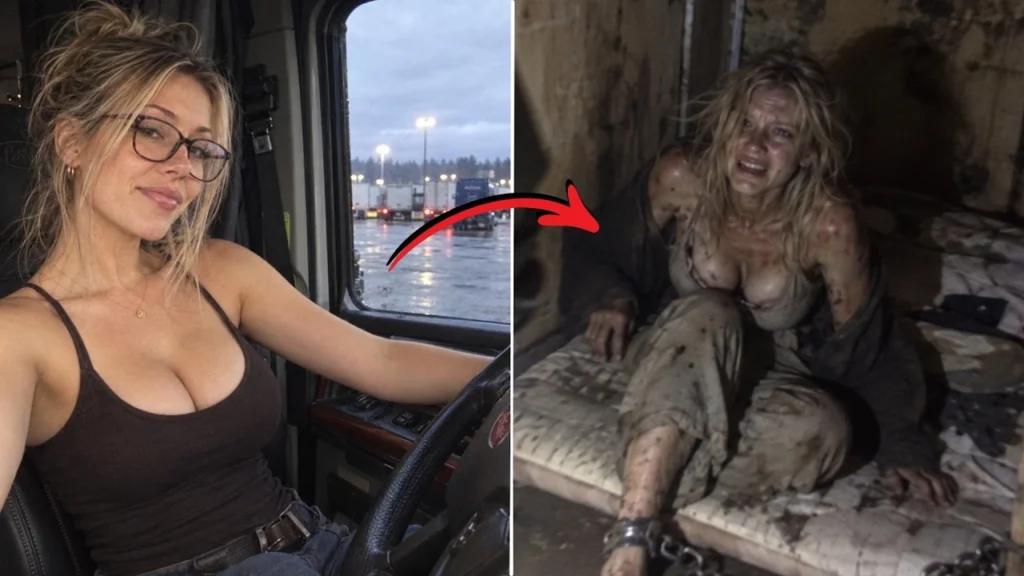
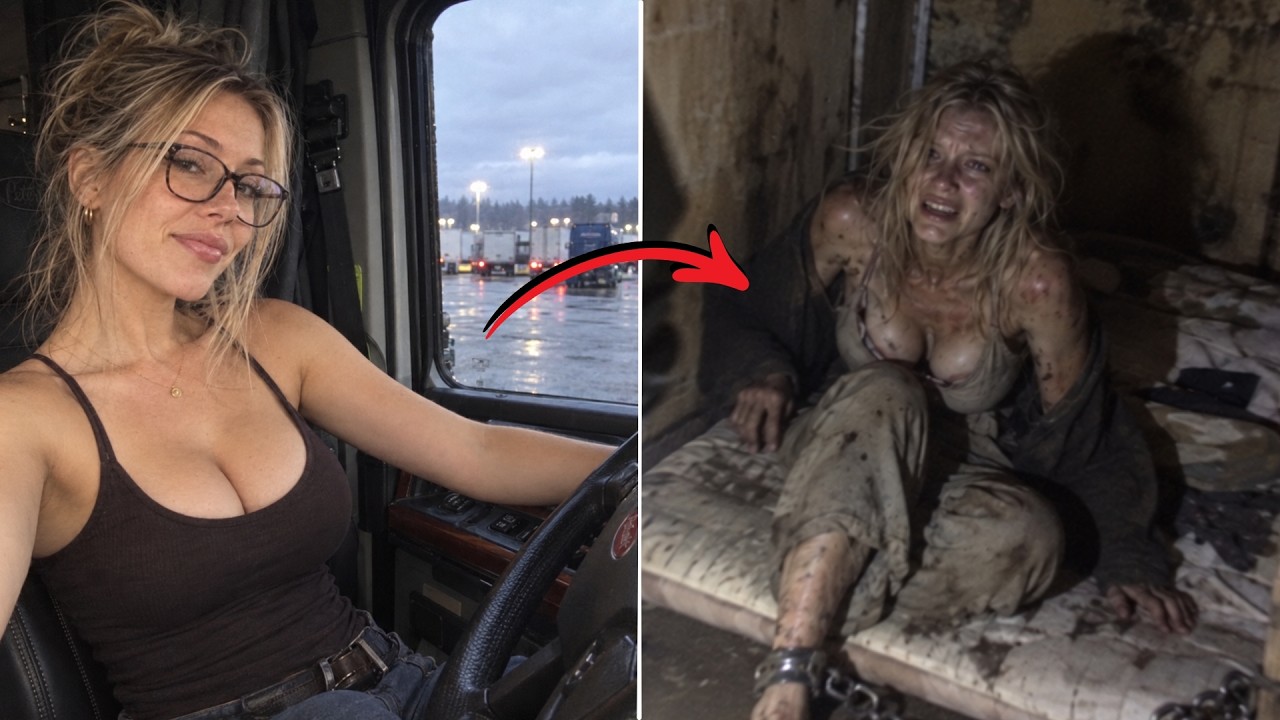
PART 3: THE HORN IN THE DRIVEWAY
“Ask her what she was protecting.”
Agent Lena Park didn’t blink.
“Hands behind your back, Mr. Garrison.”
Neil Garrison turned around without a word.
The cuffs clicked shut.
He didn’t struggle.
He didn’t shout.
On the way down the stairs, he said only one more thing.
“She never told you, did she? About April.”
THE MAN IN THE UNIFORM
Neil Garrison was 47.
A quiet, well-paid systems engineer.
For nine years, he had installed and maintained GPS tracking systems for freight companies up and down the West Coast.
He had access to everything.
Routes.
Schedules.
Rest stops.
Drivers’ home addresses.
Their medical files.
He knew which stretches of highway had no cell signal.
He knew where the cameras didn’t reach.
He knew exactly when every driver was legally required to stop and rest.
That was the first twist.
“Inspector Hale” was never a stranger who happened to find Tara in a parking lot.
He had been inside her truck for months.
Through the tracker.
THE APRIL REPORT
In April 2018, Tara noticed something odd.
Her tracker kept dropping out.
Always on the same stretch of I-5.
Always for about forty minutes.
Most drivers would have shrugged.
Tara wrote it down.
The dates.
The times.
The mile markers.
She sent it to Ray.
Ray forwarded it to the GPS vendor.
It landed on Neil Garrison’s desk.
What Tara didn’t know was that the dropouts weren’t glitches.
They were tests.
Garrison was running a cargo-theft ring.
Forty minutes was exactly how long it took his crews to swap trailers on a dark shoulder.
High-value loads vanished from trucks that seemed to be “temporarily offline.”
The ring laundered its money through a respectable-looking company called Northline Freight Systems.
Investigators later traced at least 37 stolen loads to it.
Over eleven million dollars.
And one driver had noticed the pattern.
Tara.
Her careful notes, with her careful dates, were the most dangerous document in his life.
“She was the only one who wrote it down,” Garrison told agents later. “Everyone else just complained.”
That was why he chose her.
THE NIGHT ON THE SHOULDER
Agents reconstructed October 12th, 2018, minute by minute.
At 7:46 p.m., Garrison remotely killed her tracker.
At 7:50 p.m., he walked up to her rig in Weed in a pressed uniform.
A fake badge.
A fake ID.
A clipboard.
“Thermal scanner at the weigh station flagged your air brakes,” he said. “You’ve got a serious leak.”
Tara had eleven years of safety rules in her bones.
An air-brake leak on a 40-ton load is how people die.
She followed him.
On the dark shoulder, she crawled under her trailer with a flashlight.
The needle went into her neck.
A veterinary sedative.
He’d studied her medical file to get the dose right.
Then he did something very precise.
He climbed into her cab.
He placed her keys, her phone and her logbook on the dashboard in a neat row.
So the scene would look calm.
Voluntary.
Like a woman who simply walked away.
In doing it, he knocked over her coffee.
That was the smell the officers noticed.
He carried her to his truck on the old logging road.
That was where the dog lost the scent.
At 8:20 p.m., he called her dispatcher.
“Satellite outage,” he said calmly. “Should resolve by morning.”
Those twelve hours were everything.
By sunrise, Tara was underground.
THE CARTEL THAT DIDN’T EXIST
Why didn’t he simply kill her?
That was the question that haunted the agents.
The answer came from Garrison’s own files.
He needed to know who else had seen her notes.
Who she had told.
Whether she’d kept copies.
And then he saw something better.
A disciplined, careful driver who knew every route on the West Coast.
Broken properly, she might be useful.
So he built a story.
He told Tara that a ruthless cartel had infiltrated her trucking company.
That they were killing drivers to steal cargo.
That they knew where her father lived.
He brought her printed “news clippings” he’d faked himself.
He played her “intercepted radio traffic” he’d recorded with his own voice.
He told her he was an undercover federal agent.
The only man keeping her alive.
The only man keeping her father alive.
“If you make a sound,” he said, “their scanners will find this place.
And then they’ll go to your dad’s house.”
That was the second twist.
The cartel he warned her about was real.
It was him.
So when Tara whispered, “Turn off the light, he’s listening,” she didn’t only mean Garrison.
She meant the monster he’d made her believe in.
That was why she kept saying, “They’ll find my dad.”
Every day underground, she believed her silence was protecting her father.
“What she was protecting,” Agent Park said later, “was the only thing she had left to love.”
THE COMMAND CENTER
The bunker wasn’t just a prison.
It was his office.
Hidden satellite cables ran up through the roots to antennas in the treetops.
A police scanner monitored every patrol frequency.
Lead-lined compartments hid his drives from scanners.
From that desk, two years in a row, Garrison coordinated nighttime trailer swaps across three states.
Six feet away, Tara lay in the dark.
She heard the generator start.
She heard the keyboard.
She heard him speak into the satellite radio.
Short code phrases.
Shepherd to crew. Window open. Forty minutes.
And she did the only thing she could.
She memorized it.
Every time.
Every phrase.
In the dark, she counted the minutes between the generator starting and stopping.
She counted keystrokes.
She kept a calendar in her head.
Two years of it.
THE WARM MUG
On October 14th, 2020, Garrison was in the bunker when his scanner picked up Nate’s radio call to the county.
He knew the hunters would reach the door before he could drag her out.
So he ran.
He left a warm mug on the desk.
He grabbed one laptop and climbed out through a hidden hatch in the back of the hill.
He watched everything through the camera in the ceiling.
And when the hunters broke in, he made one last attempt to control her.
Through the radio.
“Tara. Who’s with you?”
It almost worked.
THE TRIAL
The trial began in March 2021.
Garrison’s lawyers built a shocking defense.
Tara, they said, had suffered a mental breakdown.
She’d abandoned her truck.
Wandered into the woods.
Found an old military shelter.
Even chained herself.
Garrison sat at the defense table in a tailored suit.
Calm.
Still.
Watching her.
On April 20th, 2021, Tara Quinn took the stand.
She was 34 now.
Thin.
Shaking slightly.
She testified for seven hours.
She described the bunker down to the inch.
The six-foot chain.
The 50-degree cold.
The fake clippings.
The punishments.
Then the prosecutor asked her one question.
“Did you hear him speak on the radio?”
“Yes.”
“Do you remember what he said?”
Tara looked straight at Garrison.
And began to recite.
Phrase after phrase.
Date after date.
Shepherd to crew. Window open. Forty minutes.
The prosecutor put the decrypted logs from his hidden drives on the screen.
They matched.
To the day.
To the minute.
Garrison’s lawyer stopped writing.
For the first time, Garrison looked away from her.
The jury deliberated for less than three hours.
Guilty on all 28 counts.
Life in federal prison.
No parole.
Eleven members of his ring were arrested within the year.
Every one of them was found using the dates Tara carried in her head.
THE PROMISE
It took months before Tara could sleep with the lights off.
Months before she stopped hiding crackers under her pillow.
Months before a ringing radio didn’t make her freeze.
But on October 12th, 2021, at 4:30 p.m., an old man walked into the Pilot Travel Center in Weed, California.
Walt Quinn.
Sixty-three now.
He bought two coffees.
He set one on the counter.
Like every year.
Then the door opened behind him.
“Dad.”
He turned.
Tara stood there in a fleece jacket.
Thin.
Pale.
Smiling.
She picked up the second coffee.
Still hot.
“You kept leaving this for me,” she said.
Walt couldn’t speak.
He just held his daughter in the middle of a truck stop.
And truckers at the counter quietly looked away to give them privacy.
Two days later, on October 14th, at exactly noon, a borrowed Peterbilt rolled slowly up a narrow driveway in Oregon.
Walt was on the porch.
Tara leaned out of the cab.
“Happy birthday, Dad! Three years late!”
Then she pulled the cord.
The air horn blasted across the whole neighborhood.
Long.
Loud.
Glorious.
Somewhere down the street, Mrs. Patterson really did call the police.
Walt laughed until he cried.
Tara climbed down and ran into his arms.
“Noon Sunday,” she said into his shoulder. “Horn and all. I promised.”
She doesn’t drive long-haul anymore.
These days, she teaches safety courses for new truck drivers.
Her first lesson is always the same.
“Write it down,” she tells them. “When something feels wrong, write it down. Dates. Times. Places.
Somebody might need it someday.
It might even be you.”
Sometimes the smallest, most careful habit is what keeps a person alive in the dark.
And sometimes the person who refuses to stop leaving a coffee on the counter is the reason someone has a home to come back to.
If you were Tara, could you have stayed silent for two years believing it would save your family? 💭


