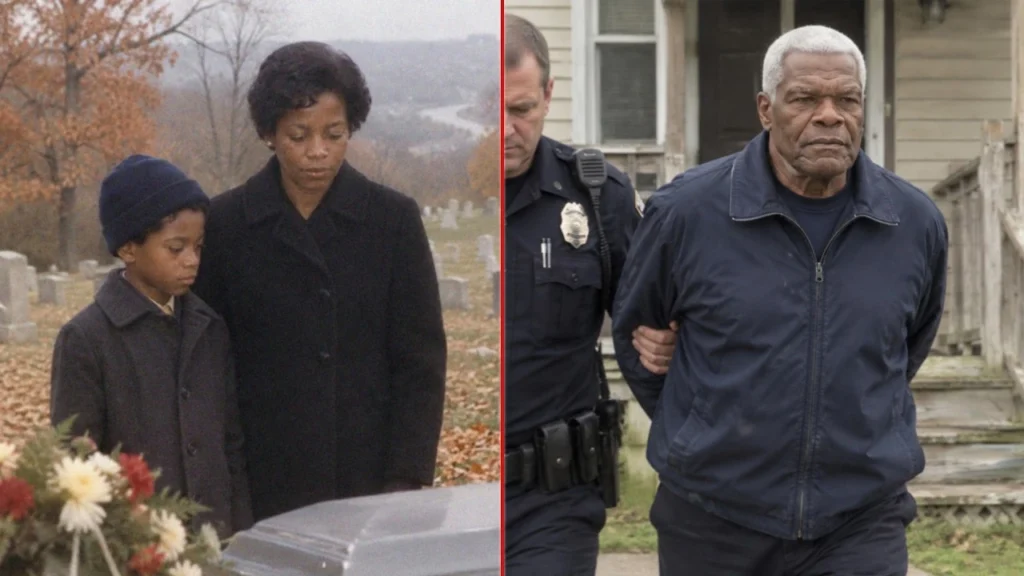
Keystone Lock and Safe Service had been a family c…
Keystone Lock and Safe Service had been a family company with a dozen mechanics, and had been bought by a bigger firm decades ago, and the new owners had thrown out almost everything.
But, the founder’s daughter, now in her 70s, still had boxes in her garage.
When Bramlett told her why he was calling, she was quiet for a moment.
Then, she said her father had kept every mechanic’s route book from the day the company opened until the day he sold it.
Each mechanic carried one in his truck and wrote down every job, every address, and every hour.
She had never had the heart to throw them away.
In 1977, the police had called the company only once, 2 days after the robbery.
The office checked the bank service card, which showed a regular service in March, and the next one planned for April 21st.
Nobody had asked for the mechanic’s own route books.
Those had gone into boxes at the end of the year and stayed there.
Bramlett spent two Saturdays in that garage sitting on a folding chair under a bare light bulb while the founder’s daughter brought him coffee and told him about the men who had worked for her father.
He found the box marked 1977 under a stack of Christmas decorations.
There were 12 route books inside, one for each mechanic.
He read them page by page until he reached Thursday, April 14th.
One entry was written in a small slanted hand.
Wylie Avenue branch, time lock moved up per customer request, 6:40 pm No one at the branch had asked for it.
Neroy had been told about a warning from the company, not a request from the bank, and the service was not due for another week.
The mechanic had signed his name at the bottom of the page.
Arnell Fitch.
The founder’s daughter remembered him.
He was young, quick with his hands, and always short of money, she said.
And he left the company in the spring of 1978 to repair washing machines.
Her father had never understood why.
Fitch had been one of the best time lock men he had.
9:27.
Clement Bramlett pushes himself up off the floor and reaches for the silent alarm under the counter.
Arnell Fitch was 76 and lived by himself in a two-room apartment in McKees Rocks with an oxygen tank beside his recliner.
He had emphysema.
He let Bramlett in because he thought he was from the church.
Bramlett slid a copy of the route book page across the kitchen table.
Fitch stared at it and did not touch it.
He said he had serviced a hundred banks and did not remember any of them and that anybody could have written that line.
Then he turned his head toward the window and Bramlett saw the top of his left ear.
A small piece of it was missing.
Fitch said a dog had bitten him when he was a boy.
He asked Bramlett to leave.
In the founder’s garage, there had been a photograph from a 1977 company picnic with Fitch standing bareheaded beside a grill and the notch in his ear plain to see.
Bramblett showed it to Gaskins.
The old guard studied it without a word, then put his good hand flat on the table.
“That was the man,” he said.
>> “That man fixed the clock that got my father killed.
Then he sat there and lied to my face”.
>> Fitch had been divorced in 1981.
His former wife was 73 and lived across the river.
She was not surprised that someone had finally come asking.
“In 1976,” she said, “her husband owed about $6,000 to a bookie in Cleveland on football bets.
Men had come to their door twice.
One of them had told her to tell Arnelle they knew where she worked.
Then, in the spring of 1977, it simply stopped.
Nobody came to the door again.
And in May, her husband came home with a mink coat.
She asked where the money came from and he told her not to ask”.
She took Bramblett to her hall closet.
The coat was still hanging there in a plastic bag.
Bramblett took the rob book, Gaskins’ account, and the woman’s story to the cold case unit of the Pittsburgh police.
The detective, a woman of 47, explained the law to him plainly.
Anyone who helped plan a robbery in which someone was killed could be charged with murder, even if he never touched a gun.
When the detective sat down with Arnelle Fitch and his lawyer, the old man understood what he was facing.
He asked for a deal.
In return for a lighter charge, he told them how it worked, and he told them one thing that nobody had guessed.
On the Monday after the robbery, the company had sent its best time lock man to the bank to find out why the clock had run fast.
That man was Arnelle Fitch.
He opened the clock, wrote that a worn spring had caused it, and replaced the spring himself.
The bookie had offered to forget the $6,000 and pay him $10,000 more if he set one time lock 20 minutes fast.
He had met only one of the robbers, the man who planned it, once in the back room of the bookie’s place in Cleveland.
Everyone called him Sarge.
He had come straight from work in a city bus garage shirt with his last name stitched over the pocket, Oakes.
In 1977, the Cleveland bus garage had only one mechanic by that name, Thurman Oakes.
That evening, Bramlett drove to the rehabilitation center and told Gaskins, who had written the report about the worn spring, the old man said nothing for a while.
Then he said that all those years he had believed the one explanation that let him sleep, and it had come from the man with the toolbox.
9:29.
From the side door, the lookout yells a warning and his voice breaks.
Thurman Oakes was 81 and lived in Cleveland.
He was a former Army staff sergeant who had served in Vietnam and then worked for years as a mechanic at the city bus garage.
He was a landlord now and the treasurer of his church.
Cleveland detectives brought him in.
He listened to every question with his hands folded on the table and said nothing.
Then he said one sentence.
He wanted his lawyer.
Fitch’s word alone was not enough to convict him, and he knew it.
The detectives pulled the county records anyway.
Between 1978 and 1982, a bus mechanic on a city salary had bought three run-down two-family houses for cash, one after another, and rebuilt them over the years with his own hands.
It looked like thrift.
It was also exactly what a careful man would do with money he could not explain.
So, the detective let Bramlett read the 1977 file, and he went back to the one lead nobody had followed, the burned car with the Ohio dealer plates.
It had been stolen from the back lot of a car dealership on Euclid Avenue in Cleveland on the night of April 14th.
There had been no broken glass.
The keys had been taken from a board in the lot office.
The dealership had closed long ago.
But one of its salesmen from the 1970s was still alive, 78 in a Cleveland suburb.
He remembered the stolen sedan because the owner had been furious.
He said keys did not walk off a board by themselves.
And he remembered which lot boy quit two months later.
His name was Nate Keel.
He had washed cars on that lot for two years.
In 1979, he opened a small used car lot of his own with what he told everyone was a loan from his uncle.
Keel was 73 now and his sons ran the business.
When the detective walked onto the lot, he offered her a coffee, listened to her first question, and said he sold used cars and had nothing else to say.
His sons asked her to leave.
He would not talk either.
But the salesman remembered one more thing.
In the spring of 1977, Nate had brought a young cousin around the lot asking whether there was any work for him.
A big, quiet kid of 19.
Nate had said the boy needed money badly because his mother needed an operation on her heart.
The cousin’s name was Eugene Satterwhite.
9:31 Four men go out the side door with four canvas bags.
Eugene Satterwhite was 65.
He had moved to Columbus, Ohio in 1978 and worked for the city water department for 34 years.
For most of that time, he had coached a youth baseball team on the east side of the city.
Bramlett did not call ahead.
On a Saturday morning in February 2023, he drove to Columbus, found the field, and sat in the bleachers through an entire practice in the cold.
When it ended and the boys had gone home with their parents, Satterwhite walked over to him and sat down on the bench below.
Bramlett told him his name.
Satterwhite did not ask why he had come.
He knew the name.
They sat in the dugout for two hours with the wind blowing grit across the empty infield.
Satterwhite said he had thought about walking into a police station a hundred times.
First for his mother’s sake and then for his own children’s.
And every time he had found a reason to wait one more year.
Then he told Bramlett everything, starting with the side street.
They had parked there at 9:00 and watched the armored car unload and drive away at 10:10.
At 9:20, Sarge looked at his watch and said, “Now”.
A minute later, the cleaner came out with the trash and they went in behind him.
There had been four of them.
Sarge planned it and found the inside man through the bookie.
Nate stole the car and drove.
The third man was a 24-year-old from Sarge’s old neighborhood, quick-tempered and carrying the pistol.
Eugene stood at the side door.
That afternoon, they split the money in a garage in Cleveland and his share was about $70,000.
The rule was simple and Sarge repeated it twice in that garage.
Nobody would ever call or meet the others again and nobody would buy anything big for a year.
When the guard died in October, nobody needed to be reminded.
Every one of them understood that if one went down for that robbery, all four would go down for a murder.
Eugene gave almost all of his share to his mother for the operation and told her he had won it at a card game.
She lived 11 more years and never knew.
The man with the pistol bought a gold Cadillac within a month.
Sarge and Nate stayed in Cleveland, a few miles apart, and kept the rule for 45 years.
Satterwhite said they had run into each other only once at the funeral of a man they both knew and had walked past each other like strangers.
Then, Bramlett asked him about 9:27.
Satterwhite took off his cap and held it in both hands for a long time before he answered.
He said he could still see the round clock above the counter.
>> He was reaching for that button.
Then, I heard the shot.
And that old man went down.
We left him there, bleeding on that floor.
I was the last one out the door.
>> “It was the man with the pistol,” Satterwhite said, “from about 6 ft away”.
He had never told anyone that, not his wife and not his pastor.
In 1979, the man with the pistol was arrested for robbing a liquor store in Detroit.
He went to prison until 1996, never said a word about the bank, and died in 2009.
The next week, Satterwhite drove to Pittsburgh with his lawyer and told the detective the same story under oath.
He said he was tired of carrying it.
In March 2023, Thurman Oaks was taken from his house in Cleveland in handcuffs.
The same morning, detectives knocked on the door of Nate Keel.
9:40, the time the vault should have opened.
Nate Keel pleaded guilty to third-degree murder before his trial began.
Eugene Satterwhite entered a guilty plea to the same charge and received 5 to 10 years.
Arnel Fitch pleaded guilty to conspiracy, and because of his illness, the judge sentenced him to house arrest with an oxygen tank in the corner of the room.
Thurman Oaks went to trial in 2024.
He was 82.
Satterwhite testified for 2 days.
Fitch testified with an oxygen tube under his nose, and Leroy Gaskins took the stand to tell a jury what he had told no one for 45 years, that he had let Arnel Fitch into the vault room the night before.
On the last day, the prosecutor played the cassette from May 1977.
The courtroom heard Clement Bramlett’s own voice, weak and slow, telling a detective that the vault had never once opened before 9:40.
Bramlett had never heard that tape before.
He sat with his eyes closed until it ended.
The jury deliberated for one afternoon.
They found Thurman Oaks guilty of second-degree murder, the Pennsylvania charge for a killing during a robbery.
The sentence is life in prison.
Oaks did not look at Bramlett once during the trial.
When the verdict was read, he folded his hands on the table the same way he had in the interview room.
Outside the courthouse, Satterwhite asked his lawyer for 1 minute and walked over to Bramlett.
He did not ask for forgiveness.
He said he had read Clement Bramlett’s obituary in October 1977 and kept it in his wallet ever since.
Then he handed it to him, folded into a small yellow square.
The $312,000 was never recovered.
Most of it had been spent a little at a time on houses, a car lot, a heart operation, and a gold Cadillac.
On April 15th, 2024, Bramlett climbed the same cemetery hill.
Meroy Gaskins was already there in his wheelchair, about 20 ft from the grave where he had always been.
His daughter had driven him and she stood behind the chair with her hands on the handles.
Bramlett was carrying a bunch of yellow tulips, the same flowers his mother had brought to that grave every spring until she died.
>> Every April he stayed back there by himself.
This year, I brought him up next to me.
>> Neither of them said much.
Before they left, Gaskins’ daughter took a picture of the two of them beside the stone, the first picture anyone had ever taken of them.
Clement Bramlett guarded that door for 8 years.
All the robbers needed was for someone to open it 20 minutes early.
The clock was 20 minutes fast.
The truth took 45 years.