The Sahara itself, like that used to be vast green grassy trees, jungle.
[music] [music] For thousands of years, the Sahara Desert has hidden a world we never knew existed.
Now, astonishing discoveries are bringing it back to light.
Satellites have uncovered hundreds of mysterious ancient tombs.
Stone circles older than Egypt’s pyramids appear to point toward the stars.
But beneath the endless sand lies something even more extraordinary.
A massive lost river and the remains of a civilization that somehow flourished in this unforgiving land.
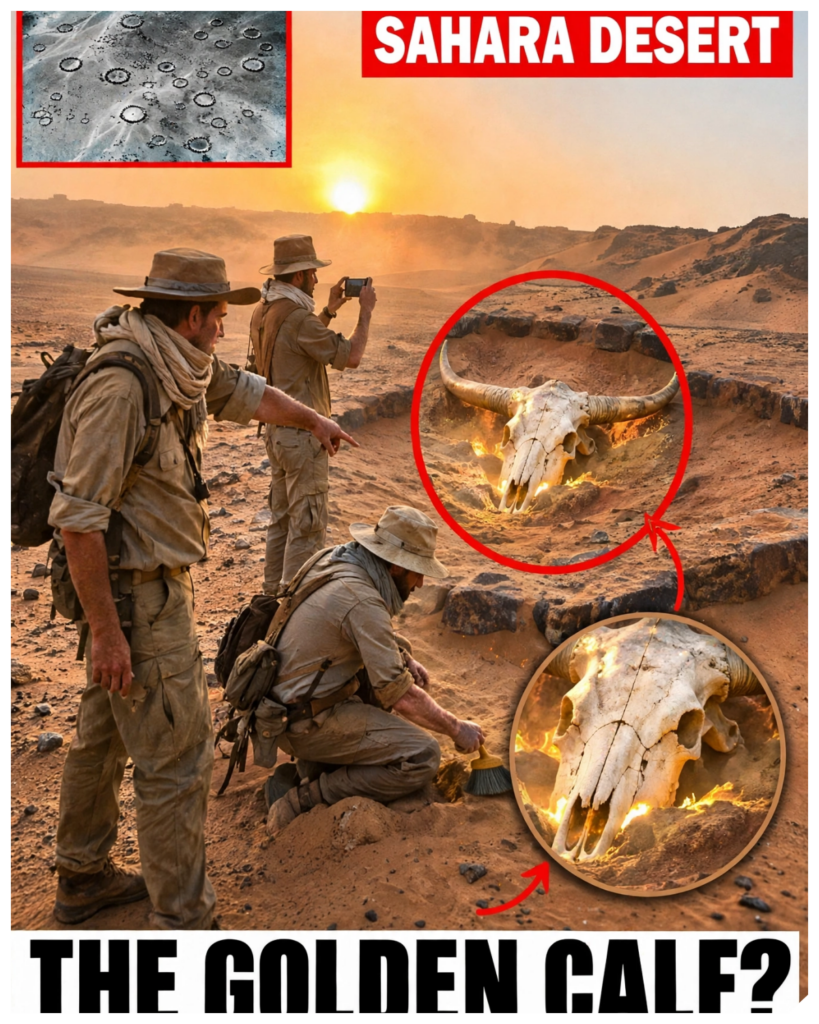
And perhaps most intriguing of all, ancient sacred cattle burials reveal a surprising connection to the golden calf described in the Bible.
How much of the ancient world have we forgotten?
And what other mysteries are still waiting beneath the Sahara?
Which of these mysteries do you find most fascinating?
Share your thoughts below and don’t forget to like and share this video so others can discover these incredible secrets, too.
The first clue to this forgotten world comes from one of the most remote regions of the Sahara.
Deep in eastern Sudan, researchers examining satellite images have uncovered something extraordinary.
260 ancient burial enclosures scattered across nearly a thousand kilometers of desert.
For thousands of years, these mysterious structures remained largely unnoticed, hidden within a landscape that today appears almost completely empty.
Yet, their discovery suggests that this vast wilderness once supported communities far more organized than we might imagine.
What makes these structures remarkable is their enormous size.
Some of the circular enclosures measure up to 80 m across.
Building monuments of this scale would have required careful planning, cooperation, [snorts] and a shared purpose.
Archaeological investigations of related sites have also uncovered human remains alongside cattle, sheep, and goats, suggesting that animals may have held a special place in the traditions of these ancient communities.
But why did people devote so much effort to these structures?
And what beliefs inspired them?
Interestingly, this discovery brings to mind a passage from the earliest chapters of the Bible.
Genesis 4:20 describes Jabal as the father of those who lived in tents and raised livestock.
Although there is no established connection between Jabal and these ancient monuments, the passage offers a fascinating glimpse into the pastoral way of life described in scripture.
Across the ancient world, livestock were central not only to survival, but also to the identity and traditions of entire communities.
Yet, these enormous circular structures may be only a small part of what the Sahara still conceals.
Farther north in Egypt’s western desert, archaeologists discovered something even more intriguing.
Mysterious stone circles that may have been designed to follow the movements of the heavens thousands of years before the great pyramids were built.
But these stones were not placed randomly at Nabtapla.
Archaeologists found that some appeared to point towards specific positions of the sun.
And that raises a surprising question.
How did people living thousands of years before the Great Pyramids know exactly where to place them?
One possible answer lies in the summer solstice, the longest day of the year.
Researchers believe certain stones may have marked where the sun rose during this important seasonal event.
At the time, Nabttopia was surrounded by grasslands and a seasonal [music] lake for the people living there.
Predicting the arrival of rain was essential.
These stones may have helped them determine when water would return and when their herds could safely move through the region.
But the mystery does not end with the sun.
Some researchers have suggested that other stones were aligned with Orion’s belt.
Three bright stars that remain visible in our night sky today.
This interpretation is still debated, but it raises another possibility.
Were these ancient people watching the stars only to track the seasons?
Or did they believe the heavens held a deeper meaning?
This is where the discovery [music] takes an interesting biblical turn.
In Job 38-31, God asks, “Can you loosen the cords of Orion?
[music] It is a powerful reminder that the same constellation studied by astronomers today also appears in scripture.”
The Bible does not identify Nabtapla, but its reference to Orion makes the ancient fascination with these stars especially intriguing.
The most remarkable detail is that the builders left no written records explaining their purpose.
Their stones have survived for thousands of years, but the knowledge behind their arrangement remains uncertain.
Were they creating a calendar, a sacred meeting place, or something combining both?
For now, the answer remains buried in the history of the Sahara.
Thousands of years ago, people watched the stars to predict the coming rains.
Yet, even today, nature can still surprise us.
Have you experienced unusual storms or flooding in your area?
Share your story in the comments and please like and share this video to help more people learn about these remarkable discoveries.
The people of Nabta once watched the sky to know when rain would return.
But in another part of the Sahara, scientists found evidence of something much bigger than a seasonal lake.
A giant river that once flowed through the desert.
Today, there is almost no sign of it on the surface.
So, how could an entire river disappear?
And where did all its water go?
The first clue was found in a surprising place deep beneath the Atlantic Ocean off [snorts] the coast of Moritania.
Researchers discovered an enormous underwater canyon stretching nearly 250 mi across the ocean floor.
Scientists knew that large rivers could help form such features.
But there was one strange problem.
No major river flows into the ocean at that location today.
Something was missing.
And for years, researchers could not fully explain it.
Then satellite radar revealed an important clue.
Beneath the desert sand, scientists identified the remains of an ancient river system called the Taman Raset River.
Thousands of years ago, when the Sahara received much more rain, this river may have carried enormous amounts of water across the region.
The surrounding land could have supported trees, animals, and communities living near the water.
But this discovery raises an even bigger [music] question.
If people once lived beside this giant river, where are the remains of their homes and settlements today?
Could entire ancient communities still be hidden beneath the sand waiting to be discovered?
The mystery also brings to mind Isaiah 43-19 where God speaks of making rivers in the desert.
The verse does not describe this particular discovery, but its words offer a striking reminder of how different this land once was.
Scientists have found traces of the river itself, but the story of the people who may have lived beside it remains largely unknown.
The lost Tamraset River raises the possibility that ancient communities once lived in places now covered by sand.
But in southern Libya, researchers have found something even more surprising.
Satellite images revealed the remains of more than a 100 ancient settlements in one of the driest parts of the Sahara.
There were villages, farms, and even buildings that looked like small castles.
How could an entire civilization have survived in a place where finding water is so difficult today?
At first, researchers thought these ruins might have belonged to the Roman Empire.
But when they examined the sites more closely, they discovered something unexpected.
The buildings belonged to the Garamantes, an ancient African civilization that had developed its own towns, farms, and defensive walls.
Some of those walls still stood several meters high, and in certain areas, entire groups of settlements were found close together.
This was not a handful of people struggling to survive.
It was a society that had found a way [music] to make the desert its home.
But the biggest surprise was not what stood above the ground.
It was what the Garamantes had built beneath it.
Archaeologists found an extensive network of underground water channels known as fogaras.
These tunnels carried water from underground sources to fields and settlements.
Without modern machines, the Garamantes had found a way to grow food and support large communities in a land that received very little rain.
Their achievement raises a fascinating question.
How did they gain the knowledge needed to build such a remarkable system?
This discovery also brings to mind Isaiah 41 to8 where God speaks of opening rivers in barren places and springs in dry valleys.
The verse does not refer to the Garamantes, but the ancient water channels show just how important water was to life in the desert.
Yet [snorts] much of their story remains a mystery.
Archaeologists have identified their towns and water systems, but many sites have never been fully explored.
Somewhere among those abandoned buildings, more clues may still be waiting to reveal how this forgotten civilization once lived.
The Garamantes were not the only ancient people who left behind signs of a remarkable culture in the Sahara.
Farther east, at Nabtapla in Egypt, archaeologists uncovered something much more unusual.
Beneath ancient stone monuments, they found carefully prepared burial places containing the remains of cattle.
But why would people living thousands of years ago go to such lengths to bury animals?
These were not simply piles of bones left behind after a meal.
Some cattle had been placed in special chambers and covered with stones, suggesting that they held an important place in the lives of these ancient communities.
Researchers believe the burials may have been connected to ceremonies or religious beliefs.
Yet, the people who created them left no written explanation.
Whatever these animals meant to them has remained a mystery for thousands of years, and this is where the discovery becomes especially interesting.
In ancient Egypt, cattle later became powerful religious symbols.
One well-known example was Hatheror, a goddess often represented as a cow or a woman with cow horns.
But could some of these beliefs [music] have roots in much older traditions from the Sahara?
Researchers have considered possible cultural connections, although no direct link has been proven.
There is also a striking connection to a familiar story in the Bible.
In Exodus 32:4, after the Israelites had left Egypt, [snorts] Aaron made a golden calf for the people.
Why did they choose a calf rather than another animal?
The importance of cattle in ancient Egyptian religion offers valuable background for understanding that decision even though the Nabta burials cannot be directly linked to the biblical event.
What makes this discovery so fascinating is that the same animal appeared in religious traditions across different periods of ancient history.
And it leaves us with a question.
Were the cattle buried at Nabta Playa simply honored animals?
Or did they represent beliefs that later generations would continue in different forms?
What do you think these ancient cattle represented?
Sacred symbols, religious offerings, [music] or something we have yet to understand?
Share your thoughts in the comments below.
The ancient cattle burials at Nabtapla reveal something important about the Sahara’s forgotten past.
The people who lived there were not surrounded by endless sand as we see today.
Thousands of years ago, much of the Sahara was covered with green grasslands, flowing rivers, and large lakes.
It was a world so different from today’s desert that scientists are still uncovering evidence of what once existed there.
And some of that evidence is truly surprising.
Researchers have discovered ancient remains of crocodiles, hippopotamuses, and fish in places where there is barely any water today.
These animals could not have survived in such dry conditions.
Their remains show that the Sahara once had rivers and lakes large enough to support an incredible variety of wildlife.
But the evidence does not stop there.
Across the desert, ancient rock paintings show herds of cattle, people hunting, and families living in landscapes that no longer exist.
These images were left by people who actually experienced the green Sahara.
They offer a rare glimpse into a time when the desert was full of life.
But then something changed.
Rainfall gradually [music] decreased, lakes began to shrink, and the grasslands disappeared.
Communities that had lived there for generations were forced to search for water elsewhere.
This remarkable transformation brings to mind Isaiah 35:1 where the prophet describes the wilderness and dry land rejoicing and blossoming like a flower.
The passage speaks of future restoration, not the ancient climate changes of the Sahara.
Still, the comparison is striking.
A land that appears almost lifeless today was once filled with water, animals, and human communities.
And that leaves a fascinating question.
If the Sahara once supported so much life, how many ancient settlements and forgotten stories might still be buried beneath its sands?
The Green Sahara was home to many rivers and lakes, but one of them was so enormous that it is difficult to imagine today.
In the heart of Africa, scientists have found evidence of a giant ancient lake that once covered an area larger than many countries.
Today, only a small part of that vast body of water remains.
So, what happened to a lake that was once among the largest on Earth?
Researchers call it Megaach Chad.
At its greatest size, [music] this ancient lake may have covered nearly 400,000 km, an area larger than Germany.
It stretched across lands that are now dry and dusty, creating an enormous home for fish, birds, and other wildlife.
Along its shores, ancient communities may have found everything they needed to survive.
But how do scientists know that such a huge lake [music] existed?
The answer lies in the marks it left behind.
Across the region, researchers have identified ancient shorelines and layers of sediment that formed when water covered the land.
These clues show where the lake once reached, even though much of that water disappeared thousands of years ago as rainfall decreased.
Mega Chad slowly began to shrink, leaving behind a landscape that looks almost nothing like its ancient past.
This remarkable discovery brings to mind Psalm 107-35, where scripture describes God turning the wilderness into pools of water and dry ground into springs.
The verse does not describe Megaachad [music] itself, but it offers a powerful image of how water can transform an empty landscape into a [music] place full of life.
Yet, the greatest mystery may not be the lake’s enormous size, but what happened along its ancient shores?
If people once lived beside this vast body of water, could the remains of their villages, tools, and forgotten communities still be waiting beneath the Sahara?
And how much of that lost world have scientists yet to uncover?
The enormous Lake Mega Chad is proof that entire landscapes can change beyond recognition.
But in Egypt, scientists have discovered another reason why so much of the ancient world remains hidden.
Some of its greatest secrets may be lying just beneath the ground in places where people have lived and walked for centuries without knowing what was there.
Using infrared images taken from satellites, archaeologists identified signs of more than 3,000 possible ancient settlements and over 1,000 potential burial sites across Egypt.
But one detail attracted particular attention.
Researchers also identified 17 locations that might contain previously unknown pyramids.
These were not pyramids rising above the sand.
They were unusual shapes and patterns detected from space, suggesting that ancient structures could still be concealed below the surface.
But how could satellites find something buried underground?
The answer lies in the materials used by ancient builders.
Mud brick walls and other structures can leave subtle differences in the surrounding soil.
Infrared images can sometimes reveal these patterns, even when nothing unusual is visible to someone standing on the ground.
However, archaeologists must still investigate the locations to determine what is actually there.
The discovery also brings to mind Exodus 11:11, where the Bible describes the Israelites building the storage cities of Pitham and Rammeses for Pharaoh.
Although the satellite findings have not been connected to these biblical cities, they remind us how much of ancient Egypt’s history may still be waiting to be uncovered.
And perhaps that is the most exciting part.
We often imagine that Egypt’s greatest discoveries have already been made.
Yet beneath ordinary fields, villages, and layers of sand, traces of ancient buildings may still remain.
If satellites can reveal thousands of possible archaeological sites from above, what might researchers discover when they finally begin digging below?
Not every mystery hidden in the Sahara begins with an ancient building.
Some begin with a story [music] that has puzzled historians for more than 2,000 years.
In Egypt’s western desert, an entire Persian army was said to have disappeared during a military expedition.
Thousands of soldiers reportedly marched into the desert, yet none returned to explain what happened.
Was the army truly swallowed by a massive sandstorm, or was something else behind its disappearance?
The story comes from Heroditus, an ancient Greek historian.
According to his account, the Persian king Cambises II sent an army of 50,000 men across Egypt’s western desert to confront the people of the Siwa Oasis.
At the time, Persia was one of the most powerful empires in the ancient world.
Its armies had conquered vast territories, and Egypt had fallen under Persian control.
Kambisces expected his soldiers to carry out their mission, but the journey across the desert would become one of history’s most enduring mysteries.
Herodotus described the army traveling deep into the wilderness before encountering a powerful sandstorm.
Strong winds reportedly swept across the desert, covering the soldiers route in sand until the entire force vanished from the historical record.
But there is an important detail.
Heroditus wrote about these events many years after they were said to have happened, and no independent ancient account has confirmed the disappearance of 50,000 soldiers in this way.
For generations, explorers [music] have searched Egypt’s western desert for evidence of the missing army.
Yet, archaeologists have never conclusively identified its remains or established exactly where the expedition ended.
This has led historians to question whether the original story was exaggerated.
Could the army have been much smaller?
Did the soldiers lose their way and run out of supplies?
Or could they have encountered resistance from local forces before reaching their destination?
There is another possibility worth considering.
The desert itself may have made the expedition impossible to complete.
Even an experienced army would have needed reliable water supplies, food, and clear directions.
Without them, a long journey across unfamiliar land could quickly become dangerous.
And if the expedition failed far from major settlements, the true explanation might never have been recorded.
What makes this story especially fascinating is that the Persian Empire also appears throughout the Bible.
In Isaiah 40-23, scripture reminds us that God brings powerful rulers to nothing.
The verse does not describe Kambises or his missing army, but it offers a meaningful reflection on the limits of human power.
Even the greatest kingdoms could not control everything that happened beyond their borders.
The fate of Kambises’s expedition remains uncertain.
The story may preserve the memory of a real military failure, or it may have grown into a legend over time.
But somewhere between the ancient account and the desert landscape lies a question historians have yet to answer.
Did an entire Persian force truly disappear?
Or has the Sahara been guarding a very different story all along?
Imagine standing in a place where the nearest road is far behind you.
The ground seems to stretch forever and the wind can erase your footprints quickly.
There is no sign telling you which direction is safe.
No river runs beside you.
Yet somewhere in this wilderness, water may be hiding beneath your feet.
Seeds may be waiting for rain.
And animals may be surviving where little seems able to live.
This is the Sahara Desert and the closer scientists look at it, the more surprising it becomes.
The Sahara covers most of North Africa, stretching from the Atlantic Ocean toward the Red Sea.
It is so large that a journey across it can pass through several countries and still leave desert ahead.
Most people picture endless golden dunes, but that familiar image tells only part of the story.
Much of the Sahara is made of hard stone, open gravel plains, mountains, and dry valleys.
Some places seem flat and empty.
Others look like landscapes from another planet.
Understanding these differences is the first clue to understanding the desert [music] itself.
Why does that matter?
Because the Sahara is not one single stretch of sand.
It is a collection of different environments, each [music] holding its own dangers and surprises.
In one region, a traveler might face towering dunes.
A few days away, the same traveler could encounter a rocky plateau, deep valleys, or mountains rising above the heat.
Some of these peaks become cold enough for snow.
The thought of snow in the Sahara sounds impossible until you remember that the desert is not defined by constant heat.
It is defined mainly by how little rain falls.
That small difference changes everything.
During summer, temperatures on the open plains can become dangerously high.
At night, however, the land may cool quickly.
In colder seasons, some places can become surprisingly chilly and the highest elevations can fall below freezing.
A person who prepares only for heat may find that the desert presents an entirely [music] different problem after sunset.
The Sahara is a land of extremes.
But those extremes are not always what visitors expect.
Even its silence can be misleading because wind and weather can transform the scene without warning.
Consider the great sand [music] dunes.
They attract the attention of photographers because they look like waves frozen in place.
[music] Some form graceful crescent.
Others stretch in long ridges or rise into enormous complicated hills.
The shapes are not random.
They reflect the way wind carries sand across the ground, around obstacles, and through open spaces.
What looks permanent is moving grain by grain.
Over time, those small changes can reshape a route, cover familiar tracks, or create barriers where the ground once seemed clear.
The desert is constantly changing, even when it appears still.
And here is a surprising detail.
Sand dunes cover only about a quarter of the Sahara.
That means much of the world’s famous desert is not covered by the towering sand hills seen in movies.
[snorts] Large areas are gravel plains or exposed rock.
In some places, the earth is so hard and bare that hardly anything can take root.
In others, ancient layers of stone sit almost undisturbed beneath the open sky.
The result is a landscape with many faces, and a person who has seen one corner of it has not necessarily seen anything like the rest.
Among these features are dry basins that may occasionally hold shallow water.
There are broad rocky plateaus and mountain ranges that break the seemingly endless horizon.
Some mountains began forming long before human history.
Others preserve the marks of volcanic [music] activity.
In Chad, Mount Kusi rises high above the surrounding desert while other mountain regions stand across Algeria and Libya.
These are not small bumps hidden among dunes.
They are major landscapes, reminders that the Sahara contains high ground as well as deep depressions.
The desert’s shape has been created through an immense history of stone, movement, weather, and time.
But the most dangerous changes may come from something you cannot build a wall against, the wind.
Across parts of the Sahara, strong winds can lift dust and carry [music] it far beyond the desert itself.
The air becomes thick, the horizon disappears, and familiar landmarks are suddenly impossible to see.
In some regions, these winds have traditional names.
Egypt has the Commson, Libya has the Gibli.
Sudan can experience powerful dustfilled winds known as haboobs.
Their names differ, but the experience can be frighteningly similar.
What began as an ordinary day may turn into a wall of dust moving across the land.
Now imagine trying to find your way [music] when the world beyond a few steps has disappeared.
Roads can be buried or hidden.
A clear path can become uncertain.
The sky itself can take on a strange color as dust fills the air.
To an observer, it might seem as though the land is being swallowed, but there is no supernatural explanation needed.
These storms show how powerful ordinary natural [music] forces can become in an extreme environment.
They also explain why travelers throughout history took desert routes so seriously.
A mistake [music] that seems small in a city can become a serious problem in the Sahara.
The wind is not the only danger that arrives unexpectedly.
The Sahara is famous for having very little rain, but that does not mean rain never falls.
When storms do arrive, some release a large amount of water in a short time.
A dry channel that has been empty for months can suddenly carry fast moving water.
The danger is especially surprising because heavy rain may fall far away beyond the sight of people standing in the channel itself.
Water can rush downstream into a place where the sky is still clear.
That is one of the desert’s strangest warnings.
Dryness does not guarantee safety from flooding.
A person unfamiliar with the region [music] might see a dry valley as a convenient road.
Yet those same channels sometimes serve as natural roots for sudden floods.
Scientists call many of them waddis.
Some follow older drainage systems.
Others carry water only when rare storms produce enough runoff.
Their channels reveal how the landscape guides rain from high places into [music] low ground.
This is why a storm over distant mountains can matter to people far away.
The Sahara does not need regular rainfall everywhere to produce powerful flows in particular places.
Sometimes a single storm is enough to change a familiar stretch of land.
There is another puzzle.
If so much of the Sahara receives so little rain, how can any water remain there at all?
Part of the answer lies underground.
Beneath sections of the desert are layers of rock that can hold water.
These underground reservoirs are called aquafers.
Water may enter them through rainfall in other locations or remain stored from much earlier conditions.
In some places, it reaches the surface through springs.
Elsewhere, it can be reached by wells.
The land above may look empty, while beneath it exists a resource [music] that has supported people, plants, and animals across generations.
This hidden water helps explain the oasis.
Seen from a distance, an oasis can seem almost impossible.
A patch of green surrounded by an enormous dry [music] landscape.
Yet, the appearance is not magic.
Groundwater and local conditions can make life possible in places where rainfall alone would never be enough.
Date palms, shrubs, and other plants may grow around such water sources.
Animals gather there, and human communities have long depended on them.
But even an oasis is not an unlimited supply.
Water must be used carefully, especially when the surrounding country offers few alternatives.
The Bible repeatedly uses the wilderness as a setting where the need for water becomes impossible to ignore.
In Exodus 17, the Israelites face thirst during their journey, and the account focuses on water provided in a place where the people desperately need it.
The story is not an explanation of Saharan groundwater, and the location should not be confused with the Sahara.
Yet, the experience is easy to understand [music] after examining how dry environments work.
In a land where water controls nearly every decision, a spring or a flowing stream is not a small detail.
[music] It can change the future of everyone who finds it.
Even beyond the oasis, the desert holds another kind of hidden water.
Sand itself [music] can store rainfall.
Although the surface may become dry again quickly, moisture can move downward and remain below.
In favorable locations, [music] it may slowly appear near the surface as a seep.
That possibility helps explain why certain plants survive in places that look completely barren.
Their roots may reach water that a person standing above would never notice.
What appears to be a landscape without resources, can contain small, carefully balanced pockets of life.
Some desert plants live through a remarkable waiting game.
Their seeds can remain in the ground while weeks or months pass without [music] useful rain.
Then, when enough water finally falls, the plants begin growing quickly.
Certain short-lived plants may sprout within days and produce seeds soon afterward.
They do not have the luxury of a long growing season.
Their chance may last only a short time before the ground becomes dry again.
From a distance, it can seem as though a lifeless patch of desert has suddenly awakened.
In reality, life was there all along, waiting for the right conditions.
Other plants use very different methods.
Some grow leaves and stems suited to conserving moisture.
Others survive in sheltered valleys or higher mountain areas where conditions are less severe than on the plains.
The Sahara even contains small surviving groups of trees associated with climates very different from those of its surrounding lowlands.
These plants offer clues to how varied the region can be.
A single label desert hides [music] the fact that temperatures, soil, moisture, and shelter can change greatly from one location to the next.
The animals are equally surprising.
Many people imagine the Sahara as a place almost completely empty of wildlife.
But small mammals, foxes, gazels, sheep, and reptiles have found ways to live across different parts of it.
Some avoid the worst heat by staying in burrows or moving during cooler hours.
Others travel over large areas in search of food.
Their lives depend on using energy and water carefully.
Survival in the desert is rarely a matter of strength alone.
Often it depends on timing, shelter, and knowing when not to move.
Even more unexpected are the creatures living near the desert’s scattered pools and waterways.
Certain frogs, snails, and small aquatic animals can survive conditions that seem almost impossible for waterloving species.
Some snails remain inactive during prolonged dry periods and become active again when rain returns.
Tiny organisms may occupy pools that appear only from time to time.
A place that seems empty in one season [music] can become busy with life in another.
To understand the Sahara, scientists [music] must sometimes return to the same location repeatedly because the desert reveals different things at different times.
And then there are the birds.
More than 300 species can be found across the Sahara when resident and migrating populations are considered together.
Some live near rocky landscapes while others depend on water or travel through the region during seasonal journeys.
From the ground, the great open spaces might seem like a barrier.
From above, birds can cross portions of this enormous region as part of a much wider movement across continents.
The desert may look isolated, but it remains connected to landscapes far beyond its borders through the lives of animals that pass over it.
One of the most puzzling features of the Sahara is how quickly appearances can change.
A traveler may see bare ground for days, then reach a valley containing shrubs, insects, [music] and signs of birds.
After rain, plants can appear in places that seemed empty.
[music] In a rocky mountain area, conditions may support species absent from the plains [music] below.
These differences are not evidence that the desert is secretly fertile everywhere.
They show how closely life follows the small openings created by water, shade, and temperature.
In the Sahara, even a modest advantage can make a [music] tremendous difference.
The shape of the land also affects where people can travel.
A rocky plateau may force a long detour.
Large dunes can slow a journey or make familiar routes difficult to follow.
Mountain ranges can separate one region from another.
While an oasis can become an important point along a route, long before modern roads and navigation, people needed [music] practical knowledge of these features.
They had to understand where water might be available, when conditions could change and which paths could be crossed safely.
The Sahara’s history is therefore not only a story of isolation.
It is also a story of knowledge passed between generations.
That knowledge helps explain why the desert has never been simply an empty space on the map.
People have lived in oases, crossed its margins, and traveled between communities separated by enormous distances.
Yet, the environment has always placed strict limits on where large populations can settle permanently.
A vast region might contain only a few dependable sources of water with long, [music] difficult stretches between them.
The result is an unusual contrast.
A desert that occupies a huge part of Africa but has far fewer permanent residents than most places of comparable size.
Its emptiness is part of what makes it so dramatic.
But it does not tell the whole human story.
There is another detail that challenges the way we imagine the Sahara.
The region does not have a single fixed [music] boundary that stays unchanged forever.
Its area can expand or contract as conditions vary.
The southern edge meets the Sahel where semi- dry landscapes [music] form a transition toward wetter country.
Changes in vegetation and rainfall across this broad border affect farming, grazing, and human settlements.
A map can show a boundary, but the land itself does not follow a sharp line.
That makes it difficult to speak of the Sahara as though it were one permanent object with an unchanging shape.
Scientists also study the Sahara’s past by examining rocks and old deposits.
These records indicate that the region has experienced major shifts between drier and less dry conditions over long periods.
The details are complicated and researchers do not agree on every aspect of when today’s desert conditions first developed.
But the central point is clear.
The Sahara has a history far longer and more changeable than a single human lifetime can reveal.
What looks permanent to us may be only one stage in a much bigger story of climate and landscape [music] change.
That long history helps explain some of the Sahara’s unusual ground.
Ancient sediments, exposed layers of rock and basins, all preserve clues to earlier conditions.
In certain places, deposits reveal environments that differed sharply from the land visible today.
[music] Scientists piece together these clues like pages from a damaged book.
One layer may tell them about water.
Another may reveal erosion or long periods of exposure.
No single clue explains the entire desert, but together they show that the Sahara has been shaped by processes acting across enormous stretches of time.
The desert even produces sounds that can surprise people.
Under certain conditions, moving sand can make a deep humming or booming noise.
This strange effect is sometimes called singing sand.
Imagine walking across a dune and hearing a low sound rise from the sand [music] itself.
It might be easy to think something unusual is hidden below.
Yet, researchers study how grains move and interact to explain the phenomenon.
The sound is real, but there is no need to turn it into evidence of a mysterious underground machine or supernatural event.
Sometimes nature is astonishing enough without inventing an explanation.
For viewers familiar with the Bible, the Sahara offers a powerful setting for thinking about the wilderness described in scripture, but accuracy matters.
The biblical accounts took place in particular regions, and not every desert mentioned in the Bible is the Sahara.
Treating all deserts as one location would create connections that the text does not make.
The stronger approach is to look at the shared human experience.
A dry landscape makes travelers vulnerable.
A source of water changes their choices.
A storm exposes how little control people have over the world around them.
These experiences give familiar biblical images a new sense of reality.
Consider Psalm 63 where David [music] speaks of longing for God in a dry and thirsty land without water.
The verse is [music] spiritual poetry, not a report about North African geography.
Yet the picture is easy to understand.
In a place where thirst is a daily concern, water becomes a powerful way to express the deepest human need.
Similarly, Isaiah describes the fading of grass and flowers to remind readers how brief human strength can be.
The Sahara provides a dramatic natural example of why such images have remained meaningful for so many generations.
The landscape also asks a question that modern society often forgets.
How much of our confidence depends on things being available whenever we need them?
In cities, [music] water comes from a tap, food arrives at stores, and navigation appears on a screen.
In the desert, those conveniences cannot be assumed.
A change in wind or rainfall can disrupt even a carefully planned journey.
[music] The Sahara reminds us that human knowledge is valuable, but it does not eliminate uncertainty.
Technology can help people understand conditions and avoid risks, while nature continues to operate on a scale no traveler can control.
That brings us to a challenge unfolding along the desert’s southern margins.
As land becomes harder to farm and support livestock, in some areas, communities and governments have sought ways to protect soil and restore vegetation.
One major effort is known as the Great Green Wall, an African initiative focused on restoring damaged landscapes across [music] the Sahel.
The original vision was often described as a broad band of trees stretching across the continent.
Over time, the idea has developed into a [music] wider effort involving land restoration, local livelihoods, and methods suited to different environments.
The name sounds like a single wall that could simply stop a desert in its tracks.
Reality is more complicated.
Trees cannot thrive everywhere, and planting without enough attention to water and local conditions may fail.
Restoring land requires understanding which plants belong in each area, how communities use the soil, and what changing rainfall patterns mean for the future.
The goal is not to make every corner of the Sahara green overnight.
It is to help vulnerable landscapes and the people who depend on them become more resilient.
That is a harder story to tell than a simple miracle, but it is also a more meaningful one.
And the challenge points back to everything the Sahara has revealed.
Water is precious, but it does not appear equally across the land.
Wind shapes the ground, but people must learn how to live with its movement.
Plants can respond rapidly to rain, yet cannot survive without conditions suited to their needs.
Animals use remarkable strategies, but their populations can still be threatened by hunting and the loss of habitat.
The desert is not a place where life has defeated every obstacle.
It is a place where life survives by staying closely connected [music] to a difficult environment.
So what is the greatest surprise hidden in the Sahara?
Perhaps it is not a single mountain, storm or secret pool.
It is the discovery that a landscape appearing so empty can be so full of activity.
Rock records tell stories of ancient changes.
Dust travels [music] across great distances.
Water moves below the surface.
Seeds wait for their moment.
Animals follow routes that few people ever see.
Every one of these stories changes the way we look at a place that seems simple from far away.
And this is where the Sahara offers one final lesson.
A person standing among the dunes sees only a tiny part of the whole.
The surface may tell one story while the rocks beneath it, the air above it, and the living things around it tell others.
The more carefully [music] scientists observe the desert, the less reasonable it becomes to dismiss it as empty or lifeless.
Its mysteries [music] do not require exaggerated claims.
They are found in the real forces that shape [music] the land and in the remarkable ways life continues within it.
The next time you see a photograph of the Sahara, look beyond the sand.
Imagine the mountain cold, the sudden flood, the underground spring, the sleeping seed, and the bird crossing a seemingly endless sky.
Remember that even a dry valley may carry water after a distant storm, and a bare patch of ground may hold the beginning of new growth.
The desert is not merely an absence of life.
It is a place that demands patience before its hidden details can be seen.
And perhaps that is why it continues to surprise us.
What does it mean to belong to God?
For many believers, the answer begins with a promise.
Throughout scripture, the Lord calls people to trust him, follow his commandments, and take part in his work.
In return, he promises guidance, forgiveness, spiritual strength, and blessings that reach beyond this life.
These promises are not presented as casual words spoken in a passing moment.
They form what scripture calls covenants.
Understanding them changes how we read the stories of Abraham, Israel, and Jesus Christ.
It also explains why members of the Church of Jesus Christ of Latter-day [music] Saints describe themselves as a covenant people.
The expression is more than a name.
It describes a relationship, a way of living, and a responsibility to bless others.
Imagine making a promise to someone you love and knowing that your actions will show whether you mean it.
A covenant has something of that seriousness, but it is not simply a bargain between equals.
In Latter-day Saint teaching, God establishes the terms, explains what he asks, and offers blessings to those who willingly accept them.
People remain free to choose whether they will enter that relationship.
When they do, they agree to act with faith and obedience rather than merely claim a religious identity.
The promise becomes visible in decisions made at home, at work, and among neighbors.
A covenant is therefore both an [music] event and an ongoing commitment.
It begins with a sacred choice and continues through daily conduct.
This distinction [music] matters because the word covenant can sound distant or complicated.
Yet, its meaning becomes clear when we look at ordinary life.
Promises create trust only when they are kept.
Someone [music] who pledges kindness but consistently acts cruy has not honored that pledge.
In a similar way, the scriptures connect covenant blessings with faithful living.
The Lord promises [music] to help his people and his people promise to remember him and keep his commandments.
This does not mean anyone becomes perfect overnight.
It means the direction of life changes.
Repentance, [music] sincere effort, and renewed obedience become part of the relationship.
The goal is not to earn God’s attention through impressive deeds.
It is to respond faithfully to the love and direction he has already offered.
The scriptures portray this pattern from humanity’s earliest generations.
Latter-day Saint teachings identify sacred covenants associated with Adam, Enoch, Noah, and other ancient figures.
Each account has its own setting, but a common theme runs through them.
God does not abandon his children to uncertainty without instruction.
He speaks, invites, warns, and offers a path forward.
In the story of Noah, for example, Genesis describes God’s covenant after the flood and the rainbow associated with his promise.
The sign is easy to remember, but the deeper point concerns God’s continuing relationship with life on earth.
Covenants create a framework through which people can understand both divine mercy and human responsibility.
Among these ancient promises, the covenant with Abraham holds a central place.
Abraham lived in a world where families, land, ancestry, and worship shaped nearly every part of society.
Genesis presents him as a man called to leave familiar surroundings and follow a future he could not fully see.
He [music] did not begin his journey with a complete map of every challenge ahead.
He received a divine invitation and responded with faith.
This is one reason his story has remained so important to generations of believers.
Before the promises about descendants and nations unfold, Abraham must decide whether he trusts the one who calls him.
His first great act is not conquest or construction.
It is obedience.
Abraham’s willingness to follow God also sets him apart from the religious practices surrounding him.
In the Latter-day Saint account presented in the teachings about covenant people, Abraham rejects the idols associated with his father’s household and [music] seeks to obey the Lord.
That decision gives the covenant its personal meaning.
It is not merely an agreement concerning the future of a family line.
It begins with an individual turning toward God.
Scripture repeatedly returns to this pattern.
A great promise may involve communities and generations, but it still calls for individual choices.
No person can substitute an ancestors faithfulness for their own.
The covenant reaches across time while asking each generation to decide how it will live.
What then did God promise Abraham?
Genesis [music] speaks of a numerous posterity and of a lasting relationship between the Lord and Abraham’s descendants.
Other passages describe land and the promise that families throughout the earth would be blessed through him.
These are enormous claims, especially when viewed from the position of a single traveler beginning an uncertain journey.
Abraham could not personally witness every generation that would follow.
He was asked to trust a promise larger than his own lifetime.
This is one of the striking features of biblical covenants.
They may begin with one person’s faith, yet their consequences are presented as extending far beyond that person.
Latter-day Saint scripture adds further detail to the way members understand this promise.
In the book of Abraham, the Lord speaks of descendants receiving the gospel [music] and the blessings associated with priesthood authority.
These blessings are connected with the responsibility to carry the message of God to the wider world.
The emphasis is not simply that Abraham’s family would [music] become large or influential.
It is that other families would benefit.
This changes the meaning of being chosen.
In this teaching, a covenant is not permission to look down on outsiders.
It is a call to serve them.
The blessing carries an assignment and the assignment concerns people beyond one’s own household.
This is why ancestry alone does not explain the covenant in Latter-day Saint belief.
The teaching distinguishes between Abraham’s descendants by birth and those who become part of his covenant family through accepting the gospel of Jesus Christ.
Galatians chapter 3 provides an important New Testament connection.
Paul teaches that those who belong to Christ are Abraham’s seed and heirs according to the promise.
The idea opens the covenant to people from different nations and backgrounds.
[music] It does not require every convert to trace a family tree back to the ancient patriarch.
What matters in the church’s teaching is faith [music] in Christ and a willingness to receive and live the gospel.
Membership in the covenant family brings [music] both privileges and obligations.
Those obligations are easiest to understand when we turn to baptism.
For members of the Church of Jesus Christ of Latter-day Saints, baptism is not merely a public [music] expression of belonging to a congregation.
It marks a sacred promise to follow Jesus Christ.
The person being baptized commits to take his name upon themselves, repent and continue in disciplehip.
The promise reaches into ordinary behavior.
How to speak to a stranger, how to treat a family member, and how to respond after making a mistake.
A baptismal covenant cannot be confined to the day of the ceremony.
Its meaning is tested whenever someone chooses honesty instead of convenience or compassion instead of indifference.
[music] The name of Jesus Christ is especially important here.
To take his name upon oneself is to accept an identity tied to his teachings.
It means that faith should become recognizable through action.
A follower cannot perfectly reproduce the Savior’s example, but can sincerely try to be more patient, truthful, forgiving, and generous.
Such qualities may seem ordinary compared with the language of everlasting promises.
Yet, they are where covenant disciplehip becomes real.
The [music] question is not simply whether a person remembers the words spoken at baptism.
It is whether those words still influence the way that person lives when no one is watching.
Latter-day Saint teaching also links baptism with the gift of the Holy Ghost.
Following baptism, confirmation is understood as an ordinance through which a person is invited to receive that gift.
The Holy Ghost is described as a guide, a comforter, and a source of spiritual understanding.
This does not eliminate difficulty or guarantee that every decision will be obvious.
It means believers can seek divine help as they try to choose wisely.
The promised companionship of the spirit is especially meaningful because a covenant is not simply a list of requirements.
It is an ongoing relationship in which God offers support while his people learn, change, and continue forward.
That relationship is renewed in a particularly visible way through the sacrament.
During worship, members partake of bread and water in remembrance of Jesus Christ.
The prayers recorded in Doctrine and Covenants chapter 20 connect the ordinance with remembering the Savior, taking his name upon oneself, [music] and keeping his commandments.
The accompanying promise concerns the presence of his spirit.
The action itself is simple.
No elaborate display is needed, but the meaning is profound for those who participate faithfully.
Week after week, the ordinance invites worshippers to examine how they have lived, remember the Savior’s sacrifice, and recommmit themselves to what they have promised.
Consider how different this is from treating religion as a collection of occasional ceremonies.
Baptism marks the beginning of a committed path.
The sacrament repeatedly turns attention back to that path.
Repentance makes it possible to acknowledge wrong choices and seek a better direction.
Prayer and scripture study provide opportunities to listen and reflect.
Service gives that reflection practical form.
[music] Each practice supports the same underlying purpose, helping disciples remember who they have promised to follow.
The strength of the covenant is not measured by how often someone uses religious language.
It is revealed in persistent efforts to keep promises, especially when doing so is inconvenient.
[music] Within Latter-day Saint doctrine, temple ordinances deepen the meaning of covenant commitment.
The source teaching describes sacred promises made in temples and connects faithful [music] obedience with the hope of exaltation.
That word refers to the highest blessings of eternal life in God’s [music] presence as understood within the church’s theology.
These teachings are distinctive and should not be confused with the doctrines of every Christian denomination.
The underlying emphasis, however, follows the same pattern already seen in baptism.
Receiving promised blessings [music] brings responsibilities.
Temple worship is presented as a call to greater devotion to Jesus Christ.
Stronger family commitments and conduct consistent with the sacred promises members have made.
Marriage and family occupy an important place in these [music] teachings.
The new and everlasting covenant is presented as including sacred marriage ordinances along with other gospel covenants.
Faithful families are invited to see their relationships as matters of lasting spiritual importance.
That view gives everyday acts of care unusual weight.
Listening to a spouse, teaching children patiently, or supporting relatives through hardship may not seem like dramatic religious achievements.
Yet family life is one of the places where devotion is most clearly tested.
A promise of eternal blessings [music] becomes meaningful only when it encourages people to show love and integrity in the relationships they have now.
The phrase new and everlasting covenant can initially seem contradictory.
How can something be both new and everlasting?
The teaching explains the terms in different senses.
It is everlasting [music] because it comes from an eternal God and belongs to his enduring plan.
It is described as new when the gospel is restored or newly [music] offered to people who have not received it in that form.
The word does not mean that God repeatedly invents unrelated promises.
Rather, [music] it emphasizes the continuing invitation to enter the relationship he establishes.
Ancient figures and modern believers are placed within one broad story of God’s [music] dealings with humanity.
Jeremiah 31 offers a significant biblical background for the language of a new covenant.
The prophet speaks of a relationship in which God’s law is written upon the hearts of his people.
The image is more personal than commandments carved into a distant surface.
It points toward inward commitment, not merely outward compliance.
For a modern believer, that distinction has practical consequences.
Someone may follow a rule to avoid criticism while resenting it internally.
Another person may learn to value the principle behind the rule and freely choose it.
Covenant living seeks the second kind of change, obedience, that grows from conviction, gratitude, and love.
That raises a question many people ask.
If God’s promises are generous, [music] why do they include conditions?
The answer offered in the source teaching is that obedience matters because covenants are meaningful agreements, not automatic rewards detached from human choice.
Doctrine and covenants chapter 82 connects the Lord’s promises with doing what he commands.
[music] The same material warns that rejecting sacred responsibilities has consequences.
These teachings are serious but their purpose should not be reduced to fear.
They are presented as reasons to treat commitments carefully.
A person who enters a covenant should understand that the choice involves more than receiving blessings.
It also involves accountability.
Accountability need not produce despair.
Central to the gospel is the possibility of repentance through Jesus Christ.
Believers make mistakes.
Sometimes repeatedly.
A covenant relationship encourages them to recognize those mistakes, seek forgiveness, repair what they can, [music] and continue learning.
This is not permission to treat promises casually.
It is an acknowledgment that spiritual growth happens in imperfect human lives.
The Savior’s role remains essential because the point of the covenant is not human self-sufficiency.
[music] People rely on Christ’s grace while taking responsibility for their choices.
Faith and obedience belong together, but neither should be mistaken for a claim of personal perfection.
The covenant also changes how believers understand the idea of being God’s people.
It would be easy to hear that phrase as [music] a declaration of special status and stop there.
Yet, Abraham’s blessing was tied to the blessing of nations.
That broader purpose challenges any attitude of superiority.
In Latter-day Saint teaching, covenant membership should produce willingness to share the gospel, assist neighbors, and care about people far beyond one’s immediate community.
A promise that extends outward cannot be fulfilled by withdrawing from everyone else.
It asks members to look beyond their own comfort and consider how their faith might become a source of help to others.
Missionary work is one expression of [music] that responsibility.
The church teaches that the gospel should be shared throughout the world [music] and its members participate through formal missions and personal conversations.
But meaningful witness is not [music] limited to public preaching.
A neighbor may first encounter someone’s faith through kindness during a difficult week [music] or integrity in a workplace disagreement.
A family member may notice patience where anger once appeared.
The content of the message matters, but so does the manner in which it is shared.
If the purpose is to bless other families, [music] respect and genuine care should shape the invitation.
People must remain free to respond according to their conscience.
To understand why priesthood appears so often in the covenant teachings, we must look at how [music] the Church of Jesus Christ of Latter-day Saints describes religious [music] authority.
The accompanying source explains that priesthood is authority to act in God’s name in the church’s ordinances and administration.
It distinguishes between holding priesthood authority and holding the keys that direct particular responsibilities.
A person may be ordained to an office without [music] possessing authority to direct every activity of the church.
That distinction is central to its organization.
Priesthood is described [music] not merely as a title but as a structure for carrying out religious service in an orderly way.
The church identifies two principal divisions of priesthood named ironic [music] and melkisedc.
The ironic priesthood is associated with ordinances such as baptism and the sacrament while the melkisedc priesthood is connected with broader spiritual responsibilities and church leadership.
The names reach back to biblical figures.
Aaron served in the priestly tradition of ancient Israel while MelkiseDC appears in Genesis as a priest and king encountered by Abraham.
Latter-day Saint scripture expands on the significance of these [music] names and the organization connected with them.
These explanations represent the church’s doctrine and should be understood within that religious setting rather than assumed to describe the practices of all Christian churches.
A striking detail is how the source describes different priesthood offices as forms of service.
Deacons help with the sacrament and practical responsibilities.
Teachers encourage members and prepare for worship.
Priests may baptize and administer the sacrament.
Bishops provide leadership and attend to both spiritual and practical needs.
Other priesthood offices have responsibilities involving teaching, ordinances, and oversight.
The specific age requirements and organization belong to the church’s established practice.
Yet the repeated theme is service rather than prestige.
Authority in this view [music] exists so that people can receive instruction, ordinances, encouragement, and care.
It is not meant to excuse pride or neglect.
The distinction between priesthood and priesthood keys clarifies how that service is directed.
The source cites a teaching from Joseph F.
Smith explaining that priesthood authority alone does not mean anyone may organize every religious action whenever they wish.
Keys refer to the authority to direct specific work in the appropriate place and manner.
In the church’s structure, particular leaders hold responsibility for particular congregations, organizations or assignments.
The goal is orderly administration.
Without such [music] a distinction, duties could overlap, and important decisions become confused.
The doctrine [music] connects religious authority with stewardship.
Someone entrusted with direction must use it carefully for the good of those being served.
The same principle explains why priesthood holders are organized into quorums.
A quorum is a group sharing an office or responsibility and working together under leadership.
The source describes groups for deacons, teachers, priests, elders, high priests, and broader church leadership.
Such organization can sound technical when presented only as numbers and titles.
Its human purpose becomes clearer when we ask what members are meant to do together.
They teach, encourage, help families, support worship, and respond to needs.
A well functioning quorum should leave people feeling remembered rather than overlooked.
Its value lies less in the structure itself than in the service the structure makes possible.
Women and other church members also serve through organizations described in [music] the source as auxiliaries working with priesthood leaders.
The document names relief [music] society, young women, young men, primary and Sunday school among them.
These groups provide teaching, support, and opportunities to participate in congregational life.
The arrangement reflects the church’s account of how responsibilities are shared under its leadership system.
What matters for understanding covenant people is that membership involves more than attending [music] meetings.
Individuals are invited to contribute their gifts, care for others, and strengthen families and communities.
The covenant is lived through collective work as well as personal devotion.
Why does the church place such weight on prophets and apostles?
The second accompanying source [music] turns to the organization of the church established by Jesus Christ.
It describes the savior calling apostles, teaching his followers, and giving leaders authority to minister.
The New Testament portrays apostles traveling, preaching, and guiding early congregations.
Letters from Paul, Peter, James, John, and Jude preserve instruction offered to believers facing different [music] challenges.
In Latter-day Saint teaching, this early organization provides a pattern for the modern church.
That claim is part of its understanding of continuity and restoration, and other Christian traditions interpret the history of church authority differently.
The account also emphasizes revelation.
Jesus teaches and [music] directs his disciples while the Holy Ghost helps them understand and carry out their responsibilities.
Acts describes Peter receiving guidance concerning the teaching of the gospel beyond his own community and Saul encountering the risen Christ on the road to Damascus.
Such stories show that the early church did not understand its mission as a purely human project.
Its leaders sought divine direction while facing questions they had not anticipated.
For modern Latter-day Saints, continuing revelation is therefore presented as essential to the church’s life.
They believe God can still guide his people rather than leaving them to depend only on human judgment.
The source then describes what it calls the great apostasy, [music] a period during which, according to Latter-day Saint belief, the original church’s priesthood authority and organization were lost from the earth.
This is a distinctive interpretation of Christian history, not a conclusion accepted by all churches or historians.
Catholics, Orthodox Christians, Protestants, and others hold different views about continuity, authority, and reform.
The Latter-day Saint account uses the idea of apostasy to explain why a restoration would be necessary.
To understand its covenant teaching fairly, we must recognize that this historical claim forms part of the church’s faith framework [music] while acknowledging that it is contested outside that framework.
In that same account, restoration means that the gospel, priesthood authority, ordinances, [music] and church organization associated with Christ’s original ministry were brought back.
Passages such as Acts chapter 3 and Revelation 14 are interpreted as pointing toward a future restoration of divine truth.
Members therefore see themselves not merely as individuals who joined a modern religious organization but as participants in an ongoing sacred history.
They connect their commitments with the biblical story of prophets, apostles, and covenants.
Whether one shares that interpretation or not, it explains why the word restored carries such importance in the church’s self-standing.
The early church’s ordinances [music] also help explain the connection between belief and action.
The source identifies faith [music] in Jesus Christ, repentance, baptism, and the gift of the Holy Ghost as foundational principles and practices.
These are not presented as isolated steps to complete and forget.
Faith encourages trust in the Savior.
Repentance [music] turns a person away from harmful choices.
Baptism publicly and sacredly marks commitment.
The gift of the Holy Ghost points toward continued guidance.
Together they describe a pattern of becoming a disciple.
Their significance grows when they shape a person’s future rather than remaining memories of past ceremonies.
The account includes teachings about spiritual gifts such as faith, healing, [music] prophecy, visions, and other manifestations of the spirit.
The New Testament [music] discusses gifts as varied ways believers may serve and strengthen one another.
In a covenant community, this variety [music] matters.
Not everyone contributes in the same way.
Some teach clearly, others listen patiently, organize [music] needed help, or offer encouragement at the right moment.
A community becomes stronger when different abilities are used for the benefit of others.
Spiritual gifts, as the source presents them, should draw attention toward God’s [music] work rather than become occasions for personal competition or claims of superiority.
One distinctive teaching in the accompanying material concerns ordinances performed on behalf of those who have died.
The source explains that Latter-day Saints believe the opportunity to hear and accept the gospel is not limited to mortal life and that living members may perform certain ordinances on behalf of others.
It connects this belief with passages in First Peter, 1 Corinthians, and additional Latter-day Saint scripture.
Christians differ significantly on how these passages should be understood within the church’s teaching.
The practice reflects a belief in God’s concern for every person and in the importance of allowing individuals an opportunity to respond.
It also demonstrates how covenant obligations can extend beyond the immediate community of living members.
With so many doctrines and ordinances, the essential question remains personal.
How should belonging to a covenant people change a person’s ordinary day?
The source itself asks what covenants have to do with clothing, actions, and obedience.
The answer cannot be reduced to appearance [music] alone.
Clothing choices may express modesty or respect according to a believer’s convictions, but outward signs mean little if they are separated from honesty and compassion.
A person can appear devout while treating others carelessly.
Covenant living calls for consistency between public worship and private character.
The promises [music] made to God should influence conduct even when there is no audience to reward or criticize it.
The workplace provides a clear example.
Imagine an employee who discovers that a mistake has benefited them financially.
No one else has noticed.
Correcting it may be uncomfortable, but integrity demands an honest response.
Or imagine a supervisor who has authority over people experiencing stress.
Covenant [music] disciplehip should encourage fairness.