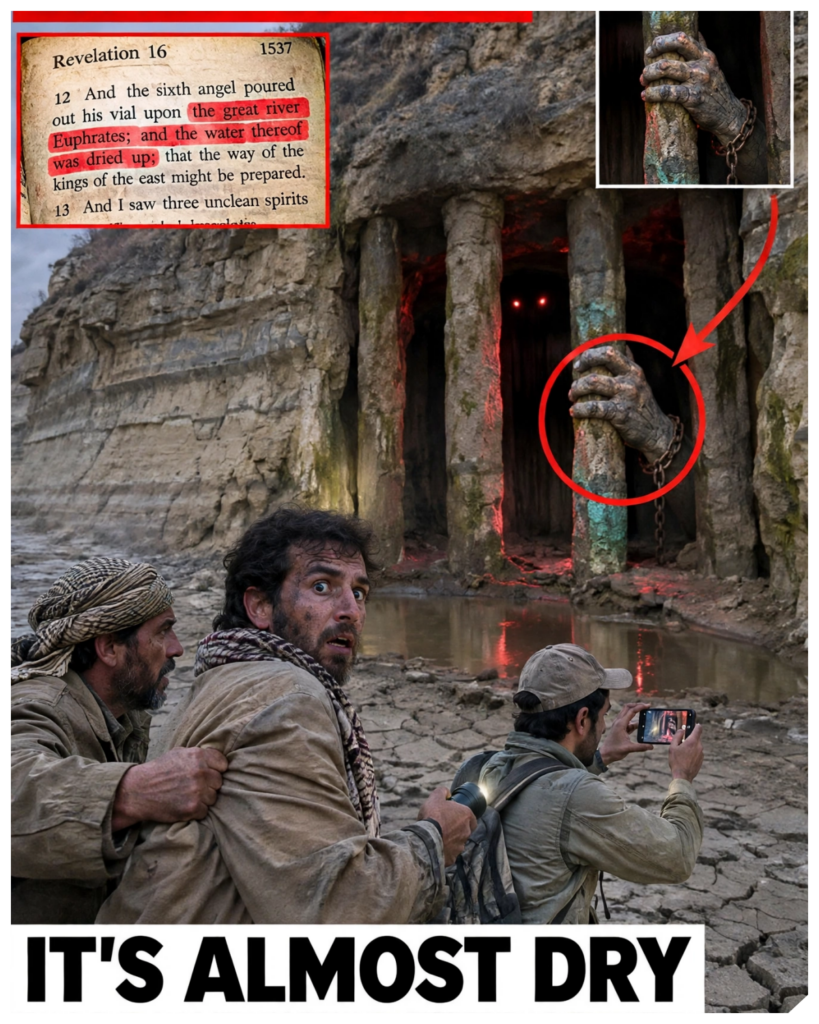
Startling and it has now been sealed shut.
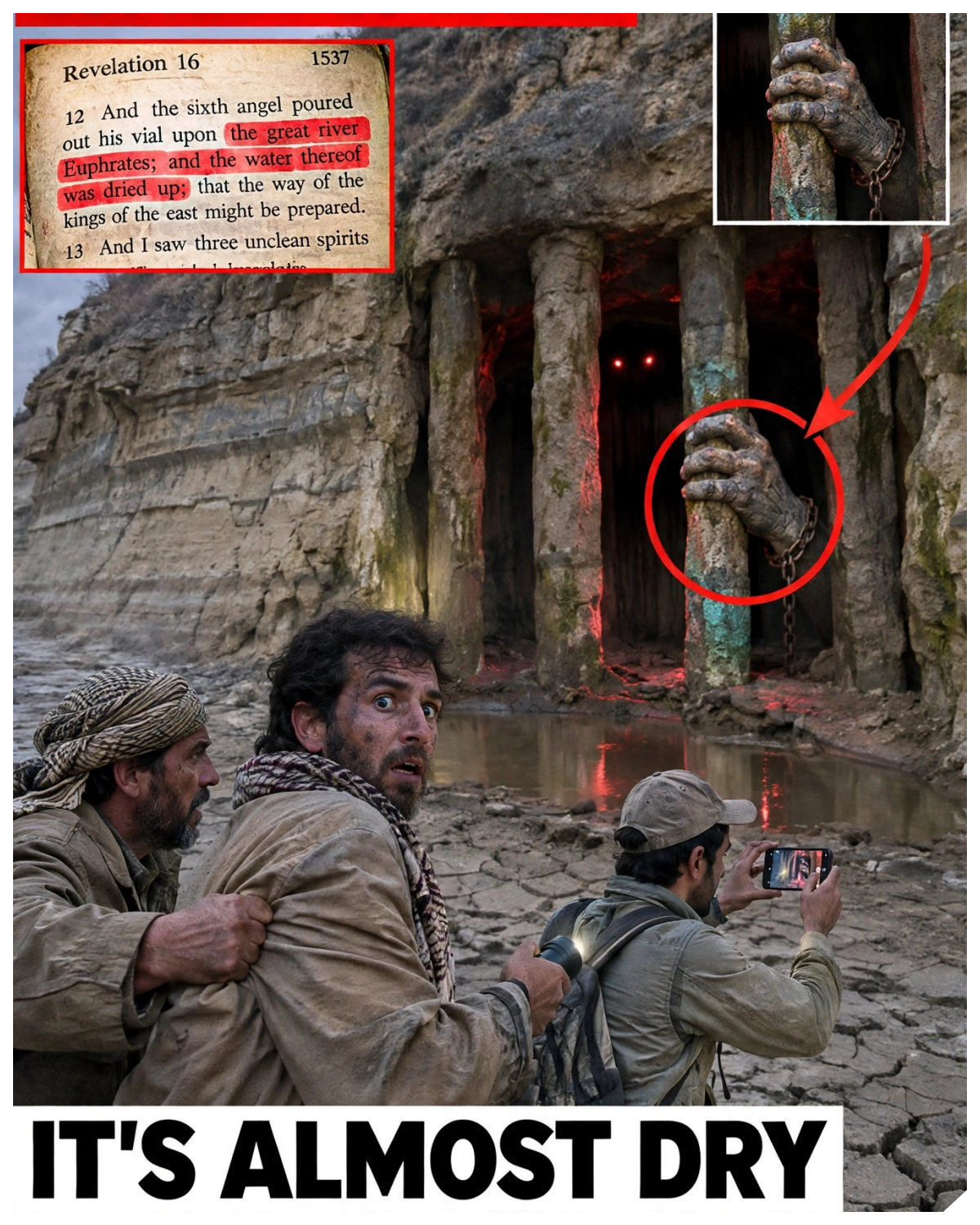
But the [music] like giants in the Bible, giants in like there’s there’s Native Americans.
Whoa.
It might be that deep dark hole right there.
Something mysterious may be hiding beneath the Euphrates River.
As its waters recede, stories have surfaced of towering stone columns resembling prison bars, ancient tunnels stretching into darkness, and strange symbols carved into hidden walls.
Some accounts even describe sealed chambers [music] said to lurk deep underground.
But how much of this is genuine discovery and how much remains legend?
For centuries, the Euphrates has stood at the crossroads of ancient civilizations and biblical prophecy.
Now, these claims are drawing attention to what might lie beneath its banks.
Could the truth be more surprising than the stories themselves?
Stay with us as we examine the evidence, explore the mysteries, [music] and consider what scripture says.
Before we begin, please like this video and subscribe for more biblical discoveries.
For thousands of years, the Euphrates River has been one of the most important waterways in human history.
Flowing from the mountains of Turkey through Syria and Iraq, it helped sustain the ancient civilizations of Sumer, Babylon, and Assyria.
Along its banks, cities flourished, agriculture expanded, and [snorts] generations depended on its waters for survival.
Yet today, this historic river faces a growing crisis.
In 2021, 13 humanitarian organizations, including the Norwegian Refugee Council and Care, warned that more than 12 million people across Syria and Iraq were threatened by shortages of water, food, and electricity.
Years of drought, rising temperatures, [music] and pressure on water supplies had already placed millions of lives at risk.
More recently, reports discussing satellite observations in 2026 have raised concerns about the river’s continuing decline.
Some accounts claim that water levels are falling three times faster than normal, although this specific figure has not been independently verified.
Nevertheless, the effects of prolonged water shortages remain deeply troubling.
Across affected areas, shrinking reservoirs have exposed stretches of barren ground, cracked mud, retreating shorelines, and previously submerged terrain reveal landscapes that were once hidden beneath the water.
For Bible readers, these changes bring to mind Revelation 16:12, which describes the sixth angel pouring out his bowl upon the great Euphrates, causing its waters to dry up and preparing the way for the kings from the east.
Scripture does not establish that today’s drought is the fulfillment of that prophecy.
Yet the resemblance has captured attention, especially as the retreating waters raise new questions about the ancient world.
And beyond the exposed river banks lies another mystery.
Stories of forgotten structures, hidden passages, and strange formations that may have remained concealed for centuries.
What truly waits beneath the disappearing waters of this ancient river?
As the waters of the Euphrates River continue to recede, reports have emerged of mysterious cave entrances appearing along its ancient banks.
Among the most unusual features are towering stone pillars that resemble the bars of an enormous prison, raising questions about what might be hidden behind them.
The pillars stand close together with narrow gaps separating each massive stone column.
Their surfaces appear rough and weathered, [music] suggesting that they have been exposed to natural forces for centuries.
From a distance, the arrangement looks remarkably similar to a row of prison bars, as though the entrance was once meant to keep something inside.
Behind these stone formations lies a dark opening leading deeper into the surrounding rock.
Narrow passages extend beyond the entrance, disappearing into shadows where sunlight [music] can no longer reach.
The deeper these passages go, the more difficult it becomes to understand what lies ahead.
The appearance of these structures is particularly interesting because the Euphrates flows through lands once occupied by powerful ancient civilizations.
The Babylonians and Assyrians built enormous stone gateways, defensive walls, and impressive structures that survived for thousands of years.
Could these stone pillars be remnants of an ancient structure?
Were they placed there to protect something important, or did natural erosion create their unusual shape?
Their true origin and purpose remain unknown.
Beyond the stone pillars, the passage continues into a series of underground tunnels.
Thick stone walls line the corridors, while narrow staircases descend into deeper sections.
Some passages are wide enough for several people to walk side by side, while others are so narrow that only one person can pass through at a time.
Reports suggest that these tunnels may extend for miles beneath the Euphrates region.
One remarkable detail is that underground tunnels beneath the Euphrates were described more than 2,000 years ago.
The Greek historian Diodoris Sichulus recorded an account of a tunnel constructed beneath the [music] river in ancient Babylon.
According to his writings, workers first diverted the Euphrates, allowing its riverbed to dry before construction began.
They then excavated a passage connecting the two sides of the city.
The tunnel measured approximately 12 ft high and 15 ft wide, providing enough space for people to travel beneath the river.
Its walls were built from brick and covered with bitumen, a thick waterproof material commonly used in ancient Mesopotamia.
Large [snorts] bronze gates were installed at both ends to control access.
Once the construction was complete, workers allowed the Euphrates to return to its original course.
The river flowed above the tunnel while people could travel through the passage below.
This account offers a fascinating picture of how ancient Babylon might have connected different parts of its city without relying on boats or bridges.
However, despite extensive archaeological work at Babylon, no physical remains of this particular tunnel have been confirmed.
The historical description remains an intriguing record of ancient engineering, especially because it describes a passage built directly beneath one of the most important rivers in the ancient world.
The tunnels hold another unusual detail.
Along their inner walls, strange markings and carved images appear, suggesting that these spaces may have served a purpose beyond simply allowing people to travel underground.
According to descriptions of the site, some sections of the rock are covered with symbols, numbers, and patterns believed to be thousands of years old.
Several markings consist of lines and geometric shapes arranged in unusual groups.
Others resemble a form of writing, although their meaning remains unclear.
What makes these symbols particularly interesting is their apparent difference from known ancient writing systems.
They do not seem to match the cunia form script used by the Sumerianss or the hieroglyphs developed in ancient Egypt.
This has raised the possibility that they represent an unknown form of communication.
Other images appear to show stars, circular patterns, and shapes resembling the movement of heavenly bodies.
Such details bring to mind the ancient Babylonians who carefully observed the night sky and recorded the movements of planets and stars on clay tablets.
Even more unusual are figures resembling creatures with both human and animal features.
Some appear to have human bodies with animal heads, while others combine features of different creatures.
These images resemble themes found in ancient Mesopotamian mythology, where gods and supernatural beings were often represented through unusual combinations of human and animal forms.
Could these carvings have been connected to religious ceremonies?
Were they intended to record astronomical knowledge, preserve important messages, or mark a place considered sacred?
The reported carvings have not been documented in a verified archaeological study, so their age and meaning remain uncertain.
Nevertheless, their descriptions raise an intriguing question about how ancient people expressed their beliefs and understanding of the world through images carved into stone.
In another section of the tunnel system, several corridors appear to end at large stone barriers with what seem to be hidden chambers behind them.
These chambers are buried beneath thick layers of earth, rock, [music] and sediment that have built up over many centuries.
Their entrances are said to be blocked by enormous stone slabs, some reinforced with heavy metal bars.
The barriers fit tightly against the surrounding walls, making it difficult to see what lies beyond them.
The arrangement raises an interesting question.
Why would anyone close off these rooms so carefully?
One possibility is that they were designed to protect something valuable.
Ancient civilizations often created secure spaces to store important possessions, religious objects, and written records.
Others have suggested that such chambers could have served as places for private ceremonies or the protection of sacred objects.
Without access to their interiors, however, their original purpose remains uncertain.
There is a real archaeological discovery that helps explain why hidden storage rooms are so fascinating.
In 2022, archaeologists uncovered the remains of Zakiku, a 3,400year-old city that had been submerged beneath the Mosul Dam reservoir in Iraq.
The city stood along the Tigris River and once belonged to the powerful Mitani Kingdom.
During the excavation, researchers discovered five pottery vessels containing more than 100 clay tablets covered in cunea form writing.
Some tablets were still enclosed in clay envelopes preserving records [music] from the ancient city.
What made this discovery remarkable was that many of the tablets had survived decades underwater despite being made from unfired clay.
Researchers believe the documents may reveal valuable information about the city’s administration, daily life, and eventual decline.
The discovery demonstrates how important records can survive for thousands of years, even after the buildings around them have disappeared.
The sealed chambers described beneath the Euphrates have not been archaeologically confirmed.
Still, the discoveries at Zakiku show why finding an ancient room filled with forgotten documents would be so significant.
A single collection of preserved writings could reveal details about people and events that history has long forgotten.
What do you believe could be hidden behind these sealed stone chambers?
Could they contain forgotten records from an ancient civilization or something far more mysterious?
Share your thoughts in the comments.
And if you enjoy exploring biblical mysteries and ancient discoveries, give this video a like and subscribe for more.
While the hidden chambers remain an unanswered mystery, a recent archaeological discovery in Syria offers a real example of ancient structures being uncovered near the Euphrates River.
This year, an unexpected discovery took place in the historic city of Raqqa, Syria.
Workers were demolishing an old residential building near the old mosque when they uncovered the remains of an ancient foundation beneath the ground.
The discovery immediately attracted the attention of the Raqqa Department of Antiquities and Museums.
Archaeologists and local officials arrived at the site and began an emergency excavation to examine the remains before further construction could damage them.
As workers carefully cleared away the surrounding soil, sections of old foundations and building materials became visible, these remains suggested that another structure had occupied the location long before the modern house was built.
After examining the construction materials and architectural features, archaeologists made a preliminary assessment that the remains might date to the Abassid period, a time when Raqqa was an important political and cultural center.
During the Abbassid era, which began in the 8th century, Raqqa developed into a significant city.
Its position near the Euphrates supported agriculture, transportation, and trade, connecting communities across the region.
This makes the discovery especially interesting.
Beneath an ordinary residential neighborhood, workers had uncovered evidence of a much older chapter in the city’s history.
The exact purpose of the ancient structure has not yet been established.
Further investigation is needed to determine how it was used and what other remains might exist beneath the surrounding buildings.
For Bible readers, the location carries another layer of meaning.
In Genesis 15:18, God establishes his covenant with Abraham and describes the boundaries of the promised land extending toward the great river Euphrates.
This passage shows that the Euphrates was already an important geographical landmark.
In the biblical account thousands of years before the modern city of Raqqa existed.
Although the newly uncovered foundations do not establish a direct connection to Abraham or biblical events, they remind us how deeply human history is connected to this ancient river.
And the discovery raises a fascinating possibility.
If the demolition of a single house can reveal remains from a forgotten period, how many more ancient buildings, streets, and everyday objects might still be buried beneath Raqqa?
For archaeologists, every uncovered foundation offers another opportunity to understand the people who once lived along the Euphrates.
The recent excavation in Raqqa reminds us how much of the Euphrates region’s history remains hidden beneath the ground.
Yet, the earlier accounts of prison-like stone pillars, underground passages, sealed chambers, and unexplained sounds have raised a different question among Bible readers.
[music] Could these mysteries have any connection to the warnings found in the book of Revelation?
The most striking connection is the description of four angels bound at the Euphrates.
Although the reported underground structures have not been proven to be connected to this passage, their unusual appearance has encouraged speculation about what the ancient prophecy might mean.
To understand its significance, we must examine what happens after the angels are released.
Revelation 9:16 describes an enormous army of 200 million mounted troops.
Jon then presents a terrifying vision of horses and riders whose appearance is unlike anything found on an ordinary battlefield.
The riders wear breastplates resembling fire, dark blue, and sulfur.
The horses have heads like lions, while fire, smoke, and sulfur come from their mouths.
These images emphasize the extraordinary nature of the judgment John witnesses.
Revelation 9:18 explains that these three destructive forces bring death to onethird of humanity.
The passage portrays a catastrophe of enormous proportions far beyond a conflict involving a single city or kingdom.
Biblical scholars have offered different interpretations of this vision.
Some believe it describes a future military conflict, while others understand the horses and their terrifying features as symbolic representations of divine judgment.
Scripture does not identify them with any modern military force or archaeological discovery.
However, the most important part of this prophecy comes after the destruction.
In Revelation 9 2021, John explains that many survivors still refuse to repent.
Despite witnessing these terrible events, they continue worshiping idols and practicing violence, theft, and other sins.
This reveals the deeper warning behind the vision.
Even when confronted with overwhelming signs of judgment, the human heart can remain unwilling to change.
The mysteries surrounding the Euphrates may attract attention, but they do not establish that these prophetic events have begun.
For Christians, the greater lesson is not to fear what might be hidden underground, but to recognize scriptures called to repentance, faithfulness, and spiritual readiness.
After examining these discoveries and the warnings found in Revelation, one question remains.
[music] What is truly hidden beneath the Euphrates River?
The answer may be less frightening than the stories suggest, but it is no less remarkable.
For thousands of years, the Euphrates has shaped the landscape of the Middle East.
Its course has shifted, its banks have changed, and entire settlements have been abandoned as civilizations rose and fell.
In more recent times, the construction of large dams has flooded ancient sites, while periods of drought have exposed land that remained underwater for decades.
These changes have given archaeologists opportunities to uncover important pieces of history across Mesopotamia.
Researchers have identified ancient streets, defensive walls, temples, burial grounds, and thousands of written records.
Each discovery provides information about how people lived, governed their cities, practiced their beliefs, and responded to disasters.
Some ruins have remained buried beneath thick layers of soil.
Others were hidden beneath reservoirs until falling water levels made investigation possible.
Together, they demonstrate that the history of this region is far from completely understood.
Yet, there is an important difference between archaeological discoveries and extraordinary claims.
The accounts of sealed caverns, tunnels stretching for miles, unexplained chain-like sounds, and enormous creatures have attracted considerable attention.
However, no reliable archaeological or scientific evidence currently confirms these particular stories.
This does not mean that every underground passage has been explored or that nothing remains to be discovered.
It simply means that the available evidence cannot support conclusions about secret prisons or supernatural beings [music] beneath the river.
For Bible readers, another important question remains.
Revelation 16:12 describes the sixth angel pouring out his bowl upon the great Euphrates River.
Its waters dry up, preparing a passage for the kings from the east.
The image is remarkable because the Euphrates historically served as a major natural barrier between regions and empires.
Its removal in John’s vision allows powerful forces to advance toward the events described later in the chapter.
Today, reports of drought and declining water supplies naturally remind some Christians of this [music] passage.
However, scripture does not provide a modern date for its fulfillment, and current environmental changes alone cannot establish that the prophetic event has occurred.
The distinction matters.
Understanding biblical prophecy [music] requires careful attention to what the text actually says, rather than treating every unusual discovery as proof that the final days have arrived.
Then in Revelation 16:15, Jesus delivers a personal warning.
Behold, I come as a thief.
Blessed is he that watchth.
These words shift the focus away from speculation and towards spiritual readiness.
The message is not that Christians must solve every mystery beneath the Euphrates.
Rather, they are called to remain watchful, faithful, and prepared regardless of what happens in the world around them.
The ancient river may reveal more forgotten history in the years ahead.
New discoveries may answer questions that have remained unresolved for generations.
But the greatest lesson is already clear.
While human knowledge continues to grow, scripture calls believers to seek wisdom, hold firmly to their faith, and live each day with an awareness of God’s promises.
Long before maps divided the Middle East into modern countries, two rivers helped shape the direction of human history, the Tigris and Euphrates crossed a landscape where rainfall alone could rarely support large populations.
Their waters made farming possible, brought people into permanent settlements, and connected communities that might otherwise have remained isolated.
Between them lay Mesopotamia, a name derived from Greek words meaning land between rivers.
Much of this historic region occupies present-day Iraq with adjoining areas extending into Syria, Turkey, and Iran.
Its importance came not from water alone, but from what generations learned to do with it.
Their influence crossed borders and continued long after individual kingdoms eventually disappeared.
The two rivers followed different courses, but belonged to one connected system.
Their headwaters rose in the highlands of eastern Turkey, where seasonal precipitation and melting snowfed streams flowing toward lower elevations.
The Tigris moved swiftly through mountainous terrain before entering broad plains.
The Euphrates traveled farther west through Syria, then crossed Iraq in a winding course.
Eventually, their waters joined in southern Iraq to form the Shatal Aarab, which [music] empties into the Persian Gulf.
Across this enormous distance, conditions changed from steep valleys to open fields, dry plains, and wetlands.
Each environment offered different possibilities for settlement and trade.
In southern Mesopotamia, the climate created a particular challenge.
Much of the land was [music] flat and fertile, but dependable rainfall was scarce.
Rivers could flood fields at inconvenient times, and their channels could shift after years of depositing sediment.
[music] Early farmers, therefore, needed more than access to flowing water.
They had to learn when to plant, where to build, and how to bring moisture into fields beyond the river banks.
By digging canals, raising embankments, and clearing drainage channels, communities transformed their surroundings.
These projects required cooperation, planning, [music] and repeated maintenance.
They also encouraged people to organize labor beyond individual households.
Irrigation changed the scale of food production.
Farmers could cultivate grain across fields that would otherwise have remained dry, while nearby communities raised animals and developed specialized crafts.
A harvest large enough to feed more than one family created opportunities for people to work outside agriculture.
Potters made containers, [music] builders constructed houses, and merchants exchanged goods.
Some residents organized supplies, settled disagreements, or supervised communal projects.
Over generations, villages grew larger, and their relationships became more complicated.
Nevertheless, dependable food supplies provided an essential foundation for increasingly complex societies.
The Sumerians became particularly influential in the southern plains.
Their settlements developed into city states, each possessing its own political institutions, religious centers, and surrounding farmland.
Urukur [music] and other cities expanded as agricultural production and trade increased.
Temples held important social and economic responsibilities while rulers and administrators coordinated construction and collected resources.
City walls offered protection, but they also reflected growing competition over land and water.
Communities faced disputes, seasonal uncertainty, and the continuing work of managing channels that could become blocked or move away from cultivated land.
Urban growth created a need to remember information beyond the limits of spoken conversation.
Administrators had to account for grain, livestock, workers, and goods.
Moving through expanding settlements in southern Mesopotamia, practical recording methods gradually developed into writing.
Early signs impressed on clay helped document quantities and transactions while later uniform scripts could express names, instructions, stories, and increasingly complex ideas.
The significance of this development extended far beyond bookkeeping.
Written records allowed knowledge to pass between generations without depending entirely on memory.
They also gave historians a rare window into the decisions, obligations, and priorities of people who lived thousands of years ago.
Clay was an especially useful writing material because it was readily available in the river valleys.
A scribe could press signs into a damp tablet using a reed stylus, then leave the tablet to dry or fire it for greater durability.
Collections of such records preserve contracts, inventories, school exercises, religious texts, and letters.
Many concern ordinary exchanges, showing that writing became part of daily administration.
Its survival is partly a result of the environment itself.
Mud could be washed away, but hardened clay often endured after buildings collapsed and settlements were abandoned.
The region’s political story also grew beyond individual cities.
Aadian rulers brought multiple territories under a larger authority, demonstrating how an empire could connect communities speaking [music] different languages.
Subsequent kingdoms inherited administrative traditions while adapting them to changing circumstances.
Political power moved among cities and dynasties.
Yet the rivers continued to support agriculture and communication.
Control of canals, farmland, and transport routes could strengthen a ruler as much as military victories.
A governing center needed food, labor, and dependable connections with surrounding districts.
Geography, therefore, helped determine both the opportunities available to rulers and the difficulties they faced when trying to maintain authority across extensive territory.
Babylon became one of the most recognizable names in Mesopotamian history.
[music] Its rulers governed an important center of politics, commerce, and learning.
The Babylonian legal tradition is often associated with Hammurabi, whose surviving collection of judgments and laws illustrates concerns ranging from property disputes to family responsibilities [music] and commercial obligations.
These texts do not mean that justice was applied equally to every person.
Different social ranks often faced different penalties and protections.
Even so, the records reveal a society that devoted considerable effort to formal rules and the resolution of conflict.
Such systems developed within a world of growing cities, [music] complicated ownership, and interdependent economic activities.
Farther north, Assyrian power emerged from settlements connected to the upper river system.
Assyrian rulers developed extensive military and [music] administrative networks linking distant provinces to major cities.
Roads, [music] river transport officials, and correspondents helped authorities manage territory.
Large construction projects, including palaces and defensive works, displayed the resources available to kings.
Yet, imperial expansion also demanded supplies and reliable communications.
Rivers made certain journeys easier, but difficult terrain and political resistance remained major obstacles.
In this way, the geography of Mesopotamia shaped not only farming settlements, but regional systems of power.
Commerce connected the river plains with lands that possessed resources the south lacked.
Mesopotamian merchants sought timber, stone, metals, [music] and luxury materials from neighboring regions.
In return, they exchanged agricultural products, textiles, and manufactured goods.
Boats transported heavy cargo along navigable stretches, while caravans carried merchandise across routes that rivers could not reach.
[music] Trading communities helped spread techniques, artistic styles, and ideas.
A city did not need to possess every useful material to become prosperous.
[music] It needed access to partners and routes.
The two rivers served as economic arteries within a much larger network reaching [music] across the ancient near east.
The same river system that supported prosperity could also cause serious environmental problems.
Flood waters sometimes damaged settlements while dry periods disrupted planting and reduced harvests.
Irrigation itself created a less obvious danger.
When water spread across fields in a hot climate, much of it evaporated, leaving dissolved salts behind.
If drainage was inadequate, groundwater could rise and bring additional salts toward the surface.
Over time, these deposits could damage crops and reduce soil productivity.
Farmers sometimes changed what they planted or moved cultivation elsewhere.
The process illustrates a difficult historical lesson.
A technique that increases production can create new problems when used intensively for generations.
Salinization affected more than individual fields.
Reduced yields could change the amount of food available to towns, increase pressure on remaining productive land, and complicate the collection of agricultural supplies.
Communities responded through adjustments in irrigation, drainage, and crop choices.
But the underlying challenge was persistent.
Water management required constant attention rather [music] than a single successful invention.
Sediment could fill canals, banks needed repairs, and too much irrigation could be as damaging as too little.
The agricultural history of Mesopotamia is therefore not merely [music] a story of overcoming a harsh landscape.
It is also a record of people repeatedly negotiating the limits of that landscape.
The southern marshlands formed another distinctive environment where rivers, channels, and shallow lakes met.
Broad wetlands supported reeds, fish, birds, and communities [music] adapted to life on water.
Reed houses, boats, fishing, livestock keeping and seasonal movement became part of local traditions.
The marsh Arabs maintained ways of life closely [music] connected to these ecosystems.
Marshes were not unused spaces awaiting development.
They were living environments with ecological and cultural significance.
Their condition depended on the amount and timing of water reaching the south.
Changes upstream could therefore affect people and wildlife far beyond the places where dams or irrigation channels were built.
Modern engineering greatly changed the relationship between the rivers and their surroundings.
Large reservoirs can store water, generate electricity, and reduce some risks associated with seasonal floods.
Canals and pumping stations can supply farms or cities far from a main channel.
These benefits are substantial, especially in places where drought threatens drinking water and harvests.
Yet, every large intervention has consequences.
Reservoirs can alter the timing of downstream flow, trap sediment, and change habitats.
Expanding irrigation may increase demand precisely when supplies are limited.
Decisions made to solve one problem can therefore create new challenges for other communities sharing the same waters.
Reduced flooding also changes how nutrients reach agricultural land.
Historically, seasonal high water carried sediment across portions of the flood plane.
Replenishing some soils and reshaping channels.
Flood control protects homes and infrastructure, but it can interrupt these natural processes.
Farmers may then rely more heavily on other methods to maintain productive fields.
In marshland areas, reduced freshwater inflow can shrink open water and alter vegetation.
Fish populations and migratory birds may lose important habitats.
Such effects reveal that the health of a river cannot be measured by water volume alone.
Timing, quality, sediment and ecological connections matter as well.
Water quality presents additional pressures.
Agricultural runoff, untreated waste water, and concentrated salts [music] can reduce the usefulness of water that remains in a channel.
As flow decreases, pollutants may become less diluted, making treatment more difficult.
And increasing risks for communities downstream.
Farmers facing lower quality supplies may struggle to maintain yields [music] even when some irrigation water remains available.
The burden can fall particularly heavily on smaller settlements with limited infrastructure.
Protecting the basin therefore requires attention to both quantity and quality.
A large reservoir offers little reassurance if the water reaching homes and fields is unsafe or [music] too saline for its intended use.
The rivers also cross political boundaries which makes their management unusually complicated.
The Euphrates begins in Turkey, passes through Syria and enters Iraq.
The Tigris likewise links Turkey and Iraq with tributaries connected to neighboring countries.
Each government must consider agriculture, electricity generation, cities, and national development.
Upstream decisions influence downstream conditions, [music] but drought and changing demand do not affect every country in the same [music] way.
Agreements over allocation can provide guidance.
Yet, cooperation becomes harder when supplies fall or political relationships deteriorate.
Shared geography creates a practical need for negotiation regardless of disagreements over other issues.
For downstream communities, uncertainty can be nearly as damaging as a low water level itself.
Farmers need to know whether irrigation supplies will arrive during planting and growing seasons.
Cities need predictable water for treatment plants and public services.
[music] Hydroelectric facilities require sufficient flow and careful operation.
When information is incomplete, households and institutions find it harder to plan.
Transparent measurements, shared forecasts, and communication between authorities can help reduce that uncertainty.
[music] Such cooperation does not eliminate water scarcity, but it can make difficult conditions more manageable and prevent avoidable misunderstandings between neighbors.
At their southern end, the Tigris [music] and Euphrates come together in the Shatal Arab.
This waterway connects Iraq with the Persian Gulf and carries major economic and strategic importance.
River access has long affected commercial movement, port activity, and the relationship between inland communities and maritime trade.
Control of navigation and surrounding territory became particularly contentious during the Iran Iraq war.
The conflict demonstrated how a river channel can acquire military importance alongside its [music] commercial functions.
Today, questions involving navigation, borders, salinity, and freshwater [music] supplies continue to show that the lower river system is not merely a local environmental concern.
Climate change adds [music] pressure to an already demanding setting.
Higher temperatures can increase evaporation from soil, reservoirs, and irrigated fields.
Changes in precipitation and snow accumulation can alter the seasonal supply entering the rivers.
More frequent or intense dry spells [music] may affect the reliability of farming and drinking water systems.
No single factor explains every local shortage because demand, infrastructure, weather, and policy interact.
Effective responses therefore require careful regional measurements rather than one simple explanation.
The challenge is to plan for uncertainty while protecting the people whose livelihoods depend on dependable water access.
Historical experience offers useful lessons [music] for this work.
Ancient farmers understood that canals needed maintenance while communities learned that storing and distributing water required collective decisions.
Modern societies possess far better measurements, engineering tools, and scientific understanding.
But the basic problem remains familiar.
Water arrives unevenly.
Different users compete for it.
And every choice has consequences beyond the immediate location.
Sustainable management can include improved drainage, efficient irrigation, pollution control, and protection of wetlands.
It also depends on institutions capable of making agreements and adapting when conditions change.
Technology alone cannot replace cooperation or responsible long-term planning.
The archaeological importance of the basin gives these environmental questions an additional dimension.
Changing landscapes can damage or expose ancient sites while new construction may threaten remains that have not yet been recorded.
Archaeologists must [music] often work alongside local authorities and residents to document discoveries before they disappear.
Preservation is not simply about saving impressive monuments.
Ordinary houses, workshop [music] debris, canal traces, and broken pottery can explain how communities dealt with work, food, transport, [music] and change.
When studied carefully, these modest materials help reconstruct lives that written royal histories rarely describe.
The region’s heritage belongs to many periods and communities, not to one empire alone.
There is a temptation to see ancient Mesopotamia only as the birthplace of civilization, as though the rest of history [music] merely followed a predetermined path.
Its real significance is more complex.
People there developed important practices, adapted earlier knowledge and influenced neighboring societies.
But they also made mistakes and faced problems they could not fully control.
Their achievements emerged through generations of experimentation, exchange and social change.
Urban living, formal administration, and written communication developed gradually under particular environmental conditions.
Recognizing that complexity makes their accomplishments more impressive because it shows how human ingenuity operated within real limits [music] rather than outside them.
The Tigris and Euphrates remain significant because their story joins the past to the present without requiring a mystery to give it meaning.
They supported early cities and powerful states, carried trade, supplied farmland, and helped produce records that transformed the preservation of knowledge.
They also revealed the long consequences of irrigation, environmental change, and competition over shared resources.
The communities living beside them today face different political and technological circumstances, yet still depend on the same essential relationship between land and water.
Understanding that relationship is part of protecting [music] both a remarkable human heritage and the future of the region.
Every human life is connected to a story that began long before birth and continues beyond death.
We inherit names, traditions, memories, and relationships from generations we never knew.
Yet, one important question remains.
Does death permanently separate families?
Or has God prepared a way for those relationships to continue into eternity?
The Church of Jesus Christ of Latter-day Saints teaches that Heavenly Father’s plan reaches far beyond the boundaries of earthly existence.
It includes those who lived centuries ago, those who are living today, and those who have not yet been born.
At the center of this belief stands Jesus Christ, whose sacrifice makes resurrection and eternal life possible.
According to Latter-day Saint teaching, resurrection and eternal family relationships are closely connected, but not identical.
Through the atonement and resurrection of Jesus Christ, everyone who has lived will eventually rise from the dead.
Eternal family unity, however, is understood to involve sacred covenants and ordinances established by God.
Baptism, confirmation, and temple ordinances form part of this religious framework.
These ceremonies represent commitments extending beyond personal belief into the responsibilities of disciplehip.
Their importance raises a difficult question about people who never had an opportunity to encounter Christianity.
If God loves every person, what happens to those who died without receiving these teachings or participating in these [music] ordinances?
Consider someone born in a remote village centuries before Christian missionaries arrived.
That person might have lived honorably, cared for relatives, and helped neighbors, yet never heard the name of Jesus Christ.
Another individual might have grown up in a [music] society where religious traditions were entirely different.
According to Latter-day Saint doctrine, neither person’s eternal opportunity should be determined solely by birthplace or historical circumstances.
God’s justice [music] must be understood alongside his mercy.
This belief forms the foundation of religious work performed on behalf of deceased ancestors.
It also explains why researching [music] family history carries such profound spiritual meaning for members of this faith.
For Latter-day Saints, temples are dedicated places where particular religious ordinances are performed under priesthood authority.
They differ from ordinary meeting houses used for weekly worship and community activities.
Temple participation involves preparation, personal commitments, and adherence to religious standards.
Inside members receive instruction concerning their relationship with God, the purpose of mortal existence, and the promises associated with eternal life.
These experiences are regarded as sacred rather than merely ceremonial.
The temple represents the belief [music] that God’s relationship with his children extends beyond a single lifetime.
Its ordinances express commitments intended to remain meaningful after death when earthly possessions and social positions no longer matter.
One of the most distinctive practices associated with these temples is the sealing of family relationships.
In ordinary civil law, marriage establishes a recognized union during earthly life.
Latter-day Saint theology teaches that a marriage performed through authorized temple ordinances can continue eternally when the participants remain faithful to their covenants.
This understanding draws partly upon Matthew 16:19 where Jesus speaks to Peter about binding and loosing on earth and in heaven.
Latter-day Saints interpret the passage within a broader teaching about priesthood authority.
The promise is conditional rather than automatic, emphasizing continuing devotion, personal righteousness and mutual responsibility.
The meaning of sealing extends beyond the relationship between husband and wife.
Children born to parents already sealed in temple marriage are understood to belong within that eternal family relationship.
Families formed under other circumstances may also participate in [music] ordinances intended to unite parents and children.
This includes couples originally married in civil ceremonies and families that have legally adopted children.
The doctrine emphasizes that family relationships can possess enduring spiritual significance.
It does not suggest [music] that ceremonies alone guarantee harmonious relationships.
Instead, [music] participants are expected to cultivate love, forgiveness, loyalty, and integrity throughout their lives while seeking the blessings promised through sacred covenants.
The principle becomes especially significant when considering deceased relatives.
Millions of people lived before the organization of the modern Latter-day Saint Church.
Many were devoted to other religions, while others belong to societies with no knowledge of Christian scripture.
Members believe these individuals can still receive opportunities associated with the restored gospel.
Living church members may participate in designated temple ordinances as representatives or proxies [music] for deceased individuals.
The ceremony is performed by a living person, but the intended spiritual beneficiary is someone [music] who has died.
This practice reflects the conviction that mortality does not exhaust the opportunities provided through God’s plan.
Proxy ordinances are not understood as [music] forcing deceased people to accept religious beliefs they never chose.
Within Latter-day Saint theology, individuals retain the ability to accept or reject the gospel after death.
The ordinance makes an opportunity available while the individual remains responsible for responding.
This distinction is essential because it places personal agency alongside the importance of religious ceremony.
A descendant may sincerely hope that an ancestor embraces a sacred covenant but cannot make that decision for another [music] person.
The teaching attempts to preserve both divine fairness and individual freedom, presenting salvation as an invitation rather than a compulsory result of family membership.
The biblical foundation commonly associated with this practice includes 1 Corinthians 15:29.
In that passage, the Apostle Paul refers to people being baptized for the dead while discussing resurrection.
Christians have interpreted the verse in different ways, and many denominations do not regard it as an instruction to perform modern proxy baptisms.
Latter-day Saints, however, understand the reference as consistent with a restored religious ordinance.
Their interpretation is also shaped by additional scriptures contained in the doctrine and covenants.
Recognizing these differences helps distinguish a particular Christian tradition from beliefs shared universally across Christianity.
The practice is important precisely because it expresses a distinctive understanding of God’s continuing work.
This teaching transforms genealogy from a personal interest into a religious responsibility.
Researching ancestors becomes a way of identifying people for whom temple ordinances may be needed.
Family history work begins with ordinary evidence, names, dates, marriages, photographs, letters, and documents preserved by relatives.
The process does not require a spectacular discovery.
A faded certificate or a handwritten entry inside an old family Bible may provide the information needed to connect one generation with another.
Each verified relationship can extend a family’s recorded history, sometimes revealing relatives whose names disappeared from living memory long ago.
Researchers often begin by speaking with older family members.
A grandparent may remember the name of a village, a childhood home, or a relative who moved overseas.
Such information can guide searches through civil registrations, church books, census records, immigration documents, and cemetery inscriptions.
Digital databases have made historical material more accessible, although records remain incomplete and unevenly preserved.
Family Search associated with the Latter-day Saint Church provides tools for organizing genealogical information and locating historical sources.
The process requires careful verification because similar names, [music] missing dates, and conflicting documents can easily lead researchers to connect unrelated individuals.
Accuracy matters for reasons beyond scholarly convenience.
A mistaken family relationship can cause generations of information to be assigned to the wrong person.
Researchers therefore compare multiple records, examine original documents when possible, and distinguish confirmed facts from family traditions.
Historical records may [music] contain spelling variations, changed surnames, or approximate birth dates.
Migration can make a person appear under different national or linguistic identities.
Some records have been destroyed by war, disaster, or [music] neglect.
Others remain inaccessible.
These difficulties encourage patience and humility.
Family history is rarely a perfectly complete account, and responsible researchers acknowledge where the surviving evidence ends.
One example from Latter-day Saint teaching concerns an Italian couple, Mario Canamela and Maria Vita, who married in 1882.
They raised a family in Sicily without participating in the religious ordinances later considered important by their descendants.
More than a century afterward, members of their family attended the Los Angeles Temple and performed a [music] sealing ordinance on their behalf.
For those descendants, the occasion represented a meaningful connection across generations.
The ceremony could not change the historical circumstances in which Mario and Maria lived, but it expressed their family’s belief that spiritual opportunities remain available beyond death.
Such experiences help explain why temple work can carry strong emotional significance.
People searching for ancestors may learn about hardships they never expected.
Poverty, migration, illness, separation, or the death of children.
Discovering these details can change how they understand their own families.
An unfamiliar name becomes a real person who once faced difficult decisions and uncertain circumstances.
Remembering that individual through research and religious observance creates [music] a form of connection that extends beyond photographs or documents.
The emotional meaning comes not from proving every family story extraordinary, but from recognizing the human lives behind names preserved in records.
Latter-day Saint [music] congregations encourage members to participate according to their circumstances and abilities.
Some organize records, help relatives understand genealogical databases, or research difficult family connections.
Others attend temples and perform ordinances for identified ancestors.
[music] Young members may participate in certain proxy ordinances when they meet the appropriate requirements.
Those unable to travel can contribute through research and preparation.
The range of activities reflects an understanding that family history is a shared responsibility.
No single individual possesses every document, skill, or opportunity necessary to reconstruct an extended family.
Progress often depends on cooperation across generations and locations.
Religious significance does not remove the practical and ethical responsibilities associated with genealogy.
Family information can be sensitive, especially when records involve adoption, uncertain parentage, or relatives who prefer privacy.
Living individuals deserve appropriate consideration when their information is collected and shared.
Religious differences within families may also require care.
Some descendants welcome temple work while others hold different beliefs about its meaning.
Respectful conversations acknowledge these disagreements without diminishing anyone’s dignity.
In this way, family history can become an exercise in understanding as well as devotion, helping people appreciate experiences and convictions that differ from their own.
The deeper theological question concerns whether God’s purposes can remain active when human life ends.
Latter-day Saints answer that question through a broader understanding of existence after death.
Earthly mortality is viewed as an important stage within a continuing journey rather than the whole of personal existence.
[music] Death ends the functioning of the physical body.
But it does not destroy the spirit.
This belief [music] supplies the essential explanation for why religious ordinances might have significance for someone who is no longer alive.
Without continuing personal existence and the [music] freedom to respond, the practice of acting on behalf of ancestors would lose its central meaning.
In Latter-day Saint teaching, human beings existed as spirits before entering mortality.
Earthly life provides experiences that could not be obtained in exactly the same way beforehand, including living [music] in physical bodies, making choices under uncertain conditions and learning through relationships.
Death separates the spirit from the mortal body.
The spirit then enters a post-mortal condition while awaiting resurrection.
This period is not understood as an empty interval without awareness.
Instead, [music] individuals continue to possess identity, memory, and the capacity for meaningful activity.
The teaching presents personal existence as continuous even though the conditions surrounding the individual change.
The resurrection promises a future reunion [music] of spirit and body through the power of Jesus Christ.
That reunion is distinct from the spiritual condition immediately following death.
According to the doctrine, all people will ultimately be resurrected, but their final eternal condition [music] involves further judgment and the consequences of their choices.
This distinction helps explain why the post-mortal world is described as a period of preparation.
It is neither [music] the final destination for every soul nor a return to ordinary earthly existence.
It is an intermediate state within a plan that extends from premortal life to resurrection and eternal judgment.
Religious accounts cannot provide the same kind of observable evidence used to investigate the physical world.
Questions about the location, appearance, [music] and daily experience of deceased spirits therefore belong to theology rather than laboratory research.
Latter-day Saint leaders have taught that the spirit world is near the earth and that deceased loved ones are not necessarily distant from the living.
These statements are offered as religious teachings, not geographical measurements.
Their intended purpose is often pastoral, providing comfort to those who mourn.
The belief that relationships continue can help grieving families understand death as separation rather than permanent annihilation.
The doctrine also emphasizes continuity of character.
A person does not automatically become entirely different after [music] death.
Attitudes, desires, loyalties, and spiritual commitments are understood to remain part of personal identity.
This principle places considerable importance on choices made during earthly life.
Someone who has cultivated compassion and truthfulness carries [music] those dispositions beyond mortality while deeply established resentment or harmful desires may remain obstacles to progress.
The purpose is not to portray personal change as impossible.
[music] Rather, the teaching suggests that moral development requires genuine willingness and [music] cannot simply be postponed indefinitely without consequences.
The Book of Mormon provides a description of differing post-mortal conditions through the prophet Alma.
In Alma 40, the righteous are described as entering paradise, a state associated with peace, happiness, and relief from earthly suffering.
Those who have chosen serious wrongdoing are described as experiencing spiritual darkness and distress while awaiting resurrection.
[music] The language distinguishes conditions shaped by one’s relationship with God.
These are not merely descriptions of physical locations.
They also concern inward experience, moral accountability, and the spiritual consequences of human decisions.
The distinction gives the doctrine a personal dimension beyond questions about the unseen world’s appearance.
Paradise is not portrayed simply as endless inactivity.
While righteous spirits are understood to enjoy relief from mortal troubles, Latter-day Saint teaching also describes meaningful work continuing beyond death.
The central activity involves helping others come to understand the gospel.
This idea is developed particularly in doctrine and covenants 138 which records a vision received [music] by Joseph F.
Smith in 1918.
The account describes Jesus Christ’s ministry among the righteous dead following his crucifixion and explains the organization of messengers to carry his message to others awaiting spiritual instruction.
In that vision, Christ’s work reaches people whose earthly circumstances prevented them from receiving his teachings.
Messengers are appointed to explain repentance, faith, and the principles associated with salvation.
The account presents the post-mortal world as a [music] place where knowledge can increase and spiritual decisions remain meaningful.
It also introduces a form of service extending beyond mortal death.
Faithful individuals are believed to participate in helping others continuing the religious responsibilities that shaped their earthly disciplehip.
This [music] concept gives the afterlife an active social dimension.
The spiritual world becomes a community of continuing relationships and responsibilities rather than a collection of isolated souls.
The New Testament contributes another important reference through 1 Peter 3:18:20, [music] which mentions Christ and the spirits in prison.
Interpretations of this passage vary among Christian traditions.
Latter-day Saints connect it with their understanding of post-mortal preaching and the possibility of learning after death.
Spirit prison within this framework [music] describes a condition experienced by people who have not received the gospel or who remain separated from God through sin.
It is not necessarily presented as a physical dungeon with visible walls and chains.
The emphasis lies on spiritual circumstances, [music] incomplete understanding, and the need for redemption.
The possibility of instruction after death reflects a particular view of divine justice.
Human beings do not enter the world with equal religious knowledge, educational opportunities, or freedom of choice.
Some encounter Christianity throughout their lives, while others have little or no access to its [music] teachings.
Latter-day Saint doctrine holds that God understands every individual’s circumstances completely.
The opportunity to respond to the gospel must therefore be considered [music] in light of both mortal experience and post-mortal instruction.
This approach attempts to reconcile universal divine love with the belief that salvation involves deliberate acceptance of Jesus Christ.
Nevertheless, the existence of further opportunity does not eliminate moral responsibility.
The teachings distinguish people who lacked knowledge from those who knowingly rejected what they understood to be true.
They also acknowledge the lasting effects of deliberate wrongdoing.
Doctrine and Covenants 19 describes the seriousness of [music] suffering associated with refusing repentance while emphasizing the suffering undertaken by Christ for [music] humanity.
The religious message is that mercy is available but should not be mistaken [music] for indifference toward evil.
Forgiveness involves a genuine change of heart rather than an automatic cancellation of every consequence.
The relationship between paradise and spirit prison is important because the two conditions are not described as permanently preventing all spiritual contact.
The vision in doctrine and covenants 138 [music] explains that authorized messengers can teach those awaiting the gospel.
Learning and acceptance remain possible within the divine plan.
This does not mean that every person immediately changes their convictions or that spiritual progress requires no personal effort.
Rather, the doctrine preserves a role for agency beyond mortality.
[music] People must still respond to what they learn.
Their choices remain meaningful even when the circumstances of their existence differ from those on Earth.
Family relationships are also described as significant within this post-mortal understanding.
Latter-day Saint leaders have taught that familial identity continues beyond the grave [music] and that spiritual communities possess organization and purpose.
Such teachings offer a particular response to grief.
Parents who have lost children, spouses separated by death and individuals [music] mourning generations of relatives may find reassurance in the possibility of renewed association.
Yet the doctrine does not promise that every relationship automatically becomes perfect.
Eternal family life is presented alongside moral accountability and covenant faithfulness, giving enduring relationships, a spiritual responsibility as well as emotional value.
These beliefs also influence the way followers understand time.
Earthly life can feel brief when compared with the generations preceding it and the unknown future beyond it.
A person may spend decades pursuing goals that eventually disappear while the consequences of kindness, [music] repentance, and faithful service may be understood to endure.
The doctrine encourages believers to examine what qualities they are developing rather than concentrating exclusively on material achievement.
Education, work, [music] and family responsibilities remain important, but their value is connected to the character formed through them.
Mortality becomes an opportunity for preparation, not simply a period to survive.
For those confronting serious illness or the approach of death, the teaching can provide a language of hope without denying the reality of suffering.
Believers may understand that physical death is not the disappearance of personal identity.
At the same time, grief remains a genuine human response.
Faith does not remove the pain of losing a loved one, and religious reassurance should not be used to dismiss sorrow.
Compassion requires listening, supporting [music] families, and allowing people to mourn in their own ways.
The doctrine offers meaning within grief rather than insisting that grief itself [music] is unnecessary.
An important distinction remains between spiritual hope and claims about communication with deceased individuals.
The teaching that spirits continue to exist does not establish that unexplained [music] sounds, unusual dreams, or mysterious experiences are reliable messages from the dead.
Latter-day Saint beliefs about post-mortal existence are grounded in scripture and religious authority rather than an expectation that every strange occurrence reveals the unseen world.
Keeping this distinction clear prevents the doctrine from becoming confused with sensational stories about supernatural activity.
Its primary concern is the destiny and moral development of human beings under God’s care.
The teachings concerning temple service and the spirit world meet at the question of how divine promises can benefit people who have already died.
One emphasizes sacred action performed by the living.
The other explains why the deceased may still possess the ability to accept religious [music] instruction.
Together, they present salvation as a work extending across generations.
Yet, their spiritual meaning also depends on a larger covenant tradition found throughout scripture.
That tradition begins with ancient families and develops into the story of Israel whose descendants are repeatedly called to remember their relationship with God and their responsibilities toward other nations.
The name Israel first belongs to Jacob, the grandson of Abraham.
According to Genesis 32, Jacob wrestled through the night with a mysterious figure and afterward received a new name.
The event marked a turning point in his life, associating his identity with a continuing relationship with God.
Jacob had 12 sons whose descendants became associated with the tribes of Israel.
Their family story would eventually develop into the history of an entire people.
The transition from one household to a nation is central [music] to understanding the covenant tradition because the promises made to individuals were understood to extend across generations.
Abraham stands at the beginning of this covenant [music] framework.
In Genesis, God calls him to leave familiar surroundings and promises blessings extending to his descendants.
These promises include land, posterity, and a relationship through which other families of the earth would receive blessings.
[music] The covenant is renewed through Isaac and Jacob, establishing continuity within the biblical narrative.
Yet it is [music] not portrayed merely as a privilege granted without responsibility.
Faith, obedience, and trust remain essential themes.
The descendants of Abraham are expected to live in ways that reflect their relationship with God and demonstrate his purposes to others.
The idea of a covenant people can easily be misunderstood if it is treated as a claim that one population possesses greater human worth than another.
In the biblical account, Israel receives responsibilities alongside promises.
The people are called to worship God, practice justice, and live according to his commandments.
Their example is intended to affect other nations.
Latter-day Saint [music] theology expands this understanding through the belief that people can become participants in Abraham’s covenant through Jesus Christ.
This approach presents covenant identity as spiritual as well as genealogical without requiring every participant to possess a documented ancestral connection to ancient Israel.
The early history of Israel includes slavery in Egypt, deliverance under Moses, and the establishment of a national religious identity.
The Exodus became a defining memory because it presented liberation as an act of divine faithfulness.
At Sinai, the people received commandments that governed worship and community life.
These instructions addressed matters such as honesty, family relationships, justice, and responsibility toward vulnerable members of society.
The covenant thus extended into everyday conduct.
Israel’s relationship with God was not limited to ceremonies or national celebrations.
It also involved how individuals treated neighbors, workers, strangers, and those [music] lacking protection.
After settling in Canaan, the tribes experienced periods of political instability [music] before monarchy emerged.
Saul, David, and Solomon became central figures in the history of the United Kingdom.
Jerusalem acquired particular religious importance under David and Solomon while royal administration and regional relationships expanded.
Following Solomon’s reign, political division produced two kingdoms.
Israel occupied the northern region while Judah remained centered on Jerusalem in the south.
Their separate histories included changing alliances, internal struggles, religious disputes, and increasing [music] pressure from larger empires.
This division profoundly affected the later meaning of scattering [music] and restoration.
Prophets repeatedly warned that political strength could not replace faithfulness to God.
Their messages challenged idolatry, exploitation, dishonesty, and confidence in military alliances as substitutes for righteousness.
The warnings often combined religious criticism with concern for social injustice.
Amos [music] condemned the oppression of vulnerable people while Isaiah and Jeremiah addressed the spiritual and political failures of their societies.
In this prophetic tradition, national disaster was not simply an unfortunate military outcome.
It could also be understood as a consequence of disregarding the responsibilities associated with the covenant.
The northern kingdom eventually fell to Assyrian expansion.
Its capital Samaria was captured in the late 8th century before Christ and portions of the population were deported.
Assyrian imperial policy involved relocating communities and reorganizing conquered territories.
These movements contributed to later traditions concerning the lost tribes of Israel.
Historical evidence supports displacement and population change.
But the idea that every member of 10 tribes disappeared completely is an oversimplification.
Some inhabitants remained in the region while others became part of wider populations.
Their descendants cannot all be traced through a single continuous historical [music] record.
Judah survived longer but eventually faced the expansion of Babylonian power.
Jerusalem was devastated in 586 BC and significant groups were carried into exile.
The destruction of the temple represented a profound religious and national crisis.
Exiled communities confronted questions about identity, [music] worship, and the meaning of divine promises outside their ancestral land.
Their experience contributed to important developments in religious memory and scripture.
The loss of political independence did not end their traditions.
[music] Instead, practices of prayer, instruction, and preserving sacred writings helped maintain communal identity under foreign rule.
The biblical narrative also describes restoration after exile.
Under Persian rule, some Judeans returned to Jerusalem and participated in rebuilding religious and civic life.
The return was neither immediate nor universal.
Many families remained in communities outside Judah, establishing enduring populations across the broader Near East.
This history reveals that scattering and gathering were complicated processes rather than single events involving every descendant at once.
Migration could be voluntary or forced, temporary or permanent.
Cultural identity persisted in different forms as communities adapted to new languages, governments, and economic conditions.
Later centuries brought further upheaval.
Roman control of Judea, the destruction of Jerusalem’s second temple in AD.70, and subsequent conflicts profoundly changed Jewish life.
Jewish communities continued developing throughout the Mediterranean and beyond.
The resulting diaspora became an important part of religious and cultural history.
