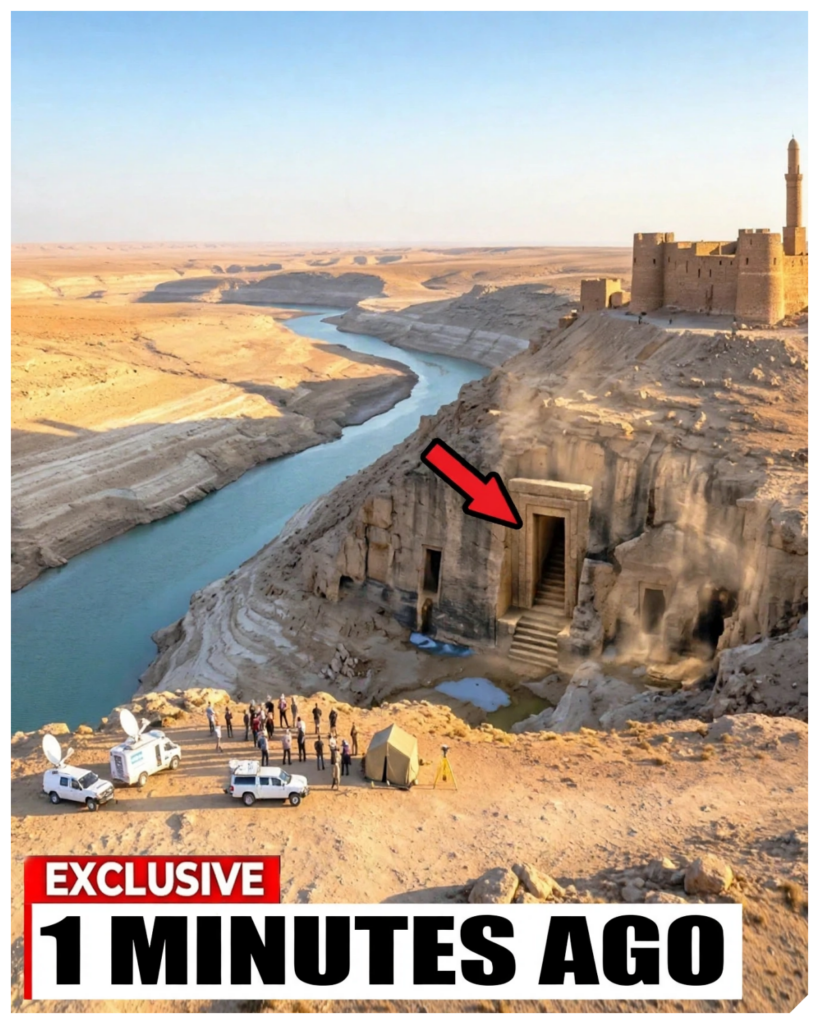
[music] [snorts] As the waters of the Euphrates River recede, The ancient riverbed begins to reveal what has long been hidden beneath it.
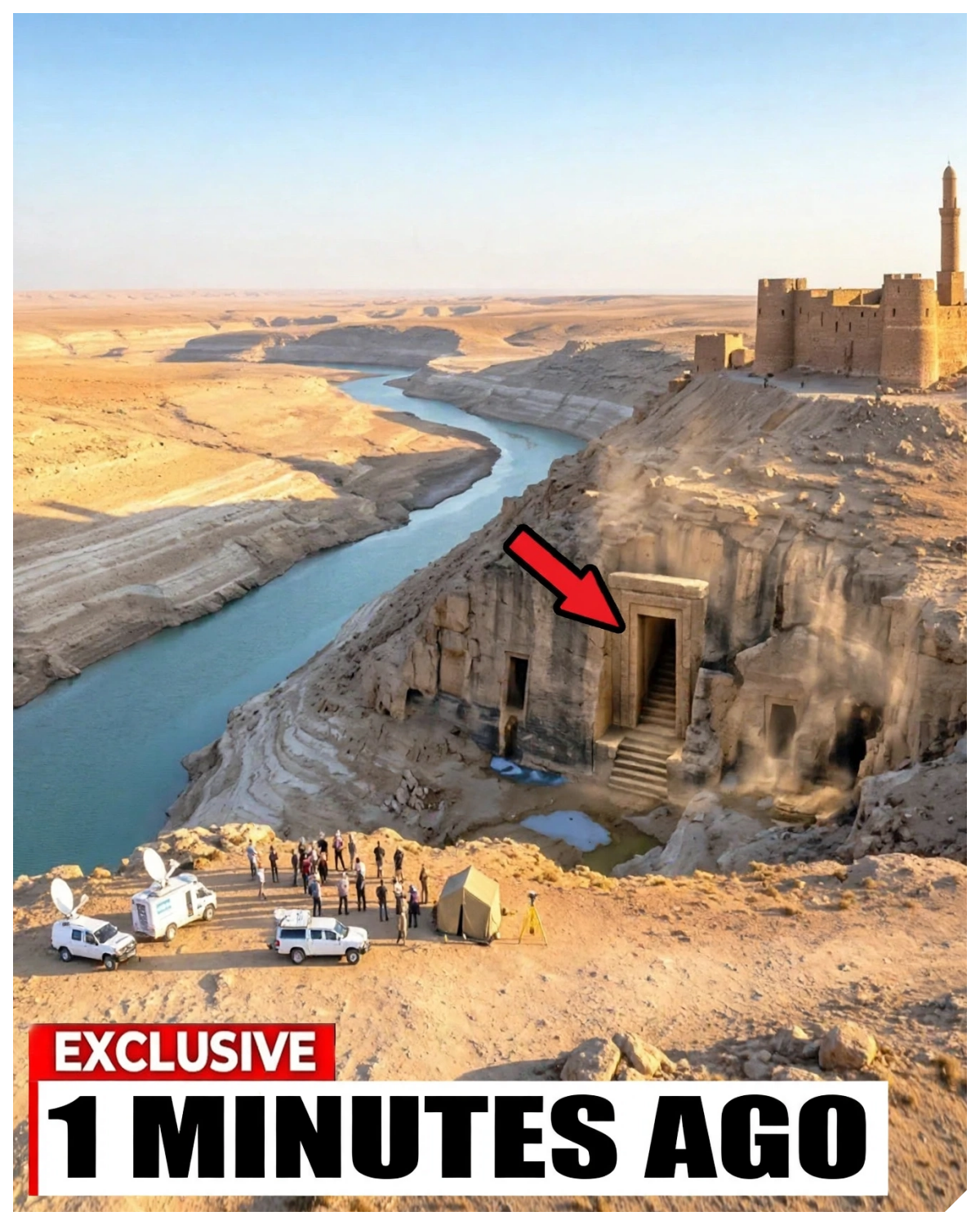
Among the exposed rocks, a deep crack leads explorers into a vast underground cavern.
Inside, they discover a turquoise lake where strange stone structures lie beneath the water.
But the mystery grows deeper.
Beyond the lake stands what appears to be a petrified forest buried beneath layers of hardened mud.
Following a narrow passage, the explorers enter a chamber filled with glowing crystal pillars where golden [snorts] veins run through the surrounding rock.
Nearby, abandoned mining tools raise an unsettling question.
Who came here before them?
And what were they searching for?
These are only the first discoveries.
What else lies hidden in the darkness?
And could any of it connect to the Bible?
Share your thoughts below and don’t forget to like, share, and subscribe as we uncover the mysteries ahead.
The mystery began when local residents discovered a deep crack in the exposed riverbed of the Euphrates.
Unlike the surrounding cracks, this opening extended far underground.
According to the account, a camera lowered through the narrow entrance revealed a vast cavern with passages disappearing into darkness.
Inside, unusual markings appeared along the stone walls, while a series of carefully shaped steps led deeper beneath the riverbed.
Their arrangement suggested that someone may have used these passages long ago.
Farther down, the passage narrowed and [music] the sound of dripping water began echoing through the darkness.
Yet, its source remained hidden.
These unusual features raised a troubling question.
Was this simply a natural cave shaped by water?
Or had someone deliberately created a passage leading to something hidden deep beneath the Euphrates?
To find out where the dripping water was coming from, the explorers decided to follow the narrow passage deeper into the cavern.
As they descended, the sound of water grew louder, suggesting that a larger source lay somewhere ahead.
Eventually, the passage opened into an enormous underground chamber.
Before them stretched a beautiful turquoise lake, surrounded by towering rock walls.
Its clear blue waters reflected their lights while the far shore disappeared into darkness.
At first, the lake appeared to be an ordinary underground body of water.
But a closer examination revealed something unusual beneath its surface.
A small underwater camera was lowered into the lake.
As it moved across the bottom, several rectangular stone formations came into view.
Nearby, a series of shapes resembling steps appeared to descend beneath the water, partially covered by sediment.
The unusual arrangement suggests that these structures may once have served a specific purpose.
But why would stone steps lead beneath the lake, and what could have caused them to disappear underwater?
The discovery also brought to mind a remarkable passage from the Bible.
In Genesis 7:11, scripture describes the fountains of the great deep bursting open during the flood in Noah’s time.
Although the underwater formations could not establish such a connection, the hidden lake offered a striking reminder of how water can conceal traces of the ancient world.
But the [snorts] mystery did not end beneath the lake.
As attention turned toward the far shore, several unusual stone formations became visible along the edge of the chamber.
At first glance, they resemble ordinary rock columns, but a closer examination reveals patterns that look surprisingly similar to the trunks of ancient trees.
Some formations display what appears to be wood grain, branching structures, and cracks filled with minerals.
Others remain deeply embedded in the surrounding sediment with only their upper sections visible.
Together, they create the appearance of a forest preserved beneath the ground.
The discovery raises questions about what this place might have looked like before it became part of an underground cavern.
If these formations are indeed petrified trees, they suggest that the surrounding landscape may once have supported vegetation before being buried by sediment and transformed over time.
One possible explanation involves powerful floods that carried enormous amounts of mud and debris across the land.
As layers of sediment accumulated, buried wood could gradually absorb minerals, preserving its original structure while turning it into stone.
For those familiar with the Bible, the scene brings to mind the great flood described in Genesis 7:17:23.
[music] Scripture tells how the waters continued rising, covering the earth, and overwhelming the living world.
Although these formations cannot establish a connection to Noah’s flood, their unusual preservation offers a striking reminder of how dramatically water can transform a landscape.
But one detail makes the discovery especially intriguing.
Several apparent tree trunks remain upright rather than lying scattered across the ground.
Could they have been buried while still standing, preserving the remains of a landscape that existed long before the cavern took its present form?
The answer remains uncertain, leaving the unusual formations as a mystery beneath the Euphrates.
Beyond the ancient forest, a narrow passage leads deeper into the cavern where golden colored veins run through the rock walls.
Some sections contain straight cuts and narrow channels, suggesting that valuable minerals may once have been extracted from the stone.
Nearby, [snorts] stone hammers, [music] broken tools, and scattered rock fragments lie across the ground.
These objects suggest that the area may have served as an ancient mine.
The most striking feature is the bright yellow material embedded in layers of white quartz resembling goldbearing rock.
If these deposits contain gold, they could explain why people ventured so far underground.
The possibility of gold beneath the Euphrates brings to mind an ancient prophecy recorded in Sahi Muslim, a collection of Islamic traditions.
According to the hadith, the Euphrates will one day reveal a mountain of gold leading to a deadly struggle among those seeking to claim it.
Although this prophecy does not describe an underground mine and is not found in the Bible, it carries a warning about the dangers of greed.
A similar message appears in 1 Timothy 6:10, where scripture warns that the love of money is a root of all kinds of evil.
The abandoned tools and mineral deposits raise an intriguing question.
If people once mined valuable materials here, why was the work suddenly abandoned?
Had the deposits been exhausted, or had something happened that forced the workers to leave their tools behind?
Whatever the explanation, the possibility of hidden gold beneath the Euphrates offers a striking reminder of how the pursuit of wealth can lead people into dangerous and uncertain places.
The abandoned mining tools were not the only clues left behind.
Behind a section of collapsed rock.
A narrow opening leads into a dry chamber containing rows of clay tablets resting on stone shelves.
Their [snorts] surfaces are covered with wedge-shaped markings resembling the ununiform writing used in ancient Mesopotamia.
A closer examination reveals something particularly interesting.
Several tablets appear to contain records of workers, quantities of precious metals, and shipments sent to royal storehouses.
These details suggest that the mining activity may have been part of a larger operation rather than the work of a few individuals searching for gold.
Among the tablets, one damaged piece attracts particular attention.
Its surface contains a series of lines and symbols resembling a diagram of underground passages.
Some markings appear to indicate another storage area beyond the known tunnels.
The records also bring to mind the extraordinary wealth of ancient Babylon.
In Daniel 5, the Bible describes King Belshazar holding a great feast during which golden vessels taken from the temple in Jerusalem were brought [music] out and used by his guests.
The account reveals how gold and precious objects represented royal power and wealth in Babylon.
However, nothing in the tablets establishes that the underground chambers were connected to Belshazzer or his kingdom.
One question now becomes especially important.
If the tablets recorded the movement of precious metals, where were those valuable materials being taken?
The diagram offers a possible clue.
Following the passage indicated by its markings, the explorers reach another chamber hidden behind a narrow stone entrance.
Inside the chamber, dozens of large clay jars stand in neat rows along the stone walls.
Some are placed inside shallow spaces carved into the floor, while others are stacked close together.
Most remain sealed with a thick black substance resembling bitumen, a material commonly used in ancient Mesopotamia to protect containers from moisture.
One of the jars has broken open, revealing a layer of hardened material inside.
Its appearance suggests that the vessel may once have contained grain, oil, or other supplies.
However, the exact contents cannot be determined without further examination.
The arrangement of the jars offers another clue rather than being scattered across the chamber.
They appear [music] to have been carefully organized with larger containers placed against the walls and smaller ones near the center.
This suggests that the room may have served as a storage facility where important supplies were kept for future use.
Such practices were essential in ancient societies where drought, poor harvests, and conflict could threaten food supplies.
Preserving [snorts] valuable resources allowed communities to prepare for periods of uncertainty.
A similar example appears in Genesis 41-47:49.
The Bible describes how Joseph gathered and stored grain throughout Egypt during seven years of abundance, preparing the nation for the famine that would follow.
Although this chamber has no established connection to Joseph, the sealed vessels bring to mind the importance of preparation and survival in the ancient world.
But one detail remains difficult to explain.
If these jars contained valuable supplies, why were so many left sealed and apparently unused?
Were they forgotten when the chamber was abandoned, or had the people who stored them been unable to return?
Without examining their contents, the original purpose of the vessels remains uncertain.
The sealed jars were not all used to store ordinary supplies.
At the far end of the chamber, several unusually heavy containers held something far more surprising.
[music] Inside were metallic grains, pieces of goldbearing quartz, and small fragments of worked gold.
Nearby, stone weights, [music] and broken containers lay scattered across the floor.
Their presence suggested that the valuable materials had been measured and prepared for transportation.
However, a passage leading out of the chamber was blocked by fallen rocks, leaving the containers behind.
This raised an important question.
Why would anyone abandon such valuable materials?
The blocked passage offered one possible explanation.
A sudden collapse may have prevented the gold from being removed.
It was also possible that another unexpected event had forced the workers to leave before completing their work.
The discovery brings to mind Isaiah 45:3, where God speaks of hidden treasures and riches stored in secret places.
Although the passage does not refer to this cavern, it offers a striking biblical parallel to the valuable materials concealed underground.
Yet the gold may not be the greatest mystery hidden beneath the Euphrates.
Other unusual discoveries could reveal clues about the people who once entered these underground passages and the ancient kingdoms they may have served.
What do you think these discoveries could mean?
Share your thoughts in the comments below.
And don’t leave just yet because what comes next may be even more mysterious than the hidden gold itself.
Deeper inside the cavern, a large stone chamber contains something entirely different from the mining tools and sealed containers.
Its walls are covered with detailed carvings of crowned rulers, precious vessels, and workers presenting valuable goods.
One carving is particularly unusual.
It depicts a long procession of people carrying heavy containers from underground passages toward a fortified city.
The containers resemble those found earlier, suggesting that the images may represent the transportation of precious metals.
Nearby, inscriptions appear to describe royal tribute, offerings, and valuable goods delivered to a ruler.
If these markings could be accurately translated, they might help explain the purpose of the underground complex and the people who controlled it.
The images also bring to mind one of the most powerful kingdoms described in the Bible, ancient Babylon.
In Daniel 2:37:38, the prophet Daniel interprets King Nebuchadnezzar’s dream of a great statue.
Its head is made of gold representing the king and the authority God had given him.
The image of gold is especially striking because Babylon was known for its wealth, powerful rulers, and magnificent buildings.
However, the carvings do not establish that the chamber belonged to Babylon.
Identifying the ruler or kingdom would require clearer inscriptions and further archaeological evidence.
Another detail makes the carvings particularly interesting.
Unlike ordinary decorations, the scenes appear to follow a sequence, beginning with workers underground and ending with valuable goods being presented before a ruler.
This arrangement suggests that the images may have been intended to record an important activity rather [music] than simply decorate the walls.
Could the carvings preserve the story of a forgotten source of royal wealth?
Or do they reveal an entirely different purpose for the underground chambers?
While many questions remain about what lies beneath the Euphrates, another remarkable discovery has drawn attention to the river’s exposed shores.
Near Kuselo’s village in southeastern Turkey, falling water levels at the Ataturkdam reservoir revealed unusual stone structures that had remained hidden beneath the water.
Local residents noticed the exposed remains and reported them to archaeological authorities.
When researchers examined the site, they identified several T-shaped stone structures resembling the ancient monuments of Gobecée.
Located in southeastern Turkey, Gobecée is famous for its massive limestone pillars arranged within monumental enclosures.
Some carry carvings of animals and mysterious symbols, offering a glimpse into the beliefs and building traditions of early human communities.
The similarity immediately raised questions about the newly exposed structures near the Euphrates.
Could they belong to the same ancient building tradition?
Professor Sabahhatin Ezer of a Diaman University suggested that the structures could be approximately 11,000 years old.
Researchers also identified smaller architectural remains nearby, indicating that the area may once have supported organized human activity.
What makes this discovery particularly interesting is the effort required to construct such monuments.
Even without modern machinery, ancient builders were able to shape large stones and arrange them into recognizable structures.
The work would have required planning, cooperation, and knowledge of stone construction.
Yet, their original purpose remains unclear.
Some ancient monumental sites are believed to have served as gathering places or locations for ceremonial activities.
Whether the structures near Kuzalos had a similar function remains a question for further archaeological study.
The discovery also raises the possibility that early communities along the upper Euphrates shared architectural traditions across a much wider region than previously understood.
Similar stone structures at different locations may help researchers trace connections between settlements and the movement of ancient ideas.
For readers familiar with the Bible, these monuments bring to mind Genesis 11:19, which describes people gathering in the land of Shinar to build a city and a great tower.
According to scripture, the builders wanted to make a name for themselves and prevent their people from being scattered.
But God confused their language, bringing their ambitious project to an end.
There is no archaeological evidence connecting the T-shaped pillars near Kuzalos to the Tower of Babu.
Nevertheless, the discovery offers an interesting opportunity to reflect on humanity’s ancient desire to construct monuments that would endure beyond their builders.
The stones also reveal something important about the changing Euphrates landscape.
Areas that once supported human activity can disappear beneath water and sediment only to become visible again when conditions change.
And the newly exposed pillars are not the only discoveries along the reservoir.
Archaeological surveys have also identified traces of ancient settlements, including rock cut spaces and pottery fragments, suggesting that the shores of the Euphrates preserve evidence of communities whose stories are still being uncovered.
The discovery of the T-shaped stone pillars was not the only remarkable finding along the Euphrates.
As water levels declined at the Ataturk Dam reservoir in southeastern Turkey, archaeological surveys revealed 10 ancient settlement areas that had remained hidden along the shores.
These sites offered a different picture of the region’s past.
Instead of monumental stone pillars, investigators encountered traces of everyday life, including pottery [music] fragments, structures carved into rock, and the remains of buildings once used by ancient communities.
Some of the most interesting features were chambers cut directly into the rocky landscape.
Their entrances and interior spaces suggested that people had deliberately modified the natural stone to create usable areas.
Archaeologists considered whether these chambers might have served as homes, workshops, or storage facilities.
The pottery fragments provided further clues.
In ancient settlements, clay vessels were essential for carrying water, storing grain, preparing food, and preserving valuable supplies.
Even broken pieces can help researchers understand how people lived, what materials they used, and how their communities developed.
These discoveries suggest that the Euphrates supported more than isolated settlements.
Its waters provided opportunities for agriculture, transportation, and trade, allowing communities to establish themselves in a region where access to reliable water was especially important.
But living beside such a powerful river also presented challenges.
Changing water levels, flooding, and shifts in the surrounding landscape could affect farmland, buildings, and access to resources.
Communities had to adapt to these conditions, sometimes changing how and where they lived.
The remains along the reservoir, therefore, preserve traces of a relationship between people and the river that continued across generations.
Some settlements may have been occupied for extended periods, while others could have changed or been abandoned as local conditions evolved.
For readers of the Bible, this landscape brings to mind the ancient world described in Genesis.
In Genesis 2:14, the Euphrates is named as one of the four rivers associated with the account of Eden.
Later, Genesis 11 describes people gathering in the land of Shinar, where they began building a city and the Tower of Babel.
Although these archaeological sites cannot be directly identified with those biblical locations, they provide a glimpse into the wider Mesopotamian world where settlements grew, communities organized their activities, and early civilizations flourished.
What makes the discoveries particularly remarkable is that many of these traces remained concealed until changing water levels exposed the surrounding ground.
Ordinarylooking rocks and fragments of pottery became clues to places where people once lived and worked.
Yet the 10 settlements represent only part of the Euphrates enormous history.
Beneath its waters and across the surrounding landscape, other remains may still be waiting to be discovered.
And that leaves one final question.
How many forgotten civilizations and untold stories might still lie hidden along the Euphrates, waiting for the river to reveal them?
Is the Euphrates River drying up?
Biblical warnings and a growing crisis in the fertile crescent.
For centuries, the Euphrates River has carried life across dry landscapes in the Middle East.
Its waters helped farmers grow crops, allowed towns to expand, and supported civilizations whose names still appear in the Bible.
Today, however, parts of this historic river system face a different reality.
Prolonged drought, rising temperatures, and growing demands for water have placed pressure on the communities that depend on it.
As water levels fall, exposed river banks, and struggling farmland offer visible signs of a crisis.
The question is no longer simply what the Euphrates meant to the ancient world, but what will happen if its waters become increasingly unreliable.
The Euphrates begins in the mountains of modern Turkey and travels through Syria into Iraq, eventually joining the Tigris before reaching the Persian Gulf.
Together, these rivers form the central waterways of Mesopotamia, a region whose name means the land between rivers.
Their channels cross areas where rainfall can be limited and unpredictable.
For generations, water drawn from the rivers has supported irrigation, drinking supplies, livestock, transportation, and local industries.
This geography explains why changes in their flow can affect people far beyond the immediate river banks.
A shortage upstream can eventually become a problem for families, farmers, and cities hundreds of miles downstream.
The surrounding region is often associated with the fertile crescent, [music] a broad area in which early communities developed forms of settled agriculture.
Access to river water helped people cultivate fields, store [music] harvests, and support larger populations.
Over time, towns grew into cities, and systems of trade, recordkeeping, and government became increasingly complex.
Ancient Mesopotamia was not built by water alone.
Its achievements depended on human invention, cooperation, and difficult choices.
Still, the rivers provided an essential foundation.
Their fertile flood plains made [music] life possible in places where surrounding land could be harsh, turning flowing water into a source of food, economic activity, and political influence.
That history makes the present decline striking.
In some parts of the basin, dry river banks have widened, fields have [music] received less irrigation water, and communities have faced uncertainty over future supplies.
The river has not disappeared along its entire course, and conditions vary greatly between locations and seasons.
Nevertheless, the wider pattern has raised serious concern.
Low rainfall, [music] intense heat, and heavy water use can reinforce one another.
When less rain falls and more moisture evaporates, [music] reservoirs and rivers come under additional stress.
The remaining water must then meet the demands of [music] people, agriculture, and ecosystems.
At the same time, an Iraqi government warning issued in 2021 drew international attention to the scale of the threat.
Officials cautioned that the country’s rivers could face a severe decline by 2040 if existing pressures continued.
This was a warning about a possible future, not a declaration that the Euphrates would certainly vanish on a specific date.
Such projections depend on rainfall, climate trends, water management, [music] and decisions made across national borders.
Even with those uncertainties, the warning served a purpose.
It showed that water scarcity was no longer a distant environmental concern.
[music] For Iraq, it had become a matter of national planning and human security.
Other evidence has shown how substantial the losses can be.
Satellite observations of the Tigris [music] and Euphrates basins indicated that the wider region lost approximately 144 cubic kilm of fresh water between 2003 and 2013.
[music] That estimate includes different forms of water storage across the basin rather than measuring a single drop in the Euphrates [music] itself.
Researchers used observations from space to detect changes that would be difficult to assess through isolated measurements on the ground.
The resulting picture was troubling.
A historically water dependent region was losing reserves on a scale large enough to affect its long-term resilience.
During dry years, flows in the wider Tigris and Euphrates system have also fallen far below historical averages.
The causes are not identical everywhere.
Natural variations in rainfall matter, but so do dams, reservoirs, irrigation withdrawals, [music] groundwater use, and the decisions of upstream and downstream authorities.
A river can look healthy in one stretch while another suffers from reduced flow.
Reservoir releases may temporarily raise levels without eliminating the underlying shortage.
Understanding this complexity is essential because describing the entire Euphrates as completely dry would be inaccurate.
The more serious issue is whether its flow will remain dependable enough to sustain the populations relying on it.
Climate change adds another layer of difficulty.
The Middle East is exposed to high temperatures and water stress and continued warming can intensify evaporation while increasing the demand for irrigation.
Heat can damage crops [music] directly even when some water remains available.
Changes in rainfall patterns may [music] also make wet and dry periods more difficult to predict.
A farmer needs more than an occasional rise in river levels.
Crops require water at the [music] right stages of growth.
When seasonal conditions become less reliable, planning becomes harder.
Investments carry greater risks and a single poor harvest can have lasting [music] consequences for a household.
For farmers along the river, the effects are immediate and practical.
Reduced irrigation can leave planted fields [music] unable to reach harvest, forcing families to cut production or switch to crops that require less water.
Some must purchase supplies at higher prices, [music] while others consider leaving land cultivated by earlier generations.
Livestock owners face similar problems when grazing areas deteriorate and drinking water becomes [music] scarce.
These changes can gradually undermine local economies.
Markets receive fewer agricultural products, seasonal employment declines, and families already living with limited resources have less protection against rising food costs.
Water scarcity also transforms life in towns and cities.
Municipal systems need reliable supplies for homes, schools, hospitals, and businesses.
When river levels are low, water quality can deteriorate as pollutants become more concentrated and treatment becomes more difficult.
Some households may turn to private deliveries or unsafe [music] sources when regular services fail.
The consequences often fall hardest on people who cannot afford alternatives.
A crisis that begins with reduced rainfall can therefore develop into a broader emergency involving sanitation, public health, household income, and [music] access to basic services.
Health professionals have warned that inadequate clean water creates conditions in which infectious diseases can spread more easily.
A 2023 British Medical Journal discussion highlighted water related health pressures in Iraq, including concerns about chalera and other illnesses.
Contaminated drinking supplies and inadequate [music] sanitation can become particularly dangerous during periods of shortage.
At the same time, overcrowding, displacement, and [music] interrupted medical services may add to the burden on vulnerable communities.
Not every disease mentioned in discussions of Iraq’s health challenges is caused by a shrinking river, but the availability of safe water remains a critical part of preventing serious outbreaks.
The environmental cost extends beyond people.
Rivers support wetlands, fish, birds, and plant communities adapted to changing seasonal conditions.
When freshwater supplies decline, habitats can shrink and salinity can become a greater concern, particularly in low-lying areas.
Southern Iraq’s marshlands are especially [music] significant because they preserve an ecological and cultural landscape shaped by water over generations.
Reduced inflows can leave channels shallow and vegetation stressed.
Fishing and traditional marshbased livelihoods become harder to maintain.
The loss is not only economic, it also threatens places closely connected to the identity and history of the people who live there.
Managing the Euphrates is complicated because its water crosses political borders.
Turkey, Syria, and Iraq each have their own needs, infrastructure, and development priorities.
Reservoirs and dams can provide electricity, regulate flooding, and support agriculture, but they also influence [music] how much water reaches downstream communities.
During shortages, these competing demands become more difficult to balance.
An upstream country may need water for its own population, while a downstream region fears losing access to a resource it cannot easily replace.
Without sustained communication and shared planning, ordinary questions about reservoir operation can become sources of mistrust.
Cooperation over the Tigris and Euphrates basin has faced obstacles, including political instability and disagreements over allocation.
Water does not cause every conflict in the region, and it would be misleading to claim that a major war is inevitable.
Yet scarcity can intensify existing tensions by adding pressure to agriculture, energy production, and public services.
Armed groups may also exploit vulnerable infrastructure or disrupted supplies.
The danger is therefore broader than a dramatic struggle over a riverbank.
Water insecurity can weaken institutions, increase displacement, and make already difficult political problems harder to resolve peacefully.
[music] Possible responses are less dramatic than predictions of future water wars, but they matter to the people affected.
Better irrigation methods can reduce waste, while repairing damaged supply networks [music] can conserve water that would otherwise be lost before reaching homes or fields.
Reliable monitoring helps authorities understand how much water is available and where shortages are developing.
Agreements between neighboring countries [music] can support more predictable management during difficult seasons.
Protecting wetlands, treating waste water, and planning crops around local conditions can also improve resilience.
None of these measures can guarantee abundant water.
But together, they offer practical ways to reduce the danger.
For many Christians, however, reports about the Euphrates [music] carry another layer of meaning.
The river appears in Genesis where it is named among the waterways associated with the account of Eden.
Its mention places the Euphrates within one of scriptures earliest descriptions of the world.
Later biblical narratives also unfold against the wider background of Mesopotamian kingdoms, migrations and conflict.
The river therefore holds an important place in religious imagination as well as geography.
When news images show cracked ground and declining water, some viewers naturally ask whether these changes connect to prophecies they have read for years.
One passage stands out.
Revelation 16:12 describes the sixth angel pouring out a bowl upon the great river Euphrates, [music] causing its water to dry up and preparing the way for kings from the east.
The image is dramatic, appearing within a sequence of visions about divine judgment.
It is understandable that modern drought reports remind some believers of these words.
But the verse does not provide a scientific explanation for contemporary water shortages.
Nor does it identify a particular modern drought as the fulfillment of the vision.
Christians have interpreted revelation in different ways, [music] including symbolic, historical, and future oriented readings.
The New Testament also teaches caution about attempts to establish a precise timetable [music] for the end of the age.
In Matthew 24-36, Jesus says that no one knows the day or hour.
That warning matters whenever a natural disaster is presented as definitive proof that the rapture or second coming is immediately [music] at hand.
Belief in Christ’s return is central to many Christian traditions.
But different churches disagree about the sequence of end times events, including the meaning and timing [music] of the rapture.
The drying of a river, however serious, cannot settle those theological disagreements or establish a date for what believers await.
There is a lesson in the contrast between biblical imagery and present conditions.
Revelation directs attention toward judgment and the limits of earthly power, while the water crisis reveals how dependent human societies remain on the natural world.
The same river that nourished ancient civilizations now tests the ability of modern governments to cooperate and protect their people.
For Christians, the situation can encourage prayer, responsible stewardship, and compassion for families [music] facing hardship.
For others, it provides a clear reason to support sound environmental policy.
Neither response requires exaggerating [music] what scientists know or dismissing the spiritual significance that scripture holds for believers.
The Euphrates remains a vital historic river, [music] but its future remains deeply uncertain.
Its condition will depend on climate, rainfall, infrastructure, agricultural choices, [music] and cooperation across borders.
People living beside it need reliable water more urgently than they need sensational predictions.
The river’s changing landscape may invite reflection on ancient history and biblical passages.
Yet, it also demands attention to present suffering.
What happens next will not be determined by a single photograph of cracked earth or one unusually dry [music] season.
It will emerge from many decisions made over time.
As the waters face mounting pressure, the question is how wisely humanity will respond.
The nature of covenants.
Throughout the [music] scriptures, the relationship between God and his people is described through promises that carry both blessings and responsibilities.
These promises are called covenants.
They are more than ordinary agreements because they involve sacred commitments between Heavenly Father and his children.
A covenant establishes a relationship in which God reveals his will, explains what he expects, and promises blessings to those who faithfully follow him.
For members of the Church of Jesus Christ of Latter-day Saints, understanding covenants is essential to understanding the purpose of the gospel, the importance of sacred ordinances, and the responsibilities that come with belonging to the Lord’s people.
Covenants [music] help believers recognize that their relationship with God is not limited to occasional prayer or religious observance.
It is a continuing commitment that shapes how they live, worship, and serve throughout their lives.
Unlike agreements made between individuals, the terms of a divine covenant are established by God.
Human beings do not determine what obedience should require or what eternal blessings should follow.
Instead, the Lord reveals his commandments and invites his children to accept them through faith.
This distinction matters because a covenant is not simply an exchange in which a person offers a good action in return for a desired [music] reward.
It is an invitation to enter a relationship with a loving heavenly father who understands the needs and eternal potential of his children.
The commandments connected to his promises provide direction while the blessings demonstrate his desire to help individuals progress toward him.
The covenant relationship also depends on human agency.
God invites people to receive his promises, but he does not remove their freedom to choose.
Every [music] person must decide whether to accept the responsibilities associated with the gospel.
A covenant therefore involves conscious commitment rather than passive membership in a religious community.
Someone may know the teachings of Jesus Christ, admire his example, and participate in religious activities without fully understanding what it means to make a sacred promise.
Entering a covenant requires a willingness to follow the Savior, even when [music] doing so demands personal sacrifice.
That decision gives religious observance a deeper purpose connecting outward actions with an inward desire to belong to God.
The scriptures present this relationship across many generations.
God made promises to individuals and communities facing different circumstances.
Yet his purpose remained consistent to guide his children toward righteousness and prepare them to receive his blessings.
Adam was instructed concerning obedience and redemption.
Enoch taught a people who were called to live in holiness.
Noah received a promise involving his family and the living creatures of the earth after the flood.
The children of Israel were invited to become a holy nation through their relationship with the Lord.
Although the responsibilities and circumstances differed, these examples show how divine promises helped people recognize their duties and understand their place within God’s work.
One of the clearest examples appears after the flood in Genesis 9.
[music] God established a covenant with Noah and his descendants, promising that the waters would never again destroy all living creatures in a worldwide flood.
The rainbow became the visible sign associated with that promise.
Its significance was not limited to Noah’s immediate family.
The covenant extended to future generations and the living [music] world.
This account reveals that God’s commitments can reach beyond the lifetime of the person who first receives them.
It also demonstrates that a covenant may be remembered through a sign [music] that directs attention back to divine faithfulness.
Whenever the rainbow appears in the biblical narrative, it recalls a promise made by God rather than an achievement of human power.
Another important example is found in Exodus 19 when the Lord addressed Israel after delivering the people from Egypt.
He reminded them of what he had done and invited them to obey his voice and keep his covenant.
If they remained faithful, they would become a treasured people, a kingdom of priests, and a holy nation.
The promise gave Israel a distinct responsibility among the surrounding nations.
Their identity was not meant to rest only upon ancestry, territory, or political independence.
It was to [music] be expressed through obedience and a way of life reflecting God’s commandments.
The relationship between deliverance and covenant is especially important.
The Lord first demonstrated his power and mercy, then invited the people to respond with faithfulness.
This pattern helps explain why covenants are closely connected [music] to the gospel of Jesus Christ.
Christians believe that humanity cannot overcome sin or obtain eternal life through personal effort alone.
The Savior’s atonement makes repentance, forgiveness, and reconciliation with God possible.
Covenants do not replace that saving work.
Instead, they describe how individuals respond to the redeemer [music] and receive the blessings he offers.
In Latter-day Saint teaching, a person enters the covenant path through faith in Jesus Christ, repentance, baptism, and receiving the gift of the Holy Ghost.
These actions are not independent religious accomplishments.
They are connected expressions of a commitment to follow the Savior and continue learning from him.
Baptism provides a particularly meaningful example.
When someone is baptized, that person enters a sacred relationship with God and takes upon themselves the name of Jesus Christ.
This promise includes a willingness to follow his teachings and remain faithful throughout life.
The act of entering the water symbolizes a new beginning while emerging from it points toward spiritual renewal.
In Latter-day Saint doctrine, baptism must be performed by proper [music] priesthood authority, making it both a personal commitment and an authorized ordinance [music] of the church.
Its meaning extends beyond a single ceremony.
The person who is baptized accepts a new responsibility to remember the Savior and live as one of his disciples.
The promise connected with baptism is explained in Doctrine and Covenants 18:22.
The passage teaches that those who repent [music] are baptized in the name of Jesus Christ and endure to the end shall be saved.
These words bring together several essential elements of covenant living.
Repentance requires turning away from sin.
Baptism marks formal entry into the covenant relationship.
Enduring to the end involves continuing in faith despite weakness, opposition, or changing circumstances.
The promised blessing is therefore connected to a lasting relationship with Christ.
A single act of obedience begins a journey that must be continued through the choices and responsibilities of everyday life.
[music] Because human beings remain imperfect after baptism.
The gospel also provides a way to renew their commitment.
Members of the Church of Jesus Christ of Latter-day Saints participate in the sacrament, remembering the body and blood of Jesus Christ through bread and water.
The prayers associated with this ordinance express a willingness to take upon themselves the Savior’s name, always remember him, and keep his commandments.
The promised [music] blessing is that they may always have his spirit to be with them.
This makes the sacrament a regular opportunity for spiritual reflection.
Rather than treating past commitments as sufficient, worshippers are invited to consider their present conduct and renew their determination to follow Christ.
Remembering the Savior is a practical responsibility as well as a spiritual principle.
It can influence decisions made in moments when religious instruction seems far removed from daily concerns.
A person who remembers Christ may choose honesty when dishonesty offers an advantage, patience when anger seems easier, or compassion when another person’s suffering creates an inconvenience.
Such decisions reveal whether covenant commitments are becoming part of individual character.
They do not require public recognition.
Their importance lies in demonstrating that the promises made to God remain meaningful outside formal worship.
The covenant relationship therefore reaches into ordinary circumstances making disciplehip a continuing responsibility rather than an activity reserved for particular days.
The gift of the Holy Ghost is another central blessing associated with covenant membership.
According to Latter-day Saint teaching, the Holy Ghost can provide guidance, comfort, warning, and spiritual understanding.
His influence helps believers recognize truth and develop greater sensitivity to God’s [music] will.
This does not mean that faithful people will never experience uncertainty or difficulty.
Rather, they are promised access to divine help as they [music] strive to live worthily.
Spiritual guidance may come through prayer, scripture study, quiet impressions, or experiences that encourage greater faith and responsibility.
The promise of the spirit’s companionship gives covenant living a personal dimension, reminding believers that they are not expected to face every challenge without heavenly assistance.
Temple covenants extend this relationship into additional sacred responsibilities.
In Latter-day Saint belief, temple ordinances teach principles connected with God’s plan for [music] his children and invite participants to make solemn promises of obedience, sacrifice, and consecration.
Temple worship also directs [music] attention toward the possibility of eternal family relationships.
These teachings are associated with the church’s understanding of exaltation, which refers to the highest blessings available through Jesus Christ and faithful adherence to divine covenants.
Because temple ordinances are regarded as sacred, members are encouraged to prepare spiritually before participating.
Such preparation includes living the commandments, strengthening faith, and understanding that sacred promises involve responsibility beyond the moment they are made.
The blessings associated with covenants should not be understood as guarantees of worldly comfort.
Scripture contains many accounts of faithful individuals who experienced suffering, [music] rejection, poverty, or uncertainty.
Their difficulties did not necessarily indicate that God had abandoned his promises.
The Lord’s purposes often extend beyond immediate circumstances, and many promised blessings concern spiritual growth and eternal life.
This distinction is important when evaluating personal hardship.
Someone who faithfully keeps a covenant may still experience illness, family problems, financial difficulty, or disappointment.
Covenant faithfulness does not eliminate the challenges of mortal life.
It provides a foundation for meeting those challenges with hope, guidance, [music] and trust in God’s ultimate purposes.
Obedience remains necessary because sacred promises cannot be separated from the responsibilities attached to them.
Doctrine and Covenants 82:10 teaches that the Lord is bound when his people do what he commands.
But when they do not, they have no promise.
Within Latter-day Saint theology, this statement emphasizes God’s reliability and the seriousness of human commitment.
It does not suggest that people possess the power to control God through religious performance.
Rather, the Lord faithfully honors the terms he has established.
If individuals deliberately reject those terms, they cannot reasonably expect the blessings specifically conditioned upon their obedience.
The passage therefore encourages integrity in spiritual life and respect for promises made voluntarily.
At the same time, covenant living must leave room for repentance.
Individuals who make sacred promises do not become incapable of making mistakes.
They continue learning, confronting weaknesses, and seeking forgiveness.
The gospel teaches that Jesus Christ makes genuine [music] change possible through his atonement.
Repentance involves recognizing wrongdoing, turning toward God, and making appropriate efforts to correct harmful behavior.
It is neither a substitute for obedience nor evidence that covenants have lost their meaning.
Instead, it provides a way to return to faithful disciplehip after falling short.
This understanding allows covenant obligations to remain serious without making spiritual progress dependent upon an unrealistic expectation of immediate perfection.
The responsibilities associated with covenants also extend beyond individual spiritual development.
A person who promises to follow Jesus Christ accepts an obligation to treat others according to his teachings.
Love, generosity, forgiveness, and [music] service become expressions of loyalty to him.
In the Book of Mormon, King Benjamin teaches that serving fellow human beings is a way of serving God.
This principle helps explain why the church connects covenant commitments with missionary work, family responsibilities, and care for people in need.
Sacred promises are not intended to create spiritual isolation.
They prepare believers to participate more fully in the work of blessing others.
Understanding covenants, therefore, changes the meaning of belonging to the Lord’s people.
Covenant identity is not merely a religious title inherited from parents or received through participation in an institution.
It involves a [music] continuing relationship characterized by promises, obligations, spiritual growth, and divine assistance.
The outward ordinances are important because they formally establish and renew that relationship, but their purpose reaches into the attitudes and actions of those who receive them.
A covenant becomes meaningful when a person allows the principles of the gospel to shape personal conduct.
Through this process, the believer gradually learns that faithfulness is expressed not only in what is promised to God, but in the kind of life built around that promise.
The larger purpose of divine covenants is to bring God’s children closer to him.
Their commandments establish direction.
Their ordinances provide sacred opportunities for commitment.
And [music] their promised blessings offer hope beyond the limitations of mortality.
Each covenant invites individuals to trust the Savior more completely and develop the attributes associated with his life.
This relationship also helps explain why the scriptures return repeatedly to the theme of remembrance.
People are encouraged to remember what God has done, what they have promised, and what they are becoming through obedience.
Such remembrance gives continuity to spiritual life, connecting past experiences with present decisions and future expectations.
These principles prepare the way for understanding one of the most significant covenants recorded in the Old Testament.
Through Abraham, the Lord established promises that extended beyond one righteous man and his immediate household.
Those promises involve descendants, priesthood [music] blessings, the spreading of the gospel, and the opportunity for families throughout the earth to receive divine blessings.
The Abrahamic covenant demonstrates how a sacred [music] relationship can shape the responsibilities of entire generations while remaining connected to the choices of individual believers.
Its significance is not confined to the distant past.
Within Latter-day Saint teaching, it continues to explain why God’s covenant people are called to serve others and [music] carry the message of Jesus Christ throughout the world.
God’s covenant with Abraham and his descendants.
[music] The story of Abraham introduces a remarkable development in the biblical understanding of God’s relationship with humanity.
[music] Rather than presenting a promise intended only for one individual, the scriptures describe blessings that would extend through Abraham’s descendants and reach families throughout the earth.
Abraham lived in a world where religious practices, family loyalties, and local traditions strongly influenced everyday life.
According to the book of Abraham in Latter-day Saint scripture, he sought [music] the blessings of the fathers, greater righteousness, and the authority associated with the priesthood.
His desire was not simply to possess land [music] or acquire material success.
He wanted to establish a lasting relationship with God and receive blessings that would help him fulfill a divine purpose.
Abraham’s spiritual journey required him to separate himself from beliefs and practices that conflicted with his devotion to the Lord.
The book of Abraham describes his refusal to accept the idolatrous worship associated with his father’s household.
[music] This background highlights an essential aspect of his character.
He was willing to seek God even when that decision placed him at odds with familiar expectations.
Faithfulness involved more than private conviction.
It required action, courage, and a willingness to follow divine instruction into circumstances he could not fully predict.
Abraham therefore became an example of someone whose commitment to God influenced the direction of his entire life.
In Genesis 12, the Lord instructs Abram to leave his country, his relatives, and his father’s household for a land that God would show him.
This command is important because Abraham was not given every detail about the journey before he began.
He received a promise and responded by moving forward.
His obedience demonstrated trust [music] in the one who had called him.
The journey also established an enduring biblical theme.
God’s people may be asked to leave familiar circumstances in order to fulfill responsibilities they do not yet completely understand.
For Abraham, faith was expressed through movement, dependence upon divine guidance, and a willingness to make choices [music] based on promises that had not yet been fulfilled.
The Lord’s promises included the formation of a great nation, the blessing of Abraham’s name, and the assurance that other families would receive blessings through him.
These statements gave Abraham’s calling a purpose extending beyond personal advancement.
His future descendants were to become instruments [music] through whom divine blessings could reach others.
The covenant was therefore both a gift and a responsibility.
God offered extraordinary promises, but those promises were connected with a larger work.
Abraham’s family was not chosen merely to enjoy privileges unavailable to everyone else.
Through that family, the Lord intended to provide opportunities for other people to know him and receive his blessings.
One of the most remarkable promises concerned Abraham’s descendants in Genesis 15.
God directs Abraham’s attention toward the heavens and compares his future offspring to the stars.
The image communicated abundance at a time when Abraham and Sarah faced the painful uncertainty of having no [music] child together.
The promise seemed difficult to reconcile with their immediate circumstances.
That difficulty is central to the story because it reveals the difference between trusting what is already visible and trusting what God has declared.
Abraham could not produce the promised future through certainty about present conditions.
His responsibility was to remain faithful while the fulfillment of the promise rested in the Lord’s hands.
The passage also emphasizes Abraham’s belief in God.
Genesis [music] 15-6 connects his faith with righteousness, establishing a principle later discussed in the New Testament.
The significance of Abraham’s faith was not that he understood every event awaiting him.
He accepted God’s promise despite limitations in his own knowledge.
This distinction would become essential to later Christian teaching about the relationship between faith and divine grace.
Abraham’s example shows that righteousness begins with trust in God.
While genuine trust finds expression in obedience, faith and action are not presented as competing forces in his story.
They belong to the same continuing relationship.
The promise of descendants eventually became inseparable from the promise of land.
God directed Abraham toward Canaan and established that his posterity would have a significant relationship with that territory.
In Genesis 17, the Lord describes his covenant as everlasting and speaks of becoming the God of Abraham’s descendants.
The land promise occupies an important place in the historical narrative of Israel.
But the covenant carries implications reaching beyond possession of territory.
It involves worship, divine identity, family continuity, and the relationship between obedience and blessing.
The Lord’s promise is therefore best understood within the wider biblical account rather than reduced to a single geographical claim.
The change of Abram’s name to Abraham marked another important moment.
In Genesis 17, God associates the new name with Abraham’s calling as the father of many nations.
Names frequently carry special meaning in biblical narratives, particularly when a change accompanies a new responsibility or divine promise.
Abraham’s new name directed attention toward the future God had declared for him.
It represented an identity shaped by covenant rather than simply by his earlier circumstances.
The change also reinforced that his family history would become part of a larger story involving peoples and generations who had not yet been born.
Sarah’s role is equally important to understanding the covenant.
The biblical account does not present the promised family as an achievement belonging to Abraham alone.
Sarah also received a divine promise concerning a son and the nations that would come through her descendants.
Her experience gives the narrative a deeply personal dimension.
The promised future involved waiting, disappointment, questions, and eventual joy.
Isaac’s birth represented more than the arrival of an heir.
It demonstrated that the covenant promises were being fulfilled through the family God had identified, despite circumstances that appeared to make such an outcome impossible.
Abraham’s later experiences tested whether his devotion depended upon receiving blessings in the manner he expected.
Genesis 22 describes the command involving Isaac, a passage that has generated extensive reflection because of its emotional and moral weight.
Within the biblical narrative, Abraham’s willingness to obey becomes a profound demonstration of trust, while God’s intervention prevents Isaac’s [music] death.
Christian readers have often understood elements of the account as pointing toward the sacrifice of Jesus Christ.
Latter-day Saint teaching likewise emphasizes the importance of Abraham’s obedience and the lessons of sacrifice.
The episode reminds believers that covenant faithfulness may require difficult choices even when the full purposes of divine commandments are not immediately apparent.
The covenant continued through Isaac and Jacob.
The Lord reaffirmed promises to them, showing that Abraham’s calling was not intended to end with his lifetime.
Through Jacob, whose name became Israel, the family developed into the people who would occupy a central place in [music] the Old Testament.
The biblical record then follows their experiences through migration, captivity, deliverance, and the establishment of a national identity.
These events demonstrate how an individual covenant could become part of the history of an entire people.
Yet the continuation of the promise did not eliminate personal responsibility.
Each generation faced decisions concerning worship, obedience, justice, and faithfulness.
The covenant with Abraham includes a further dimension emphasized in Latter-day Saint [music] scripture.
Abraham 2:11 teaches that his descendants would receive priesthood blessings [music] and that the families of the earth would be blessed through his ministry and posterity.
This passage gives special importance to the transmission of saving knowledge and sacred ordinances.
The priesthood in this teaching is not merely a position of religious honor.
It is the authority through which God authorizes the performance of ordinances and organizes his work among his [music] children.
The promise to Abraham therefore concerns the opportunity for people across the world to receive gospel blessings, [music] not simply the prosperity of one ancestral line.
That understanding changes [music] how the idea of being chosen should be interpreted.
If Abraham’s descendants are called to bless other families, their calling involves service rather than superiority.
A covenant people have responsibilities precisely because they have received knowledge and opportunities that can benefit others.
The promise does not justify pride, exclusion or indifference toward those outside the community.
Instead, it establishes an obligation to extend blessings.
In Christian teaching, that responsibility ultimately finds its fulfillment through Jesus Christ whose saving work is offered to humanity.
Abraham’s covenant becomes part of the larger divine purpose of making redemption available beyond the limits of one nation.
The Apostle Paul develops this principle in his discussion of Abraham and faith.
In Galatians 3, he teaches that those who belong to Christ [music] are Abraham’s seed and heirs according to the promise.
This statement is particularly significant because it extends covenant inheritance beyond direct biological descent.
Paul presents faith in Jesus Christ as the basis for participating in the blessings associated with Abraham.
In Latter-day Saint interpretation, this helps explain how individuals from different backgrounds can become part of the covenant family [music] through receiving the gospel.
Their ancestry does not prevent them from entering the relationship God established.
Covenant identity becomes connected with accepting Christ and faithfully [music] living his teachings.
The idea of adoption into Abraham’s family is also developed in the Book of Mormon and the Pearl of Great Price.
[music] Abraham 2:10 teaches that those who receive the gospel may be accounted as Abraham’s seed.
This does not require every convert to establish a particular biological lineage.
Instead, it emphasizes participation in the spiritual inheritance promised through the covenant.
Individuals who accept the gospel become responsible for carrying forward the work associated with Abraham’s calling.
The concept offers a broad understanding of belonging in which people from many nations can share a common religious responsibility while retaining their different cultures, histories, [music] and family experiences.
The connection between Abraham and missionary work follows naturally from this teaching.
If all families of the earth are intended to receive blessings through his covenant, sharing the gospel becomes an important expression of that purpose.
Missionaries and other church members seek to teach about Jesus Christ, [music] repentance, baptism, and the possibility of eternal life.
Within Latter-day Saint belief, this work helps fulfill the promise that divine blessings would reach the nations.
Missionary service is therefore understood as more than an effort to increase church membership.
It is connected to the responsibility of inviting others to receive sacred [music] ordinances and establish their own relationship with Heavenly Father.
The covenant also has implications for family life.
Abraham’s story is centered upon relationships between generations and Latter-day [music] Saint teaching places.
Considerable importance on the possibility of eternal family bonds.
Parents are encouraged to teach children about God, demonstrate faith through their behavior, and create homes where love and responsibility are practiced.
These efforts reflect the broader purpose of passing spiritual knowledge from one generation to [music] the next.
Yet, the covenant should not be understood as a promise that family relationships will automatically become free from pain or conflict.
Its principles invite individuals to practice patience, forgiveness, and commitment while trusting the Lord’s promises concerning eternal life.
Modern circumstances offer many opportunities to apply Abraham’s example.
A person may face decisions involving employment, education, family responsibilities, or personal convictions without knowing exactly how those choices will unfold.
Abraham’s journey illustrates the importance of responding faithfully to divine direction even when certainty is unavailable.
Such faith does not require abandoning careful thought or practical responsibility.
It involves placing moral and spiritual commitments at the center of decisions.
The question becomes whether a chosen course strengthens one’s ability to obey God, serve others, and remain faithful to promises already made.
Abraham’s willingness to follow God also offers a lesson about humility.
The biblical narrative does not portray him as someone who controlled the fulfillment of divine promises.
He experienced delay and uncertainty and [music] his family faced complications arising from human decisions.
These experiences prevent the covenant from being reduced to a simple account of immediate reward for correct behavior.
Instead, they demonstrate a relationship that continued across changing circumstances.
Abraham’s faithfulness mattered because he remained willing to respond to God.
His life shows that sacred promises can guide a person through a process whose full meaning may become visible only over time.
The responsibilities flowing from the Abrahamic covenant are therefore [music] both spiritual and practical.
Those who identify with that covenant are called to receive the gospel, honor the authority and ordinances established by the Lord, strengthen their families, and help extend blessings to others.
[snorts] These responsibilities are not limited to formal missionary assignments.
They can be expressed through teaching children, helping neighbors, caring for vulnerable people, and demonstrating integrity in ordinary relationships.
The promise that all families may be blessed invites believers to consider whether their conduct makes the influence of the gospel visible and beneficial to those around them.
Abraham’s covenant ultimately points toward a continuing divine purpose rather than an isolated event in ancient history.
Its promises connect the earliest patriarchal narratives with the ministry of Jesus Christ and the responsibilities of believers in the present.
The covenant describes a family of faith through which blessings are intended to reach outward, inviting others into a relationship with God.
Its lasting importance is found in this union of divine generosity and human responsibility.
Abraham received promises that transformed his future, but he was also called to participate in work extending far beyond his own household.
Those who regard themselves as heirs of the covenant inherit [music] that same obligation to bless others through faithful disciplehip.
The Lord’s covenant people and the new and everlasting covenant.
For members of the Church of Jesus Christ of Latter-day Saints, [music] the promises made to Abraham are not merely historical teachings.
They help explain the identity, responsibilities, [music] and eternal hopes of the church today.
Latter-day Saints believe that those who accept the restored gospel of Jesus Christ [music] and faithfully enter into sacred ordinances become part of the Lord’s covenant people.
This relationship includes individuals from many nations and backgrounds united not by a common earthly ancestry but by their commitment [music] to the Savior.
Belonging to the covenant people therefore carries a meaning that extends beyond membership records [music] or participation in religious meetings.
It involves accepting responsibilities connected to God’s work and [music] striving to receive the blessings he has promised.
The church teaches that these blessings are available through the gospel of Jesus Christ.
[music] Individuals are invited to develop faith in him, repent, receive baptism by proper authority, and obtain the gift of the Holy Ghost.
As they continue on the covenant path, they may receive additional ordinances associated with temple worship and eternal family relationships.
Each stage carries responsibilities intended to help believers become more like the Savior.
The path is understood as a continuing process rather than a series of ceremonies completed independently of one another.
Its purpose is to deepen disciplehip and prepare individuals to live in God’s presence.
In this understanding, the covenant people are not a community whose members have already achieved spiritual perfection.
They are individuals who have committed themselves to progress through the grace of Jesus Christ.
Some are new converts learning the principles of the gospel.
Others have [music] participated in church life for decades.
Their experiences, knowledge, and personal challenges may differ greatly.
What unites them is the decision to accept the Savior’s invitation and continue seeking his guidance.
This makes covenant membership a relationship involving both individual accountability and mutual encouragement.
Members are expected to strengthen one another rather than assume that religious identity alone proves personal righteousness.
One important expression of this responsibility is missionary service.
Latter-day Saints believe that the command to share the gospel applies to the church throughout the world.
Full-time missionaries are a visible part of this work, but ordinary members also participate by explaining their beliefs, inviting others to learn, [music] and demonstrating Christian principles through their conduct.
Effective missionary service requires respect for the agency and dignity of those being taught.
A sincere invitation allows another person to consider religious teachings without pressure or manipulation.
Within the church’s understanding of the Abrahamic covenant, the purpose is to offer access to blessings associated with Jesus Christ, not to establish personal superiority over people who hold different beliefs.
The responsibility to bless others is also [music] expressed through service within local congregations.
Church members receive opportunities to teach, organize activities, assist families, visit those who are struggling, and support people experiencing hardship.
Ship.
