In the spring of 1971, on the lower slope of the Mount of Olives, a crew deepening a system broke into a burial cave.
Jerusalem has thousands like it.
A family tomb from the days of King Herod with burial niches and stone bone boxes.
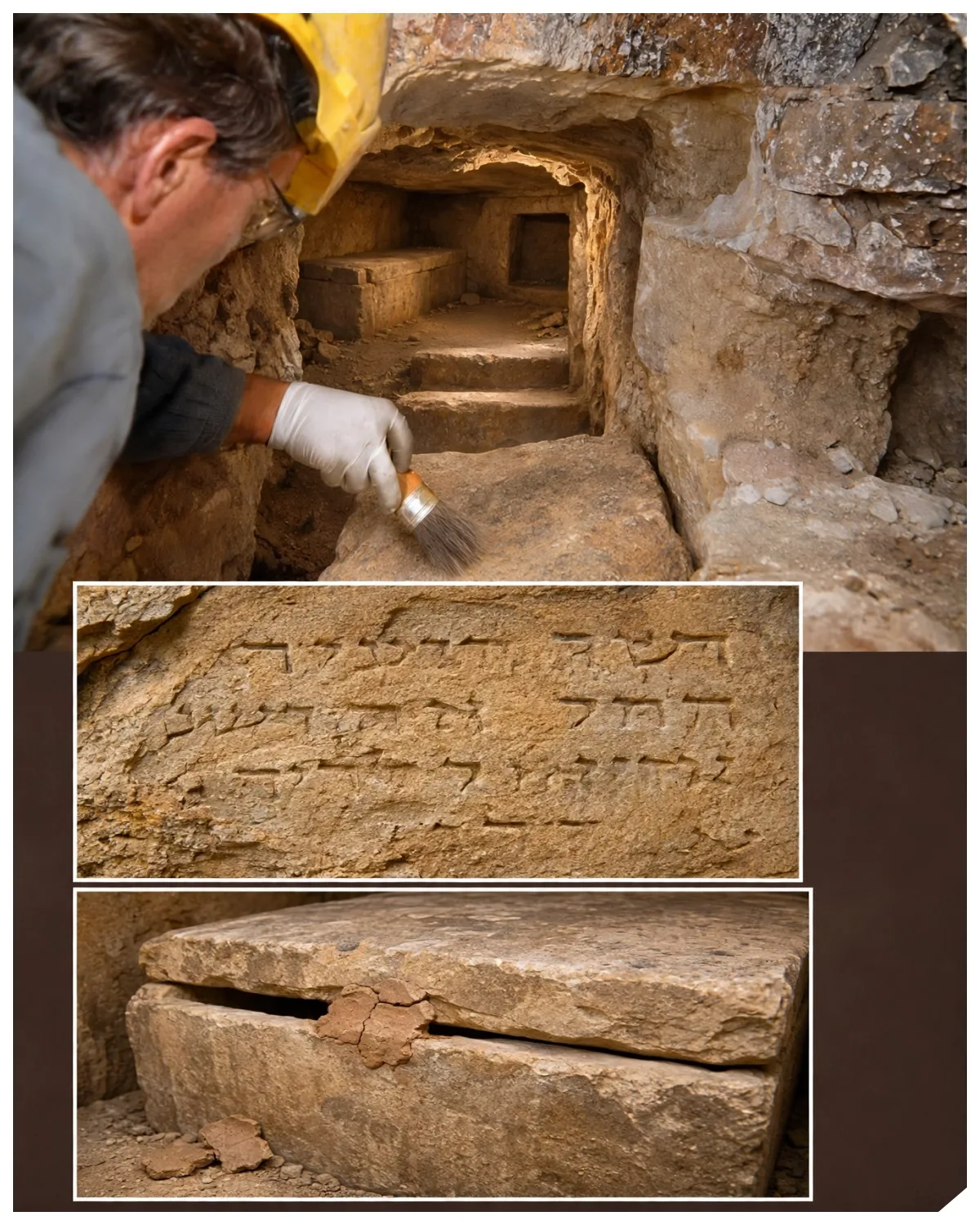
The short official notice mentioned one more thing, a limestone slab set into the floor with traces of carving.
Those traces were letters cut in the old Hebrew script of the kings of Judah, the script of Hezekiah’s Jerusalem.
And they were on the underside of the slab, facing down into the dark beneath the floor.
Words placed where no visitor could ever read them unless someone lifted the stone.
The notice says the space below was noted, not entered, and filled in for safety.
But a draftsman who was there kept a notebook.
It records 3 hours in a second tomb beneath the first.
[music] And on one of its stone benches, something lay wrapped in the remains of a linen cloth.
So what did those hidden words warn against?
And why does the official account say nobody went down?
To understand why that slab matters, you need to know that the hills around Jerusalem hold tombs from two very different worlds.
The older ones come from the time of the kings, seven or eight centuries before Christ.
They are square rooms cut into the rock with stone benches around the walls where the dead were laid.
The newer ones come from the time of Herod and the generation of Jesus.
They have long narrow niches and after about a year, the family gathered the bones into a carved limestone box called an ocuary.
The upper cave in 1971 was plainly the newer kind.
What happened beneath it comes from a man named Ysef Hadad.
He was the draftsman hired to measure and draw the cave.
He died in 2019.
His daughter Leela found a folder in his desk containing a pocket notebook, a contact sheet of 36 small photographs, and a carbon copy of a typed letter.
She sent me scans because the notice and the notebook did not agree, and she wanted to know which one was true.
The notebook is clear.
On the third day, the supervising archaeologist, a man named Aam Kessle, had two workers lever the slab up.
Kessle copied the underside text into the notebook, letter by letter, with his own field reading beside it.
There is no silver and no gold here, only his bones.
Cursed be the man who opens this.
Beneath the slab was a square shaft with footholds cut into one side.
At the bottom was a room, and on one of its benches lay a single human skeleton wrapped in the brown remains of a linen shroud.
Beside the skull sat a small clay oil lamp.
When I first read Kessle’s translation, I thought I knew exactly what it was.
That wording is famous.
In 1870, in the village of Silwan, a short walk down the same valley, a French scholar found almost the same sentence carved on the front of an ancient tomb.
It names a royal steward of Judah, says there is no silver or gold inside, [music] and curses anyone who opens it.
That inscription is now in the British Museum, and it dates to around the 7th century before Christ.
So, the ordinary explanation was obvious.
An old tomb’s door stone from the Age of the Kings, reused [music] centuries later as a floor slab.
Hadad’s sketch of the lower room seemed to support that.
Three benches lined three walls.
At the head of each bench, the stone had been carved into a raised headrest shaped like a horseshoe.
That is a signature of tombs from the time of the kings.
Nobody in Herod’s day cut burial rooms like that.
So the lower tomb was old, very old.
The man on the bench was not.
The lamp beside his head had a flared spout trimmed with a knife.
It is the kind archaeologists call a Herodian lamp, common in Jerusalem from the late first century before Christ.
Whoever lit it for him lived 700 years after the room was cut.
Old tombs were sometimes reused.
[music] But the next page made that reuse hard to explain.
Tombs from the Age of the Kings had a feature called a repository.
It was a pit cut beneath one of the benches.
[music] When a family needed room for a new burial, they swept the older bones into that pit.
Over generations, a repository could hold the remains of dozens of people along with little jugs and lamps left with them.
In this tomb, the repository was empty.
Not partly empty, swept to bare rock.
[music] Hadad recorded a few broken pieces of pottery in one corner and nothing else.
No skulls, no long bones, no teeth.
Robbers do not do that.
They took bronze, jewelry, anything they could sell and left bones behind.
Someone had removed seven centuries of an entire family’s dead carefully and completely.
Then Hadad found the old doorway.
Every tomb of that kind had an entrance on the hillside closed with a stone.
This one had been blocked from the inside.
[music] Fitted stones packed with plaster sealed against the room.
Whoever closed it had been standing in the tomb when they did it.
They left through the shaft and set the inscribed slab over it behind them.
[music] So the question was no longer whose old tomb is this?
It was stranger.
Who in Herod’s time cleared out an ancient family’s bones, laid one man alone on their bench, and closed the room from the inside?
The answer began with a photograph Hadad almost did not take.
Frame 19 on the contact sheet shows the slab’s underside lit by a lamp held almost flat against the stone.
In that kind of light, every groove throws a shadow, and the surface of the slab is covered in fine parallel grooves.
They are the marks of a tooththed chisel, a tool with a row of small teeth along its edge.
Herod’s masons used it to finish stone and its combed pattern can still be seen on the great blocks of his temple mount.
Hadad wrote one line under the frame.
Letters cut across the comb marks.
[snorts] Hold on to that because it reverses the first explanation.
If the letters cross the chisel marks, the letters were carved after the stone was finished and the finish was Herodian.
This was not an ancient door stone reused by later builders.
It was a stone dressed in Herod’s time and then inscribed in Herod’s time in a script that had been out of everyday use for centuries.
Could an old slab have been redressed?
Then the original letters would have been planed away.
There was more.
Kessle had examined the plaster sealing the slab into the floor.
Pressed into it was a small bronze coin which Hadad sketched.
Kessle identified it as a coin of King Herod.
A coin can only tell you the plaster was laid after the coin was made.
It cannot tell you how long after, but nothing in the ceiling was later than Herod, and the lamp below pointed to the same years.
Kessle’s note reads, “Sealing Herodian, nothing later.”
Herod died in 4 BC.
Most historians place the birth of Jesus a few years before that.
So, the warning was written in the generation into which Jesus was born, but its writer deliberately dressed it in the letters of Hezekiah’s age and copied a curse carved on a royal officials tomb a short walk down the valley.
In Herod’s day, that old script still carried authority.
It appeared on earlier Jewish coins, and some scribes used it to write the name of God in otherwise ordinary scrolls.
Choosing it was not an accident.
But why would anyone use the most solemn language they knew to guard a man with no silver and no gold?
There is a simple story that fits most of this, and for a while I believed it.
A wealthy family in Herod’s time cut a new tomb into the hillside.
While deepening the floor, their workers broke into an older tomb below.
The family removed the ancient bones with respect, used the lower room for one of their own dead, and sealed it with a curse against robbers.
[music] No silver and no gold simply meant there was nothing worth stealing.
That explains the shaft, the empty repository, and the lamp.
But two things refused to fit.
The first is the burial itself.
In Herod’s Jerusalem, bones were gathered into an ouary after about a year.
The upper tomb had several.
This man was never gathered.
He was left where he was laid, still wrapped.
The second is on a page of the notebook written in Kessle’s own pencil.
Kessle was not a bone specialist and he says so.
But he recorded what he saw by lamplight.
Hands, small bones reduced, tapering to points, feet the same, nasal opening widened, front of upper jaw worn back.
Kessle knew those changes are typical of long-standing leprosy.
The disease slowly destroys the small bones of the fingers and toes and the bone around the nose and upper teeth.
That was the moment the investigation changed direction.
The word in Leviticus, usually translated leprosy, covered several skin conditions, not only the disease doctors know today.
But the rule was clear.
Leviticus 13 says, “He shall dwell alone.
Without the camp shall his habitation be.”
Kessle ordered everyone out.
One worker refused to come back down, convinced the illness could still spread from bones 2,000 years old.
Kessle did not argue.
His notebook entry is brief.
Out by four, slab back, nothing touched.
But before the slab went back, Hadad took five more photographs.
They were not of the lower tomb.
They were of the room upstairs.
To see why those frames matter, look at what the public was told.
The notice runs two short paragraphs.
It describes a burial cave of the Herodian period, several ouaries, and a slab with traces of carving.
It says a space beneath the floor was noted but not entered [music] and backfilled for safety.
And it lists one burial niche sealed with plaster left unopened.
Nothing about the lower tomb.
Nothing about a man on a bench.
Nothing about the old script.
When I compared the two, the difference was not a matter of missing [music] detail.
The notice says no one entered.
The notebook describes 3 hours inside.
The carbon copy in Hadad’s folder explains why.
It is a typed letter from Kessle to the property’s owner, a businessman named Daniel Aheroni, who was building a guest house on the plot.
It is dated a week after the slab was lifted.
One paragraph is the heart of the matter.
We will report the upper cave.
The lower chamber is to be described as a void not entered.
The photographs of it will stay with me.
Kessle gives his reasons plainly.
He had made a medical observation by lamplight that he could not defend.
An inscription in the script of the kings sitting above a possible leper’s grave would produce headlines about royal tombs long before anyone could study it.
Protests over disturbed graves had halted digs in Jerusalem before, and the owner wanted his building to go ahead.
So, this was not a delay or a lost file.
It was a decision by two men to report the defensible part and leave out the rest.
Hadad was asked to hand over his film.
He did, but he had already printed a single contact sheet in his own dark room, and he kept it.
Frames 31 through 35 are on that sheet, and they show the plaster-sealed niche, the notice called unopened.
The plaster had cracked during the sistern work.
In frame 31, a lamp is held close to the surface.
Scratched into the plaster while it was still soft is a single word.
It is in the same old script as the slab.
Kessle’s reading is written beside Hadad’s tracing, harishim, the first ones or the ones who came before.
It is a word the Hebrew Bible uses for ancestors.
In Leviticus 26, God promises to remember the covenant of their ancestors.
And the Hebrew there is the same root.
So the family that sealed the man below had also sealed something upstairs in their own tomb and labeled it with the same archaic hand.
What was behind that plaster?
Frames 33 and 34 answer that.
[music] Hadad pressed a small flashlight against the crack and photographed through it.
The images are grainy, but the shapes are clear.
A heap of bones, not laid out, but gathered.
Several skulls, and among them, small clay jugs with round bodies and single handles.
Hadad sketched one beside the frame.
Kessle added a note.
Iron Age juglets, at least three.
Those little jugs belong to the age of the kings, exactly what families left with the dead in tombs like the one below.
And Hadad had already noted that the broken pottery in the empty repository came from the same kinds of vessels.
Now the pieces lined up in a way neither man expected.
The old family’s bones had not been thrown away or taken elsewhere.
They had been carried up through the shaft, placed in a niche inside the newer family’s own tomb, sealed in plaster, and marked the first ones.
Was it possible the bones behind the plaster were simply the newer family’s own earliest dead?
Kessle considered that.
But Herodian families put their dead into ouaries, not loose heaps with jugs seven centuries out of date.
And he counted more skulls than the upper tombs boxes could account for.
So the question changed for the second time.
It was no longer why hide a sick man.
It became why would a family give a place in their own tomb to strangers who had died 700 years earlier and give those strangers tomb to one of their own.
Put the findings side by side and the purpose of the whole site comes into focus.
A family of Herod’s time cut a tomb into this hillside.
Their workers broke through into an ancient grave.
To them that was serious.
The book of numbers says that anyone who touches a bone of a man or a grave shall be unclean seven days.
They could not simply shovel the old dead aside.
So they honored them.
They gathered every bone from the old repository and brought those ancestors up into the new tomb, sealed and named.
Then one of their own died.
A man who, if Kessle’s observations were right, had lived for years with a disease their law said required him to dwell alone.
They could not lay him among the family niches and they could not gather him into a family oscillary beside the others.
So they gave him the room below with the family but apart.
That arrangement has a biblical echo.
2 Chronicles says that King Uzziah who had leprosy was buried with his fathers in the field of the burial which belonged to the kings.
For they said he is a leper near his family but not inside their tomb.
And in 1931, a stone plaque turned up in a church collection on the Mount of Olives.
Written in Aramaic in the second temple period, it reads, “To this place were brought the bones of Uzziah, king of Judah.
Do not open.
People of exactly this era moved old bones and wrote warnings over them.”
Which brings us back to the slab and to its strangest feature, the words face down.
I first read that as reuse, a door stone laid in a floor upside down.
It was not.
Mourers visiting the upper tomb would see only a plain floor.
They would never know who lay beneath them.
But anyone who lifted that stone would read the warning at the very moment of opening.
There is no silver and no gold here, only his bones.
That was not a boast to robbers.
It was the truth and a plea to leave him in peace.
In the end, the 1971 team did exactly what the warning asked.
The slab went back.
Nothing was touched.
The space below was filled with soil, and within 2 years, a guest house stood over it.
Aram Kessle died in 1994.
The negatives he kept have never surfaced.
The two paragraph notice remains the only public record of the site.
Here is what the evidence can and cannot show.
The signs of leprosy were recorded by a man who was not a bone specialist working by lamplight.
And no one has ever tested those bones.
The exchange between the two families is an inference.
It rests on three recorded facts.
[music] An emptied repository, ancient jugs behind Herodian plaster, and one man left alone below.
But there is a real parallel.
[music] In 2000, in the Hinnham Valley, just south of the old city, archaeologists found a first century man in a burial niche sealed with white plaster, a rare practice in Jerusalem.
DNA testing later found that he had suffered from both tuberculosis and leprosy that proves nothing about this tomb.
But it shows families of that era faced this very choice.
A generation after that slab was laid, the Gospel of Mark tells of a leper who knelt before Jesus.
And Jesus put forth his hand and touched him.
Somewhere beneath a guest house floor on the Mount of Olives, above a sealed niche marked the first ones, a stone still lies face down, keeping the only promise it ever made.
There is no silver here and no gold.