Matches the Bible.
The stones are still there.
Some of them are longer than a man is tall.
Some, according to the archaeologists who measured them, weigh as much as 8 tons.
They sit in a long ring on the top of a hill about 20 mi southwest of Jerusalem.
And for centuries, almost nobody knew what they were.
Shepherds walked past them.
Travelers walked past them.
Part of what could be seen on the surface came from a much later time.
And so the hill kept its secret.
But under those later layers, there was something else.
A whole city.
A city that was burned and abandoned around the time of David and then buried under the ruins of later ages.
For about 3,000 years, its story stayed hidden.
And here is why that matters.
This hill looks down on one of the most famous valleys in the world, the valley of Ella.
The place where, according to the Bible, a young shepherd named David walked out alone to face a giant named Goliath.
When archaeologists finally dug into this hill, they found a fortified city from the very time the Bible places David here.
They found a massive wall.
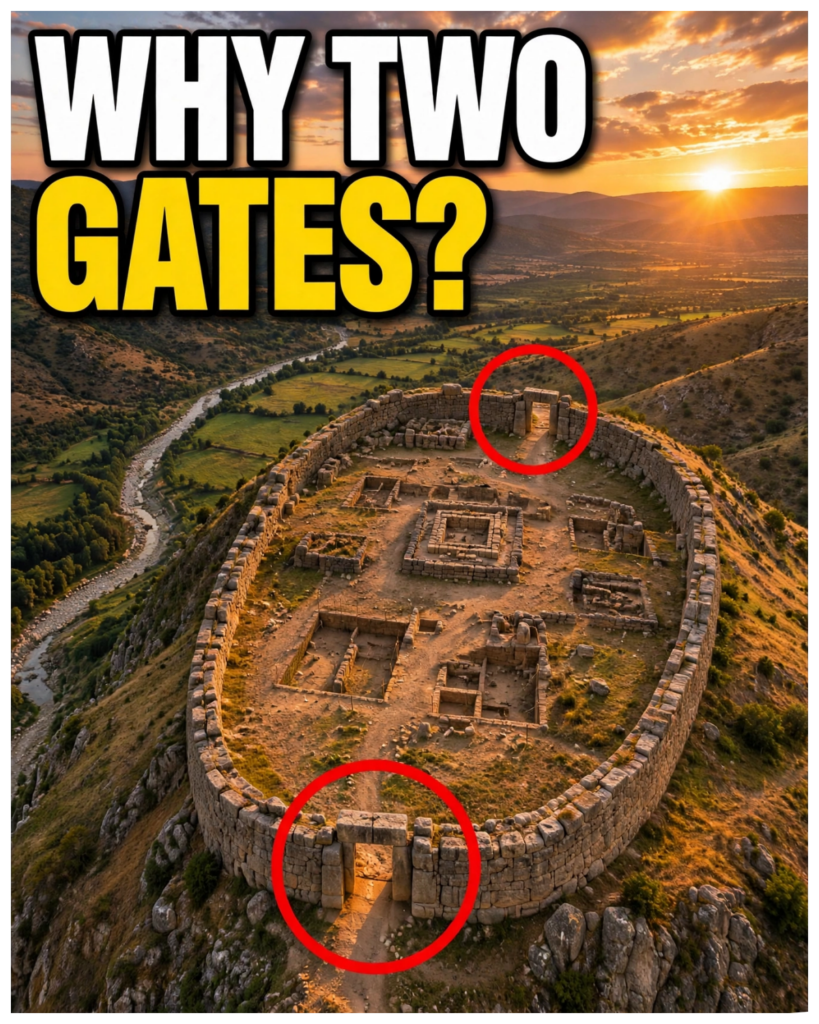
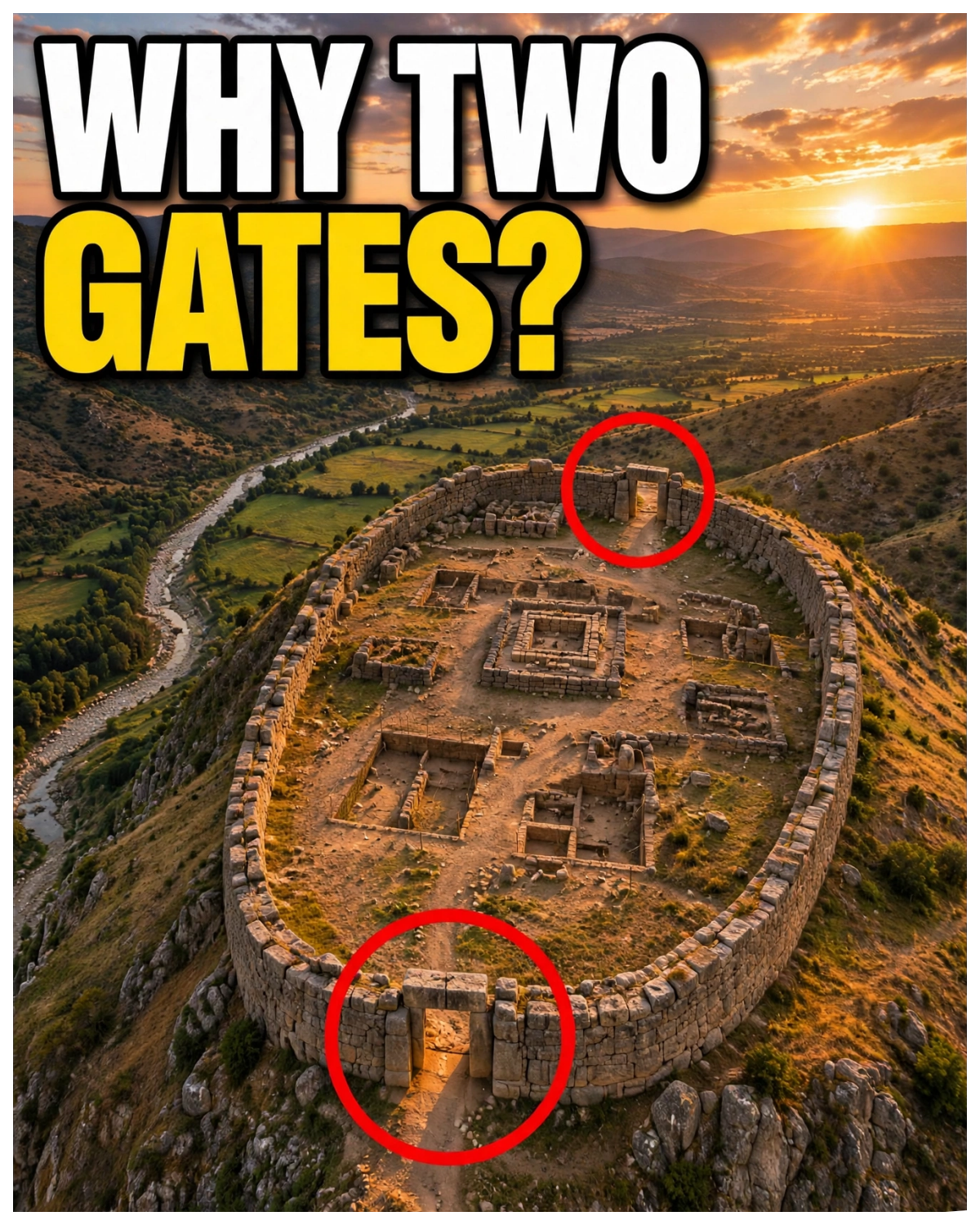
They found a second gate that nobody expected.
They found writing.
They found clues about what these people ate and what they refused to eat.
They found small models of sanctuaries that may help explain how Solomon’s temple looked.
And just a few miles away in the hometown of Goliath, they found a name scratched on a piece of pottery.
Each of these discoveries tells part of the story, but the most important clue is hidden in a single word of the Bible.
One word in one verse in the chapter of David and Goliath.
And for thousands of years, readers passed over it without noticing.
So, what was this city?
Who built it?
And how can a pile of stones on a hill in the Holy Land say something about the story you learned as a child?
Let’s go up the hill.
The site is called Kerbet Kayafa.
In Arabic, a Kerbet is a ruin.
And for a long time, that’s all it was.
Just another ruin on just another hill.
In 2007, two men decided to find out what was really there.
One was Professor Yseph Garfinko of the Hebrew University of Jerusalem.
The other was Sar Ganor, an archaeologist with the Israel Antiquities Authority.
They brought volunteers, students, and shovels.
They would dig on this hill season after season until 2013.
What they uncovered was not a village of a few huts.
It was a planned fortified city about 5 1/2 acres enclosed by a wall that ran for roughly 2,300 ft around the top of the hill.
Now picture the setting.
Just below the hill on its southern side lies the valley of Ella.
It’s a wide open valley, green in winter, golden in summer with a stream bed full of smooth stones running through the middle.
Across the valley on the other side are other hills.
And to the west the valley opens toward the coastal plain, the land of the Philistines.
This was a frontier, a border between two peoples.
On one side, the hill country of Judah.
On the other side, the great Philistine cities, Gath and Echron, and Ashdod.
Whoever held this valley held one of the main roads between the coast and the mountains of Judah.
And this is exactly where the Bible sets the battle.
Listen to how 1st Samuel chapter 17 opens.
Now the Philistines gathered their armies together to battle and were gathered at So which belongs to Judah.
They encamped between So and Azaka in Ephesim.
Then verse two, [music] and Saul and the men of Israel were gathered together, and they encamped in the valley of Elah.
And verse three, the Philistines stood on a mountain on one side and Israel stood on a mountain on the other side with a valley between them.
So, and Azaka are not legends.
They are real places and their ruins still stand on the hills around this valley.
Kerbet Cayafa stands on the northern ridge above the valley.
Azeka stands on that same ridge a little to the west and across the valley on the southern ridge are the ruins that most scholars identify as Socho.
So when you stand on the hill of Herbet Kayafa you are looking at the whole stage of the story at once.
So across the valley Azika beside you and the valley floor below where two armies once faced each other.
Azaka is a tall mound that still stands guard over the road and archaeologists have been excavating there in recent years.
Azaka appears again in the Bible centuries after David.
In Jeremiah 34:7 when the Babylonian army was attacking Judah, only two fortified cities were still holding out besides Jerusalem.
Lakish and Azika.
And here’s a remarkable detail.
[music] In the ruins of Lakish, archaeologists found letters written on pottery by Judeian soldiers in those final days.
In one of them, an officer writes that they are watching for the signal fires of Lakish because they can no longer see Azaka.
Many scholars believe it means Azaka had already fallen.
The same Azaka named at the beginning of the story of David and Goliath.
Named again by Jeremiah and named by a frightened soldier on a piece of pottery as his world was collapsing.
So the question was never is this the right valley.
Most scholars agree that it is.
The question was something much bigger.
For years a number of scholars had argued that the stories of David were mostly legends written down centuries later.
In their view, at around 1,000 BC, Judah was little more than a few scattered villages, no real kingdom, no fortified cities, no organized government, a small chief perhaps, but not the king described in the Bible.
Some went even further and asked whether David had existed at all.
This was not a small debate in a classroom.
It went to the heart of how millions of people read the Bible.
If there was no kingdom, then the story of a shepherd who became king was just a story.
And then the hill above the valley of Ella began to speak.
The first thing the archaeologists uncovered was the wall.
It was not a simple wall.
It was what archaeologists call a casemate wall.
Picture two parallel walls of stone, one outside and one inside with the space between them divided into rooms.
In times of peace, those rooms could be used for storage or as part of the houses.
In times of war, they could be filled with dirt and rubble to make the wall thicker and stronger.
And the houses of the city were built right against this wall, one after another in a ring around the hill.
The outer wall of each house was the city wall itself.
That small detail caught the attention of the excavators.
They pointed out that this kind of city plan with houses built into a casemate wall is known from later cities of Judah like Beth Sheamesh and Telen Nasp.
[music] In their view, it’s a design that belongs to a particular tradition of this region.
But the most impressive part was the size of the stones.
At the base of the wall, the builders used enormous blocks.
Some are up to 10 ft long.
The excavators estimated that some of the largest weigh between 4 and 8 tons.
Think about what that means.
There were no cranes, no trucks, no machines.
Every one of those stones had to be cut, moved, lifted, and set in place by human hands with ropes, levers, wooden rollers, and animals.
And there were not just a few of them.
The wall circled the entire hill.
A few families of shepherds don’t build something like that on a free afternoon.
A project like this needs planning.
[music] It needs workers who are fed while they work.
It needs someone who can organize a large workforce for months or even years.
[music] It needs, in other words, some kind of central authority.
Garfinkle and Ganor said it plainly.
This was not the work of a simple village.
It looked like the work of a kingdom.
But a wall alone can’t tell you its own age.
Walls are often reused, rebuilt, and repaired over centuries.
If this city came from a much later time, then it would say nothing about David at all.
So, the next question was the most important of all.
When was this city built?
To answer that question, the archaeologists turned to something very small.
In the burned layers of the city, they found olive pits.
Ordinary olive pits, the kind you might throw away after a meal.
These had been charred in a fire, perhaps the fire that destroyed the city.
And because they were burned, they had been preserved.
Olive pits are excellent for dating.
An olive grows and ripens in a single season.
So when scientists measure the carbon inside an olive pit, they are measuring a single year in the past.
A tree trunk or a wooden beam is different.
It can be very old or reused for generations.
The pits from Herbet Kayafa were sent to one of the most respected laboratories in the world at the University of Oxford in England.
There scientists used radiocarbon dating to measure them.
The results came back.
According to the scientists, the city was in Di use around 1,000 BC.
In a later summary, Garfinkle placed it more precisely from about 1,020 to 980 BC.
Now, put that next to the Bible.
The reign of Saul and the early years of David are traditionally placed in that same window in the decades around 1,000 BC.
In other words, the dating methods place this city in the very generation of Saul and David.
And the pottery agreed.
The style of the clay pots and jars found in the city belongs to the same early period.
There’s one more detail that makes this even more striking.
The excavators concluded that the city didn’t last very long.
In their view, it stood for only a few decades, perhaps one generation, and then it was destroyed and abandoned.
Many centuries later, people settled there again for a while.
But the original city was a short, intense chapter in history.
That’s what makes it so valuable.
Most ancient cities are a confusing mix of many centuries piled on top of each other.
Kirbet Cayafa is more like a single photograph, a snapshot of one moment.
And that moment is the time of David.
So now we have a fortified city built with stones of many tons standing above the valley of Elah in the generation of Saul and David.
But who lived there?
And what was its name?
Because the Bible may have mentioned this city all along.
The answer began with a gate.
As the excavators uncovered the western side of the wall, they found a gate.
A large, impressive gate with huge stones at its entrance facing west toward the land of the Philistines.
That was expected.
A city needs a gate.
But then they kept digging.
And on the southern side of the hill, they found something unusual.
A second gate.
Now, that might not sound surprising, but for archaeologists, it was.
According to the excavators, cities of this size, in this region, and in this period, usually had only one gate.
A gate was the weakest point in any wall.
Every gate was a place where an enemy could break in.
So, why would a small city on a dangerous border build two?
That’s when the excavators remembered a name.
It’s in the story of David and Goliath.
After the giant falls, the Philistine army panics and runs.
And 1st Samuel 17:52 describes their escape.
Now the men of Israel and Judah arose and shouted and pursued the Philistines as far as the entrance of the valley and to the gates of Echron.
And the wounded of the Philistines fell along the road to Shaim, even as far as Gath and Echron.
The road to Shaim.
Most readers pass over that word without a second thought.
It’s just a place on the way.
But in Hebrew, Shaam is usually translated two gates, [music] a city called two gates, named in the very chapter of David and Goliath on the road out of this same valley.
And on the hill above that valley, a city from the same time with two gates.
That is the hidden clue in a single word.
[music] And Shahim appears in another place too.
In the book of Joshua 15, there’s a list of towns in the lowlands of Judah.
And in that list, in verses 35 and 36, Shahim appears right next to Socho and Azaka.
In many English Bibles, it’s spelled Shereim there, but it’s the same name, the same two places named at the beginning of the battle story, the same neighborhood, the same valley.
Garfinkle and Ganor proposed that Kerbet Kayafa is biblical Shahim.
This is the moment to be careful because the Bible deserves honesty, not exaggeration.
Not every scholar agrees.
Some point out that the ending of the word Shaim does not always mean to in Hebrew.
Other scholars have suggested different biblical names for the site.
One has proposed Netim.
Another has proposed Adithim, a town that also appears in the same list in Joshua.
Another has connected it to a place called Gob, where David’s men fought the Philistines later.
And one scholar suggested that the round shape of the hill matches the camp of Israel’s army mentioned in the same chapter.
So, the name is still debated.
But notice what all of these proposals have in common.
Almost every one of them looks for the answer inside the Bible.
The debate is not whether this city fits the biblical world.
The debate is which biblical name it had.
And whichever name is right, the clue of the two gates remains one of the most remarkable connections ever found between a place in the ground and a word in the text.
But a city is more than stones and gates.
A city is people.
And the people of this city left behind something that is very rare, their writing.
On the morning of July 8th, 2008, during the second season of excavation, a 17-year-old volunteer named Oded Yaire picked up a broken piece of pottery from the floor of a room.
It was about 6 in across.
It looked like just another fragment of an old jar, and it went into a bucket with the other finds.
That afternoon when the pottery was being washed, someone noticed faint lines of ink on its surface.
When the archaeologists looked closely, they saw letters.
Five lines of writing in a very early form of the alphabet.
A piece of pottery with writing like this is called an ostrachon.
Ancient people used broken pottery the way we use scrap paper.
It was cheap and it was everywhere.
This ostrachon is one of the oldest alphabetic inscriptions of its kind ever found in the land of Israel and its age matched the city.
The time of Saul and David.
So what does it say?
That question has kept experts busy for years.
The ink is faded.
Some letters are hard to read and the script is so early that it could belong to more than one language of that region.
One scholar, Professor Gerson Galil of the University of Hifa, proposed that it was written in early Hebrew.
In his reading, the text speaks of caring for the weak.
He read words that may mean judge, slave, [music] widow, orphan, and stranger.
If he is right, then this broken piece of pottery is echoing the same concern for the vulnerable that we find all through the laws of the Bible.
Other experts disagree.
Some scholars like Christopher Rolston have urged caution.
They say the script is too early and the letters too uncertain to say for sure what language it is or what it means.
Others like the scholar Alan Millard think it may be something as ordinary as a list of names.
So the meaning of the text is debated.
It would be wrong to claim more than the evidence shows.
But here is what is not debated.
In the time of David, in a city on the border of Judah, someone was writing.
And that matters because one of the arguments against the Bible’s account was that the people of that time could not have written down their history.
That writing came much later.
That a kingdom without scribes could not keep records.
And yet, right here in the very generation of David in the Valley of El, someone took a piece of pottery and wrote five lines on it.
And the ostrachon was not the only writing the city kept.
In 2012, the excavators found a large jar broken in pieces.
On its shoulder, carved into the clay was a short inscription.
[music] When it was published in 2015, the scholars read it as a name, Eshbal, son of Beta.
Now, you may never have heard that name, but it’s in your Bible.
In 1st Chronicles 8:33, we read the names of King Saul’s sons.
Saul begott Jonathan, Maleshwa, Abanadab, and Eshba.
Eshba, the son of Saul, who after his father died, ruled for a short time over part of Israel.
In 2 Samuel, he is called Ishbosth.
The man named on the jar at Kerbet Kayafa is almost certainly not Saul’s son.
His father’s name is different.
But the excavators pointed out something fascinating.
In the Bible, the name Eshbal appears only in this era, the time of Saul and David.
Later, Israelites avoided names like that.
And here was the same name carved on a jar in a city from the very same time.
It’s like finding a coin with the right date on it.
A small detail, but one that fits exactly where the Bible says it should.
[music] So now we have a city, a date, a gate, and even words written by the people who lived there.
But who were they?
Were they Philistines, Canaanites, [music] or were they connected to the kingdom of Judah?
To answer that, the archaeologists looked at something surprisingly ordinary, the dinner table.
Archaeologists learn a lot from bones.
Animal bones from ancient garbage pits tell them what people ate, how they raised their herds, and sometimes what they believed.
At Kerbet Kayafa, the team collected thousands of animal bones.
Sheep, goats, cattle, the normal animals of the ancient hill country.
But there was one animal missing.
Not a single pig bone.
Compare that to the cities of the Philistines just a few miles to the west.
At Philistine cities from the same period, such as Gath and Echron, archaeologists have found pig bones.
The Philistines ate pork.
And in the Bible, the people of Israel were told not to.
Leviticus 11 lists the swine among the animals, they must not eat.
Deuteronomy 14 repeats the same command.
So on one side of the valley, cities with pig bones.
On this hill.
None at all.
Garfinkle and Ganner saw this as strong evidence that the people of Kerbet Kayafa were not Philistines.
Their diet looked like the diet of Israel and Judah.
Now again, honesty matters here.
The absence of pig bones does not prove by itself who lived in a city.
[music] Other peoples in the region didn’t eat much pork either.
That’s why scholars look at all the clues together.
But think about what this tells us in a very human way.
In a frontier town a few miles from a people who ate pork, these families kept a different table day after day, meal after meal.
In something as simple as what they cooked for dinner, they were living out what they believed.
Their faith wasn’t only on their lips.
It was in their kitchen.
And that leads to an even more remarkable discovery because the archaeologists also found where these people worshiped.
In 2012, the team announced that they had found three large rooms in the city that appeared to be used for worship.
Among the finds were objects connected to worship, standing stones, two altars made of basaltt, pottery vessels used to pour out drink offerings.
But it was what they did not find that caught everyone’s attention.
In most cities of that region and that period, archaeologists often find small figurines of humans or animals, little statues of gods and goddesses, or images used in pagan worship.
They are very common in Canaanite and Philistine sites.
At Kerbet Kayafa, in these rooms of worship, there were none.
No idols, no human figurines, no animal figurines.
Garfinkle connected that to one of the most well-known commands in the Bible.
In Exodus 20:4, God says, “You shall not make for yourself a carved image, [music] a place of worship without images.”
In a time and a region where images were everywhere, and among the finds were two small objects that would make headlines around the world.
They were models of sanctuaries, small boxes shaped like the front of a temple that may have held sacred objects.
One is made of clay about 8 in tall.
The other is carved from soft limestone and painted red about 14 in tall.
The clay model has two pillars at its entrance.
It has lions on either side and birds standing on the roof, and there are marks that may represent a curtain at the doorway.
The stone model is even more striking.
[music] Its front is carved with groups of three beams repeated across the roof in a style known as a triglyph and its doorway is recessed.
That means the door is set back inside several frames, one inside the other like a series of steps going inward.
Now, why does this matter?
Because the Bible describes Solomon’s temple in First Kings chapters 6 and 7.
And some of the words used in that description have been very hard to translate for centuries.
[music] Translators have struggled with certain Hebrew terms about the beams, the frames, and the doorways.
Garfinkle proposed that these small models from Herbet Kayafa may help solve that mystery.
He suggested that some of those difficult words in First Kings may describe exactly these features.
Trig lifts on the roof, doorways recessed, frame within frame, and the two pillars at the entrance of the clay model call to mind two famous pillars.
In first Kings chapter 7, two great bronze pillars stood at the front of Solomon’s temple.
Their names were Jockan and Boaz.
Remember, these models are older than Solomon’s temple.
They come from the generation before, the time of David.
So if Garfinkle is right, they show us the architectural style that was already known in the land when Solomon built the house of God in Jerusalem.
Not every scholar accepts all of Garfinkle’s interpretations of these objects.
Some are more cautious, and that’s part of a healthy debate.
But for the first time, archaeologists were holding in their hands objects from the time of David that look like small echoes of the temple described in the Bible.
And that brings us to the other side of the valley because every story of David and Goliath has two sides and Goliath’s side had a hometown.
The Bible says Goliath came from Gath.
1st Samuel 17:4 describes him stepping out of the Philistine camp.
A champion went out from the camp of the Philistines named Goliath from Gath.
For a long time, nobody was certain where Gath was.
Today, most scholars identify it with a large mound called Tel Safi, [music] less than 10 mi west of Kerbet Kayafa, where the valley opens toward the coastal plane.
Since 1996, Gath has been excavated by a team led by Professor Aaron Mayer of Bar Elilon University.
And Gath turned out to be enormous.
According to the excavators, in the time of David, it was one of the largest cities in the land.
A powerful Philistine center, less than 10 mi.
A city like Kerbet Kayafa on a hill above the valley had one of the strongest powers in the region as its neighbor.
No wonder its builders used stones of 8 tons.
No wonder its walls were so thick.
And then in 2005 at Gath, archaeologists found a small piece of pottery with letters scratched into it.
The inscription is short, only a few letters forming two names.
Scholars read them as Alwat and Walot.
Archaeologists dated it to around the 10th or 9th century BC, close to the time of David.
Now, here is where we need to be very clear.
This is not Goliath’s name tag.
The name written on the pottery is not Goliath and no scholar is claiming that it belonged to him.
So why did it make news around the world?
Because some experts saw those two names as remarkably similar to the ancient forms behind the name Goliath.
And like Goliath, they are not Semitic names.
They seem to come from the foreign origins of the Philistines who had come from across the sea.
Some scholars had suggested that the story of Goliath reflected a much later period.
This small find showed that names of this type were in use in Gath close to the time of David.
As Aaron Mayer put it, “The story appears to be based on the real culture of that time.”
In other words, the name in your Bible fits the place and the time the Bible says it came from.
And the size of Goliath, that’s a question many people ask.
Most English Bibles following the traditional Hebrew text say he was six cubits and a span which is over 9 ft tall.
But some of the oldest manuscripts including one of the Dead Sea Scrolls in the ancient Greek translation say 4 cubits in a span.
That would be closer to 6’9 in.
Either way, in a world where most men were much shorter, Goliath stood head and shoulders above every soldier on that field.
A professional warrior, a [music] champion, a giant to the men who had to face him.
So now look at the whole picture.
On one side of the valley, the great Philistine city of Gath, home of Goliath.
On the other side, a fortified city from the same time with two gates, massive walls, no pigbones, rooms of worship without idols, writing on pottery, and even a name from the age of Saul.
The Bible said the armies stood on two hills with a valley between them.
Archaeology now shows us two worlds facing each other across that valley in that very generation.
There are scholars who see it differently.
Some do not believe Kerbet Kayafa belonged to Judah.
A few have suggested it was built by Canaanites.
Others see a different kingdom behind it.
Professor Israel Finkelstein of Tel Aviv University has suggested that it may be connected to an early kingdom based farther north, perhaps linked to Saul.
In his view, it did not belong to David in Jerusalem, and some have argued that the dates could stretch a little later.
These are serious scholars, and their views deserve respect.
But notice something.
Even the scholars who disagree about who built Kerbet Kayafa agree on the most important thing.
This was a fortified organized city standing above the valley of Ella around the time of Saul and David.
That alone changed the debate.
For years, some scholars claimed that Judah had nothing like this in the time of David.
No fortified city, no organization, no kingdom worth speaking of.
And now the conversation is no longer about whether there was something.
It’s about who controlled it.
That’s a very different conversation.
And whichever side of the debate you lean toward, the Bible’s picture of this valley keeps standing on solid ground.
Judah’s towns on the hills, the Philistines to the west, a border and a battle.
And there’s one more thing these stones whisper if you listen.
The city was destroyed.
The excavators believe it stood for only a few decades.
Then it was burned and left empty.
We don’t know for sure who destroyed it or exactly why.
It may have fallen in one of the many wars between the Philistines and the people of the hills.
The Bible describes those battles again and again in the time of Saul and David.
Picture the families who lived there.
Mothers who baked bread in those houses built into the wall.
Fathers who walked out of those two gates to work their fields in the valley.
Children who looked out over the valley where one day a shepherd boy had stood up when nobody else would.
They lived on the edge.
Every morning they could see the danger.
They didn’t have the security of a big city deep inside the mountains.
They lived on the border facing the giant everyday.
And maybe that’s something you understand.
[music] Maybe you’re living on the border right now.
Maybe your giant has a name, a diagnosis you didn’t expect, a debt that grows every month, a son or a daughter who has walked away from God, the empty chair at the table after a funeral.
A fear that wakes you up at 3:00 in the morning.
And every day, like Goliath in the valley, that giant shouts at you, “You can’t win this.
You’re too old.
You’re too [music] weak.
You’re alone.”
The Bible says Goliath did that for 40 days.
Morning and evening, and the whole army of Israel, King Saul included, was terrified.
Then David arrived.
He was the youngest son of Jesse, sent by his father with bread and cheese for his older brothers.
Nobody had invited him to the battle.
Nobody expected anything from him.
His own brother, Eliab, scolded him for even being there.
But David heard the giant’s words, and he asked a question no one else was asking.
In 1st Samuel 17 26 he said for who is this uncircumcised Philistine that he should defy the armies of the living God?
Everyone else was measuring Goliath against themselves.
David measured Goliath against God.
And when King Saul doubted him, David remembered.
He told Saul how as a shepherd God had saved him from the lion and from the bear.
Verse 37.
The Lord who delivered me from the paw of the lion and from the paw of the bear, he will deliver me from the hand of this Philistine.
Before David ever faced the giant, he fed his faith with memory.
That’s worth doing today.
Think about the lions and the bears in your own life.
The times God carried you when you didn’t think you would make it.
The prayers he answered, the doors he opened, the nights he brought you through.
Faith grows stronger when we remember what God has already done.
Saul then offered David his own armor, his bronze helmet, his heavy coat, but it didn’t fit.
David took it off and said he couldn’t walk in it.
He had never tested it.
God doesn’t ask you to fight your battle in someone else’s armor.
He uses what he has already put in your hands.
And then comes one of the most beautiful details in the whole story.
Verse 40 says, “David chose for himself five smooth stones from the brook.
That brook is still there, a dry stream bed for most of the year, running through the middle of the valley of Ela below the hill of Kerbet Kayafa.
Visitors today walk down and pick up smooth stones from it, just like the ones David picked up.
Before the battle, there was a brook, a quiet moment, a time to prepare.
Maybe that’s what you need before you face your giant.
Not more noise, not more worry, a quiet place, your Bible open, your knees on the floor, a moment at the brook with God.
And then David walked into the valley.
The giant mocked him.
[music] He cursed him by his gods.
And David answered with words that have echoed for 3,000 years.
1st Samuel 17:45.
You come to me with a sword, with a spear, and with a javelin.
But I come to you in the name of the Lord of Hosts, the God of the armies of Israel, whom you have defied.
And then verse 47, for the battle is the Lord’s.
Not I am strong enough, not I have the right weapon, but I come to you in the name of the Lord.
One stone, one shot, and the giant fell.
The battle was never about David’s strength.
It was about David’s God.
And here is where the story goes.
Far beyond a valley in the Holy Land because that shepherd boy became a king.
And God made him a promise.
In 2 Samuel 7, God told David that his throne would be established forever.
That from his line would come a king whose kingdom would never end.
For centuries, the people of Israel waited for that king.
They called him the son of David.
And the very first verse of the New Testament opens with these words.
Matthew 1 verse 1.
The book of the genealogy of Jesus Christ, the son of David.
Jesus was born in Bethlehem, David’s hometown.
And during his ministry, the people who needed him most called him by that name.
In Luke 18, a blind man sitting by the road near Jericho heard that Jesus was passing by and he cried out, “Jesus, son of David, have mercy on me.”
Not the powerful, not the proud, the blind, the sick, [music] the outcasts.
They were the ones who called him the son of David.
David faced a giant that no one else could defeat.
And he won in the name of the Lord.
But Jesus, the son of David, faced the greatest giants of all, sin, guilt, death itself.
Every one of us stands in that valley.
And none of us can win that battle on our own.
Our sin is a giant too big for us.
But Jesus walked into the valley for us.
He didn’t come with a sword or a spear.
He came with open hands and let them be pierced for us.
On the cross, it looked like the giant had won.
But 3 days later, the tomb was empty.
That’s why Paul could write in 1 Corinthians 15:57.
But thanks be to God, who gives us the victory through our Lord Jesus Christ.
The victory that David won in the Valley of Ela was a small picture of a much greater victory.
A victory that Jesus offers to you today by grace as a gift you don’t have to earn.
And one day the son of David will return, not as a baby in a manger, not as a man on a cross, but as the King of Kings to make all things new.
[music] And on that day, every giant will fall forever.
No more death, no more tears, no more fear on the border.
So what do these stones on the hill above the valley of Allah really tell us?
They tell us that the Bible speaks of real valleys, real hills, and real people.
They tell us that in the time of David there was an organized fortified society right where the Bible places the battle.
They tell us that a single word shim two gates may have been pointing to a real place all along.
They tell us that the people of that city kept a different table worshiped without idols wrote on pottery and carried names from the age of Saul.
And they tell us that just across the valley in the giant’s hometown, names like Goliaths were real.
Archaeology cannot prove that God loves you.
[music] It cannot save anyone.
But again and again, when the shovels go into the ground, the Bible keeps being confirmed.
The stones keep pointing back to the word.
For 3,000 years, that city lay hidden under the dust.
But the God of David was never hidden.
He is the same God today.
The same God who saw a young shepherd when nobody else did.
The same God who sees you right now in whatever valley you are standing.
So whatever giant is shouting at you today, you don’t have to face it in your own strength.
You don’t have to wear someone else’s armor.
You can go to the brook, pick up the faith God has already placed in your hands, and walk into the valley saying the same words David said.
I come to you in the name of the Lord.
Because the battle is the Lord’s.
It was then and it still is.
Now, I’d love to hear from you.
If you could stand on that hill above the valley of Ela today, what would you want to see first?
The giant stones of the wall, the two gates, or the brook where David chose his five smooth stones?
Tell me in the comments.
And if you want to keep discovering the real places and the real evidence behind the stories of the Bible, subscribe to Cities Uncovered.