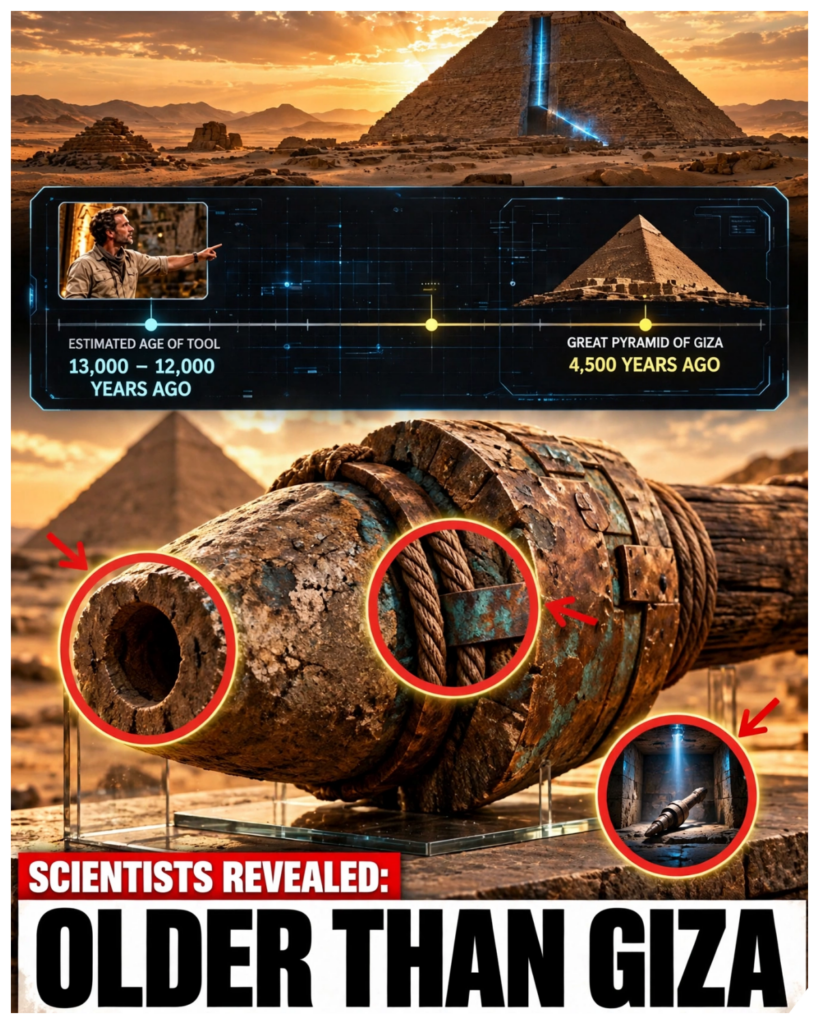
There is a tool lying inside the Great Pyramid right now, hidden in a stone shaft too narrow for a human shoulder, and the wood from which it was made may be older than the pyramid built around it.
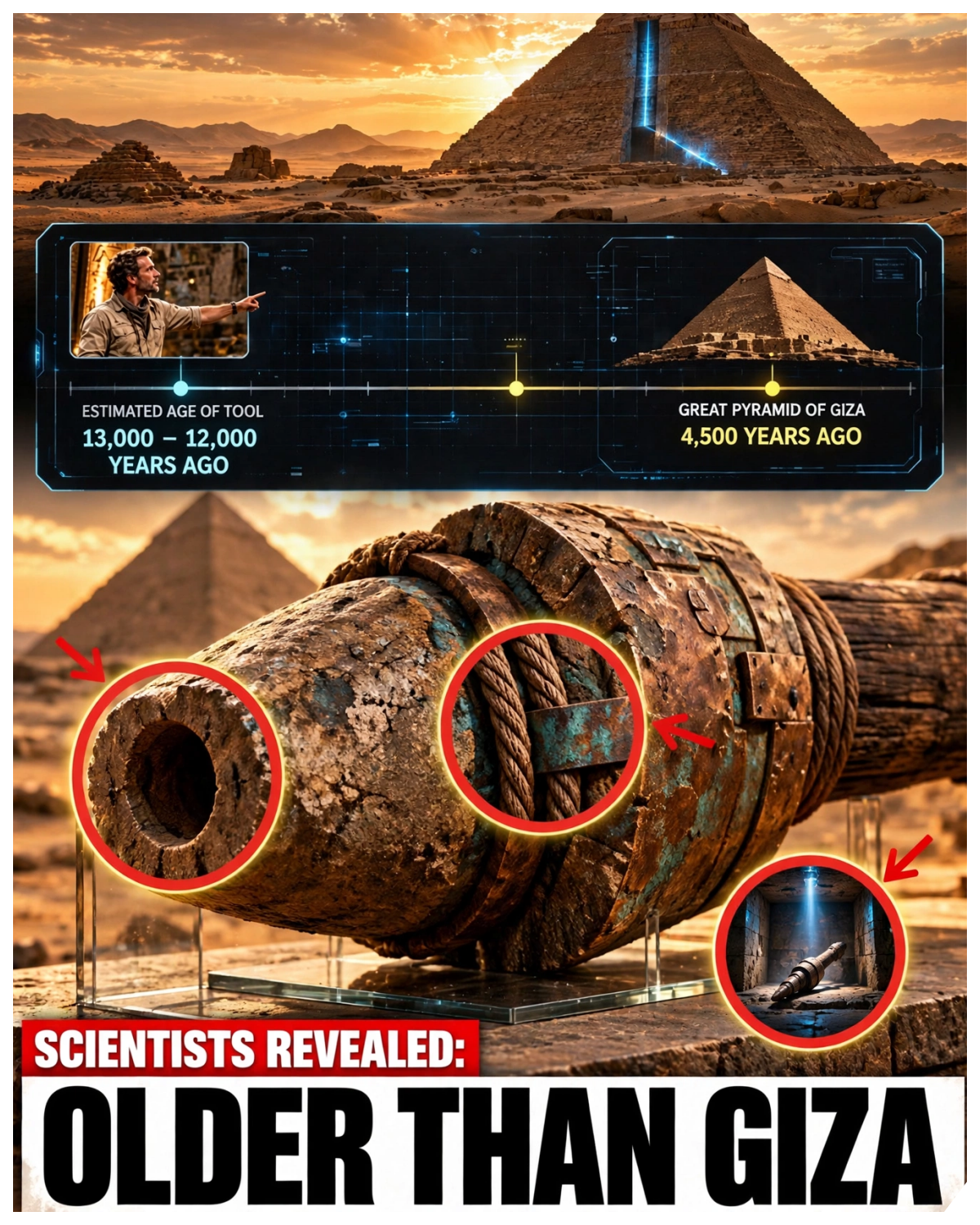
Not just a little older, potentially centuries older, a piece of that wood was pulled out of the darkness, carried across the sea, lost, and eventually discovered again inside a small tin box.
It was then tested in a laboratory.
The results are on record.
That wood had stopped growing long before the Great Pyramid was built.
And here is the part that makes the mystery even stranger.
The wood was not alone.
Lying beside it were a metal hook with two prongs and a ball of dark stone, heavy as a hammerhead.
Three objects hidden inside a passage barely 8 in wide, sealed away when the pyramid was built.
At the upper end of that passage, deep inside solid masonry, there is a small stone door with two metal pins set into its face.
Nobody has ever fully opened it.
But the tool was never the real secret.
It is only the first of three clues, each one revealing something more puzzling than the last.
The second clue is the door itself.
The third is what a camera discovered painted on the floor behind it.
So the question that matters is not simply how old the tool is.
It is what the tool was meant to reach and what might be waiting at the end of that narrow shaft.
Most visitors to the Great Pyramid climb the long ascending passage and continue toward the granite chamber near the top.
Almost nobody stops at the low opening directly ahead of them.
That opening leads into a horizontal corridor less than 4 ft high.
After 127 ft of crouching, the corridor opens into a bare limestone room with a pointed roof.
It is known as the Queen’s Chamber, although no queen was ever laid to rest there.
The name was an assumption made by Arab explorers centuries ago, and the chamber has remained silent ever since.
There are no inscriptions on its walls, no coffin, and no obvious evidence of a burial.
There is only a tall stepped niche cut into one wall and a floor left rough as though the builders had walked away before finishing their work.
The niche rises approximately 15 ft.
Long ago, treasure hunters hacked a tunnel into its back, convinced that a hidden room lay behind it.
They were digging in the wrong place.
Yet, this seemingly empty chamber occupies a position close to the center line of the entire monument, directly beneath the pyramid’s peak.
The Great Pyramid was constructed around 2560 B.CE for the Pharaoh Kufu.
Using approximately 2.3 million stone blocks, its sides align remarkably closely with the cardinal directions.
And at the heart of this extraordinary structure, the builders left a room that appeared to contain nothing.
For more than 4,000 years, its walls seemed to reveal nothing but stone.
But hidden inside those walls were passages that nobody could see, leading toward objects nobody could reach.
A chisel eventually broke through solid limestone into empty space.
A machine the size of a toy train climbed more than 200 ft into the darkness and stopped before a stone door.
Later, another machine discovered red markings on a hidden floor that had not been seen by human eyes since the pyramid was sealed.
Every one of these discoveries is documented.
And together, they point towards something hidden deep inside the pyramid.
H to understand why these discoveries matter, we must begin with some of the oldest religious writings ever found in Egypt.
They sound like poetry, but they also resemble instructions for a journey beyond the world of the living.
Approximately two centuries after Kufu.
During the reign of a king named Unes, the walls of his burial chambers at Sakara were covered from floor to ceiling with carved columns of text.
These writings are known as the pyramid texts.
Among the oldest surviving religious compositions in the world, they describe what happens to a king after death.
He rises.
He climbs toward the northern sky and takes his place among the stars that circle the celestial pole and never set.
The Egyptians called these the imperishable ones.
The king also crosses the southern sky beside Orion and the brilliant star associated with that constellation.
Again and again the texts return to the same image.
The doors of the sky open before him.
The bolts are drawn back.
The path is made clear.
But before the king can begin this journey, something must be done to his body.
A priest touches his face with a collection of ritual instruments in a ceremony intended to restore his ability to breathe, speak, and participate in the afterlife.
One instrument is an ads, a woodworking tool with a cutting blade.
Some ancient Egyptian ritual texts associate such instruments with meteoritic iron, a material highly valued because it came from the sky.
Another instrument has a blade that splits into two prongs at the tip, resembling the forked tail of a swallow.
In ritual, ordinary tools became something more than tools.
They became instruments for opening the way into the next world.
For generations, scholars interpreted the doors of the sky and the bolts of heaven as religious symbolism.
They understood the tools as ritual objects that allowed the deceased king to begin his celestial journey.
Then, inside the Great Pyramids apparently empty Queen’s chamber, a 19th century engineer pushed a wire into a narrow crack in the stone.
In 1872, a British engineer named Wayneman Dixon was working in Egypt on a bridge project near Cairo.
During his spare time, he explored the Great Pyramid with a Scottish physician named James Grant.
Dixon had a simple idea.
The granite chamber higher inside the pyramid contained two small square openings in its walls.
These were the entrances to narrow channels that extended through the masonry toward the outside air.
The chamber below it had no such openings.
Dixon examined the walls of the queen’s chamber, searching for imperfections.
On the southern wall, he discovered a hairline crack.
He pushed a length of wire into it.
The wire continued farther than expected.
Dixon then gave a hammer and chisel to a worker named Bill Grundy.
After several blows, the chisel suddenly broke through the limestone and moved into empty space.
Behind approximately 5 in of stone lay the entrance to a square channel measuring roughly 8 in across and 8 in high.
It extended horizontally into the wall for about 7 ft before turning sharply upward into darkness.
Dixon measured the corresponding position on the northern wall.
Grundy began chiseling again.
A second channel appeared, matching the first in size and height above the floor.
There were now two concealed passages, one on either side of the chamber.
The date of the discovery was recorded on the stone, opened in 1872.
Consider what this means.
The channels had not been blocked by later visitors.
They had never been opened into the chamber at all.
The builders had carried them through successive layers of masonry, leaving the final 5 in of limestone intact.
From inside the room, there was nothing to see.
From outside the pyramid, there was nothing to see either.
Unlike the channels in the chamber above, these passages never reached the open air.
Dixon even lit a fire near the entrance of one channel to determine where the smoke would emerge.
The smoke drifted into the passage, but it never appeared anywhere on the pyramid’s exterior.
The channel had neither a visible entrance nor an exit.
Early explorers attempted to investigate the northern passage by pushing jointed iron rods into it using equipment similar to that employed by chimney sweeps.
The rods eventually jammed and broke.
Some of that material remains inside the passage.
And consider what the construction of these channels required.
A sloping passage cannot simply be drilled through a completed pyramid without enormous difficulty.
The channels had to be incorporated into the structure as the monument rose with individual blocks shaped and positioned to maintain the passages alignment.
Each section had to correspond with the next, preserving the narrow channel through successive layers of stone.
Later surveys placed the inclination of these passages at approximately 40° with the channels following carefully established routes through the pyramids body.
The builders clearly knew how to create channels that reached the outside world.
The passages in the chamber above demonstrate that.
Yet in the queen’s chamber, they chose to leave both ends concealed.
Years of precise construction had produced features that were then hidden behind solid stone.
And inside the northern channel, Dixon discovered something else.
Three objects.
The first was a ball of dark gray green stone, small enough to fit inside a person’s hand and weighing a little more than a pound.
The second was a metal object approximately 2 in long, shaped like a swallow’s tail, with two curved prongs extending from a short central stem.
The third was a fragment of cedarwood approximately 5 in long.
It lay so close to the metal hook that the two objects were initially thought to belong together.
Dixon placed the objects in a small cigar box and sent them to Scotland’s astronomer royal Charles Piazi Smi.
In December of that year, a London newspaper published engravings of all three objects.
At the time, the artifacts attracted interest because they might help researchers investigate the units of measurement used by the pyramid builders.
Isaac Newton had attempted to reconstruct those ancient measurements from the dimensions of the Great Pyramid.
If the objects represented a stone weight, a metal instrument, and a wooden measuring tool, they might provide clues to the standards used by the builders themselves.
The stone was weighed carefully.
The wood was sketched and examined, but nobody could determine how old the objects were.
Dixon eventually moved on to other engineering projects.
5 years later, he helped construct the iron vessel that transported Cleopatra’s needle, a massive Egyptian obelisk to the banks of the river Tempames.
The three small objects from the pyramid, however, remained behind in the hands of researchers and collectors.
The conventional explanation for the artifacts is straightforward.
They were lost tools or construction debris.
The stone ball may have served as a pounding tool.
The metal hook could have been part of an instrument.
The cedar fragment might have broken away from a larger piece of timber while the channel was still accessible to workers.
Once the surrounding masonry was completed, the objects became trapped inside.
Piazi Smi himself considered the possibility that the ball and hook had accidentally fallen into the channel.
But there is another detail worth considering.
Return to the ritual instruments described in the pyramid texts at Sakara.
One of them has a forked blade resembling the tail of a swallow.
Examples of ancient Egyptian instruments with comparable shapes have survived from archaeological excavations.
When the metal hook discovered by Dixon is placed beside these objects, its outline appears remarkably similar.
Two prongs curve away from a central stem.
The British Museum, which holds the stone ball and metal hook, recognizes their connection with the pyramids construction and the reign of Kufu.
The artifacts are not simply cataloged as meaningless scraps.
They are associated with the period in which the Great Pyramid was built.
One possible interpretation is that the objects were deliberately placed inside the channel as ritual equipment.
Instruments used in ceremonies might have been deposited within the monument to serve the deceased king in the afterlife.
If so, the connection becomes intriguing.
Ritual texts describe tools used to open the way for a dead king.
A similarly shaped object was found inside a concealed passage in the Great Pyramid where no person could reach it after construction.
There is also another possibility.
Engineers have noted that a weight, a hook, and a straight wooden rod could form parts of a practical measuring instrument, perhaps one used to establish or check alignment.
A plum line, for example, relies on a suspended weight to establish a vertical reference.
Whether the objects were ritual equipment, construction instruments, or a mixture of both, their presence is difficult to dismiss as ordinary rubbish without further evidence.
They were left in a place that became inaccessible once the masonry was complete.
Then the objects disappeared from view.
Following the winter of 1872, the artifacts gradually dropped out of public attention.
For more than a century, researchers struggled to establish the location of all three objects.
The stone ball and metal hook eventually remained in a museum collection, but the cedar fragment could not be found.
That was the first clue and it had effectively vanished.
The second clue emerged when researchers began investigating the concealed channels with modern technology.
In 1992, the German Archaeological Institute in Cairo recruited a robotics engineer from Munich named Rudolph Gantenbrink.
The humidity generated by thousands of visitors was becoming a concern inside the Great Pyramid and his initial task was to investigate the channels in the upper chamber so that ventilation equipment could be installed.
Once that work was completed, Gantenbrink turned his attention to the two passages discovered by Dixon.
Nobody had ever seen their upper ends.
He designed a small tracked robot approximately 14 in long and weighing around 13 lb.
It carried two headlamps, a camera, and a cable trailing behind it.
He named the machine Uppuat, a name derived from the Egyptian deity Weipawette, whose name means the opener of the ways.
On March 22nd, 1993, the robot entered the southern channel and began climbing into the pyramid.
It advanced beyond 100 ft, then 150 ft, passing farther into the darkness than any earlier instrument had reached.
Eventually, the character of the stone changed.
The coarse yellow limestone of the pyramids core gave way to fine white limestone, the more carefully finished material associated with the monument’s outer casing and important interior spaces.
At a distance of just over 200 f feet, the robot’s headlamps illuminated a flat stone slab extending from one side of the channel to the other.
The surface was smooth and carefully fitted.
Two metal pins were set into its face.
Their surfaces discolored green with age.
One pin had broken, and the detached piece lay on the floor in front of the slab.
A small chip was missing from the lower corner.
When the robot’s laser pointer swept across the opening, its red dot slipped beneath the slab and disappeared into the gap.
The slab was not simply resting against the end of the passage.
It had been positioned several inches inside the final section of the channel between stone surfaces that had been dressed to receive it.
It looked like a door, and that is what researchers have called it ever since.
The small barrier measured approximately 8 in across and lay more than 200 ft from the nearest accessible chamber inside a passage that no human could crawl through.
It had been cut from fine limestone and fitted with metal pins despite being concealed so deeply within the pyramid that nobody could see it.
The ancient image of the doors of the sky and the bolts drawn back suddenly seemed less abstract.
Here was an actual stone barrier with metal fittings captured on video inside a sealed channel.
The northern passage revealed another part of the puzzle.
The robot advanced approximately 60 ft before the channel bent sharply to one side, curving around the grand gallery.
The machine could not continue, but its camera could see beyond the bend.
On the floor lay the broken iron rods left by earlier explorers.
Beyond them was a longer squared piece of wood.
The discovery suggested that the cedar fragment recovered in 1872 might have broken away from something much larger and that another portion of the original timber remained inside the pyramid.
The discovery of the stone door should have marked the beginning of a much longer investigation.
Instead, Gantenbrink’s work inside the channels came to an abrupt halt.
Approximately a week after the discovery, he was instructed to remove his equipment and leave the project.
The circumstances surrounding the decision became controversial, and he did not resume his exploration of the channels.
For years, the door remained hidden in darkness, known primarily through a short recording of the robot’s discovery.
The publicity surrounding the find, had one unexpected consequence.
It encouraged researchers to search again for the three objects recovered by Dixon more than a century earlier.
That same year, the stone ball and metal hook were located in storage at the British Museum.
The cedar fragment, however, remained missing.
In 2001, an archival record suggested that the wood might have been sent to the University of Aberdine in Scotland.
Museum staff searched a collection containing hundreds of thousands of objects, but the fragment could not be located.
The oldest and potentially most informative part of the original collection remained lost.
On September 17th, 2002, the stone door received a second visitor.
This time, the investigation was conducted using a new robotic system called Pyramid Rover, developed by the Boston-based company iRoot.
The machine climbed the southern channel carrying a small drill.
First, it measured the slab, determining that it was approximately 2 and 1/2 in thick.
It then drilled a hole roughly 3/4 of an inch in diameter and inserted a fiber optic camera through the opening.
What appeared on the other side was unexpected.
Beyond the first door lay a small enclosed space approximately 8 in deep.
At the far end stood a second stone slab.
Unlike the first, this one was rough, unpolished, and cracked across its surface.
It had no visible metal fittings.
The arrangement was now more complicated than anyone had anticipated.
There was a door, a small enclosed compartment, and another barrier beyond it.
Mend.
A few days later, the robot entered the northern channel.
It maneuvered around the broken iron rods, negotiated the bends, and continued farther into the passage.
At a point approximately 28 ft from the chamber, it encountered another white stone slab fitted with two metal pins, a second door.
Its design resembled the first, and its position corresponded closely to the distance of the southern door from the chamber.
Despite the different route taken by the northern channel which bends around the Grand Gallery, the two passages terminated at corresponding points.
The arrangement had been constructed on both sides of the queen’s chamber.
The conventional archaeological interpretation is that the channels were symbolic pathways for the king’s spirit.
Their upward angles may have been intended to connect the chamber with particular regions of the sky, while the stone barriers served as symbolic closures rather than entrances to physical rooms.
Astronomical reconstructions have suggested that the southern channel was oriented toward the region of the sky associated with Orion and the bright star Sirius, while the northern channel pointed toward the circumpolar stars that never disappear below the horizon.
These destinations correspond broadly with the celestial imagery found in the pyramid texts where the deceased king journeys toward Orion and the imperishable ones.
But the northern channel introduces another striking connection.
The Egyptians recognized a group of stars in the northern sky that modern observers associate with the Big Dipper, part of Ursa Major.
They did not picture a ladle.
Instead, their imagery included the forleg of a bull.
In Egyptian ritual traditions, the bull’s foregi, the instrument used in the opening of the mouth ceremony.
The celestial pattern and the ritual instrument therefore shared an important symbolic association.
The connection raises a fascinating possibility.
The channel containing the stone ball, metal hook, and cedar fragment points toward a region of the sky associated with a shape resembling a ritual tool.
Perhaps the placement of the objects was deliberate, linking the equipment inside the pyramid with the celestial destination of the king.
That interpretation remains speculative.
Astronomical alignments, symbolic associations, and archaeological context do not by themselves establish the builder’s exact intentions.
Yet, a further question remains.
If the barriers were merely symbolic, why was a small compartment constructed behind the first door?
Why was another slab placed beyond it?
And why were the inner surfaces of the barriers finished so carefully?
These questions led to a third robotic investigation.
In 2011, researchers used another machine known as Jedi, named after a magician in an ancient Egyptian tale associated with the court of Kufu.
The story describes a man believed to know the number of secret chambers belonging to the god of wisdom.
Engineers developed the robot at the University of Leeds.
Its most important feature was a small camera mounted on a flexible mechanical arm.
The arm was narrow enough to pass through the hole drilled in 2002 and could bend to examine surfaces that the earlier camera could not reach.
For the first time, investigators could look down at the floor of the concealed compartment and inspect the inner face of the stone door.
What they found was unlike anything visible from the outside.
The floor contained markings made with red pigment.
Small figures had been brushed onto the stone in red ochre, a material commonly used by Egyptian work crews to mark, measure, and organize construction materials.
The marks had been made by a human hand.
Then the compartment was sealed behind a stone barrier where the markings remained hidden for approximately 45 centuries.
Some Egyptologists have interpreted the figures as numerals written in a cursive form of the builder’s script.
They may represent a count, a measurement, or another form of construction notation, but their precise meaning has not been established.
One published interpretation identifies the markings as the number 121.
If this reading is correct, and if the number refers to royal cubits, it would correspond to approximately 28 ft, a distance close to the length of the channel between the chamber wall and the stone door.
Under that interpretation, someone may have recorded the length of the passage near its far end before the compartment was sealed, but this remains a hypothesis.
The markings have not been conclusively deciphered, and their meaning is still uncertain.
The camera then turned toward the inner surface of the door.
The back of the slab, a surface that nobody was ever expected to see, had been polished as carefully as the front.
The two metal pins extended through the stone and curled back on themselves, forming small, neatly finished loops on the inner side.
They were not simple projecting bolts.
They were loops shaped with care and positioned where they could be seen only from inside the sealed compartment.
The camera also examined the far wall.
Unlike the door, this surface had no metal fittings and lacked the same polished finish.
Thin red lines ran along both sidewalls precisely where they met the far wall, resembling the alignment guides that a mason might paint to indicate where a stone block should be positioned.
This was the third clue, and it brought the separate pieces of the mystery together in a frustratingly incomplete way.
There was a hook, a stone weight, a length of cedar, two stone doors with metal loops, and red markings on a hidden floor.
Yet the evidence that might explain how these objects were connected remained beyond another rough slab, only 8 in farther along the channel.
The Jetty team intended to return and investigate that second barrier, measuring its thickness, and determining whether it was a plug, a door, or simply another block of the pyramid’s core.
But political upheaval swept through Egypt in 2011, cutting the archaeological season short.
The robot never returned to investigate the barrier.
Today, access to the low corridor leading toward the queen’s chamber is restricted, and visitors generally pass through the pyramid without knowing what lies beyond its walls.
The thickness and construction of the second slab have not been established through a published investigation.
The official archaeological explanation remains incomplete, and the camera’s exploration ended before the final barrier could be examined.
One piece of evidence, however, could still be studied in a laboratory if researchers could establish its location and recover an appropriate sample.
In December 2019 at the University of Aberdine in Scotland, a curatorial assistant named Air Eladin was reviewing the University Museum’s Asian collections.
Eladin is Egyptian and had previously worked at the Egyptian Museum in Cairo.
Among the objects, she noticed a small cigar tin bearing an old Egyptian flag on its lid.
Something about it seemed out of place.
She checked the museum’s records and began investigating its contents inside, resting on a bed of tissue, where several dried splinters of cedar wood.
The missing fragment from the Great Pyramid had finally been found.
James Grant, Dixon’s companion during the original investigation, had retained the wood when the three objects were separated.
Grant had traveled to Egypt during the 19th century and was present when the concealed channels were opened.
His daughter eventually donated the fragment to the University of Aberdine in 1946.
It was mistakenly cataloged among objects associated with Asia rather than Egypt, where it remained overlooked for more than 70 years.
After more than a century of uncertainty, the cedar had resurfaced inside an ordinarylooking tin.
Modern scientific analysis then added another layer to the mystery.
A sample of the wood underwent radiocarbon dating.
The results released in December 2020 placed the woods growth between approximately 3,341 and 3,94 B.CE.
Kufu’s pyramid was built around 2560 B.CE.
If the radiocarbon results are interpreted at face value, the wood is several centuries older than the Great Pyramid.
It predates the pyramid by at least hundreds of years and may originate from a period before the construction of Egypt’s earliest monumental pyramids.
The tree was growing when Egypt was still in the early stages of becoming a unified kingdom.
There is another important detail.
Cedar does not grow naturally in Egypt.
The species commonly used in ancient Egyptian construction came from regions such as the mountains of Lebanon across the Mediterranean.
The timber therefore originated in a landscape far from the Nile Valley.
It had to be felled, transported, and imported into Egypt before eventually becoming part of an object recovered from the Great Pyramid.
Historical records demonstrate that cedar was an important imported material in ancient Egypt.
A fragmentaryary royal chronicle carved on the Polarmo stone records a delivery of cedar associated with the reign of Snferu, Kufu’s father.
The record describes 40 ships carrying cedar logs.
Beside Kufu’s own pyramid, a sealed pit discovered in 1954 contained a dismantled cedar ship approximately 143 ft long.
Its discovery demonstrated the remarkable lengths to which the Egyptians went to acquire, work, and preserve imported timber.
In 2013, archaeologists investigating an ancient harbor on the Red Sea recovered papyrie associated with an official named Mr.
His records described the transportation of fine white limestone from the quaries of Turra to Giza during Kufu’s reign.
The stone used in important parts of the pyramid, including the carefully finished limestone associated with the concealed doors, was transported through an organized network of workers, boats, and supply stations.
The evidence, therefore, reveals a sophisticated system for acquiring timber and stone.
We possess records of cedar deliveries, documentation of limestone transport, and physical evidence of imported wood used in monumental construction.
What we do not possess is a surviving record that explicitly explains the concealed channels, the stone doors, or the objects placed inside them.
The radiocarbon result also helped clarify an important question.
The objects may have been deposited during the pyramid’s original construction rather than introduced by a much later visitor.
Their archaeological context is consistent with an ancient origin.
Although the age of the wood alone cannot establish precisely when it was placed inside the channel.
This makes the cedar one of the most intriguing objects recovered from the great pyramid.
But what does its age actually prove?
It does not prove the existence of a lost civilization.
It does not demonstrate that the builders inherited their tools from an advanced society predating ancient Egypt.
Nor does it establish that a hidden archive or chamber full of ancient records lies beyond the second stone barrier.
The evidence deserves a more careful interpretation than that.
The strongest objection concerns the wood itself.
Radioarbon dating does not reveal the exact year in which a tool was manufactured.
It estimates when the sampled material stopped exchanging carbon with the environment, which generally corresponds to the period when that part of the tree stopped growing.
A cedar of Lebanon can live for centuries.
Wood taken from the heart of an old tree may therefore produce a radioarbon age significantly earlier than the date when the tree was finally felled.
The cedar could have been harvested during Kufu’s reign from a tree that had already been growing for centuries.
Alternatively, a valuable piece of imported timber could have been stored, reused, or passed down through several generations before eventually being placed inside the pyramid.
Researchers studying radiocarbon samples from Egyptian pyramids have encountered similar complications.
Some samples produce dates older than the historical period associated with the monument.
Partly because the material came from longived trees or reused timber.
Consequently, the cedar’s age does not establish that the tool itself was manufactured centuries before the great pyramid.
It establishes that the wood used to make it had been growing earlier.
The other clues also have conventional explanations.
The channels may have served symbolic or religious purposes rather than providing access to hidden rooms.
Their unusual arrangement may reflect a carefully planned ritual design.
Or it may be the result of changes made during construction.
The stone barriers could simply be finished end blocks.
The metal loops may have had a practical or decorative function.
The red markings may be ordinary construction notations similar to the marks left by masons elsewhere inside the pyramid.
The rough slab beyond the small compartment may be the beginning of the pyramid’s solid core with nothing more than additional masonry beyond it.
And the three objects recovered by Dixon may indeed have been tools accidentally left behind by workers.
None of these explanations has been conclusively demonstrated in every detail, but each remains plausible.
So no, the discoveries do not prove a forgotten civilization or establish that the Great Pyramid conceals an unknown chapter of human history, yet remove every extraordinary theory, and the physical evidence remains remarkable.
Two narrow channels were incorporated into the pyramids masonry and left inaccessible from the chamber beneath them.
Two carefully finished stone barriers were discovered at corresponding distances inside those passages.
Both had metal fittings.
One concealed compartment contained red markings on its floor, while a second barrier beyond it remains insufficiently investigated.
A piece of cedar recovered from one channel was lost for more than a century before resurfacing in a museum collection in Scotland.
Another portion of wood appears to remain inside the northern channel near the broken iron rods left by 19th century explorers.
At the very least, the builders incorporated a set of unusual objects and carefully constructed passages into the most famous pyramid on Earth.
The wood itself had been growing long before the monument was raised.
No theory about a lost civilization is necessary to find this extraordinary.
The deeper question concerns why these objects were placed there at all.
If the modest interpretation is correct, the builders may have preserved valuable timber and tools for generations before placing them inside the pyramid.
The wood could have been inherited from an earlier period, reused because imported cedar was scarce, or selected for a ritual purpose that made its age significant.
Alternatively, the objects may have been chosen specifically for the burial complex because they represented something important to the king’s journey into the afterlife.
Both possibilities suggest that the objects were more than meaningless debris.
Their context may have mattered to the people who placed them there, even if the precise intention has been lost.
The religious texts at Sakara describe a deceased king who must be prepared for a journey through the heavens.
Ritual instruments restore his abilities and celestial doors open before him.
The king ascends toward the northern stars and the region of Orion.
The Great Pyramids channels have been interpreted in relation to similar celestial imagery.
The tools found inside one passage resemble objects associated with ancient Egyptian ritual practices, and the stone barriers at the ends of the channels appear to have been deliberately constructed rather than formed by accidental damage.
These parallels do not prove that the passages were designed to function as literal roots into the sky, but they demonstrate that the pyramids hidden features deserve to be studied within the religious and architectural traditions of ancient Egypt.
Perhaps the tools were ritual offerings.
Perhaps they were construction equipment preserved inside the monument.
Perhaps the cedar came from an old tree, and its unusual radiocarbon age reflects nothing more mysterious than the longevity of the timber.
Yet even the most conservative explanation leaves unanswered questions about the compartments, the metal loops, and the second stone barrier.
The evidence that could help resolve those questions has not entirely disappeared.
The remaining wood may still lie inside the northern passage.
The second barrier in the southern channel remains an unresolved feature.
Further imaging, precise measurement, and careful archaeological investigation could clarify whether these spaces contain additional objects or simply more masonry.
No one needs to assume that a hidden chamber full of ancient records is waiting beyond the stone.
The real mystery is more precise.
What were these channels designed to do?
Why were their ends concealed?
And what purpose did the objects inside them serve?
The history of the discoveries offers its own lesson.
The stone door was identified by an engineer investigating passages that had long been ignored.
The missing cedar was found by a curator examining a museum collection under the wrong category.
Neither discovery required a theory about a lost civilization.
Both emerged because someone examined something that others had overlooked.
And that brings us to the question that remains unanswered.
If the tools were placed inside the pyramid to help the king open the way to the heavens, what did the builders believe that way led to?
Was the stone door simply a symbolic boundary in a carefully constructed religious landscape?
Or did it serve a purpose that modern investigators have yet to understand?
Tonight, the Great Pyramid still stands where it has stood for approximately 4,500 years.
The visitors have left its passages, and the Queen’s chamber remains empty.
In its walls are two small square openings, each narrow enough to be covered by two hands.
One channel rises toward the south.
The other climbs toward the north.
Inside the northern passage, a fragment of cedar older than the pyramid may still lie in the dust beside broken iron rods.
At the far ends of the channels, deep inside solid stone, small white barriers remain fitted with metal loops.
Beyond one of those barriers, a camera recorded red markings on a hidden floor.
Beyond the markings stands another wall, a barrier that has been glimpsed through a drilled hole, but never fully investigated.
The door has been filmed.
A hole has been drilled through it.
A camera has looked beyond it.
And the passage remains unfinished in the eyes of modern science.
Its final purpose still uncertain.
Somewhere inside the great pyramid, behind a narrow stone door and a second barrier that has never been properly examined.
The answer may be waiting.
Not necessarily a lost civilization.
Not necessarily a secret chamber.
Perhaps only the final piece of an ancient construction plan.
But until someone can investigate that last barrier, the question remains open.
What exactly were the builders trying to open the way to?


