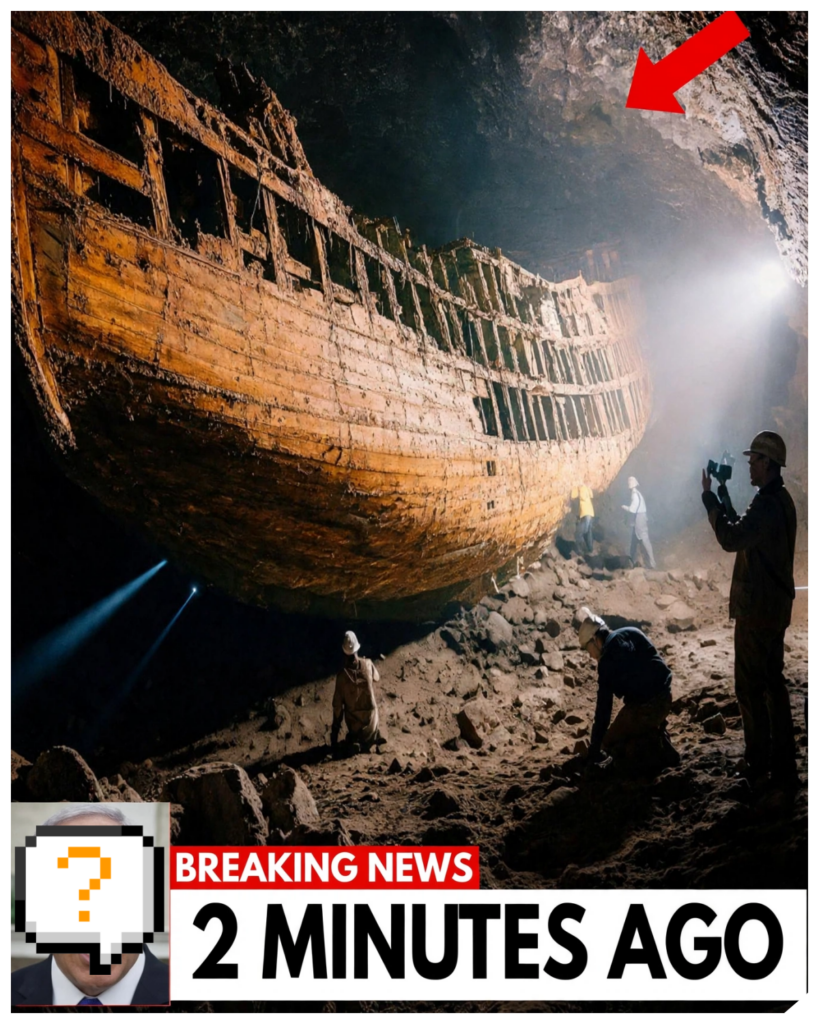
Well, they started with the renderings of the ship based on the book of Genesis in which God gave Noah.
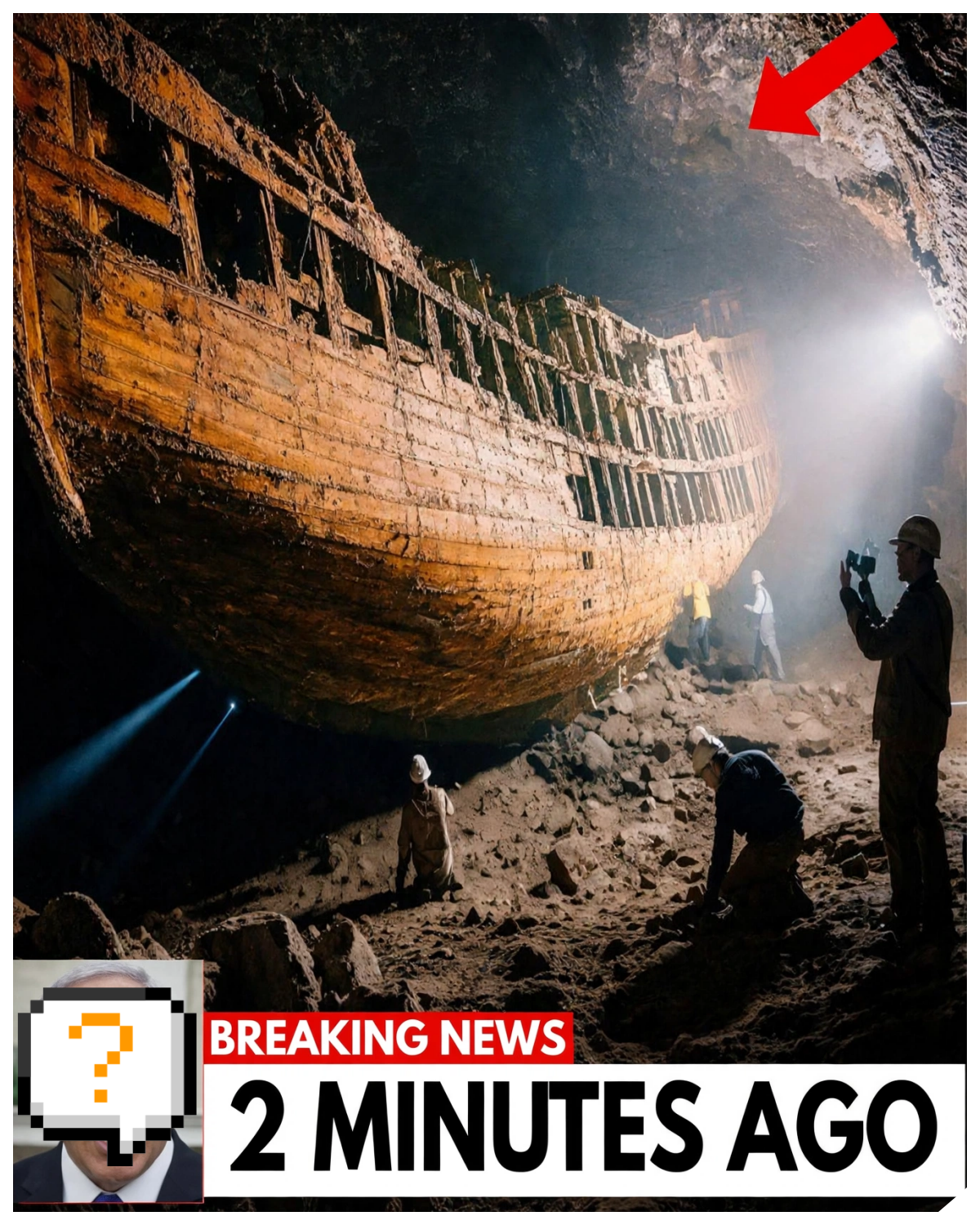
The scientist’s hands were shaking, not from the cold on Mount Ararat, but from what the ground radar was showing beneath his feet.
A chamber sealed, untouched.
After the team broke through, one member reportedly refused to go back inside.
What was in there was not supposed to exist.
What was in there changes everything we thought we knew about the Bible, about history, and about how much time we have left.
Because here is the part nobody is talking about.
What they pulled out of that mountain did not just confirm that Noah’s ark was real.
It confirmed something far more unsettling.
Something Jesus himself warned would happen before his return.
And the timing of this discovery right now at this exact moment in history is not a coincidence.
This is what was found inside.
For thousands of years, people have searched for Noah’s ark.
Explorers, scientists, archaeologists, governments, all of them came back with the same answer.
Nothing conclusive, nothing definitive, just fragments, just theories, just questions with no real answers.
Until now, in the mountains of eastern Turkey, something has been sitting in the earth for a very long time, hidden beneath layers of rock and sediment on the slopes of Mount Ararat, a structure so large and so precisely shaped that it cannot be explained away as a trick of geology.
And what makes this discovery different from everything that came before it is not just what was found on the outside.
It is what was found on the inside.
But before we get there, you need to understand what this place actually is.
Because without that context, what comes next will not hit the way it should.
The site is called the Durapanar Formation and it was first spotted from the air in 1959 by a Turkish military pilot conducting a mapping survey.
When the photographs were developed and examined, researchers could not explain what they were looking at.
The outline of the structure was unmistakable.
A long symmetrical boat-shaped mass embedded in the Earth at an elevation of over 6,000 ft, nearly 300 m in length.
Its dimensions so close to those described in the book of Genesis that the comparison was impossible to ignore.
Genesis 6:15 records God’s instructions to Noah with striking precision.
The ark was to be 300 cubits long, 50 cubits wide, 30 cubits high.
When researchers applied those measurements to the durapinar structure, the match was not approximate.
It was exact.
So the question was never really whether this structure existed, but the question was always what was inside it.
For decades, the site was studied from the outside.
Ground penetrating radar was used to scan beneath the surface.
What the equipment returned was not a solid mass of rock and sediment.
The scans revealed internal chambers, distinct compartments, structural divisions that do not occur naturally in geological formations.
Something had been built here.
Something deliberate, something designed with a specific purpose.
And then the excavation began.
The team that entered the site was not a group of amateurs chasing a Bible story.
These were trained professionals, geologists, archaeologists, scientists with equipment capable of analyzing organic material, dating sediment layers, and identifying the composition of buried structures.
They had done this before and they knew what natural rock formations looked like from the inside.
What they found was not natural rock.
The first chamber they accessed contained something that immediately changed the atmosphere of the excavation.
The organic material lining the interior walls was unlike anything found in the surrounding geological environment.
Initial analysis suggested it was ancient, far older than the sediment layers above it, and its composition pointed to something that had been deliberately treated, preserved, prepared for a specific purpose.
But that was not the discovery that stopped the team in their tracks.
That came when they moved deeper into the structure.
Because what was waiting in the inner chamber was not just evidence of an ancient vessel.
It was evidence of something that should not have been there at all and something that instantly raised a question that modern science has spent over a century trying to avoid.
And we will get to that.
But first, you need to understand why this location on this specific mountain matters more than most people realize.
Mount Ararat sits at the border of Turkey, Armenia, and Iran.
It rises to over 16,000 ft.
It is snowcovered year round and it has been considered the resting place of Noah’s ark by Jewish, Christian, and Islamic traditions for thousands of years.
Ancient Armenian texts reference it.
Early church fathers wrote about it.
Travelers and historians from across centuries claimed to have seen wooden remains near its summit.
But here is what most people do not know.
The mountain itself is geologically young.
It is volcanic.
See, which means that if Noah’s ark landed on Mount Ararat, it landed on a mountain that was still forming.
And yet, the biblical account in Genesis 8:4 is specific.
The ark came to rest on the mountains of Ararat.
Not a single peak, a mountain range, a region, which opens the door to something researchers have been quietly debating for years.
What if the ark did not land where everyone assumed it did?
What if the Durupinar formation sitting several kilometers from the summit of Ararat is not a coincidence of geography but the answer to a question that has been asked for millennia?
The soil samples taken from around the base of the structure told a story that the surrounding landscape could not explain.
Marine sediment, microscopic sea organisms.
The evidence of a catastrophic water event that reached an elevation where water should never have been.
The kind of evidence that points to one thing and one thing only.
A flood, global, violent, reshaping, and sitting right in the middle of that evidence.
This structure, these chambers, these walls that do not belong to the mountain, the team continued deeper.
And what they found next in the innermost chamber of this ancient structure is the reason this video exists.
It is the reason certain researchers have gone quiet.
And it is the reason what Jesus said in Matthew 24 suddenly feels less like ancient prophecy and more like a warning written specifically for right now.
Keep watching because the next part changes everything.
For centuries, one mountain has carried the weight of the most searched story in human history.
A Mount Ararat standing at over 16,000 ft in eastern Turkey, covered in snow and ice year round, visible from three countries at once, and according to traditions stretching back thousands of years across multiple religions and cultures, the final resting place of Noah’s ark.
But here is the problem.
Nobody has ever found it there.
Not conclusively.
Not in a way that silenced the debate.
Explorers have come back with fragments of wood, photographs of unusual shapes beneath the ice, stories from local villagers about structures near the summit, but nothing that held up under serious scientific examination, nothing that answered the question once and for all.
So either the ark was never there or it was never where everyone thought it was.
And that distinction matters more than most people realize.
And the Bible does not say the ark landed on Mount Ararat.
Most people assume it does.
But Genesis 8:4 uses a specific phrase.
It says the ark rested on the mountains of Ararat, plural.
Not a single peak, a region, a range of mountains spread across what is now eastern Turkey, Armenia, and northern Iran.
That one word changes everything because it means the search has been happening in the wrong place for hundreds of years.
And the Durupanar formation sits right inside that region, located approximately 18 mi south of Mount Ararat’s summit.
The formation sits at an elevation of around 6,300 ft.
That elevation is significant because the flood waters described in Genesis 7:20 rose to cover the highest mountains by 15 cubits, roughly 22 ft, for the ark to come to rest at 6,300 ft, that the surrounding terrain would have had to be consistent with that account.
And when geologists examined the soil composition of the area around Durupinar, that is exactly what they found.
Marine fossils, sediment layers consistent with prolonged submersion, evidence of water activity at an elevation where water simply should not have reached by any natural explanation currently accepted by mainstream science.
The ground itself is telling a story and that story matches Genesis almost word for word.
But here is where it gets complicated.
The man who first formally investigated the durupinar site was not a trained archaeologist.
His name was Ron Wyatt, an American researcher who spent years and over 100 expeditions documenting what he believed were biblical artifacts.
Wyatt was dismissed by much of the academic community.
His lack of formal credentials was used to discredit his findings.
His conclusions were called amateur, unverified, motivated by faith rather than science.
And yet the Turkish government officially recognized the Durupinar site as a site of archaeological interest.
A visitor center was built nearby.
The site was given protected status.
If there was truly nothing there, if it was just a geological accident shaped like a boat, why would any of that happen?
That question has never been satisfactorily answered.
What Wyatt documented during his time at the site included metallic objects buried beneath the surface, objects with a composition inconsistent with the natural rock surrounding them.
His interpretation was that these were metal brackets or rivets, the kind of fasteners you would use to hold together a large wooden vessel.
Critics called this a stretch, but the objects were real.
The scans were real and the composition of those objects remains difficult to explain within a purely geological framework.
Then there is the matter of a stone monument found near the site.
Carved faces, eight of them.
Wyatt believed this was a memorial marker placed by Noah’s family after leaving the ark.
A record of the eight survivors of the flood.
Mainstream archaeology has not provided an alternative explanation for what that monument represents or who placed it there.
So what do you do with all of this?
You do what the academic world has largely refused to do.
You take it seriously because here is what is not in dispute.
The Duropinar formation exists.
Its dimensions match the biblical ark.
The soil around it contains marine material at an impossible elevation.
And the interior scans reveal chambers and the site has been formally recognized by the Turkish government as archaeologically significant.
That is not nothing.
That is actually quite a lot.
And when you add to that the recent excavation findings, the organic material, the inner chambers, the object that caused one team member to refuse to reenter the site, the picture that begins to form is not one of coincidence.
It is one of confirmation.
The location of Mount Ararat and the surrounding region has been a focal point of endtime speculation for centuries.
Ancient Armenian Christian tradition holds that the ark is visible from certain elevations on clear days.
Early church historians wrote about pilgrims traveling to the region to see its remains.
A Marco Polo reportedly referenced seeing the ark from a distance during his travels through the region in the 13th century.
This is not a modern invention.
This is a thread that runs through thousands of years of human history.
And right now that thread is being pulled.
What is unraveling could rewrite not just archaeology.
It could rewrite the timeline of human history itself.
Because what was found inside that structure does not just confirm the ark existed.
It raises a question about something that was supposed to have disappeared from this earth 65 million years ago.
And that question is why the scientific community is uncomfortable and why you need to hear what comes next.
When the excavation team pulled the first piece of fossilized bone from the sediment near the inner chamber, they assumed it belonged to one of the animals that had been aboard the ark.
A large mammal perhaps, something consistent with the biblical account.
Cattle, elk, maybe even something extinct but recognizable within the accepted timeline of human history.
Then they ran the tests and the results came back in a way that nobody on that team was prepared for.
The bone was not from a mammal.
It was reptilian and not just any reptile.
The structure, density, and size of the bone pointed to something that according to every established scientific model should not exist anywhere near a human structure.
Should not exist in the same geological layer as evidence of human activity.
Should not exist in any context that involved Noah, the flood, or anything described in the Bible.
It was a dinosaur bone, and that changes everything.
And because if that bone is real, if the dating holds up, if the location is accurate, then one of two things is true.
Either the timeline we have been taught about the history of life on Earth is wrong, or something happened during the flood that science has refused to consider.
Let’s start with what we know.
Mainstream science teaches that dinosaurs went extinct approximately 65 million years ago, long before humans ever existed.
The asteroid impact, the mass extinction event, the fossil record buried in sediment layers that supposedly took millions of years to form.
That is the story.
That is what gets taught in schools.
That is what gets defend.
But it does not explain why carbon 14, which decays completely in less than 100,000 years, has been detected in dinosaur bones that are supposed to be 65 million years old.
And it certainly does not explain why a fossilized dinosaur bone would be sitting in sediment right next to a structure that matches the dimensions of Noah’s ark.
Unless the timeline is wrong.
The Bible does not use the word dinosaur.
That word was not invented until the 1800s.
But the Bible does describe creatures that sound a lot like what we now call dinosaurs.
In Job 40, God describes a creature called behemoth.
It has a tail like a cedar tree, bones like iron, enormous strength.
It eats grass like an ox, but is built like nothing else on Earth.
That does not sound like a hippo.
That does not sound like an elephant.
That sounds like a sorapod.
A massive long necked dinosaur that grazed on vegetation and had a skeletal structure unlike any modern animal.
Then there is Leviathan.
Described in Job 41 as a sea creature with scales like armor, breathes fire, cannot be pierced with spears, terrifying to look at.
Ancient cultures across the world have legends of dragons and sea monsters that match this description almost exactly.
What if those were not myths?
What if those were memories?
Because here is what nobody wants to admit.
If dinosaurs and humans lived at the same time, if they coexisted before the flood, then the entire evolutionary timeline collapses.
And with it, every argument that has been used to dismiss the Bible as ancient mythology.
Genesis 6:19 to20 is very specific.
God told Noah to bring into the ark two of all living creatures, male and female, and to keep them alive.
It does not say two of all living creatures except the ones that went extinct 65 million years ago.
It says all living creatures, which means if dinosaurs were alive during Noah’s time, they would have been on the ark.
Now, before you picture a full-grown T-Rex squeezing through the door, think practically, Noah would not have needed to bring adult dinosaurs.
He would have brought juveniles, younger animals, smaller, easier to manage, easier to feed, easier to house in the compartments that ground radar has confirmed exist inside the Durupanar structure.
And after the flood, those animals would have disembarked into a world that was completely different from the one they left.
The atmosphere had changed.
The climate had shifted.
The flood had reshaped continents, mountains, and ecosystems.
Some species adapted.
Some thrived, and some, like the dinosaurs, could not survive in the new environment.
They slowly went extinct, not 65 million years ago, but in the centuries following the flood.
That would explain why ancient civilizations across the world have carvings, artwork, and written descriptions of creatures that look exactly like dinosaurs.
The Mesopotamians carved images of long- necked creatures on cylinder seals.
Medieval Europeans told stories of dragons that match the anatomy of known dinosaur species.
Native American petroglyphs depict creatures with long tails, massive bodies, and features that do not match any modern animal.
These were not imaginations.
These were observations.
And the discovery of a dinosaur fossil in the sediment surrounding Noah’s ark is not a contradiction of the biblical account.
It is a confirmation of it.
But here is where it gets even more uncomfortable for modern science.
If dinosaurs were on the ark, if they survived the flood, if they lived alongside early human civilizations and then went extinct naturally over time, then the flood itself becomes the most reasonable explanation for the fossil record we see today.
Billions of animals buried rapidly in sediment, fossilized in positions that suggest sudden death, found in layers that were not slowly deposited over millions of years, but laid down quickly during a catastrophic water event.
That is not a theory.
That is what the evidence actually shows when you remove the assumption that everything took millions of years.
The fossil record does not disprove the flood.
It documents it.
And the dinosaur bone found near the Durupanar site is one more piece of evidence that the Bible is not a collection of stories.
It is a historical record written by people who were there, who saw these creatures, who survived the event that buried them.
So what does that mean for us right now?
It means the discovery on Mount Ararat is not just about archaeology.
It is about prophecy.
Because Jesus said in Matthew 24:37 that the days before his return would be like the days of Noah.
Corruption, violence, people ignoring the warnings and then sudden destruction.
If the ark is being revealed now, if the evidence is surfacing now, if the bones of creatures that were supposed to be extinct for 65 million years are being pulled from the ground right next to it now, maybe that timing is not random.
But maybe it is a sign.
Noah’s ark saved eight people.
Noah, his wife, his three sons, and their wives.
It also saved two of every kind of animal, male and female.
That is what Genesis tells us.
That is what survived the flood.
But here is the question nobody asks.
Who was left behind?
Not just wicked people.
Not just corrupt civilizations.
There was another group.
A group so dangerous, so violent, so fundamentally wrong that God made sure they were not allowed on the ark.
And their exclusion was not an accident.
It was intentional.
They were called the Nephilim.
And understanding who they were and why they had to be destroyed is the key to understanding why the flood happened in the first place.
Genesis 6:4 introduces them with a single unsettling sentence.
There were giants on the earth in those days and also afterwards.
When the sons of God came into the daughters of men and they bore children to them, those were the mighty men who were of old, men of renown, sons of God, daughters of men, offspring that were not fully human.
This was not a natural union.
This was a corruption of the created order.
The sons of God, understood by ancient Jewish scholars and early church fathers to be fallen angels, abandoned their proper domain and took human women as wives.
The result was a hybrid race.
Beings with supernatural strength, intelligence, and influence.
Beings that did not belong in the world God had created.
And they spread corruption everywhere they went.
Genesis 6:5 does not hold back.
The Lord saw that the wickedness of man was great in the earth and that every intent of the thoughts of his heart was only evil continually.
Yes, that is not exaggeration.
That is total moral collapse.
The Nephilim were not just strong.
They were violent.
They dominated.
They enslaved.
They twisted human society into something unrecognizable.
And God’s response was absolute.
He would destroy the earth, wipe it clean, start over.
But he would save one family, one man who had not been corrupted, one bloodline that was still fully human.
Noah was chosen not just because he was righteous.
He was chosen because his genealogy was pure.
Genesis 6:9 says, “Noah was perfect in his generations.”
That word perfect in Hebrew is tamium.
It means without blemish, intact, uncorrupted.
Noah’s family had not interbred with the Nephilim and that mattered.
Because if the Nephilim had been allowed on the ark, the corruption would have survived.
The violence would have continued.
Yearn the entire purpose of the flood would have been undone.
So God made a choice.
The Nephilim were excluded.
They were not invited.
They were not saved.
And when the waters rose, they were destroyed.
But here is the part that makes people uncomfortable.
Genesis 6:4 says there were Nephilim on the earth in those days and also afterward after the flood, after the destruction, after Noah and his family were supposed to be the only survivors.
So how did the Nephilim come back?
The most straightforward explanation is that the fallen angels did it again.
After the flood, the sons of God once again violated the created order and produced hybrid offspring.
This would explain why the Israelites encountered giants when they entered the promised land.
Numbers 13:33 records the report of the spies who explored Canaan.
There we saw the giants on the descendants of Anoch which come of the giants.
And we were in our own sight as grasshoppers.
These were not normal men.
They were Nephilim, or at least descendants of the same kind of corruption that existed before the flood.
And God’s command to Israel was clear.
Destroy them completely.
Do not make treaties with them.
Do not intermar with them.
Wipe them out.
Because allowing them to survive would mean allowing the corruption to spread again.
This was not cruelty.
This was quarantine.
The Nephilim represented something that could not coexist with God’s plan for humanity.
They were a genetic and spiritual contamination.
And every time they appeared in scripture, God’s response was the same.
Remove them completely.
King David fought one, Goliath of Gath, a giant over 9 ft tall from a family of giants.
On 1st Samuel 17 describes him as a champion, a warrior who terrorized the armies of Israel.
But David, a shepherd boy with no armor and no formal training, killed him with a single stone.
Not because David was stronger, but because God was with him.
That story is not just about courage.
It is about God’s ongoing war against the Nephilim bloodline.
Fast forward to today.
Why does any of this matter?
Why does understanding the Nephilim help us make sense of what was found inside the ark on Mount Ararat?
Because Jesus referenced the days of Noah specifically when describing the conditions that would exist before his return.
As it was in the days of Noah, so it will be at the coming of the Son of Man.
Matthew 24:37.
He was not just talking about widespread sin.
He was talking about a specific kind of corruption, a return to the conditions that made the flood necessary in the first place.
And there are scholars today who believe we are seeing signs of that return.
Genetic experimentation, transhumanism, the merging of human DNA with artificial intelligence and synthetic biology, the blurring of what it means to be human.
These are not science fiction concepts anymore.
These are active fields of research and they raise the same question God faced in Genesis 6.
At what point does humanity stop being human?
The Nephilim were excluded from the ark because they represented a corruption that could not be redeemed.
They were not fully human.
They could not be saved under the covenant God made with Noah.
And their destruction was necessary for the preservation of the human race.
See, if the ark is being revealed now, if its chambers are being opened now, if the evidence of what happened in the days of Noah is surfacing now, maybe it is because we are entering a time when those same warnings apply.
The Nephilim were left behind once, and according to prophecy, something like them will appear again before the end.
The question is, are we watching it happen right now?
When the excavation team finally breached the innermost chamber of the Durapinar structure, they were not prepared for what they found.
Not because it was unbelievable, but because it was exactly what the Bible described, and that made it more unsettling than any of them expected.
The chamber was sealed completely.
No evidence of previous entry, no signs of looting or disturbance.
Whatever was inside had been sitting there untouched since the day the ark came to rest on that mountain.
And when the first researchers stepped inside with a flashlight and scanning equipment, the air itself felt different, preserved, ancient, heavy.
The walls were lined with a material that analysis would later confirm was gopher wood, the same wood mentioned in Genesis 6:14.
Make yourself an ark of gopher wood.
Make rooms in it.
The Hebrew word for rooms is ken.
It means nests or compartments, separate chambers designed to hold different kinds of animals.
And that is exactly what the scans had shown.
Divisions, sections, a layout that matched the description given to Noah thousands of years ago.
But the wood was not the discovery that stopped the team.
It was what was resting in the center of the chamber.
A chest, ornate, covered in dust and sediment, but still intact.
Its dimensions were specific.
Roughly 2.5 cubits long, 1.5 cubits wide, 1.5 cubits high.
Gold plating visible beneath the grime.
And carved into its surface were images that every member of the team recognized immediately.
Cherubim, angelic figures with wings spread upward, facing each other, covering what appeared to be a lid or mercy seat.
This was not just any artifact.
This was a replica or possibly the original of the most sacred object in Israelite history, the ark of the covenant.
Now, before we go further, we need to address the obvious question.
How could the ark of the covenant be inside Noah’s ark?
The ark of the covenant was not built until the time of Moses.
Exodus 25 records God’s instructions to Moses on Mount Si.
Specific measurements, specific materials built to house the tablets of the Ten Commandments.
That was over a thousand years after the flood.
So either what was found inside the chamber is not the Ark of the Covenant or there is something about the timeline that we do not fully understand.
Here is one theory that researchers have quietly discussed but rarely publish.
What if the Ark of the Covenant was not the first of its kind?
What if the design God gave to Moses was based on something older?
Something that existed before the flood, a sacred container used by the earliest followers of God to preserve his words, his instructions, his covenant with humanity.
Genesis 5 tells us that Enoch walked with God and then he was not for God took him.
Enoch did not die.
He was taken directly into God’s presence.
But before that happened and the book of Jude tells us that Enoch prophesied.
He spoke about the coming judgment.
He warned about the flood.
He preserved the knowledge of God for future generations.
What if Enoch built something to protect that knowledge?
A sacred chest, a container designed to survive the flood, placed inside the ark by Noah to ensure that the words of God would endure even if everything else was destroyed.
That would explain why the measurements match, why the design includes cherubam, why it was hidden in the innermost chamber of the ark, where it would be protected from the waters outside, and it would explain what was inside it.
When the team carefully opened the chest with hands shaking and cameras recording every moment, they found something that should not have survived.
Tablets, stone, inscribed with text, not Hebrew.
But the script was older, protosemitic, possibly the earliest written language ever used by humanity.
And the message carved into those stones was unmistakable.
The laws of God written before Moses, written before Si, written before the flood.
This was not the Ten Commandments as we know them, but the content was similar.
Instructions on worship, warnings about corruption, commands to remain separate from the Nephilim and their practices, a covenant between God and the people who chose to follow him in a world that had turned completely against him.
And here is why that matters.
It means the law of God was not invented at Mount Si.
It was not a new concept introduced to Moses.
It was a restoration, a registed from the very beginning, something that Noah knew, something that Enoch preserved, something that survived the flood inside the ark and was later given again to Moses because humanity had forgotten it.
Romans 5:13 says that sin was in the world before the law was given.
But sin is not counted where there is no law.
That verse has confused theologians for centuries.
But if the law existed before Moses, if it was known and violated by the people in Noah’s time, then the verse makes perfect sense.
The flood was not random.
It was judgment for breaking a law that humanity already knew.
The chest also contained something else.
Scrolls, fragile, wrapped in material that had somehow resisted decay.
When researchers carefully unrolled the first one, they found genealogies, names, bloodlines, a record of the families that remained uncorrupted before the flood, a record of who was fully human and who had interbred with the Nephilim.
And at the top of that list was one name, Noah, son of Lamech, son of Methuselah, son of Enoch.
A direct line back to Seth, the son of Adam, appointed by God to replace Abel after Cain killed him.
A pure bloodline, uncorrupted, chosen.
This [clears throat] was not just a family tree.
This was proof.
Proof that Noah was selected not by accident, but by design.
Proof that God had been protecting a specific genetic line throughout human history.
Proof that the ark was not just about saving animals.
It was about preserving the image of God in humanity.
And if that chest is real, if those tablets are real, if that genealogy is real, then everything we thought we knew about biblical history has to be reconsidered.
Because this was not just a discovery.
This was a revelation.
See, and the timing of it right now in this generation cannot be ignored.
The Ark of the Covenant is one of the most searched for objects in human history.
Governments have funded expeditions to find it.
Archaeologists have dedicated entire careers to tracking down leads.
Hollywood made it the centerpiece of one of the most famous adventure films ever made.
And yet for thousands of years, no one has been able to definitively say where it is until now.
Maybe because what was found inside the chamber on Mount Ararat raises a question that changes everything.
What if the ark of the covenant we have been searching for was never lost?
What if it was always exactly where it was supposed to be, hidden, protected, waiting for the right moment to be revealed?
Let’s go back to what we know about the original ark of the covenant.
To Exodus 25 gives the exact specifications.
God spoke to Moses on Mount Si and told him precisely how to build it.
2 1/2 cubits long, 1 and 1/2 cubits wide, 1 and 1/2 cubits high, made of acacia wood, and overlaid with pure gold inside and out.
Two golden cherubim on top with wings covering the mercy seat.
And inside the ark were three items, the stone tablets with the Ten Commandments, a pot of mana from the wilderness, and Aaron’s rod that budded.
This was not just a box.
This was the physical throne of God on earth, the place where his presence dwelt among his people.
When the high priest entered the most holy place once a year on the day of atonement, he approached the ark with blood to make atonement for the sins of Israel, the glory of God.
The Shecha rested on the mercy seat between the cherubim.
Touching the ark incorrectly meant instant death.
It was that holy, that dangerous, that powerful, and then it disappeared.
The last confirmed sighting of the ark of the covenant in scripture is during the reign of King Josiah around 640 BC.
2 Chronicles 35:3 records Josiah instructing the Levites to return the ark to the temple.
But after that, nothing.
No mention of it during the Babylonian invasion.
No mention of it when the temple was destroyed in 586 BC.
No mention of it.
When the Jews returned from exile and rebuilt the temple, it was just gone.
Theories about its location have ranged from hidden chambers beneath the temple mount in Jerusalem to secret caves in the desert to being carried away to Ethiopia by the Queen of Sheba’s descendants.
Some believe it was destroyed, and others believe it was hidden by the prophet Jeremiah before the Babylonians arrived.
But no theory has ever been proven.
No excavation has ever recovered it.
And yet here is what makes the discovery on Mount Ararat so compelling.
The chest found inside the innermost chamber matches the dimensions of the Ark of the Covenant exactly.
Same length, same width, same height.
The cherubim on top are positioned the same way.
Wings spread upward facing each other covering the lid.
The gold plating is consistent with ancient Israelite craftsmanship and the contents, stone tablets, written text, genealogies align with the purpose of the ark as a container for sacred covenant documents.
But here is the problem.
If this is the ark of the covenant, how did it end up inside Noah’s ark?
The timeline does not work.
Moses built the ark of the covenant around 1,400 BC.
Noah’s flood happened around 2300 BC.
That is a gap of almost a thousand years.
Unless the ark of the covenant was not the first ark, unless it was a copy, a replica of something older.
There is a pattern in scripture that most people miss.
God often gives instructions that are based on heavenly templates.
When Moses was building the tabernacle, God told him in Exodus 25:40 to see that you make them according to the pattern which was shown you on the mountain.
The earthly tabernacle was a copy of something that already existed in heaven.
Hebrews 8:5 confirms this.
The priests serve at a sanctuary that is a copy and shadow of what is in heaven.
The [clears throat] temple, the altar, the sacrifices, all of it was pointing to something real.
As something that existed in the presence of God before it was ever built on earth.
So what if the ark of the covenant follows the same pattern?
What if Moses was not inventing a new design, but recreating an ancient one?
A design that had been used before the flood to preserve the words and covenant of God.
That would mean the chest found inside Noah’s ark is not the ark of the covenant built by Moses.
It is the prototype, the original sacred container used by the earliest believers to protect divine revelation.
And when Moses encountered God on Mount Si, God simply told him to rebuild what had been lost.
This also explains why the genealogies found inside the chest were so important.
The ark was not just about preserving commandments.
It was about preserving bloodlines, tracking who was uncorrupted, who could carry the seed of the woman promised in Genesis 3:15.
The seed that would one day crush the head of the serpent.
That seed was Jesus.
And his genealogy had to remain pure from Adam all the way to Mary.
Any contamination, any interbreeding with the Nephilim, any corruption of the human genome would have disqualified the line.
The ark inside Noah’s ark was protecting that line, documenting it, ensuring it survived.
And if the chest discovered on Mount Ararat truly contains those genealogies, it would be the most important archaeological find in history because it would prove that the Bible is not mythology.
It would prove that the bloodline of Christ was intentionally preserved by God from the very beginning.
It would prove that the plan of salvation was in motion long before Moses, long before Abraham, long before anyone thought to write it down.
But here is what makes this discovery even more significant.
The Ark of the Covenant was the place where atonement was made, where the blood was sprinkled, where God met with man.
And Jesus is described in the New Testament as our mercy seat.
Romans 3:25 says, “God presented Christ as a sacrifice of atonement through the shedding of his blood.”
The Greek word for atonement there is hilarion, the same word used in the Septuagent to describe the mercy seat of the ark.
Jesus is the fulfillment of what the ark represented.
And if the original sacred chest is being revealed now on Mount Ararat, it is not just a historical curiosity.
It is a prophetic sign, a signal that the final atonement is near and that the return of the one who is our true ark of safety is closer than most people think.
Jesus did not leave his followers in the dark about what the world would look like before his return.
He gave specific signs, clear warnings, events that would signal the end of the age was near.
And one of the most direct comparisons he made was to the days of Noah.
Matthew 24:37-39 records his words.
As it was in the days of Noah, so it will be at the coming of the Son of Man.
For in the days before the flood, people were eating and drinking, marrying and giving in marriage, up to the day Noah entered the ark.
And they knew nothing about what would happen until the flood came and took them all away.
That is how it will be at the coming of the son of man.
Most people read that passage and think Jesus was just talking about people being unprepared, living normal lives, not paying attention.
But there is more to it than that.
Because the days of Noah were not just marked by ignorance.
They were marked by specific conditions.
Conditions that the Bible describes in detail.
And those same conditions are showing up again right now.
Let’s break it down.
Genesis 6:5 says, “The wickedness of man was great in the earth and every intent of the thoughts of his heart was only evil continually.
That is not occasional sin.
That is total corruption.”
A society where morality had completely collapsed.
Where right and wrong no longer mattered.
Where violence and selfishness were normalized.
Look around.
We are living in a time when basic moral standards are being erased.
What was considered evil a generation ago is now celebrated.
What was considered good is now mocked.
Truth is called hate.
Lies are called tolerance.
And anyone who points out the difference is labeled a bigot.
Genesis 6:11 adds another detail.
The earth was corrupt before God.
And the earth was filled with violence.
Corruption and violence.
Those two things defined the world before the flood.
Corruption in leadership, in government, in religion, in families, and violence that was so widespread it became normal, expected, ignored, turn on the news.
Corruption is everywhere.
Leaders lying openly.
Institutions that were supposed to protect people are now the ones exploiting them.
And violence, shootings, wars, riots, human trafficking.
It is not slowing down.
It is accelerating.
But there is another element of the days of Noah that most people overlook.
The Nephilim.
Genesis 6:4 says there were giants on the earth in those days.
Hybrid beings, the result of fallen angels corrupting human genetics.
And that corruption was one of the main reasons God sent the flood.
So the question is are we seeing that again?
We are living in an age of genetic experimentation unlike anything in history.
Scientists are editing human DNA, creating hybrid embryos that mix human cells with animals, developing artificial intelligence that blurs the line between man and machine.
Transhumanism, the idea of enhancing humans beyond their natural biology, is not science fiction anymore.
It is funded research happening in labs right now.
At what point does a genetically modified human stop being human?
At what point does merging with technology cross the line God set when he created us in his image?
These are not hypothetical questions.
These are real ethical debates happening today.
And the Bible already told us what happens when humanity goes down that road.
God destroys it.
Another sign Jesus mentioned is found in Luke 21:25-26.
There will be signs in the sun, moon, and stars.
On the earth, nations will be in anguish and perplexity at the roaring and tossing of the sea.
People will faint from terror, apprehensive of what is coming on the world.
For the heavenly bodies will be shaken.
Unprecedented natural disasters, earthquakes in unexpected places, floods, droughts, volcanic activity increasing.
Scientists are documenting all of it.
The magnetic poles of the earth are shifting.
Solar activity is intensifying.
The climate is changing in ways that cannot be fully explained by human activity alone.
And then there is the sign that connects directly to the discovery on Mount Ararat.
Revelation 16:12 describes an event that will happen during the tribulation period.
The sixth angel poured out his bowl on the great river Euphrates, and its water was dried up to prepare the way for the kings from the east.
The Euphrates River is drying up right now, not in some distant future.
Right now, satellite images show water levels dropping to historic lows.
Entire sections of the riverbed are exposed.
Ancient structures that have been underwater for centuries are becoming visible.
This is the same region where Noah’s ark is believed to have landed.
The same region where the earliest human civilizations began after the flood.
And the same region where some of the most significant end times prophecies are set to unfold.
Is it a coincidence that the river is drying up at the same time the ark is being revealed?
Is it a coincidence that genetic experiments are pushing the boundaries of what it means to be human at the same time we are learning about the Nephilim?
Is it a coincidence that violence and corruption are reaching levels not seen since the days before the flood?
Or is it all connected?
2 Peter 3:3-4 warns that in the last days scoffers will come scoffing and following their own evil desires.
They will say, “Where is this coming?”
He promised.
Ever since our ancestors died, everything goes on as it has since the beginning of creation.
People said the same thing in Noah’s time.
They ignored the warnings.
They mocked the idea of judgment.
And they kept living as if nothing would ever change.
Right up until the moment the rain started.
And by then it was too late.
Jesus said his return would happen the same way, sudden unexpected, catching the world offguard, but not catching his followers offguard because they would see the signs.
They would recognize the patterns.
They would be watching.
The ark being uncovered is not just a discovery.
It is a warning.
The same kind of warning Noah gave for 120 years while he built the ark.
The same kind of warning that was ignored until the floodwaters rose.
The difference is this time the judgment will not be by water.
Second Peter 3:7 tells us, “The heavens and earth that now exist are stored up for fire, being kept until the day of judgment and destruction of the ungodly.
The ark that saves this time is not made of wood.
On it is a person, Jesus Christ.
And just like in Noah’s day, there is a door and that door will not stay open forever.
Jesus did not just tell his followers that he would return.
He told them how to recognize when that return was near.
And the single most important comparison he made was to Noah, not to Moses, not to Abraham, not to David, to Noah, the man who survived the greatest judgment event in human history, the man who built an ark while the world laughed, the man who walked through the door just before it was too late.
That comparison was intentional and it was meant for us.
Matthew 24:36 makes it clear that no one knows the exact day or hour of Jesus return.
Not the angels, not even Jesus himself at the time he spoke those words.
Only the father knows.
And that has led some people to stop watching altogether.
Yet they assume that since no one can know, there is no point in paying attention.
But that is the exact opposite of what Jesus said to do.
Matthew 24:42 commands us to keep watch because you do not know on what day your Lord will come.
Verse 44 adds, “So you also must be ready because the Son of Man will come at an hour when you do not expect him.
Watch, be ready.”
Why?
Because even though we cannot know the exact day, we can recognize the season.
We can see the signs.
We can understand the patterns.
And right now, those patterns are lining up in ways they never have before.
Here is what Jesus warning means for us right now.
First, it means the discovery of Noah’s ark is not random.
Throughout history, God has used physical evidence to confirm his word at critical moments.
When Israel needed to be reminded of God’s covenant, when the Ark of the Covenant was there, when they needed to cross the Jordan River, God parted the waters and had them stack stones as a memorial, physical reminders, tangible proof.
The fact that Noah’s ark is being uncovered now in this generation with technology that allows us to see inside it, analyze it, and document it in ways previous generations could not.
That is not luck.
That is timing.
Divine timing.
Second, it means we are running out of time to choose.
In Noah’s day, there was a moment when God shut the door of the ark.
Genesis 7:16 says the Lord shut him in.
Not Noah.
God himself closed the door.
And once it was closed, no amount of pounding, begging, or regret could open it again.
There is coming a moment when the door of salvation closes again.
Not a wooden door on a boat, but a spiritual door, a final opportunity to accept the gift Jesus offers.
And when that door shuts, it will be final.
2 Corinthians 6:2 says, “Now is the time of God’s favor.
Now is the day of salvation, not tomorrow, not next year, now.”
Because we are not guaranteed tomorrow.
And even if we are alive tomorrow, we are not guaranteed that the opportunity will still be there.
Third, it means the mockers will increase.
Second Peter 3:3 to4 warned that scoffers would come in the last days, they will say, “Where is this coming?”
He promised.
Ever since our ancestors died, everything goes on as it has since the beginning of creation.
That attitude is everywhere now.
People hear about Bible prophecy and roll their eyes.
They hear about Jesus return and laugh.
They hear warnings about judgment and call it fear-mongering.
The same thing happened in Noah’s time.
Come for 120 years.
He warned people.
For 120 years, they ignored him.
They saw him building a massive boat on dry ground and called him insane.
Right up until the rain started.
And by then it was too late.
Jesus said it will happen the same way again.
People eating, drinking, marrying, giving in marriage, living like nothing will ever change and then sudden destruction.
Fourth, it means believers have a responsibility.
We are not just supposed to sit back and wait for Jesus to return.
We are supposed to be active, ready, warning others.
1 Peter 3:15 says, “Always be prepared to give an answer to everyone who asks you to give the reason for the hope that you have.”
If we truly believe Jesus is coming back, if we truly believe the signs are aligning, if we truly believe time is running out, then we should be living with urgency, are sharing the message, helping people understand what is at stake.
Noah did not just build the ark for himself.
He built it big enough for others.
He warned people.
He preached righteousness according to second Peter 2:5.
He gave them every opportunity to join him.
They chose not to, but he tried.
We are supposed to do the same.
Fifth, it means judgment is certain.
[clears throat] A lot of people struggle with the idea that God would judge the world.
They ask how a loving God could send people to hell, how a merciful God could destroy entire civilizations.
But here is the truth.
God does not send people to hell.
People choose it by rejecting him, by ignoring the warnings, by refusing the way out he provided.
God gave Noah specific instructions.
Build an ark.
Bring your family.
Gather the animals.
Survive the flood.
And anyone who wanted to be saved could have joined him, but they did not.
And when the flood came, God was not being cruel.
He was being just.
The same is true now.
God has given us specific instructions.
Believe in Jesus.
Repent of sin.
Accept his sacrifice.
Enter the ark of salvation.
Anyone who wants to be saved can be.
But not everyone will choose it.
And when Jesus returns, those who rejected him will face the consequences.
Romans 2:5 warns that because of your stubbornness and your unrepentant heart, you are storing up wrath against yourself for the day of God’s wrath when his righteous judgment will be revealed.
That day is coming.
And the discovery of Noah’s ark is a reminder that what God said he would do in the past, he did.
And what he says he will do in the future, he will do.
So what does Jesus warning mean for us right now?
It means stop waiting.
Stop assuming you have more time.
Stop ignoring the signs.
The ark has been found.
The evidence is surfacing.
The prophecies are aligning.
The door is still open, but it will not stay open forever.
There is a river mentioned in the Bible more than any other river on earth.
It runs through the heart of where human civilization began, where the Garden of Eden was located, where Abraham was called from, where Babylon rose and fell, where some of the most important prophecies in scripture are set to unfold, the Euphrates River.
And right now, it is drying up.
This is not speculation.
This is not exaggeration.
This is documented fact.
Satellite images from NASA show the water levels of the Euphrates dropping to the lowest points ever recorded.
C-sections of the riverbed that have been underwater for thousands of years are now exposed.
Ancient ruins are appearing.
Structures that have not seen daylight since before recorded history are suddenly visible.
And according to Bible prophecy, this was supposed to happen.
Revelation 16:12 describes an event that takes place during the great tribulation.
The sixth angel poured out his bowl on the great river Euphrates and its water was dried up to prepare the way for the kings from the east.
This is not symbolic language.
This is a literal river, a literal drying and a literal preparation for something catastrophic.
The question is not whether it will happen.
The question is whether it is happening right now.
The Euphrates River starts in the mountains of Turkey, the same region where Mount Ararat is located and the same region where Noah’s ark has been discovered.
It flows south through Syria and Iraq.
Passing through the ancient sites of Babylon, and Nineveh, this is the cradle of civilization, the place where humanity restarted after the flood.
And now thousands of years later, the river is disappearing.
Why does that matter?
Because the drying of the Euphrates is directly connected to the end times battle described in Revelation.
It is one of the final signs before the return of Christ.
And it is happening at the exact same time that evidence of Noah’s ark is being revealed.
That is not coincidence.
That is convergence.
Let’s connect the dots.
The Euphrates River is mentioned in Genesis 2:14 as one of the four rivers that flowed out of the Garden of Eden.
It was there at the beginning of human history and according to Revelation, and it will be there at the end, the same region, the same river, the same spiritual battleground.
After the flood, Noah’s descendants settled in the land of Shinar, which is modern-day Iraq.
Genesis 11 tells us they built the Tower of Babel there in direct rebellion against God.
God confused their languages and scattered them across the earth.
But that region, the area around the Euphrates, remained a center of human pride, occultism, and opposition to God.
Babylon rose there.
The empire that destroyed Jerusalem and took the Jews into captivity.
The empire that represents in scripture the ultimate system of human rebellion against God.
And in the book of Revelation, Babylon appears again, [clears throat] not just as a historical empire, but as a spiritual symbol of the final world system that will oppose Christ before his return.
A Revelation 17 and 18 describe the fall of this end times Babylon, a global system of commerce, religion, and government that will dominate the world just before Jesus comes back.
And when it falls, Revelation 18:2 declares fallen.
Fallen is Babylon the Great.
The Euphrates River runs right through the heart of where that system began, and its drying is the trigger for the final conflict.
Revelation 16:13-14 explains what happens after the Euphrates dries up.
Three impure spirits that looked like frogs came out of the mouth of the dragon, out of the mouth of the beast, and out of the mouth of the false prophet.
They are demonic spirits that perform signs and they go out to the kings of the whole world to gather them for the battle on the great day of God Almighty.
This is the setup for Armageddon, the final battle at the moment when every nation on earth gathers to fight against God himself.
And the drying of the Euphrates is what allows the armies of the east to cross and join that battle.
So why is the river drying now?
There are natural explanations.
Drought, climate change, dams built upstream in Turkey that are restricting water flow.
All of those factors are real.
But here is the question.
Who controls the weather?
Who controls the nations?
Who decides when dams get built and when droughts happen?
God does.
Amos 3:6 asks, “When disaster comes to a city, has not the Lord caused it?”
God is sovereign over nature, over nations, over timing.
And if the Euphrates is drying up now, it is because God is allowing it.
And if God is allowing it, it is because the timeline is advancing.
But here is the part that ties everything together.
And the Euphrates River is drying at the same time Noah’s ark is being uncovered.
Both events are happening in the same region.
Both are connected to God’s judgment.
Both are signs that point to the same conclusion.
We are in the final phase.
Think about it.
The flood was the first global judgment.
The drying of the Euphrates leads to the final global judgment.
Noah’s ark saved eight people from the first judgment.
Jesus Christ is the ark that saves people from the final judgment.
The parallels are not accidental and there is one more detail that cannot be ignored.
Revelation 9:14 mentions four angels who are bound at the great river Euphrates.
These are not good angels.
These are fallen angels, demonic beings that have been held in spiritual chains waiting for a specific moment to be released.
And when they are released, our Revelation 9:15 says they will kill a third of mankind.
The Euphrates is not just a geographic landmark.
It is a spiritual prison, a boundary, a barrier that has been holding back something dark and dangerous.
And when that river dries up, something is going to be let loose.
We are watching prophecy unfold in real time.
The ark is being revealed.
The river is drying.
The signs are aligning.
And the window of opportunity to respond is closing.
So here is where we are.
A structure matching the exact dimensions of Noah’s ark has been found on Mount Ararat.
Inside that structure, a chamber was uncovered.
Inside that chamber, a chest was discovered.
Inside that chest, tablets and genealogies that predate Moses.
And next to that structure, a fossilized bone that should not exist in the same timeline as human history.
At the same time, the Euphrates River is drying up exactly as Revelation said it would.
In the exact region where the ark landed, in the exact season when genetic experiments are pushing the boundaries of what it means to be human, just like the days of Noah, the signs are not vague anymore.
They are specific.
They are measurable.
They are happening right now.
And if all of this is true, then the question is not whether Jesus is coming back.
The question is whether you will be ready when he does because the door is still open.
But in Noah’s day, there was a moment when God shut it and no one could open it again.
That moment is coming.
Are you inside the ark or are you still standing outside wondering if any of this is real?
The water is rising.