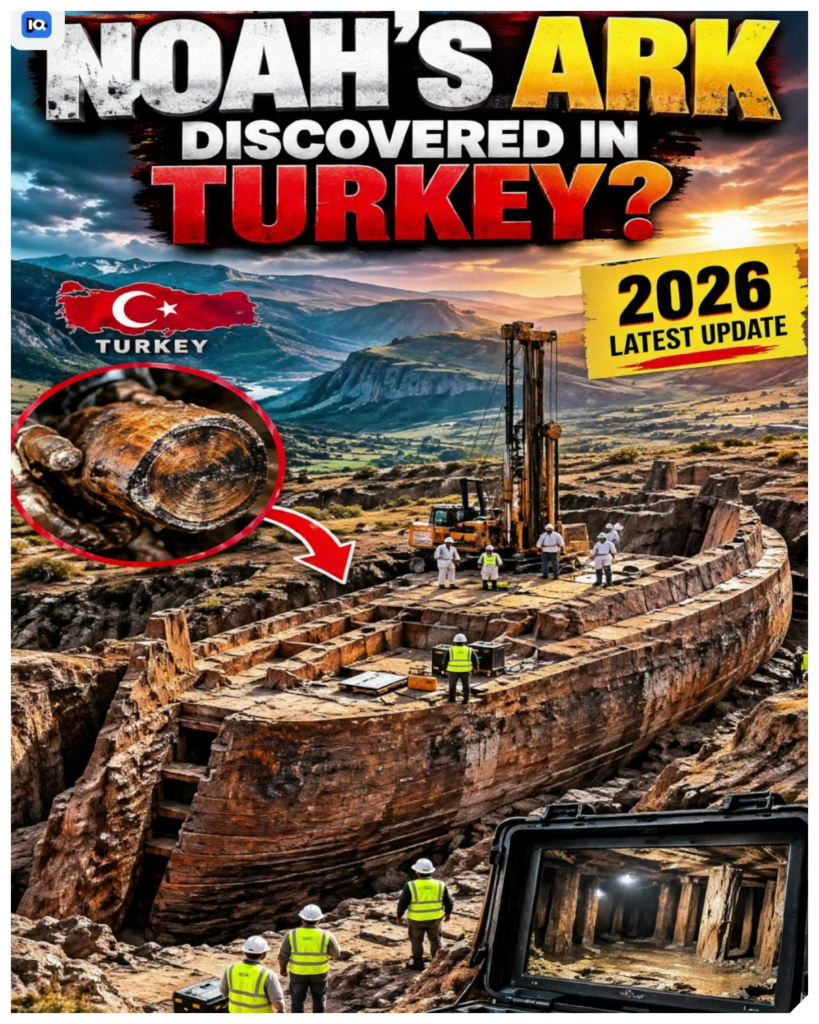
🚨 NOAH’S ARK? DRILLING BEGINS IN TURKEY — WHAT SCIENTISTS HOPE TO FIND BENEATH THE MYSTERIOUS FORMATION HAS EVERYONE TALKING!
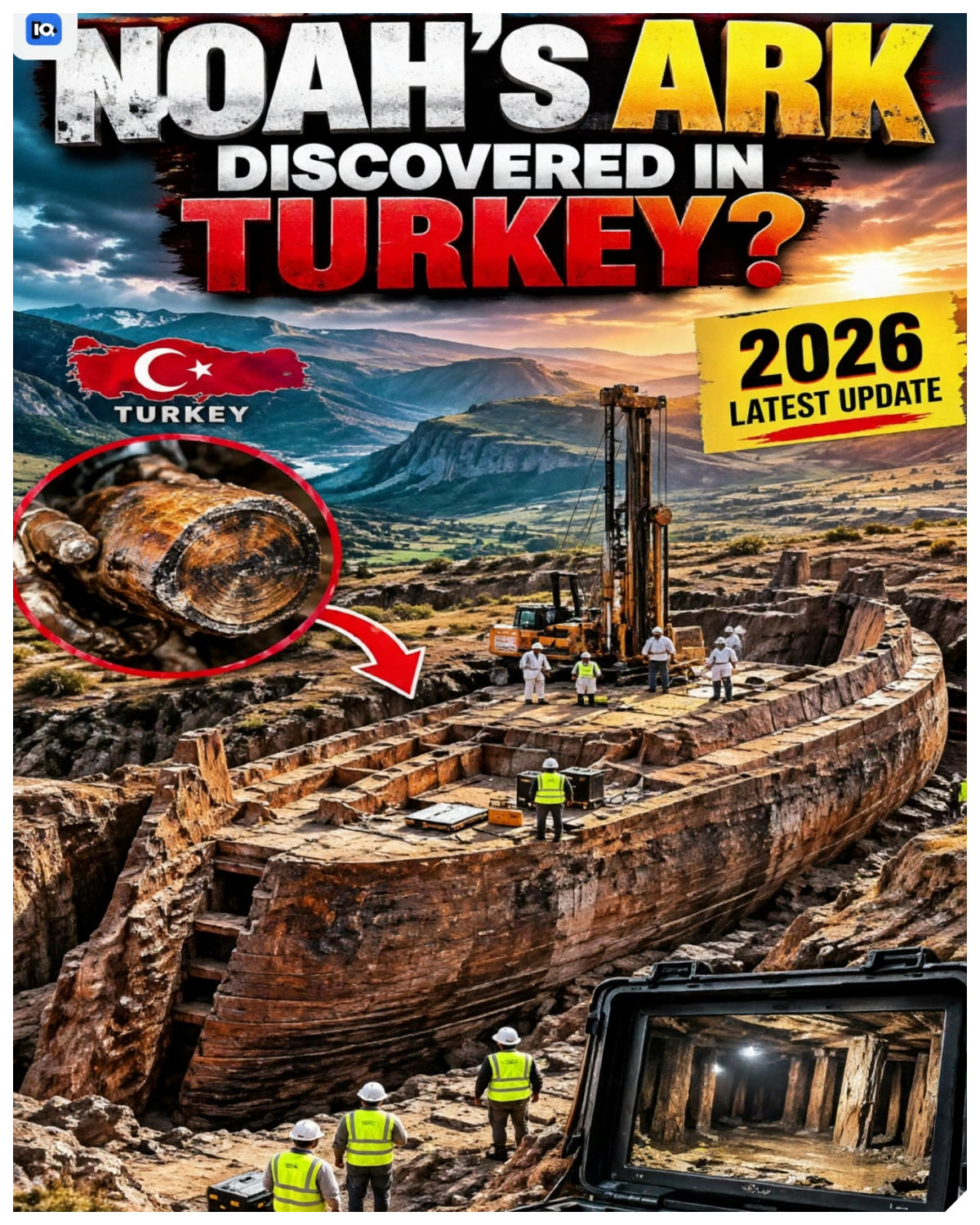
PART 1: THE DAY THEY FINALLY DECIDED TO DRILL
For thousands of years, the story of Noah’s Ark has occupied a remarkable place in human history.
According to the biblical account, Noah built an enormous vessel, gathered his family and animals, and survived a catastrophic flood that devastated the ancient world.
Generations have wondered whether the Ark was a real vessel, where it might have landed, and whether any physical evidence could still exist.
Now, an intriguing investigation in eastern Turkey has brought those questions back into the spotlight.
Near the towering slopes of Mount Ararat, where snow-covered peaks disappear into the clouds, researchers have been examining an unusual boat-shaped geological formation.
And the possibility of drilling into the surrounding ground has created a new wave of excitement.
But nobody knows what lies beneath the surface.
The story begins with a team of researchers who arrived in the region with one ambitious objective: investigate the mysterious formation and determine whether its unusual characteristics could have an archaeological explanation.
The landscape was breathtaking but unforgiving.
Cold winds swept across the mountains. The ground was uneven, and the surrounding valleys were covered with rocks that had endured countless seasons of snow, rain, and erosion.
For the researchers, every step represented another opportunity to discover something unexpected.
The formation they were investigating had attracted attention because its outline appeared remarkably similar to the shape of a large vessel.
Some enthusiasts had compared its dimensions with those described in the Book of Genesis.
According to Genesis 6:15, Noah’s Ark was described as 300 cubits long, 50 cubits wide, and 30 cubits high.
Those measurements have inspired generations of explorers to search for possible traces of the biblical vessel.
However, resemblance alone cannot establish that a geological formation is an ancient ship.
Natural processes can produce extraordinary shapes, and the area surrounding Mount Ararat contains complicated geological structures.
That is precisely why the researchers wanted more detailed evidence.
They began by documenting the formation.
Measurements were taken. Photographs were collected. Surface features were examined, and geological samples were considered for laboratory analysis.
Every observation mattered.
One researcher, standing near the edge of the formation, looked across the enormous structure and quietly asked:
“What if there really is something underneath?”
Nobody immediately answered.
The question had been haunting the team since the investigation began.
For believers, the possibility was deeply moving. For scientists, it was an extraordinary hypothesis that needed testing.
For everyone involved, the mystery was impossible to ignore.
As the investigation developed, attention turned toward the possibility of using drilling equipment to examine material beneath the surface.
The proposal immediately raised important questions.
Would drilling reveal ordinary layers of sediment and rock?
Could the formation contain unusual deposits?
Might there be evidence of ancient human activity?
Or would the investigation finally demonstrate that the boat-shaped outline was entirely the product of natural geological processes?
The researchers knew that any findings would need independent verification.
They also understood that a sensational announcement without reliable evidence could damage the credibility of the entire investigation.
So they proceeded cautiously.
Meanwhile, interest in the site continued growing.
People around the world began discussing the possibility that modern technology might finally help resolve a mystery that had fascinated humanity for centuries.
Some imagined the discovery of ancient wooden remains.
Others hoped that laboratory testing might reveal evidence of an artificial structure.
And many simply wanted an honest scientific answer.
Then came the announcement that changed the atmosphere surrounding the investigation.
Drilling was being discussed as a way to examine the formation more deeply.
For the researchers, this represented a potentially important next step.
For those following the story, it sounded like the beginning of a historic moment.
But the actual work would be far more complicated than simply placing a drill into the ground.
Before drilling could begin, the team needed to consider environmental conditions, geological stability, permits, sampling procedures, and the possibility of contamination.
Every sample would need to be carefully documented.
If anything unusual emerged, researchers would need to establish exactly where it came from and whether it had been disturbed.
One member of the investigation, a geologist named Daniel, was particularly concerned about the expectations surrounding the project.
He had spent years studying ancient landscapes and knew how easily excitement could become mistaken for evidence.
One evening, while the team gathered around a small table inside their temporary research facility, Daniel looked at the others.
“We have to be careful,” he said. “People already want us to find Noah’s Ark. But our responsibility is to discover what is actually there.”
Across the table, archaeologist Miriam nodded.
“Agreed. If the evidence supports an extraordinary conclusion, it will speak for itself.”
Outside, the wind grew stronger.
The mountain stood silently beneath a darkening sky.
For generations, explorers had come to this region carrying photographs, historical accounts, religious traditions, and enormous expectations.
Some had returned with intriguing observations.
Others had found nothing conclusive.
But this investigation was different in one important respect.
The team wanted to establish a documented scientific process rather than rely on photographs or visual comparisons.
The following morning, they reviewed the proposed drilling locations.
Each position was discussed carefully.
The researchers wanted to avoid damaging any potentially important material and ensure that any samples could be traced back to their exact locations.
Daniel studied the geological map.
Then he noticed something.
A proposed sampling point was located close to an area that had not received much attention in earlier investigations.
He leaned forward.
“Why haven’t we examined this section more closely?”
Miriam moved beside him.
They reviewed the available photographs and measurements.
At first, the location seemed ordinary.
But one detail caught their attention: the surrounding material appeared to have a different pattern from the deposits documented elsewhere.
It might have been completely natural.
Still, they agreed that the area deserved additional examination.
The team revised its investigation plan.
Over the next several days, they prepared equipment, reviewed safety procedures, and organized the documentation required for a careful geological survey.
The atmosphere became increasingly tense.
Everyone understood that the first samples might provide nothing unusual.
But the possibility of discovering something significant remained.
Then, shortly before the next stage of the investigation, Miriam received a message from a colleague who had been reviewing older photographs of the formation.
The message contained an image and a short note.
“Look carefully at the lower section. Compare it with the latest measurements.”
Miriam opened the photograph.
She studied it once.
Then again.
Her expression changed.
Daniel noticed immediately.
“What is it?”
Miriam enlarged the image and placed it beside the geological map.
For several seconds, neither researcher spoke.
The photograph showed a feature that appeared to align with an area they had already identified for further examination.
It was not proof of a vessel.
It was not proof of ancient construction.
But it raised a question that could not easily be dismissed.
Miriam turned toward Daniel.
“What if the most important part of this formation isn’t the shape we can see?”
Daniel looked at the image.
“Then where is it?”
She pointed toward the ground beneath their proposed drilling location.
And that was when the team realized something unsettling.
Their investigation might have been focused on the wrong part of the mystery all along.
But just as they prepared to revise the drilling plan, an unexpected message arrived from the laboratory.
The message contained a preliminary observation about a previously collected sample.
Daniel read it silently.
Then he looked at Miriam.
“Cancel the briefing,” he said. “We need to examine this before anyone makes an announcement.”
Because the laboratory had noticed something in the sample that neither researcher had expected.
And it might change what they decide to drill into next.
👇 Want to discover what the laboratory noticed? Check the comments for Part 2!
Đang viết
PART 2: THE LABORATORY MESSAGE NOBODY EXPECTED
And it might change what they decide to drill into next.
Daniel immediately contacted the laboratory and requested the original analysis records. Miriam began comparing the sample with earlier geological photographs.
The preliminary observation concerned an unusual concentration of mineral deposits and a pattern that required further testing.
Nobody could yet explain its significance.
Then the laboratory technician called.
“We need to discuss the sample,” she said. “There’s something about its composition that deserves a second examination.”
Daniel looked at Miriam.
“Could it be evidence of human activity?”
The technician paused.
“We can’t say that yet. But you should see the results yourself.”
❤️ LIKE and comment ARK if you want Part 3!
Once enough people comment, the final chapter will reveal what happened when the investigation moved closer to the mysterious formation.
PART 3: BENEATH THE MOUNTAIN — THE MYSTERY THAT REFUSED TO DISAPPEAR
The technician paused.
“We can’t say that yet. But you should see the results yourself.”
Daniel felt his stomach tighten.
For years, he had trained himself never to become emotionally attached to a discovery before the evidence was complete.
He had witnessed researchers become convinced that ordinary stones were ancient tools, that natural formations were buried buildings, and that unusual mineral deposits were proof of civilizations nobody could identify.
He knew how dangerous premature conclusions could be.
Yet something about the technician’s voice bothered him.
She did not sound excited.
She sounded concerned.
“Tell me exactly what you found,” Daniel said.
“We found variations in the mineral composition that weren’t expected from the initial description of the sample. But the sample is limited, and we need to examine the original material again.”
“Does it suggest artificial construction?”
“I didn’t say that.”
“Then what are you saying?”
“I’m saying you should come to the laboratory.”
The call ended.
Daniel slowly lowered his phone.
Miriam was watching him.
“What happened?”
“We’re going back.”
“Why?”
“Because apparently the laboratory doesn’t want to explain the results over the telephone.”
Miriam looked toward the mountain visible through the window.
The mysterious formation had been waiting there long before either of them was born.
It would probably remain there long after they were gone.
But for the first time, Daniel wondered whether their investigation was approaching something they had not anticipated.
The journey back
The following morning, the two researchers traveled to the laboratory where their earlier samples had been examined.
The journey was quiet.
Miriam spent most of the time reviewing the documentation on her laptop.
Daniel watched the landscape pass outside the vehicle.
He finally broke the silence.
“Do you believe we’re looking at something artificial?”
Miriam closed her laptop.
“I believe we’re looking at something we don’t understand yet.”
“That’s not an answer.”
“It’s the only honest answer I have.”
Daniel smiled faintly.
“You’re beginning to sound like me.”
“Someone has to keep you from announcing the discovery of the century before we’ve finished our measurements.”
They laughed.
But the laughter disappeared when they arrived.
The laboratory technician, a woman named Elif, was waiting near the entrance.
She had worked with geological samples for more than a decade. Her reputation was built on careful analysis, not dramatic announcements.
She greeted them and immediately led them into a small examination room.
Several sample containers stood on a table.
Beside them were printed charts, photographs, and laboratory notes.
Elif pointed toward the first report.
“This is the original sample. We’ve repeated the measurements because the initial results were unusual.”
Daniel leaned forward.
“What exactly is unusual?”
“The composition varies across different portions of the material.”
“Could that happen naturally?”
“Absolutely.”
“Then why did you call us?”
Elif picked up another photograph.
“Because the variations deserve further investigation. We cannot determine their origin from this sample alone.”
Miriam examined the photograph.
There were several visible differences in the material.
She looked at Elif.
“Are you suggesting the sample came from a man-made structure?”
“No. I’m suggesting that we shouldn’t make that assumption or dismiss the possibility without additional testing.”
Daniel nodded.
It was precisely the kind of answer he respected.
But he was still disappointed.
After all the excitement, he had hoped for something more definite.
Then Elif opened another folder.
“There is something else.”
She placed an older photograph on the table.
It showed a section of the mysterious formation.
The image had been taken during an earlier survey.
“Do you recognize this location?” she asked.
Miriam studied it.
“That’s close to the lower section.”
“Correct.”
Elif pointed toward a small area in the photograph.
“This is where the sample was collected.”
Daniel looked more closely.
The material appeared different from the surrounding deposits.
“How much material do we have?”
“Not enough to reach any archaeological conclusion. That’s why a properly designed sampling program would be important.”
Daniel leaned back.
“So we’re back where we started.”
“Not exactly,” Elif replied.
She turned the photograph around.
“We now have a better idea of what questions to ask.”
And sometimes, in archaeology, knowing which questions to ask is more important than having an immediate answer.
A mountain surrounded by questions
That evening, Daniel and Miriam returned to their temporary research facility.
The mountain was visible in the distance.
The setting sun illuminated the snow-covered slopes in shades of orange and gold.
Miriam stood near the window.
“Do you ever think about the people who first told the story?” she asked.
Daniel placed his notebook on the table.
“Which people?”
“The generations who passed down the account of Noah. Imagine what it meant to them. A flood, a vessel, a family surviving something that seemed impossible.”
Daniel considered her question.
“I think people have always needed stories that help them understand survival.”
“And what if the story preserves a memory of something that really happened?”
“Then we would still need to establish what happened, where it happened, and how the account developed.”
Miriam smiled.
“You never make anything easy.”
“That’s because evidence is rarely easy.”
For a moment, they stood in silence.
The story of Noah’s Ark had inspired explorers, theologians, historians, and scientists for centuries.
Yet the question of its physical location remained unresolved.
Mount Ararat had become particularly important in popular discussions because of its association with the biblical account.
But the mountain’s dramatic reputation did not automatically make every unusual formation an archaeological discovery.
Daniel knew that.
Miriam knew that.
And the team needed to remember it.
The next day, they planned to hold a meeting to decide whether the investigation should proceed with additional sampling.
There was one major problem.
The proposed drilling operation was not a simple matter.
The region was environmentally sensitive.
The geological structure was complicated.
And any operation involving excavation would require appropriate permissions, qualified personnel, and a clear scientific justification.
Daniel insisted that no one should begin drilling merely because the public was excited.
“If we damage the formation, we might destroy the very evidence we’re trying to understand,” he explained.
The team agreed.
They would first conduct a more detailed geological survey.
Only after reviewing the results and obtaining the necessary approvals would they consider any intrusive investigation.
But before the meeting could begin, another unexpected development arrived.
The old photograph
A historian named Samuel had been following the investigation from another research institution.
He had spent years examining historical accounts of alleged Ark sightings and early expeditions around Mount Ararat.
Samuel was not part of the field team, but he had been invited to review some of the historical material.
He sent Miriam an email containing several scanned documents.
The subject line read:
AN OLD ACCOUNT YOU SHOULD SEE.
Miriam opened the message.
There were three attachments.
The first contained a photograph of a handwritten document.
The second showed an old map.
The third was a letter describing an expedition that had taken place decades earlier.
She called Daniel.
“You need to see this.”
He entered the room carrying two cups of coffee.
“What have you found now?”
“Samuel sent us something.”
Daniel placed the cups down.
They examined the documents together.
The handwritten account described an expedition that had encountered an unusual formation in the mountains.
It included a rough sketch.
The shape was elongated.
Its edges were irregular.
And several measurements had been recorded.
Miriam looked at Daniel.
“Could this be the same formation?”
“Possibly.”
“The location description seems close.”
“Close isn’t exact.”
“I know.”
Daniel studied the map.
The document was interesting, but its historical reliability had not yet been established.
They would need to determine who wrote it, when it was produced, whether the map had been accurately copied, and whether the measurements referred to the same location.
Still, one detail stood out.
The old account mentioned a section of the formation that had reportedly been difficult to examine.
A lower area.
The same general region that had attracted their attention during the recent survey.
Daniel slowly sat down.
“Contact Samuel.”
Miriam immediately sent a message.
Within an hour, Samuel responded.
He agreed to join a video meeting.
When his face appeared on the screen, Daniel greeted him.
“We received your documents.”
“Good. I hoped you would find them interesting.”
“Where did they come from?”
Samuel explained that the materials had been preserved in a private historical collection.
He was still working to establish their complete provenance.
“Are you certain they’re authentic?” Miriam asked.
“No,” Samuel answered. “And I want to make that clear. They require proper verification. But the account may help us identify an earlier investigation.”
Daniel looked at the map.
“Does it identify the exact location?”
“Not conclusively. The description is incomplete.”
“Then what makes it important?”
Samuel paused.
“Because it mentions something the recent reports don’t.”
“What?”
“A possible change in the ground surface near the lower section of the formation.”
Miriam leaned toward the screen.
“Explain.”
“The account describes an area where material appeared to have shifted over time. The writer believed it might have exposed part of the underlying structure.”
Daniel exchanged a glance with Miriam.
“Did the expedition investigate it?”
“That’s the problem. The surviving account ends before explaining what happened next.”
For several seconds, nobody spoke.
Samuel continued.
“There may be additional pages. I’m trying to locate them.”
Daniel rubbed his forehead.
“So we’re chasing a missing chapter of an old expedition report.”
“That’s one way of describing it.”
Miriam smiled.
“Please keep looking.”
The decision to investigate
The next morning, the research team gathered around a large table.
Daniel presented the laboratory observations.
Miriam discussed the historical documents.
Elif joined remotely to explain why the samples required additional testing.
The discussion lasted several hours.
Some members wanted to proceed quickly.
Others argued that the evidence was not strong enough to justify drilling.
One researcher pointed out that a boat-shaped geological formation could be produced by natural processes.
Another emphasized that the proposed investigation needed to distinguish between the geological age of the formation and the age of any possible material found within it.
Daniel listened carefully.
Finally, he stood.
“We have two choices,” he said.
“We can allow public expectations to determine what we do next, or we can allow the evidence to determine what we do next.”
The room became quiet.
He continued.
“We are not here to prove a religious story. We are not here to disprove one. We are here to investigate a geological formation.”
Miriam nodded.
“And if we find something significant?”
“Then we document it, test it, and invite independent specialists to examine it.”
“And if we find nothing?”
“Then we report that honestly too.”
The decision was made.
The team would continue with non-invasive surveys and carefully planned sampling.
Any drilling would require the appropriate authorization and scientific justification.
No dramatic excavation would take place simply to create a headline.
For Daniel, it was a relief.
He could finally concentrate on the work.
But the biggest surprise was still waiting.
The first survey
Several days later, the researchers returned to the formation.
The weather was cold.
Clouds moved across the mountain slopes, and occasional gusts of wind swept dust across the ground.
The team began setting up the survey equipment.
Their objective was to create a more detailed picture of the subsurface conditions.
They wanted to identify variations in the geological layers and determine whether the unusual features continued beneath the visible surface.
Daniel reviewed the measurements.
Miriam checked the location records.
A technician named Peter monitored the equipment.
The first results appeared on the screen.
At first, they looked ordinary.
Layers of material.
Changes in density.
Variations in the surrounding geological structure.
Then Peter noticed an area that deserved closer examination.
“Daniel?”
“What is it?”
“Look at this section.”
Daniel approached the monitor.
The image showed a variation in the subsurface pattern.
Miriam joined them.
“Could that be a cavity?”
“Possibly,” Peter replied. “But there are several geological explanations.”
Daniel studied the display.
“Can we establish its dimensions?”
“Not from this measurement alone.”
Miriam pointed toward another section.
“What about here?”
Peter adjusted the display.
A second variation appeared.
The two features were separated by a narrow region.
They might have been unrelated.
They might have represented changes in the underlying rock.
Or they might have justified another survey.
Daniel wrote down the coordinates.
“Let’s document both locations.”
The team continued working.
By late afternoon, they had collected enough preliminary information to begin a more detailed comparison.
Nobody had discovered an ancient vessel.
Nobody had found wooden remains.
But they had identified geological features that warranted additional study.
And that was enough to keep the investigation moving.
The unexpected disagreement
That evening, the team received a message from an external consultant.
The consultant had reviewed the preliminary images and questioned the interpretation of one feature.
He believed the pattern could be explained by natural geological processes.
Daniel read the message twice.
Miriam noticed his expression.
“Bad news?”
“Not necessarily.”
“What does he think?”
“He believes we’re looking at a natural variation in the rock.”
“Could he be right?”
“Of course.”
Miriam sighed.
“Then we’re back to the beginning.”
“No. We’re learning which explanations need to be tested.”
The disagreement quickly became the subject of another meeting.
One member of the team argued that the formation’s unusual shape was enough to justify more investigation.
Another insisted that visual similarity was scientifically meaningless without supporting evidence.
Daniel remained between them.
Finally, he said something that surprised everyone.
“I hope the consultant is right.”
Miriam looked at him.
“You hope?”
“Yes. If this is an ordinary geological formation, that’s an important result. We should not be disappointed simply because nature refuses to match our expectations.”
He paused.
“But if there is evidence of something unusual, I want us to discover it properly.”
It was the most honest statement he had made since the expedition began.
A call from Samuel
Three days later, Samuel called again.
This time, he sounded excited.
“I found something.”
Miriam immediately put him on speaker.
Daniel entered the room.
“What did you find?”
“Another page from the historical collection.”
“Is it part of the same account?”
“I believe so, although the connection still needs verification.”
Samuel explained that the additional page contained a description of an earlier inspection.
It referred to a section of the formation that had reportedly been examined after heavy weather.
The writer described a difference in the surface material and suggested that further investigation might be useful.
Miriam looked at Daniel.
“Does it mention wood?”
Samuel hesitated.
“It uses a word that could be translated that way, but the context is unclear.”
Daniel immediately became cautious.
“Could it refer to timber, a tree, or simply a wooden-looking object?”
“Yes. That’s why I haven’t drawn a conclusion.”
Miriam asked him to send the complete document.
Samuel agreed.
Then he added something else.
“There is a second issue.”
“What issue?” Daniel asked.
“The date.”
“What’s wrong with it?”
“The handwriting and paper may not belong to the period the collection originally attributed to them.”
Daniel frowned.
“So the document could be newer?”
“Possibly. We need a specialist to examine it.”
The excitement in the room faded slightly.
Once again, the investigation had produced an intriguing clue without providing an answer.
But Daniel was beginning to understand something.
The story of Noah’s Ark was not simply a search for an object.
It was also a search through centuries of interpretation, memory, geography, and human expectation.
Every clue needed to be examined.
Every claim needed to be questioned.
And every answer needed to be earned.
The moment before drilling
Weeks passed.
The research team continued its work.
The formation remained unchanged, rising from the surrounding landscape like an enormous question mark.
The team completed additional surveys.
They reviewed the laboratory results.
They compared the historical descriptions with the modern measurements.
Eventually, the investigators prepared a proposal for a limited, carefully controlled subsurface investigation.
It was not an announcement that Noah’s Ark had been found.
It was a request to examine specific geological features that remained unexplained.
The proposal included environmental safeguards, documentation procedures, and a plan for independent laboratory analysis.
After the necessary review process, the fictional investigation received authorization for a limited sampling operation.
The team prepared for the next stage.
On the morning of the operation, Daniel arrived early.
He stood beside the equipment and looked toward the formation.
Miriam approached.
“You didn’t sleep?”
“Not much.”
“Are you nervous?”
“Yes.”
“Why?”
Daniel watched the clouds moving above the mountain.
“Because once we begin, people will expect answers.”
Miriam looked at the equipment.
“And what if we don’t find any?”
“Then we tell them what we found.”
She smiled.
“You really don’t know how to make a moment dramatic.”
Daniel laughed.
“That’s your job.”
The team gathered.
The equipment was checked.
The location was verified.
The sample containers were labeled.
Every step was documented.
Nobody rushed.
Nobody celebrated.
There was only a quiet sense of anticipation.
Daniel looked at Peter.
“Ready?”
Peter nodded.
“Ready.”
The operation began.
The first material recovered consisted of ordinary geological deposits.
The team recorded its depth and location.
The sample was sealed and prepared for examination.
Another sample followed.
Then another.
Hours passed.
The researchers began to relax.
Perhaps the entire operation would reveal nothing beyond the geological complexity of the formation.
And then Peter noticed a change.
“Daniel?”
Daniel turned.
“What is it?”
“Look at the latest reading.”
Miriam moved closer.
The displayed measurements indicated a change in the material being examined.
Peter checked the equipment.
Then he repeated the measurement.
The result remained.
Daniel frowned.
“Could it be contamination?”
“Possibly. We need another sample.”
The team followed the approved sampling procedure.
The next result showed a similar variation.
Nobody said anything.
Miriam looked at Daniel.
“Should we stop?”
“Not yet. Let’s document everything and have the material examined independently.”
Peter looked at the formation.
For the first time that day, he appeared genuinely unsettled.
What the sample contained
The samples were transported under controlled conditions for laboratory analysis.
Daniel insisted that the examination be conducted without telling the analysts what the team hoped to discover.
He wanted an independent assessment.
Elif agreed to coordinate the work.
The first analysis focused on identifying the material’s mineral composition.
The second examined its microscopic structure.
The third compared the results with control samples collected from nearby geological layers.
The team waited.
One day passed.
Then another.
Miriam spent the time reviewing the historical records.
Daniel returned to the field notes.
Neither wanted to speculate.
Finally, Elif contacted them.
“The first report is ready.”
Daniel immediately called a meeting.
Elif appeared on the screen.
Behind her were several charts and photographs.
“I want to be very clear,” she began. “We have identified differences between the samples, but we cannot yet determine their origin.”
Daniel nodded.
“Continue.”
“The material contains mineral components that are consistent with the geological environment. Some microscopic features are unusual compared with our control samples, but they are not sufficient to establish human modification.”
Miriam asked:
“Is there any organic material?”
“Not in a form we can confidently identify at this stage.”
“Any preserved wood?”
“No confirmed wood.”
The room fell silent.
Daniel looked disappointed.
He had expected something more.
Elif continued.
“However, one sample contains a feature that deserves further examination.”
She displayed a microscopic image.
The material appeared layered.
There were variations in texture and composition.
“Could this be the result of natural sedimentation?” Daniel asked.
“Yes.”
“Could it be associated with an artificial structure?”
“That possibility cannot be excluded, but we have no evidence establishing it.”
Miriam leaned forward.
“Then what do you recommend?”
“Further independent testing, including examination by specialists who are not involved in this investigation.”
Daniel nodded.
“That’s what we’ll do.”
It was not the dramatic answer people wanted.
But it was the only answer the evidence supported.
The most difficult discovery
Several weeks later, the independent results arrived.
The findings were not what the team had expected.
The geological formation appeared to contain a complex arrangement of natural materials.
Some of the observed patterns could be explained by sedimentation, mineralization, and long-term geological processes.
The results did not establish the presence of an ancient vessel.
They did not establish that the formation was Noah’s Ark.
But they did provide valuable information about the site’s geological history.
For Miriam, that was important.
For Daniel, it was a reminder of why the investigation had to remain scientific.
However, the story was not finished.
Samuel had continued examining the historical documents.
He now believed he had located a second collection containing additional material related to the earlier expedition.
He contacted Miriam with an unusual request.
“Can we meet in person?”
“Why?”
“I think you need to see something.”
Miriam agreed.
A few days later, Samuel arrived at the research facility carrying a small archival box.
He placed it carefully on the table.
“I’ve spent weeks trying to establish where these documents came from,” he explained.
Daniel joined them.
“What is in the box?”
“Letters, photographs, and an incomplete expedition diary.”
Miriam opened the box.
Inside were several carefully preserved papers.
The first contained a handwritten list of locations.
The second showed a mountain landscape.
The third was a letter addressed to a researcher who had participated in an earlier investigation.
Samuel pointed toward the diary.
“This is the most interesting item.”
Miriam opened it.
The handwriting was faded.
Several pages were missing.
But one passage caught her attention.
She read it aloud.
“We returned to the formation after the weather cleared. The surface remained unchanged, but the lower ground appeared different from our previous visit.”
Daniel leaned closer.
“Anything else?”
Miriam continued.
“The team disagreed about whether the shape was natural. No conclusion could be reached. Further examination was recommended.”
She turned the page.
There was a rough drawing.
It showed the outline of the formation and several marked locations.
Daniel recognized the general shape.
“That’s remarkably similar to the modern survey.”
Samuel nodded.
“Yes. But similarity does not prove identity.”
Miriam continued reading.
Then she stopped.
The next line was partly obscured by damage.
She carefully examined the paper.
Only a few words remained legible.
“Do not confuse the mountain with the vessel…”
Daniel looked up.
“What does that mean?”
Samuel shrugged.
“I don’t know.”
Miriam read the words again.
“Do not confuse the mountain with the vessel.”
For a moment, the three researchers remained silent.
Perhaps the writer had been discussing geography.
Perhaps the phrase was metaphorical.
Perhaps it referred to a disagreement within the expedition.
But it raised a different question.
Had earlier explorers also struggled to distinguish the biblical account from the geological reality of the mountain?
Daniel closed the diary.
“We need to establish who wrote this.”
Samuel nodded.
“I’ve been trying.”
“Can you?”
“I think so.”
Samuel removed another document from the box.
It contained a name.
A researcher who had participated in an earlier expedition.
Daniel looked at it.
“Have you contacted the family?”
Samuel nodded.
“They have agreed to speak with us.”
The family secret
The meeting took place several days later.
The researchers traveled to meet the elderly granddaughter of the expedition’s former leader.
Her name was Anna.
She welcomed them into a quiet house filled with photographs, books, and family documents.
A framed photograph of an older man stood on a shelf.
Anna pointed toward it.
“That was my grandfather.”
Daniel introduced himself and explained the investigation.
Anna listened carefully.
When he mentioned the mysterious formation, she smiled sadly.
“My grandfather talked about it for years.”
Miriam leaned forward.
“What did he say?”
“He believed people were asking the wrong question.”
Daniel exchanged a glance with Miriam.
“What question should they have been asking?”
Anna looked at the photograph.
“He always said that the important thing was not whether a particular rock looked like a ship. The important thing was understanding the story behind the search.”
Miriam was intrigued.
“Did he believe he had found Noah’s Ark?”
Anna shook her head.
“He never said that.”
“Did he find anything unusual?”
“He said he found evidence that deserved investigation. But he also said he could not prove what it meant.”
Daniel nodded.
That sounded remarkably similar to their own experience.
Anna continued.
“My grandfather believed that people sometimes become so desperate to find a miracle that they stop examining what is actually in front of them.”
Miriam smiled faintly.
“That sounds familiar.”
Anna disappeared into another room.
When she returned, she carried a small notebook.
“This belonged to him.”
She placed it on the table.
The notebook was old.
Its cover was worn, and several pages had become fragile.
“I’ve never read all of it,” Anna said. “Some pages are difficult to understand.”
Daniel looked at the notebook.
“Would you allow us to examine it?”
Anna considered the request.
“Yes. But I want one promise.”
“What promise?”
“Don’t turn my grandfather’s work into a story that he never told.”
Daniel nodded.
“I promise.”
Anna handed him the notebook.
Miriam opened the first page.
It contained notes about geological formations, weather conditions, and expedition observations.
Nothing unusual.
But several pages later, she found a sentence that made her pause.
She read it quietly.
“Perhaps the Ark is not waiting for us where everyone expects to find it.”
Daniel looked up.
“What does that mean?”
Miriam turned the page.
The next entry was dated several days later.
“People come here looking for a single object. They leave without understanding the mountain.”
Anna watched them.
“That was how he thought.”
Daniel slowly closed the notebook.
The words were not evidence of an ancient vessel.
They were evidence of a man who had spent years thinking about the difference between belief and proof.
And perhaps that was the most important part of the investigation.
The final examination
The research team returned to the formation with a different perspective.
They were no longer looking for a dramatic discovery.
They wanted to understand the geological history of the site.
They reviewed the survey data and compared it with regional geological information.
They studied the natural processes that could have created the formation’s unusual outline.
They also considered whether any archaeological material could be established independently.
The results were gradually becoming clearer.
The formation’s shape could be explained by natural geological processes.
The laboratory samples did not provide verified evidence of a wooden vessel.
The historical accounts were interesting but incomplete.
The alleged connection to Noah’s Ark remained unproven.
Daniel gathered the team.
“I think we know what our report needs to say.”
Miriam looked at him.
“That we haven’t found the Ark?”
“That we haven’t established that this formation is the Ark.”
“Some people won’t like that.”
“They don’t have to like it. They need to understand it.”
Peter joined the conversation.
“But doesn’t that mean the investigation failed?”
Daniel shook his head.
“No.”
He pointed toward the mountain.
“We came here with questions. We collected evidence. We tested our assumptions. We identified what we could and couldn’t establish. That’s not failure.”
Miriam smiled.
“Then what is success?”
Daniel looked at the formation.
“Being willing to tell the truth, even when the truth is less dramatic than the story we imagined.”
The announcement
The researchers eventually prepared a public report.
It explained the purpose of the investigation, the methods used, the observations recorded, and the limitations of the findings.
The report made one point especially clear:
No verified archaeological evidence had established that the formation was Noah’s Ark.
The unusual geological features required careful interpretation, and the available samples did not prove the existence of an ancient vessel.
The report also emphasized that the historical significance of the biblical account should not be confused with the scientific identification of a physical archaeological site.
When the findings were presented, reactions were mixed.
Some people were disappointed.
Others welcomed the cautious approach.
Some continued believing that the Ark might still be hidden somewhere in the mountains.
Others argued that the geological explanation was sufficient.
Daniel expected the disagreement.
What he did not expect was the message he received afterward.
It came from Samuel.
The subject line read:
ONE LAST THING.
Daniel opened it.
Samuel had discovered another entry in the historical collection.
It was a short passage written by the former expedition leader.
The entry did not describe a discovery.
It did not claim that the Ark had been found.
Instead, it contained a reflection:
“We searched the mountain for a vessel, but perhaps we should also remember the purpose of the journey. A story of survival should not become an excuse to stop asking questions.”
Daniel read the sentence twice.
Then he forwarded it to Miriam.
She replied almost immediately.
“Your grandfather’s notebook was right.”
Daniel smiled.
For the first time in weeks, he felt that the investigation had reached a meaningful conclusion.
Not because they had found Noah’s Ark.
But because they had learned something about the responsibility that comes with searching for extraordinary answers.
One final evening at Mount Ararat
On their last evening near the mountain, Daniel and Miriam walked to a quiet viewpoint.
The sky was turning dark.
The snow-covered peaks glowed beneath the fading sunlight.
Miriam looked toward the formation.
“Do you think someone will come back and investigate it again?”
“Probably.”
“Do you think they’ll find something?”
“I hope they find something worth understanding.”
“Do you believe Noah’s Ark existed?”
Daniel took a moment before answering.
“I believe the story has enormous historical, religious, and cultural importance. Whether this particular formation is connected to it is a different question.”
Miriam nodded.
“And if someone eventually finds convincing evidence?”
“Then the evidence should be examined. Independently. Carefully. Without fear.”
She smiled.
“You’re never going to become a headline writer.”
Daniel laughed.
“Probably not.”
They continued walking.
The mountain stood in silence.
For thousands of years, stories of floods and survival had traveled across generations.
People had searched for the Ark in mountains, valleys, ancient texts, and forgotten traditions.
Some believed it had been found.
Others believed it remained hidden.
The investigation had not settled the debate.
But it had demonstrated why the search required patience, honesty, and scientific discipline.
And perhaps that was a more meaningful ending than a sensational announcement.
The mystery lives on
Months later, the team published its complete research documentation.
The photographs, geological measurements, laboratory results, and historical observations were made available for further examination.
Other researchers began reviewing the findings.
Some proposed alternative explanations for the formation.
Others suggested additional geological studies.
A few continued exploring the broader archaeological questions surrounding ancient flood traditions.
The debate remained alive.
One morning, Miriam received a message from a young university student.
The student had read the report and wanted to know whether the investigation had changed her opinion about Noah’s Ark.
Miriam thought carefully before responding.
Finally, she wrote:
“An unanswered question is not proof of a particular answer. But it is an invitation to keep learning.”
She sent the message.
Then she looked toward the mountain photograph hanging above her desk.
She remembered the cold mornings, the difficult fieldwork, the laboratory discussions, the historical documents, and the moment when everyone had waited for the first samples.
She remembered how desperately people had wanted the investigation to produce a spectacular discovery.
But she also remembered Anna’s words.
Don’t turn my grandfather’s work into a story that he never told.
That sentence stayed with her.
Because the real responsibility of an investigator was not to give people the conclusion they wanted.
It was to give them the most honest account the evidence could support.
And the story of Noah’s Ark deserved that honesty.
The mountain remained.
The formation remained.
The questions remained.
And somewhere in the world, another explorer was probably preparing to begin a new investigation.
Perhaps that explorer would discover something important.
Perhaps the results would support an entirely different explanation.
Perhaps nothing extraordinary would be found at all.
But the search would continue.
Not because every mystery must end with a miracle.
But because human curiosity has always been one of the strongest forces driving discovery.
And sometimes, the greatest discovery is learning how to distinguish what we hope is true from what we can actually demonstrate.
So, was Noah’s Ark hidden beneath the mountains of Turkey?
The investigation did not prove it.
The geological formation remains an intriguing subject, but no verified evidence has established that it is the biblical Ark.
For believers, the story of Noah continues to carry a powerful message of faith, obedience, hope, and survival.
For researchers, the mystery remains an invitation to examine the past with open minds and careful methods.
And for everyone fascinated by ancient history, one question remains worth asking:
What other secrets might the mountains still be hiding?
🌍 THE END — OR PERHAPS JUST THE BEGINNING OF ANOTHER SEARCH.
DISCLAIMER: This story is entirely fictional and created for entertainment purposes only. The characters, dialogue, and narrative events are fictional. It does not represent any organization or individual, and it does not claim that Noah’s Ark has been discovered or that a verified drilling operation has established its existence in Turkey. The content was generated with AI assistance.