Hidden among the rugged mountains of southern Jordan, Petra stands as one of the world’s most extraordinary ancient cities, celebrated for its magnificent monuments carved into rose-red sandstone.
Once the thriving capital of the Nabataeans, it flourished as a powerful trading centre, leaving behind remarkable architectural achievements, advanced engineering and fascinating cultural traditions.
Yet, beneath its ancient landscape, Petra may still hold secrets that history has barely begun to unravel.
Now, geologists exploring the mysterious city have uncovered something extraordinary, raising new questions about its past.
But what exactly have they discovered?
Join us in this video as we uncover the truth.
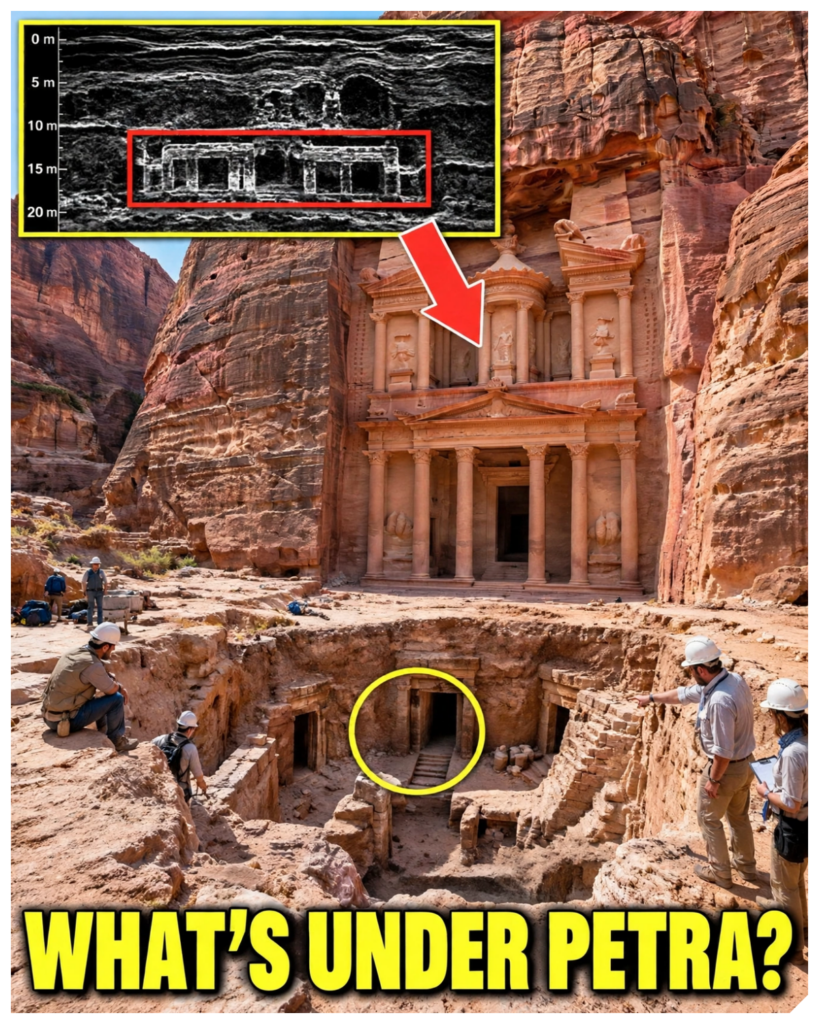
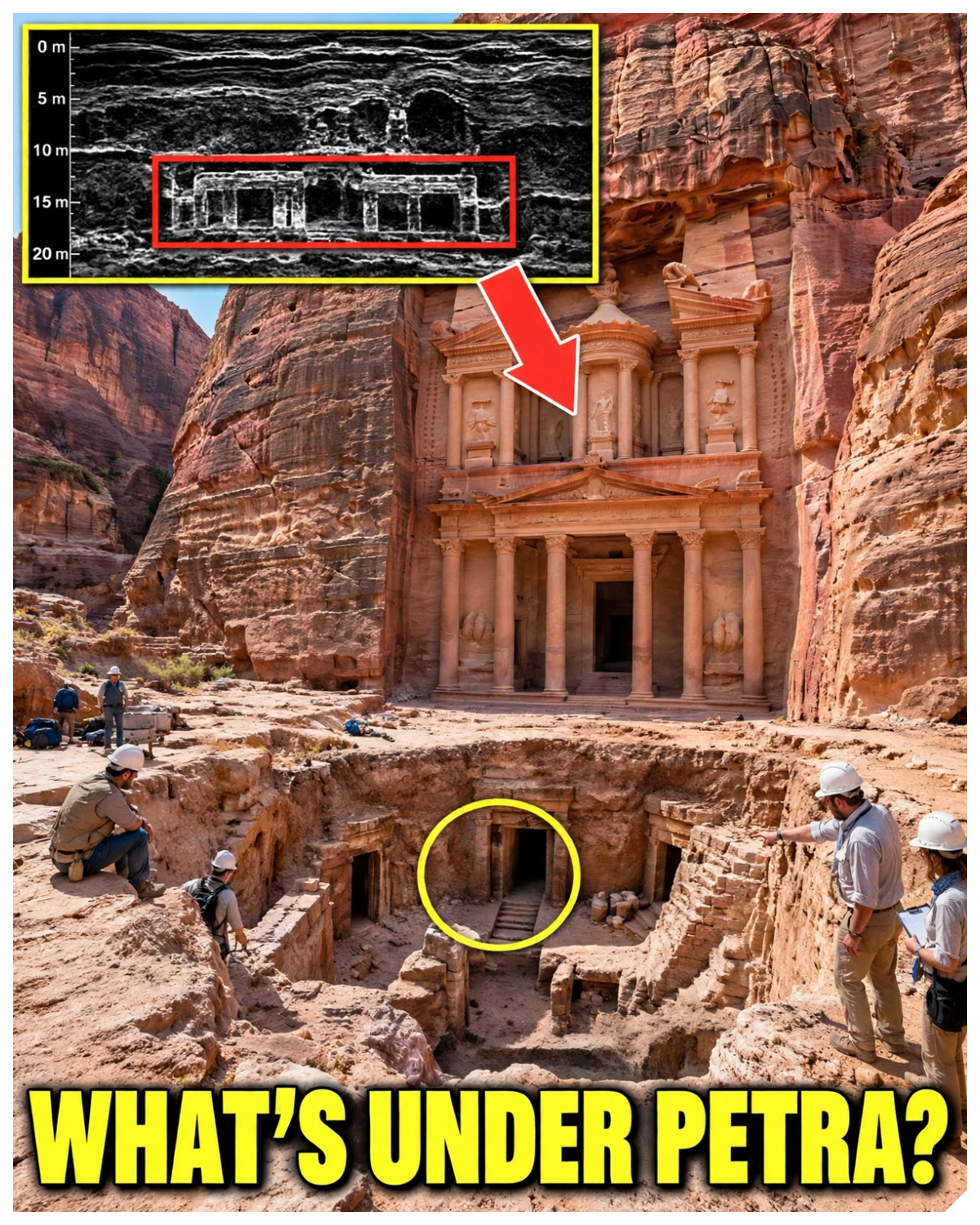
Geologists Uncover a Hidden World Beneath Petra’s Treasury In the summer of 2024, a geophysicist named Richard Bates made an unusual discovery while examining the sandy ground in front of Petra’s most famous monument, the Treasury.
Armed with a special radar machine, he carefully scanned the very spot where more than a million tourists walk every year.
But beneath the feet of these visitors was something most of them had never imagined.
They were not standing on the original ground of the ancient city.
The surface they walked on had been buried beneath layers of sand and soil, while the streets and ground once used by the Nabataeans lay several metres below.
For centuries, stories about the Treasury had focused on the treasures supposedly hidden inside it.
Local Bedouin herders once believed that an Egyptian pharaoh had concealed his gold inside the stone urn sitting at the very top of the monument.
Convinced that it contained a fortune, they fired their rifles at it in an attempt to break it open.
The bullet marks are still visible today.
Yet, while generations of people searched the monument for imaginary riches, a much more fascinating secret may have been waiting beneath the ground all along.
When Bates examined the radar readings, he noticed that the area beneath the sandy surface was not as solid as it appeared.
His equipment revealed unusual underground spaces that could point to structures hidden beneath the Treasury’s courtyard.
What researchers would go on to discover through their investigation of the surrounding rocks raised even bigger questions about the ancient city.
Could the famous Treasury be only a small part of a much larger archaeological site hidden beneath the ground?
For many years, excavating the ground directly in front of the Treasury was considered too risky.
This was not an ordinary archaeological site where researchers could simply pick up their tools and start digging.
The Treasury is Petra’s most recognisable monument, attracting visitors from across the world and appearing in countless photographs, documentaries and travel advertisements about Jordan.
Its enormous historical and cultural importance means that even the smallest mistake during an excavation could cause permanent damage.
A single crack in the ancient structure would be a devastating loss.
This was why an American archaeologist named Pearce Paul Creasman needed special permission before his team could investigate what lay beneath the monument.
Creasman, who heads the American Center of Research in Amman, was leading a major research project involving both American and Jordanian specialists.
The investigation was conducted in collaboration with Fadi Balawi of Jordan’s Department of Antiquities and Faris Breizat, who heads the authority responsible for managing Petra.
Their involvement was essential because every stage of the operation had to be carefully approved.
The researchers had to make sure that their equipment and investigation methods would not put the monument at risk.
However, this was not simply an attempt to satisfy curiosity.
The team already had a strong reason to suspect that the ground beneath the Treasury contained something important.
In fact, an earlier archaeological discovery had provided the first real evidence that the secrets of Petra extended much further below the surface than anyone had imagined.
The first major breakthrough came in 2003, when Jordanian archaeologists led by Suleiman Farajat carried out an excavation in the courtyard on the left side of the Treasury.
Rather than searching for the gold and treasures associated with the monument, they wanted to understand what was buried beneath its surroundings.
What they uncovered was remarkable.
Approximately six metres below the modern surface, they discovered ancient tombs and chambers carved directly into the natural rock.
Steps had been carefully cut into the stone, creating a passage that led down into these underground spaces.
Inside, the team found the remains of people who had been buried there centuries earlier.
The discovery was particularly important because it showed that the ground in front of the Treasury was not simply an empty space for visitors to walk across.
There was an entire archaeological layer beneath it, containing structures and evidence of the people who once lived and died in Petra.
Unfortunately, the excavation could not continue.
After the project ran out of funding, the researchers were forced to stop their work and close the site, leaving many questions unanswered.
For more than two decades, the possibility of uncovering more of this hidden world remained unexplored.
But now, with new technology and another investigation underway, researchers were finally getting the opportunity to look beneath the surface again.
What Other Extraordinary Discoveries Have Archaeologists Made Beneath Petra’s Ancient Ruins?
Keep watching to find out.
The Incredible Discovery Beneath Petra’s Ancient Treasury This was where Richard Bates became central to the investigation.
As a professor of geophysics at the University of St Andrews in Scotland, Bates had the scientific knowledge and specialised equipment needed to examine what lay beneath the ancient ground.
He brought along a device known as ground-penetrating radar, a machine that looks like a small cart and is pushed slowly across the surface.
Although it may appear simple, the technology allows researchers to investigate what is buried several metres beneath their feet without having to dig into the ground.
As the machine moves, it sends electromagnetic signals into the earth and records the echoes that return.
It works in a similar way to how bats use sound to navigate in darkness and locate objects around them.
Different materials reflect these signals in different ways.
Solid rock produces one type of response, tightly packed sand produces another, while an empty space creates a completely different pattern.
These responses appear on a screen, allowing scientists to identify possible underground structures without disturbing the ground above them.
Bates began by scanning the left side of the Treasury, where archaeologists had previously uncovered ancient tombs.
This was an important first step because it allowed him to establish what the remains of a Nabataean burial chamber looked like when examined through the radar.
Once he had identified the pattern, he moved across to the right side of the monument and repeated the process.
What appeared on his screen was something the researchers could not ignore.
The radar images from both sides showed remarkably similar patterns, suggesting that another underground structure could be buried beneath the courtyard.
When Pearce Paul Creasman examined the results, he realised that the team might finally have found evidence of another hidden chamber.
After years of wondering what lay beneath the Treasury, they now had a promising lead.
But detecting an underground room was only one part of the challenge.
The real question was how they could reach it without putting one of Petra’s most treasured monuments in danger.
The suspected chamber was located extremely close to the base of the Treasury.
This meant that digging directly down towards it would involve breaking through solid rock dangerously close to a monument that had stood for almost 2,000 years.
Even a small mistake could weaken the surrounding ground or cause damage to the ancient structure.
The researchers simply could not afford to take that risk.
They therefore decided to approach the chamber from a different direction.
Instead of digging straight down, they would excavate sideways, gradually moving towards the hidden space from an open section of the sandy courtyard.
It was a slower and more demanding method, but it offered a much safer way to reach their target.
The excavation was carried out carefully by hand, with the team using small tools, brushes and buckets rather than heavy machinery.
Every layer of sand and soil had to be removed gradually, ensuring that nothing important was damaged or overlooked.
Above the excavation site, the magnificent Treasury rose nearly 40 metres into the air.
Tourists continued to arrive, taking photographs and admiring the ancient building, while camels rested in the shade nearby.
Most visitors had no idea that an extraordinary archaeological investigation was taking place just beneath their feet.
Day after day, the researchers continued extending their trench towards the cliff, slowly getting closer to the underground space identified by Bates’s radar.
Every bucket of soil they removed revealed another layer of history that had remained buried for centuries.
The closer they got, the greater the anticipation became.
They knew that something was waiting beneath the ground, but they could not be certain what it would reveal about the people who once inhabited Petra.
Then came the moment the team had been working towards.
As the archaeologists continued digging, their tools eventually reached the natural bedrock.
But something immediately caught their attention.
Within the rock was an opening leading into a chamber that had clearly been carved out by human hands.
It was not a natural hollow or an accidental crack.
Someone had deliberately created this underground space, and it had remained hidden from the outside world for nearly 2,000 years.
The researchers carefully directed a light through the opening to see what was inside.
As the beam entered the darkness, it revealed walls with straight edges and carefully cut surfaces.
Dust filled the air, and the team stood silently, trying to take in what they had uncovered.
Then their attention shifted to the floor.
What they saw was astonishing: human remains.
These were not just a few scattered bones or fragments left behind by time.
The chamber contained the remains of entire individuals, lying in the positions in which they had been placed when they were buried.
After approximately 2,000 years in darkness, the ancient burial chamber and the people inside it had finally been uncovered.
Could these discoveries point to hidden secrets about Petra that have remained buried for centuries, waiting to be uncovered?
Stay tuned to find out.
The Geological Secrets Behind Petra’s Formation Anyone visiting Petra today will encounter the Siq, a spectacular narrow passage that winds through towering walls of rock for approximately 1.2 kilometres.
In some sections, the opening is only a few metres wide, while the cliffs rise as high as 180 metres on either side.
At first glance, it looks like a typical canyon, and many visitors naturally assume that it was formed by a river slowly cutting through the mountains over millions of years.
But geologists have discovered something far more fascinating.
The Siq was not originally carved by flowing water.
It was formed by enormous forces deep within the Earth that gradually pulled the mountain apart along a natural fracture known as a fault.
As the rocks separated, they created the enormous opening that eventually became Petra’s main entrance.
Water only came later, slowly wearing away the sharp edges and smoothing the rock walls into the curved shapes visitors admire today.
In other words, the entrance to one of the world’s most extraordinary ancient cities began as a massive fracture in the Earth’s crust.
And the geological history of the rocks surrounding it is just as remarkable.
Petra itself is carved into an ancient sandstone formation known as the Umm Ishrin Formation, which dates back approximately 500 million years.
This means the rocks existed long before dinosaurs appeared and even before the earliest trees grew on Earth.
Over millions of years, the sandstone was buried beneath the surface, where mineral-rich water slowly moved through its layers.
As the water travelled, it deposited minerals such as iron and manganese, creating natural bands of red, purple, yellow and almost white across the stone.
Eventually, geological movements brought these colourful rocks back towards the surface, exposing the beautiful patterns that can still be seen throughout Petra today.
The result is a landscape that almost looks as though an artist carefully painted the walls.
Yet every stripe and swirling pattern was created naturally, long before human beings ever set foot in the region.
However, the same geological features that gave Petra its extraordinary beauty also presented a serious challenge to the people who eventually made it their home.
The narrow valleys and natural cracks running through the mountains created a dangerous problem whenever heavy rain fell.
The surrounding hills collect water from an area of approximately 55 square kilometres, and much of this water naturally flows towards the Siq.
During ordinary weather, the passage may look completely dry and harmless.
But when winter storms arrive, it can transform into a powerful river within minutes.
Rushing water carries enormous rocks, thick mud and uprooted trees through the narrow opening, leaving anyone caught inside with very little chance of escaping.
With towering cliffs on both sides and only a few metres of walking space in certain sections, there is almost nowhere to run or climb to safety.
The Nabataeans understood this danger and knew that protecting their city would require more than simply finding a place to live.
Their solution was an extraordinary example of ancient engineering.
During the first century BC, they constructed a large dam across the entrance of the Siq to control the movement of floodwater.
They also carved a tunnel almost 90 metres long through the solid rock beside it.
This allowed dangerous water to be redirected away from the main passage instead of rushing directly into the city.
By combining their understanding of the landscape with remarkable engineering skills, the Nabataeans managed to turn a potentially deadly natural passage into a protected entrance to their magnificent city.
What other long-hidden secrets of Petra could this remarkable discovery finally reveal about the ancient city and the civilisation that once called it home?
Stay tuned to find out.
The Hidden Secrets and Deterioration of Petra In 2016, two archaeologists investigated a mystery using images captured from space.
Sarah Parcak, a specialist in identifying ancient sites through satellite imagery, teamed up with Christopher Tuttle, familiar with Petra.
As they studied images of land south of the city centre, a huge rectangular shape caught Parcak’s attention.
They sent a drone over the site before visiting it.
They discovered a stone platform measuring about 56 metres long and 49 metres wide, almost the length of an Olympic swimming pool and twice its width.
A smaller platform stood within it, once covered with paving stones.
Columns lined one side, while a grand staircase led up to the raised area.
Pottery fragments suggested it may have been built around the middle of the 2nd century BC, when Petra was still a young city, offering a rare glimpse into its early development.
No other known structure in Petra is quite like it.
Tuttle observed that archaeologists may have walked over the site for years without realising what lay beneath their feet.
The discovery raises a question: why not excavate the entire structure and reveal it to the world?
The obstacle is not money or permission.
Tuttle explained that exposing an ancient monument can set its destruction in motion.
Once uncovered, protected stone is exposed to the elements and begins to deteriorate.
At Petra, preserving what remains can be as important as discovering what lies hidden.
Geologist Thomas Paradise, of the University of Arkansas, has spent decades studying this problem.
He began researching Petra in 1990, treating the city as a natural laboratory.
Its monuments were carved at known points in history and remain in their original locations.
By measuring how much stone had disappeared from exposed surfaces, researchers could estimate how quickly the monuments were wearing away.
Paradise and his team took thousands of measurements at the Roman Theatre, the Treasury and the quarries above the city.
Their findings showed that weathering varies according to the type of sandstone.
Some surfaces lose between 1.5 and 7 centimetres of stone every thousand years.
Although that may seem slow, this loss can soften carvings and erase features that give Petra’s monuments their character.
Over time, a carefully carved sculpture can become a smooth shape.
The sandstone’s colour also reveals how well it survives.
Petra’s red and purple bands contain iron, and Paradise found that rock with more than four to five per cent iron barely weathers.
In these harder layers, chisel marks left by Nabataean stonemasons remain visible, preserving traces of work carried out more than 2,000 years ago.
Paler sandstone, with less iron, breaks down much faster.
The mineral-rich water that helped create Petra’s colourful rock formations hundreds of millions of years ago still influences which parts of the city survive.
Nature is not the only threat.
Human activity also damages the monuments.
When Paradise and his students measured the Treasury’s inner chamber, they found that parts of its walls had receded by as much as four centimetres in less than a century.
But to truly understand the significance of this discovery, we must first journey back through time and explore the fascinating history of Petra and the ancient civilisation that built it.
The Remarkable Architecture of Ancient Petra Petra is famous not only for its extraordinary rock-cut monuments but also for the remarkable architectural styles that make the ancient city so unique.
Much of its architecture reflects a style known as Hellenistic architecture, which takes its inspiration from the designs and artistic traditions of ancient Greece.
This influence is particularly visible in the beautifully decorated fronts of many tombs carved directly into the surrounding rock formations.
The Nabataeans maintained extensive trading relationships with different civilisations, bringing them into contact with Greek culture, art and architectural ideas.
As these connections grew, they began incorporating elements of Greek design into their own buildings, creating a distinctive combination of foreign influences and traditional Nabataean craftsmanship.
This mixture gave Petra an architectural identity that was different from many other ancient cities.
Despite the strong Greek influence, the monuments still reflect the creativity and cultural traditions of the people who built them.
Many of the tombs also contain small burial chambers and niches carefully carved into the stone, providing spaces where the dead were laid to rest.
One of the most striking examples of this architectural influence is the famous Treasury, one of Petra’s most recognisable monuments.
Measuring approximately 24 metres (79 feet) wide and 37 metres (121 feet) high, the building displays an impressive combination of Greek-inspired designs and intricate stone carvings.
Its architectural style is believed to have been influenced by buildings found in Alexandria, Egypt.
Looking closely at its enormous facade reveals several carefully designed features, including a broken triangular roof structure known as a pediment, with a circular building element called a tholos positioned at its centre.
Two large obelisks also appear to rise from the upper section of the monument, adding to its impressive appearance.
The lower part of the facade features sculptures of two Greek gods, Castor and Pollux, who were traditionally believed to protect travellers during their journeys.
Further up, two female figures representing Victory stand on either side of another female figure positioned inside the central circular structure.
This figure is believed to represent Isis-Tyche, a combination of the Egyptian goddess Isis and the Greek goddess Tyche, both associated with good fortune and protection.
These different figures reveal how the Nabataeans incorporated religious beliefs and artistic traditions from different cultures into the design of their most important buildings.
Another outstanding example of Petra’s architectural brilliance is the Monastery, which is considered the largest monument in the ancient city.
Standing approximately 45 metres (148 feet) high and 50 metres (160 feet) wide, it is even larger than the famous Treasury.
Like many of Petra’s other monuments, the Monastery was carved directly into the natural rock, demonstrating the extraordinary skill of the people who constructed it.
Its facade features a broken triangular pediment and a large circular structure at the centre, similar to the design found on the Treasury.
However, the building also displays stronger elements of traditional Nabataean architecture, showing how its creators combined their own building traditions with influences from ancient Greek designs.
Another interesting feature is its entrance, which stands approximately 8 metres (26 feet) high and serves as the main source of natural light entering the interior.
Outside the monument is a large open space that was deliberately flattened to provide an area for religious gatherings and worship.
The purpose of the Monastery also changed throughout Petra’s history.
During the Byzantine period, the building was used as a place of Christian worship, demonstrating how different communities and religious traditions gradually became part of the city’s history.
Although it no longer serves as an active church, the Monastery continues to hold religious and historical importance.
Today, it remains an important destination for pilgrims and visitors who travel to Petra to experience its remarkable architecture and connect with the history of the ancient civilisation that created it.
What ancient beliefs and mysterious traditions shaped Petra’s civilization, and what secrets might they reveal about the questions that have puzzled historians for centuries?
Keep watching to find out.
The Religious Beliefs of Ancient Petra The Nabataeans followed a rich religious tradition, worshipping a variety of Arab gods and goddesses during the pre-Islamic period, while also honouring several kings who were elevated to divine status after their deaths.
Among them was Obodas I, who was deified following his death in 85 BC.
At the centre of their religious beliefs was Dushara, their chief male deity, who was worshipped alongside three prominent female goddesses: Al-‘Uzzā, Allat and Manāt.
Their influence is still evident in the numerous statues and religious figures carved into Petra’s surrounding rock formations.
Beyond these representations, recent discoveries have revealed a deeper connection between Nabataean and earlier Edomite religious beliefs and the relationship between the Earth and the Sun.
This connection was reflected in the positioning of some of Petra’s most important structures, which appear to have been deliberately aligned with the sunrise and sunset during the equinoxes and solstices.
This strong religious tradition is also reflected in some of Petra’s most remarkable monuments.
One of the most significant is Ad Deir, popularly known as the Monastery, which dates back to the 1st century BC.
The structure is believed to have been dedicated to Obodas the First, who was worshipped as a god following his death.
Some interpretations suggest that the monument may have served as a place of worship dedicated to the deified king, although its exact purpose remains uncertain.
Another important religious site is the Temple of the Winged Lions, a large complex believed to have been constructed during the reign of King Aretas the Fourth, who ruled between 9 BC and 40 AD.
Located within Petra’s Sacred Quarter, at the end of the city’s main Colonnaded Street, the temple forms part of an important religious area that also includes Qasr al-Bint.
Standing opposite one another on the northern bank of Wadi Musa, these structures highlight the importance of religious worship in the ancient city.
However, Petra’s religious identity did not remain unchanged throughout its history.
Around the 4th century AD, almost 500 years after the city first emerged as a major trading centre, Christianity began to establish a presence, gradually transforming its religious landscape.
This transition gained momentum around 330 AD, following the rise of Constantine the First, also known as Constantine the Great, as the first Christian emperor of Rome.
Together with Licinius, he issued the Edict of Milan, which ended the persecution of Christians across the Roman Empire and allowed Christianity to spread more openly.
By the late 4th century and possibly into the early 5th century, the religion had become increasingly established in Petra.
Historical accounts and surviving monuments provide evidence of this growing Christian influence.
Athanasius, for instance, mentioned a bishop of Petra named Asterius, highlighting the presence of an organised Christian community in the city.
Another remarkable example is the Urn Tomb, which was later converted into a church.
An inscription painted in red on its walls records that the building was consecrated during the time of Bishop Jason in 447 AD.
This transformation of an existing Nabataean monument into a Christian place of worship offers a fascinating glimpse into how Petra’s religious traditions evolved, as new beliefs gradually became part of the city’s rich cultural history.
But what was it about ancient Petra that made it so extraordinary, captivating generations of historians and leaving so many fascinated by its remarkable history, architecture and mysterious civilisation?
Keep watching to find out.
The Royal Tombs and Hidden Structures of Petra Among Petra’s most remarkable architectural features are the Royal Tombs, a collection of impressive burial monuments designed in a Nabataean interpretation of Hellenistic architecture.
Although their facades were once richly decorated with intricate carvings, centuries of exposure to the elements have gradually worn away many of their original details.
One of the most prominent is the Palace Tomb, which is believed to have possibly served as the burial place of Petra’s kings.
Standing immediately beside it is the Corinthian Tomb, whose elaborate facade displays architectural features similar to those found on the famous Treasury.
Together, these monuments demonstrate how the Nabataeans incorporated Greek architectural influences into their own building traditions.
The other two structures within the Royal Tombs are the Silk Tomb and the Urn Tomb.
While the Silk Tomb is less elaborate in appearance, the Urn Tomb is particularly striking for its impressive facade and large open courtyard in front of it.
Beyond its original use as a burial monument, the Urn Tomb also played a role in Petra’s later religious history, as it was converted into a Christian church in 446 AD following the spread of Christianity throughout the city.
Beyond its famous rock-cut monuments, Petra has also revealed remarkable archaeological discoveries that have expanded our understanding of the ancient city’s development.
One particularly significant discovery was made in 2016, when archaeologists used satellite imagery and drone technology to identify an enormous monumental structure that had previously remained unknown.
The structure is believed to date back to approximately 150 BC, during the period when the Nabataeans began an extensive programme of public construction.
It is located at the foot of Jabal an-Nmayr, about 0.8 kilometres (0.5 miles) south of Petra’s city centre.
Unlike many of the city’s other important monuments, however, this structure faces east rather than towards the main settlement, with no obvious connection to the surrounding urban area.
Further examination revealed an enormous raised platform measuring approximately 56 metres (184 feet) in length and 49 metres (161 feet) in width.
Along its eastern side is a monumental staircase leading towards the main structure.
Within the larger platform sits a slightly smaller raised section, which supports a comparatively modest building measuring approximately 8.5 metres (28 feet) on each side.
Interestingly, this smaller building also faces east, directly towards the staircase.
Could this discovery change the history of Petra?
Share your thoughts in the comment section below.
Thank you for staying with us as we looked into the shocking discovery of geologists about Petra.
Could this be the end of the ancient world?
Don’t forget to like and subscribe.
Click the next video on your screen to explore more stories.
See you there.