🚨 BOMBSHELL DISCOVERY: Scientists Find Mysterious Evidence That Could Rewrite the Story of Noah’s Ark Forever!
PART 1: THE DISCOVERY THAT LEFT THE WORLD SPEECHLESS
For centuries, the story of Noah’s Ark has been one of the most extraordinary accounts ever told. A man warned of a coming flood. A massive vessel built against impossible odds. Animals gathered two by two. And a catastrophic flood that covered the world.
For millions of people, it is a story of faith, obedience, and survival.
For skeptics, it has always been a mystery waiting to be solved.
But now, a startling archaeological discovery has reignited one of history’s greatest debates.
And what researchers reportedly uncovered in the mountains has left even experienced investigators searching for answers.
It began with an expedition that was never supposed to make headlines.
A small team of researchers had traveled to a remote mountainous region near Mount Ararat in eastern Turkey, an area long associated with the biblical account of Noah’s Ark. The mountain’s snow-covered slopes concealed countless valleys, ancient rock formations, and places that few people had ever explored.
The expedition’s mission was straightforward: examine unusual geological formations and document possible archaeological sites.
Nobody expected to discover anything that could change the conversation about Noah.
But everything changed when one researcher noticed something strange.
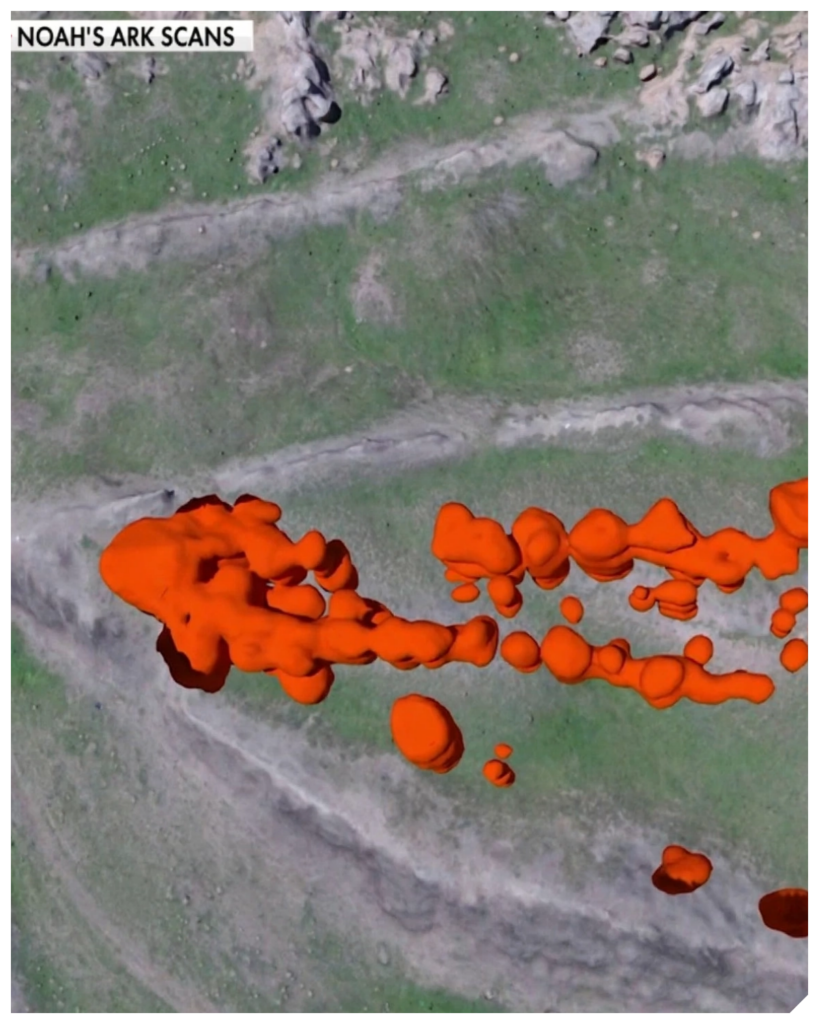
From a distance, a dark formation appeared beneath the surrounding rock. Its outline seemed unusually structured, almost as though something enormous had once rested there.
At first, the team dismissed it as a natural formation.
Mountains create strange shapes. Erosion can produce remarkably convincing patterns. And after years of searching for Noah’s Ark, researchers knew better than to jump to conclusions.
Still, something about this particular formation bothered them.
Its dimensions appeared unusually consistent.
The team began examining the surrounding area more carefully. They photographed the formation, recorded measurements, and compared its shape with historical descriptions of the Ark.
Then came the first surprise.
The structure appeared to have proportions that some researchers considered remarkably similar to the dimensions described in the biblical Book of Genesis.
According to Genesis 6:15, Noah’s Ark was 300 cubits long, 50 cubits wide, and 30 cubits high.
Those measurements have fascinated historians and researchers for generations.
Could the strange formation be connected to that ancient account?
The researchers knew they needed more than an unusual shape to support such an extraordinary possibility.
So they continued investigating.
As the expedition progressed, the team encountered another intriguing feature: unusual material and geological patterns within the formation that deserved closer examination.
Some observers began suggesting that the area might contain traces of an ancient man-made structure.
Others urged caution, pointing out that natural geological processes can create formations that resemble artificial objects.
But the questions were becoming harder to ignore.
If this was simply a natural formation, why did certain measurements appear so unusual?
And if it was connected to an ancient vessel, how could something so enormous have survived for thousands of years?
The discovery quickly attracted renewed attention from people interested in biblical archaeology.
For believers, the possibility was deeply emotional.
Imagine standing in front of a structure that might preserve a physical connection to one of the most famous survival stories in human history.
Imagine wondering whether the story passed down through generations had left behind something tangible.
Yet the scientific community remained cautious.
No responsible researcher could declare that Noah’s Ark had been found based on appearances, measurements, or unverified reports alone.
The formation would need rigorous geological analysis, independently verified archaeological evidence, and reliable dating before anyone could draw such a conclusion.
Still, the expedition had raised an extraordinary question.
What if the mountain was hiding something that had been overlooked for centuries?
As the researchers reviewed their observations, one detail continued to stand out.
The formation was not merely interesting because of its outline.
It was the possibility that its internal structure might reveal something far more significant.
The team discussed further investigations, hoping to determine whether the unusual features were entirely natural or whether evidence of human construction could be established.
Then, just when they thought they had exhausted the available clues, an unexpected development emerged.
A researcher examining the historical material connected to the site noticed a detail that had not received much attention before.
It involved an old account describing the possible remains of a large vessel in the same general region.
The account was not proof. It could not establish the identity or age of the formation.
But it offered another lead.
The team began comparing historical descriptions with the modern observations.
The more they examined the available information, the more they realized that the mystery was much bigger than a single unusual rock formation.
There were geological questions, historical accounts, competing interpretations, and centuries of speculation surrounding the mountain.
And then came the moment nobody on the expedition expected.
While reviewing the latest images and measurements, one researcher noticed something unusual in a section of the formation that had previously received little attention.
He zoomed in.
Then he enlarged the image again.
His expression changed.
He called the others over and pointed to the screen.
Nobody spoke for several seconds.
There, among the patterns they had been studying, was a feature that appeared remarkably different from the surrounding material.
It demanded a closer examination.
The team immediately began discussing whether the feature could be explained by natural processes or whether it represented something more unusual.
One researcher finally broke the silence.
“Before we make any conclusions, we need to know exactly what we’re looking at.”
But the most astonishing part was still ahead.
Because when the researchers turned their attention to the historical records one final time, they discovered a connection that could take the investigation in an entirely unexpected direction.
And the next piece of evidence would raise a question that nobody on the expedition was prepared to answer.
👇 Want to know what happened next? Comment ARK and check the comments for Part 2!
PART 2: THE CLUE THAT CHANGED EVERYTHING
And the next piece of evidence would raise a question that nobody on the expedition was prepared to answer.
The researchers returned to the unusual formation with a new plan. They wanted independent geological testing and a closer examination of the mysterious feature.
Then one member of the team noticed something that made everyone stop.
A pattern beneath the surface appeared to follow a direction they had not previously considered.
Could it simply be another geological coincidence?
Or had they finally found a clue worth investigating?
The lead researcher leaned closer to the evidence and whispered:
“Wait… if these measurements are accurate, we may have overlooked something extraordinary.”
And suddenly, everyone wanted to know what lay beneath the formation.
❤️ LIKE this post and comment ARK if you want Part 3!
Once enough people comment, Part 3 will reveal the next chapter of this extraordinary mystery.
