Yeah.
So, these are some of the ways we’re we’re hoping and plus, you know, put a cork down into one of these chambers and put stick a camera.
And he said, “What you have over there is a shipwreck.”
And I said, “Well, you know, tell me about this ship shape.”
What that original object was, [music] a ship or a spacecraft or what?
I do not know.
The man who said that is not a blogger.
He is Dr.
Kosro Baktar, a radar specialist whom the project’s own press release describes as having spent four decades on detection technology for the Air Force, the Navy, and NORAD.
He said it in a video shared on the social media of the group Noah’s Ark Scans, which the Jerusalem Post reported on October 3rd, 2026.
[music] He was talking about the radar anomalies his scans picked up under a hillside in eastern Turkey, and he called them the most significant finding in 40 years or 45 years of his career.
Every quote in this video has its outlet and date on screen.
A boat-shaped mound in eastern Turkey, roughly 500 ft long, a drill bit that snapped on something harder than limestone, and a robot built for wombat burrows sent down the hole.
The published geology says the mound is a natural fold in the rock.
In 2026, a team drilled into it.
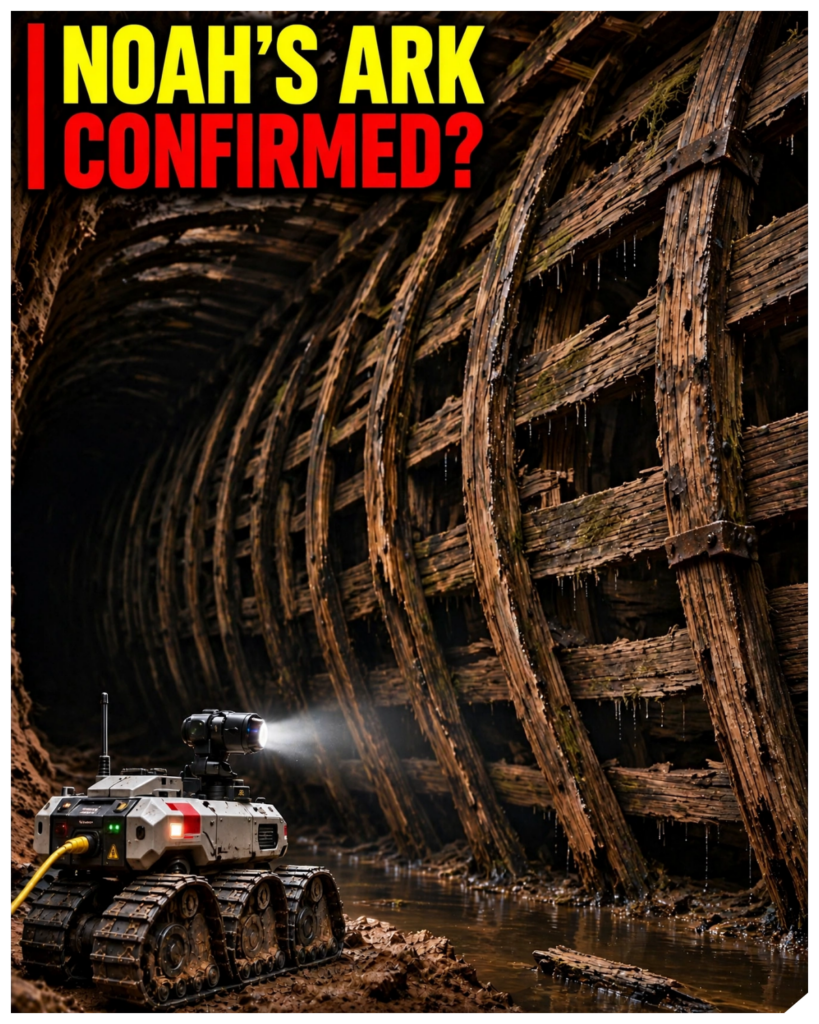
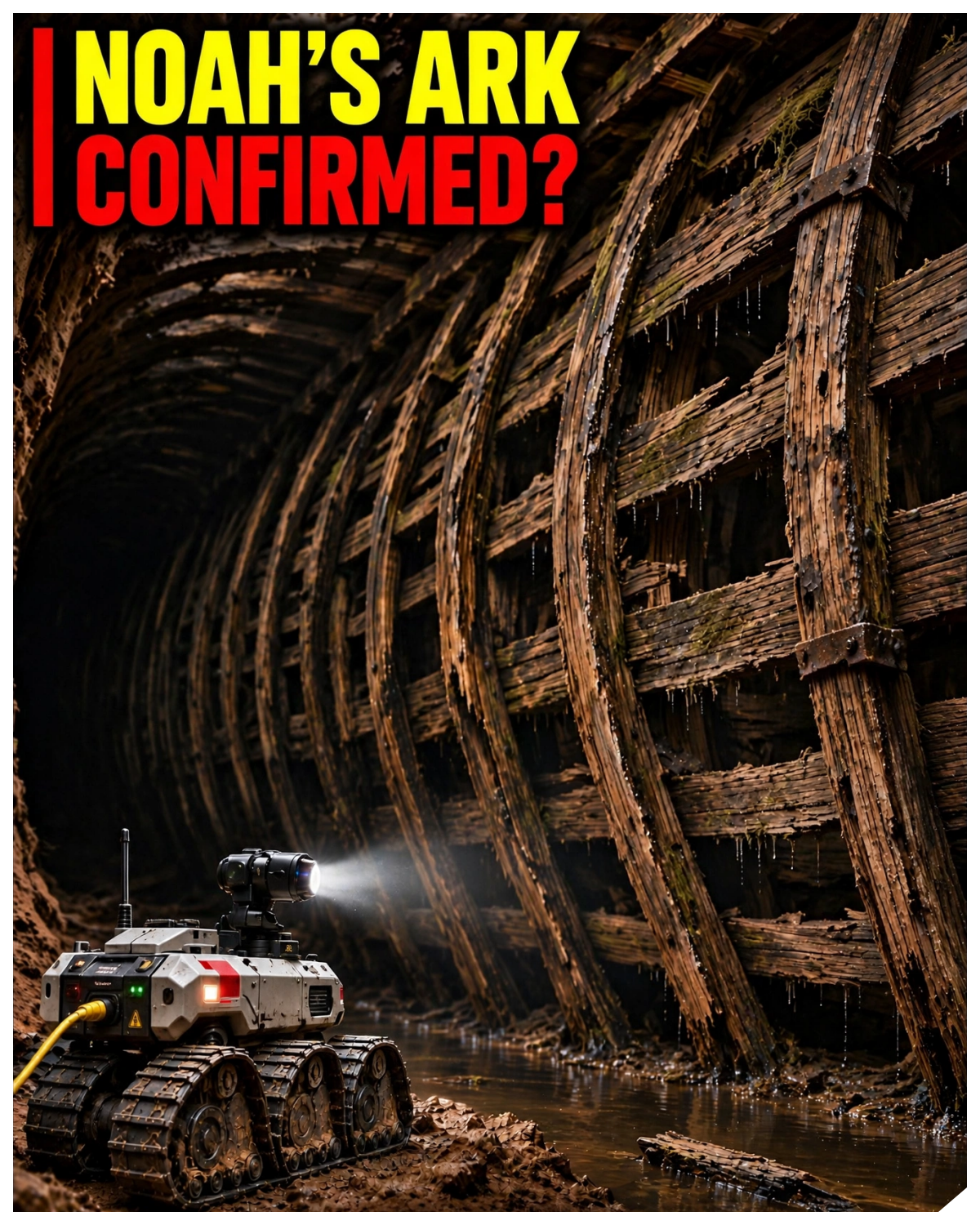
Anyway, [music] the robot is a small remotec controlled rover, a cousin of a machine built [music] at an Australian university to crawl through wombat burrows.
It was lowered down one of the drill holes about 12 m nearly 40 ft by the team’s own account.
Now, hold on to this because most videos on this topic skip it.
[music] What that robot’s camera actually showed has not been independently confirmed.
The team has posted clips of the robot going down a hole and says its footage shows no rock.
We found no outlet that describes a wooden hull, a plank, joinery, or a mapped chamber in what has been [music] shown.
You may have been told it filmed a hidden cavern.
That is a claim nobody outside the team can check.
[music] The harder evidence came before the robot.
In one hole inside the mound 13 to 16 feet down.
The drill bit snapped.
Andrew Jones, who leads Noah’s arc scans, says whatever it struck was harder than limestone.
Hard enough to break the bit.
And then he adds the sentence that makes this a story.
We do not yet know what it was.
Then on October 15, according to the AASH news agency, the project’s director told a symposium in Turkey [music] that his team had found a small amount of burnt wood sent for species identification and carbon 14 dating at laboratories in Turkey and France.
At the time of recording, no result has been published.
[music] So the real question is not the one on most thumbnails.
It is simpler and stranger.
What is actually under that mound?
Believers and doubters are now waiting on the same thing.
Laboratories.
[music] Until they speak, we will keep two piles apart.
What has been measured and what has only been claimed.
If sorting what has been measured from what has only been claimed pulls you in, subscribe to Stone and Bone.
We dig into the mysteries history tried to bury.
To see how a bare hillside ended up with a drill rig and a robot on it, go back to 1959 to an army captain and a photograph he could not stop looking at.
The place has a village name and a long list of other names.
Officially, it is the Durupanar formation near the village of Uzenili in the Dubai district of Ara province on the slope of Mount Tenderek.
[music] It sits at about 6,500 ft, roughly 18 mi south of the summit of Mount Ararat.
It is roughly 500 ft long [music] and the exact figure depends on who holds the tape.
515 ft in most coverage, 538 ft [music] by the measurement a salvage expert took in 1985.
Either way, it is longer than a football field and a half.
Seen from above, the outline reads as a boat.
How the world first heard of it begins with a story.
On May 19th, 1948, the story goes, “Rain and three earthquakes exposed the shape and a Kurdish shepherd named Rashid Sarahhan noticed it on the slope.
[music] That is local memory and we can’t verify it.
Treat it as a tale, not evidence.
[music] What is on record starts in October 1959.
Captain Ilhan Durupanar of the Turkish Army was going through aerial photographs from a NATO mapping mission taken by the Turkish Air Force [music] when he stopped on one frame, a shape on a bare slope.
It looked like a boat.
He flagged it and the formation would carry his name from then on.
In 1960, Life magazine ran the photograph and put the shape at about 500 ft long.
That page [music] reached readers across America, including a nurse anesthetist in Tennessee who would never really let it go.
We will meet him in a moment.
First, the people who went to look.
Among them was Arthur Brandenburgger, an American photogometry expert, a specialist in measuring land from photographs.
A library catalog places him at Ohio State University’s mapping lab, though some Turkish reports say Ohio University, so we’ll just say Ohio.
[music] In September 1960, he joined Durupanar and a man named George Vanaman [music] for a survey of the site.
They spent two days digging with dynamite.
They found soil and rock.
They called the formation natural and went home.
Hold on to those numbers because they are the foundation of the famous line that people had already looked and found nothing.
Two days on a hill longer than a football field and a half with dynamite, which is a blunt way to ask a question.
Does that prove anything?
The other way.
[music] It doesn’t.
Soil and rock is exactly what a natural hill produces.
But a verdict that rests on two days of digging is a verdict that never went through a modern test.
Before we go any further, lock in your guess in the comments.
Ship, rock, or something else entirely.
Then watch what the evidence does [music] to it.
The 1960 team left, and for 17 years, the verdict stood.
Then a man with a nurse’s license and a metal detector arrived carrying a machine he said could pick out buried things by frequency.
Ron Wyatt was born in Hamilton, Ohio in 1933 and raised in Gatlinburg, Tennessee.
He worked as a nurse anesthetist.
[music] He later said that a 1960 Life magazine article started his obsession and from 1977 on he was at the Durapanar site again and again.
He was not a geologist.
He said he had found petrified gopher wood, the biblical word for the ship’s timber.
He said a metal detector had picked up rusted iron brackets laid out in a grid in the ground, and he used a device he called a molecular frequency generator, which critics compare to a dowsing rod.
In 1985, he got company.
David Facult was a different kind of man.
Born in Chicago in 1939, he served as a US merchant marine officer and became a salvage expert, someone who finds sunken things for a living.
He joined Wyatt at the site that year along with a geoysicist named John Bombgardner.
They brought ground penetrating radar and they brought [music] Wyatt’s frequency generator.
Not everything repeated.
Bombgardner could not reproduce the metal striations with a conventional metal detector.
What Wyatt’s equipment showed did not show up for a geoysicist with ordinary equipment.
Facult went ahead anyway.
He measured the formation at 538 [music] ft.
And in 1988, he published a book called the ark of Noah, arguing that the Durupanar formation was the remains of the biblical vessel, a credentialed salvage man in print with a book.
For a while, that was the high point of the case.
Turkeykey’s part in this is murkier than the legend.
Wyatt’s supporters say that in 1986 [music] and 1987, Turkish officials accepted the claim and that a national park and visitor center followed.
We found no Turkish government document that backs that up, so call it what it is.
A claim from the supporters side.
What is verified is smaller.
A visitor center exists.
The Jerusalem Post quotes Jones recalling an earlier version as a bare cinder block building and reports that his group renovated it in 2022.
[music] And in 2011, Turkeykey’s parliament gave jurisdiction over arcreated work to a board of five professors at Adra Ibrahim Chetchin University.
Here is a detail most videos leave [music] out.
The earliest serious criticism of Wyatt did not come from atheists.
[music] It came from fellow believers.
John D.
Morris in 1990 and Andrew Snelling in 1992.
Both from the creationist side called Wyatt’s tools unscientific.
Snelling put it sharply.
They were advertised in treasure hunting magazines, not [music] scientific journals.
The work carried real risk, too.
In 1991, Wyatt and three others were taken hostage by Kurdish separatists and held for 3 weeks.
He never returned to the site.
He died in 1999.
So, by the late 1980s, the case had a nurse, a salvage expert, a book, and a lot of enemies on both sides.
What it did not have was a laboratory.
And the man with the best credentials was about to do something nobody expected.
September 1994, David Facold is back at the formation.
This time with an Australian geologist named Ian Plyr.
What Fold said after that visit is on record and it is hard to read twice.
I believe this may be the oldest running hoax in history.
The man who wrote the ark of Noah had walked the ground with a geologist and come away calling it a hoax.
Two years later, he put his name to a paper.
In 1996, in the journal of geocscience education, Fac and a geologist named Lawrence Jean Collins of California State University, Northridge, published a study with a title that left nothing to the imagination.
Bogus Noah’s Ark from Turkey exposed as a common geologic structure.
Here is what the paper said.
The formation is an eroded doubly plunging sincline which is a trough of folded rock layers that slopes down at both ends.
The famous iron brackets are lemonite, a rusty natural mineral.
[music] The magnetite and goethite in the rock are what make a metal detector buzz as if iron were there.
[music] They found no fossilized wood and no traces of elemental carbon.
The gopherwood bark was metamorphosed peritite, a natural rock.
The so-called [music] anchor stones were local andesite.
Notice one thing because you may hear the opposite.
The authors noted that earlier trenching and core drilling had also found no wood.
So the claim that nobody had ever drilled here is not quite right.
What nobody had done was a modern permitted deep drilling program by a university.
We will get to that.
Then in April 1997, Fold went further.
Under oath in an Australian courtroom.
He called the ark claim nonsense.
He had published it, walked away from it, written the paper against it, and now he said so under oath.
He died on April 26th, 1998 in Corvalis, Oregon.
And here the story splits.
A biographer, June Daws, wrote a book in 2000 called Noah’s Ark: A Drift in Dark Waters.
In it, she says that before he died, Facult had returned to believing.
Collins disputed that in a letter in 2016.
So there are two versions of a dead man’s last conviction and nobody alive can settle it.
All we have are his public words and his public words call it a hoax.
Let me ask you something.
And I mean it.
Did you grow up with this story?
A Sunday school lesson?
An old VHS tape in the church basement?
[music] A parent or a grandparent who swore the ark had been found in Turkey?
Tell us in the comments how you first heard it and whether you ever heard the other side.
Because for most of the world, 1996 was the [music] end of it.
A published paper, a reversal, a death.
Case closed.
It wasn’t.
23 years later, a new kind of evidence arrived and it came from a machine that could see underground.
The group behind it calls itself Noah’s Ark Scans.
It is led by Andrew Jones who is based in [music] the United States and has been working at the site since 2019.
In that year, a firm from Oregon, Topa 3D, ran a three-dimensional ground [music] penetrating radar survey, and the team also used electrical resistivity, a method that [music] reads how the ground conducts current.
When the scans were reprocessed, the team reported right angle patterns and a tunnel-like feature about [music] 13 m, roughly 43 ft, running through the middle.
These are the team’s claims.
They have not been peer-reviewed.
Now, the other side of the argument, and it deserves a fair hearing.
Fractured rock can also produce straight lines and right angles underground.
Radar does not label what it sees.
A line on a screen is a line on a screen.
There is another voice that [music] matters here, and it is not a skeptic.
Ken Ham of Answers in Genesis, a creationist ministry, criticized these reports in a blog post quoted by the debrief.
His line.
None of these [music] reports objectively assess the raw geoysical data by canvasing other interpretations.
Snelling, the same Snelling who criticized Wyatt, argues the site sits in a valley, not on a mountain, as he [music] reads Genesis.
When believers are criticizing the believers, it’s worth listening.
Then came the dating headline from 2023.
[music] A team from Istanbul Technical University, Adra Ibrahim Chchchchchchchchchchchchchchchchchchchchchan University and Andrews University in Michigan collected [music] about 30 soil and rock samples around December 2022 and tested them at Istanbul Technical University.
In late October 2023, they announced clay-like material, marine deposits, and evidence of human presence in the area from roughly 5,500 to 3000 BC, the Chalcolithic period.
Many headlines turned that into an age for [music] the ark.
It said nothing of the kind.
It pointed to human presence in the area.
Vice Rector Farukqa said the results aren’t enough to show evidence of Noah’s ark.
And on the dating itself, with the dating, it is not possible to say that the ship is here than the soil.
In 2024, soil scientist William Crabtree tested 88 samples from inside and outside the outline.
Inside there was more organic matter and more potassium and the pH was about one unit lower.
Jones says the organic matter was about three times higher inside [music] which is the team’s figure.
Archo News reported carbon about 40% higher inside [music] and the project’s director suggested that might relate to wood offered as a possibility.
And here is the part that keeps this honest.
Crabtree’s own caveat.
The decomposition of organic material affects all three of those readings.
In other words, decomposing organic material can move all three numbers and the numbers cannot say what was decomposing.
Soil that is different is soil that is different.
It does not tell you why.
Stop and take stock.
A photograph.
Two days of dynamite.
A book and a reversal.
Radar shapes soil that differs and not one deep permitted universityled look inside the formation.
In 2026, that changed.
In May 2026, Turkeykey’s Ministry of Environment, Urbanization, and Climate Change approved an invasive study of the formation.
By the Post’s account, [music] it took two weeks from the day the project’s director applied.
And Jones says the only question the ministry asked was about [music] how deep the cores would go.
The director is Professor Sanker Atila of the Department of Archaeology at Civas Kumhurat University.
About 20 researchers from five countries joined him [music] with fieldwork that began in the summer of 2026 and ran roughly 90 days.
The team is multiffaith.
As one member, the Israeli lawyer and researcher Ohave Cohen put it.
The project brings together Jews, Christians, Muslims, and researchers from across the world.
Noah’s Arc Scans, a crowdfunded group, is a research and funding partner.
It did not run smoothly.
After a wave of complaint calls, a local governor halted work for nearly a week that resumed under the same permit.
Now, the framing, most videos tell you nobody had ever drilled here.
The project’s own side admits otherwise.
Noah’s Ark scans itself describes a limited drilling in 1988 and calls the water cooled cores from it corrupted.
So, 2026 was not the first time a drill touched the site.
[music] As the project presents it, it was the first permitted university-led deep core drilling.
And this time, [music] the drilling was dry with no cooling water.
The team’s methods, a GPS grid across the formation, two-dimensional and three-dimensional models, high precision radar, soil sampling, and those dry cores.
[music] The radar belonged to Dr.
Cosro Baktar, the voice from the start of this video, and his firm Baktar Radar.
This was its first use at [music] the site.
The technology is reportedly derived from a system developed for the Air Force.
A press release on August 18th, 2026 described a central feature about 250 ft long, which the team read as a tunnel or hallway.
Read what came next because the project’s own paperwork is careful.
[music] The release said the radar showed no clear boundary for bedrock in the process data.
Then the team conceded that this does not by itself prove bedrock is absent and that anomalies of this kind do not prove an archaeological origin.
Jones told the debrief, “We are not trying to end this debate with a press release.”
Then in the video, the post reported on October 3, Bkar said he was 100% sure [music] the repeated anomalies came from the same original object.
The line you heard at the top of this video followed a ship or a spacecraft or what?
I do not know.
And Noah’s Arc Scans wrote that the report confirms that the Durupanar formation is not geological.
Notice the word confirms.
That is a claim.
It is not a finding.
Professor Atala’s words are more careful and more [music] telling.
At the Noah’s Ark Symposium, in remarks Noah’s Arc scans published, he [music] said, “In our holy books, Noah’s Ark had three levels.
In our radar studies, we also identified a formation with three levels.”
A project director lining up a scripture with a scan.
Then in the Jerusalem Post’s report of October 22 on possible voids under the formation, I don’t want to say absolutely.
[music] And it’s a corridor.
Maybe it can be a geological hole.
And as the Turkish outlet NTV reported on September 27th, he said social media claims that it was 100% proven [music] do not reflect the results, though his team had reached very important and interesting findings.
So the man in charge says it may be a geological hole and he also says his radar found three levels.
Which of those did the drill support?
The plan was ambitious.
16 holes, 12 inside the formation, four outside as controls.
[music] In places, the cores reached about 20 m around 66 ft.
The press release talks of samples from up to 18 m around 60 ft, but 60 ft was not the plan.
The team had planned to core to 75 m, about 246 ft, because it estimated bedrock sat at about 70 m, around [music] 230 ft.
They never got near it.
Remember that number because it matters later.
The first moment came in one hole inside the formation.
At four to 5 m, 13 to 16 ft down, the drill bit broke on a hard layer.
Jones in the project’s release, “Whatever the core drill struck was harder than limestone, hard enough to break the bit.”
And then, as Newsweek quotes him, we do not yet know what it was.
What are the options?
Jones gave two.
Petrified or heavily mineralized wood or a hard block of rock in the surrounding debris.
He did not choose.
The bit is, as far as the reporting shows, still down there, and the plan is to drill a slightly wider hole next season to retrieve it.
The second claim, no [music] bedrock, Jones told the Post, “We didn’t hit any solid rock layer across the [music] site, and in an interview with Fox News about the interior holes, we did not find bedrock at all.
Rich organic [music] layers.
The team says cavities in the drilling as well, including one filled with mud and water.
Now, because this channel does not make things up, two cautions.
First, you may hear that bedrock showed up in the control holes outside the formation while none showed up inside.
We found no report that says so.
The claim is only that no hole struck bedrock.
[music] Second, remember the 70 m.
The team expected bedrock at about 230 ft.
It drilled about 60 to 66 ft.
Finding no bedrock at 20 m is not a test of a prediction made for 70.
That’s the evidence at the center of this story.
[music] Every source for it is listed in the description.
And Jones himself is cautious.
To Newsweek, he listed his own [music] limits.
We have not identified any material as ancient wood or established its age.
No laboratory results are [music] in yet.
Organic matter accumulates naturally in soils and slope deposits.
Identifying ancient wood would not by itself establish human construction [music] and then the line that matters most for a skeptic if the interior material matches the surrounding earth flow that supports [music] a natural origin.
He added that the team is not announcing any plan for large-scale [music] excavation and that peer review that stage is still ahead.
Read that again.
That is the leader of the group that helped fund the drilling, saying in public what a natural result would look [music] like.
That is not a victory lap.
It is not a retreat either.
So, the ground is giving us a [music] broken bit.
No bedrock to 20 m and a project leader who says the case could [music] still go either way.
And then the team sent in the robot.
Meet the man who built it.
Robert Ross is an associate professor of electronics engineering at Latroe University in Melbourne, Australia.
In 2021, a paper in SN Applied Sciences described his earlier machine, Wombot, a robot designed to explore wombat burrows.
It entered about 30 burrows in Tasmania, as part of a study of whether burrow conditions help spread the mites that cause sarcoptic mange.
Inside, the burrows averaged about 11° C, around 52° F, and about 85% humidity.
The same technology has since been adapted for armadillo burrows in South America.
About 9 months before the October 2026 coverage, Ross read a call for a robot that could go underground at a site in Turkey.
He answered it.
What he built is a smaller version of Wombot called [music] Gopher after the gopher wood of Genesis.
It has waterproof wide-angle cameras on the front and rear, environmental sensors, [music] and a rating to work up to 25 m, about 82 ft, underground.
It left Australia in late July 2026, though one report says mid July.
Ross has been measured about it.
[music] He told Yahoo News Australia that it was exciting to see our technology helping researchers investigate and better understand what’s there.
Yahoo also reports that he described the site as potentially the discovery of the century and acknowledged that it may turn out to be something completely different.
Both halves of that sentence belonged together.
Now, what Gopher actually did by the team’s own account.
[music] The first attempt struggled.
In the team’s own post, the wheels had trouble moving on very loose sediment and the robot needed modifications.
On what the team calls the second mission, it says the robot reached 12 [music] m, nearly 40 ft.
Some reports say the bore hole was 18 m deep, so treat any single depth number carefully.
In [music] the same Tik Tok post, Noah’s Ark scans said that Gopher is going back to the United States for upgrades.
[music] Winter in that part of Turkey is freezing and a project partner says it shuts the site down.
And what did the camera show?
Here is where we must be exact.
[music] The team has posted clips and says its footage shows no rock and no bedrock inside.
Newsweek notes that this has not been independently confirmed.
We found no outlet that describes a wooden hull, planks, joinery, artifacts, or a mapped chamber in what has been shown.
At the time of recording, nobody outside the team has [music] described a void or a structure in the robot’s pictures.
Now, think about the common version of this story.
You may have heard that the robot found an open space, a cavern, and that if this were solid rock, there would be no floor for it to roll on.
[music] That is an inference, and it fails a simple test.
A drilled hole has a floor, whatever it is drilled through.
A bore hole in solid rock has a bottom.
The bore hole in loose earth has a bottom.
Wheels slipping on a floor of loose sediment tell you the floor is loose.
They do not tell you that a room is there.
The cavities the team talks about come from the drilling.
One of them, they say, filled with mud and water.
Not from anything the robot’s clips have been shown to confirm.
So, here is the fair summary, and it is less dramatic than the rumor and more interesting.
A robot built for wombat burrows went down a hole at one of the most argued over hillsides in Turkey.
It struggled.
It is being rebuilt, and whatever it recorded, nobody outside the team has confirmed enough of it to say what it found.
That sounds like a letdown.
It isn’t [music] because the other thread in this investigation does have a physical object sitting in a laboratory right now.
Start with where things stood until October.
As Newsweek reported it, [music] the team’s own position was that it had not identified any material as ancient wood [music] or established its age.
Then in mid-occtober that picture shifted.
On October 15th at the 8th International Otto Mountain and Noah’s Ark Symposium, Professor Aila reported a small amount of burnt wood.
According to the e-hot news agency, it went for species identification and carbon 14 dating in Turkey and in France as Ancient Origins relays the IAHA report.
[music] He expected the French result in about 15 days and the Turkish analyses in about 3 months.
[music] 15 days from October 15 is the end of October.
At the time of recording, as of late October 2026, nothing [music] has been published.
Now, the questions people argue about, where did the wood come from and from how deep?
Noah’s Arc scan says almost 30 ft down, about 9 m.
The IHA report gives no depth.
The Jerusalem Post reported pieces that may be petrified wood sent [music] to seas.
Burnt and petrified are not the same thing.
Fully petrified wood usually implies a very long time, though mineralization can start sooner, so petrified [music] is a label to test, not to assume.
Jones himself had the best sentence of all.
In the project’s release, he said it is also possible the team found the charred remains of a shepherd’s campfire.
That is the leader of the project, handing the skeptics their best argument.
So, what can a carbon 14 test actually say?
It dates when the plant died.
It does not tell you the wood was part of a boat.
Jones says the same.
A date that falls [music] near the roughly 4,300 to 4,500 years ago that many literal readers of Genesis use for the flood would be a headline.
[music] A date far from it would be one too.
Neither tells you a vessel was built.
Then the pottery.
[music] The team found ceramic fragments near the formation, not inside it.
Jones links them to two ancient [music] settlements nearby.
If this is Noah’s Ark, we have people living right beside it early on.
The age of the pottery has not been established by a laboratory.
And the post’s visit also notes marine fossils at and around the site alongside the marine deposits reported in 2023.
[music] So, here is where a careful viewer lands.
A bit that broke on something hard.
A little burnt wood, soil that differs, pottery beside it and not in it, and a project director who says it may be a geological hole.
Here is what I want to leave you with before the next part.
People assume the carbon 14 date will be the verdict and it will not.
The comparison that tells the two stories apart is a different one and it was sitting in Jones’s own caveat all along.
Two models each makes predictions.
Each prediction can fail.
Model one is natural.
Collins’s 1996 paper written with facade says the shape is an eroded doubly plunging sincline.
[music] Andrew Snelling of Answers in Genesis, a creationist, is described in a Snopes writeup as [music] attributing the shape to earthquakes in 1948 and 1978, pushing up basement rock.
A Turkish geologist, Eshref Atabe, is reported [music] to back a geological origin as well.
And Jones himself raised the possibility that the interior matches the surrounding earth flow.
Model 2 is a buried vessel.
Noah’s Arc scans reads the radar as a long central tunnel, right angles, three levels, [music] and reads the drilling as no bedrock and a hard layer that might be wood.
Now, the scoreboard.
Each result on the way has a limit.
First, and this is the one that matters most, interior cores against control [music] cores.
If the interior material matches the surrounding earth flow, Jones says that supports a natural origin.
If it is chemically different, the question stays open.
Different soil is not a boat.
Crab trees caveat lives here.
Second, the species identification.
[music] It tells you what kind of tree.
It does not tell you who burned it or why.
Third, the carbon 14 date.
It tells you when the plant died.
It cannot tell you the wood was part of a vessel.
Fourth, the bit.
If the team drills that wider hole next season and [music] retrieves it, whatever it struck can finally be identified.
Petrified wood or a hard block in the debris.
Vif depth.
Remember the 70 m.
The team’s own estimate put bedrock [music] far below where anyone has reached.
So, a real test of the natural model needs a core that goes much deeper than 20 m.
Ararat has seen a claim collapse into dispute before.
In April 2010, a Hong Kong group claimed a wooden structure high on the mountain and its own former archaeologist said he had reason to believe local men staged it.
What is different at Durupanar in 2026 [music] is a permit, a university, control holes, and laboratories.
And remember Farooq Kaya’s sentence from [music] 2023 with the dating.
It is not possible to say that the ship is here.
Even the best date in the world only says when.
It cannot say what.
The comparison that matters most inside against outside all the way down is still waiting on the laboratories and on a deeper hole.
The next move is almost funny.
The team plans to drill a slightly wider hole next season to fish out a broken drill bit.
A second season is planned for the summer of 2027 pending a permit.
Initial results are expected over the winter and a detailed report in the spring of 2027.
The university plans a volume called Durupanar Formation 2026 research plus three international conference papers.
If you want to check our work, the sourcing for every date and quote in this video sits in the research files that live in Bloodline.
Our membership tier at $6.99 a month.
The link is in the description.
67 years separate an army captain’s photograph from a robot built for [music] wombat burrows.
In between a nurse, a salvage man who wrote a book and then called it a hoax.
[music] Two days of dynamite, radar shapes, soil that differs, and a bit that broke on something nobody can name.
The shape has simply sat there asking the same question of everyone who looked.
[music] Everyone who climbed that slope arrived with an answer.
A boat, a fold, a landslide, a hoax, a hope.
The ground has not agreed with any of them.
A date is coming.
It will say when a tree died.
[music] It will not say what the tree was part of.
We dig into the mysteries that history tried to bury.
And we don’t make them up.
[music] If a story where the evidence cuts both ways pulls you in, subscribe to Stone and Bone.
The laboratories are about to speak.
And we will be here when they do.
[music] And tell us in the comments what do you think broke that bit and what date will the carbon 14 test come [music] back with.
One drill bit still in the ground.
One piece of burnt wood in a laboratory with a number about to be written on it.
Until that number arrives, the oldest question on that hillside is still open.
What is under the mound?
