15 April 1912 — the news that the Titanic,
The world’s most famous ship and believed to be the safest, had sunk on its very
First voyage shook the entire world.
The White Star Line, the very company that
Built the Titanic, then vowed to create a gigantic ship that would never sink.
After years of hard work,
HMHS Britannic was completed.
Learning from the Titanic disaster,
Britannic was made so much stronger and safer that engineers claimed:
The Titanic may have gone down, but HMHS Britannic could never sink.
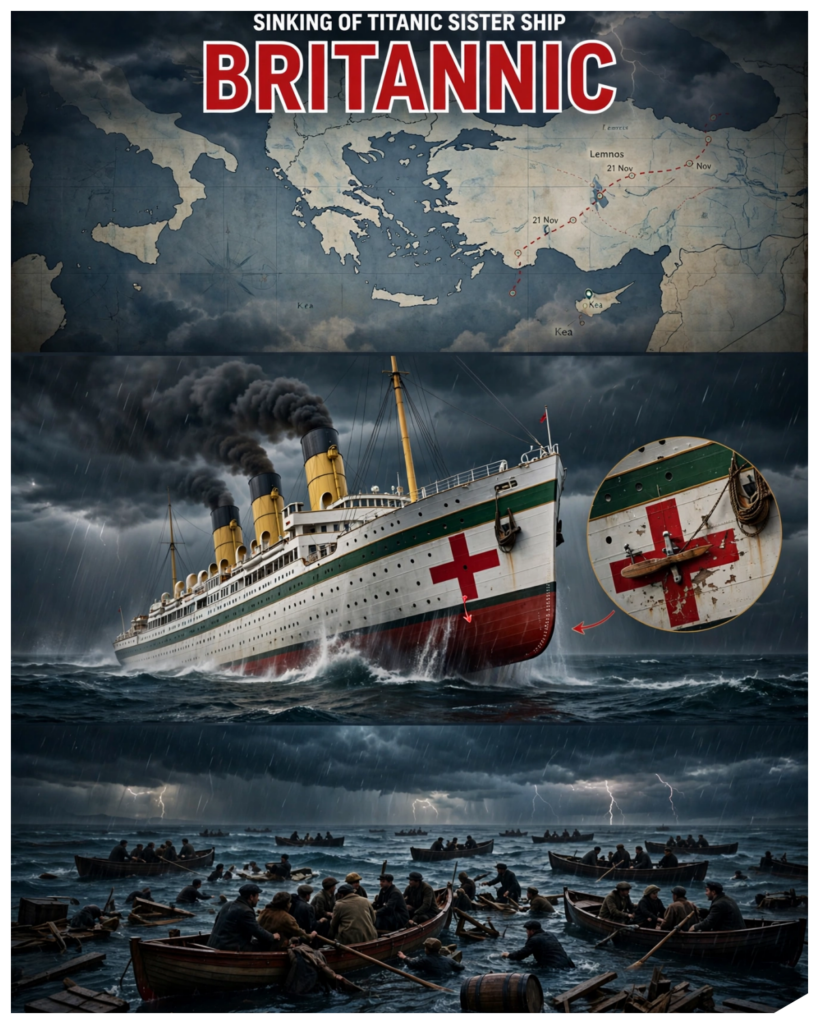
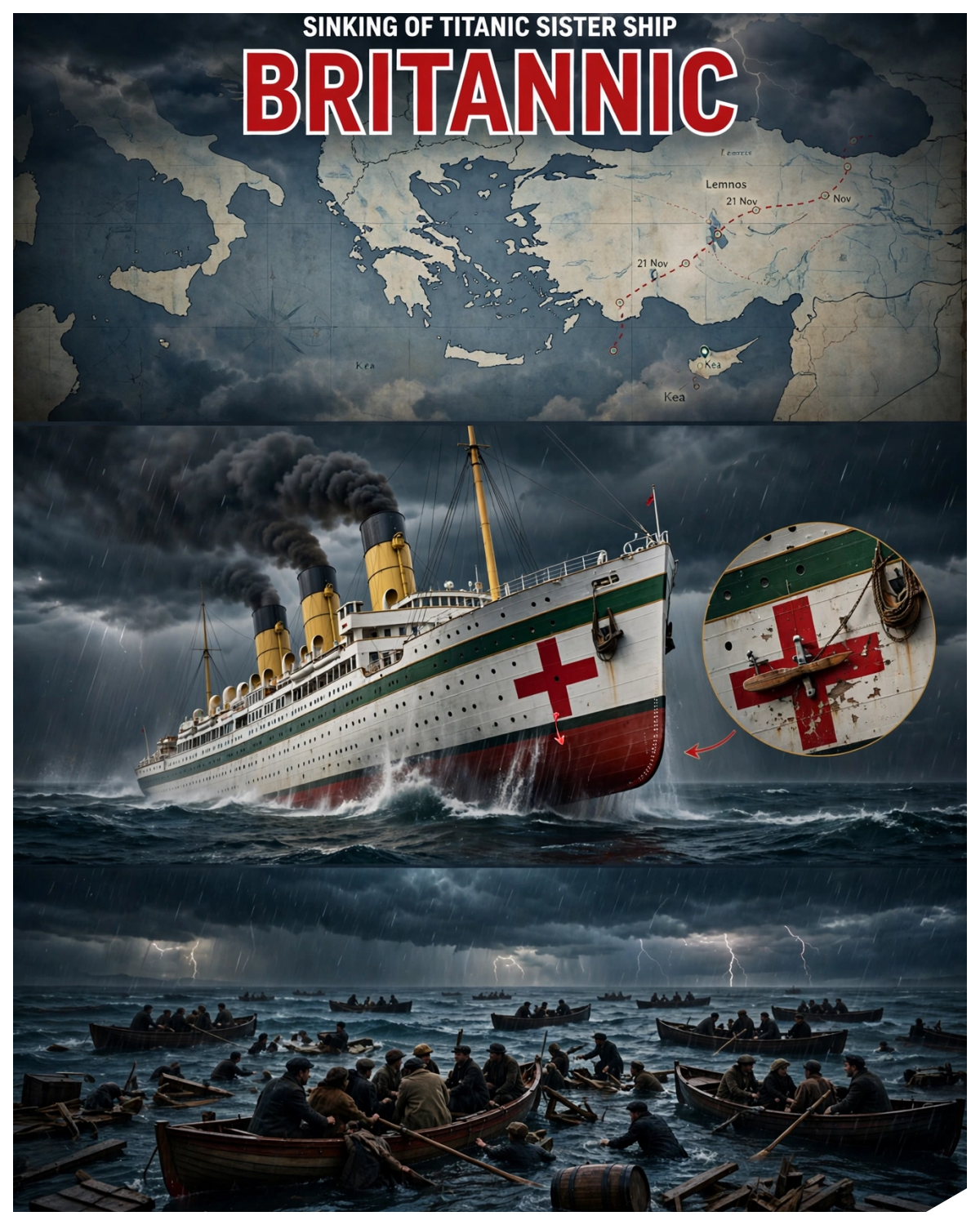
But around four years later, on 21
November 1916, as HMHS Britannic was passing through the Aegean Sea,
Something happened — its bow began dropping rapidly into the water,
And within moments seawater started pouring into the ship at speed.
The vessel built to be even safer than the
Titanic was now sinking before their eyes.
Most shocking of all: while the
Titanic took 2 hours and 40 minutes to sink, Britannic disappeared
Into the depths in just 55 minutes.
Once again, the whole
World was left stunned.
So what exactly happened that such a huge,
Powerful ship — capable of staying afloat even after six watertight compartments
Had flooded — sank in only 55 minutes?
And the biggest question of all: what
Became of the 1,066 people on board?
Let’s find out the full story
Of how the HMHS Britannic sank.
At the start of the twentieth century, the
Battle to rule the seas was at its peak.
The world’s biggest shipping companies
Were in a race to build ships that weren’t just larger and more luxurious, but also
Set new standards for speed and safety.
In that race, the White Star
Line decided to build three great Olympic-class transatlantic liners.
The first was RMS Olympic, the second
RMS Titanic, and the third was meant to be even bigger and even safer than both.
At the time, it was called Gigantic.
But before work on the third ship
Could properly move forward, on 15 April 1912, something happened
That shook the entire world.
Titanic, hailed as “unsinkable”, struck
An iceberg on her maiden voyage and disappeared into the depths of the
Atlantic Ocean, taking more than 1,500 lives.
That historic tragedy changed
The rules of the shipping industry overnight.
For the White Star Line,
It wasn’t just a financial loss—it was a deep stain on its reputation that
Seemed almost impossible to erase.
In Belfast, the Harland and Wolff shipyard
That had built Titanic was also building that third Olympic-class ship for White
Star Line, originally named Gigantic.
But after Titanic sank, White Star
Line renamed her Britannic and decided to make her design even safer.
Harland and Wolff’s engineers swore
Titanic’s mistakes would not be repeated.
Learning from the disaster, Britannic
Received major safety upgrades.
Titanic’s biggest flaw was that the height
Of her watertight compartments was too low, so in a collision water could spill
Over from one compartment into the next.
On Britannic, the height of the 15
Watertight bulkheads was increased, and six of them were extended up to B Deck.
That meant even if six compartments
Were completely flooded at the same time, the ship would still stay afloat.
On top of that, a double hull was
Fitted inside the ship, protecting vital areas like the engine room
And boiler rooms from heavy impact.
In other words, even if a huge hole
Was torn in the outer hull, the inner hull could still stop water
From rushing into the main sections.
Another major reason so many died on
Titanic was the lack of sufficient lifeboats for everyone on board.
Britannic fixed that too.
Large crane-like structures called
Gantry davits were installed.
They were powerful enough that
Even if the ship listed to one side, lifeboats could still be
Lowered safely from the other side.
Britannic carried a total
Of 48 lifeboats—enough to save more than 3,600 people.
She was also fitted with a massive turbine
Engine producing 18,000 horsepower.
Overall, Britannic was built so
Strong and so safe that no one could even imagine her sinking.
On 26 February 1914, when Britannic was
Launched into the water at the Belfast shipyard, a huge crowd gathered to watch.
At 269 metres long, 29 metres wide, and
Weighing around 48,158 tonnes, she was even broader and heavier than Titanic.
Her interior décor and furnishings
Were meant to be spectacular.
First-class passengers were to
Enjoy a grand pipe organ, an elegant café, palm courts, a hair salon for
Women, a children’s playroom and swimming pool—every luxury you’d
Expect from a five-star hotel.
White Star Line intended to send Britannic
Into the North Atlantic as the most luxurious passenger liner in the world.
But it was as if fate had
Written something else for her.
Before her interiors were even
Fully completed, World War One broke out in August 1914.
On one side were the Allied
Powers, including countries like Britain and France; on the other
Were the Central Powers—Germany, Austria-Hungary, and the Ottoman Empire.
In no time, the smell of gunpowder
Spread across Europe, and green valleys and open fields slowly turned
Into mud, smoke, and piles of bodies.
The war affected the seas too.
As soon as it began, commercial
Transatlantic trade came to a standstill.
The British Admiralty needed large ships
To bring back and treat the thousands of soldiers being wounded at the front, so
It began taking control of the country’s biggest merchant ships and ocean liners.
On 13 November 1915, the
Admiralty officially took control of Britannic as well.
The ship that had been built to
Carry the world’s richest in luxury was ordered, overnight, to be
Converted into a hospital ship.
In no time, her beautiful chandeliers,
Expensive carpets, carved wooden panels and lavish furniture were removed.
Where a grand first-class reception
Room was meant to be, a large operating theatre was prepared.
And the first-class dining
Room—where people would once have sat down to fine meals—was turned
Into an ICU for treating patients.
Her exterior was transformed too.
Under the Geneva Convention, enemy
Forces were not allowed to attack hospital ships—but it had to be
Clearly visible that the ship wasn’t being used for any military purpose.
So Britannic was painted entirely white.
A thick green stripe was added
Along the middle of her hull, with large red crosses that could be
Seen even at night with lights.
From far away, it was obvious this
Wasn’t a warship, but a hospital ship meant to save the wounded.
After this transformation, she was
Given a new name: HMHS Britannic.
Britannic’s main mission was to bring
Thousands of wounded British and Allied soldiers safely back to England.
At the time, the Gallipoli front
Was becoming one of history’s bloodiest battles, and the Allied
Forces were suffering heavy losses.
Conditions became so bad that instead
Of sending more troops in, the British Army needed to evacuate the wounded—and
HMHS Britannic was chosen for the job.
On 12 December 1915, HMHS Britannic was
Officially commissioned, and command was given to Captain Charles Alfred Bartlett.
Bartlett was known for his long
Experience at sea and his ability to spot icebergs from a distance—earning
Him the nickname “Iceberg Charlie”.
Just days later, on 23 December
1915, Britannic set off on her first mission from Liverpool
To Naples and then to Mudros.
On that voyage, she carried 52
Medical officers, 101 nurses, 336 orderlies, and 675 crew members.
When Britannic reached Mudros,
Floating on the blue waters of the Mediterranean, the scene was chilling.
Thousands of soldiers were seriously
Wounded—some had lost limbs, others were writhing in agony from
Gunfire and poisonous gas attacks.
Britannic’s large wards now
Functioned like a moving hospital.
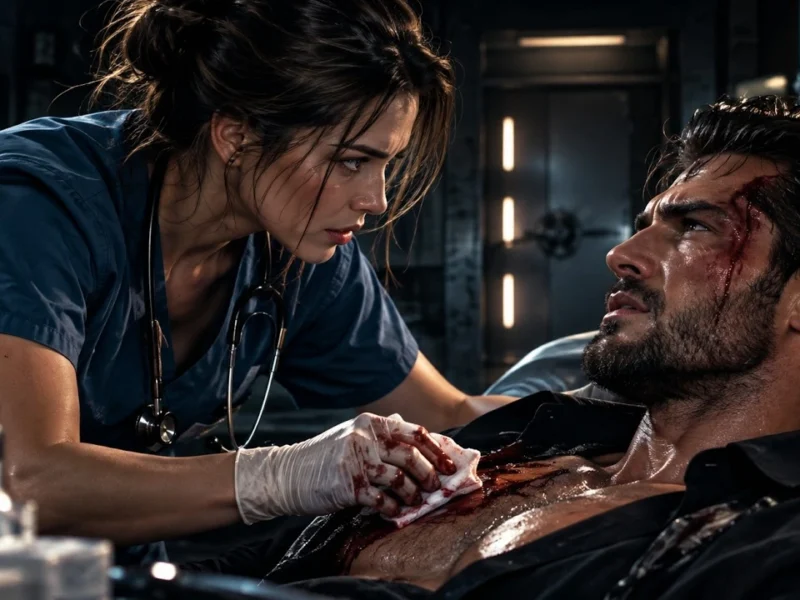
Doctors and nurses worked day
And night to treat the injured.
On her very first mission, Britannic
Brought more than 3,300 wounded soldiers safely to Southampton.
After that, Britannic completed
Several successful voyages.
During her second trip in January
And February 1916, she again reached Naples and Mudros and
Rescued thousands more wounded soldiers, bringing them home safely.
Then, on her third voyage in March
And April 1916, Britannic once again headed into the Mediterranean,
Becoming a lifeline for soldiers suffering on the battlefield.
But when the Gallipoli campaign ended
And the British Army withdrew, there was no longer the same need to bring
Back wounded in such large numbers.
So the Admiralty removed
Britannic from hospital-ship duty.
In June 1916, she was brought
Back to Belfast to be converted once again into a passenger liner.
As compensation, the Admiralty
Paid White Star Line £75,000.
Workers and craftsmen returned
To the ship—some reinstalling the pipe organ, others restoring the
Rooms to look like a luxury hotel.
It seemed Britannic had finally
Escaped the horrors of war.
But that relief wouldn’t last long.
Before the work was even
Finished, fighting intensified again on the Salonika front.
Allied forces were battling disease
On one side, and on the other, German and Bulgarian attacks were driving
Up the numbers of dead and wounded.
The Admiralty called Britannic back
Into the war just three months later.
She was converted back into a hospital
Ship, and on 28 August 1916, Britannic was once again deployed in that role.
In September and October 1916,
Britannic successfully completed her fourth and fifth voyages.
On every trip, Captain Bartlett
And his staff worked with extreme caution, because the Mediterranean
Had become even more dangerous.
German submarines were roaming the
Area, and German forces had laid sea mines in many places—mines that
Could cause a massive explosion the moment a ship struck them.
Every voyage was now far
More perilous than before.
By November 1916, HMHS Britannic
Was ready for her sixth journey.
This giant hospital ship had
Already saved thousands of lives.
Across England, she was
Seen as a protector.
But no one realised that this sixth
Voyage would become the final voyage of a ship once thought impossible to sink.
On 12 November 1916, at around 2:23
In the afternoon, HMHS Britannic began her sixth voyage from Southampton.
Her destination was Mudros once
Again, where she was to bring back more than 3,000 wounded soldiers.
At that moment there were no wounded
Soldiers on board, but around 1,066 people were aboard—673 crew
Members, 315 staff from the Royal Army Medical Corps, and 77 nurses.
Among those nurses was a remarkable
Woman: Violet Jessop, often considered one of history’s
Luckiest—or perhaps unluckiest—women.
Violet Jessop had been aboard RMS Olympic
In 1911 when she collided with HMS Hawke.
A year later, in 1912,
She was also on Titanic.
She survived Titanic’s sinking—and now, in
1916, the same Violet Jessop was serving as a nurse on HMHS Britannic, where
Something terrible was about to happen.
On 15 November, Britannic passed
Through the Strait of Gibraltar and entered the Mediterranean, reaching
Naples on the morning of 17 November.
But the weather in Naples turned dreadful.
Heavy rain and violent winds forced the
Ship to remain in port for two days.
Captain Bartlett didn’t want to lose
Time, so as soon as the storm eased on the afternoon of 19 November,
Britannic set off again, passing through the Strait of Messina and
Heading towards the Aegean Sea.
By the night of 20 November,
Britannic had passed Cape Matapan.
The weather was now perfectly clear.
The night was calm, and the
Sea’s surface shone like glass.
On the morning of 21 November 1916,
As the crew woke to the golden rays of the sun, the beautiful
Islands of Greece came into view.
At around 8 a.m., Britannic
Entered the Kea Channel.
Her propellers churned the water
Into white foam behind her, and everything seemed completely normal.
But beneath the ship was something no
One above had any idea about: sea mines.
About a month earlier, on 28 October 1916,
The German submarine U-73 had laid several mines in the Kea Channel, because Allied
Ships regularly passed through this route.
Now Britannic was moving
Straight through that minefield.
At 8:12 a.m., while most officers,
Doctors and nurses were having breakfast in the dining hall, the
Ship’s starboard side struck a sea mine.
In the next instant, there was
A terrifying explosion, and the Britannic—calm just seconds
Before—shuddered violently.
The blast was so powerful that doctors
And nurses dropped their cups of tea.
Heavy wooden tables and chairs were
Thrown into the air and crashed away.
Where there had been silence
Moments earlier, warning alarms suddenly began to sound, and
Screams and panic echoed everywhere.
The explosion was so strong it
Didn’t just tear through the double hull—it ripped straight into the
Internal watertight bulkheads as well.
Water was now flooding in
Fast, and the groaning sound of twisting metal could be heard.
Captain Charles Alfred Bartlett
Immediately took command on the bridge and ordered the emergency
Watertight doors to be shut, to stop the water spreading through the ship.
But here, luck completely
Abandoned Britannic.
The blast damaged the forward section so
Badly that several watertight doors jammed in their tracks and couldn’t fully close.
And an even bigger problem still remained.
At the time of the explosion, some nurses
And crew on the lower decks had left cabin portholes—small round windows—open
To let in the fresh morning air.
As the bow began to dip, thousands
Of gallons of water surged through those open portholes like a
Tsunami, pouring into the rooms.
In moments, compartments one, two, three
And four were filling rapidly, and now water was entering boiler rooms five
And six through the portholes as well.
Britannic had been designed so
That even with six compartments flooded, she could still float.
But once seawater began flooding more
Than six compartments, the limits of her safety system were exceeded—and
Panic spread across the ship.
As the forward and starboard side sank
Rapidly under the weight of water, Captain Bartlett quickly realised the
Situation was slipping out of control.
He ordered the radio operator
To send a distress call.
As soon as Britannic’s wireless
Message reached nearby ships, British vessels such as HMS Courageous,
HMS Heroic and HMS Foresight began heading towards her location.
But Britannic didn’t have much time.
Water was spilling over the tops of the
Watertight walls and flooding the ship.
Titanic had taken around two hours and
Forty minutes to sink, but Britannic was going down so quickly that Captain
Bartlett barely had time to think.
He saw that the coast of Kea Island
Was only three nautical miles away.
He believed that if Britannic could
Somehow be driven onto the shore and beached, the ship—and all 1,066 people
Aboard—could be saved from sinking.
With that in mind, Captain
Bartlett ordered the engine room to drive the ship at full speed.
Britannic’s enormous propellers
Began spinning faster, and the ship surged towards Kea Island.
But that decision was about to
Prove a catastrophic mistake.
As the ship moved forward, the
Force of her motion made water rush in even faster through the
Torn bow and the open portholes.
The list increased so rapidly that
The portholes on the starboard side went completely underwater.
Pictures, clocks and stretchers hanging
On the walls began falling one by one.
The floor tilted so steeply that
People clung to walls and railings, desperately trying to keep their balance.
Everyone was terrified, haunted
By the fear that Britannic would meet the same fate as Titanic.
In that atmosphere of dread and
Death, while the captain was still trying to beach the ship, chaos
Had erupted on the lower decks.
Some crew members and officers,
Panicking, began lowering lifeboats without the captain’s orders.
Two lifeboats were lowered into the
Sea with around forty people aboard.
It was a terrible blunder—because
The ship was still moving at full speed, and her massive propellers
Were spinning in a deadly way.
The moment the lifeboats hit the
Water, they were caught by the current and the pull of the propellers.
In seconds, both boats began to be
Dragged towards the churning blades.
The people inside stared in horror.
They kicked and struggled, screamed
And shouted—but the roar of the engines and the deafening rush of
Water swallowed their cries completely.
The spinning propellers pulled
Both lifeboats in, and within seconds the wooden boats were
Smashed into hundreds of pieces.
The bodies of those aboard were cut by
The iron blades, and the calm sea turned red with human blood in an instant.
During this horrific destruction, Nurse
Violet Jessop was also in one of the boats being dragged towards the propellers.
Seeing death right in front of her,
She didn’t waste a second—she jumped straight from the lifeboat into the sea.
While swimming underwater, her
Head struck something with such force that her skull fractured.
But once again, fate was on her side.
Despite the severe injury, she kept
Swimming, and people in another lifeboat managed to pull her out.
1911 on Olympic, 1912 on Titanic,
And now 1916 on Britannic.
Even after witnessing the major
Disasters involving all three White Star Line ships up close,
Violet Jessop survived once again.
But not everyone was as fortunate as
She was: the thirty people who went down with her had already been killed.
By now it was 8:45 in the morning.
As soon as Captain Bartlett realised
The propellers were chopping through lifeboats and people, he
Ordered the engines stopped at once.
That ended the bloodshed, but it also made
Reaching Kea Island virtually impossible.
The shore was still a long way off, and
Britannic’s bow was completely submerged.
Then Captain Bartlett finally gave the
Order every captain dreads: abandon ship.
In this difficult situation, the ship’s
Gantry davits proved their worth.
Even though the vessel was listing
Heavily to one side, the gantry davits continued lowering lifeboats
Into the water smoothly and safely.
By 9 a.m., the scene inside the
Ship had become like a nightmare.
Water had reached B Deck and A Deck.
The Grand Staircase—where expensive
Chandeliers and ornate clocks were meant to hang—was now drowned beneath seawater.
Captain Bartlett understood that saving
Britannic was no longer possible.
Using the ship’s remaining steam, he
Had the whistles blasted at full power.
Out at sea, that piercing sound
Felt as though the ship itself was mourning its own death.
Before long, most of the lifeboats
Had pulled away from the ship, packed with everyone aboard.
By regulation, Captain Bartlett
Was the last man to leave.
He swam to a lifeboat and watched
Britannic sink with his own eyes.
Hundreds of eyes were fixed
On the terrifying sight.
Under the pressure of the
Water, the ship’s huge funnels snapped one by one like playing
Cards and crashed into the sea.
Then, suddenly, there was a
Dreadful cracking sound—as if the giant ship’s spine had broken.
And exactly fifty-five minutes
After the explosion, at around 9:07 a.m., HMHS Britannic rolled
Fully onto her starboard side and disappeared forever into the depths.
But there was one major difference between
The Titanic and Britannic disasters.
Titanic sank into the ice-cold waters of
The Atlantic, whereas Britannic went down in the Aegean Sea at a normal temperature.
What’s more, Britannic had
Sufficient lifeboats, and land was no longer far away.
Local Greek fishermen from Kea Island
Were the first to come to help.
They turned their small boats towards
The people struggling for their lives in the water, pulling many out.
Soon after, British Navy ships arrived
In response to the distress call.
HMS *Courageous* rescued 339
Survivors, while HMS *Heroic* brought 494 people to safety.
HMS *Foresight* and several French ships
Also took part in the rescue operation.
In this way, out of the 1,066
People aboard Britannic, 1,036 survived and 30 died.
But those 30 did not die by drowning—they
Were killed by the propeller blades.
If those two lifeboats had not been
Launched too early and had not drifted into the propellers, it’s possible
Not a single life would have been lost in this terrible disaster.
In other words, as horrific as the sinking
Was, its outcome was just as astonishing.
This 48,000-ton ship could not save
Herself and went down in just 55 minutes.
Yet she still saved the lives of
More than a thousand people on board.
News of Britannic’s sinking
Sent shockwaves through Britain.
In wartime, the loss of such a
Large hospital ship was a huge blow to the Allied nations.
Britain accused Germany of violating
The Geneva Convention by firing a torpedo at a hospital ship.
But later investigations made it clear
That Britannic had struck a sea mine laid by the German submarine U-73.
The investigation revealed three
Main reasons she sank so quickly.
First: if the portholes on F Deck
And E Deck had not been left open, Britannic could have remained
Afloat for hours despite flooding in the watertight compartments,
And could have reached the shore.
Second: Captain Bartlett’s decision to
Drive the ship at full speed towards land increased the rate at which
Water poured in, and Britannic began listing to starboard more rapidly.
Third: the violent shock of the blast
Bent bulkhead frames, preventing several emergency doors from sealing completely.
After Britannic sank, her wreck
Lay hidden in the depths of the Aegean Sea for decades.
The world’s attention was on the
Search for her sister ship, Titanic.
But where Britannic lay remained
A mystery for a long time.
Then, in 1975, marine researcher
Jacques Cousteau arrived near Kea Island aboard his research vessel
*Calypso*, and on 17 December 1975 he discovered Britannic’s wreck.
Lying at around 400 feet, it was in
Much shallower water than Titanic.
The ship’s white paint and red
Cross markings were still visible, though over time marine life had
Encrusted her steel structure.
After that, Britannic’s wreck
Became a special site for advanced divers around the world.
In 1995, Dr Robert Ballard—the
Man who found Titanic’s wreck—also visited Britannic.
In 2003, British technical diver
Carl Spencer went inside to inspect the boiler rooms and engine rooms.
However, in 2009, during another
Britannic diving mission, he died from decompression sickness.
Today, the wreck of HMHS Britannic
Is considered a war grave under the supervision of the Greek
Government, and diving there without official permission is illegal.