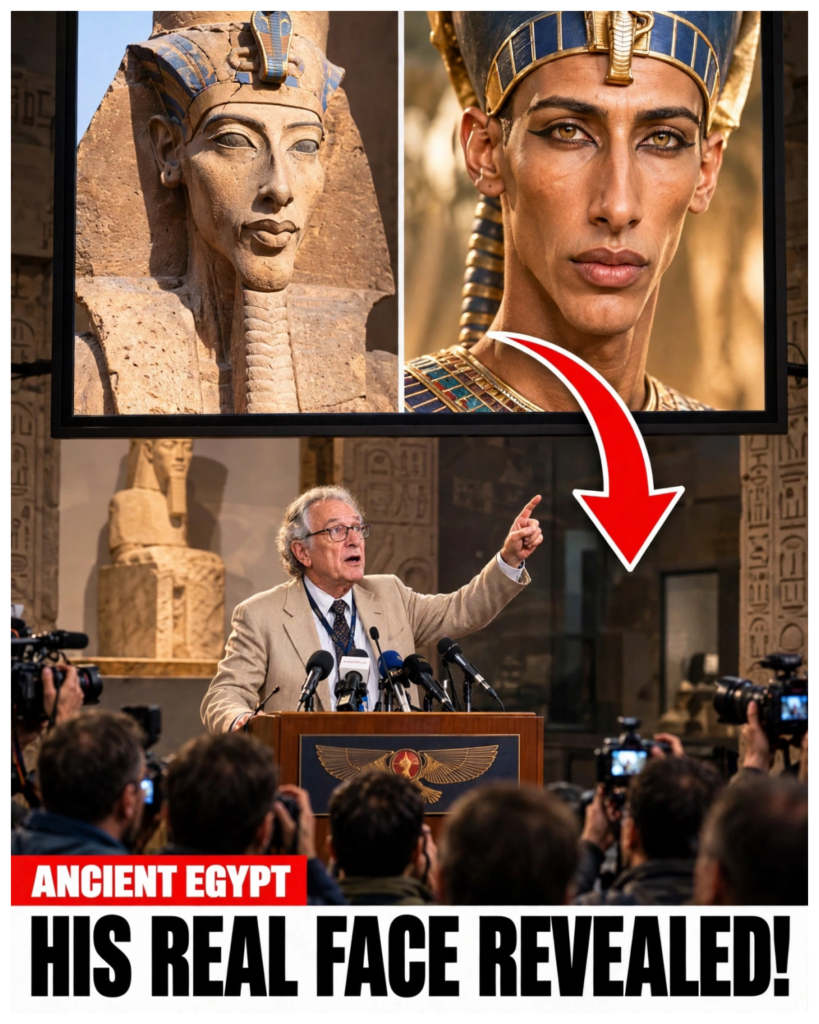
For over 3,300 years, Pharaoh Akhenaten’s real face remained a mystery.
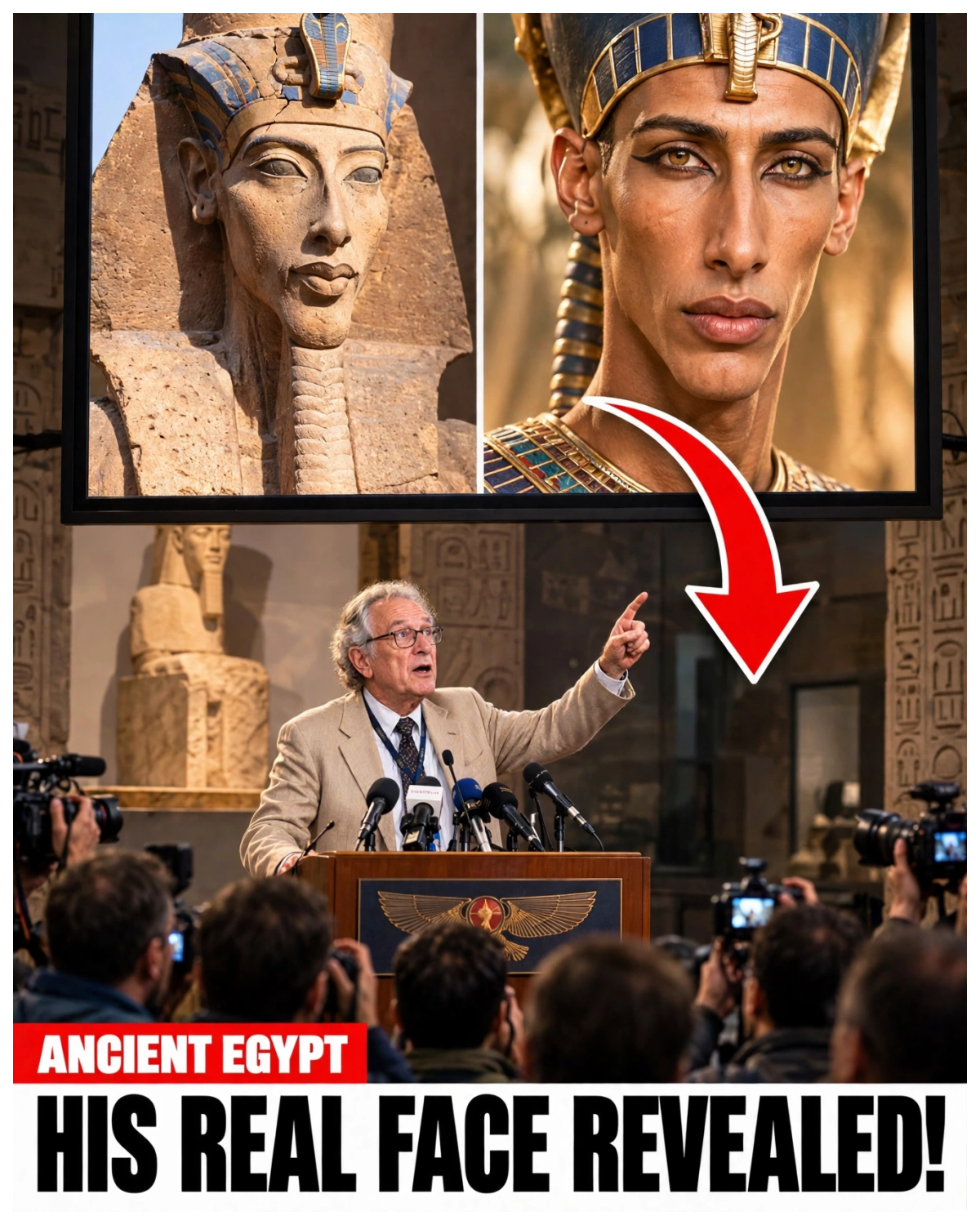
Ancient paintings showed him with a long face, strange body shape, and unusual features.
But did he really look that way?
Scientists decided to study his remains and recreate his face using modern technology.
What they found surprised many people and raised new questions about this ancient king.
Some wondered if his strange appearance was real or simply the way artists portrayed him.
Now, his reconstructed face offers a new look at one of Egypt’s most mysterious rulers.
But what secrets does his face reveal?
Join us in this video as we discuss the details.
Scientists Recreated Akhenaten’s Face After 3,300 Years More than 3,000 years ago, ancient Egypt was ruled by powerful kings who believed their duty was to protect the land, serve the gods, and keep the kingdom strong.
Most pharaohs followed the same religious rules as their fathers and grandfathers.
They built temples, offered gifts to the gods, and worked closely with powerful priests.
But one king decided to change almost everything.
His name was Akhenaten, and the choices he made would turn Egyptian life upside down.
Even today, his unusual statues, strange body shape, and sudden change of religion continue to raise questions.
Some people have even claimed that he looked like a visitor from another planet.
However, the real story is far more complicated.
To understand why Akhenaten became such a mysterious figure, it is necessary to look at his family and how he became king.
Akhenaten was born into Egypt’s royal family during the Eighteenth Dynasty.
His father was Amenhotep the third, one of the richest and most powerful rulers of his time.
His mother was Queen Tiye, a respected woman who played an important role in royal life.
Egypt was wealthy, and foreign rulers often sent gifts and letters to the royal court.
At first, Akhenaten was not expected to become king.
His older brother, Prince Thutmose, was seen as the next ruler.
However, Thutmose died before he could take the throne.
The reason for his death remains unknown.
After this loss, the path to the throne opened for Akhenaten.
When he first became king, he was known as Amenhotep the fourth.
In the early part of his rule, he followed many of Egypt’s old customs.
But things soon changed.
He gave up the name Amenhotep and took the name Akhenaten, which showed his connection to Aten, the sun disk.
This was not just a simple name change.
It was a sign that the new king had a different plan for Egypt.
At that time, Egyptians worshipped many gods.
Amun was one of the most powerful, and his priests controlled large temples, land, and wealth.
Akhenaten began to challenge this system.
He declared Aten the only god that should be worshipped.
He ordered changes to religious life, closed temples linked to Amun, and had the names of some old gods removed from monuments.
For ordinary Egyptians, these changes must have been difficult to understand.
Their families had worshipped many gods for hundreds of years.
Suddenly, the king was telling them that their old beliefs were wrong.
Some historians believe Akhenaten truly believed in Aten.
Others think he also wanted to weaken the priests and bring more power under his own control.
Whatever his reasons, his actions changed the kingdom in a major way.
Aten was shown as a round sun disk with rays reaching down toward the king and his family.
Some rays ended in small hands that appeared to offer the sign of life.
These images became a major part of Akhenaten’s new religion.
To his followers, they showed the sun giving life to the world.
To people who look at them today, they can seem unusual and mysterious.
But there is no reliable proof that the images showed spaceships or visitors from another planet.
They fit within the religious ideas of ancient Egypt.
Akhenaten also created a new capital called Akhetaten, now known as Amarna.
He chose a place along the Nile that had not been a major royal capital before.
He marked the land with stone monuments and said the city belonged to Aten.
New temples were built with open spaces that allowed sunlight to reach the altars.
This was different from many older temples, which had dark rooms and enclosed halls.
The new city became the centre of the king’s religious plans.
His wife, Queen Nefertiti, held an important place beside him.
She appeared in official art more often than many earlier queens.
In some scenes, she was shown taking part in actions usually linked to the king.
The couple had six daughters, and artists often showed the family sitting together, holding children, and sharing affection.
But the mystery did not end with Akhenaten’s death.
A hidden tomb, a mysterious skeleton, and modern DNA tests would reveal shocking clues.
Could these discoveries finally explain who he really was?
Let’s delve deeper.
The Lost Body, The Dna Tests, And The Face That Returned After 3,000 Years Akhenaten’s unusual appearance was not the only mystery surrounding his life.
After his death, his religious changes were rejected, and later rulers worked to restore the old gods.
His name and memory were removed from many official records.
His new capital was left behind, and the royal family moved away from the city.
Over time, much of what had happened during his reign became difficult to understand.
Then, many centuries later, discoveries began to bring parts of the story back to life.
In 1887, clay tablets were found near the ruins of Amarna.
They contained letters between Egyptian rulers and kings from other lands.
The letters spoke about gold, marriages, political problems, and requests for soldiers.
Some foreign leaders complained that their enemies were attacking them and asked Egypt for help.
These letters gave historians a closer look at the world around Akhenaten’s reign.
They also raised questions about whether the king paid enough attention to problems outside Egypt while focusing on his new religion.
However, the letters covered different periods, so they cannot prove that Akhenaten ignored every request for help.
Another important discovery happened in 1907 in the Valley of the Kings.
An excavation team found a burial chamber now known as KV55.
Inside were damaged objects, human remains, and a coffin that had been badly changed.
The name on the coffin had been removed, and the face covering had been damaged or taken away.
In ancient Egyptian belief, a person’s name and body were important for life after death.
The damage raised questions about why someone had treated the burial in this way.
At first, the man inside the tomb was difficult to identify.
Some objects carried the name of Akhenaten, leading researchers to connect the burial to his family.
Early reports suggested different identities, and the debate continued for years.
Some researchers believed the remains might belong to Akhenaten, while others thought they belonged to another royal man.
The bones appeared to belong to someone who had died at a relatively young age, which made the identification harder.
In 1912, another discovery helped researchers understand the skill of artists who worked during Akhenaten’s time.
German archaeologists found a painted bust of Queen Nefertiti in the remains of a sculptor’s workshop at Amarna.
The face was carefully shaped, and much of its colour remained clear after more than 3,000 years.
The bust showed that artists of the time could create lifelike faces.
This raised a simple but important question.
If they could make Nefertiti look so natural, why did they show Akhenaten with such unusual body features?
One possible answer is that the artists were not trying to copy his real appearance.
They may have been following new rules ordered by the king to show his special place in the religion of Aten.
Other people suggested that Akhenaten may have had a medical condition.
Some theories focused on hormones, while another suggested Marfan syndrome, a condition that can affect the bones, eyes, and other parts of the body.
However, the shape of a statue cannot prove that someone had a disease.
There is also no strong scientific evidence that Akhenaten was an alien.
Such claims grew because his images looked different from those of other kings, but unusual artwork is not proof of life from another planet.
In 2010, a team led by Egyptian archaeologist Zahi Hawass published a study of royal mummies and other remains.
The researchers used DNA tests and medical scans to study family links.
They reported that the man connected to KV55 was a son of Amenhotep the third and Queen Tiye.
They also identified him as the father of Tutankhamun.
The study further suggested that Tutankhamun’s mother, known as the Younger Lady, was the full sister of his father.
This meant that the young king’s parents were brother and sister.
The study helped explain some family links, but it did not end every debate about the identity of the man in KV55.
Some experts continued to question whether the remains belonged to Akhenaten.
The research also failed to provide clear support for the medical conditions that had been suggested to explain his unusual statues.
This strengthened the idea that his appearance in art may have been planned for religious reasons.
Then, in 2021, researchers released a digital reconstruction of the face of the man linked to KV55.
The project used old photographs, records, and measurements because the remains had badly broken down after their discovery.
Brazilian digital artist Cícero Moraes helped rebuild the skull on a computer and add layers of facial tissue and skin using a method developed for forensic face reconstruction.
The team left out royal crowns, jewellery, and makeup so that the image would focus on the face itself.
The result showed a young man with a strong jaw, almond-shaped eyes, and an ordinary human appearance.
It gave people a new way to imagine the person who had been hidden behind the damaged burial for so long.
Still, the image was only an estimate.
It could not prove the man’s identity or show every detail of his real face.
Akhenaten’s story remains important because it brings together a great religious change, unusual royal art, lost remains, and modern science.
But if Akhenaten’s face remained a mystery for over 3,300 years, could a modern discovery finally reveal what the ancient pharaoh really looked like?
Let’s learn more.
The Mystery Of Akhenaten’s Face And The Man Found In Tomb Kv55 For more than 3,300 years, the true face of Pharaoh Akhenaten has remained a subject of debate.
He was one of the most unusual rulers in ancient Egyptian history.
His religious changes shocked the country, and his strange appearance in ancient statues has raised questions for many years.
In 2021, a team of researchers worked on a digital reconstruction of a man whose remains were found in an ancient Egyptian tomb known as KV55.
The project used photographs, skull measurements, X-rays, and other records to create an image of what the man might have looked like.
Brazilian digital artist Cícero Moraes helped bring the face to life.
The result showed a young man with a strong jaw, almond-shaped eyes, and a calm expression.
However, the discovery did not solve the mystery of Akhenaten’s identity.
Researchers have not proved that the reconstructed face belonged to the famous pharaoh.
The man’s identity remains uncertain, and the difference between his reconstructed face and Akhenaten’s statues has created even more questions.
Many ancient statues showed Akhenaten with a long face, narrow eyes, thick lips, a long neck, wide hips, and a round stomach.
Some images also gave him a chest and body shape that looked different from those of other Egyptian kings.
His daughters were sometimes shown with long heads and unusual body shapes.
These images have led people to ask whether Akhenaten really looked this way or whether artists were following a special style.
Some experts believe the unusual features may have been used to show his religious beliefs and special place as king.
Others have suggested that the artists may have copied real features but made them look stronger than they were.
There is not enough evidence to say exactly how much of the artwork showed his true appearance.
Another idea focuses on Akhenaten’s father, Amenhotep the third.
The transcript discusses claims that the older king may have had a large skull and a pointed chin.
Some people have suggested that artists may have used similar family features when creating Akhenaten’s statues.
However, these claims do not prove that the unusual images were exact pictures of the royal family.
Ancient Egyptian artists often followed rules that gave kings and gods special looks.
Their work was not always meant to show every part of a person’s real body.
The mystery became more serious when archaeologists discovered Tomb KV55 in the Valley of the Kings in 1907.
The team was led by Edward Ayrton, and the work was supported by Theodore Davis.
Inside the tomb, researchers found a badly damaged coffin and human remains.
The name written on the coffin had been erased, and the gold covering that had once protected the face was missing.
These discoveries raised questions about who had been buried there and why the burial had been damaged.
In ancient Egypt, names and faces were important because people believed they helped the dead remain known in the afterlife.
Removing a person’s name or destroying parts of a burial could therefore carry a serious meaning.
Still, the damage alone cannot show exactly who ordered it or why it happened.
Objects found in KV55 connected the burial to Akhenaten’s royal family, but they did not settle the identity of the dead man.
Early studies suggested that the man may have died in his mid-twenties, with some estimates placing his age at about 26.
This raised doubts because Akhenaten was believed to have ruled for many years and fathered children.
However, the age of a person who died thousands of years ago can be difficult to estimate from damaged bones.
Different studies can also produce different results.
For this reason, the age estimate cannot settle the question on its own.
Scientists later examined royal remains and studied DNA to learn more about the family of Tutankhamun.
A 2010 study led by Egyptian archaeologist Zahi Hawass reported that the KV55 man was the son of Amenhotep the third and Queen Tiye and the father of Tutankhamun.
If the man in KV55 was not Akhenaten, then the pharaoh’s real burial place remains unknown.
Could the missing body still be hidden somewhere in Egypt?
Let’s find out.
The Royal Family, The Erased King, And The Search For The Truth The discovery of the man in Tomb KV55 created a new way to study the royal family of ancient Egypt.
Researchers compared the remains with other royal mummies, including Tutankhamun.
The skulls were said to share some features, leading to suggestions that the two men were closely related.
However, a similar appearance does not prove the exact relationship between two people.
They could be father and son, brothers, or other close relatives.
DNA results and the objects found in their burials are more useful when studied together.
The 2010 study offered important information about Tutankhamun’s family, but it did not end every argument about the identity of the KV55 man.
The question remains important because Akhenaten was the father of Tutankhamun according to the study’s findings only if the unknown man was correctly identified as Akhenaten.
The difference between the two questions must be clear: scientists may learn that a man belonged to the royal family without being able to prove his name.
Akhenaten’s life also became difficult to understand because his religious changes were rejected after his death.
Before becoming king, he was known as Amenhotep the Fourth.
He later changed his name to Akhenaten and gave special importance to the Aten, represented by the sun disk.
He pushed Egypt away from its traditional gods and placed the Aten at the centre of royal worship.
This decision challenged the power of priests who served the older gods.
Akhenaten also built a new capital called Akhetaten, which is now known as Amarna.
There, he created temples designed to let sunlight enter the open spaces.
His wife, Nefertiti, played an important role in royal life, and their family appeared in many artworks.
But after Akhenaten died, his religious system did not last.
The young king who followed him was first called Tutankhaten.
He later changed his name to Tutankhamun, showing the return of the worship of Amun.
Traditional religious practices were restored, and Akhetaten was gradually abandoned.
Buildings linked to the Aten were taken apart, and some of their stones were used in other structures.
Akhenaten’s name was also left out of later lists of Egyptian kings.
In some later records, he was treated as an enemy of the traditional religious order and called the “criminal of Akhetaten.”
These actions helped push his reign out of the main story told by later Egyptian rulers.
However, it is difficult to know whether every act of destruction had the same purpose or who ordered each one.
The treatment of Akhenaten’s memory has led to a bigger question: why was there such a strong effort to reject his rule?
One possible reason was that his religious changes threatened powerful priests and long-standing beliefs.
Restoring the old gods may also have helped later rulers gain public support and show that Egypt had returned to its earlier ways.
Still, the full reasons behind the removal of his name and the damage to objects linked to him are not known.
The mystery of his burial makes these questions even harder to answer.
If the man in KV55 was Akhenaten, the damage to the coffin and the missing gold face covering may be connected to the way later generations treated his memory.
But if the remains belonged to another royal man, the location of Akhenaten’s body is still a mystery.
His remains may have been moved, destroyed, or placed in a burial that has not yet been found.
These are possible explanations, not proven facts.
Modern technology has helped researchers study the past in ways that were not possible before.
The 2021 facial reconstruction used available records to create a picture of the man from KV55.
It gave the public a chance to imagine what he may have looked like, but it could not prove that the face belonged to Akhenaten.
It also could not explain why the royal burial was damaged or where the pharaoh was finally laid to rest.
The reconstruction is therefore one part of a much larger search for answers.
But the mystery did not end there.
Scientists turned to DNA for answers, uncovering shocking secrets about Akhenaten’s family.
What did they discover?
Let’s take a closer look.
The Dna Discovery That Changed The History Of Egypt’s Royal Family For many years, scientists struggled to understand the family history of Pharaoh Akhenaten and his son, Tutankhamun.
Although the ancient Egyptians left behind many records, some important details about their royal family remained unclear.
The discovery of human remains in Tomb KV55 raised even more questions.
Researchers wanted to know who the man was, how he was related to other members of the royal family, and whether his remains belonged to Akhenaten.
Modern science eventually offered a new way to investigate these questions.
In 2010, a research team led by Egyptian archaeologist Zahi Hawass examined 11 royal mummies using DNA tests and medical scans.
The main goal was to understand the relationships between members of the royal family and investigate some of the health problems found in their remains.
The work was not easy because the bodies had been preserved for more than 3,000 years.
Over time, heat, moisture, and other changes can damage DNA.
The chemicals used to preserve bodies during mummification can also affect genetic material.
This makes it difficult for scientists to recover clear samples that can be trusted.
To improve their chances, the researchers collected small samples from inside bones and teeth.
These areas can offer better protection for genetic material than exposed parts of the body.
The scientists also had to take steps to prevent contamination.
If modern human DNA entered an ancient sample, it could affect the results and lead to incorrect conclusions.
The researchers compared the genetic information from different royal mummies to identify possible family relationships.
Their findings helped them build a family tree covering several generations of Tutankhamun’s royal family.
One of the most important discoveries concerned the man found in Tomb KV55.
The research team reported that this man was the son of Amenhotep the third and Queen Tiye.
They also identified him as the father of Tutankhamun.
These findings led the team to conclude that the man was most likely Akhenaten.
The objects found in the tomb, including items bearing Akhenaten’s name, also supported this view.
However, not every researcher agrees that the evidence proves his identity beyond doubt.
Questions about the man’s age and the way the genetic results should be understood have continued to create debate.
The DNA investigation also revealed a surprising detail about Tutankhamun’s mother.
Researchers identified a mummy known as the Younger Lady as his mother.
According to the study, she was the full sister of the man found in KV55.
If that man was Akhenaten, the finding would mean that Tutankhamun’s parents were brother and sister.
This discovery gave researchers a clearer picture of the close relationships within Egypt’s royal family.
However, it is important to understand that the conclusion depends partly on the identification of the KV55 man as Akhenaten.
If that identification changes, some parts of the family story may need to be reviewed.
The discovery also raised questions about why members of the royal family married close relatives.
In ancient Egypt, kings were not viewed as ordinary men.
They were believed to have a special connection with the gods.
Some royal families believed that keeping marriage within the family helped protect the royal bloodline and its special position.
As a result, marriages between close relatives sometimes took place among members of the royal family.
These practices were different from the rules followed in many societies today.
However, close-relative marriage can increase the chance that parents will pass the same harmful gene to their children.
This can raise the risk of certain inherited health problems.
Could the close family relationships revealed by the DNA study help explain why Tutankhamun suffered from several health problems during his short life?
Keep watching for more.
Tutankhamun’s Health And The Possible Cost Of Royal Intermarriage Tutankhamun became king of Egypt when he was about nine years old.
He died at around 19, leaving behind a tomb filled with gold, jewellery, furniture, and other valuable objects.
Yet the treasures found in his burial told only one part of his story.
Medical examinations of his remains showed that the young king may have lived with several physical problems.
Researchers found evidence of a clubfoot, dental difficulties, and a mild curve in his spine.
A clubfoot is a condition in which the foot is shaped or positioned in a way that can make walking difficult.
More than 100 walking sticks were found in Tutankhamun’s tomb, and some showed signs of regular use.
This has led researchers to believe that he may have needed support when walking.
His teeth also showed signs of problems, including teeth that were crooked or did not fit together properly.
These findings suggest that his health may have affected his daily life.
However, scientists cannot know exactly how much pain he experienced or how these conditions affected every part of his life.
Researchers have also tried to understand what caused his early death.
For many years, people suggested that Tutankhamun might have been murdered.
One theory claimed that he had suffered a serious blow to the head.
However, later examinations suggested that some of the damage to his skull may have happened during the process of mummification.
This means the damage cannot be treated as clear proof that he was attacked.
Another theory suggested that he may have suffered an accident that injured his leg.
Yet researchers have not found enough evidence to confirm one exact explanation for his death.
The 2010 investigation provided another possible clue.
Scientists reported finding genetic material from malaria parasites in Tutankhamun’s remains.
Malaria is an illness caused by parasites that enter the body through infected mosquito bites.
The researchers also found evidence of damage in a bone in his foot.
This damage was linked to a condition called avascular necrosis.
It happens when part of a bone does not receive enough blood and the bone tissue begins to die.
The researchers suggested that malaria may have contributed to Tutankhamun’s death, especially because he already appeared to have other health problems.
However, the findings do not prove that malaria was the only cause.
His death may have involved several factors, and the exact answer remains uncertain.
His medical problems have also raised questions about the possible effects of marriage between close relatives.
When two closely related people have children, they are more likely to carry some of the same inherited genes.
If both parents pass on the same harmful gene to a child, that child may have a higher chance of developing certain health conditions.
When close-relative marriage continues over several generations, the risk of some inherited problems can increase.
Scientists call one possible result inbreeding depression.
In simple terms, this means that repeated breeding within a closely related group can increase the chance of harmful inherited traits and reduce overall health.
Similar problems have been studied in royal families in other parts of history.
However, this does not mean that every member of a royal family who married a relative would become ill.
It also does not prove that all of Tutankhamun’s conditions came from his family background.
Some illnesses may have had other causes, including infections or injuries.
Researchers must examine each condition separately before drawing conclusions.
The debate surrounding Tutankhamun’s family also affects the question of whether the man found in Tomb KV55 was Akhenaten.
The 2010 research team believed the genetic evidence, together with the objects found in the tomb, strongly supported that identification.
Other researchers have questioned the conclusion because of concerns about the estimated age of the remains and the interpretation of the DNA results.
This disagreement shows that scientific discoveries do not always settle every historical question.
DNA can help scientists understand how people were related, but it cannot always prove a person’s name without other evidence.
Researchers must also study ancient records, burial objects, and human remains before reaching a strong conclusion.
The discoveries surrounding Tutankhamun have changed the way people understand his family and his health.
They have revealed close family relationships and offered possible explanations for some of his physical problems and early death.
At the same time, important questions remain unanswered.
Scientists are still examining how much of his poor health may have been inherited and what finally caused him to die so young.
The story also shows that wealth and royal power could not protect every ancient king from illness.
Even a ruler surrounded by riches could face serious health problems that medicine at the time could not fully treat.
What other secrets might scientists uncover if they continue studying the DNA and remains of Egypt’s ancient royal family?
Share your thoughts in the comments section below.
Thanks for watching.
Akhenaten’s mysterious tomb, shocking DNA discoveries, and Tutankhamun’s hidden health problems have revealed new details about ancient Egypt’s royal family.
But what other secrets remain buried beneath the sands of Egypt?
Like, subscribe, and turn on notifications for more.


