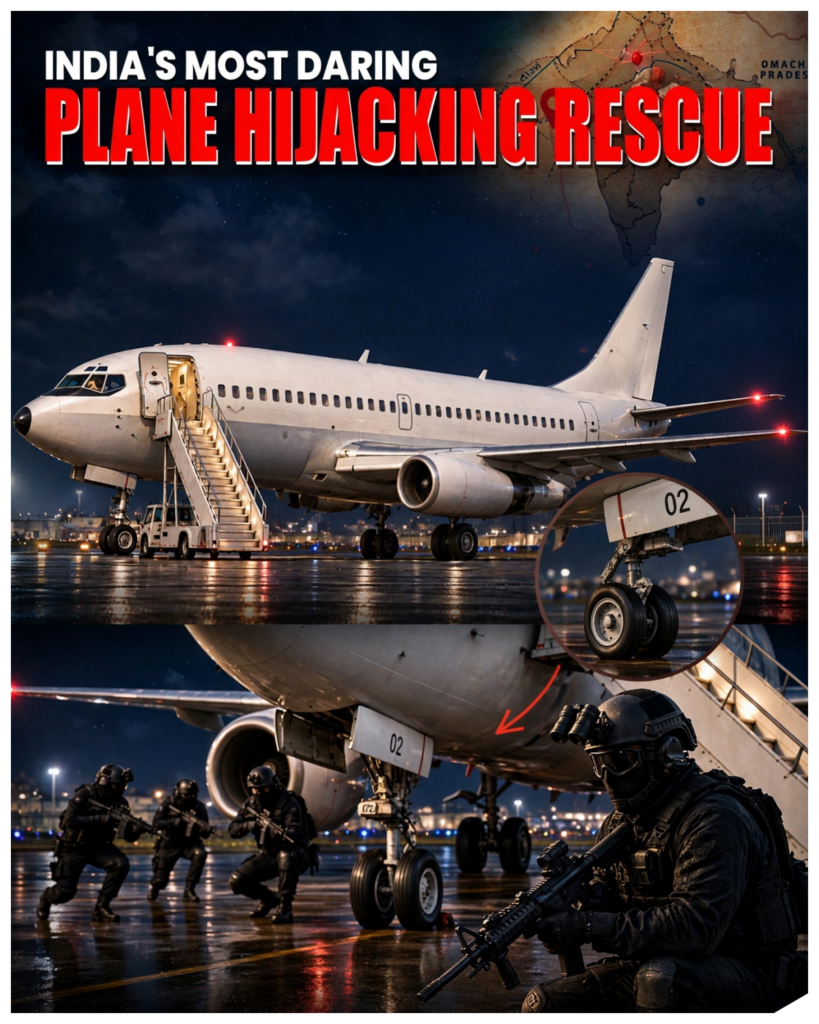
INDIA’S MOST SHOCKING PLANE HIJACKING — THE FIVE-MINUTE OPERATION THAT ENDED IC-427’S NIGHTMARE
On April 24, 1993, a routine domestic flight in India became the center of one of the most frightening hostage crises in the country’s aviation history.
Indian Airlines Flight IC-427 had departed Delhi for Srinagar, carrying 141 people.
Among the passengers were families, children, government personnel, and ordinary travelers expecting nothing more than a short journey across northern India.
But somewhere above the ground, an apparently injured passenger was preparing to reveal a terrifying secret.
He had boarded the aircraft pretending to have difficulty walking.
His legs were covered in plaster casts, supported by metal rods.
To other passengers, he appeared to be recovering from an accident.
In reality, the plaster concealed weapons.
The man was identified in later reporting as Mohammad Yousuf, a member of the militant organization Hizb-ul-Mujahideen.
He was traveling under the assumed identity of HM Rizvi, according to contemporary accounts.
His disguise had allowed him to board the aircraft without immediately attracting the attention that an armed passenger would normally provoke.
The flight was approaching the beginning of a journey that would change dramatically within minutes.
At approximately 2:43 p.m., Delhi Air Traffic Control received information that the aircraft had been hijacked.
The man claiming to be in control of the plane demanded that it be diverted to Kabul, Afghanistan.
He reportedly claimed to possess pistols and a hand grenade.
He also presented himself as someone acting under the authority of Syed Salahuddin, the leader associated with Hizb-ul-Mujahideen.
The demand was clear.
The aircraft was to be taken to Afghanistan.
But the route he wanted was immediately complicated by an important international decision.
Pakistan’s air traffic authorities refused permission for the aircraft to enter Pakistani airspace.
Without that permission, the hijacker could not simply continue toward Kabul along the route he had demanded.
The aircraft eventually returned to Indian territory and landed at Amritsar Airport at approximately 3:20 p.m.
The situation on the ground was now extremely dangerous.
The aircraft was no longer simply a passenger plane.
It had become a sealed hostage environment containing 141 people, with a heavily armed man threatening to use violence if his demands were not met.
Among those trapped inside were 126 passengers, nine infants, and six crew members, according to contemporary reporting.
Outside the aircraft, airport personnel and security officials faced an increasingly difficult decision.
Every passing minute increased the pressure.
The hijacker demanded fuel so the aircraft could continue toward Kabul.
He refused to abandon his demands.
The authorities needed to prevent the aircraft from leaving while avoiding an action that could endanger the people inside.
The Crisis Management Group at the Cabinet Secretariat was activated.
Officials in Delhi established contact with authorities in Amritsar.
The Deputy Commissioner and Senior Superintendent of Police became involved in negotiations.
The Indian government was now dealing with a situation that required coordination between civil aviation authorities, police, intelligence personnel, and specialized counter-terrorism forces.
At first, negotiations offered the most immediate opportunity to resolve the crisis without violence.
Officials attempted to persuade the hijacker to surrender.
But the man remained determined to have the aircraft refueled and flown to Afghanistan.
As the hours passed, the atmosphere became increasingly tense.
The hijacker reportedly fired a warning shot that pierced the aircraft’s fuselage.
The sound of a gunshot inside an airport environment made the danger impossible to ignore.
For the passengers, the situation must have felt almost unreal.
They had boarded a domestic flight expecting to reach Srinagar.
Now they were trapped inside a stationary aircraft, unable to know whether the next sound would be another warning shot or the beginning of a rescue operation.
Outside, officials had to consider the possibility that the hijacker might act on his threats.
The aircraft could not be allowed to become a vehicle for transporting hostages across international borders.
But a rescue operation also carried enormous risks.
An armed man surrounded by civilians could turn a few seconds of confusion into a tragedy.
The authorities therefore needed a force trained specifically for this kind of emergency.
That force was the National Security Guard.
The NSG, popularly known as the Black Cats, had been established as India’s specialist counter-terrorism organization.
Its personnel received specialized training for situations involving armed terrorists, hostage rescue, and other high-risk security emergencies.
The organization had developed a dedicated capability for dealing with aircraft hijackings.
The 1993 crisis would become one of the defining early tests of that capability.
The government dispatched an NSG anti-hijacking team to Amritsar.
For the commandos, the mission represented something more than another security assignment.
It was their first major operational test in a real aircraft hijacking.
The situation was particularly challenging because the hostages were still inside the aircraft.
The hijacker remained armed.
The negotiations had failed to produce a peaceful resolution.
And the longer the crisis continued, the greater the possibility that someone could be seriously injured.
The commandos and the negotiating team eventually received authorization to carry out an assault.
The precise timing was left to the judgment of the personnel on the ground.
The operation would later become known as Operation Ashwamedh.
Its objective was simple to state but extraordinarily difficult to achieve.
Stop the hijacker.
Save every hostage possible.
Prevent the aircraft from being taken out of the country.
And do it without turning the rescue into a disaster.
As midnight approached, the airport remained tense.
The hijacker was still inside the aircraft.
The passengers and crew had endured hours of uncertainty.
The rescue team waited for the opportunity to act.
Then, at approximately 1:05 a.m.
On April 25, the NSG launched its operation.
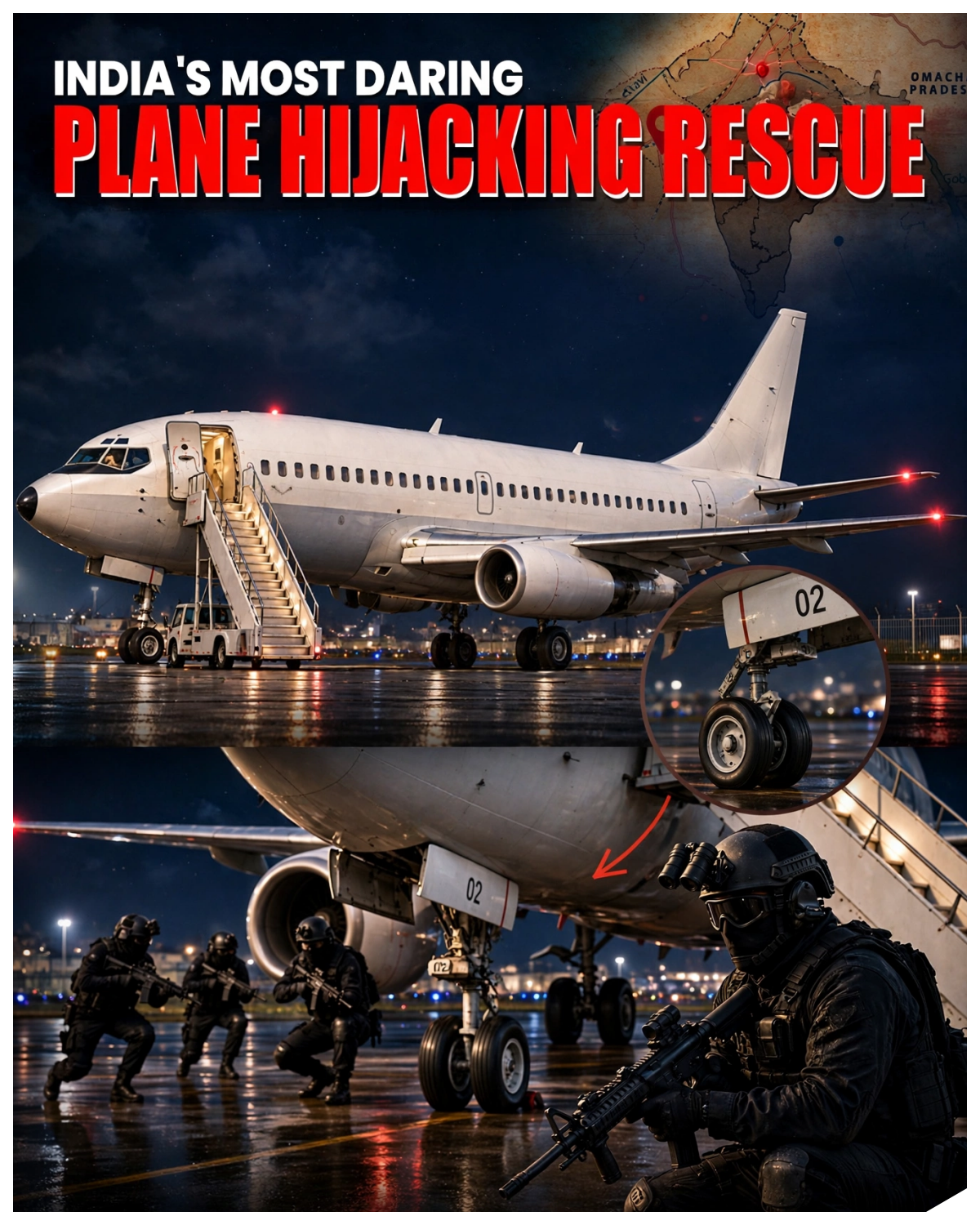
The aircraft was approached under cover of darkness.
According to the contemporary account later published by India Today, the commandos were able to move into position beneath the aircraft from the rear.
The circumstances inside the plane created a narrow opportunity for intervention.
The cabin crew had opened the wheel locks on the aircraft’s doors, helping make access possible.
The commandos moved quickly.
They entered through the aircraft’s available access points, taking the hijacker by surprise.
At that moment, Mohammad Yousuf was reportedly speaking over a radio telephone with KPS Gill, then the chief of Punjab Police.
He had no reason to expect that the situation was about to change so suddenly.
The commandos reached him from behind.
The hijacker attempted to react and fire his weapon.
But he was shot before he could carry out another attack.
The assault was over remarkably quickly.
The man who had held 141 people hostage was no longer in control of the aircraft.
The hostages were rescued.
No passenger or crew member was killed or injured during the operation.
For the people inside IC-427, the nightmare that had begun hours earlier had finally ended.
The aircraft remained intact.
The passengers were alive.
And India had prevented a hijacked domestic flight from being taken to another country.
But even after the rescue, questions remained about the final moments of the hijacker.
The initial official account presented to Parliament stated that commandos had shot him and that he was removed from the aircraft in an injured condition.
He was handed over to the police.
According to the statement delivered by Civil Aviation Minister Ghulam Nabi Azad on April 26, 1993, Punjab Police Chief KPS Gill reported that the hijacker died from his injuries while being moved toward a police vehicle.
However, a contemporary India Today investigation reported another version based on unnamed sources.
Those sources alleged that the hijacker had been taken away alive, questioned briefly, and subsequently shot.
That account differed from the official explanation.
The competing versions should not be treated as equally established facts.
The parliamentary statement provides the government’s account, while the alternative claim was attributed to unnamed sources in contemporary reporting.
What is clear is that the hijacker did not survive the operation.
The rescue itself, however, was widely regarded as a success.
For the NSG, Operation Ashwamedh became a defining achievement.
The counter-hijacking unit had been trained for an emergency that most security forces hoped would never occur.
Now it had demonstrated its capabilities during a real hostage crisis.
The operation was also recognized for its speed.
Later accounts described the assault as a five-minute commando operation and reported that it entered the Limca Book of Records as an exceptionally rapid counter-terrorism mission.
The significance of the rescue extended beyond the immediate outcome.
It demonstrated that India’s specialized security forces could respond to an aircraft hijacking with a coordinated operation designed to protect passengers and crew.
The story also became part of a larger debate about aviation security in India.
Six years later, another Indian Airlines aircraft would become the center of a much longer and more devastating hijacking crisis.
On December 24, 1999, Indian Airlines Flight IC-814 was hijacked while traveling from Kathmandu to Delhi.
That aircraft was eventually taken to Kandahar, Afghanistan.
The crisis lasted seven days and ended after the Indian government agreed to release three imprisoned militants in exchange for the hostages.
The contrast between IC-427 and IC-814 became a subject of intense public discussion.
People asked why the 1993 crisis had ended with a rapid rescue operation while the 1999 crisis had continued for an entire week.
The two incidents were different in important ways.
They involved different hijackers, different demands, different political circumstances, and different operational conditions.
Nevertheless, the memory of Operation Ashwamedh became an unavoidable reference point in discussions about the later Kandahar hijacking.
The 1993 operation had shown what could happen when a specialized team received authorization to act while the aircraft remained on Indian soil.
The 1999 crisis presented a far more complicated international situation, with the aircraft eventually reaching territory controlled by the Taliban.
The comparison continues to be discussed by historians, journalists, security experts, and people interested in India’s counter-terrorism history.
Yet the most important part of the IC-427 story remains the people who survived.
There were 141 lives inside that aircraft.
Some were adults traveling for work.
Some were children and infants.
Others were members of the flight crew, whose professional responsibilities continued even after the plane had been seized.
For them, the operation was not about military records or political comparisons.
It was about getting home alive.
The pilots and cabin crew had been forced into an extraordinary situation.
They had to manage a threatening passenger, protect the people under their care, and cooperate with authorities outside the aircraft.
Their actions formed an important part of the larger rescue effort.
The successful conclusion was not the achievement of one individual alone.
It depended on the coordination of aviation officials, negotiators, police personnel, intelligence authorities, and the NSG commandos who carried out the final assault.
The political leadership also had to make a difficult decision about when negotiations had reached their limits.
The government statement presented to Parliament documented the major events and the decision to authorize the operation.
For historians, that official record remains an important source for understanding how the crisis unfolded.
It also preserves a reminder of the pressure faced by officials who had to decide whether to continue negotiations or risk an armed intervention.
The name Operation Ashwamedh would become closely associated with the successful rescue.
It gave a name to an event that might otherwise have remained one more entry in the history of aviation emergencies.
But behind the name was a frightening sequence of events that began with a passenger who appeared to be injured.
The plaster casts concealed weapons.
The domestic flight became a hostage crisis.
A demand to fly to Kabul brought the aircraft to Amritsar.
Negotiations failed to produce a peaceful surrender.
And in the early hours of April 25, the NSG brought the crisis to an end.
The entire episode lasted less than a day, but its consequences for India’s security planning and public understanding of aircraft hijacking were lasting.
The rescue became a landmark in the history of the National Security Guard.
It also demonstrated why aircraft hijacking is among the most difficult emergencies a government can face.
A passenger aircraft is not an ordinary building.
It is a confined environment filled with civilians, limited exits, complex systems, and people who have no control over the threat confronting them.
Any decision made outside the aircraft can have immediate consequences for everyone inside.
That is why specialized training, intelligence, coordination, and careful judgment are essential.
The men and women aboard IC-427 had no way of knowing how the crisis would end.
They could not see the preparations taking place outside.
They could not know when the authorities would decide that the danger had become too great to allow negotiations to continue.
They could only wait.
And then, in the darkness of Amritsar Airport, the aircraft was stormed.
Within minutes, the hostage crisis was over.
No innocent passenger or crew member had lost their life.
The hijacker was dead.
And the plane that had been intended to become a vehicle for an international escape remained on Indian soil.
More than three decades later, Operation Ashwamedh remains an important chapter in India’s counter-terrorism history.
Its legacy is not simply the speed of the rescue or the reputation of the commandos.
It is the fact that 141 people boarded a plane expecting an ordinary journey and found themselves caught in a terrifying ordeal, yet every hostage survived.
The story of IC-427 is a reminder that behind every dramatic security operation are ordinary people whose lives depend on decisions made under extraordinary pressure.
On April 25, 1993, the Black Cats brought that nightmare to an end.
And the name Operation Ashwamedh became permanently connected with one of India’s most remarkable aircraft hostage rescues.