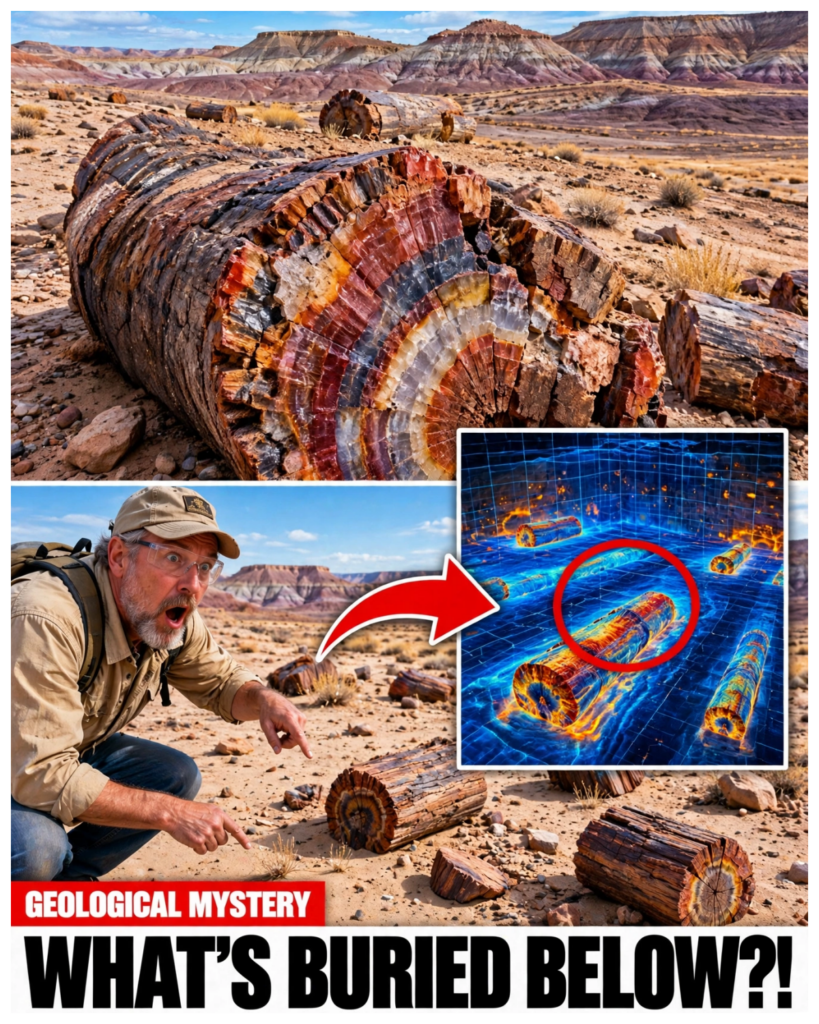
For years, Arizona’s Petrified Forest has amazed visitors with its ancient trees turned to stone, but geologists are now uncovering secrets that could change everything we thought we knew about this mysterious landscape.
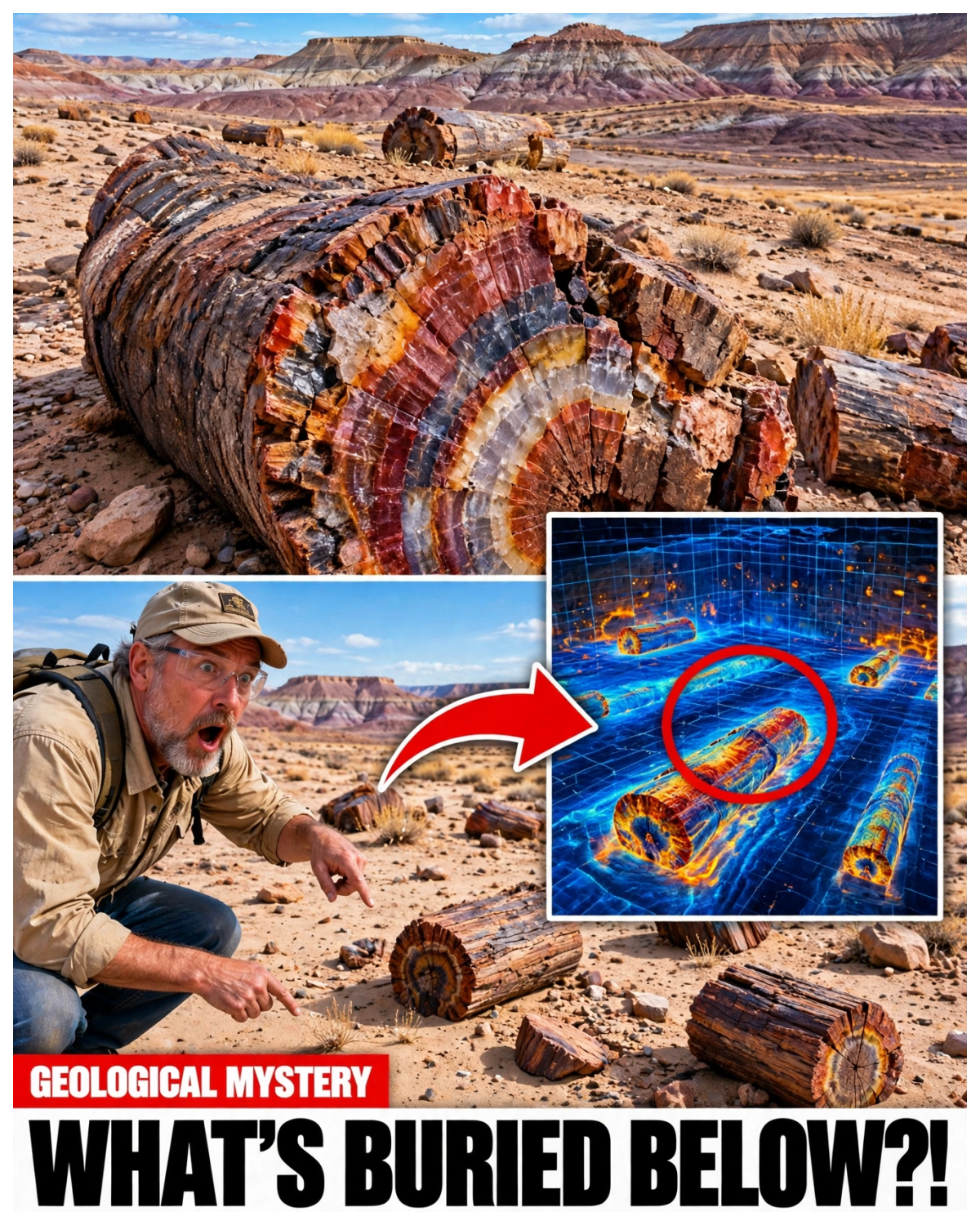
Hidden beneath its colorful rocks and fossilized wood lies a remarkable story of prehistoric life, powerful geological forces, and a world that vanished millions of years ago.
So, what exactly have scientists discovered?
Why is it challenging long-held beliefs?
The truth buried beneath Arizona’s ancient forest is far more astonishing than anyone expected.
Arizona’s Petrified Forest Hides Ancient Secrets Across the colourful red and lavender badlands of northern Arizona lies a breathtaking landscape that sparkles like broken glass beneath the sunlight.
This remarkable place is the Petrified Forest, where the remains of ancient trees have turned into stone over 200 million years.
Despite the dry air, rising heat, and seemingly lifeless surroundings, the land holds extraordinary secrets about Earth’s distant past.
Protected since 1906, the park features countless petrified tree trunks scattered across its colourful hills and valleys.
Some lie broken into smaller sections, while others stretch across the ground, displaying brilliant colours and patterns that reveal the incredible natural processes that preserved these ancient trees for millions of years.
But the most astonishing part is what happens when you look closely.
These are not simply rocks shaped like trees.
Under the right conditions, the microscopic structures of the original wood can remain visible inside the stone.
The trees’ ancient cells, once part of living plants that absorbed water and reached towards sunlight, have been preserved through a remarkable natural process.
As mineral-rich water entered the buried wood, it carried substances that gradually filled its tiny spaces and replaced much of its original material.
Over enormous stretches of time, the wood became petrified, transforming into stone while retaining many details of its former structure.
The colours make the scene even more extraordinary.
Some logs glow deep red or rich brown, while others display shades of white, yellow, lavender and purple.
These differences are linked to minerals and trace elements deposited during the fossilisation process.
In some places, crystals formed inside empty spaces, creating brilliant patterns that look almost too beautiful to belong to an ordinary desert landscape.
Yet the Petrified Forest holds a mystery that challenges the story many visitors expect to hear.
The familiar explanation suggests that a lush tropical forest once stood here, fell where it grew, and slowly turned to stone.
However, the National Park Service explains that many of these trees were transported by ancient waterways before they were buried.
Their final resting places were not necessarily the places where they once grew.
That discovery changes everything.
Rather than a forest frozen in place, the landscape preserves evidence of ancient rivers, floods, burial and geological transformation.
Each fossilised trunk becomes a clue to the environment that existed millions of years ago, when this region looked nothing like the dry badlands visitors see today.
There is also a surprising modern story hidden among the ancient stones.
Visitors have removed pieces of petrified wood from the park for generations, despite rules protecting these irreplaceable treasures.
Some stolen stones have eventually been returned, occasionally accompanied by letters expressing regret.
And that is what makes this landscape so intriguing.
Beneath its beautiful colours lies a complicated history of vanished ecosystems, powerful natural forces and extraordinary preservation.
The Petrified Forest is not simply a collection of ancient trees turned to stone.
It is a geological time capsule, preserving fragments of a lost world and reminding us that the truth behind nature’s greatest wonders can be far stranger than the stories we first believe.
But what is the story that has been told for years, or centuries, about this strange forest?
Does it, in anyway, match up with what scientists’ claims?
Let’s find out.
Geological Secret of Arizona’s Petrified Forest For generations, visitors to Arizona’s Petrified Forest have carried a fascinating story in their minds.
They imagine a time when this dry, barren landscape was covered by a warm, rain-soaked forest.
Towering trees stood tall, until they eventually fell and became buried beneath layers of earth.
Over millions of years, their wooden trunks transformed into solid stone, while minerals flowing through them created the brilliant shades of red, purple, yellow, and gold seen today.
Later, the government stepped in to protect these extraordinary natural treasures.
Yet, local legend adds another curious twist: anyone who takes a piece of petrified wood home may suffer terrible bad luck.
There is, however, a remarkable history behind the land’s protection.
In June 1906, the United States passed the Antiquities Act, giving the government greater power to protect important archaeological and natural sites.
Just months later, in December, Petrified Forest was declared a national monument, safeguarding more than 60,000 acres of striking desert terrain.
It received national park status in 1962, and its boundaries expanded again in 2004.
Today, it is far more than an unusual roadside attraction.
It is a protected landscape containing some of the world’s most celebrated examples of ancient wood turned to stone.
Visit at sunrise, and the scenery seems almost impossible to explain.
Hills stretch into the distance, displaying layers of red, lavender, grey, and other earthy colours.
These bands belong to the Chinle Formation, a geological record built up over millions of years.
Across the slopes lie enormous petrified logs, scattered like the remains of a forgotten world.
Some are so large that they span narrow gullies, resembling bridges carved from stone.
Standing among them, visitors may feel as though an ancient forest suddenly froze in time, leaving behind a silent and mysterious landscape.
But there is a detail that challenges the familiar story.
According to the National Park Service, many of these trees were carried by streams before being buried rapidly beneath river sediments.
In other words, the logs did not necessarily become petrified where the trees originally grew.
They travelled through an ancient landscape, perhaps swept along by powerful currents, before settling in the place where they are found today.
That distinction changes how we understand this remarkable site.
The Petrified Forest may preserve the remains of an ancient forest, but it does not necessarily mark the exact location where that forest once stood.
Instead, it tells a more intriguing story of movement, burial, mineral transformation, and immense geological change.
What visitors see today is not simply a forest turned to stone, but the final resting place of trees carried there by forces that shaped a vanished world.
Now, what have geologists said so far about the origin of the forest?
What explanations seem to back the claim?
Keep watching.
Arizona’s Petrified Forest Hides Astonishing Secrets A forest buried exactly where it once stood captures a single moment in time.
But when a river carries fallen trees away before burying them, the story becomes far more complicated.
Suddenly, the rocks begin to reveal not just what happened, but what came before and what followed.
Scientists can investigate where the trees originally grew, how far they travelled, how quickly they were buried, and how long it took for ordinary wood to become stone.
They can even search for evidence of events that happened after the trees were transformed.
In this ancient landscape, every layer of rock holds another clue, waiting for someone to understand its meaning.
Walk along the trails of Arizona’s Petrified Forest, and you will encounter enormous stone trunks scattered across the ground.
Many lie in separate sections, with breaks so straight and clean that you might mistake them for the work of a skilled lumberjack using a powerful saw.
Yet no human hand made these cuts.
The explanation lies in the nature of the material itself.
Although quartz can form beautiful, durable crystals, it is also brittle.
Under enough pressure, it can crack suddenly.
As stress built up inside these mineralized trunks, the stone fractured across the grain, splitting the logs into pieces.
What looks like deliberate cutting is actually the result of natural forces acting with remarkable precision.
But the broken trunks are only part of the mystery.
Their colours tell another fascinating story.
Some appear brown and weathered, resembling ordinary pieces of old firewood.
Others glow with brilliant shades of red, orange and white.
Look closely at certain specimens, and you may discover tiny crystal-lined chambers containing purple amethyst or golden-yellow citrine.
These sparkling interiors look almost like miniature treasure chests hidden inside ancient logs.
Why do neighbouring pieces of petrified wood look so different?
If they all formed under similar conditions, why did some become relatively plain while others developed such extraordinary colours and crystals?
The answer lies in the minerals and chemical conditions present as water moved through the buried wood.
Different minerals introduced different colours, while changing conditions allowed crystals to grow inside hollow spaces and cracks.
Each trunk became a unique record of the environment surrounding it.
Then there is another surprising reminder that petrified wood has a history beyond geology.
Hidden within the park are the remains of an ancient structure known as the Agate House.
Built between approximately 1050 and 1300, it contains eight rooms constructed largely from petrified wood.
Long before modern tourists arrived, people recognised the stone’s usefulness and carried these heavy fragments into walls.
Today, the structure raises an intriguing question: how did people gather and arrange these unusual building materials, and what was daily life like inside those stone walls?
Even here, Arizona’s ancient trees continue telling stories that reach far beyond the forest itself.
So when did this rock stop being ordinary building material and start being a treasure?
And who decided the difference?
How did the woods transform into the stones they are today?
Stay with us.
How Arizona’s Ancient Forest Turned to Stone Around 220 million years ago, the world looked nothing like the planet we know today.
Every continent was joined into one gigantic landmass called Pangaea, and the region that would eventually become Arizona lay near the equator.
Dinosaurs were only beginning to appear, and the land now protected within Petrified Forest National Park was a warm, muddy floodplain crossed by wandering rivers.
These rivers frequently overflowed their banks, drowning the surrounding land and reshaping the landscape.
The colourful hills scattered across the park are more than beautiful scenery.
They are records of an ancient world, with each layer revealing a different chapter of its history.
Some contain river mud, others preserve volcanic ash, and others were formed from sand deposited by shifting waterways.
Together, these layers make up the Chinle Formation, a remarkable collection of rocks that preserves evidence of life and environmental change millions of years ago.
The famous petrified logs are only one part of this much larger story.
The ancient floodplain was also home to a surprising variety of creatures.
Phytosaurs, powerful reptiles with long, crocodile-like snouts, hunted near the rivers.
Armoured plant-eaters searched the riverbanks for vegetation, while early dinosaur relatives moved through the same environment.
Remarkably, scientists continue to discover previously unknown animals through tiny fossil remains.
This means the park is not simply a graveyard of ancient trees.
It is a vast natural archive that still holds secrets about creatures that disappeared long ago.
Then, dramatic changes transformed the landscape.
Volcanoes erupting hundreds of miles away released enormous quantities of ash into the atmosphere.
As the ash settled across the region, rivers became clogged and their waters spilled over the surrounding plains.
Violent floods uprooted trees, swept their trunks downstream and forced them into tangled piles against river bends and sandbars.
Geologists call these enormous accumulations river log jams.
This explains why many petrified logs lie scattered and piled together rather than standing upright like trees in a living forest.
Their transformation began when thick layers of muddy sediment and volcanic ash buried the fallen wood.
Rapid burial protected the trunks from oxygen and slowed the decay that would otherwise have destroyed them.
Over time, groundwater carrying dissolved silica seeped into the buried wood.
As minerals accumulated inside its tiny spaces, quartz gradually replaced the original organic material.
Scientists call this process permineralization.
The wood did not simply become stone overnight.
Instead, minerals preserved its internal structure with extraordinary detail.
Under a microscope, scientists can still identify the outlines of cells that once transported water through living trees.
Their delicate patterns remain visible, although quartz now fills them.
That is the astonishing secret of Arizona’s petrified forest: ancient trees were transformed into stone while preserving microscopic evidence of the life they once carried.
What efforts were put in place to get the age of the stones?
What was the most accurate of all?
Stay tuned.
Arizona’s Petrified Forest Reveals Earth’s Secrets For years, scientists struggled to agree on the identity of the remarkable fossilized wood found in Arizona’s Petrified Forest.
One of the most famous scientific names associated with these ancient trees eventually turned out to be invalid under the rules of scientific naming.
What once seemed like a straightforward classification became a complicated puzzle.
Today, the National Park Service recognizes fourteen different kinds of fossil wood in these rocks.
The discovery revealed that this ancient forest was far more diverse than a single scientific label could suggest.
But identifying the wood was only part of the mystery.
Scientists also needed to establish exactly how old the forest was.
And that was where things became even more fascinating.
Ordinary carbon dating could not help because the remains were far too ancient.
Instead, researchers turned to a remarkable natural timekeeper hidden inside volcanic ash: tiny crystals called zircons.
When these crystals form, they trap uranium but initially contain almost no lead.
Over millions of years, the uranium slowly decays into lead at a predictable rate.
By measuring the amounts of uranium and lead inside a zircon, scientists can calculate how long ago the crystal formed.
It is almost like reading an ancient hourglass that has been running for hundreds of millions of years.
As research advanced, the dates became increasingly precise.
One important geological layer was dated to approximately two-hundred-and-nine-point-nine million years ago, with an uncertainty of only about 72,000 years.
For rocks this ancient, that level of precision is extraordinary.
Further research placed the Chinle Formation, which contains the Petrified Forest’s famous fossils, between approximately 227 million and 209 million years old.
At last, scientists had a much clearer timeline of the prehistoric world preserved beneath Arizona’s surface.
Yet the rocks visible above ground held only part of the story.
In 2013, researchers drilled deep beneath the park and recovered more than 850 metres of geological core.
One continuous section stretched approximately 520 metres, preserving an extraordinary record of the Triassic Period.
Inside these ancient layers, scientists discovered magnetic reversals that could be matched with records from North America’s East Coast.
Even more astonishing, they identified a repeating climate pattern linked to the gravitational influence of Jupiter and Venus.
This cycle occurred roughly every 405,000 years and has persisted for more than 215 million years.
What appeared to be a collection of ancient logs had become part of a much larger planetary clock.
These discoveries also challenged a dramatic theory about the past.
A massive asteroid impact in present-day Quebec occurred around the period when animal life recorded in these rocks was changing.
However, geological evidence showed that the changes happened too gradually for the impact to be their main cause.
Instead, the climate was becoming progressively drier.
The evidence transformed the story of Arizona’s Petrified Forest, replacing dramatic speculation with something even more remarkable: a scientific record of Earth’s changing climate, ancient life and planetary rhythms.
But… how did the researchers successfully date the wood that had become petrified?
What did they observe?
Stay glued.
Arizona’s Rainbow Wood Hides Ancient Secrets For years, scientists had been dating the minerals surrounding Arizona’s famous petrified wood.
But there was one important problem.
The surrounding rock was not the main attraction.
It was the ancient wood itself, with its striking shades of brown, orange, red, and white, that drew people’s attention.
To understand how these beautiful colors formed, researchers needed to look beyond the rock and examine the quartz preserved inside the logs.
The question they wanted to answer was simple, but the implications were enormous.
If the quartz formed when the trees were first buried, its age should match the surrounding volcanic ash.
That would support the familiar explanation that the wood became fossilized soon after burial.
But what if some of the quartz developed much later?
That possibility could change how scientists understood the history of these remarkable fossils.
In 2018, a team of researchers decided to investigate.
Rather than relying on the surrounding rock, they directed a highly focused laser at tiny areas of quartz inside the petrified wood.
The laser created microscopic pits in the mineral, allowing sophisticated instruments to measure the amounts of uranium and lead trapped within it.
These elements acted like a natural clock, preserving clues about when the quartz had formed.
Some of the results supported the established explanation.
The brownish wood produced dates consistent with quartz forming shortly after the trees were buried.
In other words, these samples appeared to preserve evidence of the original fossilization process, dating back more than 200 million years.
However, the orange, red, and white samples revealed a more complicated story.
Their dates were younger and less consistent.
Instead of recording a single ancient event, they suggested that groundwater had entered the wood long after its original burial, carrying dissolved minerals that eventually crystallized into fresh quartz.
This discovery introduced an important distinction.
Quartz formed during the initial burial recorded the ancient environment that first preserved the trees.
Quartz deposited later recorded another chapter in the region’s geological history, when water returned and altered the existing fossils.
Suddenly, Arizona’s celebrated rainbow petrified wood looked less like a perfect snapshot of one prehistoric moment and more like a record written and rewritten over millions of years.
The brown wood appeared to preserve the earliest chapter, while some of its brighter colours reflected later geological changes.
That does not mean every petrified log underwent the same process, or that its original history has disappeared.
Instead, the findings suggest that scientists must examine each sample carefully before drawing conclusions.
The rainbow colours remain extraordinary.
But beneath their beauty lies a far more intriguing story: one in which ancient trees, buried by long-vanished landscapes, continued recording Earth’s changing history long after their lives had ended.
Now, what explanation was given to how the petrified forest became visible?
Should it not be deeply buried under the soil after millions of years?
Let’s find out.
Arizona’s Buried Prehistoric Secrets Arizona’s Petrified Forest is far more than a collection of colourful rocks and ancient tree trunks.
It is a remarkable window into a world that existed millions of years before humans appeared on Earth.
Beneath its striking landscape lies a story of powerful forces, gradual changes and prehistoric secrets that nature preserved for an astonishing length of time.
Two major geological processes, tectonic uplift and differential erosion, help explain how these hidden treasures eventually came to light.
Tectonic uplift happens when enormous forces deep within the Earth push sections of the planet’s crust upward.
This movement can raise rock layers that once lay far below the surface, bringing ancient geological formations closer to the open air.
Across the Colorado Plateau, where Arizona’s Petrified Forest is located, uplift gradually raised vast areas of land and exposed rocks containing evidence of a distant prehistoric world.
Some of these formations date back to the Late Triassic Period, approximately 225 to 205 million years ago.
At that time, the region looked very different from the dry, colourful landscape visitors see today.
Ancient forests, rivers and other environments supported plants and animals that have long since disappeared.
When trees fell and became buried beneath sediment, minerals gradually replaced their original organic material, preserving their shapes as petrified wood.
Yet tectonic uplift was only part of the story.
Even after these ancient rocks were raised, many fossils remained hidden beneath layers of soil, sediment and stone.
This is where erosion began to make a difference.
Wind, rain and flowing water slowly wore away the materials covering the fossil-rich deposits.
Although these forces may seem weak when observed over a few days or years, their effects become extraordinary over millions of years.
Little by little, they removed layers of rock, revealing colourful petrified logs, fossils and striking geological formations that had remained concealed for ages.
Another important process is differential erosion, which occurs when different types of rock wear away at different speeds.
Softer rocks break down more quickly, while harder, more resistant layers survive for longer.
As the weaker materials disappear, the stronger rocks may remain as ridges, cliffs, raised platforms and unusual formations.
This uneven erosion gives the landscape much of its distinctive appearance.
Together, tectonic uplift and erosion have helped transform the region into an extraordinary natural record of Earth’s history.
Uplift brought ancient rock layers closer to the surface, while erosion gradually uncovered the evidence they contained.
Today, the Petrified Forest provides scientists with valuable clues about prehistoric plants, animals, ancient climates, and changing environments.
By examining its fossils and rock layers, researchers can reconstruct parts of a world that vanished millions of years ago, revealing how dramatically our planet has changed through time.
How well does the forest seem to be preserved and protected?
How have stolen pieces been recovered so far?
Keep watching.
The Petrified Forest’s Mysterious Curse Revealed For years, Petrified Forest National Park has warned visitors against taking pieces of its ancient wood.
One famous sign claimed that fourteen tons of petrified wood disappeared every year.
However, that figure came from older estimates, not an exact count.
With thousands of visitors exploring such a vast landscape, measuring every missing fragment would be nearly impossible.
Yet once a number appears on an official sign, people often accept it as unquestionable truth.
Over time, park staff began photographing the same locations year after year to understand what was really happening.
The pictures revealed something surprising.
Entire sections of the landscape were not being stripped bare, and most visitors respected the rules.
Even more fascinating was an experiment that exposed an unexpected side of human behaviour.
Signs telling visitors that many others had stolen wood actually encouraged more theft.
By contrast, a simple, polite request asking people to leave the wood where it belonged proved much more effective.
The lesson was startling: telling people that everyone breaks a rule can make breaking it seem perfectly acceptable.
But the park has another, far stranger weapon against theft: a curse.
Nobody knows precisely how the legend began, but stories of bad luck supposedly following people who stole petrified wood have spread for generations.
Since at least 1935, visitors have returned stolen pieces in packages accompanied by letters of apology.
More than eight hundred such letters have reportedly been collected.
Some people confessed that they believed a single stolen stone had brought illness, misfortune or a string of unfortunate events into their lives.
Is the curse real?
There is no scientific evidence that stealing petrified wood can magically change someone’s destiny.
Yet the legend has achieved something ordinary warning signs often cannot.
It has persuaded hundreds of people, across many decades, to admit their mistakes and return what they took.
In a curious way, the curse became a form of punishment people imposed upon themselves.
Unfortunately, returning the stones cannot undo the damage completely.
Nobody can identify the exact hillside or location from which every piece was removed.
Consequently, the returned fragments accumulate in piles, separated forever from the places where they formed more than 200 million years ago.
The story becomes even more complicated when we consider the people who lived here centuries earlier.
Between approximately 1050 and 1300, inhabitants constructed an eight-room pueblo using petrified wood, building a home from the colourful stone surrounding them.
They took materials to create shelter, while later collectors sought profit and tourists wanted souvenirs.
The difference between these actions is not always simple.
But one question remains: when does taking something from the past become an act of destruction rather than a way of connecting with it?
Do the geologists’ scientific explanations available seem to demystify Arizona’s petrified forest?
Could there be more mysteries left to be told about these logs?
Stay with us.
The Petrified Forest’s Hidden Ancient Secrets As evening settles over the badlands, the ancient landscape begins to grow quiet.
The brilliant shades of red, purple, and lavender slowly deepen as the last rays of sunlight disappear behind the distant hills.
The glittering logs that once seemed to glow with their own light gradually fade into the growing darkness.
Somewhere beyond the main trail lies a collection of stones that have been returned by visitors, each one more than 200 million years old.
Yet, despite their extraordinary age, these pieces of ancient wood may never find their way back to the exact hillsides where they originally rested.
For generations, people have looked at the Petrified Forest and imagined a simple story of a woodland frozen in time.
Trees fell, were buried, and slowly turned to stone.
It sounds like a remarkable explanation, but the deeper scientists look, the more complicated and fascinating the story becomes.
What appears to be a peaceful forest preserved forever is actually the result of powerful rivers, violent volcanic activity, layers of burial, and countless movements of water that transformed the fallen trees over millions of years.
First, ancient rivers carried branches and fallen trunks across the landscape, sometimes sweeping them far from where they had grown.
Volcanic ash and other sediments eventually buried the wood, protecting it from complete decay.
Then came the slow, almost invisible work of mineral-rich water.
As water moved through the buried logs, it carried dissolved silica into the wood’s tiny spaces.
Gradually, the original organic material was replaced or filled with minerals, leaving behind the remarkable stone structures we see today.
But the process was not as simple as one burial followed by one transformation.
Water returned again and again, carrying different minerals and changing the colours, patterns, and textures inside the wood.
Each movement left another mark, creating a natural record of events that unfolded across enormous stretches of geological time.
In a sense, every petrified log is like an ancient manuscript, filled with layers of information that scientists are still learning to interpret.
And that is where the real mystery begins.
The familiar story of a forest turned to stone was never entirely false.
It simply concealed a much richer history beneath its surface.
Every new discovery raises fresh questions about ancient rivers, volcanic landscapes, shifting environments, and the remarkable chemistry that preserved these trees for hundreds of millions of years.
As the final sunlight catches the quartz crystals embedded within the logs, the stones sparkle once more before darkness takes over.
They have survived the rise and fall of landscapes, the movement of water, and unimaginable stretches of time.
Yet their story remains unfinished.
Beneath the open sky, these glittering remnants of an ancient world continue to hold secrets, waiting for the next curious scientist to uncover another page of Earth’s extraordinary past.
Now, what do you think about the geologists’ revelations of Arizona’s petrified forest?
What other mysteries could the forest be hiding, waiting to be discovered?
We’d love to hear your opinions in the comments below.
And don’t forget to like and subscribe.


