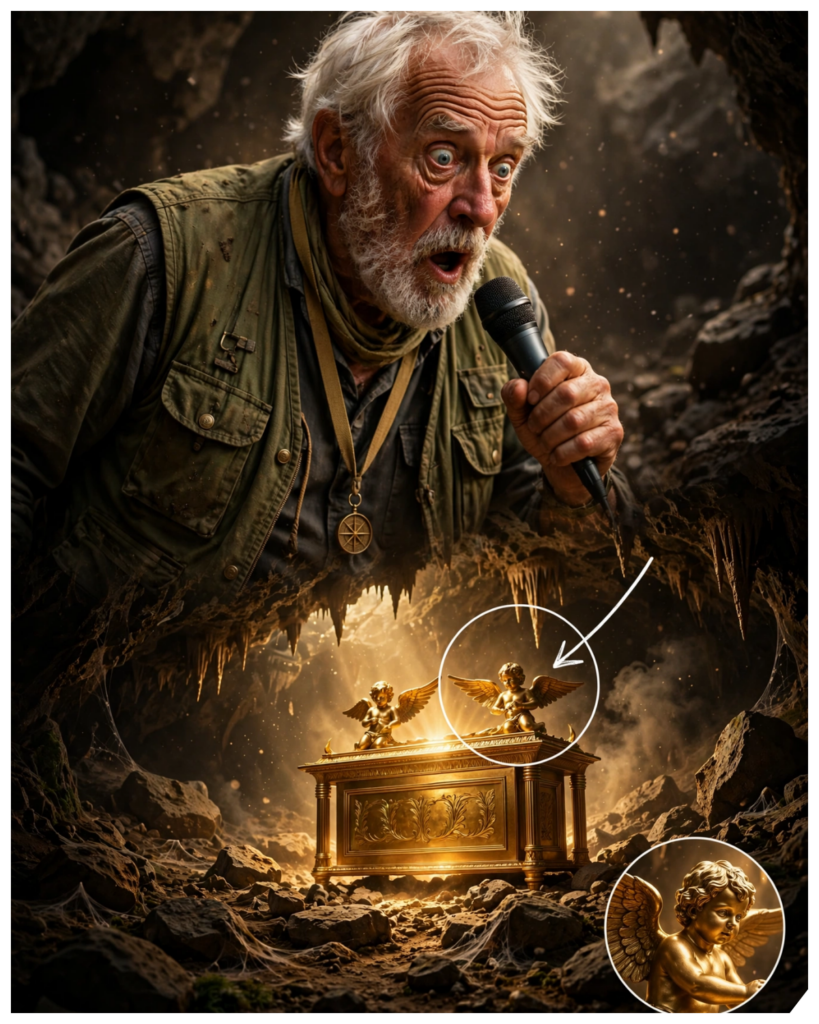
Before he died, Ron Wyatt revealed the terrifying truth about the Ark of the Covenant.
To his followers, Wyatt was a divinely guided witness who had stood before the very throne of God on Earth.
To his critics, he was a man of deep conviction who crossed the line between faith and fact.
Yet in the account he left behind before he died in 1999, Wyatt described a discovery beneath Jerusalem that he believed changed everything we knew.
About history.
About the Old Testament.
About Christianity.
Ready to dig in?
Let’s get started with understanding the man himself!
Who Was Ron Wyatt?
Ron Wyatt was an American nurse-anesthetist and biblical archaeologist who became one of the most prominent figures in the field of faith-based exploration during the late twentieth century.
Born on June 2, 1933, in the United States, Wyatt pursued a medical career and worked professionally as a nurse anesthetist in Madison, Tennessee.
His interest in archaeology began in the early nineteen seventies, when he started taking self-financed expeditions to the Middle East in search of physical evidence that could corroborate events and locations described in the Bible.
Without formal training in archaeology or affiliation with any academic institution, he undertook these expeditions independently, often with little equipment beyond basic excavation tools, cameras, and faith-based conviction.
Wyatt’s approach to discovery relied heavily on biblical interpretation, personal intuition, and what he described as divine guidance, positioning him as a polarizing figure between mainstream archaeologists and religious audiences eager for tangible proof of scripture.
But his approach paid off!
Well, at least, he claims as such.
In 1977, Wyatt began exploring a site in the Ararat region of eastern Turkey that he believed contained the remains of Noah’s Ark.
The area, near the village of Doğubayazıt and the Durupınar formation, had long been associated by locals with the Ark legend.
Wyatt used ground-penetrating radar and metal detectors to claim that subsurface structures matched the biblical dimensions of the Ark described in Genesis: approximately 300 cubits long, or around 515 feet.
The Turkish government briefly designated the area as a national park in 1987, naming it the “Noah’s Ark National Park,” which Wyatt cited as official validation of his discovery.
Wyatt’s other notable projects included expeditions to Egypt, Saudi Arabia, and the Sinai Peninsula.
He asserted that he had located the true crossing site of the Red Sea at Nuweiba Beach on the Gulf of Aqaba, where he reported finding coral formations shaped like chariot wheels.
He later identified a mountain in northwest Saudi Arabia, known as Jebel al-Lawz, as the biblical Mount Sinai, citing petroglyphs of bovine figures and blackened rock formations as evidence of ancient Israelite activity.
But in 1982, Wyatt made his most famous and disputed claim.
He said that he had discovered the Ark of the Covenant in a hidden chamber beneath the Garden Tomb area of Jerusalem, directly below what he believed to be the site of Christ’s crucifixion.
This assertion drew international attention but no institutional support.
Until his death from cancer on August 4, 1999, Wyatt maintained the authenticity of his discoveries and founded the Wyatt Archaeological Research organization to preserve his work.
So, what did he actually find?
Wyatt’s Ark of the Covenant Claim.
According to Wyatt’s own accounts, the discovery took place in Jerusalem on January 6, 1982, during one of his self-financed expeditions.
Wyatt maintained that his work was guided by divine direction rather than formal archaeological procedure, and that his search had led him to a location just north of Jerusalem’s Damascus Gate, near a site popularly known as the Garden Tomb.
This area has been associated by some Christian traditions with Golgotha, the site where Jesus Christ was crucified.
Wyatt believed this geological escarpment concealed a cave system that held the Ark of the Covenant, the sacred chest that contains the stone tablets of the Ten Commandments and symbolizes God’s covenant with Israel.
Wyatt reported that after several years of excavations and tunneling through the limestone substrate, he discovered a narrow opening leading into a chamber approximately 6 meters beneath the surface.
Within this chamber, he claimed to have found a rectangular stone container resembling a sarcophagus, which he identified as the resting place of the Ark of the Covenant.
The dimensions, according to his reports, matched roughly those described in the Hebrew Bible, about two and a half cubits in length, one and a half cubits in width, and one and a half cubits in height, which is around 131 by 79 by 79 centimeters.
He further stated that the chamber contained other temple-related artifacts, including the original stone tablets of the Ten Commandments, a golden censer, the table of showbread, and various utensils once used in the ancient Israelite sanctuary.
Wyatt described these objects as being covered with animal skins and encased in a protective layer of stones and debris, suggesting intentional concealment before the Babylonian destruction of Jerusalem in 586 BCE.
A striking element of Wyatt’s account concerned what he described as a vertical fissure or crack in the rock above the chamber.
He claimed to have traced this fissure from the chamber’s ceiling up to the surface of the escarpment, precisely where he believed Jesus was crucified in the first century CE.
According to the Gospel of Matthew, an earthquake occurred at the moment of Jesus’ death, splitting the rocks around the crucifixion site.
Wyatt argued that this geological feature was the very crack opened by that earthquake.
He maintained that when the Roman soldier pierced Jesus’ side with a spear, blood and a clear fluid, interpreted as water, flowed from the wound, seeped through the fissure, and dripped directly onto the Mercy Seat, the gold-covered lid of the Ark of the Covenant.
His narrative continued with claims of physical evidence to support this connection.
He stated that he observed a dark residue or dried substance on the top of the stone container housing the Ark.
Using a scraping tool, he collected a small sample of this material, which he described as dried blood.
Wyatt claimed to have brought this sample to an unspecified laboratory in Jerusalem for testing.
The analysis, according to his later interviews, allegedly revealed that the substance was human blood containing only 24 chromosomes instead of the normal 46, as in 23 X chromosomes from the mother and a single Y chromosome from the father.
This, he argued, was genetic proof of a miraculous conception, aligning with the Christian doctrine of the virgin birth.
He further claimed that the blood cells were still “alive” when rehydrated.
Wyatt interpreted this finding as physical, scientific validation of both Christ’s divinity and the unique salvific purpose of his crucifixion.
He presented the discovery as the ultimate convergence of the Old and New Covenants, the place where the divine law, symbolized by the stone tablets inside the Ark, was literally sanctified by the blood of Jesus, who Christians regard as the fulfillment of that law.
In his view, the Ark of the Covenant’s concealment beneath the crucifixion site was not a coincidence but divine orchestration.
He described the entire scenario as the culmination of God’s redemptive plan, physically demonstrated in stone, gold, and blood.
Wyatt further stated that the discovery fulfilled ancient prophecy and that God had intentionally withheld public revelation of the Ark until a future “appointed time.”
He often referenced eschatological themes, suggesting that the Ark’s reappearance would coincide with end-time events described in the Book of Revelation, including a period of global religious conflict and moral testing.
Wyatt also recounted a mystical dimension to his experience inside the chamber.
He claimed that during his final visit to the site, he encountered four angelic beings standing near the Ark.
According to his testimony, the angels were charged with protecting the sacred relic and told him explicitly that the Ark was not to be removed or displayed to the public until the close of human history.
They reportedly lifted the lid of the Ark, allowing Wyatt to see the stone tablets of the Ten Commandments inside.
He said that he was permitted to photograph or film none of it and was instructed to keep the discovery secret until God authorized its disclosure.
Wyatt later asserted that these angelic directions explained why no verifiable images or documentation of the chamber ever surfaced.
He also claimed to have delivered a message from the angels, stating that the Ark’s eventual revelation would coincide with the enforcement of what he described as the “mark of the beast,” a future global law against God’s commandments, as interpreted through Adventist eschatology.
Wyatt’s claim has persisted in popular religious media, supported by organizations such as Wyatt Archaeological Research, which he founded in 1996, and by numerous online ministries.
While his work has been dismissed by professional archaeologists as pseudoarchaeology, his narrative continues to inspire faith-based interpretations of biblical history.
For many believers, Wyatt’s story symbolizes a bridge between scientific inquiry and divine revelation, a modern echo of the ancient quest to locate the sacred artifacts of Israel’s temple.
So, what do the supporters say?
Supporting Evidence and Arguments.
Supporters of Ron Wyatt’s claim regarding the Ark of the Covenant frequently connect it to his wider record of alleged biblical discoveries, arguing that his history of similar findings lends credibility to the 1982 Jerusalem account.
Wyatt, who conducted over one hundred self-financed expeditions across the Middle East between 1977 and 1997, reported discovering sites and artifacts corresponding to some of the most famous episodes in the Hebrew Bible.
These included what he identified as the remains of Noah’s Ark at the Durupınar site in eastern Turkey, approximately 29 kilometers south of Mount Ararat, chariot wheels and skeletal remains in the Gulf of Aqaba which he associated with the Exodus and the Red Sea crossing, the ashen formations at the southern end of the Dead Sea that he claimed were the cities of Sodom and Gomorrah, and the real Mount Sinai located in Jabal al-Lawz in northwestern Saudi Arabia.
To Wyatt’s followers, these discoveries form a consistent pattern of divine revelation and archaeological confirmation, each guided by prayer and biblical reference.
Supporters often note that Wyatt’s early discoveries predated later expeditions that found similar geographical markers, such as coral-covered chariot wheel–like structures in the Red Sea, interpreting this as indirect corroboration of his claims.
Proponents of Wyatt’s work also claim that Israeli authorities, aware of the potential religious and political implications of finding the Ark, restricted further exploration beneath the Garden Tomb area.
According to Wyatt’s organization, Wyatt Archaeological Research, the cave entrance was later sealed by the Israel Antiquities Authority for security reasons.
The restriction has been interpreted by followers as a combination of divine and governmental control meant to preserve the sanctity of the find.
In this view, the lack of open access is itself a fulfillment of prophecy, consistent with Wyatt’s claim that the Ark would remain hidden until the end times, when a global “mark of the beast” law, interpreted as a universal moral or religious test, would arise.
The third major line of support comes from faith-based validation rather than empirical evidence.
Believers in Wyatt’s claim frequently cite biblical passages such as Hebrews nine-eleven-to-twelve, which describes Christ entering the heavenly sanctuary “by his own blood,” and Matthew twenty-seven-fifty-one, which records the tearing of the temple veil and the splitting of rocks at the moment of the crucifixion.
These scriptures, according to supporters, prefigure the physical and spiritual reality of Wyatt’s description of Christ’s blood falling onto the Mercy Seat of the Ark as the literal atonement for sin.
To these adherents, the twenty-four-chromosome “blood analysis” Wyatt reported serves not as a scientific anomaly but as a divine signature confirming the virgin birth and messianic identity of Jesus.
Churches and ministries sympathetic to Wyatt’s work, including some within the Seventh-day Adventist community, emphasize that the Ark’s concealment aligns with God’s historical pattern of revealing sacred objects only when spiritually significant.
For instance, they draw parallels between the Ark’s disappearance during the Babylonian invasion in 586 BCE and its reemergence during the era preceding Christ’s Second Coming.
Collectively, these arguments position Wyatt’s Ark claim within a framework that blends archaeological narrative, prophetic expectation, and theological symbolism.
His supporters see continuity between his numerous discoveries and his final testimony about the Ark, treating them as complementary episodes in a broader divine plan.
But what do the mainstream academics say?
Scholarly and Archaeological Criticisms.
Mainstream scholars and archaeologists have consistently dismissed Ron Wyatt’s claim.
No photographs, film footage, or physical samples of the alleged artifacts have ever been publicly released or independently examined.
Despite Wyatt’s repeated statements that he had filmed the chamber and collected a blood sample for laboratory analysis, none of this material was made available to the scientific community before his death in August 1999.
The Israel Antiquities Authority, or IAA, which regulates all archaeological activity in Israel under the Antiquities Law of 1978, has stated that there is no record of any excavation permit ever issued to Wyatt or his associates for work beneath the Garden Tomb or anywhere near the Damascus Gate escarpment.
Similarly, the Garden Tomb Association, which manages the site often linked to Wyatt’s claim, has confirmed that no cave, chamber, or tunnel corresponding to his description has been documented or reported in any official survey.
No recognized archaeologist, historian, or biblical scholar has ever seen the supposed chamber, the Ark, or any of the associated objects that Wyatt described, leaving his claims unsupported by any verifiable witness testimony from the academic field.
Moreover, Wyatt’s expeditions were self-funded and privately conducted, with no institutional affiliation, peer review, or academic oversight.
In professional archaeology, every licensed dig is required to maintain detailed field notes, stratigraphic profiles, artifact catalogues, and photographs to ensure that context and provenance are preserved and can be verified.
Wyatt produced none of these.
There are no site maps, no measurements, and no recorded stratigraphic data from the excavation he claimed to have conducted beneath Jerusalem.
His discovery relied on unverified testimony rather than observable evidence.
The absence of a chain of custody for any physical material, particularly the so-called blood sample he claimed to have tested in Jerusalem, violates basic standards of archaeological and scientific integrity.
Furthermore, professional archaeologists note that tunneling beneath Jerusalem’s limestone formations without structural support or authorization would have been both technically hazardous and legally prohibited, especially in a politically sensitive area just outside the Old City walls.
Scientific objections to Wyatt’s claims are even more decisive.
His report of a blood sample containing only twenty-four chromosomes, twenty-three from a human mother and a single Y chromosome from a divine father, has no basis in known genetics or molecular biology.
All human cells, regardless of parentage, contain forty-six chromosomes, and there is no documented mechanism through which a functioning human genome could exist with half that number.
Moreover, Wyatt’s statement that the blood was still “alive” when rehydrated contradicts established biochemical principles.
Red blood cells and DNA degrade rapidly after death, particularly in the absence of freezing, desiccation, or other controlled preservation environments.
Even under the best-known archaeological preservation conditions, such as those found in Egyptian mummies or Pleistocene fossils, intact living cells cannot be revived after millennia.
No laboratory report, sample data, or chain-of-custody record has ever been presented to corroborate Wyatt’s extraordinary biological assertions.
Even scholars of religion and archaeology categorize Wyatt’s approach as pseudo-archaeology, a term used to describe the presentation of unverifiable or nonstandard findings as authentic historical discoveries.
His blending of theology, personal revelation, and material claims is seen as departing from the critical methodologies required for scientific inquiry.
Biblical archaeologists such as Doctor James K.
Hoffmeier from the Trinity Evangelical Divinity School and Doctor Israel Finkelstein from Tel Aviv University have emphasized that no credible evidence supports any of Wyatt’s reported discoveries, including the Ark of the Covenant, Noah’s Ark at Durupınar, or the Red Sea chariot wheels.
Critics also argue that such claims risk exploiting religious faith by substituting unverifiable testimony for demonstrable fact, thereby blurring the line between devotion and documentation.
Mainstream Christian theologians, including those from the Evangelical Theological Society and the Seventh-day Adventist Biblical Research Institute, have likewise rejected Wyatt’s Ark claim, asserting that it lacks both biblical necessity and evidentiary foundation.
They maintain that the theological significance of Christ’s atonement does not depend on physical confirmation through an archaeological find.
But Wyatt’s supporters have refused to back down!
They defend him as a man of honesty, conviction, and faith.
Born in 1933 in Kentucky, Wyatt spent much of his professional life as a nurse anesthetist in Tennessee before funding his own expeditions across the Middle East.
His followers view his modest means, lack of institutional backing, and lifelong consistency as proof that he had no motive for deception.
Even on his deathbed in 1999, Wyatt reaffirmed every claim he had made, from finding the Ark of the Covenant to locating Noah’s Ark and the Red Sea crossing.
To his defenders, the ridicule and resistance he faced only confirm the spiritual significance of his work.
Supporters also accuse the scholarly establishment of harboring institutional bias against any evidence suggesting divine intervention in history.
They argue that modern biblical archaeology operates within a secular framework that excludes faith-based interpretations.
This, they say, unfairly marginalizes discoveries that cannot be explained by conventional science.
Some even attribute the opposition to denominational politics, suggesting that Wyatt’s Adventist background and prophetic worldview made him an easy target for dismissal.
Wyatt’s defenders ultimately appeal to faith over empiricism.
They maintain that his discoveries were never meant to provide scientific proof.
Instead, they were a spiritual confirmation of prophecy.
And what is that prophecy?
That God would reveal the Ark “in His appointed time.”
This faith-based defense keeps Wyatt’s story alive decades later.
Whether seen as revelation or legend, his tale endures!
Well, that’s it for now, thanks for watching!
Did you like this video?
If you did, please consider liking, dropping a comment, and hitting the subscribe button so that you don’t miss out on our new uploads.
Also, don’t miss this video you see on your screen right now, it’s truly unbelievable!


