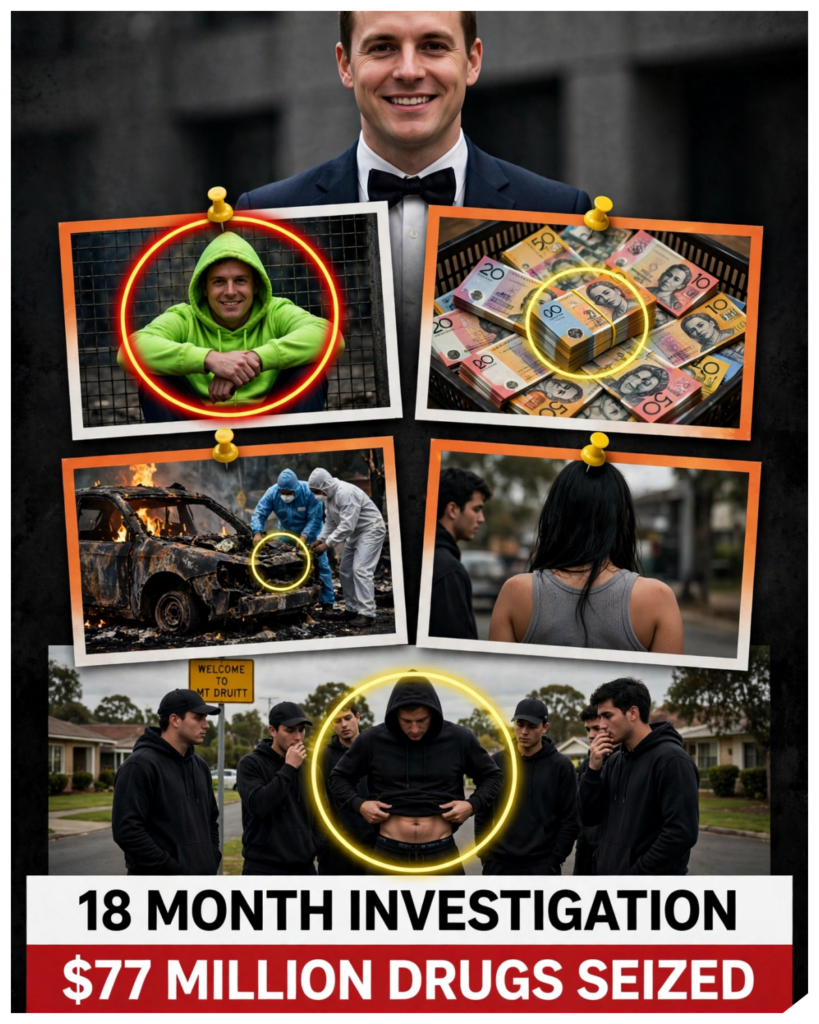
Daniel Badger used to work as a security guard in Western Sydney.
Nothing about that job description explains how a decade later, Australian police would come to regard him as one of the country’s highest priority organized crime targets.
A man they believe has spent years directing a transnational drug empire from the other side of the world while never once setting foot back on Australian soil to face it.
In June 2026, New South Wales police executed a coordinated series of raids across Sydney’s southwest, Strathfield South, Mrylands, Canley Heights, Bankstown, Cabraata, Fairfield, Cassula.
By the time it was over, 18 search warrants had been carried out, 18 people arrested, and police say they’d seized drugs with an estimated street value of $77 million.
Cocaine, methamphetamine, ketamine, metma, and tens of thousands of pharmaceutical tablets.
The operation had a name, Strikeforce Dakota, working alongside Strikeforce Loopin 2, and a target, what police allege is the Badger Organized Crime Network, a syndicate authorities say has spent roughly a decade importing drugs into Australia from Southeast Asia.
The man they say sits at the center of it, was nowhere near any of those raids.
Police alleged Daniel Rodney Badger has run the operation from Vietnam and Cambodia.
Reportedly acquiring Cambodian citizenship under a different name while a network of trusted associates on the ground in Sydney allegedly handled the receiving, storing, and distributing.
He remains wanted.
He has not been arrested, let alone convicted of anything.
What makes this case bigger than one drug syndicate is who police believe Badger’s network has been working alongside.
A rapidly growing alliance of Western Sydney street gangs known as the Coconut Cartel, allegedly built by a man named Anthony Ple, himself still a fugitive, who’s accused of fusing previously separate smaller gangs into a single network with reach stretching from Southeast Asia to Europe.
That alliance has already been linked in various reports to the largest cocaine seizure in Australian history, a wave of shootings and firebombings carried out by teenagers on behalf of senior figures who stayed out of the violence entirely and the assassination of one of its own architects, gunned down in Vietnam, by men reportedly hired by his own rivals.
None of what follows is settled.
Most of the people at the center of this story are still fugitives, still facing untested charges or already dead without ever standing trial.
In this episode, we go through what’s actually been confirmed on the public record, the raids, the seizures, the alleged structure connecting Badger’s network to the Coconut Cartel, and we’re careful throughout to separate what police allege from what’s actually been proven.
If you’re new here, this channel covers Australian true crime and organized crime history from the record.
Facts only, no glorification.
Subscribe and turn on the bell so you don’t miss the rest.
We’ll start with the man whose name is now attached to one of Australia’s most wanted case files, a Western Sydney security guard who left the country in 2016 and never really left the headlines since.
Less than a decade ago, Daniel Rodney Badger was by every visible measure an unremarkable man.
He lived in a housing commission property in Auburn in Sydney’s West, worked as a security guard at hotels and racecourses, and according to his own father, was engaging a personal trainer in an effort to lose weight.
Nothing in that picture, a workingclass suburb, a modest job, an ordinary gym routine, suggests the trajectory that followed.
Today, Badger is 40 years old, based somewhere in Southeast Asia, and sits on the Australian Federal Police’s high value target list.
A roster police describe as containing fewer than 100 names, reserved for people they allege are having a significant impact on serious criminal activity inside Australia while remaining out of the country’s reach.
The transition from Auburn security guard to alleged transnational drug boss appears to have happened gradually and largely out of public view over the course of roughly a decade.
Badger is understood to have moved to Vietnam around 2016 with his then partner, though the exact timeline remains unclear, and it appears he traveled back and forth between Australia and Southeast Asia for some period before relocating permanently.
Even while establishing himself overseas, he kept a foothold in Australia.
His last known listed Australian address was that same singlestory housing commission property in Auburn as of 2016.
And that same year, he was also registered as a co-purchaser of an upmarket unit in Wentworth Point.
A detail that suggests whatever income Badger was generating by this point had already moved well beyond what a racecourse security job could support.
His life in Vietnam, at least in its early public traces, looked conventional enough to attract no particular suspicion.
In September 2015, Badger appeared in a Vietnamese news article photographed at a charity event organized by a multi-million dollar fertilizer and chemical company as the business donated glasses to 45 people with visual impairments.
The following year, a stock market report referenced him as a shareholder in that same Vietnamese company.
Whatever else was happening in Badger’s life during this period, he was also building a public profile as a legitimate overseas businessman and investor.
The kind of profile that on paper gives no indication of the allegations that would eventually attach to his name.
By 2019, that overseas life had become substantial enough to include a lavish, high-profile wedding in Vietnam.
In 2020, he married a Vietnamese national and reportedly opened a car wholesale business in Ho Chi Min City.
And in July 2022, in a move that has since become one of the most consequential details in his entire case, Badger was granted Cambodian citizenship by naturalization, taking on a new name, Sanarther Sen.
That single administrative step matters enormously to how this case has unfolded because Cambodia, unlike Vietnam, has no formal extradition treaty with Australia.
Whether or not that was Badger’s specific intention in seeking Cambodian citizenship, it’s had exactly that practical effect.
Australian authorities believe he may now be living in Cambodia, functionally beyond the reach of any extradition request CRA might otherwise make.
Australian Federal Police have been direct about how seriously they regard him.
AFP Deputy Commissioner Ian McCartney told the ABC that Badger is of significant interest to the agency and described the broader strategy behind the high value target list in blunt terms.
Police say they know where these offshore figures are and what countries they’re living in and are working to bring them to account regardless.
That’s a notable statement of confidence about location.
Knowing where a target lives is a very different problem from being able to actually arrest them, particularly when the country in question has no legal mechanism obligating it to hand a wanted person over.
What allegedly happened between Badger’s quiet departure from Auburn and his current status as one of Australia’s most wanted organized crime figures is where the case turns genuinely serious and where the language of alleged becomes not just a legal formality but a necessary caution about how much remains unproven.
Police alleged that Badger came to direct a large-scale drug importation and distribution network, moving methamphetamine, cocaine, and other substances into Australia over a period of roughly a decade, coordinating the operation from Southeast Asia while relying on a network of trusted associates on the ground to receive, store, and distribute what arrived.
None of that has been tested in an Australian court because Badger has never been arrested.
He remains, as of the most recent police operations against his alleged network, a fugitive.
The allegations attached to his name go well beyond drug trafficking.
And this is where the case demands the most caution of all.
Police alleged that in April, a 45-year-old woman named The Kim Tran was abducted from her home in Bankstown by masked men before being killed and her body disposed of in a burning vehicle with an 8-year-old boy also allegedly assaulted with a baseball bat during the same incident at the house.
Police have said they will allege the attack was retribution connected to trans husband who was allegedly working as a methamphetamine cook for the network and was accused within the syndicate of stealing a significant quantity of drugs.
It is critical to state plainly what the public record actually establishes here.
These are allegations under active investigation and nobody, Badger included, has been convicted of anything connected to Kim Tran’s death.
Whatever the eventual truth, a woman is dead, a child was allegedly harmed and the case remains, as of this account, unresolved by any court.
That’s the profile that has emerged piece by piece over the past several years.
A man who left an ordinary life in western Sydney, built a second, more prosperous existence in Southeast Asia through some combination of legitimate business and police allege an increasingly serious criminal enterprise and who secured legal protections, a foreign citizenship, a country with no extradition treaty that have so far kept him beyond the reach of the Australian justice system entirely.
Whether Daniel Badger is, as police allege, the architect of a network responsible for tens of millions of dollars in drug trafficking and at least one alleged murder, or whether the truth is more complicated than the picture painted by an active law enforcement investigation, is a question no Australian court has yet the opportunity to test.
What happened next?
A coordinated 18-month police operation aimed at dismantling whatever network operates in his name inside Australia is where the public record becomes considerably more concrete.
By the time New South Wales police went public with the results of their operation against the Badger network in June 2026, they’d already spent roughly 18 months building toward it.
That timeline matters because it separates this case from the kind of reactive single incident policing that characterizes much organized crime reporting.
This was a sustained coordinated investigation run across two connected strike forces, each targeting a different layer of the alleged network.
Strikeforce Dakota was aimed at the importation side, the point where drugs allegedly entered the country and were first received by people on the ground.
Strike Force Loopin 2 focused on what came after the distribution network police allege was responsible for moving product across New South Wales once it arrived.
Splitting the investigation this way reflects a basic reality about how transnational drug syndicates are believed to operate.
A single strike force targeting one address or one shipment might disrupt a specific transaction, but it does little to dismantle the structure behind it.
Two connected task forces, each working a different part of the alleged supply chain, gave police a chance to build a picture of the network as a whole, rather than picking off isolated players.
The raids themselves ran across roughly a week in late June and early July 2026, moving progressively through Sydney’s southwest in a pattern that traced suburb by suburb what police allege was the network’s operational footprint.
The first wave came under Strike Force Dakota beginning on 25 June with searches at properties in Strathfield South and Burwood that police allege were connected to the syndicate.
According to police accounts of the searches, officers found a significant quantity of illicit drugs, restricted substances, drug packaging equipment, steroids, and electronic devices believed to be linked to the network’s operations.
The following day, a 37year-old man was arrested in Strathfield South, after which investigators carried out further searches at nearby properties.
He was subsequently charged with multiple commercial drug supply offenses and possessing restricted substances and was refused bail, a detail that on its own signals how seriously the courts treated the initial evidence police presented.
Though it remains, as with every charge in this case, an allegation yet to be tested at trial.
Strike Force Loopin 2 then shifted the operation’s focus toward what police allege was the network’s Australian distribution side.
On 30 June, detectives working alongside the Specialist Raptor Squad, a unit within the UN Double Woos Police State Crime Command, specifically tasked with targeting groups and individuals engaged in serious and organized crime with a propensity for violence, executed coordinated search warrants across Mrylands, Canley Heights, and Bankstown.
During those searches, police alleged they seized a pistol, ammunition, cash, and electronic devices while arresting four men aged between 21 and 40.
Those four were charged with an extensive list of offenses, commercial drug supply, participating in a criminal group, firearms offenses, directing the activities of a criminal group, and dealing with the proceeds of crime.
All four were refused bail.
The operation expanded again on 2nd July with further raids across Cabraata, Fairfield, and Cassula, supported this time by the Southwest Metropolitan Operations Support Group alongside the Raptor Squad.
Three more men, aged 19, 21, and 38, were arrested and charged.
This time with offenses including commercial drug supply, participating in a criminal group, failing to comply with digital evidence access orders, and possessing goods suspected of being stolen.
All three again were refused bail.
Taken together across the full span of the operation, police reported executing 18 search warrants, arresting 18 people, and seizing drugs with an estimated street value of roughly $77 million.
The specific breakdown of what was recovered gives some sense of the scale involved.
Approximately 38 kg of cocaine, 125 kg of methylampetamine, 16 kg of ketamine, 3 kg of MDMA, several hundred g of cannabis, and more than 34,000 tablets of pharmaceutical drugs, including tramodol and Xanax.
That’s not the profile of a single opportunistic dealing operation.
It’s the kind of diversified multi-ubstance inventory that fits with what police allege about the network structure.
An operation built to import and move several different classes of drugs simultaneously rather than specializing narrowly in one product.
It’s worth pausing on the range of charges laid across these arrests because they reveal how police were trying to frame the case legally, not just in terms of drug supply, but as organized crime in a structural sense.
Charges like participating in a criminal group and directing the activities of a criminal group are specifically designed to capture organizational involvement.
The difference between simply possessing or selling drugs and being part of a coordinated enterprise with an internal hierarchy.
By laying those charges alongside more conventional drug supply and firearms offenses, police were signaling their intention to prosecute this not as a series of disconnected individual crimes, but as evidence of a single structured network, precisely the kind of case that, if it holds up in court, would validate the broader picture police have been building around Daniel Badger’s alleged role since well before these specific arrests took place.
None of the 18 people arrested and charged during this operation have at the time of this account been convicted of anything.
Refused bail is a significant legal outcome, reflecting a court’s view that the evidence presented at the bail hearing was serious enough or the flight risk high enough to justify continued detention.
But it remains, like every stage of this process so far, a step before trial rather than a finding of guilt.
Under Australian law, all 18 are presumed innocent, entitled to have the charges against them tested to the same standard as any other defendant, regardless of how the operation has been characterized in police statements or media coverage since.
What the raids didn’t produce, notably, was Daniel Badger himself.
Every arrest took place inside New South Wales, targeting people police allege were operating as the network’s on the ground infrastructure, receiving shipments, storing product, coordinating local distribution.
The man police say sits at the top of that structure remained throughout the entire operation somewhere in Southeast Asia beyond the reach of the search warrants, the Raptor squad, and the 18 arrests that resulted.
That gap, a network’s alleged local infrastructure dismantled in a single coordinated strike, while its alleged offshore architect remains untouched, is a pattern that recurs constantly in modern transnational organized crime investigations.
And it’s a pattern this series has already documented in earlier cases.
It’s also, according to police themselves, far from the end of this particular investigation.
Authorities have said the arrests represent a significant disruption to the network’s Australian operations, while acknowledging that the broader transnational structure and the people allegedly directing it from overseas remains very much intact and very much the ongoing focus of further inquiry.
That focus increasingly extends beyond Daniel Badger’s alleged network alone and toward a separate allegedly connected criminal alliance that has been reshaping Sydney’s underworld with a speed and visibility that’s drawn attention well beyond the drug trade itself.
Where Daniel Badger’s alleged network represents one model of transnational organized crime.
A single figure allegedly directing supply from overseas feeding an Australian distribution operation.
The Coconut Cartel represents something structurally different and in its own way more unusual.
Not one gang, but an alleged coalition of many.
Stitched together under a single banner by a man who, according to reports, spent years building relationships rather than territory, the Coconut Cartel’s origins trace back to a split within an already wellestablished Western Sydney criminal network.
According to reporting on the group, it emerged in early 2026 when a man named Lorenzo Lamalu broke away from the Alamemed family, a long-running criminal organization based out of Mrylands that this series has already referenced in earlier episodes covering Sydney’s gang landscape.
Lamalu reportedly began building a rival organization composed largely of Pacifica members.
And the name chosen for it, Coconut Cartel, was a deliberate reclaiming of a slur historically used against Pacific Islander people.
The kind of provocative, self-aware branding that signals a group actively cultivating a public identity rather than trying to stay hidden.
That visibility is by most accounts one of the group’s defining features and it stands in sharp contrast to the deliberately lowprofile Daniel Badger reportedly maintained for years while building his own alleged network.
Anthony Ple described in reporting as the coconut cartel’s most senior figure remaining in the public eye has reportedly spent a considerable amount of time documenting his own freedom on social media even while functioning as a wanted fugitive.
A pattern this series has already observed in other Australian organized crime figures where public visibility seems to serve as both a recruitment tool and a form of psychological theater aimed at law enforcement.
Other senior figures associated with the group, including a man named Henry Koopa, have been arrested in connection with alleged methamphetamine seizures running into the hundreds of kilograms.
What made Ple’s alleged role genuinely distinctive, according to reports on the network structure, wasn’t leadership of a single organization in the traditional sense.
Rather than running one gang, Ple is reported to have functioned more as a connector, building relationships across what had previously been a scattered collection of independent Western Sydney street gangs and uniting them under a shared banner while separately forging direct links to overseas drug suppliers.
That’s a meaningfully different criminal model from the hierarchical single leader structure this series has documented in gangs like the Kancheros or the Mongrel mob.
Rather than commanding one organization from the top down, Ple is alleged to have positioned himself as a kind of broker between groups, offering access to supply lines and international connections in exchange for those groups folding into a broader coalition.
The list of groups reportedly absorbed into or aligned with that coalition illustrates just how fragmented Sydney’s gang landscape had become before the Coconut Cartel’s emergence and how quickly that fragmentation was allegedly reorganized into something larger.
Reports describe gangs including one known as Ryder Collide or Rock built for the cause.
The Final Crime Family, the Outcast Jail Gang, KVT, and Lone Wolves.
As part of the network, alongside former members of a group called the Inner West Brotherhood, defectors from two other named gangs, Proper 60 and Ready for War, reportedly joined the coalition as well, with several former associates of a group called Al Medina, switching allegiance during the same period.
Evidence, if accurate, of a genuinely fluid and rapidly shifting underworld landscape where loyalty to any single named gang appears to have mattered considerably less than access to the resources a larger coalition could provide.
That coalition’s reach reportedly extended well beyond Sydney’s borders.
According to reporting on the network, the Coconut Cartel is alleged to have established relationships with members of the head hunters in New Zealand, the same gang this series has already covered in its coverage of the Wicado Kamancherro’s international connections alongside Dutch members of the Bandido’s motorcycle club, Moroccan organized crime figures, and various smaller Asian organized crime groups.
Ple himself reportedly spent extended periods traveling through Vietnam, Mexico, Dubai, and Albania, with many of those trips documented on his own social media accounts.
Whatever the exact truth of each individual connection, the pattern is consistent with what this series has already documented in the Kancherero and Malcoun stories.
A genuinely globalized criminal landscape, where relationships built through international travel and encrypted communication increasingly matter more than the old geographically bounded gang rivalries that once defined organized crime in Australia.
Those overseas connections, according to reporting, are believed to have opened direct access to suppliers capable of moving commercial quantities of cocaine and methamphetamine into Australia.
Access that transformed the practical capabilities of what had previously been in most cases relatively small and localized Western Sydney street gangs.
That shift matters enormously for understanding why authorities have treated the Coconut Cartel’s emergence with such urgency.
A street gang fighting over local territory and small-scale drug dealing is a serious but familiar policing problem.
A coalition of street gangs suddenly wired directly into international cartel level supply chains represents something categorically more dangerous.
Precisely the kind of escalation in capability that a report on the network described as marking a dramatic shift, giving groups that had previously operated at a street level access to drug quantities more typically associated with major established international syndicates.
Crucially, and this bears repeating given how serious the allegations against this network are, none of what’s described here about the Coconut Cartel’s structure, its leadership, or its connections, has been tested in an Australian court.
Anthony Ple remains, as of this account, a fugitive.
The relationships alleged between the Coconut Cartel and Daniel Badger’s separate network.
The two organizations reportedly sharing overseas contacts, drug supply lines, and trusted Australian associates, with Badger’s network allegedly handling importation, while the Coconut Cartel allegedly provided an established distribution structure across Sydney, represent police and media characterizations of an ongoing unresolved investigation, not established fact.
Whether the full picture eventually painted in a courtroom matches what’s currently being alleged in police statements and reporting is like almost everything else in this story still an open question.
What isn’t in dispute because it played out in a way far more concrete and far harder to characterize as mere allegation is the violence that has accompanied this network’s rise.
Violence that has already claimed lives on two continents and that increasingly appears to have relied on some of the network’s youngest and most disposable members to carry it out.
The violence attributed to the Coconut Cartel and its allied networks has followed a pattern this series has already documented elsewhere.
Senior figures staying deliberately removed from the bloodshed while much younger, more expendable people carry it out on their behalf.
According to reporting on the network’s operations, teenagers were reportedly recruited specifically to carry out shootings and firebombings connected to the coalition’s various disputes, a structure that, if accurate, allows the people directing the violence to remain legally and physically insulated from it.
Some of these attacks were reportedly filmed by the perpetrators themselves, complete with commentary from what’s described as teenage participants and shared or circulated in ways that suggest the violence was at least in part intended to be seen and to send a message rather than simply resolve a specific dispute quietly.
That pattern of recruiting minors to carry out serious violence is genuinely troubling on its own terms.
Independent of whatever underlying dispute it’s connected to.
It places young people, some of them barely into their teens, at direct legal and physical risk on behalf of adults who face considerably less exposure.
One of the clearest and most tragic examples of this pattern involves a series of attacks reportedly targeting homes and businesses connected to a man named Isaiah Utai.
Described in reporting as a former associate of the Alamemed family, the same organization the Coconut Cartel had split from.
Isaiah’s father, Matt Utai, a former NRL player, was shot and killed as a result of this same series of attacks.
It’s worth being precise about what that means.
A father was killed, according to reporting on the case, not because he was himself the primary target of whatever underlying dispute existed, but because of his connection to his son.
That’s a devastating illustration of how violence tied to organized crime networks like this one routinely extends well beyond the people directly involved in criminal activity, reaching family members who may have had no operational role in the disputes that got them killed.
The single highest profile act of violence connected to this entire network though took place not in Sydney but in Vietnam.
And it involved one of the Coconut Cartel’s own founding figures.
Lorenzo Lamalu, the man reported to have broken away from the Alamadine family in early 2026 to establish the Coconut Cartel in the first place was killed while in Ho Chi Min City alongside an associate named Sa.
According to reporting on the killing, Lamalu was assassinated by men allegedly hired by his own criminal rivals.
In what’s been described as one of the strangest and most significant developments in this entire saga, a senior figure in a Pacific organized crime group, murdered on foreign soil by people reportedly hired specifically for the purpose.
With the news breaking beyond Australia into media coverage across Asia and the Pacific, there’s a real symmetry worth noting between how Lemlu died and the broader operating model this series has already described for both the Coconut Cartel and Daniel Badger’s separate network.
Lemalu had reportedly built much of his own network’s capability through direct connections to associates and suppliers in Vietnam, the same country where he was ultimately killed.
It’s a detail that underscores how thoroughly this entire criminal ecosystem now operates across borders with senior Australian organized crime figures increasingly living, working, and in Lamalu’s case, dying overseas in countries with different legal systems, different police relationships with Australian authorities, and in many cases far less capacity or motivation to fully investigate a killing involving foreign nationals.
It’s important to be careful about what can and can’t be concluded from Lamalu’s death.
He was by every account available himself a senior figure in an organization allegedly responsible for serious criminal activity.
And his death appears to have resulted directly from rivalries within that same criminal world rather than any unconnected cause.
That context doesn’t make his killing any less serious as a criminal matter.
And Vietnamese authorities, to the extent they’ve pursued the case, would presumably be investigating it as a murder in its own right, separate from whatever broader narrative Australian reporting has built around it.
But it does mean Lamalu’s death sits in a genuinely different category from Matt Utai’s.
One, a former NRL player apparently killed because of his son’s alleged associations.
The other a man reportedly killed as a direct consequence of his own leadership role in exactly the kind of organization whose violence had already claimed other lives.
Taken together, these episodes paint a picture of a criminal ecosystem where violence has become almost routine, deployed against rivals, against family members of rivals, and eventually against the network’s own senior figures when internal disputes or external rivalries turned lethal.
That pattern isn’t unique to the Coconut Cartel specifically.
This series has already documented similar dynamics across Melbourne’s Gangland War, where killings frequently extended beyond the primary combatants to associates, family members, and eventually the architects of the violence themselves.
What does appear distinctive about this current wave based on the available reporting is the specific combination of youth and geography involved.
Teenagers allegedly recruited to carry out shootings on Australian soil while senior figures increasingly conduct their business and in Lamalu’s case meet their deaths thousands of kilometers away in Southeast Asia.
None of the specific individuals allegedly responsible for ordering the attacks on Isaiah Utai’s associates or for Matt Utai’s death or for Lemlu’s assassination in Vietnam have, as far as the public record available for this account shows, been convicted in any court proceeding.
Some remain fugitives.
Some, like Lamalu himself, are no longer alive to ever face that process.
The pattern this series has now documented across multiple cases.
Nick RDV’s unsolved murder, Andrew Venamman’s death before trial, and now this current wave of violence connected to the Coconut Cartel keeps recurring for structurally similar reasons.
Professional or gang-ordered killings carried out across jurisdictions or through intermediaries specifically to insulate the people who ordered them are extraordinarily difficult to prosecute.
Even when investigators have a confident working theory of who’s responsible.
What connects this violence back to the broader international story this series has been tracing is the scale of drug supply that appears to have financed and motivated it.
The disputes that led to shootings, firebombings, and at least two killings weren’t happening in isolation.
They were, according to the pattern described in reporting on the network.
Disputes over control of drug supply chains that had in a remarkably short period scaled up from street level dealing to quantities more typically associated with major international cartels.
Understanding how that scale up happened and what it reveals about the connections between Sydney street gangs and the wider transnational drug trade means looking at the single largest piece of physical evidence to emerge from this entire case.
A discovery buried literally underground in a quiet corner of Sydney’s outskirts that turned out to be the largest cocaine seizure in Australian history.
On a Friday in June [music] 2026, Australian federal police officers moved on a semi-ural property in Londereerry on the northwestern fringe of Sydney and found something that would make the entire case look considerably larger than a series of suburban raids and a wanted fugitive’s Instagram presence had suggested up to that point.
Buried beneath shipping containers on the property, concealed in underground bunkers behind false container flooring.
Officers discovered approximately 2.7 tons of cocaine hidden in plastic tubs.
The Australian Federal Police put the estimated street value of that hall at roughly $816 million.
Officials described it without qualification as the largest cocaine seizure in the country’s history and the biggest overall drug seizure since 4.5 tons of Mdama were intercepted in Melbourne back in 2007, nearly two decades earlier.
Two men, aged 21 and 25, were arrested at the scene after allegedly attempting to flee when police arrived.
They were charged with possessing a commercial quantity of an illicit drug, an offense that carries a maximum penalty of life imprisonment, and were refused bail.
It’s worth pausing on the ages of the two men actually caught at the scene.
21 and 25 is young even by the standards of drug supply offenses generally and it fits a pattern this series has already identified running through both the Badger network and the Coconut Cartel.
The people physically present when police make an arrest and therefore the people bearing the most direct legal exposure tend to be considerably younger and lower in any alleged hierarchy than the figures police believe are actually directing the operation.
AFP Commander Steven J addressing the seizure publicly was direct about where investigators believe the real significance of the case lay not with the two men in custody but with the broader criminal architecture behind them.
He described the alleged plot to distribute nearly three tons of cocaine as demonstrating just how highly organized and determined these criminal networks have become and said police would continue working to identify the syndicates and everyone else involved in facilitating what he specifically termed this alleged attempted drug import.
A careful choice of words that appropriately leaves open exactly how the courts will eventually characterize what happened.
Police sources have alleged that the two men arrested at the Londair property were low-level operatives within a larger organized crime network connected to the Coconut Cartel, which by this point in the broader investigation had already been reported as including former members of an established Sydney crime family.
That alleged connection is significant for understanding the true scale of what this case now represents.
A single seizure of 2.7 tons of cocaine isn’t the output of a handful of Western Sydney street gangs running small-cale local dealing operations.
It’s the kind of quantity that requires serious international supply relationships, substantial logistics and financing, and enough organizational sophistication to move product across borders without detection until in this instance it wasn’t.
If the alleged connection to the Coconut Cartel holds up, it would confirm exactly the trajectory this series has already traced in earlier parts.
A coalition of previously disconnected street gangs, given access through Anthony Ple’s alleged international relationships to supply chains capable of moving drugs at a scale more typically associated with established cartel level trafficking organizations rather than local Sydney crews.
The London Dairy Discovery also illustrates something important about how these transnational drug networks are believed to actually function in physical logistical terms.
A detail that’s easy to lose sight of amid the more dramatic elements of this story.
The assassinations and the teenage gunmen and the fugitives hiding behind foreign citizenships, moving nearly three tons of cocaine into the country, concealing it beneath false container flooring on a semi-ural property, and storing it there undetected for whatever period preceded the raid, requires patient, methodical planning, shipping arrangements, a secure storage location chosen specifically for its isolation, and enough operational discipline.
To keep that location secret from law enforcement for as long as it took.
That’s a very different kind of criminal competence from the visible almost performative violence this series has already documented.
The film shootings, the social media posts, the high-profile wedding in Vietnam.
It suggests that whatever public-f facing bravado figures like Anthony Ple have displayed the actual logistics underpinning this network’s drug supply have been handled with considerably more discipline and secrecy at least until the specific failure that led AFP officers to that London property.
How officers came to search that particular property in the first place, whether through surveillance connected to the broader Badger and Coconut Cartel investigations, an informant or some other investigative lead hasn’t been made fully public in the reporting available for this account, and speculating about it would go beyond what’s actually known.
What is clear is that the discovery landed at a moment when Australian authorities were already treating this broader network spanning Daniel Badger’s alleged Southeast Asian operation and the Coconut Cartel’s alleged Sydney-based coalition as one of the most significant organized crime threats currently facing the country.
A seizure of this scale arriving in the middle of that same broader investigation doesn’t just add another item to an already long list of alleged offenses.
It provides for the first time in this case direct physical evidence of exactly the kind of large-scale internationally sourced drug importation that police had up to this point largely been describing in terms of allegation and intelligence assessment rather than tons of product recovered from the ground.
That gap between allegation and physical proof, a gap this series has returned to repeatedly across multiple Australian organized crime cases is narrower here than in almost any other story this series has covered.
Two men are in custody, refused bail, facing a charge that carries a maximum sentence of life imprisonment over drugs that were physically found, weighed, and valued by the Australian Federal Police.
That’s about as concrete as this kind of case gets.
What remains unresolved and what connects this single seizure back to everything this series has already traced through the Badger Network and the Coconut Cartel is who specifically financed, organized, and stood to profit from those 2.7 tons.
And whether the people police believe are ultimately responsible, many of them still overseas, still protected by citizenship arrangements or simple distance will ever actually face a court over it.
Pull back from the individual pieces of this story, the raids, the seizures, the killings, the fugitives scattered across three or four countries, and a pattern emerges that this series has now documented across multiple seemingly unrelated Australian organized crime cases.
The people who face the most immediate legal consequences are consistently the ones furthest from actual power, while the people police believe are directing events remain for now beyond reach.
18 people arrested in the Dakota and Lupin 2 raids.
Two young men caught with 2.7 tons of cocaine at London.
Teenagers reportedly recruited to carry out shootings and firebombings on behalf of senior figures who never touched a weapon themselves.
And at the top of it, at least according to the picture police have built so far, two men, Daniel Badger and Anthony Ple, who remain fugitives, one protected by a Cambodian passport and the absence of an extradition treaty.
The other apparently confident enough in his own freedom to document it on social media.
One senior figure in this same ecosystem, Lorenzo Lamalu, has already been killed, allegedly by men hired by his own rivals in a country where any Australian investigation into his death faces obvious jurisdictional limits.
This isn’t a new pattern in Australian organized crime, even if the specific geography and cast of characters are new.
This series has already traced versions of the same structural problem across very different cases.
Nick Radv’s murder where the two men most consistently named as responsible both escaped a courtroom.
One through death and one through a plea deal that never covered that particular killing.
J Malcoun’s decades of documented proximity to serious violence matched against a single formal conviction.
The Wicado Comancheros whose founding leadership was comprehensively convicted only for the organization itself to keep operating under new figures.
What connects all of these stories and what the Badger and Coconut Cartel case adds a particularly stark current-day illustration of is a basic asymmetry built into how organized crime functions and how justice systems are built to respond to it.
Serious criminal organizations are structured deliberately to insulate the people at the top from the evidence that convicts the people at the bottom.
Justice systems, meanwhile, are built to require exactly that kind of direct evidentiary connection before they can act.
The gap between those two realities is where figures like Badger and Ple currently exist.
Not proven guilty, not proven innocent, simply beyond the reach of a process that would answer the question.
Either way, there’s a specific modern wrinkle to this particular case that’s worth sitting with because it may represent something genuinely new rather than just a repeat of old patterns.
Citizenship arrangements like the one Badger allegedly obtained in Cambodia function as a kind of legal technology for evading accountability.
Not hiding from police in the traditional sense, but restructuring one’s own legal identity and geographic position specifically to exploit gaps between different countries extradition treaties.
That’s a different and in some ways more troubling form of evasion than simply going into hiding.
It suggests a level of forward planning around the legal consequences of alleged criminal activity that goes well beyond the operational secrecy.
This series has already documented in other cases.
If the allegations against Badger are accurate, he didn’t just build a drug network and then flee when authorities closed in.
He appears to have restructured his own legal status years in advance in a way specifically designed to survive exactly the kind of high-v valueue target designation the AFP eventually placed on him.
It’s worth being honest, too, about how much of this entire case remains genuinely unresolved.
Because the temptation in telling a story like this is to let the sheer accumulation of allegations, drug trafficking, murder, child abuse during a home invasion, teenage gunmen, and assassination on foreign soil, the largest cocaine seizure in the country’s history, create an impression of settled fact that the actual public record doesn’t support.
18 people have been arrested and charged.
None have been convicted.
Two men are in custody over the London Derry seizure.
Facing a charge that carries a maximum sentence of life imprisonment, but that charge too remains untested.
Daniel Badger has not been arrested.
Anthony Ple has not been arrested.
Whatever role either man actually played in the network authorities alleged they built, that role has not yet been tested in front of a single Australian court.
And under the law, both remain formally exactly as innocent as anyone who has never been charged with anything at all.
That’s a genuinely uncomfortable place to leave a story this serious.
And it’s worth being direct about why.
A woman named Kim Tran is dead, allegedly murdered in front of her own child.
A father named Matt Utai is dead, allegedly killed because of his son’s associations.
Lorenzo Lamalu is dead, reportedly assassinated by men hired for the purpose.
None of the people allegedly responsible for those deaths have faced a court over them.
That’s not a comment on whether the underlying allegations are true.
It’s simply a statement of where the legal process currently stands.
And an honest account of this case has to hold both things at once.
Serious credible allegations investigated by professional law enforcement agencies and a justice system that has not yet had the opportunity to test a single one of them against the highest standard the law requires.
What happens next realistically depends on factors well beyond any single police operation.
Whether Cambodia’s lack of an extradition treaty with Australia eventually shifts.
The way this series has already documented happening with the UAE’s changing tolerance for hosting figures like J Malcoun whether Vietnamese or Cambodian authorities have any independent interest in pursuing charges against Badger or Ple on their own soil separate from whatever Australia is seeking.
Whether the 18 people already arrested in Sydney choose to cooperate with prosecutors in exchange for reduced sentences, potentially providing exactly the kind of direct testimony that’s historically been the missing piece, connecting street level arrests to the senior figures police believe are actually responsible.
And whether the momentum visible in this current wave of arrests and seizures continues or whether, as has happened repeatedly in this series’s coverage of Australian organized crime, from the Kancheros to the Melbourne Gangland War, the network simply reconstitutes itself under new names and new figures once the current set of arrests has run its course.
This is deliberately an unfinished story because the events themselves are unfinished.
Unlike almost every other case this series has covered where enough time is passed to offer at least a partial verdict, a conviction, an acquitt, a case that quietly went cold.
The Badger Network and the Coconut Cartel remain live, developing, and genuinely uncertain in their eventual outcome.
What can be said with confidence is only this.
An alleged transnational drug network connected to real deaths and a historic drug seizure has drawn the sustained attention of federal and state police across at least three countries.
And as of this recording, the men authorities believe sit at the top of it remain free.
If you want more researched source-based coverage of Australia’s organized crime landscape as it develops, subscribe and turn on the bell.
We’ll update this story as it moves through the courts.
And we’ll see you in the next one.