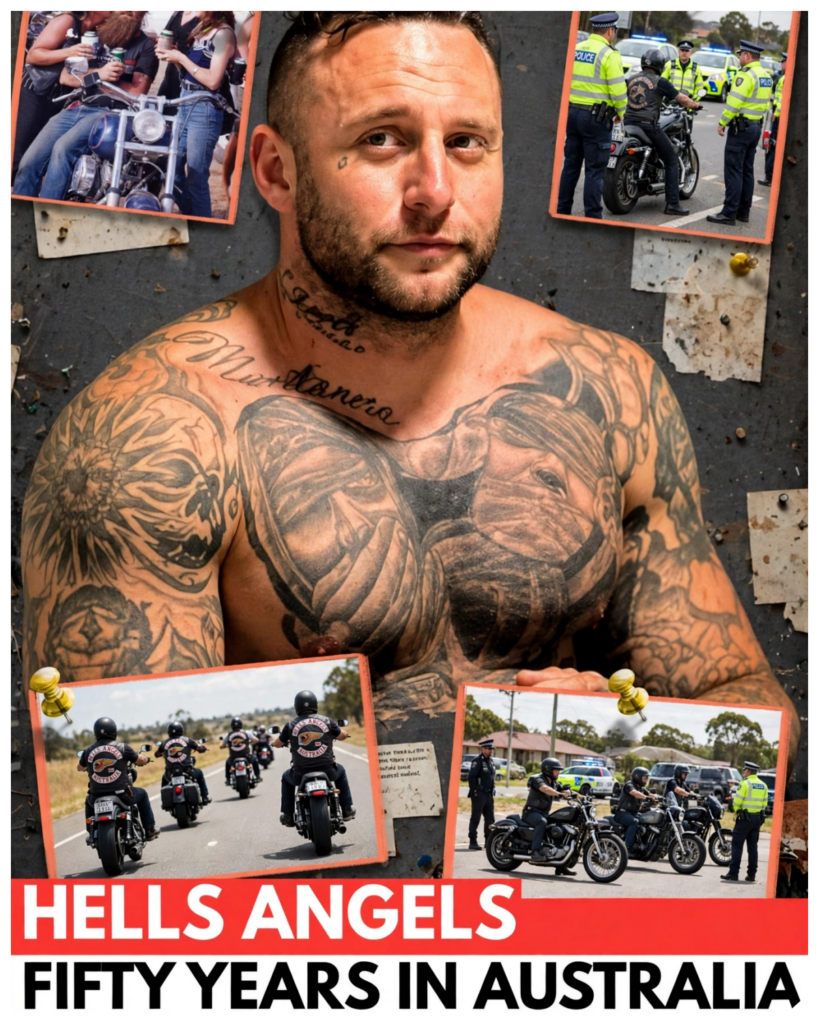
In May 2023, someone fired seven shots from a high-powered rifle into a Sydney apartment.
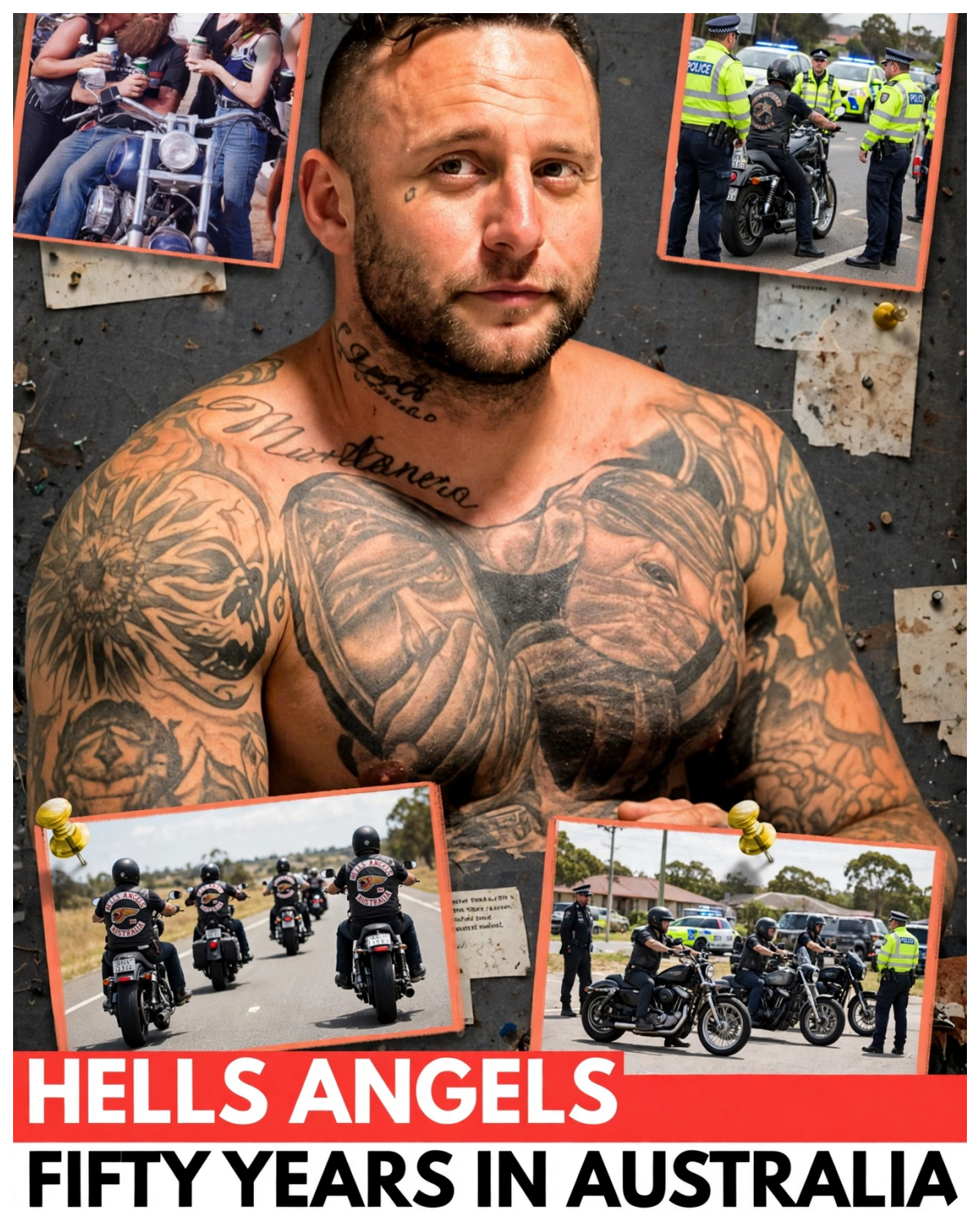
Nobody was hit.
Within a week, police had two Hell’s Angels members in custody.
One of them, a heavily tattooed man named Mayaz Elcardi, refused bail alongside his co-acused James Shakluna, who was found with a scoped semi-automatic rifle and a quantity of drugs when detectives searched his home in Campbell Town.
On its own, it’s a fairly ordinary story by the standards of this channel.
A bikey shooting, an arrest, a strike force.
What makes it worth examining more closely is what it’s actually part of.
A chapter of one of the world’s most recognizable outlaw motorcycle clubs that’s been operating in Australia for exactly 50 years through a rivalry that started of all things over the color red.
Before we go further, a note on how this video is put together.
This account draws on court reporting, police statements, and academic and journalistic research into the Hell’s Angels Australian history, specifically cross-cheed across independent sources.
Some details connected to individual more recent cases, including exactly what happened to Mayazel Kurdie and James Shluna after their arrest, remain limited in what’s publicly available.
Where that’s the case, we’ll say so directly rather than filling the gap with assumption.
The Hell’s Angels arrived in Australia in 1975, setting up their first chapters in Melbourne and Sydney.
Within a short time, they were at war with the rebels, not over drugs, not over territory, but because the Hell’s Angels demanded the rebels stop wearing red and white on the basis that it was too close to their own colors.
That dispute ended, according to one account of the period, with rebels members beating a Hell’s Angels chapter president inside his own home using a baby’s pram.
It’s an almost absurd detail to open a 50-year history with, and it’s also a genuine documented starting point for exactly the kind of violence that would eventually produce one of the deadliest single incidents in Australian bikey history.
The killing of a man at Sydney airport in 2009 and continue producing headlines right through to a shooting in a Sydney apartment building in 2023.
In this video, we’ll go through the Hell’s Angels full Australian history in order, the club’s arrival and its earliest rivalries, the specific violence that’s defined its reputation over five decades, its shift into legitimatel looking business fronts, and where it stands today, including what’s actually known about its most recent chapter of trouble.
If you’re new here, this channel covers organized crime and gang history across Australia and New Zealand using court records and verified public reporting.
No dramatizing, no glorifying.
Subscribe and turn on the bell if you want to see where this one goes.
We’ll start in 1975 with a club that arrived already carrying a reputation and a color scheme that would cost someone dearly within a matter of years.
The Hell’s Angels Motorcycle Club, founded in California in the late 1940s, expanded into Australia in 1975, establishing its first chapters in Melbourne and Sydney.
From that starting point, the club grew steadily over the following five decades into what’s now, according to available estimates, a network of roughly 250 members, spread across 14 chapters nationally.
Smaller in raw numbers than several of the country’s other major outlaw motorcycle clubs, including the Rebels, but according to two Canadian journalists who documented global Hell’s Angels operations in 2006, still widely regarded as the single most powerful outlaw motorcycle organization operating in the country, despite that comparatively modest membership figure.
That reputation for power rather than sheer size traces back to how the club conducted itself almost immediately after arriving.
According to reporting on the club’s early Australian history, its first serious conflict wasn’t with an international rival club expanding into contested territory or a dispute over drug distribution rights.
It was with the rebels over something considerably more symbolic.
The Hell’s Angels demanded the rebels stop wearing red and white club colors on the grounds that the combination was too similar to their own.
It’s worth sitting with how unusual this specific origin point is, even by the standards of outlaw motorcycle club culture generally, where colors and patches carry genuine, sometimes lethal significance.
This wasn’t a dispute over turf, over a drug market, or over a specific act of disrespect between individual members.
It was a demand about aesthetics backed by the implicit threat of violence that any serious outlaw motorcycle club rivalry carries.
The dispute didn’t end quietly.
According to one documented account of the period, it culminated in rebels members entering the home of a Hell’s Angels chapter president and beating him using, of all available weapons, a baby’s pram.
It’s a genuinely strange, almost darkly comic detail to sit alongside everything else this account will go on to document about the club’s history.
And it’s worth including precisely because it illustrates something real about how these early rivalries actually played out.
Less like the carefully organized, strategically calculated territorial wars true crime coverage often implies, and more like escalating, sometimes almost absurd cycles of retaliation between groups of men prepared to use serious violence over genuinely minor provocations.
What this early conflict established, regardless of its specific strange details, was a pattern that would recur throughout the club’s Australian history.
The Hell’s Angels engaging in sustained serious rivalry with the country’s other major outlaw motorcycle clubs across multiple states and multiple decades well beyond this initial dispute with the rebels.
According to broader research into Australian bikey violence, the Hell’s Angels have also maintained significant documented tension with the nomads specifically a rivalry police have connected to competition over the amphetamine trade, weapons distribution and recruitment.
Considerably more conventional criminal motivations than the color dispute that first defined the club’s arrival in the country.
It’s worth understanding the broader criminal landscape the Hell’s Angels have operated within across this 50-year period because their own specific activities have evolved alongside it.
Police and academic researchers have documented the club’s Australian operations as historically including drug trafficking and production, prostitution, armed robbery, arms trafficking, the fencing of stolen goods, and murder for hire.
A genuinely broad criminal portfolio consistent with the kind of comprehensive organized crime activity this channel has documented across other major outlaw motorcycle clubs in its broader coverage.
More recently, according to the same body of research, the club has shifted a significant portion of its visible activity into legitimate looking business fronts, gyms, tattoo parlors, holage and transport companies, and private security firms.
Police alleged this shift serves two connected purposes.
Laundering existing criminal proceeds through businesses that can plausibly explain significant cash flow and exploiting genuinely new lawful income streams using exactly the same intimidation tactics the club developed during its earlier gang wars.
Applied now against legitimate business competitors rather than rival criminal organizations.
By the time this account reaches its most recent chapter, the 2023 South Kuji shooting connected to Mayors Alcerturi and James Shakluna, it’s worth understanding that this specific incident sits at the end of a 50-year continuum, not as an isolated, disconnected event.
A club that once fought over the color red had by the 2020s become an organization police describe operating simultaneously through violent drugconnected street crime and through a network of ostensibly legitimate small businesses.
The same fundamental duality this channel has documented across virtually every major outlaw motorcycle club covered in its broader work.
Any account of Australian outlaw motorcycle club violence eventually has to reckon with a single event that reshaped the entire country’s approach to bikey gangs.
Even though the Hell’s Angels themselves weren’t directly involved in it, the Milara massacre of 2nd September 1984.
It’s worth explaining why an incident involving two entirely different clubs belongs in an account of Hell’s Angel’s history.
Specifically, on Father’s Day 1984, at a public swap meet held at the Viking Hotel in Milpera, a southwestern Sydney suburb, a violent gun battle erupted between the Common Cheros and the Bandidos.
A rivalry that had its own separate origin tracing back to a group of commoneros breaking away to form Australia’s first Bandidos chapter under a new national president Colin Caesar Campbell who’d previously served as sergeant-at-arms for both organizations before the split.
The resulting battle killed seven people, including a 14-year-old bystander with no connection to either club, and left a further 28 people wounded.
It remains, by most measures, the single deadliest incident in Australian outlaw motorcycle club history.
Milp’s significance for this account isn’t that the Hell’s Angels were involved.
They weren’t.
It’s that the massacre fundamentally changed how Australian police, media, and the general public understood outlaw motorcycle clubs as a category of threat.
From that point forward, Clive Small, a retired assistant commissioner of New South Wales Police, has directly traced the broader trajectory of Australian bikey violence back to Milper, specifically describing it as the moment traditional criminal codes, including notably an unwritten rule against targeting rival members families, began breaking down in favor of what he’s characterized as considerably more indiscriminate, nastier violence from groups he’s described as having simply grown grown as a broader menace in the decades since.
It’s against this postmilera environment, one where Australian police, courts, and legislators had already been forced to fundamentally reassess how seriously to treat outlaw motorcycle club violence that the Hell’s Angels own most significant modern incident took place in 2009 in an environment already primed by decades of institutional memory connected to what had happened at that suburban pub.
25 years earlier.
That 2009 incident is worth covering in detail because it represents the clearest, most consequential single event in the club’s modern Australian history.
In March 2009, a common associate named Anthony Zervvis, 29 years old, was beaten to death at Sydney airport in a brawl connected to the club’s ongoing rivalry with the Hell’s Angels.
The specific trigger, according to reporting from the period, connected to Derek Wahoo, a senior Hell’s Angels figure, who also held a position at the New South Wales Roads and Traffic Authority.
A detail worth including because it illustrates something this channel has documented repeatedly across its broader coverage.
Senior outlaw motorcycle club figures often maintain genuinely legitimate, sometimes surprising day jobs alongside their club roles, right up until a specific incident forces those two identities into direct public collision.
Wayoo was suspended from his RTA position in the immediate aftermath of the airport brawl.
Cervas’s death happened in front of dozens of ordinary travelers at one of the country’s busiest airports.
A level of public exposure that made it genuinely impossible for the broader public to treat this as a contained underworldonly matter in the way earlier bikey violence had sometimes been perceived.
New South Wales Police Commissioner Andrew Scipioni, commenting on the incident at the time, described it in terms that connected directly back to the trauma this channel has already noted rippling out from the specific setting a new low marked by the sheer number of ordinary members of the public, traumatized by witnessing it in a busy, otherwise unremarkable airport terminal.
Five people were eventually charged with offenses connected to the airport brawl, though notably none directly with causing Zervis’s death itself.
A detail worth including because it reflects a pattern this channel has documented across other cases involving group violence.
Where establishing individual criminal responsibility for a specific fatal outcome amid a chaotic multi-person brawl often proves considerably harder than establishing that a serious coordinated act of violence took place at all.
Zervis’s funeral, held shortly after, drew more than 200 mourners, including Hell’s Angels members, attending in full Club Regalia alongside what was described as respectful representation from rival organizations, including the Bandidos, a scene this channel has now documented recurring across multiple different gang funerals in its broader coverage, where formal rivalries are sometimes set aside, at least temporarily, for the specific occasion of mourning a death connected to the broader subculture all these organizations share.
There’s a further more personal dimension to this specific case worth including, one that connects directly to a name this channel has previously flagged as worth investigating in its own right.
Anthony Zervvis was the brother of Peter Zervvis, described in reporting from the period as a senior Hell’s Angels leader.
Weeks before his brother’s death at the airport, Peter Zervis had himself been shot, struck in the shoulder, chest, abdomen, and foot in an attack police at the time suspected was connected to the same underlying rivalry that would soon claim his brother’s life entirely.
It’s worth sitting with the specific compounding tragedy this represents.
A senior Hell’s Angels figure surviving a serious multi-wound shooting attack only to lose his own brother to the same broader conflict within a matter of weeks.
This channel hasn’t yet produced a dedicated account of Peter Zervis’s own story specifically, and it remains a case worth returning to in future coverage given the genuine depth suggested by even this brief connection to the broader 2009 crisis.
The airport brawl’s aftermath produced lasting institutional change in a way that connects directly to patterns this channel has documented across its coverage of other Australian organized crime cases.
New South Wales Police established Strike Force Raptor specifically in response to the escalating bikey violence of this period.
The same dedicated anti-bikey unit this channel has referenced repeatedly throughout its broader coverage of the rebels, the commoneros, and other major clubs tasked specifically with disrupting outlaw motorcycle club activity through sustained targeted operations rather than treating individual incidents as isolated matters for ordinary police response.
By 2012, 3 years after the airport brawl, senior police figures were still describing the broader biky landscape in terms suggesting the underlying tensions hadn’t meaningfully subsided.
Reporting from that period documented a further wave of shootings across Sydney, specifically connected to disputes involving the Hell’s Angels and the Nomads.
Homes sprayed with gunfire while children slept inside.
Further incidents extending into South Australia, Western Australia, and Queensland.
Clive Small’s own assessment offered during this same period was blunt that Australia’s biky gangs had moved a step away from what he characterized as genuine allout war driven by competition over the amphetamine trade, weapons distribution, and new member recruitment.
What this entire period from Milper in 1984 through the airport brawl in 2009 to the renewed wave of shootings police were still documenting into the following decade establishes is a pattern of sustained evolving violence that the Hell’s Angels have been a consistent significant participant in throughout.
Even when the specific triggering incident, as with the airport brawl, originated in a dispute the club itself wasn’t the primary instigator of, it’s this same underlying pattern playing out across five decades in multiple states that the 2023 South Kuji shooting connected to Maya’s Elkurie ultimately represents a single recent data point within.
By the 2010s, the Hell’s Angels Australian operations had evolved in a direction this channel has now documented across virtually every major outlaw motorcycle club covered in its broader work.
A deliberate, sustained shift toward legitimatelooking business fronts, operating alongside rather than instead of the club’s more traditional criminal activities.
It’s worth understanding why this shift happened and why police and researchers treat it as significant rather than simply a natural benign business diversification.
Gyms, tattoo parlors, hage and transport companies and private security firms share a specific useful characteristic for an organization managing substantial criminal proceeds.
They’re businesses where genuinely large cash flows, inconsistent client bases, and physically imposing staff don’t automatically draw the same scrutiny they might in a more conventional retail or service business.
A gym can plausibly explain significant membership revenue without detailed, individually verifiable records of every transaction.
A security firm can plausibly employ large, visibly intimidating staff without that presence itself raising questions given its precisely the quality the industry is meant to provide.
A holage company can move goods and by extension potentially elicit goods across state lines under the same basic operational cover any legitimate transport business requires.
Police alleged this specific pattern serves two connected functions simultaneously.
First, it provides a genuine laundering mechanism for existing criminal proceeds, money generated through drug trafficking or other traditional organized crime activity.
Pass through a legitimate seeming business until it emerges as clean, taxable, explicable income.
Second, and this is worth taking seriously as a distinct concern from simple money laundering, it provides access to genuinely new income streams exploited using the same intimidation tactics and organizational discipline the club developed during its decades of gang warfare now redirected against ordinary business competitors rather than rival criminal organizations.
A security firm connected to an outlaw motorcycle club, for instance, might secure contracts not purely through competitive pricing or service quality, but through an implicit understanding among potential clients of what declining to award that contract might risk.
This is worth connecting to a broader pattern this channel has documented extensively elsewhere in its coverage of Australian organized crime most directly in its account of Mick Gatau’s own multi-deade career as a construction industry mediator and the recent formal allegations connecting him to preferential treatment secured through a union relationship rather than through open competitive advantage.
The specific mechanism differs considerably between an outlaw motorcycle club’s security business and a construction industry fixes mediation services.
But the underlying logic is strikingly similar.
Legitimate seeming commercial activity operating in genuine parallel to ordinary market competition sustained not purely through commercial merit but through the implicit sometimes explicit threat connected to the people actually running it.
It’s worth being fair in covering this pattern to the genuine complexity it creates for law enforcement trying to address it.
A legitimate gym, tattoo parlor, or security firm considered purely on its own operational terms isn’t illegal to run plenty of ordinary Australians work in exactly these industries without any connection to organized crime whatsoever.
The specific challenge investigators face isn’t identifying that these businesses exist, but establishing to a criminal evidentiary standard that any specific business’s success or operations are actually connected to intimidation or laundered proceeds rather than simply reflecting genuine commercial competence from people who happen to also hold outlaw motorcycle club membership.
This channel has documented this same evidentiary challenge recurring across its coverage of other cases.
The gap between a strong credible investigative theory about how a business is actually operating and the considerably higher bar required to prove that theory in a criminal court.
There’s a further dimension to this business diversification worth considering.
Connected to Hearts changed the practical experience of policing outlaw motorcycle clubs compared to the more purely violent conflicts this account traced in its previous part.
A gang war fought through drive-by shootings and public brawls, however serious its consequences, is at least visible, generating police reports, hospital admissions, and the kind of media coverage that puts sustained public and political pressure on authorities to respond decisively.
Criminal activity conducted through a legitimate seeming security contract or through cash moved via a hage company’s ordinary logistics operations is considerably less visible by design, requiring the kind of sustained resource inensive financial and surveillance investigation this channel has documented other Australian police task forces conducting against other clubs.
Rather than the more straightforward, if still challenging, work of investigating and prosecuting a specific act of gang violence after the fact.
It’s worth returning briefly to the 2023 South Koji case in light of this broader business front pattern because it illustrates something about how these two dimensions of Hell’s Angel’s activity sustained legitimate business infiltration and continued more traditional street level violence actually coexist rather than one having fully replaced the other.
The shooting itself and the subsequent discovery of a scoped semi-automatic rifle and drugs during the search of James Shakluna’s Campbell Town property reflects exactly the kind of conventional violent organized crime activity this account traced in its coverage of the club’s earlier decades.
Not evidence of a club that’s transitioned entirely into white collar legitimate seeming operations, but one that continues operating across both registers simultaneously.
Deploying legitimate business fronts were useful while remaining fully capable of exactly the kind of direct armed violence that’s defined its reputation since 1975.
This dual capacity legitimate business infiltration alongside continued armed violence is worth understanding as the club’s actual current operating model rather than treating either dimension as having superseded the other.
Police operations targeting the Hell’s Angels in the years surrounding the South Koji shooting reflect the same duality directly.
Operation Morpheus, launched by Australian authorities in early 2025, specifically targeted outlaw motorcycle gangs, including the Hell’s Angels, resulting in the arrest of Peter Skitso Hewitt, described in reporting as a prominent Angels enforcer, alongside his son, Bo Hewitt, with firearms, drugs, and substantial cash seized during the raids.
It’s worth noting the specific title given to Hewat in that reporting, enforcer, not businessman or company director, suggesting that even amid the broader shift toward legitimate business fronts this account has traced in detail, the club has retained figures whose specific role remains explicitly connected to more traditional forms of physical intimidation and violence, operating alongside whatever legitimate commercial infrastructure the organization has built around them.
Taken together, what this part of the account establishes is that the Hell’s Angel’s modern Australian operations shouldn’t be understood as a straightforward evolution from violent gang to sophisticated business network in the way that framing might initially suggest.
It’s closer to an organization that has successfully built both capacities simultaneously.
A genuine ongoing capacity for coordinated business infiltration and money laundering, operating alongside a continued, apparently unddeinished capacity for the kind of direct armed violence that first defined the club’s arrival in Australia exactly 50 years ago over a dispute about the color red.
It’s worth returning in more detail to the specific incident that opened this account because a full and honest treatment of it requires being direct about the genuine limits of what’s publicly documented.
A different standard of certainty than this account has been able to apply to the broader decades spanning history covered in its earlier parts.
At around 8:00 on the evening of Saturday, 27th May, 2023, police were called to an apartment complex on Gregory Street in South Ki in Sydney’s eastern suburbs following reports of a shooting.
According to police accounts, seven shots from a high-powered firearm were fired into a unit from the street outside.
The physical damage was confined to the building’s exterior.
No one was reported injured in the attack.
Detectives from Eastern Beach’s Police Area Command attended the scene and established a crime scene before the investigation was handed to a dedicated unit, Strike Force Orbison, established specifically to pursue the case.
That investigation moved relatively quickly by the standards of cases this channel has covered elsewhere.
On Friday the 2nd June 2023, 6 days after the shooting, police arrested a 41-year-old man, later identified in reporting as James Shikluna, at a property on Farnsworth Avenue in Campbell Town in Sydney’s Southwest.
Officers executing a crime scene warrant at the property allegedly located a semi-automatic high-powered rifle fitted with a scope along with a quantity of drugs.
Both subject to further forensic examination at the time of his arrest.
Shloa was charged with firing a weapon at a dwelling house with disregard for safety along with a separate charge connected to failing to disclose the identity of the firearms registered user.
Maya Zelcerdi, described in contemporaneous reporting as 31 years old, was arrested separately in connection with the same investigation and according to available reporting, remained in custody alongside Shikluna, with both men refused bail as their matters proceeded to court.
It’s worth being direct at this point about exactly where this account’s independent verification of Elceder’s specific case reaches its limit.
Despite repeated targeted searches, this account hasn’t been able to locate independently verified reporting on how Elced and Shikluna’s cases ultimately resolved, whether either man was convicted, what specific sentence, if any, followed, or what either man’s current status is as of this account being compiled.
This isn’t a gap this channel has chosen to leave out for narrative convenience.
It reflects a genuine limitation in what’s publicly readily documented about this specific case roughly 3 years after the initial arrests.
A pattern this channel has now encountered in a handful of other cases across its broader coverage where an initial arrest generates clear verifiable news coverage.
While the case’s eventual resolution simply doesn’t produce the same volume of follow-up reporting, particularly for cases that don’t involve fatalities or produce especially lengthy custodial sentences.
It’s worth reflecting on what this specific gap actually represents because it’s a genuinely instructive example of the broader challenge this channel faces across its work more generally.
A shooting serious enough to warrant a dedicated strike force involving a scoped semi-automatic rifle and drugs connected to two named members of one of the world’s most recognizable outlaw motorcycle clubs generated real substantive news coverage at the point of arrest.
Multiple outlets, including Daily Mail Australia and NSW Police’s own official channels, covered the initial charges in detail.
That same case, absent a fatality or an unusually lengthy headline generating sentence, appears to have simply stopped generating further coverage once the initial arrest cycle concluded, leaving this account and presumably most members of the public who might search for an update without an easily accessible answer to the most basic remaining question.
What actually happened to these two men in court?
This account is choosing to present that gap honestly rather than either fabricating a plausible sounding resolution or simply omitting Alcedi’s case from this broader history entirely.
It’s worth explaining why both of those alternatives would represent a worse approach than the one this account has actually taken.
Fabricating a specific outcome, inventing a sentence, a plea, a verdict this channel hasn’t actually verified, would represent exactly the kind of confident sounding misinformation this channel has committed across its entire body of work, not to produce.
Emitting the case entirely, having already used it as this account’s opening hook, would represent a different kind of dishonesty, quietly discarding a real documented incident once it became clear the story couldn’t be told with the same completeness as this account’s other cases.
Rather than being direct about exactly where that incompleteness lies, what this account can offer instead is the case’s actual documented significance within the broader history this channel has traced.
Not as a fully resolved individual story complete with a clean narrative arc from arrest to sentencing, but as a genuine verified data point demonstrating that the same pattern of violence this account has traced back to 1975 armed targeted shootings connected to Hell’s Angel’s members investigated by dedicated police strike forces resulting in arrests on weapons and property damage charges remained an active current feature of the club’s Australian operations as recently as 2023, roughly midway through this account’s 50-year timeline, and this channel’s own present-day vantage point.
There’s a further point worth making about what this specific gap says about the broader challenge of documenting organized crime accurately and responsibly.
One this channel has now encountered across multiple different cases throughout its work.
Some organized crime figures generate sustained extensive public documentation, court records, ongoing appeals, media profiles, sometimes even their own public interviews of the kind this channel drew on in its recent coverage of Mick Gatau specifically.
Others, including apparently both Elcardi and Shicluna, generate a single sharp burst of coverage connected to a specific arrest before receding from public documentation almost entirely, regardless of how serious the underlying allegations against them actually were.
This channel doesn’t have a way to fully explain why some cases follow one pattern and others follow the second.
It may reflect genuinely different case outcomes, different levels of ongoing media interest, or simply the practical limits of what remains easily searchable years after an initial arrest cycle concludes.
What this account can say with confidence, closing this specific part of its coverage is this.
On the evening of 27 May 2023, someone fired seven shots into an occupied apartment building in Sydney’s eastern suburbs.
Within a week, two men connected to the Hell’s Angels Motorcycle Club were in custody, refused bail, facing serious charges connected to that attack.
What happened to either of them after that point remains, as of this account being compiled, genuinely unresolved in the public record this channel has been able to access, and that specific honest uncertainty is itself a meaningful part of the broader story this account is trying to tell about how organized crime actually gets documented.
And how much of it, even involving named individuals and serious weapons charges, simply falls outside what remains easily verifiable once the initial headlines fade.
There’s a specific thread worth pulling through everything this account has now traced, from the 1975 dispute over red and white colors through to a shooting in a Sydney apartment complex nearly five decades later.
Because it says something meaningful about how outlaw motorcycle club violence in Australia actually sustains itself across genuinely different eras, different generations of membership and different specific triggers.
The Hell’s Angels Australian history didn’t begin with a dispute over drugs, territory, or money.
The motivations this channel has documented driving most of the organized crime violence covered across its broader work.
It began with a demand about aesthetics backed by the implicit threat every serious outlaw motorcycle club rivalry carries.
And it escalated almost immediately into genuine physical violence delivered with a baby’s pram.
That specific almost absurd origin point matters because it establishes something worth carrying through the rest of this account.
The underlying trigger for outlaw motorcycle club violence often matters considerably less than the surrounding cultures readiness to escalate any dispute, however minor, into serious physical confrontation.
That same readiness to escalate is visible across every subsequent chapter this account has traced.
The 2009 Sydney airport brawl that killed Anthony Zervvis grew out of an underlying rivalry that had by that point already absorbed decades of accumulated grievance.
The specific immediate trigger for that particular confrontation matters less in the broader sweep of this history than the fact that two organizations with a multi-deade history of mutual hostility happened to find themselves in close proximity at a genuinely inopportune very public location.
The 2023 South Kuji shooting, whatever its own specific underlying cause, a detail this account hasn’t been able to independently establish, fits the same broader pattern.
Violence connected to club membership investigated by a dedicated police strike force producing arrests without necessarily producing a clear publicly documented explanation of exactly what triggered it in the first place.
It’s worth connecting this specific pattern to the broader body of work this channel has built across its coverage of Australian and New Zealand organized crime.
This account has documented internal disputes within Brothers for Life, escalating from a missing quantity of cocaine into a month-long shooting campaign.
It’s documented a rebels chapter’s internal politics producing consequences stretching across more than a decade from a 1997 chapter disbandment through to a national president’s killing in 2003.
The Hell’s Angel’s own history, as this account has now traced it, fits comfortably within the same broader pattern organizations where the specific immediate cause of any given act of violence often matters less than the underlying readiness built up over decades of accumulated rivalry, institutional memory, and genuine subcultural expectation to respond to almost any provocation with exactly the kind of serious sometimes fatal escalation this account has documented recurring across five decades.
There’s a final reflection worth offering connected directly to the genuine gap in this account’s own coverage of the South Kuji case specifically.
This channel set out in this account to trace a 50-year history using the same standard it applies to every case it covers court records and verified public reporting with honest acknowledgement of the gaps where that verification simply isn’t available.
What this account found, working through that history in detail, is a club whose broadest patterns are genuinely well documented.
Its arrival, its earliest rivalries, its evolution into legitimate seeming business fronts, its role in some of the country’s most significant biky violence sitting alongside individual.
More recent cases like Elcur’s own, where the same level of documentation simply doesn’t yet exist or hasn’t remained easily accessible in the years since.
That combination, a wellocumented institutional history punctuated by individual cases.
This account genuinely can’t complete with the same confidence is.
This account would argue a more honest picture of what 50 years of organized crime history actually looks like.
Then a version that either ignored the institutional pattern in favor of individual anecdotes or smoothed over the genuine gaps in individual cases for the sake of a cleaner, more complete feeling narrative.
The Hell’s Angels have been operating in Australia for exactly as long as this account has now traced through a genuinely consistent pattern of escalating violence dating back to an argument about the color red.
And whatever happened to Mayor’s Elkurie and James Shikluna after their 2023 arrest.
It happened as part of that same still ongoing 50-year story.
This account set out to examine a single relatively minor incident.
Seven shots fired into a Sydney apartment building in 2023, injuring no one, and found, in tracing its broader context properly, an organization with exactly 50 years of continuous Australian operations behind it, spanning some of the country’s most significant single acts of gang violence, a documented shift into legitimatel looking business infrastructure, and a persistent, apparently unddeminished capacity for exactly the kind of direct direct armed confrontation that defined its arrival in the country back in 1975.
It’s worth closing by being honest about the different standards of confidence this account has been able to apply across its various parts.
The broad institutional history, the club’s 1975 arrival, its early rivalry with the Rebels, its documented role in the environment surrounding Milpera, and the subsequent 2009 airport brawl, its shift toward business fronts alongside continued violence rests on genuinely solid, multiply sourced reporting and academic research.
The kind of foundation this channel is comfortable presenting with real confidence.
The account’s more recent chapter connected specifically to Mayor’s Elk Certie and James Shluna rests on considerably thinner ground.
Solid independently verified reporting on the initial incident and arrests followed by a genuine gap in what’s publicly available about how either man’s case actually concluded.
Both of these things can be true simultaneously.
And this account has tried to hold them in view together throughout rather than letting the strength of one undermine honest treatment of the other.
The Hell’s Angel’s 50-year Australian history is real, well doumented, and genuinely significant, connected directly to some of the country’s most consequential single incidents of organized crime violence, and to broader shifts in how Australian law enforcement has approached outlaw motorcycle clubs as a category of threat since the 1980s.
The specific gap in this account’s knowledge about one recent case doesn’t diminish that broader history’s significance.
It simply reflects a genuine, honest limit in what this particular case has generated in terms of accessible, verifiable public reporting.
A limit worth naming directly rather than either papering over it or letting it undermine confidence in everything else this account has been able to establish with considerably more certainty.
There’s a broader reflection worth offering connecting this account to the wider body of work this channel has built across its coverage of Australian and New Zealand organized crime more generally.
Every major outlaw motorcycle club and criminal organization this channel has documented the rebels, the common cheros, brothers for life and now the Hell’s Angels shares a similar underlying structure.
Individual leaders and individual incidents cycling through arrest, violence, and legal consequence at a genuinely rapid pace, while the broader organization itself persists, largely undisturbed by any single person’s rise or fall across time scales considerably longer than any individual career within it.
The Hell’s Angel’s own 50-year Australian history, as this account has now traced it, fits this same pattern precisely.
A club that survived multiple generations of rival organizations, multiple waves of dedicated police task forces, and a fundamental shift in its own operational model from pure street violence toward legitimate seeming business infrastructure while never fully abandoning the capacity for direct armed confrontation that first defined it.
What this suggests taken as a whole is that questions like what happened to Mayazeri may simply matter less in the broadest sense than this account’s opening hook initially suggested.
Not because the individual case isn’t genuinely significant to the people directly involved in it, including whatever victim or intended target the South Koogi shooting was actually aimed at.
But because the case itself represents one small, currently unresolved data point within a 50-year pattern that has proven across every measure this account has traced, considerably more durable and more significant than any single incident within it.
This channel covers organized crime and gang history across Australia and New Zealand using court records and verified public reporting rather than speculation, including, as this account has demonstrated throughout, being honest about exactly where that verification currently reaches its limit.
If you’re new here, that’s the standard we hold to on every case.
Subscribe and turn on the bell if you want to see where this one and the broader 50-year story it’s part of goes next.


