They refused her at every ranch until the exiled Apache said, “Then I’ll build one with her.”
The wind tore across the open range like it had a grudge against anything soft, and Dileia Cummings pulled her shawl tighter, though it did little to hide her size or the shame that came with it.
She was broadshouldered, thick around the waist, with sunburn on her cheeks and calluses on her palms.
And every ranch owner who looked at her saw only a burden, too big to ride, too loud to serve, too rough to touch.
The last place had barely let her finish speaking before the foreman tipped his hat with pity and said, “We ain’t hiring.”
The one before that had asked if she could cook and laughed when she said she could mend fence better than most men.
She wasn’t delicate, wasn’t dainty, and somewhere along the trail, word had traveled faster than she could.
Big girl alone, talks like a man, walks like she owns the dirt.
She’d tried to work her way up from the river towns, trading labor for food, sleep for shelter, but each gate closed faster than the one before.
Her boots were worn thin, her food gone, and still she walked because walking meant she hadn’t laid down yet.
By dusk she stood on the edge of a burned out field where no cattle roamed, no smoke rose, and no dogs barked, just empty land and a single half-standing shack with no door.
A crow watched her from the fence post like it knew something she didn’t, and she stared back until the bird blinked first.
She was too tired to care if it was private land, too angry to ask permission, and too hungry to pretend pride mattered anymore.
So she stepped past the splintered fence, laid her pack down in the dry grass, and muttered, “Ain’t no one here to tell me no.”
But someone was a shape moved by the trees.
Tall, unmoving, watching.
He didn’t speak, didn’t threaten, didn’t raise a rifle.
He just stood, arms crossed, face unreadable, like the land itself had sent someone to decide her fate.
She froze, unsure whether to run or beg.
The man didn’t flinch.
Apache, she realized by his hair, his stance, his eyes that burned with silence instead of fire.
She’d heard stories, some cruel, some kind, but she didn’t know which kind this was.
He nodded once, slow, then turned and walked back into the trees, saying nothing.
She waited until full dark, heart pounding, then crawled into the corner of the shack and slept with her boots on.
In the morning, there was a loaf of bread sitting on the stump outside the fence, still warm.
She didn’t see who left it, but the crow was gone, and for the first time in months, no one had told her to leave.
She stayed another night because her legs achd too much to move, and the wind had torn part of her dress, and no one had come to drive her off yet.
The ruined shack had no roof, and the ground was hard, but it was hers for the moment, and that was more than she’d had in weeks.
Dileia worked with what she could find.
Branches for a lean to, rocks for a fire ring, an old metal bucket for boiling what roots she could dig up, and as she patched the wall with strips of burlap from her bag, she felt it again.
That stare.
The Apache man stood far off, halfway up a ridge near the line of dead trees, arms crossed, unmoving, a dark silhouette against the sky.
He never approached, never spoke, just watched like a hawk, not hunting, just witnessing.
She didn’t wave, didn’t call to him, didn’t ask for help because she didn’t want another man telling her what she was or wasn’t.
But she found herself glancing toward that ridge more than once, wondering why he didn’t chase her off like the others.
That afternoon, she spotted a rabbit trap, old but functional, and reset it with some scraps of bread.
The next morning, a rabbit was waiting.
No sign of blood, just a clean kill.
Dileia narrowed her eyes.
She hadn’t caught it, and the bread hadn’t been touched.
She looked to the ridge.
He was gone.
That night, she cooked the meat over a low fire, chewing slowly, watching the treeine with suspicion softened by a strange warmth.
He was feeding her without speaking, offering help without claiming credit.
It didn’t make sense.
No one did that.
Not white men, not four men, not even women out here.
She remembered the look in his eyes.
Calm, direct, without pity.
He didn’t see her as a mouth to feed or a body to judge, just a person who needed a loaf of bread and a roof that didn’t leak.
On the third day, she saw him again, closer this time, standing just beyond the line of burnt fence, still silent, still watching.
Dileia stood up, wiped her hands on her skirt, and said nothing.
Just nodded like he had.
He didn’t nod back.
He dropped a small axe by the stump, turned and walked off.
No words, no conditions, just steel and silence.
Dileia stared at the tool for a long time, then picked it up.
It was sharp, balanced, useful.
For the first time since her father’s farm burned, she felt like someone had given her a reason to stay.
Not by saying she could, but by not stopping her.
And that made her want to build.
By morning, Dileia had dragged the broken timber from the back pasture, sweating through her patched bodice as the sun climbed higher.
And though her arms shook, she never slowed, because if a man could leave an axe without asking anything in return, then she could at least be the kind of woman who deserved it.”
The handle fit her hand like it had been waiting.
The first chop cracked through rotten bark.
The second tore deep, and by the fifth swing, something in her chest unlatched.
Not just the breathlessness, but the ache of never being chosen.
She built all day, not fast, not skilled, but steady.
Posts first, then bracing limbs, then reeds layered for shelter.
When dusk cooled the valley, she turned and saw him again, closer than ever now, kneeling in the dirt near the edge of the clearing, not watching this time, but sharpening another blade with a wet stone.
She didn’t speak, neither did he.
He set the blade down beside the stump, then poured a line of water from his canteen onto her fire pit stones, testing the cracks.
She caught her breath.
He wasn’t fixing her work, just checking it wouldn’t burst under heat.
She nodded slowly.
He returned the nod once and stood.
Before walking off, he looked at her shelter.
She expected a smirk, a correction, even the faintest condescension.
But he just looked, then blinked slow like someone cataloging a truth he had no right to hold.
Then walked away.
Dileia sat on the new bench she’d made, shoulders wide and aching, dirt on her palms, hair wild with effort, and felt something rare.
Not approval, not pity, not even alliance, but space.
Space to be large, loud, clumsy, bruised, and completely, undeniably present.
That night she slept under her own roof, with her own hammer near her hand, and dreamed not of escape, but of deeper roots.
Three days passed, and her shelter took shape, awkward, but proud, like her own body, broad in frame and rooted deep.
But just as the morning sun cut across the valley, three horses kicked up dust on the rise, and Dileia froze mid swing, axe in hand, sweat already stinging her eyes.
The men wore the smuggness of towns folk who thought decency was theirs to grant.
Farmers and brothers of those who’d laughed at her in church thrown scraps at her feet in alleys muttered too much woman behind her back.
“You setting up here now?”
One said, smirking at the crude hut.
Thought this land was for folk who could finish things.
She didn’t answer, just braced her boots deeper into the earth.
Another man spit in the dirt.
Heard you’ve been seen with that red bastard.
You don’t even pretend to be decent, huh?
The third man, older, quieter, uncoiled a length of rope from his saddle horn.
Slow, like a lesson.
Can’t let things grow wild, miss.
This ain’t Apache land, and you ain’t welcome to squat with his kind.
Dileia stepped forward, not fast, but firm, and planted her axe in the stump between them.
“Then do it,” she said.
“Hang the fat woman if it makes your breakfast sit better.”
They didn’t expect that.
Their laughter caught in their throats, and the horses shifted under them.
Then came a sound from behind.
Low boots, slow steps, and silence so thick it stiffened the wind.
He stood there, the Apache, not 10 ft behind her now, holding nothing but a branch of mosquite and the same unreadable face he’d always worn.
The man with the rope flinched.
This don’t concern you, savage.
The Apache didn’t blink.
He walked past Dileia, bent, and placed the branch at top the roof she’d built, as if sealing it with honor.
Then he turned, looked at each man with the calm of someone who’d buried worse, and said nothing.
The rope dropped.
One by one, they pulled their horses around and left.
When they were gone, Dileia’s hands trembled, but not from fear.
She looked at him.
“You risked a lot,” he nodded.
“So did you,” he said.
“Now it’s your land, too.
The cold came early that year, and the mornings hit hard, stiffening joints before the sun even kissed the rim of the hills.
Dileia, thick-bodied and strong willed, had hauled a whole bundle of chopped wood from the far edge of the trees, refusing to ask for help.
She moved slower now, her breath shallow, her cheeks flushed, not from pride, but exhaustion.
She didn’t notice the stone half buried in the frozen ground.
Her boot caught and her body slammed to earth with a thud that silenced even the birds.
The logs scattered and so did her breath, gone in a weeze as she clutched her side, blinking against the gray sky.
She didn’t cry out, didn’t call for him.
But minutes later, he was there, crouched beside her without a word, his hand not reaching, but waiting, palm open in the air between them like an invitation.
She nodded once.
He helped her sit, checked her side with the kind of care that came not from training, but memory.
Slow, aware, as if her body deserved reverence, not repair.
When she tried to stand, he stopped her with a hand, gently pressing her shoulder down.
Rest.
It was the first word he’d said in two days.
And she did.
For once, she did.
From where she lay beneath the half-built roof.
She watched him gather the wood she dropped, stack it near the fire pit, and then head inside the hut.
Smoke curled up not long after.
Real smoke from a cooking flame, not just a warming one.
The smell of wild onions and meat hit her nose like a memory from childhood.
She couldn’t remember the last time someone cooked for her.
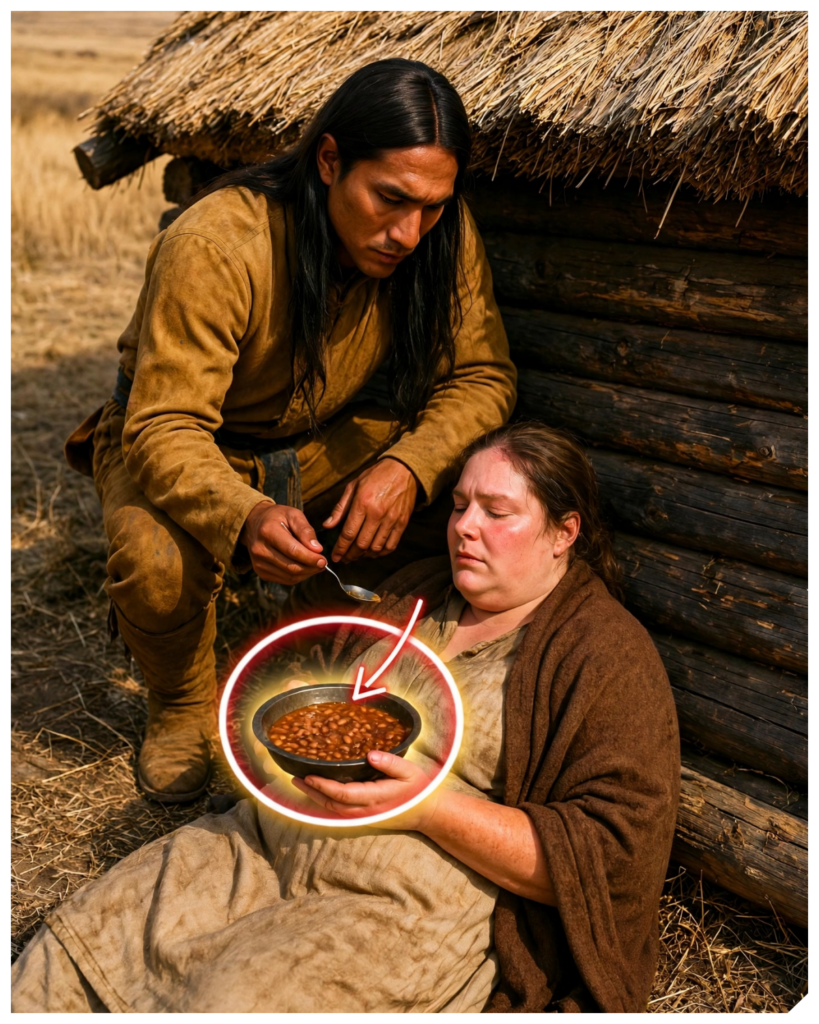
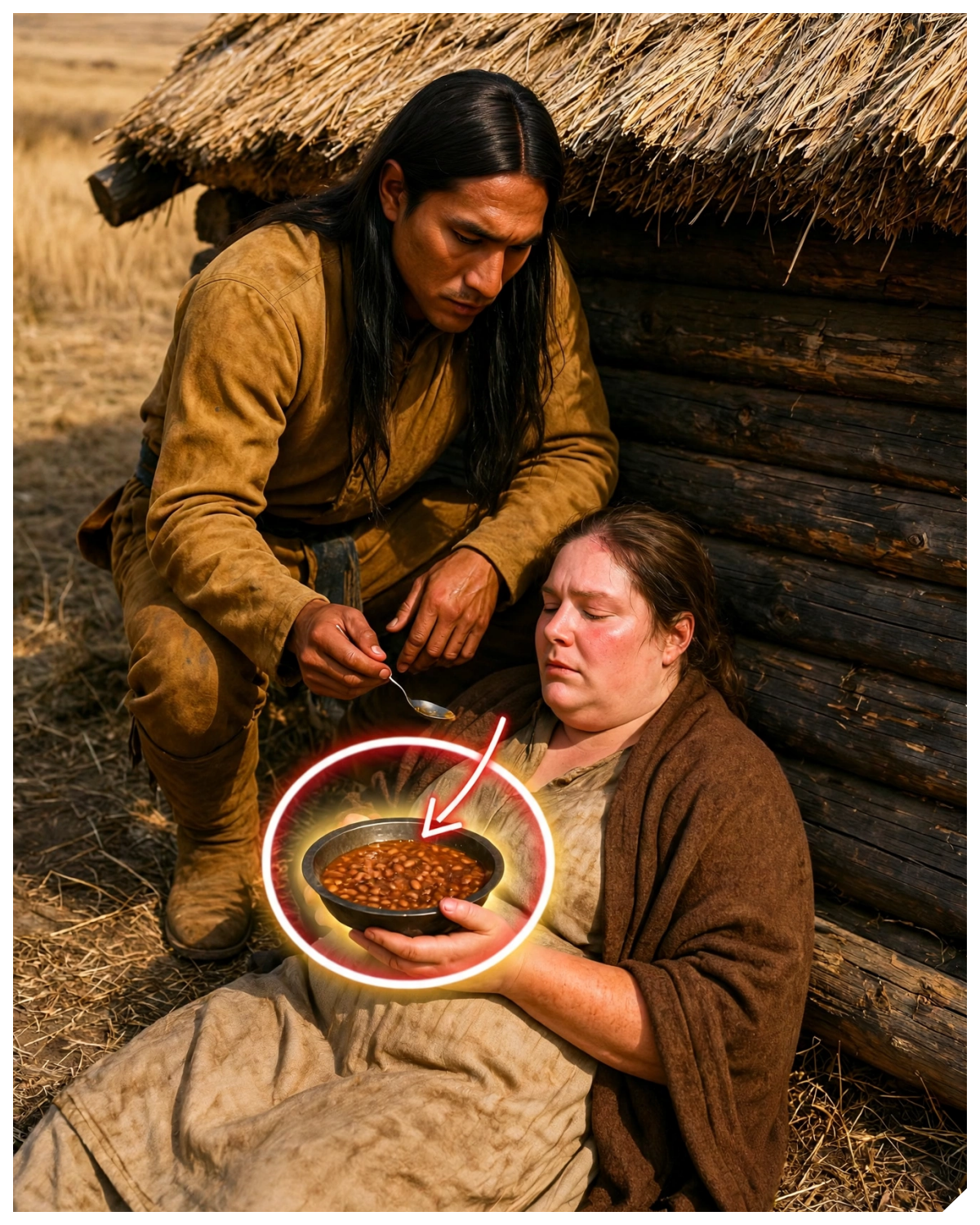
When he came out, he brought a tin plate, half burnt bread, beans, and venison stew thick enough to carry heat in the belly for hours.
He handed it to her without a smile, but his silence felt warmer than words.
She looked at him, unsure if she should say thank you or apologize for falling.
Instead, she said neither.
She took a bite.
Her hands shook.
He turned to leave, but she spoke quiet, raw.
Why are you still helping me?
He looked back, the fire reflecting in his dark eyes.
Because you didn’t ask to be built smaller.
Then he walked off as if he hadn’t just said the kindest thing anyone ever told her.
That night the fire crackled low beneath a sky swollen with stars, the cold creeping closer despite the flames.
The roof still wasn’t finished, but it covered half the hut now, enough to block wind from the north and let the warmth hold steady between them.
Dileia sat close, her coat unbuttoned, a wool blanket around her shoulders, watching the Apache as he stirred the pot one slow circle at a time.
He hadn’t said more since the stew, not one word.
But his silence no longer felt like distance.
It was its own language now.
Every movement of his hand, the way he nudged another log into the fire without breaking eye contact with the flame, the way he always left the tin cup just close enough for her to reach without asking.
It all added up to something solid.
He sat cross-legged, tall even when grounded.
His frame lean and wide in equal measure, the scars on his forearms catching faint orange light as he worked.
She realized he was always moving around her, not away.
He did things quietly.
Cut the wood she dropped.
Reshaped the door frame when it cracked.
Moved her saddle under shelter during the first storm.
Not for thanks, not for pride, just because she was there.
And he had decided that meant she shouldn’t be cold or hungry or without a roof.
Still, he hadn’t touched her since the fall.
Not once.
He hadn’t brushed a strand of hair or grazed her elbow when they passed.
He left space for her to step into if she wanted.
That night, she did.
As he leaned forward to adjust the pot’s lid, her hand moved without thought.
It reached across the fire’s glow, past the cup, past the line they hadn’t crossed, and settled quietly on his wrist.
Not to stop him, just to feel that he was real.
His hand stilled beneath hers.
He didn’t flinch or look up.
But after a long pause, he turned his palm over and let her fingers slide into it.
Their hands didn’t fit perfectly.
His was rough, wide.
Hers was square and calloused from years of self-reliance, but they held.
No squeeze, no pull, just held in the stillness while the fire snapped and the night watched.
They didn’t say a word.
They didn’t have to.
The silence that once kept them apart had become the place where they met.
And neither of them pulled away.
The mule wagon creaked into town at sunrise, empty but for the tools he had come to return.
The borrowed hammer, the dented nails, the saw he promised he didn’t steal.
He said nothing as he handed them over at the smithy, tipping his chin once to the man who didn’t make eye contact.
From the saloon porch, two ranchers paused their cards.
From the feed store, the older woman who’d once told Dileia, “No openings here, stepped inside and locked the door behind her.
The town had made itself clear.
They still thought silence was obedience and that a woman like Dileia was something to pass over, not evil, just unworthy.
But the Apache didn’t linger.
He tied off the mule at the water trough and walked toward the merkantile.
Inside he set two coins on the counter and pointed at a bolt of calico fabric.
“Blue,” he said.
“That one.”
The clerk hesitated.
You sure?
The Apache didn’t answer, just unrolled a length with his own hands, cut it with the store’s shears, and nodded once.
He wasn’t buying for himself.
When he turned to leave, he met the eyes of the barber’s wife, a tall woman with thin lips who said too much and missed too much.
She squinted at him and asked, “She with you now?”
And for the first time in that town, he spoke without lowering his voice.
“She’s not with anyone,” he said.
“She’s herself.”
Then he left the bolt of fabric on the wagon seat and rode back out the same way he came.
By dusk, the name Dia had passed more lips than it had in 5 years.
Some whispered in shame, some in doubt, and some in that careful, quiet way folks speak when they know they misjudged and don’t want to admit it.
But in the unfinished cabin up north, she was already laying out the fabric with a needle in her hand, smiling for no reason, her thumb brushing the corner of the cloth like it meant something.
“They’ll say my name now,” she said aloud, half to herself.
Maybe not kind, but they’ll say it.
The Apache seated nearby mending the harness strap didn’t look up.
I already did, he said simply.
Long time ago.
She didn’t answer, but she didn’t need to.
That night she hung the fabric in the doorway, not as a curtain, but as something softer than wood to walk through.
It moved when he passed under it, brushing his shoulder as if the house itself welcomed him now.
Not because he built it, but because he chose her to stand inside it with him.
And in that small movement, that soft blue fold swaying at dusk, a life had begun.
The torch light came at midnight, flickering low against the pines as six men rode up the hill in silence, their boots thudding on wet earth as they dismounted just past the creek.
They didn’t bother tying the horses.
They weren’t staying long.
One held a rusted rifle.
Another carried a kerosene can.
And all of them had the look of men pretending to enforce some kind of law that no paper had ever written.
We warned her, said the oldest one.
Said we don’t want no mixing, no Apache running ranches like white folks.
Another spat on the ground.
Not with one of ours, he added.
The cabin light glowed faint behind a muslin curtain, and inside Dileia had already risen from bed, already wrapped her shawl tight, and stood barefoot on the wooden floor, watching the flames bob between the trees.
“You see them?”
She asked.
The Apache nodded once.
“Don’t open the door,” she shook her head.
“No, I will.”
And before he could answer, she stepped out into the night barefoot, stepping onto the porch with her hands folded in front of her.
“Evening,” she said clearly, not yelling, not afraid.
The men paused, “Surprised maybe, or unsure why she looked so steady.”
“Go back inside,” one muttered.
“Ain’t safe out here,” she stepped down a single stare.
“Then drop your fire and go home.
This land ain’t yours, and neither am I.
The man with the rifle raised it halfway.
“You’ll regret saying that,” he warned.
“Maybe,” she replied.
“But I regret letting men like you speak over me more.”
The Apache appeared in the doorway, then, silent and still, holding only a bucket of water in one hand and a rope in the other.
He didn’t reach for a weapon.
He didn’t shout.
He just stood.
One of the younger men hesitated.
“She with him?”
He asked quietly.
“No,” the oldest said.
“She’s with herself.
And that’s the worst kind.
They turned then one by one until only the man with the rifle remained.
You keep pushing.
Someone’s going to push back,” he growled.
The Apache stepped onto the porch, set the bucket down, and met his eyes.
“Then push,” he said.
But it won’t be me that falls.
The man stared a moment longer, then lowered the rifle and turned away.
The horses were already moving by the time he reached them.
And when the night stilled again, Dileia sat on the porch step, shaking a little, barefoot in the cold, and the Apache knelt beside her, brushing mud from her heel.
“Still think I ain’t worth building with?”
She whispered.
He didn’t answer.
He just tied the shawl tighter around her shoulders and sat beside her until morning.
They came down from the ridge three days later, walking behind a wagon of salvaged tools, timber, and a wheelbarrow filled with seed sacks.
Not hiding, not sneaking, not asking permission.
Dileia wore a simple cotton dress stained at the knees and sleeves from packing the roofline mud, her braids tied tight, her back straight.
The Apache wore no feathers, no painted marks, just his buckskinned shirt and a widebrimmed hat that shadowed his face.
When they reached the town edge, folks stopped what they were doing.
A child dropped a pale.
A man setting up crates at the store let one fall.
Mrs.
Hargrave, who’d once screamed that Dia should be barred from the church, stood outside the bakery with flower on her apron and narrowed eyes.
The Apache kept walking.
Dileia walked beside him, but when they reached the well, he stopped, turned slowly, and stood on the first stone ring where the town usually gathered for Sunday announcements.
I won’t speak long, he said.
And even his voice startled folks as if they hadn’t imagined he could sound human.
You all judged her before you knew her.
You said she didn’t belong here.
Neither do I.
But we’ve built something.
It’s not your land, but it’s ours now.
And I won’t ask you to forgive her for staying when no one else would have.
I’m asking you to learn from her instead.
A wind caught the back of Dileia’s skirt and billowed it out gently.
Someone coughed.
A boy from the feed shop whispered.
That’s the woman who fixed her own roof, right?
An older woman muttered.
She planted tomatoes in November and they lived.
From the edge of the crowd, Mayor Tally stepped forward, adjusting the strap of his suspenders.
“That land ain’t officially yours,” he said slowly, voice uncertain.
“Ain’t officially no one’s,” the Apache replied.
“But we’re the ones keeping it alive.”
There was no applause, no gasps, just silence until little Janie Holloway, maybe 9 years old, stepped forward with a jar of preserved peaches in her arms and walked up to Dileia.
“Mama says I can’t talk to you,” she whispered.
“But she didn’t say I can’t give this.”
Dileia knelt slowly.
“Thank you, Sugar.”
And that’s when it shifted.
When the town saw not a trespasser, not an outcast.
Not a woman who’d built a home with someone they’d been taught to fear, but a woman who hadn’t broken, hadn’t begged, hadn’t burned.
The Apache stepped back, said nothing more, because she didn’t need defending anymore.
She was already home.
The cabin was finished by the time the creek thawed, and the dogwoods began to bloom white against the ridge.
No sign marked the trail to it.
No fence told where the land started or ended.
But inside it held warmth.
Two chairs carved by his hands.
Curtains stitched by hers.
A clay jug of water that never ran empty without being refilled.
One morning, as mist curled low over the hilltops, Dileia stood barefoot on the porch holding a mug of coffee and watching the way the smoke from their chimney curled into the quiet sky.
The Apache came up from the creek carrying two trout strung on a stick, the wet morning glinting off his shoulders.
“Saw some fresh bootprints near the lower trail,” he said softly.
“She didn’t flinch.
Let him look.
We’re not hiding.
He nodded, setting the fish down in a metal pan and sitting on the porch rail beside her.
For a while, they said nothing.
Somewhere behind the trees, a red bird called.
The cabin didn’t creek anymore.
It had settled into the earth like it belonged.
Later that week, Mrs.
Hargrave came up alone, hands full of cornmeal and a jar of lard.
I’m not saying I approve, she muttered.
I’m saying I saw your tomato vines.
That kind of yield don’t lie.
Dileia took the gifts with a thank you and didn’t invite her in.
That evening, two boys from town came to ask about bartering eggs.
By the end of the month, someone hung a tin cup at the trail fork with a piece of paper that read, “Delie’s place.
Ask before stepping in.”
They hadn’t wanted her in town.
Now they sent folks up to ask how she kept her plants from wilting.
The Apache never once called the cabin his.
He always said hours.
He never put up a fence.
But one day he nailed a sign to the side of the cabin, not where the wind could take it, but under the porch awning where only visitors would see it.
It read simply, “We stay kind.”
When the rains came that spring, they held hands under the roof they’d packed themselves, watching it hold, not drip, not groan, just hold like they did.
Please like, share, and subscribe to support more truehearted stories on stories left behind.
If the town wouldn’t give you a home, would you build one from scratch like she did, or would you walk away?
Tell us in the comments.