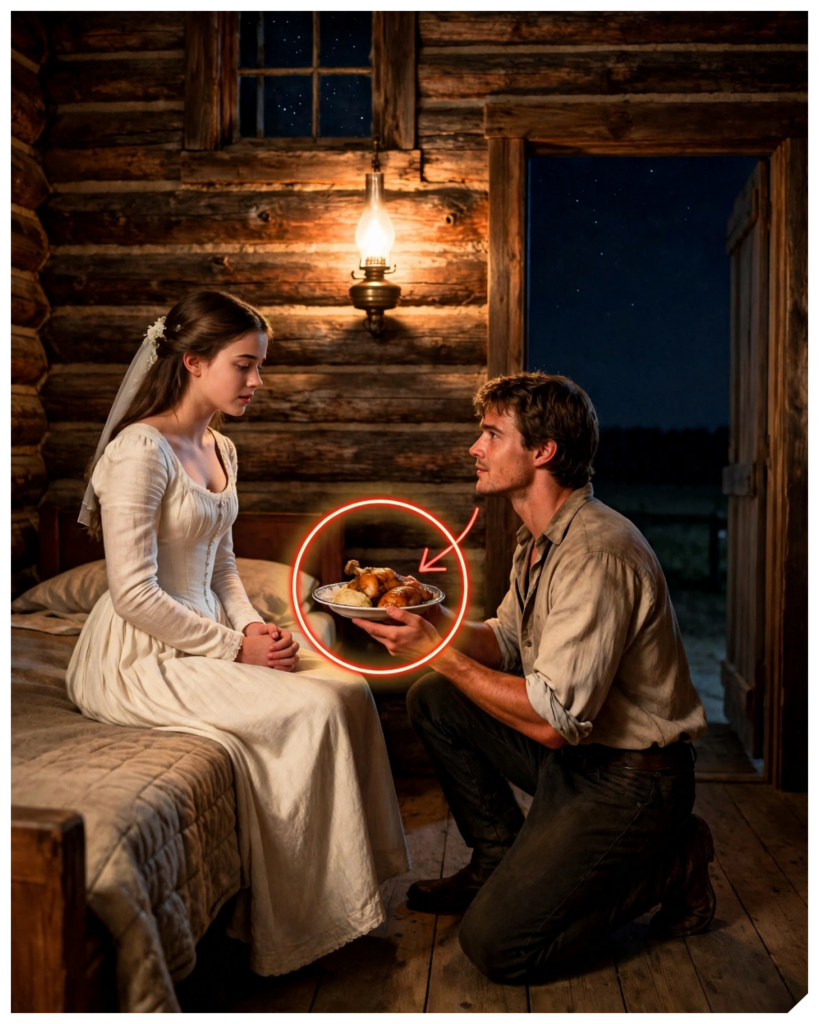
The virgin bride asked, “Do I have to lay with you?”
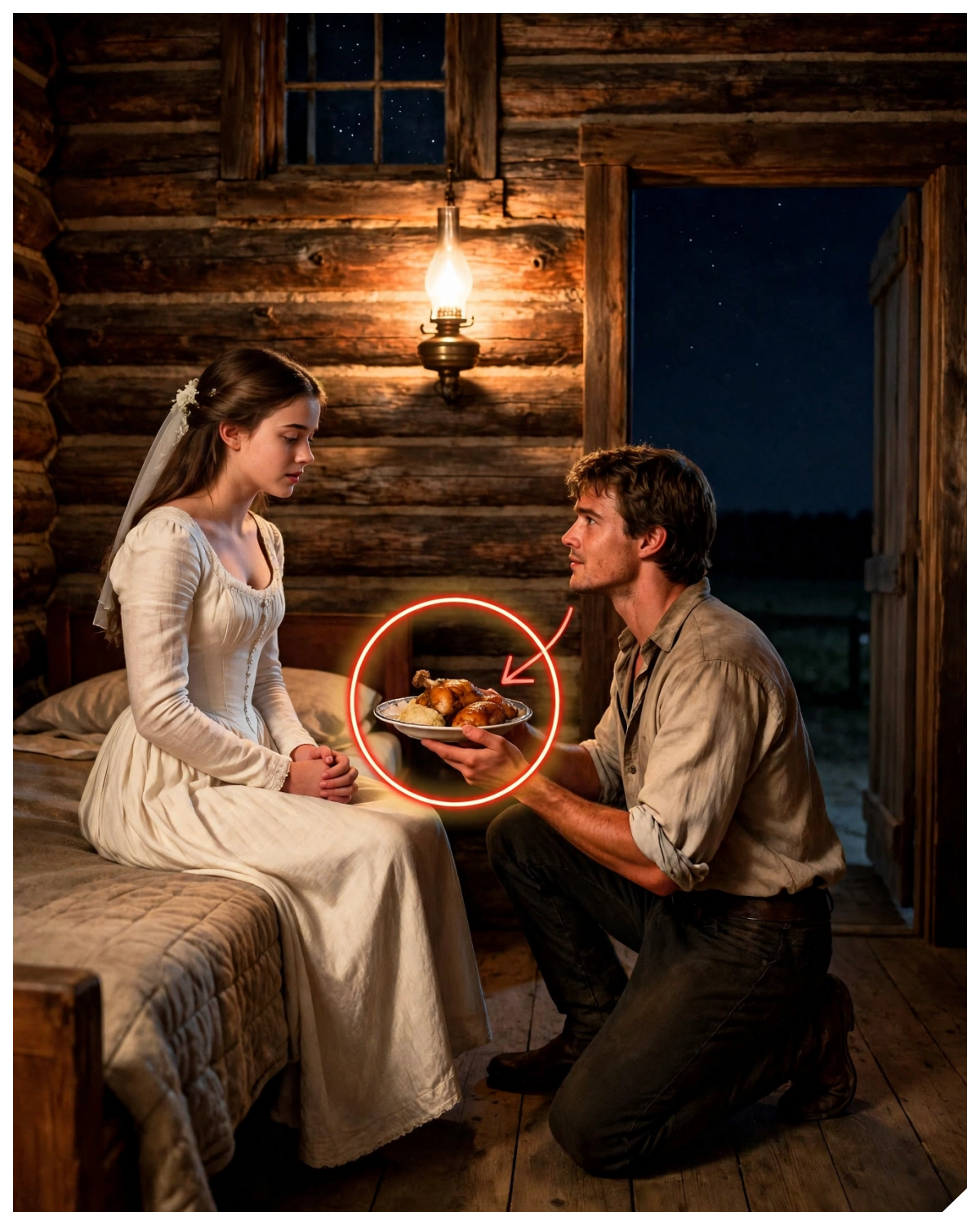
The cowboy said, “Just eat first.”
They unloaded her from the wagon like a parcel, boots dusty, veil crooked, jaw set like someone walking into court rather than marriage.
She was only 19, a trade made by her uncle to settle debt, sent across three counties to the ranch of a man she’d never seen.
The men who’d brought her, laughing, spitting, poking fun at how thin her arms looked under the sleeves, barely knocked before leaving her on the porch, then rode off fast like they were glad to be done with it.
The door creaked open, and the man inside didn’t say a word, just stepped aside.
He was older, 30, maybe more, broad-shouldered, sunbrowned, with a calm in his face that didn’t match the tension in hers.
She didn’t walk in at first.
I don’t want none of this, she said, her hands clenched on her skirt.
He looked down at her boots.
Shoes don’t choose where they walk.
Folks do.
Then he turned and walked back into the dim cabin, leaving the door open like he didn’t expect her to follow.
But she did after a long breath.
Inside, the cabin smelled like smoke and sage, and something stewed slow all day.
A small table sat near the hearth.
Two tin plates.
One chair had a cushion.
He didn’t touch her.
Didn’t tell her what was expected.
Just said, “You can eat if you want.
Fire’s warm.”
She stood frozen, torn between hunger and fear.
A whole roast potato sat untouched on the plate.
She stared at it like it might trick her.
He sat on the floor, not the chair, and leaned against the wall, watching the fire.
“Name’s Carter,” he said.
“You can keep yours or change it.
Either way, I won’t take it from you.”
The way he said it, quiet with no claim, made her legs tremble more than any grab would have.
The wind outside moaned low like it wanted to come in, too.
She didn’t touch the food.
Not yet.
But she didn’t run either.
Carter didn’t look at her again that night.
Just said one thing before the fire died.
I don’t need a wife.
Just didn’t want you handed to Worse.
And then he slept on the floor, boots still on.
She didn’t sleep that night.
Just sat curled in the corner of the bed he said she could use, watching his unmoving form on the floor.
Dawn came pale and slow through the window, brushing the wooden walls in a light that didn’t feel like hers.
Her stomach growled, but she ignored it.
When Carter stirred, he didn’t look at her, just stood, stretched once, and went outside without a word.
She crept to the fire, wrapped the shawl tighter, and finally bit into the cold potato.
It was dry now, but the salt hit her like tears.
Later that morning, he returned with wood and water.
“You’ll want your own basin,” he said, and set one down beside the hearth.
“Ain’t no woman’s job here, just chores that need doing.”
She didn’t answer.
He didn’t press.
Days passed like that.
Quiet, no touching, no questions.
Until one night the stew boiled too long and the smoke stung her eyes.
She coughed, waved it away, and he stepped in, gently moved the pot, then opened the window without saying a thing.
That night, she sat across from him, and the words left her lips before she could swallow them.
“Do I have to lay with you?”
Carter didn’t look up.
He just kept stirring.
No, he said, “You don’t have to do nothing.
You weren’t part of choosing.”
She blinked at him, unsure if it was a trick.
He met her eyes slow and sure.
I didn’t ask for you, and I ain’t owed you.
I’m just feeding someone who looked hungry.
Her hands trembled.
Why’d you take me then?
Cuz they would have handed you to someone who don’t ask.
That answer sat between them heavier than the cast iron pot.
That night he brought a second blanket and offered it for her to use instead.
Winter’s here can be cruel, he said.
She didn’t take it, but not because she didn’t want it.
She just didn’t know how to reach.
She stayed awake long after he’d laid down again, her back against the wall, her chest still not steady.
But for the first time since the wagon, she didn’t feel like she’d been claimed.
Just seen.
The next morning brought sle, the kind that cut sideways and stuck to everything.
She wrapped her sleeves over her hands, watching through the cracked window as Carter hauled logs from the shed, his hat drooping with ice, shoulders hunched under the weight.
He didn’t ask for help, but she opened the door anyway, teeth clenched against the cold.
He stopped when he saw her and held out a pair of his old gloves without a word.
She put them on slowly.
They swallowed her hands, still warm from his.
Together they stacked wood in silence, her breath fogging the air, her braid stiff with frost.
When her fingers slipped on the axe handle, he didn’t scold her.
He just nudged her elbow, showing her how to hold it better.
Not a teacher, not a husband, just a man making room.
When they finished, she returned inside first and watched from the window as he knelt to fix the barn latch.
Boots sunk in mud, hair soaked.
She made tea the way her mother used to, strong with salt if there was no sugar.
When he entered, dripping and wind burned, she held out the cup.
It’s bitter, she warned.
He took it anyway and drank slow, steam curling from his lip.
Tastes like kindness, he muttered half to himself.
She looked down.
That night, he didn’t sleep on the floor.
He slept in the chair, boots still on, hat tilted down.
She stayed on the bed, blanket drawn to her chin, eyes wide in the dark.
At some point, the wind pushed the shutters open and she jolted up.
He didn’t wake, but his arm twitched, reaching toward where she was, like even in sleep, he knew she was scared.
She crossed the room and closed the shutters herself.
When she turned around, he was watching her quietly.
“Storm’s loud,” she whispered.
“Yeah,” he said.
“But it’ll pass.”
He didn’t say anything else.
She didn’t either, but when she climbed back under the blanket, she didn’t shake as much.
Outside, the storm cracked again.
But inside, the silence held steady.
It wasn’t safety yet, but it wasn’t fear.
When he handed her the ledger the next morning, she blinked at the columns of names and numbers like they were written in another language.
You’ll need to help me track the feed in medicine, he said.
I can’t read much past cow weight.
She hesitated.
I My letters are poor, she murmured.
He scratched his neck, then shrugged.
Then we’ll both squint at it till it makes sense.
She sat beside him at the table, unsure how close to be, and for the next hour, they traced names with their fingers, sounded out syllables, and circled numbers they didn’t understand.
At one point, she accidentally called out a wrong total and cursed under her breath.
Carter just grinned.
“Well, now we know you cuss better than I do.”
Her eyes widened.
“I shouldn’t have said that.”
“You’re in my house, not in sin,” he replied, still smiling.
“Something in her cracked a little.
No one had ever laughed when she got things wrong.
No one had ever made her mistake feel like part of learning.
He turned the page and when he saw the line for wife’s signature, he paused.
You want me to cross that out?
She looked at the word wife.
It didn’t fit her yet.
Maybe never would.
But before she could answer, he sighed.
Didn’t mean to rush.
Just the ledgers old.
Then he crossed it out himself and wrote her name instead.
No pressure, no ownership, just space for her to be whoever she was ready to be.
That evening she found herself humming as she washed the dishes.
He was outside with the chickens, coaxing the lame hen to eat.
She watched him through the window.
How he tilted his head to listen to things most men ignored.
When he came in, he said, “Hen took seed from my hand today?”
She nodded.
“First time took three weeks.
Worth it.”
Of course, she still got life.
She didn’t know if he meant the hen or her.
That night, when he lit the lamp low, she sat at the table again.
“You can write your name,” he said, offering the ledger.
She hesitated, then picked up the pencil.
Her fingers trembled, but he didn’t look away.
When she finished scrawling the crooked letters, he didn’t correct her.
He just nodded.
Looks like someone who survived.
She looked at her name.
It wasn’t perfect, but it was hers.
A storm rolled in before sunrise.
Hard rain and winds that shook the shutters loose.
Carter was already outside when she woke, wrestling a tarp over the feed sacks.
By the time she reached the porch, he was soaked to the skin and limping slightly from a slip in the mud.
“You’ll catch your death!”
She shouted.
He waved her off, teeth clenched, then yelped as he clutched his knee.
Without thinking, she ran barefoot across the yard, rain slapping her face, and slipped under his arm.
I told you,” she muttered, dragging him back toward the house.
Inside, she made him sit by the stove while she boiled water, her hands trembling, not from fear, but from how suddenly the rolls had shifted.
She took off his boots, peeled back the wet fabric around his calf, and winced at the purple swelling beneath.
“Don’t fuss,” he said weakly.
I’m fine.
She didn’t reply.
She just fetched a basin, found a clean cloth, and began wiping the dirt away.
His jaw was tight, but he didn’t stop her.
She wrapped the knee with gentle firmness, fingers careful not to prod where it hurt most.
“You’re good at this,” he said quietly.
“Too good.”
She didn’t look at him.
I cared for my mother when her bones gave out and my little brother after the fever took his speech.
Carter didn’t speak for a long while.
The fire cracked.
The wind howled.
“Someone should have cared for you back then,” he said.
She shrugged.
“Didn’t seem like the world worked that way.”
He stared at her, eyes soft.
“Well, this house will.”
That stopped her hands.
“This house?”
He nodded.
Wherever you are, I want it to be a place that returns the kindness you’ve spent.
She looked away.
I’m not used to being treated like a person.
Then get used to it.
She stood abruptly and went to the stove, poured two mugs of strong tea, brought one back to him.
Drink, she said.
He took it without protest.
When she sat across from him, he offered a crooked smile.
Storm’s supposed to pass by noon.
I know, she replied.
But maybe you stay seated anyway.
He raised the mug.
Boss’s orders.
Something like that.
They sat in silence, the rain easing to a whisper against the window.
She didn’t touch him.
Didn’t need to.
The care was already given.
By dusk, the rain had gone, leaving the ranch glazed in silver light and the scent of wet cedar thick in the air.
She sat on the porch steps with her knees tucked under her skirt, arms around herself, watching the last droplets drip from the eaves.
Carter hadn’t said a word since she’d rewrapped his leg after lunch.
He hadn’t needed to.
He moved slowly but steadily through the cabin, boiling more water, straightening the table, stirring the stew she’d left to simmer.
And when she went to fetch the wood from the stack, she found it already filled to the top neatly, silently, as if he had known she’d look there first.
She watched him now through the open door.
He was sitting at the table, one arm on the wood, head resting back, not asleep, but still.
A quiet kind of man, she realized, but not the kind that hid behind silence.
No, Carter’s silence was different.
It was not a wall, but a place, a space where her presence didn’t have to shrink, explain, or obey.
A space where no one asked her to lie down, undress, or please.
She had spent years learning to read the difference.
She rose slowly, bare feet pressing against the cool floorboards, and stepped inside.
Her fingers brushed over the windowsill as she passed, then paused behind his chair.
For a moment, she stood there without speaking, without even breathing.
Then she stepped closer.
He didn’t flinch, didn’t shift, just waited.
She placed her hand lightly on his shoulder, his breath caught, not from desire, but from something deeper.
Reverence, maybe.
Then she stepped away, pulled the second chair out, and sat down across from him.
Their eyes met.
Neither spoke, neither had to.
The oil lamp on the table flickered gently between them, casting gold across his stubbled cheek and the frayed cuff of her sleeve.
In another house, in another story, she might have been expected to say something tender or clever to make it easier, to pretend.
But here now, she didn’t.
She just let the quiet settle.
Let it wrap around them like the worn quilt folded on the bench.
He reached for the stew pot and ladled some into her bowl first, passed her a hunk of bread without a word.
She took it with both hands.
When their fingers brushed, she didn’t pull away.
He didn’t push.
They ate like that in the soft hush of evening, with only the fire and the spoon against tin to break the quiet.
When she finally looked up again, her eyes said, “Thank you.”
His just nodded.
She woke before the sun, not from noise, but from a shift in the air, the kind that tells you you’re no longer alone in your thoughts.
Carter was already up, feeding the fire with slow, careful motions, dressed and clean like a man about to face something he didn’t want to.
She sat up on the cot, blanket wrapped tight around her, heart steady but uncertain.
“You’ll want to stay inside today,” he said quietly, not looking at her.
“Wagons came through last night.
Some of the old men are talking.”
She stood, walked to the window, and saw what he meant.
Four horses tied to the post by the fence, a wagon’s wheel tracks in the mud, and voices carrying up from the main trail.
She didn’t ask what they were saying.
She already knew.
Word had spread.
She’d been bought, returned, taken again.
And now she was here, not as a wife, but as something else no one had a name for.
The town wouldn’t like that.
They never liked when a woman didn’t come with a label to point at.
She turned to him.
They’ll think you took me.
I didn’t.
That won’t matter.
He nodded once slowly.
Let them think what they want.
I don’t need their blessing to be decent.
She stepped closer, hands trembling now, despite herself.
You could send me away.
They’d believe you did your part.
He looked up finally and there was steel in his eyes.
And what would that make me?
She didn’t answer.
Didn’t need to.
He moved to the door, but before he opened it, he paused.
You’ll hear things today.
Some ugly, but don’t twist yourself small just to fit what they say.
You’re not their shame.
When he walked outside, she stood there in the warm cabin, heart pounding, throat thick.
Her first instinct was to pack, run, vanish into the hills again, but her hands didn’t move.
Her feet didn’t either.
Instead, she stepped to the porch.
Not outside it, but just close enough to hear the voices clearer.
They were saying her name wrong, calling her that girl, that bought bride, that mouthy thing with no ring.
And then Carter spoke.
One line, low but loud enough to carry.
If you’ve come to measure my honor, you’ll have to speak to the woman eating at my table.
Silence.
Then a few horses turned.
A wagon shifted.
And just like that, some left.
Not all, but some.
She stepped back inside, breath shaking now.
Not from fear, but from the weight of something she hadn’t felt in years.
Not safety, not even kindness, something bigger, a place she hadn’t asked for, but might be allowed to stay.
By midm morning, the town’s eyes had shifted from whispering to watching, and by noon, they were waiting for a scene.
It came in the form of Sheriff Dalton himself, tall and well-dressed, stepping off his horse with the slow, deliberate gate of a man who believed he owned the silence.
Carter was working the fence out front, shirt sleeves rolled up, dirt on his palms, no badge, no gun.
The sheriff walked straight up to him, not sparing a glance for the cabin behind him.
“Heard you took in someone else’s bride,” Dalton said, voice just loud enough for the few men gathered by the well to hear.
“Town’s concerned.”
Carter didn’t stop hammering.
She’s not someone else’s anything.
They said she was bought, then sent back, then bought again.
And none of that changes what she is now.
And what’s that?
Dalton asked, tone turning sharp.
Carter finally looked up, face calm.
Safe?
The sheriff smirked, tipped his hat back.
You planning to marry her?
Didn’t say that.
Then what are you doing?
Letting her breathe.
Dalton stepped closer.
That ain’t how this place works, Carter.
A woman lives under your roof.
Folks expect she’s been claimed.
Carter dropped the hammer into the dirt.
Not roughly, just with finality.
Then let folks learn something new.
Behind the window, she stood frozen, hearing every word.
Her heart thundered, not from fear of Dalton, but from the fear that Carter might yield, that he might back down, that he’d send her packing just to keep his fence and name clean.
But he didn’t.
The sheriff stepped back.
“Don’t make me come again.
You won’t have to,” Carter said.
And then, as Dalton turned, Carter added, “Because next time, it won’t be words.”
The sheriff paused, but something in Carter’s stance, maybe the lack of fear, maybe the quietness, made him decide today wasn’t the day.
He rode off, leaving only dust behind.
Carter picked up the hammer again.
The men by the well said nothing.
One tipped his hat, another looked down, and the last one spat and walked away.
But no one followed Dalton.
No one cheered him either.
She stepped out then onto the porch slowly.
She hadn’t planned to, but her feet moved like they belonged now.
He didn’t look at her, just kept working.
You shouldn’t have to defend me, she said quietly.
Didn’t.
Then what was that?
He glanced up and there was the hint of a smile.
Sad and warm.
I was defending breakfast and for the first time she smiled too.
Not wide, not proud, just enough to feel it in her chest.
Because now the whole town had seen, and the world hadn’t ended.
It was the day of the spring market, and though Carter hadn’t asked her to come, he hadn’t told her not to either.
When she stepped down from the wagon, blue cotton dress freshly mended, hair brushed and braided, the town’s folk quieted, not cruy this time, but with the sharp curiosity of those who remember someone as broken and don’t yet know what to do with her standing hole.
She held her own basket, walked beside Carter without touching him, and when someone muttered, “That her?”
She didn’t flinch.
They passed the blacksmith first, who gave a grunt and a nod.
Then the school teacher, who looked at her with something almost like apology.
At the baker’s stall, Mrs.
Tully offered two sweet rolls instead of one.
“For the lady,” she said, and didn’t blink when the word slipped out.
“They made their way to the church steps where Reverend Pike stood holding a ledger, gathering names for the new town registry.
Every woman to list her household, her husband, or her father.
She hesitated.
Carter stepped aside.
“Ain’t my place to answer for her,” he said.
The reverend blinked.
“Then whose is it?”
She stepped forward, voice low but clear.
“Mine,” pen in hand, her fingers shook.
She looked at the space marked name.
For years, that space had been filled for her by her father, her first buyer, the marriage contract that was never spoken aloud, but signed in bruises.
But this time, she took a breath and wrote slowly, deliberately.
First her given name, then a last one that wasn’t Carter’s and wasn’t her pasts.
It was just a word she’d heard him say once while talking to the horses.
Steady.
She looked up.
Is that allowed?
The reverend stared.
Then Carter chuckled.
Soft.
If a horse can carry it, so can she.
The reverend swallowed and wrote it down.
Miss steady.
Then the crowd stirred but didn’t speak.
Not mockery, not laughter, just something shifting in the dust.
An old idea making room for something new.
When they turned to leave, she heard a child’s voice call from behind the feed cart.
Miss Steady, you dropped your ribbon.
She turned.
A little girl ran up and placed the blue strip in her hand, eyes wide.
My mama said you was a bride.
I was, she said.
And now, now I’m whatever I want to be.
The girl beamed.
Then I want to be like you.
It was a strange kind of victory that moment, silent, small, but real.
As they climbed back into the wagon, Carter handed her the reinss.
“You sure?”
She asked.
“Ain’t my name on the paper?”
He replied.
“Just seemed right you drive us home.”
“And so she did.
Straight down the main road, past every pair of eyes that once looked through her.
None of them saw a bride, but none of them looked away either.
That evening the wind moved gently across the plains, stirring the grass around the cabin like it too had come to rest.
Inside the table was set for two, but neither of them sat.
She stood at the open door, apron dusted with flower, watching the last light touch the hills.
Behind her, Carter was fixing the latch on the back window, muttering to himself about the draft.
“You hungry?”
She asked without turning.
“Always,” he answered, not meaning just food.
She stepped outside barefoot, letting the cool earth steady her.
“I don’t want to owe you,” she said quietly.
“You don’t,” he replied.
“Then why do you keep giving?”
Because I don’t need anything back to know it’s worth it.
She looked up at the first star.
Everyone I ever knew made a promise first before they hit me.
Before they took what they wanted.
Before they walked out.
Carter came to the doorway but didn’t follow.
Then I’ll make none.
She turned.
No promise.
He shook his head.
Not tonight.
Not ever.
Just choices every day.
She studied him for a long time, then nodded once.
She walked back inside and sat at the table.
He joined her.
They didn’t pray.
They didn’t toast.
They just ate slowly, quietly, like it was the first meal neither of them had to earn with pain.
When they were done, she stood again.
“I’ll be sleeping in the loft,” she said.
“All right,” he replied.
You need more quilts?
No, she said, but maybe one of those old books up there.
He smiled.
A few of them got happy endings.
Maybe I’ll find one that doesn’t end at all.
She climbed the ladder, the wood creaking under her weight, and disappeared into the warm dark above.
He didn’t look up, just cleared the plates and washed them like he always did.
Steady, careful, not rushing.
The fire dimmed low from the loft.
Her voice came.
You ever get tired of not asking for anything?
Sometimes, he admitted, but then I remember what it’s like when someone gives you something just because they can.
She was quiet a moment, then.
Good night, Carter.
He paused.
Good night, Steady.
The wind sighed outside, carrying no threats.
The night closed in, not with fear or need or expectation, but with stillness, and that in the end was more sacred than any vow.
Please like, share, and subscribe to support more truehearted stories on stories left behind.
If a young bride said, “Do I have to lay with you?”
Would you have offered her food and silence like the cowboy did or followed the world’s way?


