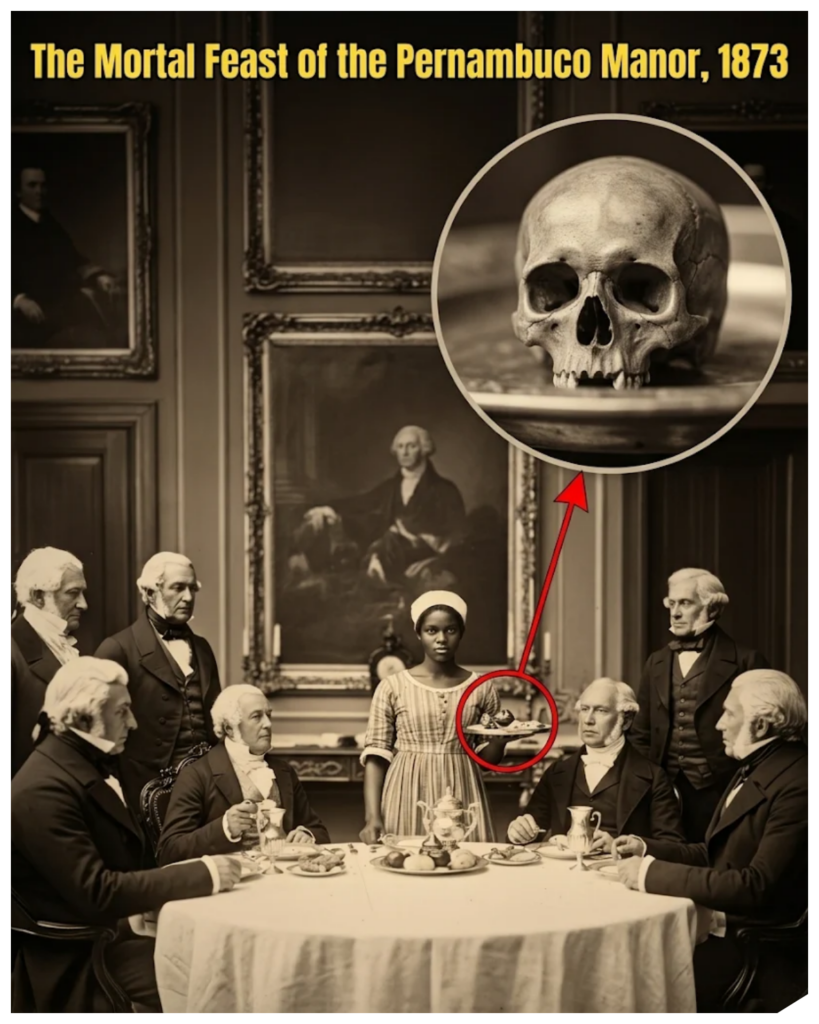
THE LAST SECRET OF THE SOBRADO DAS PALMEIRAS
“The real mastermind behind the eleven farmers’ banquet had just revealed himself.”
For a moment, Maria could not breathe.
The man standing behind Tomás wore a black suit and carried a walking cane with a silver handle.
His hair was almost entirely white.
A thin scar ran from his temple toward his jaw.
Maria recognized him immediately.
It was Henrique Albuquerque.
Augusto’s eldest son.
But according to every account she had ever heard, Henrique had died in Portugal in 1862.
His funeral had supposedly taken place in Recife.
His inheritance had been divided.
And his name had disappeared from the family’s correspondence.
Yet here he stood.
Alive.
“Good evening, Maria,” he said.
She took a step backward.
“You are dead.”
Henrique smiled.
“That is what your father wanted everyone to believe.”
Elias raised his hands slightly.
“Put down the weapon, Tomás.”
The younger man laughed.
“Why should I?”
“Because you do not understand what you are doing.”
“Oh, I understand perfectly.”
Tomás pointed the revolver toward Maria.
“All my life, I believed I was the son of an ordinary woman. I believed my father was a merchant who had abandoned us. I believed my family had nothing.”
Henrique stepped forward.
“And now you know the truth.”
Tomás nodded.
“I know that I am an Albuquerque.”
Maria looked at him.
“That does not make you one of them.”
His expression hardened.
“You have no idea what it means to grow up without a name.”
She answered quietly.
“I know what it means to grow up without a father.”
Tomás looked away.
For a brief moment, his grip on the revolver weakened.
Henrique noticed.
“Do not listen to her. She has been manipulating everyone since she arrived.”
Maria turned toward him.
“You are the one who arranged this banquet.”
“Of course.”
“You invited eleven farmers.”
“Eleven men who owed me money.”
“And you intended to make them confess.”
Henrique laughed.
“Confession? No, my dear. I intended to make them disappear.”
Elias stared at him.
“Why?”
Henrique looked around the chamber.
“Because these men were becoming liabilities. They had grown old, frightened, and sentimental. Some had begun talking about the past. Others wanted to sell their properties and leave Pernambuco.”
He tapped his cane against the floor.
“I could not allow eleven loose tongues to destroy the family fortune.”
Maria shook her head.
“So you brought them here to kill them?”
“Not personally. I had arranged for the mansion to be surrounded. Once the documents were recovered, the entire property would be destroyed.”
Tomás looked at him.
“You said the plan was to recover the inheritance.”
“It is.”
“You said Maria was the only obstacle.”
“She is.”
“Then why are we still here?”
Henrique’s expression changed.
“Because you have become inconvenient.”
Tomás stared at him.
“What?”
Henrique turned toward Maria.
“Your brother has been useful, but he has also learned too much.”
Elias understood first.
“Henrique never intended to give you the inheritance.”
Tomás’s face went pale.
“Is that true?”
Henrique shrugged.
“Do you honestly believe a man like me would divide his fortune with an illegitimate son?”
Tomás lowered the revolver.
“You promised.”
“I promised you an opportunity.”
Maria slowly stepped toward him.
“Tomás, listen to me. You are not responsible for what our father did. You do not have to become like them.”
Henrique interrupted.
“Enough.”
He raised his cane.
A hidden blade slid from its silver handle.
Elias immediately moved between him and Maria.
“Do not take another step.”
Henrique laughed.
“Still protecting women, Elias? It seems you have learned nothing from your mother.”
The words struck Elias deeply.
He remembered Clara.
He remembered the nights when she worked until dawn.
He remembered how she had warned him never to trust the Albuquerque family.
And he remembered the day she died, holding his hand and asking him to promise that he would never allow hatred to control his life.
He had kept that promise for many years.
But standing in the underground chamber, facing Henrique, he felt that promise becoming harder to honor.
Maria noticed the change in his expression.
“Elias.”
He looked at her.
“Remember why we came here.”
He nodded.
Then he slowly lowered his hands.
“Henrique, there is something you have not considered.”
The older man frowned.
“What?”
“The ledger.”
Henrique looked toward the table.
“What about it?”
“It contains the original accounts. Every payment. Every fraudulent transfer. Every name.”
Henrique smiled.
“And?”
“Copies were made.”
The smile disappeared.
“Where?”
Elias looked toward Maria.
She understood immediately.
The documents had been hidden in the old chapel.
Her mother had told her about it years earlier.
Henrique turned toward Tomás.
“Search them.”
Tomás hesitated.
“Why?”
“Because I said so.”
But Tomás no longer moved.
Henrique raised the hidden blade.
“You foolish boy.”
Then he lunged.
Everything happened quickly.
Elias pushed Maria aside.
Tomás fired.
The gunshot echoed through the underground chamber.
Henrique fell against the table.
The ledger slid to the floor.
For several seconds, nobody spoke.
Then Maria saw the blood spreading across Henrique’s white shirt.
Tomás stared at the revolver.
“I didn’t…”
He dropped it.
“I didn’t mean to.”
Elias approached Henrique cautiously.
The older man was still alive.
He looked toward Tomás.
“You… ungrateful…”
Then he collapsed.
Maria knelt beside him.
“Do not move.”
Henrique laughed weakly.
“You think… this changes anything?”
“What do you want?”
He reached into his coat.
Maria caught his wrist.
A folded paper slipped from his pocket.
She opened it.
It was a property document.
The estate that Isabel had been trying to protect was not the only property involved.
The paper contained the name of another family.
The same family whose land had supposedly disappeared in 1861.
But at the bottom was something Maria had never seen before.
A second heir.
A woman named Helena.
“Who is Helena?” she whispered.
Henrique smiled.
“Your mother never told you everything.”
Maria stared at him.
“Who is she?”
Henrique closed his eyes.
“Your sister.”
The words seemed to shake the walls.
Maria looked at Elias.
He was equally shocked.
Henrique continued.
“Isabel had another child. An older daughter. She was taken away before the events of 1861.”
Maria’s eyes filled with tears.
“Where is she?”
Henrique tried to speak.
But before he could answer, his head fell to one side.
He was dead.
For the first time in twelve years, the secret of the Albuquerque family had cost one of its members his life.
But the greatest mystery remained unanswered.
Where was Helena?
And why had Isabel hidden her existence?
THE ELEVEN MEN AND THE TWELFTH CHAIR
When Maria and Elias returned to the dining room, the scene was chaotic.
The ten remaining farmers were gathered around Augusto.
The colonel was conscious, although weak from his wound.
The servants had placed a blanket beneath his head.
The younger Tomás followed behind Maria.
Nobody spoke when they entered.
Augusto looked at his eldest son’s empty place beside the table.
“Where is Henrique?”
Maria lowered her eyes.
“He is dead.”
The colonel closed his eyes.
For several moments, he seemed unable to understand the words.
Then he began to cry.
It was not a loud or dramatic display.
Only two tears rolled down his cheeks.
“My son…”
Maria stood before him.
“Your son tried to kill us.”
Augusto looked at her.
“I know.”
“He planned this entire banquet.”
“I know.”
“And you knew he was alive.”
Augusto swallowed.
“Yes.”
The room became silent.
Maria stepped closer.
“Why?”
The colonel looked at the eleven chairs.
“Because I was afraid.”
He took a painful breath.
“Henrique was always the most ambitious of my children. He believed wealth gave him the right to control everything. When he discovered the documents Isabel possessed, he became obsessed with finding her.”
“Why did you help him?”
“Because I had spent my entire life building an empire. I believed that if the truth emerged, everything would collapse.”
Maria’s voice trembled.
“So you allowed him to destroy my mother’s life.”
Augusto lowered his head.
“Yes.”
“And you allowed him to make me grow up without knowing who I was.”
“Yes.”
Maria looked at him with an expression that contained both anger and grief.
“Did you ever love her?”
Augusto did not answer immediately.
Then he whispered:
“More than I deserved.”
Maria shook her head.
“Love is not something you can use as an excuse for cruelty.”
The colonel closed his eyes.
“I know.”
For the first time, the powerful landowner appeared to understand the consequences of his actions.
He had spent decades believing that money could buy silence.
He had mistaken fear for respect.
And he had confused possession with love.
Now the people he had controlled were watching him fall.
Manuel Ferreira approached the table.
“Colonel, we need to discuss what happens next.”
Augusto looked at him.
“There is nothing left to discuss.”
“We all have families.”
“You should have thought of that before signing the documents.”
Raimundo looked down.
“I regret what happened.”
Maria turned toward him.
“Regret does not restore twelve years.”
The farmer nodded.
“No. It doesn’t.”
One by one, the men placed their envelopes on the table.
Each contained a signed statement acknowledging their involvement in the fraudulent property transfers.
Sebastião offered to testify.
Francisco promised to identify the foreign accounts.
Vicente admitted that he had used his political influence to obstruct earlier investigations.
The men who had spent twelve years hiding behind their wealth were finally beginning to tell the truth.
But Maria was not satisfied.
She pointed toward the empty chair at the end of the table.
“Who was the twelfth person?”
Augusto looked at her.
“What?”
“There were eleven farmers. But tonight, you said there were twelve people in this room.”
Elias understood.
“The person in the portrait.”
Maria nodded.
“Who was it?”
Augusto stared toward the staircase.
Then he answered.
“Isabel.”
THE WOMAN WHO NEVER DIED
The story of Isabel began long before the mysterious banquet.
In 1861, she had been twenty-six years old.
She was intelligent, determined, and unwilling to accept that powerful men could steal from families simply because they possessed more money.
Her father had been a respected landowner.
When he died, his property should have passed to his children.
But forged contracts and fraudulent debts had been used to transfer the estate into the hands of the eleven farmers.
Isabel discovered the deception while searching through old family records.
She found a letter written by her father.
It contained a list of payments made to several officials.
The letter also mentioned a hidden inheritance belonging to her mother.
That inheritance included the land surrounding the Sobrado das Palmeiras.
Augusto had married into the family years earlier.
He knew the property was valuable.
He also knew that Isabel’s mother had died without leaving a clear will.
So he convinced several influential men to sign fraudulent documents.
The plan was supposed to be simple.
The estate would be divided among the eleven farmers.
Isabel would be forced to accept a small payment.
And the matter would disappear into the endless complications of legal proceedings.
But Isabel refused.
She began collecting evidence.
She secretly copied contracts.
She interviewed former employees.
She contacted relatives in Recife.
And she discovered that the eleven farmers had been meeting at the mansion for years.
When she confronted Augusto, he offered her money.
She refused.
When he offered her a new property, she refused again.
Finally, he threatened to take Maria away.
Maria had been born only a few months earlier.
Isabel understood that her daughter was the one thing the men could use against her.
She therefore agreed to attend the secret meeting on March 4, 1861.
She intended to negotiate.
Instead, she discovered that the men had already signed a document ordering her permanent removal from the property.
The document did not explicitly demand her death.
It instructed the men to ensure that she would never again interfere with the estate.
Henrique interpreted that order in the cruelest possible way.
He arranged for Isabel to be taken to a distant property.
But Joaquim, the mansion’s old butler, discovered the plan.
He warned Isabel.
And with the help of Clara, the kitchen servant, he arranged her escape.
Isabel left the mansion before dawn.
She traveled through small villages, using false names and relying on people who had once worked for her family.
She eventually settled in a quiet town far from Pernambuco.
Maria remained with Clara for a time.
The arrangement was necessary because Isabel believed that anyone searching for her would first look for her daughter.
She sent letters through trusted messengers.
She never revealed her location.
And every year, she sent Maria a small amount of money.
For twelve years, Isabel lived with the knowledge that her daughter was growing up without her.
It was the greatest sacrifice she had ever made.
But it was also the only way she believed she could keep Maria alive.
In 1873, after Henrique discovered that some of the documents still existed, Isabel decided to return.
She knew the danger.
She also knew that the eleven men were growing old.
Their alliances were weakening.
Their memories were becoming unreliable.
It was time.
She contacted Elias.
He had been living under the name Tomás Ribeiro since leaving the region.
She also contacted Maria.
And together they planned the banquet.
Not to kill the farmers.
Not to punish them through violence.
But to force them to confront the truth in front of witnesses.
The appearance of Elias as an elderly version of Tomás was part of a deliberate deception.
He had used the name of the younger man because Henrique had been searching for the supposed original Tomás for years.
Elias wanted to know whether the younger man was working with Henrique.
He also wanted to discover whether his father’s illegitimate son would choose the same path as the Albuquerque family.
But the plan had become far more dangerous than anyone expected.
Henrique had discovered the arrangement.
He had replaced several servants.
He had arranged the gunshot.
And he had intended to destroy the mansion after recovering the ledger.
The banquet was therefore both a trap and a confession.
A final confrontation between the past and the present.
THE LAST LETTER FROM ISABEL
At dawn, Maria and Elias left the mansion through the main entrance.
The rain had stopped.
A pale orange light spread across the sugarcane fields.
The air smelled of wet earth and wood smoke.
Maria carried a small leather case.
Inside were the original documents, the photographs, and a letter written by her mother.
She had not yet opened it.
Elias walked beside her.
For several minutes, neither spoke.
Finally, Maria stopped beneath a large tree.
“Do you think she knew we would survive?”
Elias considered the question.
“I think she hoped.”
Maria looked down at the envelope.
Her name was written across it.
To my beloved daughter, Maria Isabel.
The handwriting was unmistakable.
Her hands trembled as she opened it.
The letter read:
“My dear Maria,
If you are reading this, then I have finally stopped running.
I wish I could have held you every night when you were a child. I wish I could have watched you grow, listened to your first words, and seen the person you became.
But I was afraid.
I was afraid that the men who wanted our family’s land would take you from me. I was afraid that the truth would place a target on your back.
I know that you may hate me for leaving you.
I will not ask you to forgive me.
I only ask you to understand that every day I spent away from you was a day I spent hoping you would live long enough to discover who you truly were.
You are not the daughter of a fortune.
You are not the heir to a mansion.
You are not the product of a family name.
You are my daughter.
That is the only inheritance I have ever been proud to leave you.
There is one more thing you must know.
Your sister, Helena, is alive.
She was taken from me when she was very young. I searched for her for years, but I never discovered where she was sent.
I never stopped looking.
If you find her, tell her that I loved her.
Tell her that I never abandoned her.
And tell her that she has a sister who has been waiting for her.
With all the love I was unable to give you in person,
Your mother,
Isabel.”
Maria pressed the letter against her chest.
For the first time that night, she allowed herself to cry.
Elias placed a hand on her shoulder.
“She loved you.”
Maria nodded.
“I know.”
“And she loved Helena.”
“I know.”
They stood beneath the tree until the sun rose above the fields.
Then Maria folded the letter carefully.
“We have to find her.”
Elias smiled.
“Then we will.”
THE FALL OF THE ELEVEN FARMERS
The investigation lasted almost two years.
The documents recovered from the Sobrado das Palmeiras were delivered to the authorities.
Several families who had lost their land finally received the evidence necessary to challenge the fraudulent transfers.
The eleven farmers faced public scrutiny.
Some cooperated.
Others attempted to deny everything.
But the records were too extensive.
There were signatures, payments, correspondence, and testimonies from former employees.
The truth could no longer be buried.
Manuel Ferreira admitted his role in the original agreement.
Bento Cavalcanti surrendered several properties acquired through fraudulent deeds.
Raimundo Nascimento identified the officials who had assisted the scheme.
Francisco Lins revealed the financial transactions that had been hidden through merchant accounts.
Vicente de Sá lost his political influence.
Pedro Gouveia and Joaquim Farias faced investigations into their property dealings.
Sebastião Moura became one of the most important witnesses because he had preserved copies of several original letters.
Antônio Barros died before the investigation was completed, leaving behind a statement admitting his involvement.
The remaining men spent years trying to protect their reputations.
But the old community had changed.
People who had once feared the farmers began speaking openly.
Families returned to properties they had lost.
And the name Albuquerque, once associated with wealth and authority, became a symbol of a scandal that no one could ignore.
Augusto survived his wound.
He spent the remaining years of his life away from public life.
He never regained control of the estate.
Maria visited him once.
It was several months after the investigation began.
He was sitting in a small room overlooking a garden.
His beard had grown longer.
His eyes looked tired.
When Maria entered, he struggled to stand.
“You came.”
“I did.”
He pointed toward a chair.
“Please.”
She remained standing.
Augusto looked at her for a long time.
“Do you hate me?”
Maria considered the question.
“I hate what you did.”
He nodded.
“That is fair.”
“I don’t know whether I can ever forgive you.”
“I don’t expect you to.”
“Why did you never tell me?”
Augusto looked toward the window.
“Because I was a coward.”
Maria said nothing.
He continued.
“I told myself I was protecting you. But the truth is that I was protecting my fortune. I convinced myself that silence was necessary. Every year, it became harder to speak.”
He reached toward a drawer and removed a small velvet box.
Inside was a silver pendant.
It was identical to the one Isabel had worn in the photograph.
“Your mother gave me this before everything happened.”
Maria looked at it.
“Why do you still have it?”
“Because I never stopped thinking about her.”
She closed the box.
“You should have thought about her when she needed you.”
Augusto lowered his head.
“Yes.”
Maria placed the box on the table.
“I did not come here to give you peace.”
He looked up.
“I came because I wanted you to know that I found her letter. I know what she sacrificed. And I know that she never stopped loving me.”
Augusto’s eyes filled with tears.
“Thank you.”
Maria turned toward the door.
“One more thing.”
He looked at her.
“I am not asking for your name, your money, or your inheritance.”
She paused.
“I only wanted to know the truth.”
Then she left.
Augusto never saw her again.
THE SEARCH FOR HELENA
The letter about Helena changed everything.
Maria and Elias began searching through baptismal records, church registers, and old correspondence.
They visited villages where Isabel had once lived.
They spoke to elderly women who remembered a young girl being taken away by a traveling family.
They examined documents from orphanages and private households.
But the search produced little information.
For months, they found nothing.
Then, in early 1875, a letter arrived from a priest in the town of Goiana.
He had seen the description of Helena in a newspaper.
He believed he knew where she might be.
According to his records, a girl matching the description had been raised by a family named Monteiro.
She had been adopted in 1861.
Her new name was Helena Monteiro.
The family had moved several times before settling in a small town near the coast.
Maria read the letter three times.
Then she looked at Elias.
“Do you think it’s her?”
“I think we should find out.”
They traveled for several days.
The roads were difficult.
Their carriage broke down twice.
And when they finally reached the village, they discovered that the Monteiro family had moved away.
A neighbor told them that Helena had married a schoolteacher.
They had two children.
And she was living in a small house near the church.
Maria approached the house alone.
She stood outside for several minutes.
A woman emerged carrying a basket of laundry.
She was in her early twenties.
Her dark hair was tied behind her head.
She had Isabel’s eyes.
Maria knew immediately.
“Helena?”
The woman stopped.
“Yes?”
Maria struggled to speak.
“My name is Maria.”
Helena frowned.
“Do I know you?”
Maria reached into her handbag.
She removed the old photograph.
It showed Isabel standing with two little girls.
Helena took it.
Her hands began to tremble.
“Where did you get this?”
Maria’s eyes filled with tears.
“From our mother.”
Helena looked at the photograph again.
Then she looked at Maria.
“Our mother?”
Maria nodded.
For several seconds, Helena remained completely still.
Then the basket slipped from her hands.
“She is alive?”
Maria shook her head gently.
“No.”
Helena covered her mouth.
“When did she die?”
“Six months ago.”
The younger woman began crying.
Maria stepped forward.
“I am so sorry.”
Helena looked at her.
“Why didn’t she come for me?”
Maria held out the letter.
“She searched for you. She never stopped.”
Helena read the words slowly.
When she reached the final paragraph, she pressed the paper against her face.
For the first time in fourteen years, she understood why her childhood had been surrounded by unanswered questions.
She had not been abandoned.
She had been hidden.
And somewhere in Pernambuco, a sister had spent years growing up without knowing she existed.
Helena looked up.
“Are you really my sister?”
Maria smiled through her tears.
“Yes.”
Helena stepped forward.
They embraced.
Neither knew how long they remained there.
But when they finally separated, Helena whispered:
“Tell me everything.”
And Maria did.
She told her about the mansion.
The banquet.
The eleven farmers.
The secret documents.
The family inheritance.
And the woman who had sacrificed everything to protect them.
Helena listened without interrupting.
When Maria finished, Helena looked toward the house.
“My husband and children are inside.”
Maria nodded.
“I would like to meet them.”
Helena smiled.
“Then come inside, sister.”
THE MANSION BECOMES SOMETHING ELSE
In 1876, the Sobrado das Palmeiras was officially transferred away from the Albuquerque family.
Maria had the opportunity to sell it.
Several merchants offered substantial sums.
Others wanted to purchase the land and turn it into another plantation.
But Maria refused.
She remembered her mother’s words.
She was not the daughter of a fortune.
She was not the heir to a mansion.
She was a daughter who had finally discovered the truth.
After discussing the matter with Helena and Elias, Maria decided to transform the property.
The old servants’ quarters were repaired.
The dining room was converted into a meeting hall.
The private study became a library.
And the land surrounding the mansion was divided into smaller properties that were returned to families who could establish their rightful claims.
A portion of the estate was dedicated to education.
Children from nearby villages could attend lessons without paying tuition.
Helena helped organize the school.
Her husband became its first teacher.
Elias supervised the restoration of the old buildings.
And Joaquim, the elderly butler who had protected Isabel, became the caretaker.
The mansion slowly changed.
The dark curtains were removed.
The windows were opened.
The old furniture was repaired.
Flowers were planted in the garden.
For the first time in many years, children could be heard laughing inside the building.
One afternoon, Maria stood in the dining room.
The long mahogany table remained.
So did the eleven chairs.
She had considered removing them.
But Elias advised her against it.
“Let them remain,” he said.
“Why?”
“Because people should remember what happened here.”
Maria looked at the empty seats.
“Eleven men came here believing they controlled the future.”
Elias nodded.
“And they discovered that the past had not forgotten them.”
Maria walked toward the head of the table.
There was still one additional chair near the window.
The twelfth chair.
It had belonged to Isabel.
Maria placed a small white flower on it.
“She should have been here,” she whispered.
Elias stood beside her.
“She is.”
THE LAST BANQUET
On October 17, 1883, exactly ten years after the mysterious banquet, Maria organized a gathering at the mansion.
It was not a private meeting.
There were no secret invitations.
No armed guards.
No hidden documents.
The doors were open to everyone.
Families from nearby villages arrived.
Children ran through the garden.
Musicians played beneath the balconies.
Food was served in the dining room.
And at the center of the table sat Maria, Helena, Elias, and Joaquim.
The old butler had become a respected figure in the community.
He was nearly eighty years old.
His hands trembled when he lifted his glass.
Maria stood.
“Ten years ago, this mansion was filled with fear.”
The room became quiet.
“Eleven powerful men gathered here because they believed their wealth could protect them from the truth.”
She looked toward the old chairs.
“They were wrong.”
A few people smiled.
Maria continued.
“My mother taught me something I will never forget. A person’s worth is not measured by the land they own, the money they possess, or the family name they carry.”
She looked toward Helena.
“It is measured by what they do when they have the power to hurt someone weaker than themselves.”
Helena took her hand.
Maria raised her glass.
“Tonight, we do not celebrate the fall of eleven men.”
She paused.
“We celebrate the survival of the people whose voices they tried to silence.”
The room erupted in applause.
Joaquim wiped his eyes.
Then he raised his glass.
“To Isabel.”
Everyone repeated the name.
“To Isabel.”
For a moment, Maria imagined her mother standing near the window.
She could almost hear her voice.
She could almost feel her hand resting on her shoulder.
And although Isabel was gone, Maria no longer felt that she had lost her completely.
The truth had brought her mother back in a different way.
Not as a ghost.
Not as a photograph.
But as a story that could finally be told.
THE ELEVENTH NAME
Years later, after Maria had grown older, she discovered one final document hidden inside the leather case.
It was a small folded paper.
The handwriting was Isabel’s.
Unlike the other documents, it contained no financial records or legal statements.
It was a list of names.
The eleven farmers.
But beneath them was a twelfth name.
Joaquim.
Maria immediately called the old butler.
He was sitting in the garden, watching the children play.
“Joaquim, did you know my mother had written your name?”
He looked at the paper.
Then he smiled.
“Yes.”
Maria sat beside him.
“Why?”
The old man remained silent for a moment.
Then he said:
“Because I was the twelfth person at the first banquet.”
Maria looked at him.
“What?”
“Your mother had invited me. I was not a farmer, but I knew everything that had happened. I was the person who carried the documents from one room to another.”
Maria stared at him.
“Why didn’t anyone tell me?”
“Because your mother wanted the men to believe there were only eleven witnesses.”
Joaquim looked toward the mansion.
“She understood that powerful people often count the people they can see. They forget the servants. The workers. The people who prepare their food, open their doors, and clean their rooms.”
He paused.
“She knew that the truth would survive because ordinary people had remembered it.”
Maria looked again at the list.
There were eleven signatures.
And one additional name.
Joaquim had not been a farmer.
He had not been wealthy.
He had not owned land.
But he had been the person who made the entire story possible.
Maria took his hand.
“Thank you.”
The old man smiled.
“Your mother thanked me many years ago.”
He looked toward the dining room.
“She told me that one day, this mansion would be filled with people who had nothing to fear.”
Maria followed his gaze.
Children were running through the garden.
Helena was speaking with a group of parents.
Elias was repairing a broken chair.
The dining room was filled with voices.
And for the first time in its long history, the Sobrado das Palmeiras felt like a home.
EPILOGUE — THE MANSION THAT NEVER FORGOT
In the years that followed, the story of the eleven farmers became part of local memory.
Some people remembered it as a tale of greed.
Others remembered it as a mystery.
A few insisted that the elderly man who appeared during the banquet had been a ghost.
The story grew with every generation.
Some claimed that the mansion’s chandelier still trembled whenever a storm approached.
Others said that, on October 17, the sound of eleven glasses could sometimes be heard inside the empty dining room.
But Maria never encouraged those stories.
She knew what had happened.
She knew that no ghost had exposed the farmers.
No supernatural force had opened the hidden cabinet.
And no curse had destroyed the Albuquerque fortune.
It had been human choices.
Greed.
Fear.
Silence.
And the courage of people who refused to let the truth disappear.
In 1893, twenty years after the banquet, Maria returned to the mansion with her children.
She was now a respected woman in the region.
Her sister Helena lived nearby.
Elias had become an elderly man who spent much of his time teaching local children to read.
Joaquim had died peacefully several years earlier.
Maria placed flowers beside his grave.
Then she walked into the dining room.
The twelve chairs were still there.
Eleven around the long table.
And one beside the window.
She sat in the chair that had once belonged to her mother.
Her youngest child approached.
“Mother, why do you always come here on this day?”
Maria smiled.
“Because this is where our family learned the truth.”
“Was it a terrible night?”
She considered the question.
“Yes. But it was also the beginning of something better.”
The child looked toward the old photographs on the wall.
“Who is that woman?”
Maria followed the child’s gaze.
It was Isabel.
Her mother stood in the photograph wearing a simple dress and a silver pendant.
Her expression was calm.
Her eyes were determined.
Maria smiled.
“That is your grandmother.”
“Was she brave?”
Maria reached for the photograph.
“Braver than she ever knew.”
Outside, the wind moved through the sugarcane fields.
The afternoon sun illuminated the mansion’s white walls.
And somewhere in the distance, the church bells began to ring.
The Sobrado das Palmeiras had once been a place where eleven powerful men gathered to bury a secret.
But they had forgotten one important thing.
A secret can be hidden in a document.
It can be buried beneath a floor.
It can be protected by money, fear, and influence.
But it cannot remain buried forever when someone is brave enough to speak.
Eleven farmers entered the mansion in 1873 believing they owned the future.
But the woman they had tried to silence had already secured something more powerful than their fortunes: the truth.
And that was the final mystery of the Sobrado das Palmeiras.
Not how one man disappeared.
Not why eleven wealthy farmers remained silent.
But how a single woman’s courage managed to outlive them all.