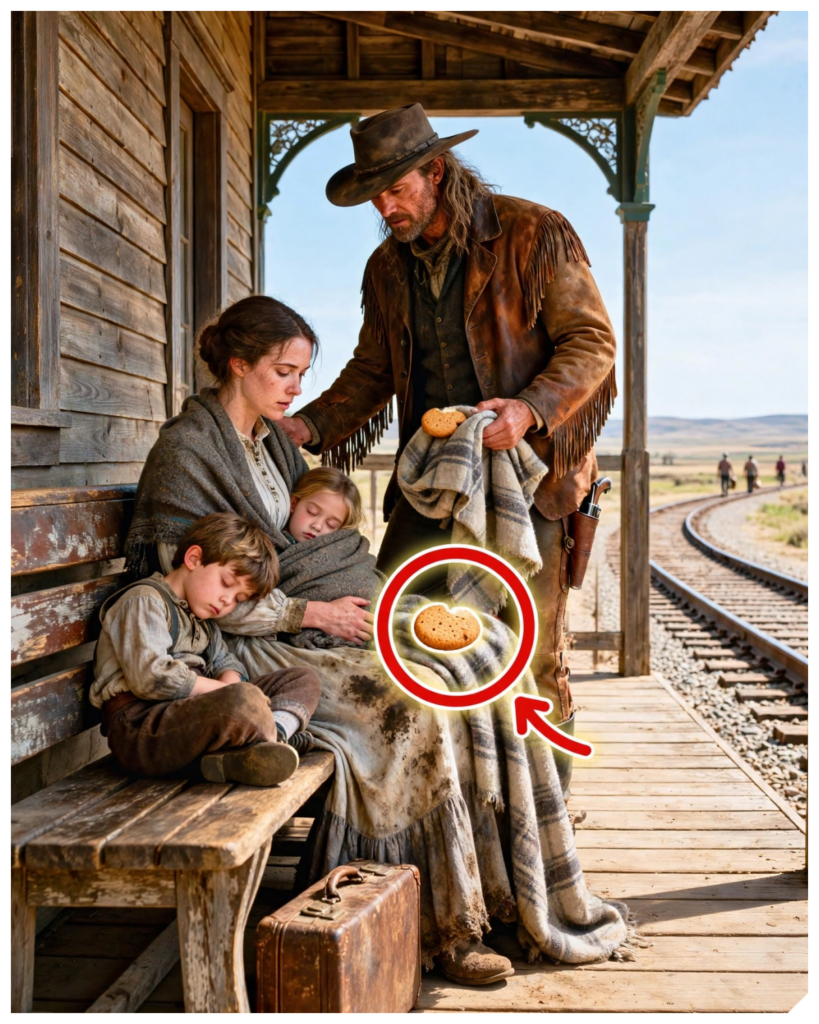
She slept three nights on a station bench with her twins.
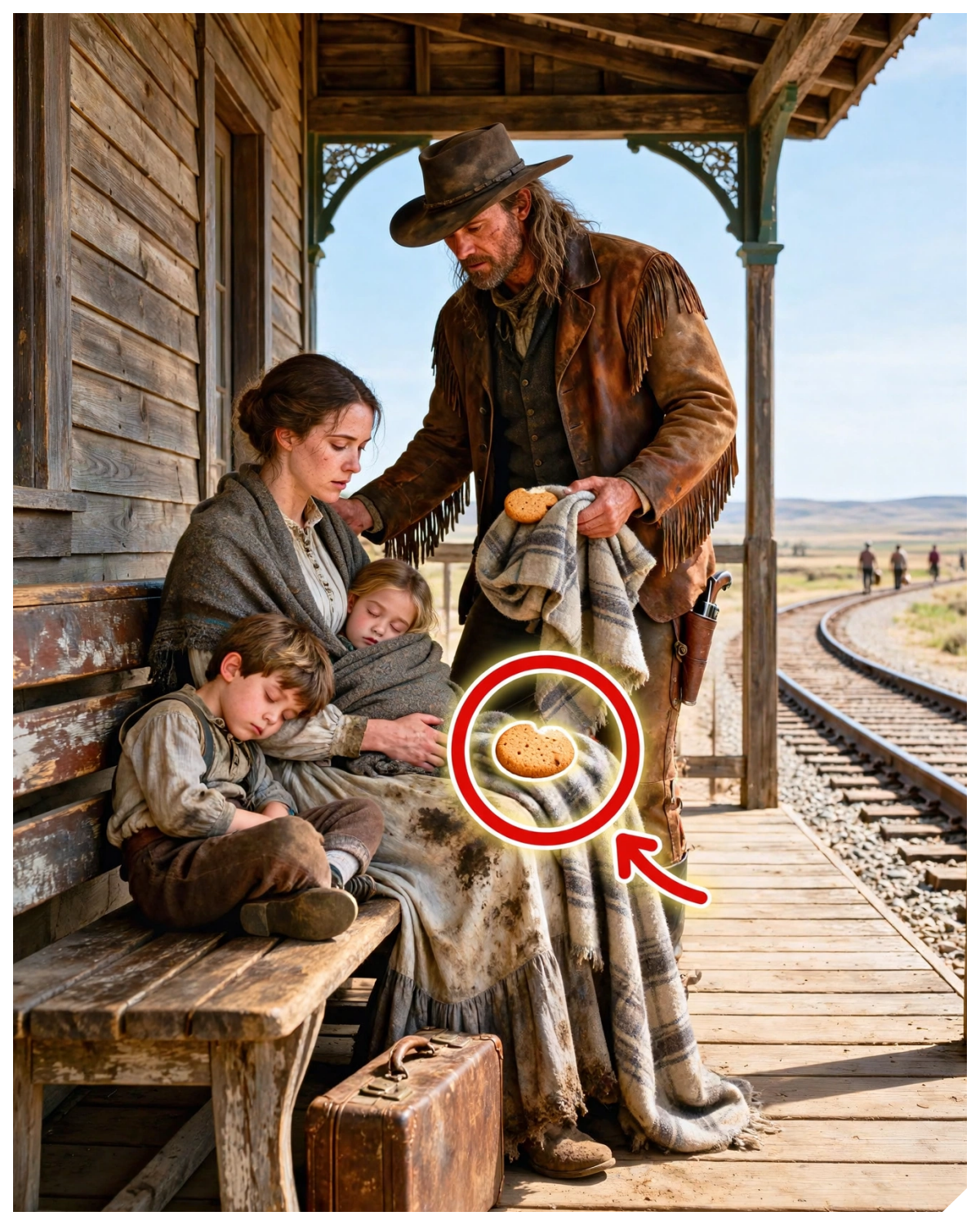
Then the giant cowboy shocked everyone.
The third night came cold, not with frost, but with the kind of creeping stillness that makes children cry in their sleep.
And mothers forget how long they’ve been breathing.
Norah sat stiff on the wooden bench under the far awning of the Bleak Ridge train station, her arms curled around two small bodies, one of them coughing softly into her coat, the other too tired to whimper anymore.
Passengers passed by in pressed coats and hats, casting her only sideways glances, some pausing long enough to judge her dirty dress or the tin can by her feet.
But no one stopped.
No one asked what a widow and her twins were doing at a station with no train for two more days.
She had no ticket, no money, and no husband, only an old railway map, a worn out prayer in her head, and two children who hadn’t eaten more than crusts since Tuesday.
That was when she first noticed him.
Just a shadow near the edge of the freight shed, unmoving, broad as a horse and still as a fence post.
He didn’t speak, didn’t draw near, just stood there at the edge of lamplight, eyes lost under the brim of his hat.
She blinked and he was gone.
But in the morning, there was bread near her boots, thick rye, still warm like it had come from someone’s home, and a tin of peach preserves beside it.
She looked around, suspicious, but no one paid her any mind.
She didn’t trust it, not at first.
She made the boys wait while she tried it herself.
When the sweetness hit her tongue, she wept, not loud, but in that tight, shoulder-shaking way that only people who’ve run out of prayers know.
That afternoon, when the older boy, Jesse, pointed and said, “Mama, there he is.”
She looked up and saw the figure again.
Same man, same shadow, standing across the rail line this time, half hidden between two empty freight cars.
He didn’t move, didn’t wave, just watched for a breath or two before melting back into the dry wind and dust.
She tried to rise and chase after him to ask who he was or why he’d helped, but her knees gave out halfway up, and she slumped back onto the bench.
Whatever this was, a kindness, a trap, or the last mercy of a stranger, it had found her before she collapsed completely.
And as the sun dipped behind the water tower and the lamp light flickered to life, Norah tucked her sons under the coat again and whispered, “We’ll wait one more night.”
She didn’t know she’d already been seen, chosen, and counted, not by a savior, but by a man who’d once walked past someone just like her, and had never forgiven himself.
The dawn came slow, but golden, and with it the wind shifted.
Bleidge woke in pieces.
Clatter of doors, iron wheels squealing down side tracks, boots thutting across platforms, but none of it stirred the giant cowboy until the widow with the twins tried to rise again and stumbled.
That was when he moved.
No warning, no sound.
One moment Norah was struggling to keep her balance, and the next a pair of boots bigger than her hands planted themselves in front of her, and the morning light caught the dust around him like a halo of grit.
He wasn’t just tall, he was colossal.
His shadow covered her and the boys, blocking the rising sun, and when he crouched, the platform creaked under his weight.
Don’t stand yet,” he said, his voice the kind of quiet that could stop a mule but calm a child.
Jesse flinched, but the younger one reached for him like he knew him.
“How long you been here?”
He asked, not unkindly.
Norah swallowed, shame crawling up her neck.
“Three nights,” the man nodded once.
Then slowly he set down a folded blanket beside her, followed by a small sack that smelled like apples, cornbread, and boiled eggs.
“Eat first, then we’ll talk.”
She stared, stunned.
“Who are you?”
She asked.
“Name’s Briggs,” he said.
“No one important.”
And then he stood again and walked a few paces away, turning his back as if to give her dignity while she opened the food.
A station worker slowed as he passed, tipping his hat toward Briggs.
“Didn’t think you were back in town?”
The worker mumbled.
Briggs didn’t answer.
The man moved on.
Norah broke off a piece of cornbread, handed it to Jesse, then gave the softest egg to her youngest.
They chewed like it was treasure, eyes darting to the big man who didn’t look back.
Only when the boys finished did Briggs turn again.
“You waiting on someone?”
He asked.
Norah nodded.
“My cousin?
She said she might come?”
Her voice cracked.
“She didn’t.”
Briggs didn’t say anything for a long time, then low and even.
“And where would you go if not here?”
“I don’t know,” she admitted.
“I thought maybe maybe God would send someone.”
Briggs looked at her then, not her face, but her hands, which trembled from hunger and holding too much too long.
“Sometimes he does,” he said.
“He just wears boots.”
He held out a paper in his other hand.
Train schedule, handwritten notes scrolled across it.
“Delays!
No train until Friday.
Storm on the Western line.”
She stared at it.
“How did you know?”
I asked, he said.
“I notice.”
And then quieter.
I’ve missed things before.
She didn’t know what that meant yet, but the weight of it pressed into her like memory.
He took a slow breath.
Finish eating, then we’ll get you warm.
You don’t have to decide nothing yet.
The twins huddled against her as she nodded.
And as the wind stirred again, and her coat no longer felt like a wall, but a tent under someone’s watchful care, Norah realized this wasn’t just a stranger.
He had waited for her.
By midm morning, the benches cleared and the mailbags were carted off, but the giant cowboy stayed rooted near the edge of the station like a pine tree carved from stone.
He didn’t hover, didn’t intrude, just stood guard with his arms crossed, hat shadowing eyes that seemed to count every tremble in the widow’s hands and every twitch in the smaller twins legs.
When Norah finally rose, both boys clutching her skirts, Briggs gestured not with words, but a slow nod toward the depot fence, where a narrow alley curved behind a row of freight crates.
She hesitated only a breath, then followed.
Beyond the alley was a small warming shed, rarely used, its wood scorched from a long ago stove fire, but still standing.
He pushed the door open, dusted off an old crate with his glove, and motioned.
You can sit here.
They’ll sleep warmer in here than out there.
Norah stepped inside, boys wideeyed, but obedient.
You’re not law?
She asked quietly.
He shook his head.
Was long ago.
Now I mostly fix fences and read train reports.
He leaned against the door frame.
I don’t mean harm.
She looked away.
You’re the first man to say that without sounding like a lie.
One of the boys sneezed and Briggs gently handed over his kirchief.
Rough but clean.
Then came the knock, sharp, angry, a voice outside.
Briggs, that her?
It was a man in a patched vest, boots clicking like judgment.
Briggs turned his head slowly.
Stand down, Eli.
I heard talk.
The man spat.
She’s some mail order bride that ran.
Left a rancher halfway to Marion.
He’s got a reward out.
Norah flinched, gripping the boys.
Briggs didn’t move.
You see her running?
You see fear?
That ain’t the point.
Eli snapped.
She’s marked.
She’s trouble.
Briggs stepped forward, towering.
Then let her be my trouble.
Silence.
Eli sneered.
Just like you to pick up another lost cause.
Remember how that ended last time?
Briggs didn’t flinch.
I remember everything.
The man spit near his boot, then stormed off.
Norah blinked hard.
“Was it true?”
She whispered.
“What he said about another woman?”
Briggs didn’t meet her eyes.
She asked me to ride with her north.
I said, “No,” he exhaled.
Next, I heard her name was etched on a pine marker.
Norah stared at him.
“So why help me?”
“Because I didn’t last time.”
He looked at the boys and because they’re still breathing, she stepped closer.
“You don’t even know my name.”
“Don’t need it yet,” he said.
“But I will.”
“When we get where we’re going.”
“And where is that?”
She asked.
Briggs’s mouth curved.
Not a smile, but something thoughtful.
Somewhere no one calls you trouble.
Outside, the sky thickened with gray, hinting at early snow.
Inside the shed, the twins curled up against each other, warm now, fed now, safe for the first time in days.
Norah sat beside them, fingers still trembling, but not from fear.
For the first time in her memory, someone had stood for her before knowing her story.
She didn’t even realize she’d started crying until Briggs passed her a second kirchief and didn’t look away.
That night, snow dusted the depot roof like powdered sugar on ash, quiet and patient.
Inside the abandoned warming shed, the air grew thinner, colder until Briggs returned with firewood stacked in one arm and a battered kettle in the other.
He’d been gone just long enough for doubt to creep in.
But he came back, not with promises, but with proof.
Norah had curled the boys into a wool saddle blanket, their faces sunken from exhaustion, but pink with warmth now.
Briggs struck Flint against steel until flame caught, slow and flickering, and the little tin stove sputtered to life.
No one spoke for a while.
Silence was safer.
Briggs poured snow melt into the kettle and set it at top the stove, then leaned against the crate.
There’s coffee if you want, or I can tell you a story.
I ain’t good with talking, but I reckon quiet ain’t always kind either.
Norah didn’t answer right away.
She traced her fingers along the rim of her son’s collar, felt the thrum of his small breath.
“You can tell me the truth instead.”
“About what?”
He asked.
“Why you’re not like the others?”
She whispered.
“Why you ain’t asking what I did to end up like this?”
Briggs took off his hat slowly, as if removing armor.
His voice was low.
“Because I already know.
You loved wrong.
Trusted wrong.
Thought marriage would be protection instead of prison.”
She looked up, startled.
He nodded.
“I’ve seen it too many times.
The kind of man who wants a wife but not a woman who sees obedience where he should see strength.
Her voice broke.
He told me if I left, no one would ever believe me.
Briggs’s jaw flexed, but he said nothing.
He added two more logs to the fire and adjusted the kettle.
The warmth crept through the small room, casting the walls in gold.
“The boys don’t speak much,” he said after a moment.
They’ve learned not to be heard.
Norah nodded.
The older one talks in his sleep.
The younger one don’t talk at all.
Not since that night.
She didn’t explain what night and he didn’t ask.
Instead, Briggs gently pulled something from his coat pocket.
A carved wooden horse.
Rough but sturdy.
Found this on the trail weeks ago.
Was going to toss it.
Now I think it’s his.
He offered it wordlessly, and to her surprise, the younger twin reached for it with tiny fingers, holding on like it was a rope to shore.
Norah’s throat tightened.
“You don’t even know our names,” she said again, voice shaking.
“I will,” he said, eyes on the fire.
“When you’re ready.”
The kettle whistled.
Briggs poured the coffee and handed it to her, thick and bitter and warm.
My name’s Briggs Harper, he added after a pause.
I don’t own much, just a little stretch by the rimtrail, but it’s quiet and the roof don’t leak.
She held the cup, stared into the steam, then finally met his eyes.
And if I said I’ve got nowhere else, Briggs didn’t blink.
Then I’d say you already arrived.
And outside, under the drifting snow, the bench they’d once called home sat empty for the first time in three nights.
By morning, the sky stretched wide and clear, pale blue, with a thin line of frost edging the canyon ridge.
Briggs loaded the twins onto his buckboard with quiet care, laying down a quilt of canvas sacks to cushion them, while Norah stood frozen beside the wagon, her fingers tightening and loosening at her sides like she wasn’t sure if she was allowed to hope yet.
“You ain’t obligating yourself to me,” she said finally, watching him tie down the firewood behind the seat.
“I can find work somewhere, clean houses, wash linen.
It’s not about work, Briggs said without looking at her.
It’s about rest.
You’re owed some.
He climbed into the seat and waited until she stepped up beside him, then flicked the res, and the wagon rolled slowly out of the depot yard.
No one from the town stopped them.
No one even looked.
The road wound into the mesa like a trail made for hiding, a long dirt path laced with the tracks of elk and coyote.
The boys fell asleep against Norah’s lap within minutes, and Briggs didn’t speak, letting the stillness hold steady between them.
The cabin appeared like a secret, tucked beneath the shadow of pine and rock, its chimney leaning and its door crooked.
But the moment Norah stepped inside, she saw something that broke her a little.
A broom leaned carefully by the hearth, as if he’d tried to make it livable, as if he’d believed someone else might come.
She set the boys down on a straw mattress in the corner and touched the wood stove, still warm from the ember Briggs left behind last time.
“It’s small,” Briggs said quietly.
But the roof holds and the door locks.
I figure that’s a good start.
She turned to him.
It’s the first place where the wind don’t reach through my bones.
He smiled a little at that and set down a sack of dried beans, then turned back toward the wagon.
I’ve got to ride into Dunford in a day or two.
Get more food, blankets, whatever else you need.
Norah hesitated.
And if someone asks why you’re buying for four, I’ll say it’s for folks that matter,” he said.
“And if they press.”
He looked back at her then, and for the first time, she saw the kind of man who didn’t bluff.
Then I press harder.
That night, with the door bolted and the wind howling outside like a memory trying to break back in, Nora knelt beside her children and watched them sleep.
She whispered the words she hadn’t said in months.
We’re home, my loves.
We’re home.
Then she turned to see Briggs asleep in the rocking chair near the stove, boots still on, hat over his face, but one arm stretched toward the fire like he was keeping watch even in rest.
And for the first time in her life, Norah slept without her hand on a blade.
Not because she’d stopped being afraid, but because someone else had finally chosen to be unafraid for her.
Two days later, the wind shifted, bringing not only the scent of pine and smoke from far away fires, but the sound of hooves, where no rider should have been.
Norah was tending the twins outside near the rain barrel, washing their hands after a breakfast of cornbread and jerky, when she froze at the echo rolling down the canyon.
Briggs stepped out of the barn before she could call for him.
Rifle already in hand, eyes scanning the trail without panic, just the tight readiness of a man who’d been hunted before.
“Get the boys inside,” he said.
She obeyed without question.
The cabin door shut soft and sure behind her, and she crouched low by the mattress, whispering to her sons as if quiet might make them invisible.
Outside, the hooves stopped.
A voice rose, mocking, too loud for such quiet country.
Briggs, that you still breathing up here with your ghosts?
Norah peered through the in the logs and saw them.
Three riders, dustcoated, mouths twisted with the kind of confidence that came from knowing towns wouldn’t dare name them.
The one in front dismounted slow, letting his spurs jangle like punctuation.
“Heard you were nursing a woman,” the man called.
“And a couple of brats.
Ain’t like you to keep company, Briggs.”
Briggs didn’t answer.
Just stood firm, gun resting across his forearms like he was weighing the wind.
“You came a long way,” he finally said.
“Just to bleed in my dirt.”
One of the other men laughed.
We ain’t here to bleed.
We’re here to collect.
Norah couldn’t breathe.
She could only watch as Brig stepped forward once.
“You come again?
I’ll bury you up here so deep the coyotes will file a complaint.”
The lead man grinned, sharp and slow.
“You think a woman and some bastards are worth dying over?”
“I think they’re worth living for,” Briggs said, which is more than I can say for any of you.
There was a pause, a breathless slice of silence where the world itself held still.
Then, without another word, the riders turned.
Dust rose in their wake, and Briggs didn’t lower the rifle until they vanished down the ridge.
Norah opened the door slowly, not realizing her hands had been shaking until she saw the red marks in her palms.
Briggs walked back, quiet as always.
And when she looked at him, he only said, “You okay?”
She nodded.
“Who were they?”
“Ghosts from when I ran with bad men,” he said.
“But they don’t haunt me no more.”
“Why not?”
She asked.
“Because this time,” he said, eyes resting on her and the boys, “I got something worth guarding.”
That night, when the wind rose again, Briggs put another log on the fire and pulled his chair closer to the door.
And Norah, watching him from the shadows, realized something terrifying and beautiful.
This was the first man who’d ever looked at her children like they weren’t baggage, but like they were the very reason he’d draw breath and stand tall with a gun in his hands.
The next morning broke clear and gold, but the peace didn’t settle easily.
Norah swept the porch in slow arcs, the twins playing nearby with sticks pretending to be horses, while Briggs hammered fresh boards onto the window shutters without explaining why.
She didn’t ask because in her bones she already knew.
Trouble wasn’t done with them yet.
After lunch, a lone rider came.
Not one of the outlaws from before, but a boy barely 20.
Dust streaked and wild eyed.
He carried no weapon, only fear.
“Mr.
Briggs,” he called, stopping at 10 feet short of the porch.
“I got a message from Boon.”
Briggs didn’t flinch, but Norah saw something go tight in his jaw.
“Speak it.”
Boon says he wants the woman.
Says she’s got debts on her name.
Says you can hand her over by Friday or the next fire you see will be your cabin.
Norah dropped the tin plate in her hand.
It clattered and spun like a coin, deciding fate.
Brig stepped down, slow and heavy.
Tell Boon if he wants her, he’ll have to cross me.
And when he does, I won’t bury him near the river.
I’ll leave him where the hawks can carry pieces home.
The boy nodded, pale and sweating.
Yes, sir.
I’ll tell him.
He turned his horse fast and vanished.
When the dust settled, Norah walked out to Briggs, her breath tight.
You knew this would happen.
I did.
Then why take us in?
He turned, gaze steady but soft.
Because no woman should be hunted for a man’s mistakes, and no child should watch their mother shiver through nights waiting for mercy.
She stared up at him, her voice trembling.
You think we’re worth dying for?
I don’t plan on dying, he said.
But I’d rather bleed on this dirt than watch you look over your shoulder for the rest of your life.
That night, as dusk turned the valley to blue and gold, the twins asked if they were still going to leave someday.
Norah crouched by them, brushing dust from their cheeks.
“No,” she said.
“We’re staying.
Mr.
Briggs says we’re safe here now.”
“Is he our new paw?”
One of them whispered.
Norah looked across the room where Briggs stood polishing the rifle again, his body blocking the door like it was made for guarding.
“Not yet,” she whispered.
“But I think he’s already family.”
Later, when the stars came out, she stepped out onto the porch.
Briggs was there as always, watching.
She sat beside him, close enough to feel the heat from his shoulder.
You once told me you didn’t know your place in this world, she said, but I think I do now.
He looked at her, eyes shadowed but steady.
And where’s that?
Right here, she said.
Between my boys and a man with a backbone made of iron and a heart that finally found something soft to hold.
He didn’t speak, just nodded once, solemn and slow.
Then for the first time he spoke her name, not in caution, not in warning, but in reverence.
And she for the first time whispered his back like a vow, like a thread sewn across the scars of two broken pasts, pulling tight, pulling close.
By Friday dusk, the whole valley knew.
Word moved faster than smoke in dry wind, and every rancher from Saddle Pass to Jasper Creek had heard Boon was coming for blood.
Some left town, some bolted their doors.
But a few rode out to stand near the cabin, not with guns raised, but with hats low and backs straight, like men who remembered what it meant to protect the right thing, even if it wasn’t theirs.
Briggs didn’t ask for help, didn’t give orders, just checked every window shutter twice, filled the water barrels, and told Norah and the boys to stay inside no matter what they heard.
But Norah had stopped obeying fear a long time ago.
She stood behind him on the porch, a lantern in her hand, her jaw set like stone beneath her soft curls.
If this place is going to burn, she said, then I’m burning beside you.
Briggs didn’t argue.
He just passed her the second rifle.
Then, as the sky turned red, they heard hoof beatats.
Too many.
A dozen, maybe more.
Boon rode front, smug and slow, coat flapping behind him like a judge’s robe.
“You going to hand her over, cowboy?”
He called.
“Or should we take the roof down first?
Briggs stepped forward, giant and steady.
You’ll touch nothing here, Boon smirked.
One man against all this.
One man with nothing left to fear, Briggs said, and a whole valley watching to see if they still got a soul.
Boon laughed, raised his hand, and then stopped.
Because from the trees, one by one, shapes emerged.
Old men, young hands, farm boys with dull tools, a preacher with a shotgun.
No one said a word.
They just stood there, not behind Briggs, but beside him.
Boon’s horse danced sideways, uneasy.
This ain’t your fight, he snapped.
But the preacher stepped forward, eyes like iron.
It became ours the second she tucked those twins into clean sheets instead of graves.
Another man added.
It became mine the day this cowboy carried her off the station bench like she was made of something sacred.
The circle of riders hesitated.
Boon looked around, seeing no soft target left.
Only men who’d buried wives, lost land, made peace with pain, and now stood for something more than pride.
Boon spat, cursed, then wheeled his horse.
Ain’t worth it,” he muttered.
“Let the giant and the widow rot together.”
As they vanished into the hills, the tension broke like thunder.
Men let out breaths.
The preacher tipped his hat.
Briggs didn’t move.
Norah ran to him, trembling.
[clears throat] “They’re gone,” she whispered.
“You did it.”
“No,” he said.
“We did.”
She looked at the ground, then at the crowd, then at him.
“What now?”
Briggs took the rifle from her, set it down, and cupped her cheek with the hand that once held only war and weight.
“Now we stop surviving,” he said.
“We start living.”
Behind them, the boys peeked out, eyes wide with awe.
One whispered, “Is it over?”
Norah turned, “No, sweetheart.
It’s just beginning.”
And inside the cabin the fire crackled, not with warning, but with warmth.
By morning the train came again, whistle low, steam rising like breath in the cool dawn.
And the same bench where Norah once curled her children into her shawl, stood quiet and clean beneath a golden sun.
People in town slowed as they passed it.
Some nodding with quiet respect, others pausing like they were remembering something they couldn’t name.
That bench, once the edge of Norah’s shame, had become something else now, a mark of what had been lifted.
Inside the telegraph office, Briggs posted a notice.
Hiring hands, cabins got space, children welcome.
And under it, in pencil, Norah added one line.
No woman turned away.
The message spread, not loud, not fast, but steady, like water rising.
That week alone, three women came, one with bruises under her shawl, one with a boy who wouldn’t speak.
One with nothing but a name she refused to give.
Briggs met each one at the door, never asking more than, “You hungry?”
Norah had set aside her apron and now helped build bunk beds with spare planks and rail ties.
Her fingers blistered, but her smile firm.
The twins ran barefoot through the orchard, no longer silent shadows, but laughing sparks, and the valley that once held only ghosts began to hum again with living sounds, hammering, chopping, babies crying, boots scuffing wooden steps.
On Sunday, the preacher who once avoided her came up the path with his wife and a peach pie.
He tipped his hat and said, “We were wrong.”
Norah nodded, not with bitterness, but grace.
“I was too,” she said.
“I thought love had to look like rescue.
Turns out it looks like someone who stays.”
Briggs, listening from the fence, turned to the rising sun and breathed deep.
For a man who’d once laid his head in the dust of battlefields and thought peace a myth, the sight of children sleeping safe and women laughing in the kitchen was a bigger miracle than any preachers’s verse.
That night around the fire pit they’d dug together, folks gathered, some broken, some new, some just curious.
Norah stood holding one of the twins in her arms and told them not a sermon but a story of a bench, a cowboy, a second chance.
No one interrupted.
When she finished, silence settled like dust, and then someone clapped.
Another followed.
Briggs stayed seated, watching her.
She caught his eye across the fire light, and for a moment all the miles they’d walked alone vanished.
She mouthed two words across the flames.
Thank you.
And for the first time in his life.
The giant cowboy lowered his head, not in shame, but in awe.
That night, under a sky full of stars they’d once prayed beneath in fear.
A widow and a rancher didn’t just survive.
They became the center of a story others wanted to believe in.
And on that station bench, no one ever had to sleep alone again.
By the next week, the station bench had no dust on it, not because someone cleaned it, but because no one ever sat on it again long enough to leave a mark.
The spot where Norah once cradled her children in exhaustion, had become something else entirely.
A place people pointed to with reverence, where someone had once made a different choice.
Briggs had built a small covered shelter beside it with a wooden sign that simply read, “Start again here.”
Folks said the idea came to him after he saw a young boy asleep on the freight cart.
His mother too proud to ask for help, but too tired to move.
Briggs didn’t speak.
He just knelt, offered a biscuit, and walked her toward the house behind the orchard.
Word spread, not just about the bench or the cowboy, but about the way no one was turned away.
Women came, some with children, some with bruises, one even barefoot, each one met by Norah first, arms full of blankets, and her eyes full of something stronger than pity, recognition.
Norah no longer looked like the woman who arrived silent and half starved.
She walked tall, carried purpose in her shoulders, and spoke with clarity.
She had no title, but the town followed her lead as if she did.
The twins helped where they could, carrying buckets, wiping tables, even sharing their corner of the bed roll with newcomers.
They laughed now.
They fought sometimes, too, like normal children do when the world doesn’t feel like it’s ending.
That Sunday, Briggs stood at the doorway of the old freight office and didn’t move when the preacher approached.
The man offered no sermon, only a question.
Do you need more hands?
Briggs nodded once, always.
And so the preacher stayed.
He swept floors, hammered nails, and never once asked what any of the women had done or where they came from.
That night, under stars and lamplight, the table was full.
Some chairs, some crates, some just folks sitting on the ground.
Norah served stew made from five different pots, and Briggs carved wooden spoons for the ones who came empty-handed.
A girl no older than eight whispered, “Is this a church?”
Norah smiled, “No, sweetheart, but it’s holy.”
When the fire died down and the dishes were stacked, Briggs found Norah at the doorway watching the wind move through the orchard.
He stood beside her, not touching, just near enough for her to know she wasn’t alone.
“You didn’t just save me,” she said.
“You made a place where no one has to be saved again.”
He shook his head slowly.
“I didn’t make it.
You did.
I just had big hands and an extra horse.”
She laughed softly, leaned her head against the door frame, and said, “Well, let’s build more then.”
And they did.
That corner of the station town, once a place for delay, for shame, for forgetting, became known for something else entirely.
Not because it had a sign or a sermon or a name, but because whenever a woman arrived with nothing but children and fear, someone met her there, took the bags from her hands, and said gently, “You’ll never wait alone again.”
“Please like, share, and subscribe to support more truehearted stories on stories left behind.
If you saw a mother and her twins sleeping on a bench, would you have stopped like the cowboy did or walked on?
Tell us in the comments.