They knew what he had eaten last, [music] a pasty a few hours before he died.
They knew his shoes had been polished and that they were far cleaner than the shoes of a man who had spent the day walking around a seaside town.
They knew someone had removed the label from [music] every piece of clothing he wore.
What they did not know for 73 years was his name.
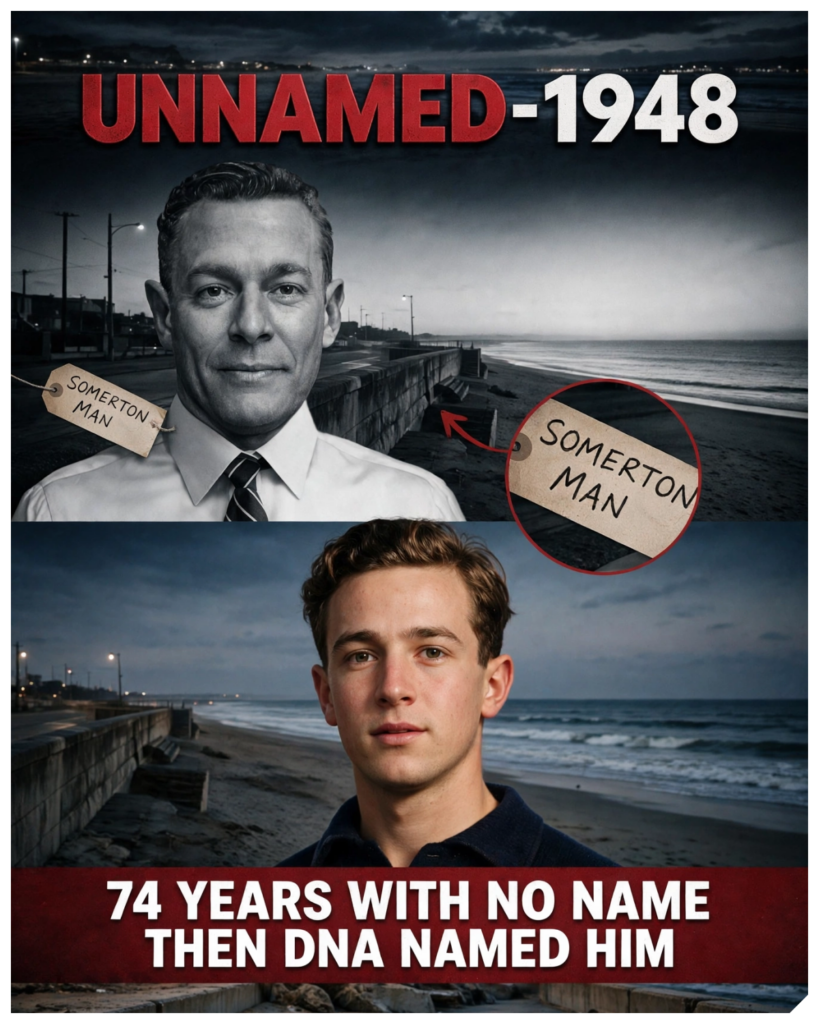
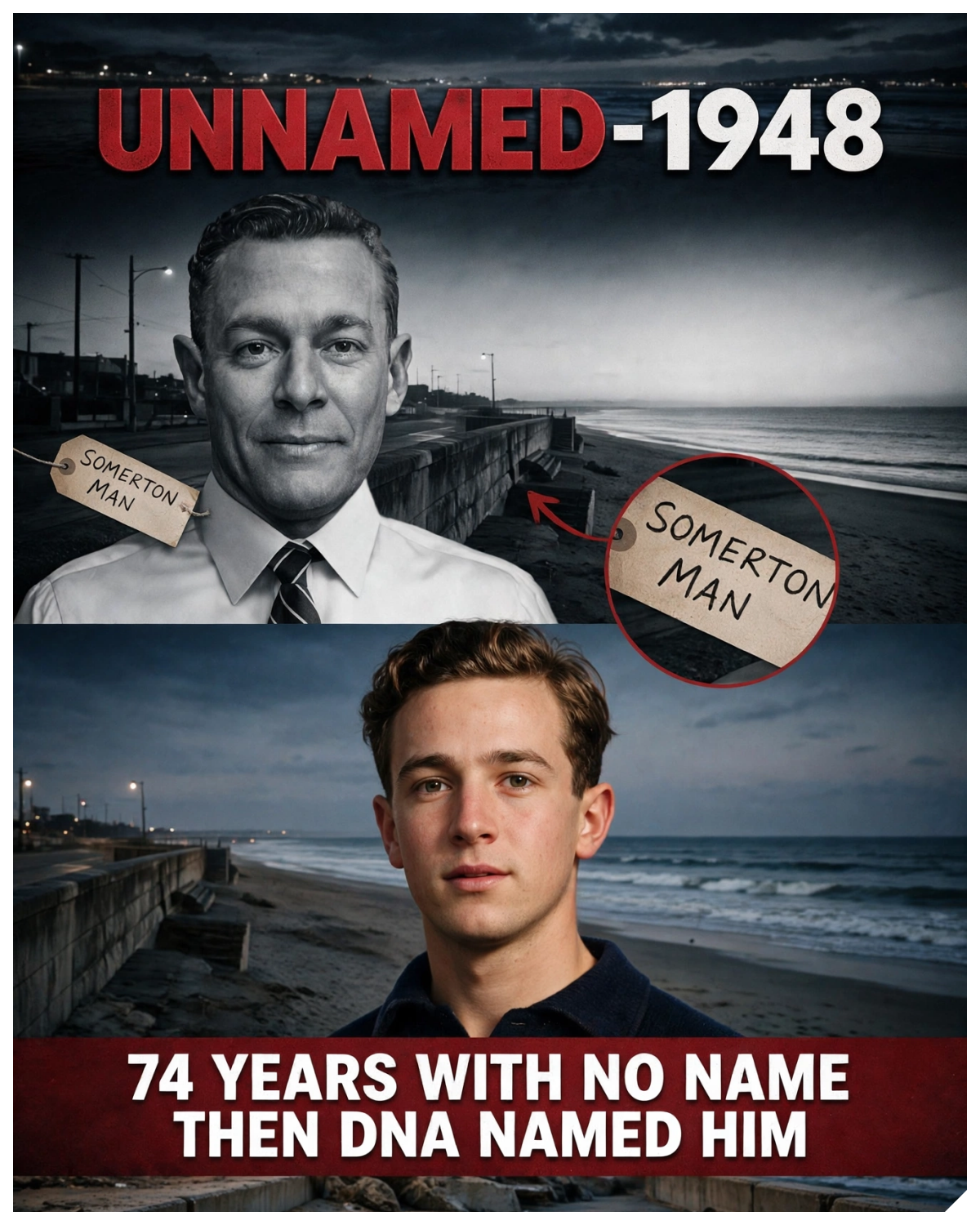
The newspapers called him the [music] Summerton Man.
He was found on a beach just outside Adelaide, South Australia on the morning [music] of December 1st, 1948.
Months later, in a tiny pocket sewn inside his trouser pocket, a pathologist found a rolled scrap [music] of paper printed with two words in Persian.
Tamam shu, “It is ended.”
Within a year, the case had drawn attention far beyond Australia.
A spy, people said, “A sailor, a jilted lover.
Everyone had a theory.
Nobody had a name.
Before they buried him, a museum taxiderermist made a cast of his head and shoulders in plaster so that someone someday might look at that face and know it.
Nobody did.
The plaster face went into storage.
The man went into the ground under a stone that called him the unknown man.
[music] And for 73 years, 7 months, and 25 days, which [music] is 26,900 days, nobody could say who he was.
This is the story of the Summerton man.
[music] Who he really was and how a few hairs caught in that plaster led to the name that researchers say is his.
It is a name the state of South Australia, as this video is made, has still not confirmed.
It starts with two young men exercising horses on the sand.
This is the Unnamed Files.
[music] We follow the people the world forgot to name all the way to the day they [music] get it back.
If you want to know who the Summerton man really was, subscribe.
Now, back to Summerton.
Summerton Park is a seaside suburb about 11 km southwest of the center of Adelaide, just down the coast from Glenn Elg.
It has a long esplanade above a wide flat beach.
In 1948, on the landward side of that esplanade, at the corner of Bickford Terrace, stood the crippled children’s home.
The war had been over for 3 years.
Clothing rationing had ended only that June and a new kind of war was beginning.
Within months, Australia would create a new security service, ACIO, [music] in part to deal with Soviet espionage.
That mood would shape how this case was seen for the next 70 years.
On the evening of Tuesday, November 30th, 1948, people walking along the esplenade noticed a man lying on the sand below it opposite the home.
He was lying back with his head against the seaw wall and his leg [music] stretched out in front of him.
One couple at around 7:00 saw him extend his right arm as far as it would go and then let it drop.
Another couple watched him for about half an hour from 7 while the street lights came on.
They did not see him move.
They remarked to each other that it was odd he was not reacting to the mosquitoes.
They thought he was most likely drunk or asleep.
Nobody went down to check.
At about 6 the next morning, Wednesday, December 1st, two apprentice jockeys came along the beach exercising their horses.
They rode past a man lying against the seaw wall.
A local man, John Lions, was on the beach as well, and he called the police.
Constable John Moss arrived at about a/4 to 7 and Detective H.
Strangway took up the inquiry with him.
The man was in the same position the witnesses had described the night before.
Head against the wall, legs out, feet crossed.
A half-sm smoked cigarette rested on the collar of his coat.
He had died during the night.
Doctors would come to suspect poison, but no poison was ever found, and no cause of death was ever determined.
That is all this story needs to say about how he died.
Then came the inventory.
[music] He wore a white shirt, a red, white, and blue tie, brown trousers, a brown knitted pullover, and a smart gray and brown double- breasted jacket.
In his pockets, police found an unused secondass railway ticket from Adelaide to Henley Beach and a bus ticket from the city.
A narrow aluminium comb made in the United States, half a packet of Juicy Fruit Chewing gum.
An Army Club cigarette packet holding seven cigarettes of a different brand, Canidas, and a box of Bryant and May matches about a quarter full.
What was missing told them more.
He had no wallet.
He had no hat, which for a man in a suit in 1948 was unusual.
There was no license, no letter, no paper of any kind, nothing with a name on it.
Detectives took his fingerprints and checked them against South Australia’s records.
On December 4th, police announced the result.
His prints were not on file.
The first question anyone asks about a body is who he was.
In Adelaide in the summer of 1948, there was no answer.
So investigators turned to the body itself.
According to the medical evidence, the dead man was of British appearance, about 40 to 45 years old, and in top physical condition.
He was about 180 cm tall, just under 5’11, fair to ginger hair, going gray at the temples, broad shoulders, and a narrow waist.
His hands showed no sign of manual work.
His calf muscles were unusually high and pronounced, the kind seen in people who wear high heeled boots or dance.
Every one of those details was a clue, and none of them led anywhere.
His teeth were compared against dental records.
They matched no known person.
The government pathologist who performed the postmortem, Dr.
John Dwire, believed he had been poisoned.
“I am quite convinced the death could not have been natural,” he said.
“But every test for poison came back with nothing.”
On December 3rd, the news printed his photograph on its front page.
[music] No one who came forward knew him.
On December 10th, with no identification, the body was inbalmed.
Police said it was the first time they knew of that being needed.
It preserved him for the months ahead.
Decades later, it would turn out to have badly damaged his DNA.
Then, on January 14th, 1949, staff at Adelaide Railway Station found a brown suitcase in the cloak room.
It had been checked in on November 30th, the day before he was found, and never collected.
Its label had been removed.
Inside were clothes, a dressing gown, slippers, shaving gear, an electrician screwdriver, and a stenciling brush.
Most of the clothing labels had been cut out just like the ones he was wearing.
Most, but not all.
On a tie was the name Teen.
On a laundry bag, Keen.
On a singlet, Keen.
There was also a card of orange waxed thread made by the firm of Barber, a kind not available in Australia.
It matched thread that had been used to repair a pocket in the trousers the dead man had on that tied the suitcase to him.
A coat in the case had stitching that suggested it had been made in the United States.
With the suitcase and the tickets, police pieced together part of his last day.
They believed he had arrived in Adelaide on an overnight train from Melbourne, Sydney, or Port Augusta.
That morning he bought a ticket for the 1050 train to Henley Beach.
It was the first of only three tickets that clerk sold for that train between a4 6 and 2 in the afternoon.
He never got on it.
Instead, he checked his suitcase into the station cloak room, walked out onto North Terrace, and caught a bus heading toward Glennel.
Glennel is the suburb just north of Summerton Park.
Then, around the time of the coroner’s inquest in June 1949, Professor Cleland found something everyone had missed.
Sewn inside the dead man’s trouser pocket was a smaller pocket called a fob pocket and inside it was a tightly rolled piece of paper.
Printed on it were the words tam should.
Public library staff identified them as the final words of the Rubayat of Omar Cayam, a book of Persian poetry popular in English translation.
They mean ended or finished.
The back of the scrap was blank.
It had been torn from a book.
Police went looking for it all across the country.
But before they found it, the city had to decide what to do with him.
He already had a name of sorts, not a name, but a place.
The newspapers called him the Summerton Man.
[music] One Adelaide Papers editorial called the case one of Australia’s most profound mysteries.
In June 1949, a journalist reached for the poem itself.
The Summerton man, he wrote, seems to have made certain that the glass would be empty, saved for speculation.
By then he had been dead for 6 months and the inquest was about to resume.
So the authorities did one [music] more thing to keep his face.
At the South Australian Museum there was a taxiderermist named Paul Lawson.
In early June 1949, Lawson went to the city morg and made molds of the dead man’s head and shoulders and separately of his ears.
Back in his workroom, he filled the molds with plaster of Paris strengthened with cy fiber.
When they were broken away, what remained was a bust.
The Summerton man’s face cast in pale plaster, the eyes closed.
Pressed into that plaster, though no one paid any attention to them, were a few strands of the man’s own hair.
The bust went to the police on June 16th for the inquest.
Its purpose was simple.
If someone who had known him saw it, they might recognize him.
After the inquest, it went back to Lawson’s office for safekeeping.
Years later, it would end up locked away in the museum of the South Australia Police Historical Society.
2 days earlier, on June 14th, 1949, the Summerton man was buried at West Terrace Cemetery in Adelaide.
He did not get a Poppers funeral.
The South Australian Grandstand Bookmakers Association, the men who took bets at the city’s racecourses, paid for his burial.
The Salvation Army conducted the service.
After the funeral, a headstone was added.
It said only what Adelaide knew.
Here lies the unknown man who was found at Summerton Beach 1st of December 1948.
In the years that followed, flowers began to appear on the grave.
Police once questioned a woman seen leaving the cemetery.
She said she knew nothing about the man.
In another state in Victoria, a family photo album sat in a back room.
Two of its pages were stuck together.
Back in Adelaide, the headstone stayed where it was, and the years began to pass.
If it gets to you that a city buried a man whose name nobody knew, and that a group of bookmakers paid so he wouldn’t go into a popper’s grave, hit like.
It tells YouTube these stories matter.
[music] Now, back to the inquest.
It had first opened a few days after he was found and then been adjourned.
It resumed on June 17th, 1949 before the city coroner, Thomas Erskin Cleland.
It heard from doctors and police and from the ticket clerk and the bus conductor who had sold the dead man his tickets.
Neither of them remembered him.
The coroner could reach no conclusion on who the man was or how he died or even whether the man seen moving on the beach that evening was the man found there in the morning.
[music] Nobody had seen his face.
As early as April 1949, authorities had called it an unparalleled [music] mystery.
It was not for lack of names.
The trouble was that there were too many.
On December 2nd, 1948, the morning after he was found, the advertiser had reported that the body [music] was believed to be that of a local man, EC Johnson, about 45 of Arthur [music] Street, Panham.
Within a day, Mr.
Johnson walked into a police station to show them he was alive.
Think about that for a second.
The first [music] name ever attached to this man belonged to someone who had to prove he wasn’t dead.
More names followed.
By early February 1949, there had been eight separate positive identifications.
When his photograph was published in Victoria, 28 people said they knew who he was.
Victorian detectives checked every claim and disproved them all.
For a while, they had wondered whether he was from Victoria at all because the dry cleaning marks on his clothes looked like the ones used by several Melbourne firms.
A nationwide check of those marks went nowhere, and the detectives concluded it was unlikely he was a Victorian.
His fingerprints were sent overseas.
The FBI in the United States could not match them.
[music] Scotland Yard could not help.
Then, in July 1949 came the book.
A man brought police a copy of the Rubayat that he said he had found in his car parked in Glenn [music] Elk.
Its last page had been torn.
Tests showed the scrap from the dead man’s pocket had come from it.
In the back of the book, under ultraviolet light, detectives found the faint indentations of handwriting.
Five lines of capital letters that looked like a code.
Code experts were called in.
Nobody could read it.
Decades later, in 1978, cryptographers from Australia’s Department of Defense reported that it was too short to give any satisfactory answer.
And beneath the code, there was something easier to read, a telephone number.
The number belonged to a nurse who lived about 400 m from where he had been found.
She told police she did not know the dead man.
She said she had once owned a copy of the Rubiat and in 1945 in Sydney [music] she had given it to an army lieutenant named Alf Boxel.
Detectives showed her the plaster bust.
[music] She said she could not identify him.
But the detective leading the case, Lionel Leane, said she was so taken aback that she appeared about [music] to faint.
Paul Lawson, who was in the room, later said she looked away and [music] would not look at it again.
She asked police to keep her name out of the record [music] and they agreed.
We are going to keep it out too.
Now the police thought they knew who the dead man was, Alf Boxel.
But on July 27th, 1949, detectives found Alf Boxel alive in Sydney working at a bus depot.
He still had his copy of the Rubiad.
Its last page was intact and the words [music] tam should were still on it.
He was not the Summerton man.
The tips never stopped.
By November 1953, police said they had received the 251st solution to who he was.
And no, that’s not a typo.
If you’re wondering how a man could lie under a headstone for seven decades while this many people tried to name him, subscribe.
The person who refused to give up is coming next.
[music] And what he found is the reason this story has an ending.
Now, here is what went wrong.
There was one clue that seemed small at the time, the name on the tie, Keen.
Police searched for a missing T Keen and found no one in any English-speaking country.
They came to believe that whoever cut out the labels had either overlooked those three or left them on purpose, knowing Keen was not the dead man’s name.
Either way, it was treated as a dead end.
It would turn out to be the most important clue in the case.
The file went cold and pieces of it went missing.
In March 1958, the inquest was resumed, heard nothing new, and was adjourned indefinitely.
The original copy of the Rubat was lost in the 1950s.
Over the years, witness [music] statements disappeared from the police file.
The autopsy reports went missing, and in 1986, the Brown suitcase and everything in it were destroyed because they were no longer required.
In 1951, in a Melbourne newspaper, a short legal notice appeared.
A woman was divorcing her husband on the grounds of desertion.
Nothing connected it to a grave in Adelaide.
The deeper failure was the system itself.
In 1948, there was no national way to match an unidentified body in one Australian state against a missing person in another.
The country’s first national DNA program for its unidentified dead was not launched until August 2020 by the Australian Federal Police.
When it audited what police and forensic facilities were holding, it counted 850 sets of unidentified human remains.
It also counted about 2,600 people who had been missing for more than 3 months.
The program’s lead, Jodie Ward, said those remains were not case numbers, but people with names, families, and stories still waiting to be discovered.
And the Summerton man had one more problem of his own.
The inbalming fluid that had preserved him in 1948 had broken down much of his DNA.
We’ll get to his name, but first, you need to understand why it took 73 years and who refused to accept that it never would come.
The man who refused was Derek Abbott.
He is a professor at the University of Adelaide and his field is electrical and electronic engineering, not forensic science.
In March 2009, he and a team of his students began working on the Summerton Man.
They started with the code.
Then they turned to everything else.
The question that took over was the oldest one.
Who was he?
Abbott came to believe that the only way to answer it was DNA.
In 2011, South Australia police gave him access to something no one had treated as evidence for 60 years, the plaster bust.
Caught in it were about 50 of the dead man’s hairs.
The body itself was out of reach.
In October 2011, South Australia’s attorney general, John Ralph, refused to allow an exumation.
There needed to be public interest reasons, he said, that go well beyond public curiosity.
So Abbott worked with what he had.
Old hair is a difficult source of DNA, and this hair had spent decades inside plaster.
In December 2017, his team announced they had found three hairs at the right stage of growth and sent them to the Australian Center for Ancient DNA at the University of Adelaide.
In February 2018, the lab produced his complete mitochondrial profile.
It told them his mother’s line was European and that it belonged to a rare lineage.
Shared by about 1% of Europeans.
It could not tell them a name.
Abbott tried faces, too.
In July 2013, he released an artist’s impression he had commissioned of the man as he might have looked alive.
For decades, he pointed out, the only image people had seen was the autopsy photograph, and it was hard to tell from that what the man had really looked like.
The impression brought no name either.
Abbott was not the only one keeping the case alive.
Jerry Feltus, a retired South Australian detective who had worked it as a cold case, had published a detailed account of it in 2010.
He called it the unknown man.
The calls for an exumation kept coming.
On October 14th, 2019, a new attorney general, Vicky Chapman, gave conditional approval.
The work became part of an operation by South Australia police called Operation Persevere set up to put names to all the unidentified human remains in the state.
On May 19th, 2021, the digging began at West Terrace Cemetery.
His remains were deeper than anyone expected and the work took 12 hours.
Late that day, four pawbears carried a coffin out of the cemetery under police escort.
Detective Superintendent Dez Bray from Major Crime spoke to reporters at the cemetery.
The Summerton man, he said, was not just a curiosity or [music] a mystery to be solved.
He was somebody’s son, perhaps somebody’s father or brother.
And Bray was honest about the odds.
They might not succeed, he said.
Vicky Chapman was hopeful.
It’s an enduring mystery, she said.
But I believe that finally we may uncover some answers.
The remains went to Forensic Science SA.
Its assistant director of operations, Anne Coxin, said the technology now available was light years ahead of what had existed in the 1940s.
But she warned that the imbalming fluid was a complication.
Even if they recovered DNA, there might be no match.
Abbott kept going on his own.
The state had the body.
The suitcase was long gone.
But he had the hair from the plaster.
The one piece of the Summerton man that had survived every loss in the file because for 60 years no one had thought of it as evidence and he had found a genealogologist who knew what to do with it.
If it means something to you that a professor spent 13 years trying to name a man he had never met, hit like.
It helps these stories reach the people who need them.
Now, to understand how this case finally broke, you need to understand one thing about DNA.
Every cell in your body carries two kinds of it.
There is a small amount in the mitochondria, the tiny power plants inside your cells.
You inherit it from your mother who inherited it from hers, almost unchanged for generation after generation.
That makes it hardy and relatively easy to read.
It also makes it nearly useless for finding one particular person because thousands of people can share the same maternal line.
That is what the 2018 test had found.
A lineage, not a family.
Then there is the DNA in the nucleus of your cells.
Half comes from your mother and half from your father, shuffled into a new combination with every generation.
Labs can read it at hundreds of thousands of points called markers.
Two people who share long stretches of it are related, and the more they share, the closer the relationship.
That is what genetic genealogy uses.
Millions of people have taken home DNA tests to learn about their ancestry, and many have chosen to let their results be compared with other people’s.
Upload an unknown person’s DNA, and it can turn up their cousins, usually not close ones, third cousins, fourth cousins, people who share a great great grandparent.
Then genealogologists do the slow part.
They build each cousin’s family tree back [music] to the ancestors they share, and then forward again through every branch, looking for someone who fits.
If you’ve ever spat into a tube to find out where your family came from, you are part of the reason this [music] works.
Abbott worked with Colleen Fitzpatrick, an American forensic genealogologist and a pioneer in using online family tree data to solve cold cases.
Her firm, Identifinders International, [music] is based in California.
The hair was more than 70 years old.
More than 60 of those years had been spent inside plaster, and it yielded about 2 million DNA markers.
They loaded the profile into a genealogy database.
It returned as many as 4,000 possible matches.
Fitzpatrick later described working [music] through that soup and ocean of DNA cousins.
The team built out a family tree that eventually held more than 4,000 people.
So, how do you find one man in a tree that size?
Abbott’s answer was simple.
They looked for people [music] with no date of death.
A man born in the right years who shows up in the records as a child, as a worker, as a husband, and then never shows up again.
In a [music] tree of 4,000 people, nearly every life ends with a death record.
They were looking for the one that just stopped.
By March 2022, one man stood out.
[music] He was the right age.
He had no death record, and he was very closely connected to a family named Keen, the name on the tie.
The clue that had been written off as a dead end for 73 years.
But a candidate is not an identification.
To prove it or to rule it out, they needed someone alive today [music] from the right family who would give a sample.
They followed the tree down the man’s mother’s side generation by generation and found a man who runs a shop selling combustion heaters in Barnsdale in Eastern Victoria.
He got a call from a professor in Adelaide asking him to take a DNA test.
His first thought, he said later, was that it was a scam.
He checked that the professor was who he said he was.
Then he volunteered.
His sample matched on the mother’s side, exactly where the tree said it should.
The man he was related to was his [music] first cousin, three times removed.
The team had already found a cousin on the father’s side from a completely different branch.
Two relatives from [music] two distant parts of one family, both pointing at the same man.
Abbott called it triangulation.
On Saturday, July 23rd, 2022, the final pieces of DNA proof fell into place.
3 days later, the team went public.
According to the research team led by Professor Derek Abbott of the University of Adelaide and genealogologist Colleen Fitzpatrick, his name was Carl Webb.
South Australia police have not confirmed it.
When the team announced it, police said they had not verified the result, but were cautiously optimistic that it could be a breakthrough.
They said they were still actively investigating the case and that the identification would ultimately be decided by the coroner.
For 73 years, he was the Summerton man.
From here on, we will call him by the name the researchers found.
He was born on November 16th, 1905 in Footsgay in [music] Melbourne.
He went by Charles.
He was the youngest of six children.
His father, Richard August Webb, had come to Australia from Hamburg in Germany.
[music] His mother was Eliza Amelia Morris Grace.
They married in 1892, and in time, the family ran [music] a bakery in Springville, southeast of Melbourne.
In 1921, a photograph was taken of the Swinburn Technical College under 16 football team.
The team list includes a C Web.
An independent researcher found that photograph after the name was announced and his family believe he is the boy at the far left of the front row.
He would have been 15 or 16.
It’s thought that when the family bakery closed, Charles retrained.
He became an electrical instrument maker.
On October 4th, 1941, he married Dorothy Robertson, a pharmacist and sheropist.
They later lived in a flat in Brami Street, South [music] Yara.
Then the losses came.
His father had died in 1939.
In 1943, his brother Roy died as a prisoner of war.
That same year, his nephew John Keane, the son of his sister, Freda, died while serving with the Royal Australian Air Force.
In 1946, his mother died.
Abbott and Fitzpatrick believe that after losing four people so close to him in 7 years, Charles spiraled down.
Which brings us back to the name on the tie.
Abbott believes the clothes marked Keen most likely belonged to that nephew and were sent home to the family after he died.
The two men were almost exactly the same size.
If Abbott is right, the clue police treated as a decoy was a dead airman’s clothing worn by his uncle.
There is another side to Charles Webb, and the record does not allow us to leave it out.
In 1951, Dorothy filed for divorce on the grounds of desertion.
That was the notice in the Melbourne paper.
In her statement to the court, she described a solitary man with few friends of his own who was often in bed by 7 at night.
She said he was moody and that he was violent and threatening toward her.
[music] She said he wrote many poems, most of them about death.
She told the court that one day in March 1946, she came home and found him gravely unwell.
People who have since studied her account believe it was an attempt to take his own life.
She nursed him back to health, she said, even feeding him by hand.
When he recovered, he told her she had been a fool to help him.
From then on, she said, he became more violent.
In September 1946, after what she described as years of physical and verbal abuse, she left him.
Charles moved out of the flat in 1947.
After that, he drops out of the record.
There is no known address, no known job, and no death certificate.
Abbott found evidence that Dorothy had moved to South Australia.
He has speculated that Charles may have gone to Adelaide to find her and he has been clear that it is speculation.
The record does not say why he was on that beach.
Her divorce was granted in 1952.
If the researchers are right, he had by then been in West Terrace Cemetery for almost 3 years.
His family had stories of a relative who went missing many years before.
That was all they had.
When Abbott tracked down his living relatives, every one of them was from a generation well below his.
None of them had known him.
At first, nobody could find a single photograph of him alive.
When he announced the name, Abbott said he hoped that as it got out, someone would turn up an old photo album in a garden shed somewhere.
[music] 4 months later, someone did.
The man in Barnsdale who had taken the DNA test was Antro Bonafasio, but the photographs came from another branch of the family.
In 2022, Abbott contacted a man in Victoria named Stuart Webb, who he believed was the greatgrandson of one of Charles’s brothers.
He asked whether Stuart was related to a man named Norman Webb.
Norman was Stuart’s grandfather.
With help from his aunt, Stuart went through an old photo album his late grandparents had put together, kept in a back room.
Within 10 minutes, he found a large family group photograph.
19 people of all ages at what looked like a family day out in the country.
He could not tell which of them was Charles.
A week later, he realized that two of the album’s pages were stuck together.
He prized them apart.
Inside was another family photograph with names handwritten beside the faces.
Grandpa, Grandma, Roy, and Charlie.
Stuart said it was like being on a treasure hunt.
He went back to the big group photo, and now he could find him, a young man at the end of the [music] back row, holding his hand above the head of the man thought to be his brother-in-law, Gerald Keane, as a joke.
For more than 70 years, every face anyone had of him was made after his death.
And there, if the researchers are right, he was in a family album in a back room in Victoria, smiling.
Stuart’s sister, Christy Webb, gave a saliva sample.
The result fell right in the expected range.
On a video call recorded for the ABC program Australian Story, Abbott told her she was Charles’s great [music] great niece.
Christy said she felt happiness and joy and sadness too for a family member who had been forgotten.
He was not a headline, she said, or an unsolved mystery.
He was family.
This was a person, she said.
When the identification was announced, Abbott said it kind of feels like climbing Mount Everest.
Elation at the top, he said, and exhaustion.
Fitzpatrick said she was 100% convinced they had the right man.
By 2026, Abbott put his own certainty at 99.99%.
But the state’s answer is still not in.
South Australia police have been running their own separate DNA investigation on the remains exumed in 2021.
In July 2026, a police spokesperson described that investigation as complex and ongoing.
When it is finished, police will report to the state coroner.
The coroner will decide whether to hold an inquest and will publish findings.
Abbott said police had told him the report was close and that he expected the coroner’s findings by the end of the year.
At the time this video was made, the coroner had not ruled.
Officially, the Summerton man is still unidentified.
In 2022, the ABC reported that police had contacted many of the same relatives Abbott found.
Police have said little in public since.
Not everyone is ready to accept the research team’s answer before then.
Jerry Feltus, the retired detective, said in 2022 that he would not say he believed it until the police and forensic results came back, though he thought they possibly would confirm it.
Forensic scientist Zanthy Mallet pointed out that the usual way to confirm an identity is to compare the DNA to something known to have belonged to that person, like a toothbrush or a hairbrush.
For a man who walked out of his own life in 1947, nothing like that exists.
There is also no cause of death.
The 1949 inquest could not determine one, and it remains undetermined.
The research team and most of the experts interviewed by Australian Story believe Charles Webb most likely took his own life.
Abbott has said that after more than 70 years, the bones are very unlikely to show how he died and that why he came to Adelaide may never be known.
We are not going to fill that gap.
Most of the famous clues are still unexplained, too.
The code in the book, the phone number, the scrap of paper in the hidden pocket.
Abbott has said the only clue that has really been explained is the one that seemed smallest, the name Keen.
His remains are no longer at West Terrace.
Abbott understands they are still at the forensic science center in the city.
Police will [music] not say.
Abbott has said he understands why the police work has taken 5 years because more pressing forensic cases rightly come first.
[music] The plot where the unknown man lay is empty.
Once the coroner rules, his family can decide whether to have him rearied there or moved closer to them in Melbourne at their own cost.
Stuart Webb has said he understands police have other priorities and the family is fine to wait.
He also said a move was unlikely.
[music] “It’s kind of nice he’s buried there,” he said.
For 73 years, the story people told about the Summerton man was [music] that nobody had come for him and nobody knew his face.
The record does not quite bear that out.
It shows a family that had stories of a relative who went missing, and it shows an album with his picture in it and his name written beside his face.
The answer was never in a spy file or a code or a poem.
Part of it had been sitting all along in a back room [music] in Victoria between two pages that had stuck together.
In June 1949, a museum taxiderermist pressed plaster against a stranger’s face so that someone might one day recognize him.
In the end, it was the plaster that did the recognizing.
A few hairs held in it for [music] more than 60 years, carrying his name the whole time.
The headstone that called him the unknown man has been taken away.
The plot at West Terrace Cemetery is empty now, waiting on a decision only his family can make.
If the researchers are right, he was 43 years old.
He was born in Footsgay.
He was the youngest of six.
He grew up around a family bakery.
His family believe he played football for his technical college.
He made electrical instruments.
He wrote poems.
In one photograph, he is a young man at the end of the back row with his hand over his brother-in-law’s head, joking.
The researchers say his name is Carl Webb.
His family called him Charlie.
For 73 years, the world called him the Summerton Man.
He deserves to be remembered as Charles.
This has been the Unnamed Files.
If his story stayed with you, share it with someone who would want to know his name.
[music] And subscribe because in Australia alone, hundreds more are still waiting for theirs.


