Thousands of years ago, ancient builders moved stones so enormous that even today, their achievements leave experts asking how they did it.
Without modern cranes, trucks, or powerful machines, these people somehow lifted, dragged, and placed giant blocks with astonishing care.
Some weighed as much as several elephants, yet they became part of temples, monuments, and mysterious stone circles that still stand today.
So what tools and secrets made these incredible feats possible?
The answer may be far more surprising than you ever imagined before.
The Journey Behind Stonehenge’s Mystery At the heart of Stonehenge stands a stone whose journey may be more astonishing than the monument itself.
Known as the Altar Stone, this massive slab weighs approximately six tonnes, yet its geological origins appear to lie hundreds of kilometres away.
Its presence raises a question that has challenged researchers: how could prehistoric communities transport such a heavy object across vast distances without engines, trucks, or modern lifting equipment?
The answer begins with scientific evidence that has changed how experts understand one of Britain’s most famous ancient landmarks.
For generations, Stonehenge has attracted attention because of its enormous stones, carefully arranged structures, and uncertain construction methods.
Researchers have worked to understand where its materials came from and how ancient communities brought them together.
The Altar Stone became especially important when geological analysis pointed away from an expected Welsh origin.
Instead, research published in 2024 in Nature linked its distinctive mineral composition to northeastern Scotland.
This finding transformed a familiar archaeological question into a far greater transportation puzzle.
The distance involved is staggering.
According to the study, the stone travelled at least seven hundred and fifty kilometres before reaching Stonehenge.
That figure alone forces a closer examination of what prehistoric people could accomplish.
The journey would have crossed a landscape very different from the modern British countryside, with rivers, coastlines, wooded areas, and difficult terrain presenting potential obstacles.
Routes that appear manageable on a map today may have been far more demanding thousands of years ago.
Every stage would have required planning, coordination, and a way to move an immense weight without contemporary machinery.
Yet the geological discovery does not reveal precisely how the stone arrived.
Identifying its likely source is one challenge; reconstructing its complete journey is another.
Researchers have considered whether maritime transport could explain how such a heavy object travelled so far.
Moving it by water might have avoided some barriers on land, but that possibility does not establish the exact route, vessel, or sequence of operations used.
The evidence points toward a remarkable journey while leaving important practical details unresolved.
That uncertainty has helped fuel wider arguments about ancient engineering.
Some people see monuments like Stonehenge as evidence of forgotten knowledge, while others reach for explanations involving extraordinary or mysterious forces.
However, the Altar Stone’s distant origin does not prove that prehistoric builders possessed impossible technology.
Instead, it presents a concrete problem that must be investigated through geology, archaeology, and realistic assessments of human capability.
The discovery therefore changes the central question.
The challenge is no longer simply why ancient people placed giant stones at Stonehenge, but how they managed the difficult journey required to bring them there.
The source is becoming clearer, yet the method remains uncertain.
What could reveal the missing steps behind this extraordinary achievement?
How did ancient builders control stones weighing hundreds of tonnes without modern machinery?
Could their forgotten techniques explain these engineering marvels, or are we overlooking something crucial?
The next discovery pushes the limits of what we thought possible, raising an even more extraordinary question: how far did their ingenuity truly reach?
Stay with us.
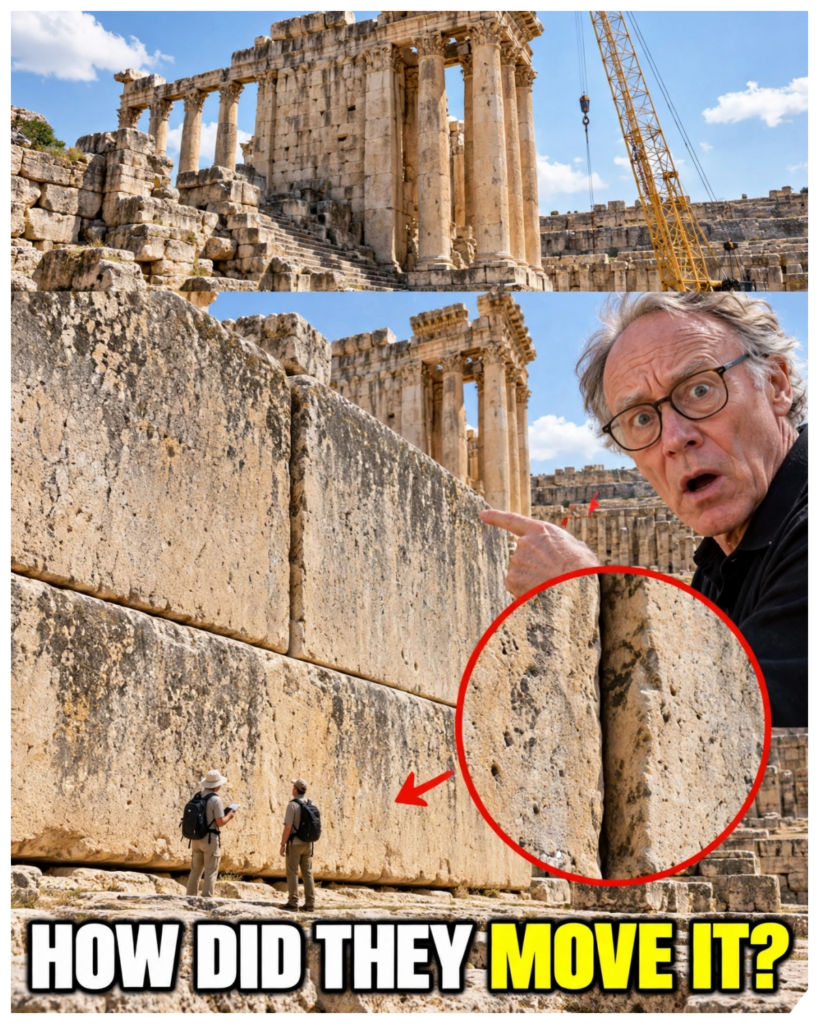
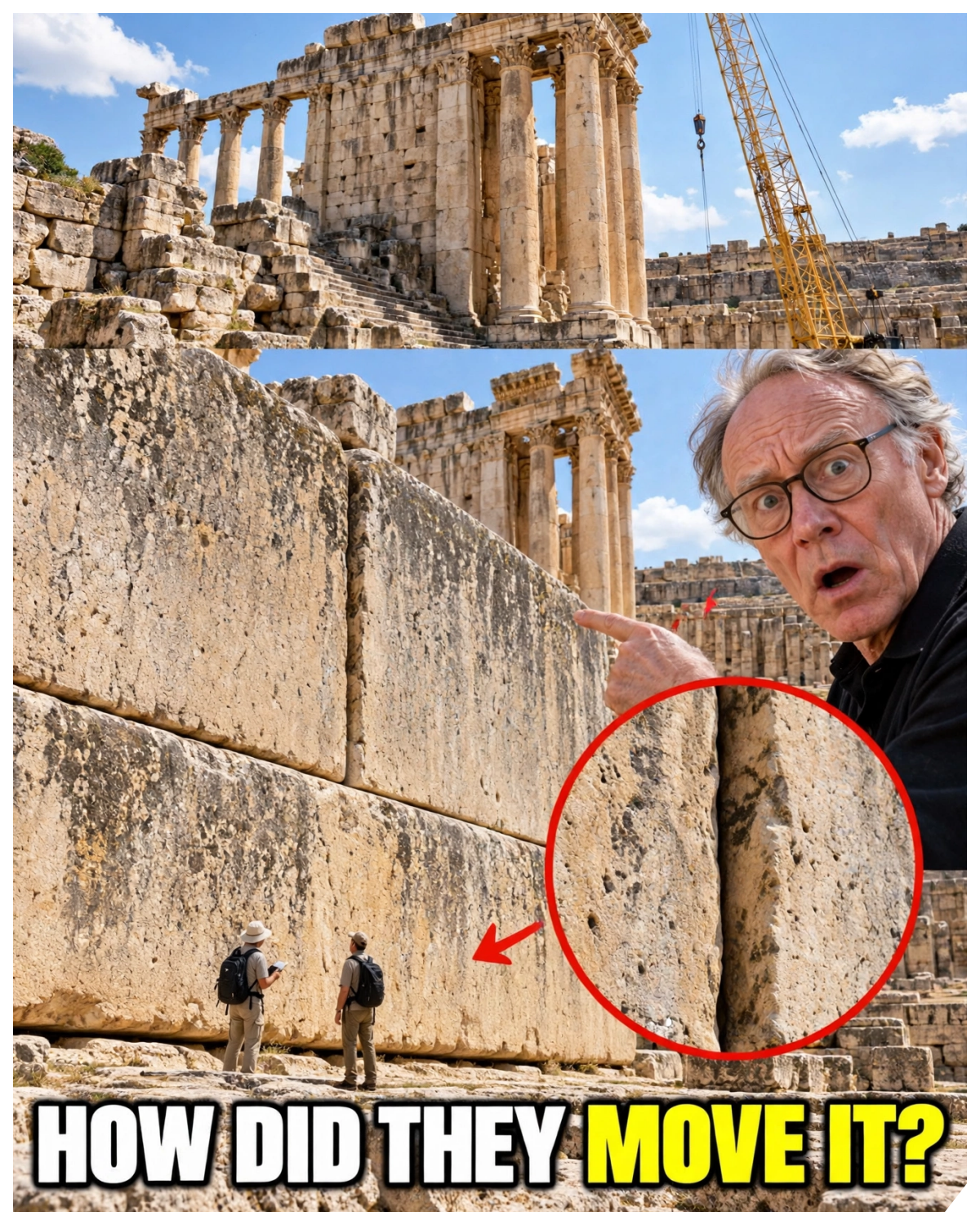
The Colossal Stones Of Baalbek In Baalbek, present-day Lebanon, ancient builders left behind a construction challenge that still commands attention.
Within this monumental complex, enormous limestone blocks form part of a structure associated with Roman-period architecture.
Their sheer size raises an immediate question: how could workers move such immense weights into position without modern cranes, engines, or heavy lifting equipment?
The answer is not found in the stones alone.
It also depends on understanding the landscape, the available tools, and the extraordinary planning required to transform quarried rock into monumental architecture.
The most famous example is the Trilithon, a group of three colossal limestone blocks incorporated into the temple complex.
Each is commonly estimated to weigh around seven hundred and fifty tonnes.
Even one would present a formidable challenge to any construction team.
Together, they reveal the scale of the undertaking and the precision needed to position such massive pieces within a larger architectural design.
Their dimensions turn an ordinary question about building into a deeper investigation of force, balance, and control.
The challenge becomes even more striking when attention shifts to the nearby quarry.
There, unfinished stones include examples often estimated to exceed one thousand tonnes.
These enormous blocks demonstrate that the ambition of the builders extended beyond the stones already incorporated into the complex.
Yet their presence also creates an important distinction.
A block remaining in a quarry does not prove that it was successfully transported or installed.
The completed Trilithon and the unfinished quarry stones represent related, but different, stages of the construction story.
Moving a block of this magnitude would involve more than raw strength.
Workers would have needed to prepare a route, manage changes in elevation, and consider whether the ground could support the tremendous load.
Any uneven surface could complicate movement, while poor control might threaten the stone itself.
Reaching the destination would not end the challenge, because placing each block accurately within the structure demanded another carefully managed operation.
Prepared ramps, sledges, ropes, winches, and coordinated pulling have been proposed as ways to explain how ancient builders handled heavy loads.
These approaches offer possible mechanical solutions, but the precise methods used for every stage at Baalbek should not be treated as conclusively established.
The surviving stones reveal the achievement more clearly than they reveal every action that produced it.
There is also a larger question behind the weight.
Monumental construction could express architectural ambition, wealth, authority, and imperial power.
Choosing enormous blocks may therefore have served purposes beyond practical construction alone.
Baalbek shifts the investigation from how far ancient builders could move a stone to how they controlled extraordinary weight.
The engineering challenge grows, but so does the need to separate evidence from assumption.
Did ancient builders maneuver colossal granite boxes through narrow underground passages with such remarkable precision?
Which forgotten techniques made this extraordinary feat possible, and could the next discovery challenge everything we assume about their engineering abilities?
The evidence may hold a surprising answer, but where should we look next?
Keep watching.
The Mystery Beneath Saqqara’s Stone Beneath the ancient Egyptian landscape at Saqqara lies a remarkable underground complex that presents a different kind of engineering challenge.
The Serapeum, associated with the burial of sacred Apis bulls, contains enormous stone sarcophagi whose sheer size raises difficult questions about the people who created them.
These were not simple containers assembled from separate pieces.
Each required skilled workers to shape a massive block, hollow its interior, and prepare a lid that could fit with impressive precision.
The result was monumental craftsmanship, but the process behind it remains a compelling subject of investigation.
The granite sarcophagi are particularly striking because granite is exceptionally hard compared with many other building stones.
Producing such large objects demanded careful planning, sustained labor, and tools capable of gradually removing material without ruining the entire block.
The stone also had to be selected and prepared before its final shape could emerge.
Aswan, hundreds of kilometres south of Saqqara, supplied granite for major Egyptian monuments, demonstrating the long distances involved in ancient stoneworking.
However, the exact origin of every individual sarcophagus should not be assumed without specific evidence.
The wider challenge remains clear: enormous pieces of stone had to pass through several demanding stages before they could serve their intended purpose.
First came extraction from the quarry, followed by shaping, hollowing, and finishing.
Then came transportation, potentially across considerable distances, before the completed sarcophagi could reach their underground destination.
Each stage introduced its own risks.
A damaged block represented a serious loss of time and labor, while the weight of the finished object made every movement difficult.
Yet the greatest challenge may have emerged when these enormous containers reached the Serapeum itself.
Open ground can accommodate large transport arrangements, but underground galleries offer far less room to turn, manoeuvre, and position heavy objects.
The builders had to account for these restrictions within their construction plans.
The smooth surfaces and accurately fitted lids reveal a high level of skill, but precision alone does not establish that ancient workers possessed modern machinery or mysterious technology.
Traditional methods, organized labor, careful measurement, and practical experience deserve serious consideration before extraordinary explanations are accepted.
The empty sarcophagi have also encouraged speculation, yet their condition cannot independently prove that they were designed for a secret technological purpose.
Their emptiness raises questions about their history, not automatic evidence of hidden devices.
The Serapeum therefore shifts the investigation beyond the familiar image of stones dragged across open landscapes.
It forces attention toward the final, confined stages of monumental construction, where even a small miscalculation could create a formidable obstacle.
Understanding how the builders managed these spaces may reveal as much about their engineering judgment as the enormous stones themselves, while leaving one crucial challenge open: how did they position such massive objects underground with such precision?
Every cut carried the risk of destroying months of work, so how did ancient craftsmen shape granite with such extraordinary precision?
Which forgotten techniques made these achievements possible, and could their greatest engineering secret lie in the tools themselves?
Let’s find out.
The Quarry That Defied Stone Long before an enormous stone could rise above a temple or monument, someone had to free it from solid rock.
At Aswan, in southern Egypt, ancient workers faced this challenge with granite, a remarkably hard material that demanded patience, strength, and careful planning.
The journey toward monumental construction began not with transportation, but with the dangerous work of cutting into the earth itself.
Every strike mattered, because a mistake could damage a block that had required enormous effort to prepare.
The challenge was not simply to remove stone, but to preserve its intended shape.
Without modern cutting machinery, Egyptian craftsmen relied on hard stone pounders, abrasive materials, and repeated grinding to work the granite.
Copper tools also played a role in ancient stoneworking, although copper alone could not easily cut through such a hard surface.
The process depended on technique, suitable abrasives, and sustained effort rather than the power of metal alone.
Workers had to understand how different materials behaved and how repeated actions could gradually change a surface that initially seemed almost impossible to shape.
Extracting a massive block required more than attacking its exposed face.
Workers could create trenches around the intended stone, gradually separating it from the surrounding bedrock while controlling its dimensions.
The work demanded careful observation, because the deeper the cutting progressed, the greater the importance of maintaining the block’s integrity.
A stone intended for monumental construction could not simply be roughly detached and repaired later without consequence.
Its size, shape, and condition determined whether it could serve its purpose.
Precision added another layer of difficulty.
Straight edges, measuring tools, repeated checks, and experienced craftsmanship helped workers maintain the desired dimensions.
Such methods required discipline throughout the process, particularly when the material was difficult to shape and the consequences of an error could be severe.
The impressive results found in ancient Egyptian construction therefore reflect not only physical labor, but also accumulated knowledge, practical judgment, and the ability to repeat demanding techniques consistently.
Yet the quarries also preserve evidence of what happened when ambition met the limits of the material.
The unfinished obelisk at Aswan reveals the risks behind Egypt’s monumental projects.
Still attached to the bedrock, it offers a glimpse of the immense undertaking required to produce a single enormous structure.
A crack could compromise the stone and bring work to a halt, leaving the intended monument unfinished despite the labor already invested.
That abandoned project changes the way the finished monuments can be understood.
Their survival represents successful planning and skilled execution, while the unfinished obelisk exposes the uncertainty that accompanied such work.
Before ancient builders could transport giant stones across rivers or position them within monumental structures, they first had to conquer the quarry.
And even their greatest skill could not guarantee success.
Could a simple trick with water explain how ancient builders moved enormous stones across the desert?
Which other overlooked techniques made these impossible tasks achievable, and might the greatest engineering breakthrough still be waiting to be uncovered?
Stick with us.
The Science Hidden Beneath Sand An ancient Egyptian image offers a small detail with enormous consequences.
Workers haul a heavy statue across the ground on a wooden sledge, while one figure pours water onto the sand ahead of it.
Yet that small stream of water may help explain how people moved loads that weighed far more than any individual could manage alone.
The scene shifts attention away from impossible strength and toward a practical question: could the ground itself make the journey easier?
The weight was real, and moving it demanded planning, labor, and control.
A sledge could keep a load supported, while ropes allowed workers to pull together.
But even with enough people, the surface beneath the runners mattered.
Dry sand can pile up in front of a moving object, creating resistance and wasting much of the force applied.
The challenge was not simply to pull harder.
It was to reduce the effort lost at every step.
In 2014, researchers tested how water affects the behavior of sand during this kind of movement.
Their experiments showed that adding the right amount of water can increase the sand’s stiffness.
The grains form a firmer surface, making it harder for the sledge to push a growing mound of sand ahead of it.
As a result, the force needed to pull the load can fall significantly.
Water, in this case, does not make the stone lighter.
It changes the conditions around it, allowing human effort to work more effectively.
The finding also depends on balance.
A surface that is too dry may resist the runners, but flooding the sand does not automatically improve the situation.
The useful effect appears when the moisture level is suitable, not when water is poured without judgment.
The method therefore calls for observation and control, as well as coordinated pulling, strong ropes, a prepared route, and steady movement.
Each part supports the others; no single trick replaces the wider organization required to transport a massive object.
The experiment offers a clear explanation for how one difficult task could become more manageable, but it does not settle every question about ancient construction.
It cannot prove that every Egyptian monument, much less every giant stone around the world, was moved in exactly this way.
Different sites presented different materials, distances, and obstacles, and the evidence must be considered in its own setting.
Still, the image of water meeting sand reveals something important: ancient builders may have relied on careful observation of ordinary materials rather than mysterious technology.
The deeper puzzle is no longer whether people could move enormous stones, but how many practical solutions they learned to combine.
The detail changes the question.
What other secrets lie hidden in the waterways that connected ancient civilizations?
How did builders coordinate enormous shipments without modern navigation or machinery, and what does Stonehenge reveal about their reach?
The answers may challenge everything we believe about ancient engineering and human ingenuity.
The Rivers That Carried Giants The greatest challenge facing ancient builders was not always the weight of the stone.
Sometimes, it was the distance between the quarry and the monument.
A massive block could be shaped with remarkable care, yet its journey remained dangerous and exhausting.
Across ancient Egypt, the Nile offered a solution that changed the scale of construction.
Instead of dragging every heavy load across difficult ground, builders could use waterways to move materials toward their destinations.
The river became more than a source of life.
It formed part of an extensive transportation network supporting monumental architecture.
Not every stone used in these structures came from the same place.
Much of the limestone used in the Great Pyramid at Giza came from nearby quarries, reducing the distance that ordinary building blocks needed to travel.
Other materials demanded a more complicated journey.
High-quality white limestone used for the pyramid’s outer casing was obtained from Tura, across the Nile from Giza.
Granite used in important sections of Egyptian monuments came from Aswan, far to the south.
These different sources reveal that construction depended on selecting suitable materials and organizing their delivery, not simply gathering whatever stone lay closest.
Moving such cargo through water required careful planning.
Heavy blocks had to be loaded onto vessels capable of carrying their weight, secured against shifting, and transported along navigable routes.
Workers also needed suitable conditions for unloading the cargo and bringing it to the construction site.
The Nile made long-distance movement more practical, but it did not eliminate the difficulties.
Each stage depended on coordination between quarry workers, transport crews, laborers, and those receiving the stones.
A delay or failure at one point could disrupt the wider operation.
Monumental construction therefore required much more than skilled stonecutters; it demanded an organized system connecting distant sources with ambitious building projects.
This evidence also changes how researchers approach another ancient mystery: Stonehenge’s Altar Stone.
Geological research has linked the approximately six-tonne stone to northeastern Scotland, hundreds of kilometres from the monument in southern England.
How it reached Stonehenge remains unresolved.
Because difficult terrain would have complicated an entirely overland journey, researchers have considered whether waterways and sea transport played a role.
Yet a possible maritime journey should not be mistaken for a proven route.
The precise method, sequence of stops, and circumstances of transportation remain open questions.
The comparison reveals an important distinction.
Egyptian evidence demonstrates that waterways supported the movement of construction materials, while Stonehenge presents a separate transportation problem whose solution is still debated.
The Nile’s role cannot prove exactly how the Altar Stone travelled, but it shows why rivers and coastal routes deserve serious consideration.
Ancient builders may have relied on connected systems rather than one extraordinary machine.
Their achievements become even more impressive when the challenge is understood not as moving a single giant stone, but coordinating an entire journey across landscapes and water.
How did ancient builders raise massive stones higher and higher without a complete ramp system surviving to explain their methods?
Which design offered the greatest control, and what overlooked engineering principle might finally bring us closer to understanding how the Great Pyramid rose?
Stay glued.
The Great Pyramid’s Unfinished Climb Moving a giant stone across level ground was only one part of the challenge.
At the Great Pyramid of Giza, every block that had to reach a higher course presented a different problem: the load needed to rise without slipping, the route had to bear its weight, and workers had to guide it into position with care.
The higher the construction climbed, the more difficult the task became.
A method that worked near the ground could become harder to manage as the structure grew.
Ramps offer a practical explanation, but they do not provide one simple answer.
Researchers have proposed several designs, including long, straight ramps that approached the pyramid directly, zigzag routes climbing along one face, and spiral paths that wound around the structure.
Other reconstructions suggest that some ramps may have run inside the pyramid rather than entirely outside it.
Each model attempts to solve the same problem, yet each brings its own questions about space, stability, and control.
The slope mattered enormously.
A gentle incline could reduce the force needed to pull a heavy load upward, but it would require a longer route and more building material.
A steeper ramp would occupy less space, yet demand greater effort and careful control to prevent a stone from sliding backward.
The surface also had to remain firm beneath repeated movement.
If the route shifted, weakened, or became damaged, moving a block could turn into a risk for the workers and the unfinished structure.
Building the ramp was itself an undertaking.
Its materials had to be gathered and arranged, its surface maintained, and its shape adjusted as the pyramid rose.
A route useful during one stage of construction might no longer reach the required height later.
Workers would need to coordinate pulling teams, ropes, and the placement of each block, using controlled movement rather than brute force alone.
Even after a stone reached the correct level, it still had to be positioned accurately within the growing structure.
The difficulty is that no complete surviving ramp system reveals exactly how the Great Pyramid’s builders organized this process.
Archaeologists and engineers can test proposals against the monument and the practical demands of moving heavy loads, but several arrangements remain possible.
That uncertainty has helped fuel speculation, although it does not prove that the work required unknown technology or methods beyond human skill.
The ramp debate therefore exposes a distinction between understanding the challenge and knowing every detail of its solution.
Ancient builders clearly raised immense stones, but the precise route, design, and sequence they used remain unsettled.
The mystery is not whether ramps could help; it is which arrangement, or combination of arrangements, made the climb possible.
Imagine carving an entire temple from solid rock, starting at the top without room for a single irreversible mistake.
Which forgotten techniques made such precision possible, and what can this masterpiece reveal about ancient engineering?
Could its greatest secrets lie in the stone itself?
Let’s uncover the mystery.
A Monument Shaped from Stone At Ellora in India, the Kailasa Temple presents a different ancient engineering mystery.
Its scale and detail invite a familiar question: how could builders create something so ambitious with the tools and knowledge available to them?
Yet Kailasa changes the problem.
Rather than assembling giant blocks brought from distant quarries, its makers shaped the temple directly from living rock.
The temple is traditionally associated with Rashtrakuta ruler Krishna I and dates to the eighth century.
It forms part of Ellora’s rock-cut monuments, created across several centuries.
The site reflects an established tradition of carving sacred spaces into stone, but Kailasa takes that approach to an extraordinary scale.
Its architecture was not simply placed upon the ground.
Much of the surrounding rock had to be removed to reveal the intended building within it.
That method demanded careful planning.
The sanctuary, courtyard, columns, sculptures, and architectural details all had to emerge from a single mass of rock.
Before excavation advanced, builders needed a clear sense of the forms they intended to preserve.
Its design had to guide every removal from the first cut onward.
With assembled masonry, individual blocks could be shaped, moved, and adjusted before being set in place.
At Kailasa, every cut affected the same continuous material.
Removing too much stone in the wrong place could permanently damage a feature that could not simply be replaced.
The challenge was not only physical strength.
It also involved sequence, measurement, skilled carving, and a plan capable of guiding work as the monument slowly took shape.
Each newly exposed surface had to fit the larger design.
The finished temple gives little sense of how unforgiving that process could have been, because the evidence of effort became columns, figures, and carefully defined spaces.
Achievements of this kind have encouraged speculation about whether ancient builders possessed lost methods or knowledge modern observers have overlooked.
The scale can make ordinary explanations feel insufficient, especially when the work is viewed without its historical setting.
But the temple belongs to a broader tradition of rock-cut architecture, and its existence supports the skill and organization of human craftspeople rather than proving extraordinary outside intervention.
Its precise construction sequence and the decisions behind each stage remain subjects for study, not invitations to treat uncertainty as proof of the impossible.
Kailasa widens the story of giant stones.
Some ancient builders moved immense blocks across land or water; here, the central task was removing rock while protecting the monument hidden inside it.
The mystery shifts from transportation to controlled excavation.
That distinction reveals how varied ancient engineering could be, while leaving one compelling question in view: how did its makers coordinate such demanding work with lasting precision?
What other ancient achievements might force us to rethink humanity’s forgotten capabilities?
Which engineering secrets remain buried beneath monuments that have survived for thousands of years?
And as new discoveries emerge, will we finally understand how far human ingenuity truly reached?
Engineering Behind The Impossible Stones The monuments become clearer when considered together.
Stonehenge, Baalbek, Saqqara, the Egyptian pyramids, and Ellora appear to pose one impossible question: how could ancient builders move and shape enormous quantities of stone without modern machinery?
Yet their differences matter as much as their scale.
Each site presented its own materials, distances, terrain, purpose, and practical limits.
The evidence points not to one universal secret, but to engineering solutions developed for different challenges.
At Stonehenge, the Altar Stone adds a remarkable distance to the puzzle.
Geological research links it to northeastern Scotland, hundreds of kilometres from the monument in southern England.
That finding sharpens the question of transport, but does not settle the journey.
A sea route is plausible, but the precise path and method remain uncertain.
The stone’s origin is a significant clue, but it does not fully explain how it arrived.
Baalbek presents a different problem.
Its enormous limestone blocks reveal the scale of ambition behind the ancient complex, while the largest stones left in the quarry show how difficult extraction could become.
At Saqqara, the challenge shifts underground, where massive sarcophagi had to be moved and positioned within galleries.
Neither setting requires the same answer as Stonehenge.
Distance, weight, access, and final placement changed the task, so methods used in one place cannot explain every other monument.
The broader evidence offers a practical framework.
Quarry workers could shape stone with pounding tools and abrasives, while teams dragged heavy loads on sledges.
Experiments suggest that carefully dampened sand can reduce the force needed to pull a sledge.
Waterways offered another means of carrying materials, and ramps, ropes, and coordinated teams could help raise or guide loads.
At Ellora, the Kailasa Temple demonstrates a different approach: builders carved a monumental structure from living rock rather than assembling separate blocks.
These techniques were responses to specific materials, landscapes, and construction goals.
Such work depended on more than tools.
Planning, skilled specialists, organized labour, repeated practice, and knowledge passed between generations could turn difficult tasks into workable systems.
Ancient builders did not need identical methods across continents; they needed reliable ways to solve the problems before them.
Their achievements suggest that observation and practical experimentation could produce results that still astonish centuries later.
That conclusion, however, does not erase uncertainty.
The scale of these monuments has inspired theories about aliens, vanished civilizations, and technologies supposedly lost to history.
Such ideas can appeal when the engineering seems hard to imagine, but dramatic claims are not archaeological evidence.
Research supports human construction and offers credible explanations for many stages of the work, while leaving particular details open to debate.
The exact route of the Altar Stone, the sequence of some lifting operations, and the arrangement of certain ramps are not equally well understood.
The revelation is more complex than a hidden technology waiting to be uncovered.
Ancient engineering was a collection of adapted solutions, shaped by resources, experience, and each site’s demands.
Recognizing human skill does not mean every mystery has been solved.
It means remaining questions can be investigated without dismissing what the evidence shows, and without turning uncertainty into proof of something supernatural.
The monuments still hold unanswered details, and those gaps make future discoveries important, not proof that their builders were incapable, but a reason to examine their ingenuity more closely.
So, what do you think?
Were these giant stones proof of extraordinary human ingenuity, or could ancient builders have possessed knowledge still misunderstood today?
We’d love to hear your thoughts in the comments below.
Don’t forget to like, share, and subscribe!