In the headquarters of the Tacoma Police Department in Washington State, there is a case file that three generations of detectives have opened, read, and closed again without an answer.
It has outlived the men who first wrote it.
It has outlived filing systems, computer systems, and an entire century.
The oldest pages are typed on manual typewriters.
The ink pressed so hard into some letters that you can feel them from the back of the sheet with your fingertip.
There are carbon copies gone soft and gray.
Handdrawn maps of a city park with arrows marking a playground, a picnic table, and a ravine.
Black and white photographs of a child’s bicycle lying in the grass.
A pencil sketch of a man’s face drawn from the memory of a 12-year-old witness.
And there are lists, lists of names that over the decades would grow to more than 2,000 men.
Somewhere in that file is a single line that holds the whole case together.
It records that in the spring of 1986, swabs were taken during an autopsy and preserved.
Nobody who took them could have imagined what they would one day reveal.
We like to tell ourselves that the people who hurt children are strangers, shadowy men in vans, drifters who pass through town and are gone by nightfall.
It is a story that lets us sleep because it means the danger is somewhere far away and not living on our street.
The truth is usually closer to home.
Killers do not vanish into thin air.
More often, they simply go back to their lives.
They go to work.
They raise their own children.
They coach.
They volunteer.
They care for the sick.
They grow old in the same city where they did the unthinkable.
And all the while, in an evidence locker, the proof of what they did waits for the world to learn how to read it.
This is the story of one of those files.
It is the story of a 12-year-old girl who rode her bicycle to a park with her little sisters on a spring morning, and of the picnic lunch that was waiting on the table when she should have been.
It is the story of a mother who never stopped asking, of a little girl who grew up to become a detective, and of a city that spent 30 years hunting one monster before discovering that there were two.
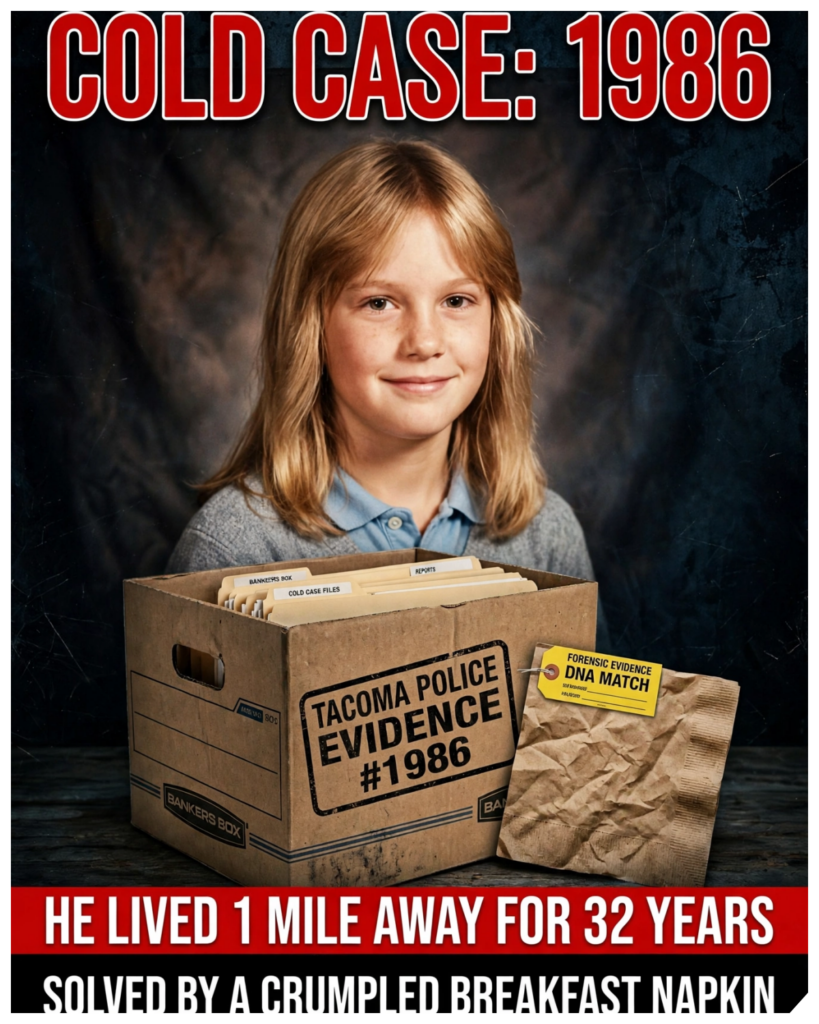
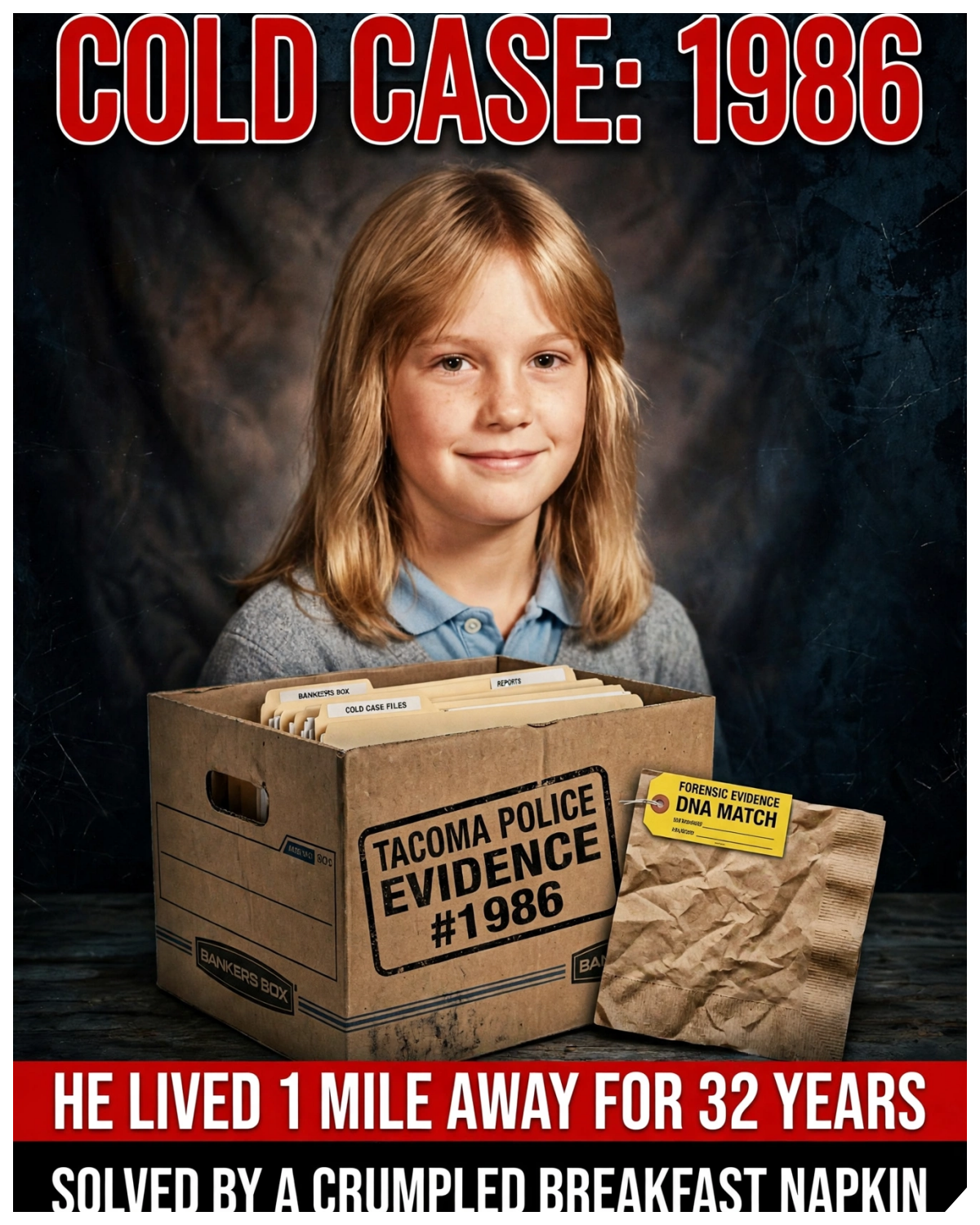
And it is the story of a breakfast napkin, a brown paper napkin crumpled in a man’s hand at a restaurant near the psychiatric hospital where he worked while a detective sat about 10 ft away and watched.
It began on the morning of Wednesday, March 26, 1986 in Puet Park in the north end of Tacoma, Washington.
This is the file on the murder of Machella Welch.
Machella was 12 years old in the spring of 1986.
She had blonde hair and bright eyes, and she was the oldest of three sisters.
Angela and Nicole were younger, and Nicole was only nine.
Their mother was Barbara Leonard.
Decades later, Nicole would describe her big sister in the simplest, most devastating terms.
When she fell down and scraped her knee, it was Machella who came running to help.
“Michella was like a second mother to her,” she said.
The oldest sister who looked out for the little ones, the one who was in charge.
The north end of Tacoma in the mid 1980s was a place where that kind of responsibility could be handed to a 12-year-old without a second thought.
It is an old neighborhood of tall trees and craftsman houses built on bluffs above the waters of Puet Sound.
On clear days, you can see the Olympic Mountains across the water and Mount Reineer rising to the southeast.
The neighborhood is threaded with ravines and gulches, deep green folds in the land where creeks run down toward the sound, thick with ferns, maple, and Douglas fur.
Kids in North Tacoma rode their bikes everywhere in 1986.
There were no cell phones and no tracking apps.
You left the house in the morning.
You told your mother where you were going and you came home when you were hungry.
Parks were the playgrounds of the whole neighborhood and older siblings were the babysitters.
On Wednesday, March 26th, the three sisters set out for a day at Puet Park.
Puet Park sits at the head of one of those wooded gulches, a neighborhood park with a playground and picnic tables at the top and a steep overgrown ravine falling away behind it toward the water.
To the girls, it was a perfect place to spend a spring day.
They rode their bikes there together that morning.
At some point, the sisters realized they had forgotten their lunch, and Mckela, being the oldest, being the one in charge, set off on her bicycle at about 10:00 in the morning to get lunch for the three of them.
Her younger sisters wandered off to play near the gulch, the way kids do.
They poked around the trees and the paths at the edge of the ravine.
When they came back up to the playground, they found Machella’s bicycle there.
And on the picnic table, they found the sandwiches.
Their lunch was waiting for them, exactly as their big sister had promised.
But Machella was gone.
At first, there was no reason to panic.
She had to be close by.
Her bike was right there.
The lunch was right there.
Maybe she had gone to the restroom.
Maybe she was looking for them.
The girls did what their family always did when they got separated.
They had a family call, a loud, distinctive yelp that carried through the trees, and they called it out across the park.
There was no answer.
Nicole would remember that moment for the rest of her life.
Years later, recalling the silence that came back after the family call, she said simply, “And at that moment, I knew.”
The girls went for help.
The adults came, and as time passed with no sign of Mckela, the call went to the Tacoma Police Department.
A 12-year-old girl was missing from Puet Park.
Patrol officers arrived and began to search.
Machella’s mother came.
Neighbors came, walking the paths, calling her name into the ravine.
Search and rescue teams were called in and with them a search dog.
There were police cars along the street at the top of the park and men in rain gear moving down into the gulch, pushing through wet ferns and brambles and fallen logs.
Daylight in Tacoma in late March doesn’t last much past 7:00, and the ravine was steep, thickly overgrown, and dark under the trees.
Every hour made the search harder.
It was the search dog that led them to her.
In an isolated part of the gulch, more than a quarter of a mile from the playground, hidden among the trees near a makeshift fire pit, searchers found Michella Welch.
She was dead.
The medical examiner would determine that she had died of blunt force trauma to her head.
The autopsy also recorded a long wound across her neck about 7 in.
And there was evidence that she had been sexually assaulted.
This was a 12-year-old child.
She had been taken from a neighborhood park in the middle of a weekday morning while her little sisters played nearby.
The scene in the gulch was processed by the light of flashlights and portable lamps.
Investigators photographed everything.
The position of Machella’s body, the ground around her, the fire pit, the paths leading in and out.
They searched for footprints in the soft, wet earth of the ravine.
They bagged and tagged what they could.
And during the autopsy, the medical examiner took swabs and preserved them.
That decision, routine as it was, would become the most important act in the entire case.
But it would be 20 years before anyone could make those swabs speak.
The news ripped through Tacoma.
A child taken in broad daylight from a park in one of the city’s most beloved neighborhoods.
Parents stopped letting their children ride to the park alone.
Kids who had roamed free the week before were suddenly kept in yards and driveways.
Every man walking alone near a playground became a person to be watched.
The Tacoma Police Department threw everything it had at the case.
Detectives went door to door through the north end.
They talked to everyone who had been in or near Puet Park that morning.
They interviewed Machella’s friends, her classmates, her family, her neighbors.
They found one witness who seemed to offer a real lead.
A classmate of Machella’s told police she had seen a man in the park that day watching the sisters.
A police sketch artist sat down with the young witness and drew a face based on her description.
The sketch was released to the public.
If someone recognized that face, it might be the break the case needed.
Composite sketches are powerful tools, but they are also fragile ones.
A witness sees a stranger for a few seconds, often without knowing that the moment matters.
Memory fills in gaps.
A child witness describing an adult man may get his age, his height, or his hair badly wrong without meaning to.
A sketch can point investigators toward the right man.
It can just as easily point them toward a hundred wrong ones and away from the man who actually did it.
In Machella’s case, the sketch generated calls.
It generated names.
What it never generated was her killer.
Then a call came in that seemed at the time like exactly that kind of break.
A jogger contacted police to say he had seen a man in nearby Point Defiance Park who looked like the man in the sketch.
Point Defiance is a huge city park on the tip of the North Tacoma Peninsula, just a couple of miles from Puet Park.
The detectives took the tip seriously.
As they took every tip seriously, they wrote it down.
The jogger’s name went into the file.
His name was Robert Washburn.
Hold on to that name.
In 1986, the forensic tools available to the Tacoma detectives were, by today’s standards, painfully limited.
Fingerprints, if they could be found at all on outdoor surfaces in a wet northwest ravine, had to be compared by hand.
The biological evidence could be typed by blood group A, B, AB, or O, and some other protein markers.
Those results could narrow a pool of suspects to a percentage of the male population, but they could never name one man.
DNA fingerprinting had just been developed in Britain, [clears throat] and it had not yet been used in an American courtroom.
For the detectives working Machella’s case, the swabs in the evidence locker could tell them almost nothing.
So they did what detectives had always done.
They [clears throat] chased names.
It is worth remembering just how close and how far away the science was.
In 1986, the year Machella died, a British geneticist named Alec Jeff had only recently discovered that every human being carries a unique pattern in their DNA.
That same year, in a village in Leicester, England, his technique was used for the first time in a murder investigation.
The first conviction in the United States based on DNA evidence would come the following year in Florida.
And the national database that would one day let American police compare a crime scene profile against millions of offenders, COTUS, would not be fully running until 1998.
The tools that would eventually name Mckela’s killer were being invented piece by piece in laboratories on two continents during the very years her case was going cold.
They looked at men in the neighborhood with records.
Men who had been seen in the park.
Men reported by neighbors, by relatives, by anonymous callers who were sure they knew who had done it.
Some were interviewed and quickly cleared.
Others were investigated for weeks before being eliminated.
None of them led to Michella’s killer.
Then, in the summer of 1986, the nightmare happened again.
On August 4th, 1986, a 13-year-old girl named Jennifer Bastion went for a bike ride in Point Defiance Park.
She never came home.
Her body was found on August 28th, hidden in the woods of the park.
She had been sexually assaulted and strangled.
To the detectives and to the terrified city, the connection seemed obvious.
Two girls of almost the same age, both blonde, both brighteyed, both on bicycles in North Tacoma parks, just a couple of miles apart, both taken, assaulted, killed, and left in the woods within 5 months of each other.
Their bodies had been left in similar positions, their clothing disturbed in similar ways.
Everyone came to believe the same thing.
One man had killed both girls.
North Tacoma had a predator and he was hunting children on bicycles.
The two cases were investigated together, side by side for decades.
Detectives built a list of men connected to one case or the other.
Men seen in the parks, men with records of sexual offenses, men named in tips, men who lived nearby, worked nearby, drove through.
The list grew to roughly 2,300 names.
Some of those men gave samples.
Some were investigated and cleared.
Some had died or moved away.
But the killer or killers stayed hidden.
[clears throat] The years turned.
1986 became 1990.
The detectives who had worked the original investigation moved on, retired, grew old.
Machella’s case and Jennifer’s sank into the cold case files of the Tacoma Police Department.
For Machella’s family, there was no moving on.
Barbara Leonard had sent her daughter off to the park on a spring morning, and her daughter had never come home.
Angela and Nicole grew up with an empty space at the head of the family, the big sister who should have been there to guide them through school, through first jobs, through first heartbreaks.
Nicole would later say that her family had carried that burden since she was 9 years old.
The sandwiches on the picnic table became a kind of family symbol of what they had lost.
Michella had done exactly what she said she would do.
She had brought lunch for her sisters.
And somewhere between leaving it on that table and coming back to find them, someone took her.
Across town, Jennifer Bastion’s mother, Patty, carried her own unbearable version of the same grief.
She would eventually volunteer with the police department’s cold case efforts.
Desperate to do something, anything, to move her daughter’s case forward.
And somewhere in Tacoma, a man was living his life.
Gary Charles Hartman was about 33 years old in the spring of 1986.
He lived in the north end of Tacoma, a little more than a mile from the entrance of Puget Park.
He had a brother who also lived in the north end.
Hartman was married.
He had two children of his own.
He had no criminal record, not then and not in the decades that followed.
His name never appeared on any list of suspects.
He was never interviewed in connection with Machella’s case.
He was never asked for a sample.
As far as the police were concerned, he did not exist.
Over the years, Hartman built a career in a profession devoted to caring for vulnerable people.
He became a nurse working at Western State Hospital, a large psychiatric hospital in Lakewood, just south of Tacoma.
He worked with patients in crisis, people suffering from serious mental illness.
His co-workers knew him as a colleague.
His neighbors in Lakewood knew him as a married man with a family.
Eventually, he would divorce and he would grow older, still working, still living in the same corner of Washington State where Machella Welch had died.
Criminologists who study offenders who evade detection for decades, describe a pattern they call compartmentalization.
The crime is sealed off in a locked room of the mind.
On top of it, the offender builds an ordinary life layer by layer, job and family and routine, until the ordinary life is the only one anyone can see.
Some of these men live in constant dread of a knock at the door.
Others come to believe year after year that the knock will never come.
We cannot know what Gary Hartman thought about during those years or whether he ever thought about the girl in the ravine, but we know he stayed.
He did not run.
He worked and lived within a few miles of Puget Park for more than three decades.
In May of 2006, 20 years after Michella was killed, the swabs taken during her autopsy finally spoke.
Forensic analysts developed a male DNA profile from them.
For the first time since 1986, Machella’s killer had a genetic identity.
It is a reminder of how fragile that kind of evidence is and how much depended on the people who had handled it in 1986.
DNA breaks down with heat and moisture.
Bacteria and mold consume it.
A swab stored carelessly for two decades might have yielded nothing at all.
Machella had been stored properly and it held.
The profile was searched against the state DNA database and against COTUS, the FBI’s combined DNA index system, which holds the profiles of convicted offenders and arrestes across the country.
If the killer had ever been convicted of a crime that required a sample, the system would find him.
It found no match.
The man who killed Machella had never been entered into any database.
His profile sat in the system unmatched year after year.
Years later, the Tacoma Police Department took a fresh look at both 1986 cases.
The detective who led that effort was Lindseay Wade.
Lindseay Wade was a Tacoma native.
In the spring and summer of 1986, she was 11 years old.
She was a North End kid herself, the same age as the girls who were being warned to stay out of the parks.
She grew up in the shadow of those murders.
Then she grew up to become a police detective.
And now the files of Machella Welch and Jennifer Bastion were on her desk.
Wade went back to the beginning.
She worked through the list of roughly 2,300 men connected to the two cases and narrowed it down to a few hundred who seemed most likely.
With help from the FBI, investigators tracked down about 160 of those men and asked each of them for a voluntary DNA sample.
It was slow, unglamorous work.
A detective would track a man down, sometimes in another state, sometimes decades removed from the life he had lived in Tacoma in 1986.
Explain why they had come.
Ask whether he would be willing to rub a cotton swab along the inside of his cheek to help rule himself out.
Most agreed.
Each swab was sealed, labeled, logged, and shipped to the lab.
And then the waiting began again.
One by one, the samples were sent to the lab.
One by one, they came back.
Excluded.
Excluded.
Excluded.
Then Wade made a discovery that turned everything investigators thought they knew on its head.
Additional evidence from Jennifer Bastion’s case, including her swimsuit, yielded a male DNA profile of its own.
When analysts compared the profile from Jennifer’s case to the profile from Machella’s case, they did not match.
In 2016, the Tacoma police announced it publicly.
For 30 years, the city had believed a single predator killed both girls.
The DNA said otherwise.
Two different men had killed Michella Welch and Jennifer Bastion, 5 months and a couple of miles apart.
It was a stunning revelation.
It meant that every assumption that had shaped 30 years of investigation, every suspect who had been cleared because he couldn’t have committed both crimes, every theory built around a single killer had to be rethought.
And it meant that there were two men to find, not one.
That same year, Tacoma police turned to a Virginia company called Parabon Nanolabs, which offered something called DNA phenotyping.
Using the killer’s genetic profiles, Parabon predicted their likely physical traits: ancestry, skin color, eye color, hair color, even face shape.
In 2016, police released composite images for both cases.
They hoped someone somewhere would recognize a face.
The images produced no useful tips.
But in early 2017, Detective Wade tried something almost nobody in American law enforcement had tried before.
She began working with a genetic genealogologist named Barbara Ray Venter.
Working with another genealogologist, Nancy Averil, Ray Venttor took a different approach.
Instead of searching the law enforcement databases for the killer himself, they would search the public databases for his relatives.
A detailed genetic profile built from hundreds of thousands of tiny markers called single nucleotide polymorphisms was generated from the crime scene sample and uploaded to the consumer genealogy sites family tree DNA and GEDNA.
Those sites hold the DNA of ordinary people who took tests to learn about their ancestry and who chose to share their results publicly.
If Michella’s killer had cousins in those databases, their DNA would partially match his.
The more DNA two people share, measured in units called centmorggans, the closer their relationship.
From each partial match, the genealogologists built family trees using public records, birth certificates, marriage records, obituaries, census data, gravestones.
They looked for the place where the family trees of different matches came together and then traced the descendants forward branch by branch looking for a man who was the right age and in the right place.
In 1986.
It was painstaking monthsl long work and slowly the trees began to converge on one family.
The genealogologist identified a set of suspects, two Hartman brothers and two of their cousins.
Both brothers had lived in the north end of Tacoma in 1986.
At the time, Ray Venttor and Averil asked to remain anonymous.
The following year in April 2018, Barbara Ray Venttor would become famous as the genealogologist whose work helped identify the Golden State Killer in California.
She would go on to help solve case after case and to train others in the method, helping turn investigative genetic genealogy from an experiment into one of the most powerful tools in modern policing.
But before that case made headlines around the world, she had been quietly working on the murder of a 12-year-old girl in Tacoma.
After the Golden State Killer arrest made investigative genetic genealogy front page news, Parabon NanoLabs, which had launched its own genealogy unit, offered Tacoma police a free second opinion on Machella’s case.
Parabon’s genealogologist built the family tree independently, and Parabon came to the same answer.
Two brothers who shared the right amount of DNA with the matches, both living in Tacoma’s North End in 1986.
One of them was Gary Hartman.
Two independent genealogy teams had pointed to the same family, but a family tree is not evidence.
To charge a man with the rape and murder of a child, detectives needed his own DNA, compared directly against the profile from Michella’s autopsy, and they needed to get it without tipping him off.
The law allows police to collect what people throw away.
In 1988, in California versus Greenwood, the United States Supreme Court ruled that people have no reasonable expectation of privacy in their discarded trash.
A coffee cup in a public bin, a cigarette butt on a sidewalk, a napkin left at a restaurant, all of it can be collected.
On June 4th, 2018, Tacoma police began watching Gary Hartman’s home on Lake Grove Street Southwest in Lakewood.
He was 66 years old.
The next morning, June 5th, Hartman drove to work at Western State Hospital.
Detectives followed.
Then, instead of going inside for the day, he went with a co-orker to a restaurant nearby for breakfast.
One of the detectives walked into the restaurant and took a seat about 10 ft away, close enough to watch, not close enough to draw attention, just another customer having breakfast.
Hartman ate his breakfast and talked with his coworker.
And as he ate, he wiped his mouth with a brown paper napkin.
Then he wiped it again.
Several times the detective watched every movement.
When Hartman was finished, he crumpled the napkin and put it in a bag with his trash.
When an employee came by to clean up the table, the detective asked for the bag.
The employee handed it over.
It was a moment that took perhaps 10 seconds.
A restaurant worker clearing a table, handing a bag of garbage to a customer who asked for it.
But inside that bag was a crumpled brown paper napkin carrying the saliva of the man the genealogologist had pointed to.
The detective sealed it, documented exactly when and where it had been collected, and began the chain of custody that a judge would one day review.
A used napkin is close to ideal for this kind of work.
Every time a person wipes their mouth, the paper picks up saliva, and saliva carries cells from the inside of the cheek, each one holding a full copy of that person’s DNA.
Wiping several times as Hartman had only adds to the sample.
Investigators who rely on discarded items prefer exactly this kind of object.
Something used by one person, handled briefly, and collected quickly before anyone else touches it.
The napkin went to the Washington State Patrol Crime Laboratory.
There, forensic scientists cut samples from the paper, extracted the DNA, and copied it millions of times over through polymerase chain reaction, PCR, a technique that amplifies tiny traces of genetic material into enough to analyze.
Then they built a profile from short tandem repeats, the specific places on the genome where short sequences of genetic code repeat a different number of times in different people.
They compared that profile marker by marker to the DNA profile developed in 2006 from McKela Welch’s autopsy swabs.
They matched.
After 32 years of silence, the detectives knew who had killed Michella Welch.
Lindseay Wade, the detective who had been an 11-year-old North End kid in 1986, had retired that spring.
Before she left, she had sent off the last of her voluntary DNA samples in the Bastion case.
But the napkin was the work of the team she had built, of the genealogologists she had brought in, of the questions she had refused to stop asking.
Gary Hartman was arrested in June 2018 and booked into the Pierce County Jail.
Detectives searched his home in Lakewood on Friday, June 22nd, 2018.
The Pierce County Prosecutor’s Office formally charged him with first-degree murder and first-degree rape.
Bail was set at $5 million.
The arrest stunned the people who knew him.
A co-orker at Western State Hospital told reporters she was shocked.
His neighbors described a married man with two children.
He had no criminal record.
He had spent his career as a nurse caring for some of the most vulnerable patients in the state.
Pierce County Prosecutor Mark Linquist announcing the charges said the murders of 1986 were part of the reason his office had formed a cold case team in the first place.
He spoke about the power of the new genealogy technique and Mckela’s family after 32 years finally had a name.
Hartman pleaded not guilty.
He did not make any public statement about the crime.
No recorded confession has ever been made public and he did not explain himself to reporters.
What happened in the gulch below Puet Park on the morning of March 26th, 1986 is known only through the evidence.
A 12-year-old girl taken while she was alone for a few minutes, carried or led more than a quarter mile from the playground into the trees, assaulted and killed, and left near a fire pit in the ravine.
That leaves the hardest question in the file, the one no lab result can answer.
Why?
Why would a married 33-year-old father with no criminal record take a child from a park in his own neighborhood?
Why did he never, as far as anyone knows, offend again?
Investigators have never publicly said whether they connected him to any other crime.
And Gary Hartman has never explained.
What psychologists can say is that offenders like Hartman often rely on the very ordinariness that protected him.
A man with a family, a steady job, no record.
Exactly the kind of man no one would ever put on a list.
Exactly the kind of man who never appeared among the 2300 names.
The DNA did not care about any of that.
There was one more turn in the story, and it came only weeks before Hartman’s arrest.
Before she retired in the spring of 2018, Lindseay Wade sent her final batch of voluntary DNA samples in the Jennifer Bastion case to the lab.
There were 18 of them.
Within about a month, one came back as a match to the DNA from Jennifer’s swimsuit.
It belonged to Robert Washburn.
Robert Washburn was the jogger.
In 1986, before Jennifer Bastion was killed, he was the man who had called the Tacoma police to say he had seen someone in Point Defiance Park, who looked like the sketch from Machella’s case.
He had inserted himself into the investigation of one little girl’s murder months before he murdered another.
A genetic genealogologist list of possible surnames in Jennifer’s case had included the name Washburn, too.
Investigators and psychologists have long recognized a pattern in which offenders insert themselves into police investigations.
Some call in tips.
Some join search parties.
Some hang around crime scenes or befriend detectives or offer theories to reporters.
Sometimes it is a way to learn what the police know.
Sometimes it seems to be a kind of thrill, a way of staying close to the case.
And sometimes perhaps it is a way of steering suspicion towards someone else.
Whatever Washburn’s reason, the fact remains one of the names in Machella’s file, written down in 1986 as a helpful citizen, belonged to a man who would kill another child that same summer.
Washburn later pleaded guilty to Jennifer Bastion’s murder and was sentenced to 27 years in prison.
He never told investigators why he had called them in Machella’s case.
Asked about his motive, Lindseay Wade would only say that it was another question they would all like to know the answer to.
So, it was true.
There had been two killers in North Tacoma in 1986.
Two men, two little girls, two parks, a few months, and a couple of miles apart.
And for 30 years, the city had been looking for one.
The arrests in Tacoma came at a turning point for genetic genealogy itself.
After the Golden State Killer case, the public began to ask hard questions about privacy.
People who had uploaded their DNA to learn about their great-grandparents had never imagined it might be used to identify a cousin in a murder investigation.
In 2019, Jed Match changed its rules so that users had to actively opt in before their profiles could be used in law enforcement searches, and the number of profiles available to investigators dropped sharply overnight.
The debate over how and when police should be allowed to use these databases continues to this day.
But for families like Machella’s who had waited more than three decades, the technique had delivered something nothing else ever had, a name.
Gary Hartman’s case moved slowly through the courts.
The CO 19 pandemic postponed his trial.
When it finally came, Hartman waved his right to a jury and asked for a bench trial.
A trial in which the judge alone decides guilt or innocence.
Defendants sometimes choose a bench trial when they believe the facts of a case are so emotionally overwhelming that a jury would struggle to look past them.
A judge, the reasoning goes, will focus more narrowly on the legal questions, such as how the evidence was collected and whether the DNA work was sound.
In a case built on the rape and murder of a 12-year-old girl, the choice was perhaps understandable.
It did not change the outcome.
The case was heard by Pierce County Superior Court Judge Stanley Rumba.
The prosecution laid out its case.
Mckela, separated from her sisters for a few minutes in Puet Park.
Hartman, then in his 30s, living a little more than a mile from the park entrance.
The DNA from her autopsy swabs.
The genealogy that led to the Hartman brothers, the napkin from the breakfast table, the match.
Judge Rumba took less than two hours to reach his verdict.
Guilty of first-degree murder.
On a Tuesday in March 2022, nearly 36 years after Machella Welch disappeared from Puet Park, Gary Hartman returned to the courtroom for sentencing.
He was 70 years old.
He walked into court using a walker.
Mckela’s family was there.
Her mother, Barbara Leonard, who had waited 36 years for this day, spoke directly about the man who had taken her daughter.
“Lock him up,” she said.
And throw away the key.
The sentence would not bring her daughter back, she said, but justice had been served.
Now he would pay the price.
And then she said something else, something that may be harder for many people to understand than anger.
She said she prayed that Hartman could find repentance and forgiveness with God.
Her daughter Nicole had said much the same thing back in 2018 when the arrest was announced.
Nicole, the little sister who had shouted the family call into the trees at 9 years old and heard only silence.
She said that she forgave him.
It was hard, she said.
But if she held the anger inside, it would only make her angry.
Since Michaela didn’t get to live her life out, she said she wanted to live her own life out for good.
Her family, reporters noted, said they forgave him.
Then it was Hartman’s turn.
He broke down in court.
Sobbing, he apologized to Mckela’s family.
I’m so sorry, he said.
God knows I’m so sorry.
He offered no explanation, only those words.
Judge Rumba sentenced Gary Hartman to 26 years and 6 months in prison.
At 70 years old, it was effectively the rest of his life.
The judge said Hartman would likely die in prison.
The McKela Welch case after 36 years was closed.
There is a postcript and it is the kind of ending families of the murdered often fight for.
Lindseay Wade and Patty Bastion, Jennifer’s mother, campaign together for a change in Washington state law.
In 2019, Governor Jay Eninsley signed what became known as Jennifer and Machella’s Law.
It expands the state’s DNA database, allowing samples to be collected from deceased sex offenders, requiring samples from people convicted of indecent exposure, and making sure those profiles reach the national database promptly.
The girl’s names are written into the law of the state where they died so that the next family might not have to wait 30 years.
But this story should not end with Gary Hartman.
He had 32 years of freedom that Machella never had.
He has had enough of our attention.
So, let us end with her.
Michaela Welch was 12 years old.
She had blonde hair and bright eyes.
She was the big sister, the one who picked her little sisters up when they fell and scraped their knees.
The one who was trusted to be in charge.
On the last morning of her life, she did exactly what a good big sister does.
She took care of everyone.
She rode her bike to get lunch and she brought it back and she set it on the picnic table for them.
She deserved to be 13.
She deserved high school and a driver’s license and a first job and a first love.
She deserved to stand beside her sisters at their weddings and to hold their children.
She deserved to grow old.
She was remembered by a mother who sat in a courtroom 36 years later and still found it in her heart to pray.
By two little sisters who grew up carrying her, one of whom chose to live her own life fully because Michella could not.
By another grieving mother across town who stood beside Machella’s family to change the law.
She was remembered by whoever in the spring of 1986 took swabs during a child’s autopsy and made sure they were preserved.
By the analysts who pulled a profile from them 20 years later by genealogologists who worked through census records and family trees before almost anyone believed their method would work.
By a detective who had been an 11-year-old North End kid herself and who never forgot what it felt like to grow up in the shadow of that summer.
And by another detective who sat 10 ft away from a man eating breakfast and waited for him to crumple a napkin.
Killers count on time.
They count on families giving up and detectives retiring and evidence gathering dust in a locker.
For 32 years, Gary Hartman counted on all of it.
But time is not forgiveness.
Time is only waiting.
The truth was preserved in an evidence locker in the spring of 1986.
And it waited for science and it waited for memory and it waited for the people who would not let her go.
Her name was Machella Welch and