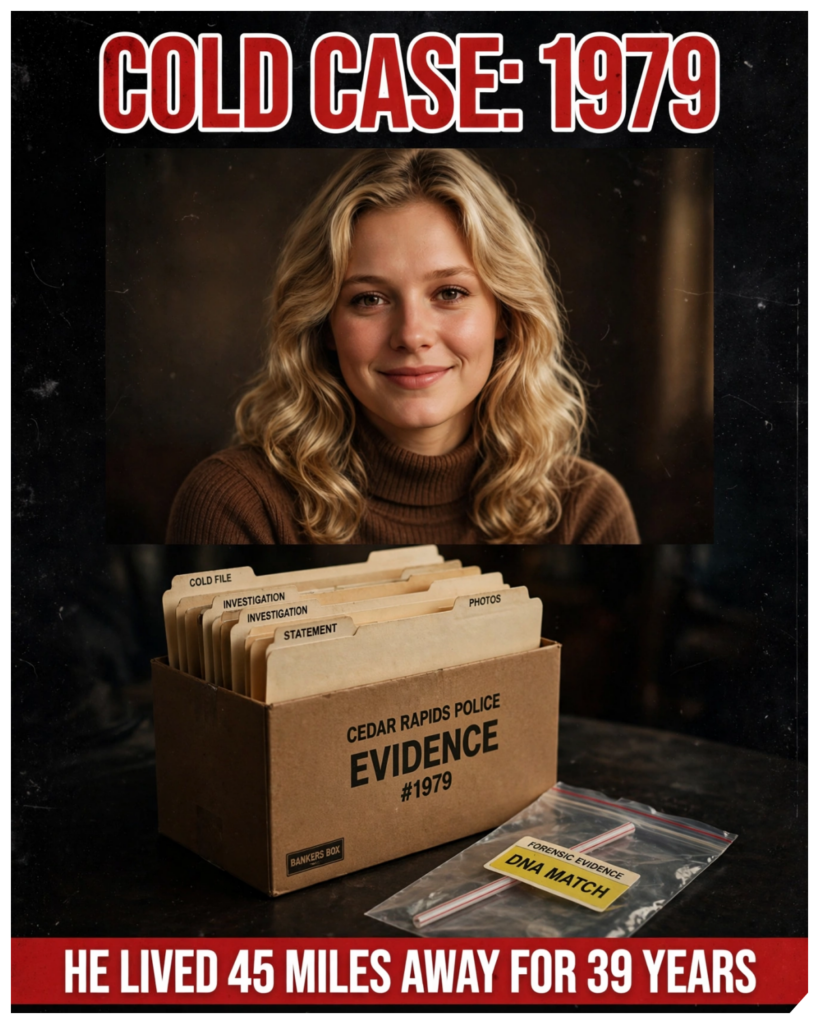
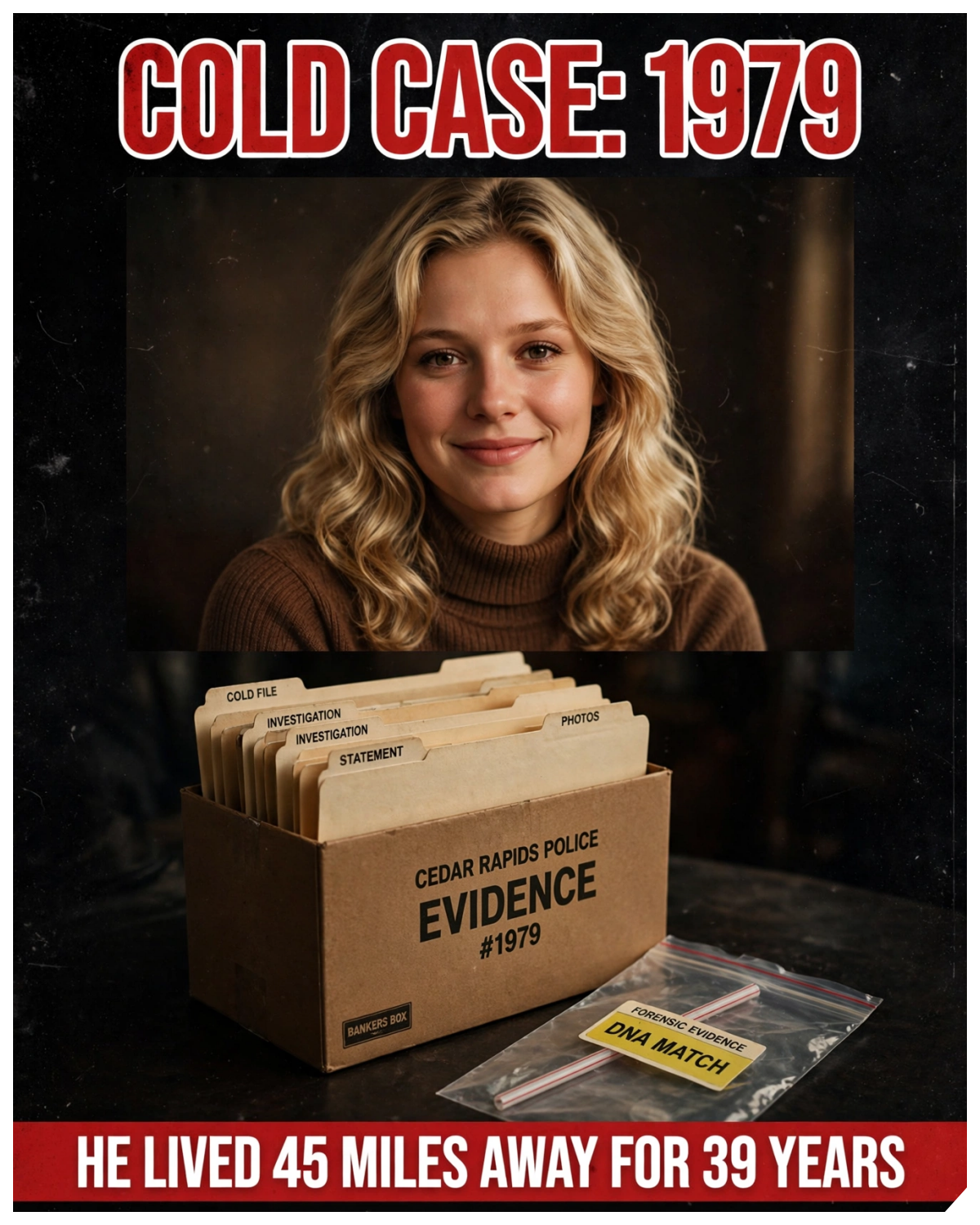
At about 4:00 in the morning on Thursday, December 20th, 1979, police in Cedar Rapids, Iowa, were searching the parking lot of the Westale Mall.
The mall had been open for less than 2 weeks.
Its lots were nearly empty at that hour, a wide sheet of cold asphalt under the lights.
In the northeast corner near the J C Penney store, they found a tan 1972 Buick Electra.
2 hours earlier, a father named Albert Martino had called the police.
His 18-year-old daughter, Michelle, had taken the family Buick to the mall the evening before to pick up a winter coat.
She had never come home.
Michelle was inside it, slumped across the front seat toward the passenger side, still wearing the white and brown rabbit fur jacket she had put on for a school banquet.
She had been stabbed more than 20 times in the face, the neck, and the chest.
Her hands were cut where she had grabbed at the blade.
The inside of the car was covered with blood and with clumps of fur torn from her jacket.
Her purse was in the car.
Her money was in the purse.
She had not been sexually assaulted.
There were no fingerprints because whoever did this had worn gloves.
There was no weapon.
No one came forward who had seen the attack.
A senior at Kennedy High School, a baton twirler and choir singer who planned to study interior design in the fall, had been killed in a shopping mall parking lot a week before Christmas.
And no one had seen it happen.
Police called it personal.
Someone had attacked her face.
Someone had wanted her dead.
They would spend 39 years trying to find out who.
They would question an ex-boyfriend the whole town suspected.
They would chase a violent offender who had attacked a woman with a knife in the same city a month earlier.
They would hypnotize witnesses, consult psychics, release a sketch, and take DNA from more than 125 men.
Michelle’s father would sue them all.
Both of her parents would die without an answer.
A detective who started the case in 1979 would retire and his son would grow up, join the same police department, and take over the file.
And the man who killed Michelle Martino would walk away from that parking lot and spend the next four decades in Manchester, a small town about 45 miles to the northeast.
He would build a business, raise a family, and become a respected member of his community.
He had no criminal record.
His name never appeared in the case file, not once.
What finally caught him was a drop of his own blood left on the back of Michelle’s dress the night she fought for her life and a plastic straw he left in a soda glass at a pizza ranch.
This is the story of Michelle Martino, the family that waited, the two generations of detectives who refused to let her go, and the stranger who walked away from a mall parking lot and disappeared into an ordinary life.
If you want to know not only who killed her, but how he stayed hidden for 39 years in plain sight, stay with me.
And if you are new here, subscribe to the Cold Record.
We go back into the files that time tried to bury and we follow them to the last page.
To understand what Cedar Rapids lost that December, you have to start long before Michelle was born.
Albert and Janet Martino were both veterans.
Albert had served in the Air Force during the Second World War.
Janet had served in the United States Army.
They married, settled in Cedar Rapids, and had a daughter, Janelle.
Then they tried for another child.
Janet suffered five miscarriages.
On October 6th, 1961, when Janet was 44 years old, Michelle Marie Martino was born.
Her sister Janelle was 12 years older.
The family lived on Woodfield Lane on the northeast side of Cedar Rapids, a city of about 110,000 people along the Cedar River in eastern Iowa.
In 1979, Cedar Rapids was a working town built around cereal mills, meat packing, and the Collins radio and avionics plants.
The Martinkos were Catholic and attended St.
Pius I 10th.
Michelle grew up to be quiet, smart, and talented.
At Kennedy High School, she was an above average student.
As a sophomore, she earned a spot on the twirling squad, which was nearly unheard of for a girl that young.
She twirled a baton at halftime during football games.
She sang in the women’s choir and in the concert choir, the school’s top vocal group.
She acted in school plays.
She was involved in a Christian youth group called Campus Life.
She was also striking.
She had blonde hair styled in a Farah faucet cut, the look of the late 1970s.
She dressed carefully and liked nice clothes.
Her principal, Michael Clover, later described her in a few plain words.
She was quiet, he said, but attractive.
Her close friend, Jane Hansen, who twirled with her, described her differently.
To Hansen, Michelle was an ordinary teenager who was just starting to blossom.
Decades later, Hansen still kept a Skipper doll on her shelf that reminded her of her friend.
A choir classmate named Blair Gaunt remembered holding Michelle’s hand on the choir bus.
Not everyone at Kennedy was close to her.
Michelle had a small circle of friends.
Some people believed other girls were jealous of her looks and her clothes.
There was also tension over a boy.
For about 2 years, Michelle had dated a classmate named Andy Sidell.
Their relationship had ended, and some of Michelle’s friends felt that he had taken the breakup badly, that history would follow him for decades.
By her senior year, Michelle had a plan.
She would graduate in the spring of 1980, and in the fall, she would go to Iowa State University to study interior design.
She had a part-time job at the mall.
She was 18 years old and she was getting ready to leave home.
Wednesday, December 19th, 1979 was 6 days before Christmas.
That evening, the Kennedy Concert Choir held its holiday banquet at the Sheran Inn in Cedar Rapids.
Michelle dressed for it in a black jersey dress, a black scarf, black panty hose, and heels.
Over it, she wore her waistlength rabbit fur jacket.
She carried a brown leather purse.
During the banquet, Michelle mentioned that she wanted to go to Westdale Mall afterward.
She had put a winter coat on layaway and wanted to finish paying for it.
She asked her friend Jane Hansen to come along.
Hansen said no.
She had homework.
Another friend agreed to go, then backed out.
So Michelle went alone.
She had $180 with her.
She drove the family’s Buick to Westale on the southwest side of the city.
The mall was brand new.
Michelle parked in the northeast section of the lot near J C Penney and walked in.
Several people saw her inside.
One was Tracy Price who knew her from choir.
He was at the mall with three friends and Michelle told them she was there to pick up a coat she had bought.
Price later said he noticed that she had a fair amount of cash and he warned her to be careful about flashing her money.
By one account, she told someone that evening that she felt as though she was being followed.
Police would later say they knew she was all right up until about 8:00.
The last confirmed sighting put her outside a jewelry store in the mall sometime after 8.
Then she walked out to the parking lot to the Buick in the northeast corner.
Nobody knows exactly what happened next.
Investigators would later describe what they believed happened based on the evidence.
Michelle got into the driver’s seat.
It was a cold night and she likely started the engine to let the car warm up.
Before she could pull away, someone opened the driver’s door.
The attacker pushed her across the bench seat toward the passenger side, climbed in after her, and pulled the door shut.
Then he attacked her with a sharp pointed weapon.
The medical examiner could not say for certain that it was a knife or how large it was.
He stabbed her in the face, in the neck, and in the chest.
Her lungs were pierced.
So was her aorta, the body’s largest artery.
She lost about a third of her blood.
Michelle fought.
The wounds on her hands showed she had grabbed at the weapon and tried to push it away.
She was trapped in the front seat of a car with her attacker, and she fought hard enough that in the struggle, the attacker cut himself.
Some of his blood fell onto the back of her black dress.
Some of it ended up on the Buick’s gear shift.
Then he got out of the car, closed the door, and walked away into the night.
The medical examiner would place the time of death between 8 and 10:00 that night.
The Martino house on Woodfield Lane waited.
As the hours passed, her parents grew frightened.
At about 2:00 in the morning, Albert called the police.
At about 4:00, police found the Buick in the northeast corner of the lot.
Among the detectives who responded that morning was Captain Charles Gelanick of the Cedar Rapids Police Department.
Many years later, his daughter Sue remembered what her father told her about the scene.
Michelle was slumped over the passenger seat.
There was blood throughout the car and rabbit fur from her jacket matted with blood covered the inside of it.
Another officer who worked the case from the beginning was Harvey Deninger.
He could not have known it then, but his family’s connection to this file was only beginning.
The investigators went through the Buick carefully.
They found no usable fingerprints.
On some surfaces, they found impressions that looked like the texture of rubber gloves, the kind sold in any grocery store for washing dishes.
The killer had come prepared not to leave his hands behind.
Years later, prosecutors would point to those gloves as evidence that the murder was planned.
There was almost no blood outside the car.
Michelle had been killed inside it, in the driver’s area, and across the bench seat.
Her purse was still there with the money still in it.
Her clothes were not disturbed.
The medical examiner found no sign of sexual assault.
Without robbery and without a sexual motive, investigators were left with one conclusion.
Whoever did this had come for Michelle herself.
The attack on her face in particular looked to them like rage.
Police told reporters the killing appeared to be personal in nature.
They began looking for someone who knew her.
That morning at about 4:30, Jane Hansen’s phone rang.
It was Janet Martino calling to tell her that Michelle was dead.
Years later, Michelle’s sister, Janelle, described the first moments with her parents in a single sentence.
“They just hugged,” she said, and they couldn’t believe she was gone.
The news spread through Kennedy High School before the end of the week.
It was nearly Christmas break.
Students who had sung beside Michelle at the choir banquet a few nights earlier now learned that she had been killed within hours of leaving it.
Blair Gaunt, the classmate who used to hold her hand on the choir bus, later said that the murder left him numb for decades.
The mall had been open less than two weeks.
Now it had become a crime scene.
In the first week, the Cedar Rapids Police Department received more than 200 tips.
Detectives worked through them one by one.
The first person most people wanted them to look at was Andy Sidell.
He had dated Michelle for about 2 years.
Some of her friends believed he had been obsessive about her after their breakup, and Michelle’s close friend, Gail Dawson, later said that many people were convinced he was the killer.
Police questioned him.
His mother told them he had been home with her that night.
Without any physical evidence connecting him to the car, there was nothing more they could do.
After high school, Sidell joined the Navy.
The suspicion stayed in Cedar Rapids long after he left.
Another former boyfriend, Mike Hayrick, was away at college more than 100 miles from Cedar Rapids.
Police questioned him, too.
He later said detectives showed him photographs from the crime scene, watching for his reaction.
They looked at a teenage boy who had been found carrying a knife.
They looked at an employee of the shopping center.
Each was cleared.
Then there was Dennis Lee McKe.
A month before Michelle’s murder, McKe had raped a woman at Knife Point in Cedar Rapids.
A violent man, a knife, the same city, the same season.
For a time, he was the investigator’s prime suspect.
McKe denied having anything to do with Michelle’s death.
He was never charged with her murder.
Years later, police would say plainly that if his DNA had matched, he would have been.
It did not.
McKe died in prison on January 15th, 2012.
Investigators used polygraph examinations to clear several people.
They brought in hypnotists, hoping that witnesses who had been at the mall that night might remember more under hypnosis than they could while awake.
By one count, as many as 30 people were hypnotized.
Police even consulted psychics.
Forensic hypnosis was popular with police departments in the late 1970s.
Investigators believed it could unlock details a witness had seen but could not consciously recall.
A face, a license plate, the color of a coat.
Since then, research has shown how unreliable it is.
Hypnotized witnesses become more confident in their memories without becoming more accurate, and they can absorb suggestions from the person questioning them and come to believe them as their own.
Many courts now limit or bar testimony from witnesses whose memories were refreshed this way.
In 1980, it was one of the few tools Cedar Rapids detectives had left.
In April 1980, a $10,000 reward was offered for information leading to the killer.
On June 19th, 1980, 6 months after the murder, Cedar Rapids police released a composite sketch.
It was based on the descriptions of two witnesses who had been questioned under hypnosis.
It showed a white man in his late teens or early 20s, about 6 feet tall, weighing 175 to 175 lbs, with brown eyes and curly brown hair.
Tips came in.
None of them led anywhere.
And then in 1981, the department learned something that should have reached it more than a year earlier.
A woman came forward to say that at about 2:00 on the morning of December 20th, 1979, she had driven past the Westale parking lot.
She had seen Michelle’s car and she had seen a man standing beside it.
She had not kept this to herself.
She had passed it to someone connected to the city’s public safety commissioner, expecting it to reach the police.
It never did.
The information went nowhere for months before the woman finally contacted detectives herself.
By then the trail was cold.
Detectives considered charging the commissioner.
In the end, no charges were filed.
Detectives built a list of suspects.
Over the years, it grew to more than 80 names.
One by one, they eliminated more than 60 of them.
Through alibis, polygraphs, and the limited forensic tools they had, but they never got to the man who did it.
In 1979, the evidence that would one day solve the case was sitting in front of them.
There was blood in that car that was not Michelle’s, but the science of the time could not use it.
Blood typing could tell investigators whether a stain was type A, B, AB, or O.
That might eliminate some suspects.
It could never point to one person.
DNA profiling would not be invented until 1984 in England, and it would not be used in an American courtroom until the end of that decade.
So Michelle’s dress and the other evidence from the Buick were packaged, labeled, and put into storage at the Cedar Rapids Police Department.
They stayed there for the next quarter of a century.
Albert and Janet Martino did not let the case fade.
In the mid 1980s, Albert filed a lawsuit against the owners of Westdale Mall, arguing that the mall had not provided adequate security in its parking lot.
The case went all the way to the Iowa Supreme Court.
On September 17th, 1986, the court ruled in favor of the mall owners.
The years passed in the House on Woodfield Lane.
Christmas came every December, one week after the anniversary.
Janet had been 44 years old when Michelle was born.
The family had her for 18 years.
Albert Martino died on July 24th, 1995.
Janet Martino died on March 30th, 1998.
Neither of them ever learned who killed their daughter.
Neither lived to see science clear the young man so many people had blamed.
They died with the questions.
If you have stayed with the story this far and you want to see how two generations of one police family finally closed this case, this is the moment to subscribe to the cold record because the next part of this story moves 45 miles away to the small town where the killer was living his life.
45 mi northeast of Cedar Rapids in Delaware County, there is a town called Manchester.
It is a small place about 5,000 people surrounded by farmland.
The Machada River runs through the middle of it.
Jerry Lynn Burns grew up there.
He was born on December 23rd, 1953, one of three brothers, and graduated from West Delaware High School in Manchester in 1972.
In 1975, he married a woman named Patricia.
He worked for John Deere.
Later he co-owned a truck stop.
Eventually he started a powder coating business in Manchester called Advanced Coating Concepts which applied durable finishes to metal parts.
In December 1979, Jerry Burns was 25 years old.
He was married.
He had no criminal record.
As far as anyone has ever been able to establish, he had no connection to Michelle Martino.
Investigators never found any link between him and Michelle, her school, or her family.
In the years after the murder, his life went the way many lives go in smalltown Iowa.
He worked.
He raised three children.
He built his business.
People in Manchester knew him as a hard-working man who ran a respectable company.
Patricia died in 2008.
He would later tell investigators that his family had gone shopping at Westdale Mall over the years.
Sure, he said.
They had been to Westdale.
There is no public record of what Jerry Burns thought about during those decades or whether he ever thought about the girl in the Buick at all.
Criminologists who study offenders who are never caught describe a pattern in which the crime is sealed away from everyday life and everyday life is built up around it until it becomes the only version of the person that anyone sees.
Some of those offenders live with fear.
Some come to believe that time has made them safe.
What is known about Jerry Burns is this.
For 39 years, he went to work, came home, raised his children, and grew old in a town 45 mi from the parking lot.
And no one ever came to his door.
In 2005, the Martino file came to rest on the desk of a Cedar Rapids cold case investigator named Doug Larrison.
Larrison was not a stranger to the case.
He had gone to Kennedy High School.
He was one of Michelle’s classmates.
In 1979, he had been a teenager in the same hallways, and now he was a police investigator with her file in front of him.
Larrison started where every good cold case investigator starts.
He read everything and in the paperwork, he found a lab report that had never been followed up.
Years earlier, someone had tested the gear shift of the Buick and found blood that was not Michelle’s.
It came from a man.
Nobody had pursued it.
Larrison had the evidence re-examined.
On the back of Michelle’s black dress, analysts found a blood spot.
From it, they developed a male DNA profile.
It matched the blood from the gear shift.
Think about where that blood was.
On the gear shift of the car, where the killer’s hand would have been, and on the back of a dress worn by a young woman who had been pushed across a seat and stabbed while she fought.
To Larrison, the conclusion was simple.
On October 2nd, 2006, he and fellow investigator George Abow announced the new DNA evidence to the public.
There is no doubt whatsoever, Larrison said, that this is the killer’s blood.
The profile was entered into Cotus, the FBI’s national DNA database.
If the killer had ever been convicted of a crime that required him to give a DNA sample, Cotus would find him.
It found nothing.
A new $10,000 reward was offered, and Michelle’s family put up half of it.
Larrison and his team went back to the list of names from 1979 and began testing everyone they could find.
One of the people they tested was Andy Sidell.
For more than 25 years, he had lived with the suspicion of the people who had known Michelle.
In the 2000s, he voluntarily gave a DNA sample.
It did not match.
The man so many people in Cedar Rapids had been sure about was not the killer.
Albert and Janet Martino had both died before the science could clear him.
Larrison and his colleagues tested more than 100 people.
None [clears throat] of them matched.
In 2009, the Iowa Division of Criminal Investigation listed the Martino murder among about 150 cold cases it hoped to solve with advances in DNA technology.
Still, the profile sat in the system with no name attached.
In 2013, an anonymous letter arrived accusing a member of Michelle’s own family.
Is investigator Jeff Melgren followed up and DNA cleared him.
That December, a tip came through Lynn County Crimestoppers pointing to another man.
Police called the information credible and in April 2014, they publicly asked the tipster to get back in touch.
The suspect’s DNA did not match either.
Doug Larrison had given the case years of his life.
Eventually, he said he was burned out and he asked to be replaced.
In 2008, while all of this was happening, the evidence itself nearly did not survive.
That June, the Cedar River rose to more than 31 ft, far above any level ever recorded, and flooded about 10 square miles of Cedar Rapids.
It was one of the worst natural disasters in Iowa’s history.
Thousands of homes were damaged and much of downtown was underwater.
Water reached the police department’s evidence storage.
Some of the bags were soaked, including the one holding Michelle’s dress.
The DNA had already been taken from the blood stain by then, [clears throat] but the lab later advised that the flood and humidity meant there was little chance of finding more.
In 2015, the Martino file was handed to a new lead investigator.
His name was Matt Deninger.
He was Harvey Deninger’s son.
Harvey Deninger had worked the case in 1979.
He had retired without an answer.
Now, his son was a Cedar Rapids investigator, and the same file his father had worked was his to solve.
Matt Deninger was candid about the odds.
They just needed to get lucky, he said.
By then, a new kind of DNA science was emerging.
A company in Virginia called Parabon Nanolabs had developed a service it called Snapshot.
Using a DNA sample, Parabon could predict a person’s likely ancestry, skin color, eye color, and hair color, and build a composite image of what that person might look like.
It was called DNA phenotyping.
Deninger sent the Martino profile to Parabon.
The analysis cost about $5,000.
On May 16th, 2017, Cedar Rapids police held a press conference and released the result.
Images of a white man with blonde hair and blue eyes shown as he might have looked at 25 and as he might look decades later.
Michelle’s sister Janelle and her husband John were shown the images before the public saw them.
Jon called it sobering and disturbing at the same time.
Janelle said it was very personal.
It brings it to a person, she said.
Over the next four months, police received more than 100 new tips.
Blair Gaunt later said that one of their classmates had been recognized in the images by people who knew him.
DNA eliminated him as it eliminated every other person tested.
By the end of 2017, the list of men excluded by DNA had grown to more than 125.
Then, in the spring of 2018, the world of cold case investigation changed overnight.
In April 2018, investigators in California arrested a former police officer named Joseph D’Angelo and identified him as the Golden State Killer, one of the most notorious serial offenders in American history.
They had found him by uploading crime scene DNA to a public genealogy website called GE Dead Match, finding his distant relatives and building their family trees until they led to him.
Within weeks, Parabon launched its own genetic genealogy unit and police departments across the country began sending their oldest cases.
Parabon uploaded the Martino DNA to GE dead match.
The way this works is worth understanding because it is the reason Jerry Burns was found.
Traditional forensic DNA, the kind stored in Cotus, looks at a small set of locations on the genome, enough to confirm whether two samples came from the same person, but not enough to find relatives.
Genetic genealogy uses a far larger set of markers, hundreds of thousands of tiny variations called single nucleotide polymorphisms.
When two people share long stretches of identical DNA, it means they share ancestors.
The more DNA they share, measured in units called centmorggans, the closer the relationship.
In July 2018, the search came back with a match.
It was not the killer.
It was a woman named Brandy Jennings who lived in Vancouver, Washington.
Based on how much DNA she shared with the profile from the Buick, genealogologists estimated she was the killer’s second cousin once removed.
That is a distant relationship.
Second cousins share a set of great-grandparents.
Once removed means the two are a generation apart.
From one woman in Washington State, the task was to build out her entire family, branch by branch, until the tree reached a man who fit.
Matt Deninger spent months on it.
He worked through birth records, marriage records, obituaries, and gravestones.
He traced the family’s lines across generations, and across state lines.
As he narrowed the possibilities, he and other investigators collected DNA from living relatives on different branches of the tree with their cooperation and sent the samples to the Iowa DCI Crime Lab for comparison.
Each sample showed whether the killer belonged on that branch or another.
This approach is sometimes called target testing.
A family tree built from records can show many possible paths to the killer, but it cannot say which path is the right one.
A cheek swab from a willing relative can.
If that relative shares the expected amount of DNA with the crime scene profile, investigators know they are on the right branch.
If not, the branch can be closed off and the search moves somewhere else.
Each test removes dozens of people from the tree at once.
Eventually, Deninger identified a man who was a first cousin of the killer.
That narrowed it to one set of brothers, the sons of one family in Manchester, Iowa, 45 mi from the mall.
Their names were Donald, Kenneth, and Jerry Burns.
One of the three had killed Michelle Martino.
Investigators needed to find out which, and they needed to do it without any of the brothers knowing, so they followed them, and they waited for each brother to throw something away.
Asking directly was not an option.
If any of the brothers was approached for a sample, word could reach the others within hours.
A guilty man who knew the police were coming could hire a lawyer, refused to cooperate, or simply stop leaving his DNA in public places.
Two of the three brothers were innocent, and investigators did not want to accuse anyone before they knew which one it was.
The law allows it.
In 1988, in a case called California versus Greenwood, the United States Supreme Court ruled that people have no reasonable expectation of privacy in things they discard.
Trash on a curb, a cup in a public bin, a straw left behind at a restaurant.
Investigators do not need a warrant to collect it.
From one brother, they collected a straw he used at lunch.
From another, they recovered a toothbrush from his garbage.
For Jerry Burns, they went to lunch.
On October 29th, 2018, Burns went to a pizza ranch in Manchester.
Investigators went in too and took the booth next to his.
They watched him eat.
Over the course of the meal, he drank at least two sodas out of a glass with a straw.
When Burns finished and left, Matt Deninger walked over to the table.
He took the glass Burns had been drinking from.
He packaged the straw right there at the table, sealed it, and sent it to the DCI crime lab in Ankeny.
The results came back.
Neither Donald nor Kenneth matched.
The straw from the pizza ranch did.
At the DCI lab, criminalist Michael Schmidt had compared the profile from the straw with the profile from the blood on Michelle’s dress, location by location across the genome.
He would later tell a jury that it was the clearest match he had ever seen in his career.
In his experience, he said family members might share seven or eight of those locations.
These samples shared everyone.
A match like this, he said, he would only expect to come from Jerry Burns’s identical twin.
Court documents put the chance of a random unrelated person matching at less than 1 in 100 billion.
To put that number in perspective, there are about 8 billion people alive on Earth today.
The odds meant that if you could test every human being on the planet more than 10 times over, you would not expect to find another unrelated person whose DNA matched the blood on Michelle’s dress.
Deninger later said that when the lab called, he asked them to confirm.
Yes, they told him.
It’s a match.
For 39 years, Michelle’s killer had been invisible.
Now, investigators had his name, his address, his business, and his blood.
The arrest came 39 years to the day after Michelle walked out of Westdale Mall.
On December 19th, 2018, Matt Deninger and a fellow investigator JD Smith drove to Manchester and walked into Advanced Coding Concepts.
Jerry Burns was there at the business he had built.
He was 64 years old.
They had brought a coffee mug with a hidden camera inside it.
The entire conversation was recorded.
The setting was deliberate.
Interviewing Burns at his own business was less formal than bringing him to a police station.
People talk more easily on familiar ground, and a man who has not been arrested is not yet in custody, which shapes what investigators are required to tell him before they begin asking questions.
The investigators told Burns they were working on an old case.
They asked whether he knew anything about the murder of Michelle Martino.
He said he knew only what he had seen in the news.
He said he did not know her.
He said he had not been there.
Asked about Westdale Mall.
He said his family had gone there over the years.
“Sure,” he said.
They had been to Westdale.
Then, Deninger told him why they were really there.
“I already know that your DNA is going to match the DNA that we have on file.”
He said, “The reality is we have your DNA at the crime scene, and so we know you were there that night.
But what we don’t know, Jerry, is why it happened.
Burns did not explode.
He did not break down.
He did not offer an explanation.
He did not say there had been a mistake.
Over and over to almost every question, he gave the same three-word answer.
Test the DNA.
Deninger asked him what happened that night.
I don’t know, Burns said.
I was not there that night.
Well, Deninger said, we know better than that.
The investigators asked Burns for a cheek swab.
He refused.
So, they served a search warrant that compelled him to give one.
They swabbed the inside of his mouth.
They also examined his hands and arms looking for old scars because they knew that the man who killed Michelle had cut himself during the attack.
They photographed what they found.
Then they placed Jerry Burns under arrest for first-degree murder.
In the back of the squad car, handcuffed, the recording continued.
Deninger tried again.
He said he wished Burns could talk him through what had happened that night.
I don’t recollect, Burns said.
Then he said something that investigators would remember.
People, he said, could block things out of their memories.
What Burns did not say in the business or in the car was just as striking.
He never said Deninger had the wrong man.
He never said he had not killed Michelle Martino.
At trial, an investigator would testify that across the entire recorded interview, Burns never directly denied the killing.
That is a pattern interrogators recognize.
Someone who is truly innocent, confronted with the claim that their DNA is at a murder scene, usually reacts with outrage and denial.
They insist they have never been there.
They demand to know how such a thing could be possible.
What Burns did instead was shift the weight onto the science and onto his own memory.
Test the DNA.
I don’t recollect.
People can block things out.
Each answer avoided a lie that could be disproven, and each one avoided a confession.
The cheek swab went to the DCI lab.
It matched the straw.
It matched the blood stain on her dress.
And investigators said Burns’s DNA was also on the Buick’s gear shift.
Cedar Rapids Police Chief Wayne German stood in front of reporters and announced the arrest.
Lynn County Attorney Jerry Vanderandon reminded the public that Burns was presumed innocent.
Burns was booked into the Lynn County Jail with bail set at $5 million cash only.
Janelle and John Stonebreaker issued a statement thanking the Cedar Rapids police for their persistence.
In Manchester, people who had known Jerry Burns for decades could not believe it.
His daughter Jennifer and his brother Don said they did not think he was guilty.
Don suggested that a job Jerry once had at a car dealership might explain how his DNA ended up in the car.
Deninger dismissed the idea.
Michelle’s friend, Elizabeth Layman, heard about the arrest and said she just started screaming.
Burns pleaded not guilty.
He hired Leon Spies, a prominent defense attorney from Iowa City.
Spies moved quickly.
He asked the court to throw out the DNA from the straw, arguing that police had violated Burns’s constitutional rights by collecting his genetic material without a warrant.
He argued that a person does not abandon their DNA just because they leave a straw behind at a restaurant.
The judge disagreed.
Discarded property, the court ruled, carries no reasonable expectation of privacy.
The straw stayed in.
Prosecutors wanted to introduce something else.
Internet searches found on Burns’s business computer in 2018, which investigators described as violent and disturbing.
The judge excluded them.
They were from almost four decades after the murder, the court said, too far removed in time to be used at trial.
The defense also argued that the publicity in Lynn County made a fair trial impossible there.
Judge Fay Hoover Grind agreed, citing what she called pervasive and prejuditial pre-trial publicity.
The trial was moved 80 miles away to the Scott County Courthouse in Davenport.
While he waited for trial in the Lynn County Jail, Jerry Burns made a friend.
His name was Michael Allison.
He was being held on federal drug charges and had prior drug convictions of his own.
The two men played pinnacle.
They talked about their lives.
Burns started calling Allison’s son.
And Allison called him dad.
When the Cedar Rapids Gazette ran a photo of Burns in handcuffs, Burns autographed it and gave it to Allison.
He wrote to my favorite son, Michael.
Burns never told Allison he killed Michelle.
But Allison said Burns talked around the case.
Once after a court appearance, Burns described staring down an officer.
“Son,” Allison quoted him as saying, “They might have me, but I don’t have to bow my head to him.”
Allison said Burns believed he had already won because he had spent all those years free out there with his family.
And then there was the pinnacle game.
Allison kept beating him.
Burns told him that if he didn’t stop winning, he was going to have to take him to the mall.
Allison said the comment disgusted him.
He contacted his attorney.
Jury selection began in Davenport on February 10th, 2020.
Opening statements came on February 12th.
Janelle and John Stonereer sat in the courtroom.
Members of the Burns family came to support him.
Jerry Burns, 66 years old, attended every day in a suit.
Assistant Lynn County Attorney Nick Maybanks led the prosecution.
He told the jurors they were about to go on a journey back in time to learn about an Iowa high school girl.
He described the wounds, her lungs pierced, her aorta pierced, a third of her blood gone.
The killer, he said, had been cut too and had left his blood on her dress.
Leon spies told the jury that DNA does not tell the whole story.
It is not, he said, a silver bullet.
The prosecution called the retired doctor who had performed the autopsy in 1979.
Former investigators testified about the scene and the glove marks on the car.
Andy Sidell, the ex-boyfriend so many people had suspected, testified that he and Michelle had just kind of grown apart.
Tracy Price told the jury about seeing her at the mall that night and hearing about the coat she had come to pick up.
Matt Deninger testified about the family tree, the cousins, the three brothers, and the pizza ranch.
The jury watched the recording from the coffee mug camera and heard Burns say, “Test the DNA.”
Again and again, Michael Schmidt of the DCI Lab testified about the match, the clearest he had ever seen.
He walked the jurors through the odds.
He said it was almost unbelievable that the technology to get them to this point existed.
Michael Allison took the stand.
Spies went after him hard.
Was he using Jerry Burns as a bargaining chip to get a better sentence in his federal case?
No sir, Allison said, not at all.
He said no one had promised him anything.
Jailhouse informants are among the most debated witnesses in American courts.
They are often facing charges of their own, and they have an obvious reason to offer prosecutors something valuable.
Studies of wrongful convictions have found that false testimony from informants played a role in a significant share of cases later overturned.
That is why defense attorneys attacked them and why juries are warned to weigh their testimony carefully.
In this case though, Allison’s account was not the foundation of the prosecution.
It was a detail added on top of the DNA.
The jury did not need to believe Michael Allison to convict Jerry Burns.
They only needed to believe the blood.
The defense case rested on the evidence itself.
Spies pointed out that Michelle’s clothing had been stored for nearly 40 years.
In 2008, flood water had soaked the bag holding her dress.
Some items had been packaged together if the evidence had been handled carelessly.
He argued DNA could have moved from one place to another.
The defense called a single witness, a forensic DNA consultant who testified that secondary transfer DNA carried from one surface to another through contact was a real possibility.
He did not claim it explained how Jerry Burns’s blood got onto Michelle’s dress.
A criminalist for the prosecution testified that the way the evidence had been stored was not unusual for its time.
At one point, a prosecutor asked a witness whether the blood tied burns to the scene.
Spies moved for a mistrial.
The judge denied it.
When the prosecution rested, the defense asked for a judgment of a quiddle.
That was denied, too.
Burns did not testify.
In his closing argument, Nick Maybanks called the contamination theory nonsense.
The only DNA found on her dress in that vehicle and in that location, he said, was the DNA of Jerry Burns.
As for intent, he said the attack could be read in no other reasonable way than malice.
In the prosecution’s view, a man who brings gloves to a parking lot and stabs a teenager more than 20 times has made a decision.
Spies told the jury that when the evidence consists of tiny genetic samples, the handling and integrity of that evidence is critically important.
Nearly 40 years a flood and bags stored together, he argued, left reasonable doubt.
On February 24th, 2020, the jury began deliberating.
They were out for less than 3 hours.
They found Jerry Lynn Burns guilty of first-degree murder.
The Burns family sat quietly as he was led out.
They stayed in the courtroom after the reporters left.
Janelle Stonebreaker spoke afterward.
“The family now knew who had killed her sister,” she said, even if they did not know all of the reasons.
She wished her parents could have been there to see it.
In Iowa, first-degree murder carries a mandatory sentence of life in prison without the possibility of parole.
Sentencing was scheduled for April 2020, then delayed by the CO 19 pandemic.
The defense filed a motion for a new trial.
It was denied.
On August 7th, 2020, Jerry Burns was sentenced to life in prison without parole.
He was also ordered to pay $150,000 in restitution to Michelle’s estate.
Michelle’s brother-in-law, John Stonereaker, gave a victim impact statement by video, speaking for himself and for Janelle.
He spoke directly to Burns about the life that was now waiting for him.
It helps to know, he said, that his life will be a sad little cell.
He told Burns he would never again smell the rich, freshly plowed earth of Delaware County.
And then he spoke about Michelle.
She had fought so hard that night, he said, that her attacker cut himself.
In doing that, Michelle became her own best witness.
Jerry Burns, he said, had been clever enough to steal 39 years of freedom he didn’t deserve, and he knew it.
Burns has never admitted killing Michelle Martino.
He has maintained his innocence.
He appealed.
His lawyers argued that the straw was taken in an illegal search under the Fourth Amendment and the Iowa Constitution, that leaving DNA on a straw is not the same as abandoning it, that the jury should have been told more about Michael Allison’s possible motives, and that the evidence was insufficient.
The Iowa Supreme Court heard the case on September 30th, 2022 in a courtroom at the University of Iowa College of Law.
On March 31st, 2023, the court affirmed his conviction.
A person who leaves a straw behind in a restaurant, the court found, has not kept a reasonable expectation of privacy in the DNA on it.
Jerry Burns is serving his sentence at the Animosa State Penitentiary in Iowa.
The murder of Michelle Martino changed more than one family.
It left behind lessons about evidence, about suspicion, and about who we fear.
The first lesson is about a single lab report.
In the early years of this case, someone tested the Buick’s gear shift and found a man’s blood.
Then the result sat in the file unread until a former classmate of Michelle’s picked it up decades later.
Cold cases are rarely solved by one brilliant insight.
More often they are solved by someone patient enough to read every page and ask why a lead was never followed.
Doug Larrison found that report.
Without it, there would have been no profile, no genealogy, and no straw.
The second lesson is about the people who were suspected and never did it.
For more than 25 years, many people in Cedar Rapids believed Andy Sidell had killed his former girlfriend.
There was never any evidence.
There was only a breakup and a story people told each other.
When the DNA finally cleared him, Michelle’s parents were already gone.
Dennis McKe, a man who had committed a violent crime, was suspected, too, and the science cleared him as well.
More than 125 men gave DNA in this case and were excluded.
Every one of those names had been somebody’s theory.
The truth was a man nobody had ever mentioned.
The third lesson is about the law.
The pizza ranch straw became the subject of a ruling by the Iowa Supreme Court.
The question was whether police can take DNA you leave behind on a cup, a straw, or a napkin and use it to identify you without a warrant.
The court said yes.
That ruling now guides investigators across the state and it is part of a much larger national debate about genetic privacy.
Most people who uploaded their DNA to genealogy websites were looking for long-lost relatives.
They were not thinking about murder investigations.
A distant relative in Vancouver, Washington, helped solve a murder in Iowa simply by sharing her DNA online.
The fourth lesson belongs to the families.
Albert and Janet Martino had their younger daughter for only 18 years.
Albert went to court to argue that the mall should have protected her.
He lost.
Both of them died in the 1990s, still waiting.
Their older daughter Janelle and her husband Jon carried the case forward, contributed to the reward, looked at the computerenerated face of a stranger in 2017, and sat in a courtroom in Davenport in 2020 to hear the verdict.
In a case that took 39 years, the family’s patience was as important as any test.
The fifth lesson belongs to the Deninger family.
Harvey Deninger was one of the officers on this case in 1979.
He retired without an answer.
His son Matt inherited the same file and finished it.
Few cases in American policing span two generations of the same family and fewer still and the way this one did.
And the last lesson is the most uncomfortable one.
For almost 40 years, investigators believed Michelle had been killed by someone who knew her.
The violence looked personal.
Her face had been attacked.
The theories always pointed to a boyfriend, a jealous classmate, someone with a grudge.
In the end, prosecutors described the murder as a random act of violence committed by a stranger.
A man from a town 45 miles away who came with gloves and had no known reason to choose her except that she was there.
That kind of crime is the hardest of all to solve because there is no relationship to trace.
There is only the evidence the killer leaves behind.
In this case, the killer left his blood.
He left it because Michelle Martino fought him.
She was 18 years old.
She was born after her mother had lost five pregnancies.
She twirled a baton at Kennedy High School football games and sang in the concert choir.
She dressed up for a holiday banquet in a black dress and a rabbit fur jacket.
She was going to study interior design at Iowa State.
On the last night of her life, she took $180 to the mall to pay off a winter coat.
The mall where she was killed has since been redeveloped and renamed Westdale Town Center.
The stores have changed.
J C Penney, the store nearest to where the Buick was found, is still there.
What happened there lives on in the record.
It shows that a girl pinned in the front seat of the family Buick with no way out fought hard enough to leave her killer bleeding.
That a classmate found the report that everyone else had missed, that a detective’s son finished his father’s case, and that on the 39th anniversary of her death, the man who thought he had gotten away with it was told in his own business that he had not.
This is the cold record.
We reopen old cases and stay with them until the last page.
If Michelle’s story stays with you, subscribe and share


