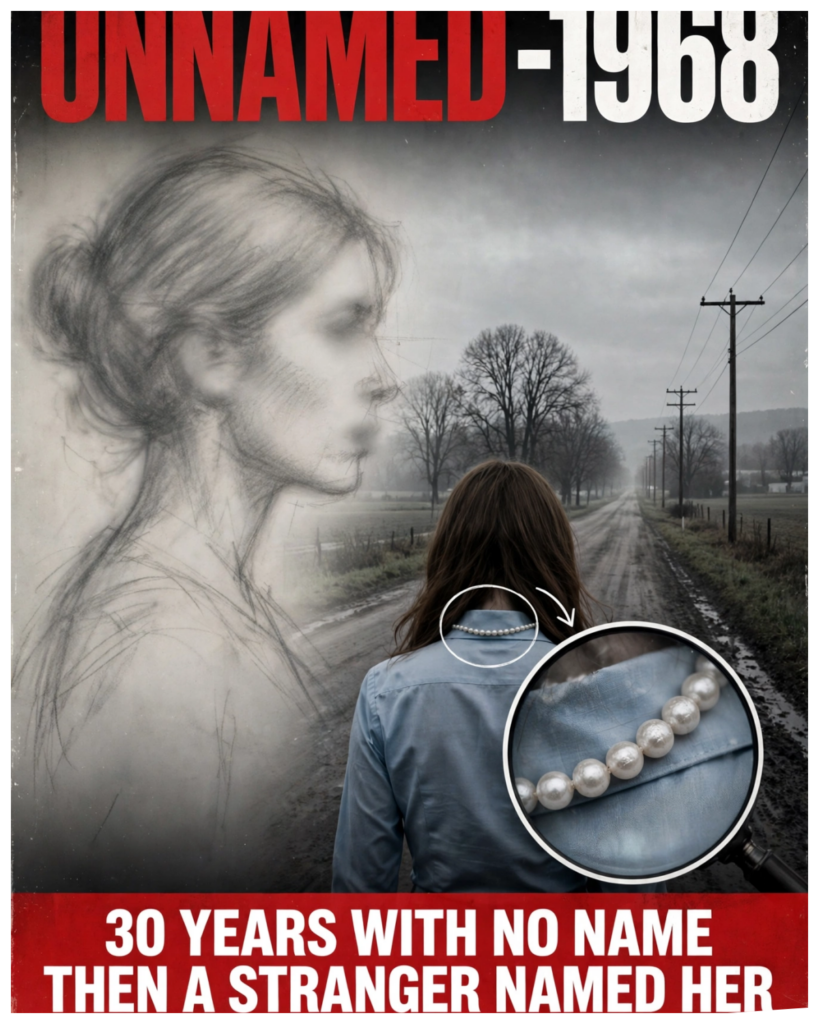
The bundle was green canvas, the kind a tent is packed in, tied shut with rope through its brass eyelets.
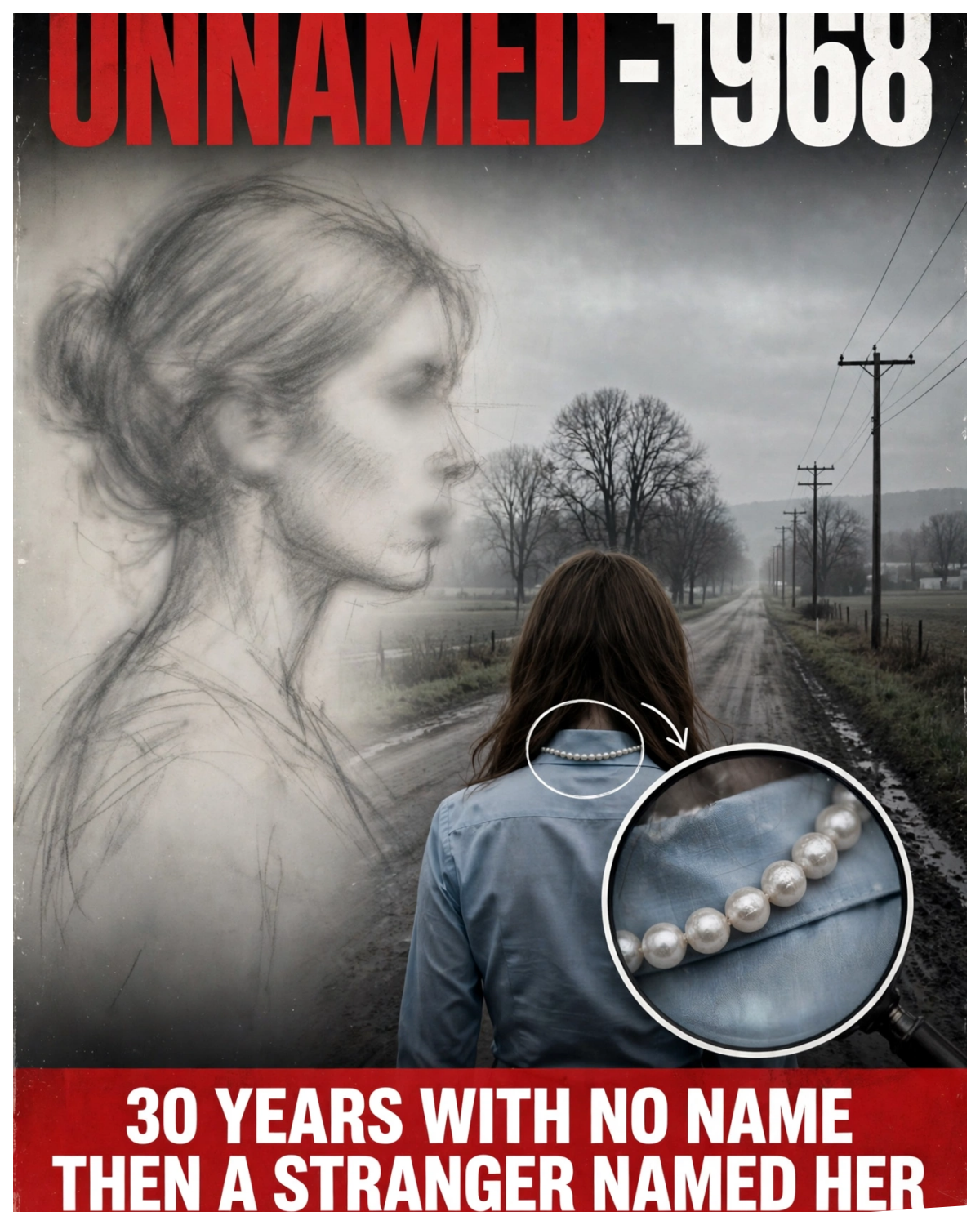
In May of 1968, a well driller found it in the brush beside Eagle Creek in Scott County, Kentucky.
Inside was a young woman.
Nobody knew who she was, so the newspapers named her after the only thing she had been found with.
They called her tent girl.
Someone had left her a few steps past a fence along US Highway 25, and nobody ever came to ask about her.
For 29 years and 11 months, that was her name in the case [music] file and in the papers.
It was carved into her headstone in Georgetown Cemetery above a police artist sketch of a face nobody recognized and a list of everything investigators thought they knew about her.
Her height, her weight, the color of her hair, her age, which they got wrong.
The stone ended with one word, unidentified.
She was not unidentified because nobody loved her.
People were looking for her.
They were looking in the wrong state for a woman they had been told walked away.
And in Kentucky, the people who had her were looking for a teenager.
It took a man who first heard her story when he was 17 years old.
It took 11 years of microfich, long drives, and thousands of his own dollars.
And it took a few lines typed by a stranger on the early internet to bring the two halves of this story together.
This is the story of who she was and how a factory worker from Tennessee gave her back her name.
It starts with the man who found her on an ordinary working morning.
This is the Unnamed Files.
We follow the people the world forgot to name all the way to the day they get it back.
If that’s the kind of story you want more of, subscribe.
Now, back in May of 1968, Wilbur Riddle was 40 years old and he drilled water wells for a living.
He lived in Monterey in Owen County.
On Friday, May 17th, he drove to a job near Sadieville, a small town about 13 mi north of Georgetown, the Scott [music] County seat.
The job was a new Gulf station going up beside an exit of Interstate 75.
Sadville was a railroad stop and not much more.
The interstate was brand new through that stretch of Kentucky.
It was taking over from US Highway 25, the old two-lane road that wound along Eagle Creek as the main route north toward Cincinnati.
When Riddle arrived that morning, he found a note on his truck.
[music] His boss wanted him to hold off drilling until he got there.
So, Riddle had time to kill.
Down the road, linemen were working on the telephone poles.
Old glass insulators were coming down.
The thick colored glass knobs that had held the wires.
A friend of Riddles liked them.
Riddle went to collect some.
Glass insulators had been around since the days of the telegraph.
By the 1960s, they were being pulled down and thrown away, and collectors were picking them up off the roadsides.
Searching pole to pole along the creek with his arms full of glass, he noticed a bundle tucked partly under a big rock beside a dead redbud tree.
It was on the creek side of a sagging waist high fence about 20 paces from the road.
It was dark green canvas.
The ends were tied with rope threaded through round brass eyelets the way a tent is packed.
It was about 4 ft long.
Riddle set the insulators down on the rock.
He nudged the bundle with his foot and pulled at a corner.
It tipped over the edge of the bank and rolled down into the gully about 30 ft.
He followed it.
Through a slit in the canvas, he could see enough.
He did not need to open it any further.
For a while, he just stood there at the bottom of the bank with the creek on one side and the road above him, thinking about what to do.
He told the story many times over the years, and he was honest about that moment.
If he left and someone else came along and found what was in that canvas, he reasoned, they might have thought I had put it there.
He decided he could not just walk away.
He climbed back up to his truck, drove to the nearest open filling station, a Chevron in Sadville, and fed coins into the pay phone.
Decades later, he remembered what he said when the Scott County Sheriff, Bobby Vance, picked up.
I think I found a dead body.
The sheriff came out from the courthouse in Georgetown with the deputy and the coroner.
[music] The state police came, too.
Riddle went over the morning again for them, then watched the ambulance take her away, still wrapped in the canvas.
Think about that spot for a second.
It was a gravel pulloff on the old highway right beside the new interstate exit.
For [snorts] a northbound driver leaving Interstate 75 at Sadville, it was the first place to pull over.
Investigators noticed that in the spring of 1968, a brand new interstate could bring anyone through Scott County and take them out again within the hour.
Inside the canvas was a young woman.
She had been dead for some weeks.
Reports said she had been struck on the head.
There was almost nothing else.
No clothes, no shoes, no jewelry, only a piece of cloth and nothing with a name on it.
Whatever she had been wearing was gone.
What was left mostly was the bag.
Green canvas roped through brass eyelids.
Investigators could see what it was.
They could not see where it had come from or who had tied it shut.
The first question was the obvious one.
Who was she?
Nobody in Scott County could say, and nobody was calling to ask.
The autopsy and the examinations that followed could tell investigators a great deal about her, just not the one thing they needed.
They knew she was small, [snorts] 5′ 1 in tall, between 110 and 115 lb.
They knew she had short reddish brown hair, and that her nails had been manicured.
They knew there was a gap between her front teeth.
What they did not know was her name.
The doctors estimated her age at about 16 to 19.
They estimated she had died 2 to 3 weeks before she was found, sometime around the end of April 1968.
Both of those estimates would go on her headstone.
Hold on to the first one.
Each clue was a door, and investigators tried every one.
In 1968, that meant comparison, one record at a time.
A tooth or a fingerprint can only identify someone if there is a matching record to hold it against.
And someone has to know which record to pull.
Her teeth could be compared against the dental records of missing girls.
Her fingerprints could be checked.
Both searches were made.
[music] Nothing matched.
Then there was the bag.
According to newspaper accounts from the time, the canvas and the cord were sent to an FBI laboratory in Washington.
The answer that came back was the worst kind.
Everything was standard material made and sold by a large number of companies.
There was nothing to trace.
The one object that had come with her pointed everywhere at once.
The piece of cloth was examined, too.
[music] According to those same accounts, it turned out to be part of a cloth diaper.
On its own, it said nothing about who she was.
So, they tried her face.
According to newspaper accounts, a Covington police officer named Harold Muser, who also worked as a sketch artist, spent about a week studying the autopsy photographs.
Then he drew what she might have looked like in life.
The sketch was published across Kentucky.
Later that year, he drew a second version, and that one went out, too.
Neither brought anyone forward who knew her.
That was the problem.
In a single picture.
She had no identifying marks, no tattoo, no scar anyone recorded, nothing that set her apart.
She looked like a young woman you might pass on any [music] street in America in 1968, and a great many missing girls fit what little was known about her.
Tips came in and the sheriff’s office followed them.
Most went nowhere quickly.
One did not.
Within weeks, investigators were looking hard at a missing girl from Pasadena, [music] Maryland.
Her dental record seemed to fit.
While investigators chased that lead, she got a name.
The coverage that spring and summer was intense.
It came from a reporter for the Kentucky edition of the Cincinnati Post.
She had been found in a tent bag.
So, in print, she became tent girl.
The name stuck the way names do when there is nothing to replace them.
It was not cruel exactly.
It was simply all anyone had.
A woman was reduced to the thing she was found in, and the name traveled farther than any fact about her.
A year after she was found in May of 1969, her case ran nationally in [music] Master Detective, a pulp crime magazine, along with her sketch.
Its headline asked two questions.
Who is the tent girl?
And who killed her?
The magazine changed the names of some of the people involved.
It even gave Wilbur Riddle a madeup name.
It presented her as one of the most baffling cases in Kucky’s history.
[music] Nobody who read it came forward to say who she was.
For 3 years, the investigation went on looking for her family.
Then around 1971, she was buried.
She was laid in a county-owned section of Georgetown Cemetery toward the back under an apple tree.
A later account in the Georgetown paper says that at first the grave was marked only by its plot [music] number.
Then someone donated a headstone.
It was engraved with the police sketch of her face [music] and with every fact anyone had.
It reads in full.
Tent girl found May 17th, 1968 on US Highway 25 North.
Died about April 26th to May 3rd, 1968.
Age about 16 to 19 years.
Height 5’1 in.
Weight 110 to 115 lb.
Reddish brown hair unidentified.
It is a strange object that stone.
It is a grave marker and a missing person poster at the same time.
It was carved in the hope that someone someday would walk past, look at that face, and know her.
[music] For a long time, no one did.
Instead, she became something else.
She became a local legend.
Generations of children in that part of Kentucky grew up hearing about Tent Girl, the dead girl with her face on [music] her grave.
Parents invoked her to hurry their kids to bed.
Teenagers passed her story around like a ghost story.
But she was not a ghost story.
She was a sister and [music] a wife.
She was somebody’s mother.
In Ohio, a little girl had been told that her stepmother simply left.
Her father had told her so.
Nothing in her world connected that missing woman to a stone in Georgetown with no name on it.
Back in Scott County, the grass grew over the grave, and the years began to pass.
If it gets to you that a town carved a stranger’s face into a headstone because it had no name to carve, hit like.
It tells YouTube these stories matter and it means more of them get told.
Now, back to that lead from Maryland.
The girl from Pasadena had been reported missing and her dental record seemed close enough to take seriously.
The local paper in Georgetown put the question in a headline.
Was this her?
It was not.
The Maryland lead was ruled out.
Another door closing in Scott County.
That summer brought one more possibility.
In early June, the Lexington paper reported a killing in Pennsylvania with similar circumstances.
A 16-year-old girl from Philadelphia found that April tied inside a bag in a creek in Bucks County.
Investigators compared the two cases.
They were never connected.
In 2010, prosecutors in Bucks County closed theirs with an account of that girl’s death that had nothing to do with Kentucky.
That was the pattern.
A missing girl would surface somewhere in the country.
The details would look close and then they would not be close enough.
Every comparison was made by hand, by phone, by letter, one office at a time.
And every comparison started from the same description, a girl between 16 and 19.
Here is the part that matters.
While investigators in Kentucky searched for a missing teenager, her own family was searching, too.
They just were not searching in Kentucky.
One of her sisters filed a missing person report in Florida.
Florida was the last state where the family knew she had lived.
Nobody in her family knew she had been living in Kentucky at all.
So, there were two pieces of paper.
A report of a missing woman in a police file in Florida, [music] and an unidentified woman in a sheriff’s file in Scott County, Kentucky.
They might as well have been on different planets.
Nothing matched.
Nothing could.
For three decades, the two files never met.
In 1968, there was no national system that would lay those two records side by side.
The FBI’s national crime computer did not open a file for missing persons until 1975.
A file for the unidentified dead did not come online until 1983.
And entering an unidentified body into that file was voluntary.
A national database built specifically to match the missing with the unidentified.
[music] The national missing and unidentified person system called Namos did not launch until 2007.
[music] She was not unusual.
When the Justice Department finally tried to count the unidentified dead in this country in 2004, the survey found more than 13,000.
[music] The National Institute of Justice estimated the true number was closer to 40,000.
That is more people than live in Georgetown, Kentucky today.
If you’re wondering how a woman stays nameless that long while her own family is looking for her, subscribe.
The person who refused to accept it is coming next.
And what he did is the reason this story has an ending.
By the time she was buried, there was a second problem.
This one was carved in stone.
It seemed small at the time.
One line on a headstone.
Age about 16 to 19 years.
A reasonable estimate made by doctors in 1968 from what they could see.
But anyone who came looking for her was told to look for a teenager.
A family missing a girl of 17 might read that stone and wonder.
A family missing a married mother in her 20s had every reason to read it and move on.
The doctors who examined her thought she was a teenager.
In fact, she was a petite 24year-old woman.
And no, that’s not a typo.
The one fact about her age that anyone could read, the one carved on her grave, pointed the wrong way.
When the state’s forensic anthropologist examined her again in 1998, according to one detailed account of the case, she placed her age somewhere between 20 and 30.
None of this was anyone’s villain.
It was a sheriff’s office in a rural county doing comparisons by hand with a description that was slightly off and no way to see a report sitting in another state.
Years later, the man who finally solved it said he understood that.
I sympathize with law enforcement, he said, because they just can’t keep track of them all.
We’ll get to her name.
But first, you need to understand why it took nearly 30 years.
Because no system ever found her.
A person did.
In 1987, a 17-year-old boy in Livingston, Tennessee, heard the story of Tent Girl for the first time.
He would not let it go for the next 11 years.
His name was Todd Matthews.
He had been born in 1970, 2 years after she was found.
He was dating a 17-year-old named Lorie Riddle.
Her father was Wilbur Riddle, the well driller.
And Wilbur had a story.
It was the first time Matthews had ever heard of a Jane Doe.
Riddle had been carrying the story for almost 20 years.
He had a worn copy of the Master Detective article, and he let the young man read it.
Within a year, Todd and Lorie were married.
Along with a wife.
He got her father’s mystery.
He was 17 when he started.
He would be 27 by the time it ended.
Matthews was not a detective.
He was a factory worker.
He had no training and no badge.
What he had was a question he could not put down.
Two of his own siblings had died as infants.
He could visit their graves.
He knew where they were.
Nobody who loved Tent Girl could say the same.
There was no internet to search in 1987, so he did it the slow way.
I was going down to the library, he said later, and using microfich to read old newspaper articles.
He drove 200 m from his home in Tennessee to her grave in Georgetown.
He went to see the undertaker who had buried her.
He went to the local newspaper.
He read every article he could find.
He called anyone who might know something.
He followed leads that went nowhere and paid for them himself.
Thousands of dollars of a factory worker’s wages for a woman he had never met.
It cost him more than money.
His wife once left him for 6 months over it.
He didn’t talk about anything else.
Lorie Matthews said years later, it wasn’t normal.
They reconciled after he agreed to limit the time and money he spent on the dead.
He was not the only one who could not let her go.
Wilbur Riddle kept her too in his way.
Decades later, he was still taking visitors to the spot along Route 25 where he had found her.
He left a rusted old knife blade on the flat rock so he could show people exactly where er, he told the writer Deborah Halber in 2011.
She’d probably still be laying there on that rock if it weren’t for me.
Riddle had even thought about asking the state to put up a marker by the guard rail, a tent girl memorial plaque.
Deborah Halber, who interviewed both men, writes that as Riddle saw it, the young man from Tennessee had stolen away both his daughter and tent girl.
At the Scott County Sheriff’s Office, at least one deputy, John Ferris, stayed connected to her case [music] for 27 years.
For Matthews, the stone in Georgetown summed up the whole problem.
It was a name on a grave, he said.
But it was Tent Girl, not her real name.
That was the only name that she had.
Then the world began to change around him.
He scraped together the money for a computer.
By the mid 1990s, people all over the country were going online and some of them were doing something nobody had organized.
They were posting their missing brothers, daughters, sisters, descriptions, dates, last known places.
All over the country, people like Matthews were teaching themselves the new technology one late night at a time.
And without quite meaning to, they were building a movement.
In November of 1997, 10 years into his search, Matthews built a website called tentgirl.com.
He put her story and her sketch online, and he waited for her family to find him.
He did more than wait.
He posted her story to a Kentucky mystery [music] site.
He wrote to people who ran websites about strange and unsolved cases and sent them everything he had so her sketch would turn up in [music] as many places as possible.
Somewhere out there, he believed someone was looking at the other half of this story.
Her family did not find his website, [music] so he went looking for them.
If it means something to you that a factory worker spent 11 years on a woman he never met, hit like.
It helps these stories reach the people who are still searching.
Now, early in 1998, Todd Matthews was doing what he did most nights after work.
He was combing the internet for the missing.
It helps to understand what the internet was for this kind of search.
In 1998, there was no national database the public [music] could search.
Name was nearly 10 years away.
What existed were scattered volunteer sites, message boards, chat rooms, and online classified pages where families typed out what they knew and hoped the right stranger would read it.
For the first time, a family’s missing person and a county’s unidentified dead could end up on the same screen on the same night, but only if someone was looking at both.
Matthews was looking at both.
On an online classified site, he found a post from a woman in Benton, Arkansas.
She was searching for her sister more than 30 years after that sister had vanished without a word to her family.
Her sister, the post said, has been missing from our family since the latter part of 1967.
She has brown hair, brown eyes, is about 5’2 in tall, and was last seen in the Lexington, Kentucky area.
Her message said more.
Her sister had married a man who worked in a carnival.
She had a gaptothed smile.
Lexington is about 15 miles from where Tent Girl was found.
The latter part of 1967 was a few months before.
The height was within an inch of the stone.
The hair was close.
Matthews read the message over and over.
Then he raced into the bedroom and shook his wife awake.
“Lori,” he said.
“I found her.
I found tent girl.”
He emailed the woman in Arkansas.
Emails went back and forth.
Phone calls followed.
Then she sent him a photograph of her sister.
When Matthews saw it, he had no doubt.
It looked just like the face carved into the stone in Georgetown.
They compared everything they had.
Both women were 5′ 1 in tall.
Both weighed about 110 lb.
Both had reddish brown hair, manicured nails, and a gap between their front teeth.
The woman in Arkansas was 40 years old.
She had been a child when her sister disappeared.
Now, she was on the phone with a factory worker in Tennessee comparing her sister’s smile to a sketch on a grave.
She contacted the Scott County Sheriff’s Office.
By the middle of February, Sheriff Bobby Hammonds had the lead.
On February 18th, the local paper in Georgetown ran the headline.
The sheriff had a lead in the tent girl case.
She was still a local legend, and now the county waited with everyone else.
Family photographs were compared with the autopsy photographs from 1968.
Kucky’s state forensic anthropologist, Dr.
Emily Craig, reviewed what they had.
It was compelling enough to act on.
Craig later explained why this case was different.
This opened up a Pandora’s box.
She said, “A civilian searching the internet found a possible match and presented evidence to law enforcement, the coroner, [music] and me.
The match was Strong, but Strong was not proof.
Strong had failed before with the girl from Maryland and her dental records.
There was one way to be certain, and it had not existed when she was buried.
DNA.
Here is the idea.
Simply [music] every person’s DNA is inherited from their two parents.
Two sisters with the same mother and father inherit from the same two [music] people.
So their DNA is related in a way a laboratory can measure.
A strangers is not.
Recover DNA from the woman in the grave.
Compare it with a sample from the woman who believes she is her sister and the result can say whether they are family.
Recovering it after 30 years is the hard part.
Soft tissue does not last.
Teeth and bone protect DNA far better, sealed inside hard mineral.
That is where the scientists would look.
On March 2nd, 1998, her grave in Georgetown Cemetery was opened.
She was taken to Frankfurt to the state’s forensic laboratory where Dr.
Craig examined her.
Samples of her teeth and bone went to a DNA laboratory.
In Arkansas, [music] the woman who had written the post gave a sample of her own saliva.
Then, everyone waited.
Matthews, the family, and the sheriff’s office could do nothing to hurry the lab.
[music] March passed.
Then most of April.
On the morning of April 22nd, 1998, the Georgetown paper told its readers that the identity of Tent Girl might be announced that day.
It was.
The DNA from the teeth and bone matched the woman in Arkansas.
They were sisters.
The Scott County Sheriff’s Office announced that Tent Girl had been identified.
After 29 years and 11 months, the stone in Georgetown was wrong about one more thing.
She was not unidentified anymore.
Her name was Barbara Anne Hackman.
For 29 years and 11 months, she was Tent Girl.
From here on, she has a name.
The sheriff’s office announced her as Barbara Anne Hackman Taylor.
Taylor was her married name.
When her family chose the words for her new stone, they left it off.
Her sisters called her Bobby.
She was born on September 12th, 1943 in Illinois.
She had sisters and they had never stopped wondering about her.
The woman in Arkansas who wrote the post and whose saliva matched was her younger sister, Rosemary Westbrook.
Another sister, Nancy Hitchcock, lived in Florida.
Two more lived on opposite coasts, one in Maine and one in California.
By 1998, the sisters were spread across the whole country, and none of them had been able to find her.
There is a photograph of Bobby from 1961, when she was 17 or 18 years old.
In April of 1998, Deputy John Ferris, who had been connected to her case for 27 years, studied that photograph beside the police sketch from 1968.
A newspaper photographer captured the moment.
It is about as close as anyone could get to holding the two halves of her story in the same place.
In time, Bobby married.
She had met her husband, Earl Taylor, while she was babysitting his young daughter, Bonnie.
Earl worked for carnivals, and carnival work meant moving.
Her sisters said later that they did not see her much in those years because she traveled with her husband.
But when they talked about her, that was not what they led with.
They told reporters fond stories about her.
A very loving person, Nancy Hitchcock said.
Very sweet.
By the spring of 1998, she would have been 54 years old.
She was 24 when she disappeared.
Bobby and Earl had two children of their own, a son and a daughter.
The son died before his mother was ever found.
The daughter, Shel, was born in 1967.
Bonnie, her step-daughter, lived with them, too.
Bobby had first known Bonnie as the little girl she babysat.
Now, she was her stepmother and a young mother of two.
[music] In 1967, the family was living in Lexington, Kentucky.
Her sisters did not know that.
As far as they knew, the Tailor were somewhere else.
What happened next comes from Bonnie, who was 7 years old at the time.
She told reporters in 1998 that her father and her stepmother argued during their marriage, including on the last day she ever saw Bobby.
The couple argued that morning.
Bonnie went to school.
When she came home, her father took her and the baby Shelley, then 8 months old, to Ohio.
Ohio was where Earl’s own family lived.
Earl told Bobby’s sisters that his wife had left the family.
He told his daughters the same thing.
He was still telling them that when he died in 1987.
Her family did what they could with what they had been told.
Nancy Hitchcock filed a missing person report in Florida, the last state where she knew the tailor had lived.
And in the 1990s, Rosemary typed out a short description of her sister and posted it online in the hope that the right stranger would read it.
That is the gap.
Between a morning in Lexington in late 1967 and a Friday in May of 1968 along US Highway 25, about 15 mi away, the record does not say what happened to Bobby.
We are not going to guess.
What the record does show is how her family learned.
In April of 1998, her sisters, her daughter, and her stepdaughter spoke to reporters at the Scott County Courthouse in Georgetown, the same courthouse Sheriff Bobby Vance had driven out from 30 years before.
Both daughters had come from Ohio.
Shelley, who had been a baby when her mother vanished, was now a grown woman with children of her own.
Bonnie was in her late 30s.
Shelley had seen the police sketch of Tent Girl before the DNA came back.
It gave her hope, she said.
That the woman really was her mother.
She told reporters what looking at it had been like.
It was like looking in a mirror, she said, and that was scary.
And she said what it had meant to grow up without an answer.
I just assumed she would always be missing.
Bonnie, now Bonnie Carpenter, the last of them to see Bobby alive, kept it simple.
Just finding her for the family is enough.
Then the sisters had a decision to make.
After 30 years, they knew where she was.
They could have taken her home to any one of their own states.
They decided she would stay in Georgetown.
That spring, Bobby was buried again in the same plot where she had lained for nearly three decades.
This time, her family was there.
Rosemary came with two of her other sisters.
So did Todd Matthews.
So did Wilbur Riddle, the man who had found her 30 years before beside Eagle Creek.
This time he stood at her grave with her sisters.
The Associated Press carried the news across the country.
DNA tests had solved the puzzle of tent girl.
The Georgetown papers headline that weekend said that family and community mourned her together.
That spring, CBS News told her story nationally on 48 hours.
They did not take the old stone away.
The one that says tent girl with the sketch and the estimates and the word unidentified still stands.
[music] Beneath it, the family placed a small gray stone of their own.
It carries her birth name, Barbara Anne Hackman.
It carries the nickname, too.
It carries her date of birth, the presumed date of her death, and a line her family chose.
Loving mother, grandmother, and sister.
It does not say Taylor.
It was the best piece of mind in the world, Rosemary Westbrook said.
10 years later.
What Todd did for our family, I can’t describe it.
I don’t have the words.
Just to have a grave to visit means everything when you have been wondering for so long.
What Todd did did not stop with Bobby.
He went on to help build the Dough Network, a volunteer group that works to match the missing with the unidentified.
He founded Project EDN, a group of forensic artists who volunteer their time to draw faces for the unidentified so that someone somewhere might recognize one.
He was asked to serve on a government task force involved in creating Namos.
And in 2011, he went to work for Namos itself as its director of case management and communications.
These are all people with mothers or fathers or brothers or sons, he said in 2006.
We need to know who they are.
Her story kept traveling.
In 2018, 50 years after Wilbur Riddle found her, the investigation discovery series Who Killed Jane Doe told it again.
Dr.
Emily Craig put it plainly.
From that case, she said, “Internet soothing has taken off.
People who wanted to match the missing with the unidentified began posting stories online,” she said.
And because of that, investigators started making matches they never could have made before.
Matthews kept visiting her.
10 years after the identification, he was still making the drive from Tennessee to that plot in Georgetown.
In 2014, a book about amateur detectives, Deborah Halberers’s The Skeleton Crew, opened with her story.
The identification changed his life, too.
He once said it was like creating a second identity for himself.
Hers was the first name he helped give back.
It would not be the last.
Her name was found.
Whoever killed her was not.
Here is what the record shows.
Earl Taylor never reported his wife missing.
He told her family she had left him.
He died of cancer in October of 1987, more than 10 years before anyone knew she was in that grave.
No one has ever been charged in her death.
When she was identified, her family said that any conclusion about what happened to her had to be reached by the police.
If you know anything about the death of Barbara Anne Hackman in Scott County, Kentucky, the Scott County Sheriff’s Office can be reached at 5028637855.
And there are things the records still cannot explain.
Her first stone says she died around the end of April 1968.
Her family last knew of her in late 1967.
Where she was in between or whether the doctor’s estimate was simply wrong, nobody has been able to say.
[music] And the green canvas bag has never been traced.
No one knows where it came from.
Those questions belong to the investigators.
The rest of this story belongs to her.
For nearly 30 years, the story people told about her went like this.
[music] A teenage girl, nobody’s in particular, found in a bag beside the road, never claimed because nobody was missing her.
None of that was true.
She was not a teenager.
She was 24.
She had not been forgotten.
One sister filed a report in Florida.
Another typed her description into a computer and a stranger in Tennessee read it.
She was not nobody’s.
She was a mother.
Her baby daughter grew up, had children of her own, and came to Georgetown to learn what had happened to her.
Whoever tied that green canvas bag shut left her with nothing that could say who she was.
And yet, the bag became the one thing that kept her in view.
Because of it, she had a name, even a wrong one.
Because of that name, a town remembered her.
A well driller kept her rock, and a 17-year-old boy could not stop thinking about her.
The bag held her in the story until the story could find her family.
Today, there are two stones on that grave in Georgetown.
On top, the old one with a sketch of her face and the word unidentified.
Beneath it, the small gray one her sisters chose [music] with her real name.
She’s family now.
Todd Matthews has said she was family the whole time.
Wilbur Riddle found her on a Friday in May.
Her family got her back in April, 30 years later, because a sister in Arkansas typed a few lines into a computer and a stranger in Tennessee would not let her go.
She has now rested in Georgetown under her own name for more than 28 years.
That is longer than she lay there without one.
She was 24 years old.
She was from Illinois.
She had reddish brown hair and a gaptothed smile.
She was a sister, a wife, and the mother of a baby girl.
Her sisters called her Bobby.
Her name is Barbara Anne Hackman.
For nearly 30 years, the world called her tent [music] girl.
She deserves to be remembered as Bobby.
This has been the Unnamed Files.
If her story stayed with you, share it with someone who would want to know her name.
And subscribe because there are thousands more still waiting for theirs.