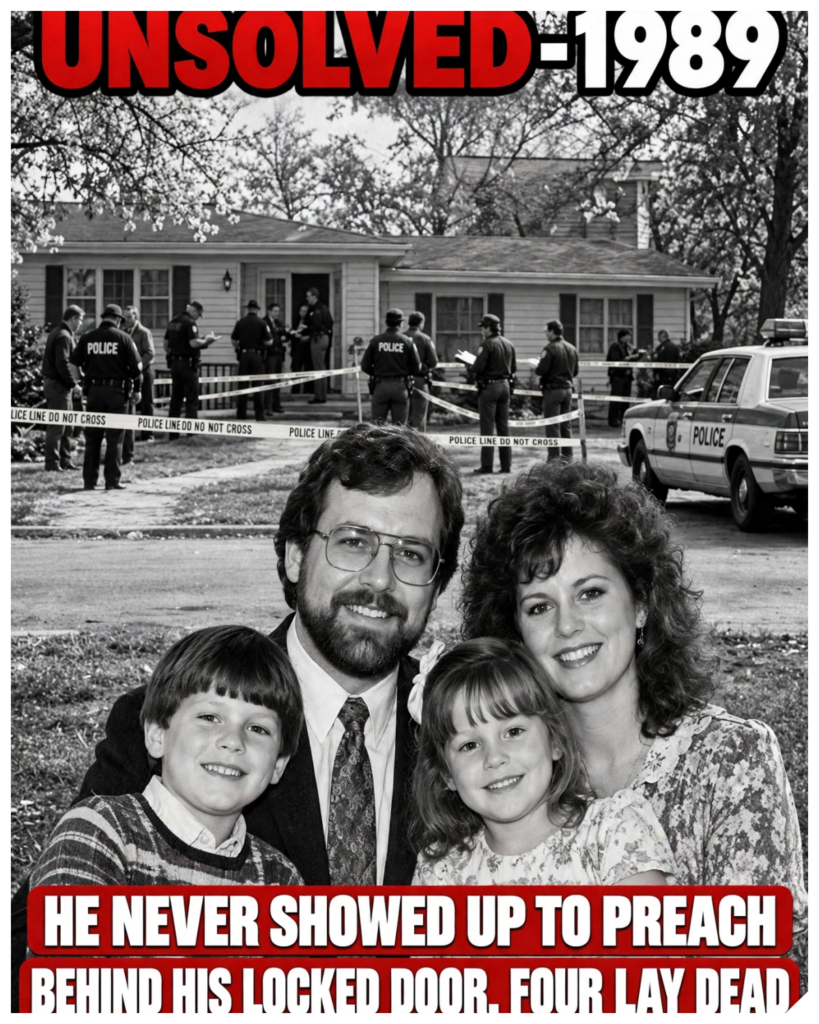
On the last Sunday of April 1989, a pastor did not show up for church in Lakeville, Indiana.
That never happened.
Robert P was 38 years old.
He led the congregation at Olive Branch United Brethren Church.
And on that Sunday morning, the people in the pews checked their watches and looked toward the door.
Nobody in that room knew it yet, but the empty pullpit was already the answer to a question the county would spend 17 years asking for.
For members of one family were dead.
The house was locked.
There was no weapon.
There were no witnesses.
And the person police suspected from the very beginning would not be charged for 13 years.
That is not a story about a stranger who broke into a quiet parsonage.
That is a story about what investigators believe had happened behind a locked door and about a conviction that has been fought over in courtrooms ever since.
But before we get to any of that, we have to go back to the weekend of the Lville High School prom.
Because to understand what this town lost, you first have to understand the P family.
Lakeville sits in St.
Joseph County, a short drive south of South Bend in the flat farm country of northern Indiana, where county roads run straight to the horizon, and a church steeple is the tallest thing for miles around.
In 1989, it was the kind of place where people knew whose truck was parked outside the feed store, where spring mint plowed fields and the smell of turned earth, and where a high school prom was a weekend the whole community quietly watched over.
Cassette tapes played in the family cars.
George Bush had barely settled into the White House.
Telephones still hung on kitchen walls, and a long distance call was something you planned for.
A church like Olive Branch was more than a building on Sunday.
It was where people were baptized, married, and eventually buried.
And the pastor’s family lived right beside it in a parsonage, which meant that their home was part of the life of the congregation.
When the lights were on, the neighbors knew the family was home.
When the shades were drawn, people noticed.
Robert P was the pastor.
He was 38.
His wife, Dawn, shared the home with her daughters, 8-year-old Janelle and six-year-old Jolene, who were still young enough to be in the early grades of school.
Robert’s own children from an earlier marriage, lived there as well.
His son Jeff was 17, a high school senior.
His daughter, Jock, was 14, and Don had a third daughter, Jesse, who was nine.
It was a blended family, the kind that takes patience and work in a house where the front yard was also the church’s front yard.
That spring, Jeff was looking forward to the prom.
He was taking Darla Adams, a girl he considered his first love.
But by the account of investigators, the weekend was complicated.
Jeff had gotten into trouble in a burglary case, and his father had grounded him.
According to prosecutors, father and son had argued over whether Jeff would be allowed to go on the afterprom trip to an amusement park north of Chicago.
It was an ordinary quarrel between a father and a teenager.
It was the kind of argument families all over the Midwest were having that same weekend.
On Saturday, April 29th, the P home stood beside the church the way it always had.
By the next morning, it would hold a silence that no one in Lakeville had ever heard before.
Trial records placed Jeff at a local gas station at about 5:20 that Saturday evening where he got help fixing his car.
From there, he drove to Darla’s house, changed into his tuxedo, and went to the dance.
It was a festive night.
Friends danced, photographs were taken.
Years later, Darla would say that at some point during the weekend, Jeff told her he had a strange feeling that something bad had happened at home.
Sunday morning arrived.
The service at Olive Branch was about to begin.
Pastor P was not there.
The congregation waited.
Minutes passed.
It was so unlike him that someone had to go and check.
A church elder named Wisdale walked next door to the parsonage.
The shades were drawn, which was unlike the family.
The doors were locked.
He knocked.
No one answered.
He found a spare key and let himself in through a side door.
Robert P was inside.
Tisdale went to the telephone.
He called 911.
While he waited for help, he looked for the rest of the family.
He went down a few steps of the basement stairway.
He later said that was enough.
He went no farther.
Don P was dead.
So were Janelle and Jolene.
Detectives Mark Center of the Indiana State Police and John Bodic of the St.
Joseph County Police were among the first on the scene.
Years afterward, Center would say that no human being should ever have to see what he saw that morning.
Investigators determined that Robert P had been shot twice at close range with a shotgun.
The others had also been shot at close range.
The pastor’s own shotgun, a 20 gauge Mossberg, would never be found.
The doors were locked.
Nothing had been taken.
There was no sign of a burglary or a robbery.
Within hours, Detective Center had reached a conclusion that would shape everything that followed.
Someone from the inside had done this.
By afternoon, word had spread through Lakeville the way it does in small towns, from porch to porch and from one telephone line to the next.
Neighbors stood in their yards.
Church members gathered in quiet clusters.
Many of them still dressed for a service that had never begun.
Nobody knew what to say.
So, for a long while, nobody said anything at all.
Two members of the family were not in the house that night.
Jock, 14, had been visiting a friend.
9-year-old Jesse had been at a sleepover.
They had left home as children, never imagining that the house they left would no longer be a home when they returned.
In the days that followed, Detective Center and his team did what investigators do.
They interviewed relatives, church members, neighbors, and friends.
They checked for any sign of an outsider, for any stranger who might have been seen near the parsonage, for anything missing or disturbed.
They found nothing.
The stranger theory, the one the whole town wanted to believe, collapsed within days.
That was the first dead end.
And in some ways, it was the most painful.
A community can survive the idea of a monster who came from somewhere else.
It is much harder to accept that the answer might be closer to home.
Suspicion turned toward the people who had been in the house that weekend.
Jeff P, a 17-year-old who had been at odds with his father, was always the leading suspect.
Investigators said.
So, Detective Bodic located Jeff in Illinois, but suspicion is not proof.
There was no murder weapon.
There was no eyewitness.
There were no fingerprints linking Jeff to the crime.
Years later, Sitter would describe it as a very tough case to prove and a very tough case to prosecute.
County prosecutors agreed.
They did not file charges.
And there was a deeper problem.
The way a few key pieces of evidence were gathered in those first days would become the center of a legal fight that lasted decades.
Prosecutors would one day tell a jury about a pair of blue jeans.
Defense lawyers would argue for years that investigators never properly documented where those jeans were found.
Meanwhile, back at Olive Branch, a congregation that had lost its pastor, his wife, and two little girls tried to work out how to carry on.
A town that had left its doors unlocked had to decide whether it still could.
And two surviving girls faced the unthinkable fact that their father, their mother, and their sisters were gone.
The surviving girls were taken in by family while the adults around them tried to sort through paperwork, funerals, and questions no child should have to hear.
Life does not pause for grief.
School still started in the fall, and the calendar kept turning whether anyone wanted it to or not.
Weeks became months.
Months became a year.
By 1992, 3 years had passed.
The case files sat in a cabinet.
The teenagers who had danced at that prom were old enough to vote, then old enough to marry.
Some left Lakeville and never came back.
The church went on holding services because that is what churches do.
But every spring when the weather warmed and prom season returned, the town remembered what had happened.
By 1996, 7 years had passed.
Janelle would have been 15.
Jolene would have been 13.
Their classmates were in high school now, driving cars and planning for college.
And no one who had known those girls could look at a school hallway without seeing the empty places.
By 2000, 11 years had passed.
The investigators who first walked through that front door had grown older.
The families who loved the victims had grown older, too.
But the parsonage beside the church was never just another house to the people who remembered.
It was where a family had been taken in a single night.
The surviving daughters grew up carrying the weight of it.
Jesse, the 9-year-old who had been at a sleepover that night, would one day speak publicly about what it was like to be the sibling left to pick up the pieces.
Every year on the last weekend of April, the question returned, “Who did this?
And why had no one answer for it?”
One man never let go.
More than 30 years later, Detective Mark Center would still say he could remember walking into the P home on the 30th of April, 1989.
Tom had not loosened the case from his mind.
Every case on this channel represents weeks of digging through records, verifying facts, and piecing together real lives that were lost.
If you want us to keep uncovering the truth behind stories like this one, please take a second to like this video, subscribe, and let us know in the comments where in the world you’re watching from.
Your support is what makes this possible.
Now, let’s get back to the P family.
For 13 years, the case sat in silence.
Then, in 2002, something shifted.
A newly elected prosecutor took office in St.
Joseph County.
A cold case effort was organized and among the first files pulled from the shelves was the one Mark P.
It did not begin with a confession.
It did not begin with a DNA match or a fingerprint or a witness stepping forward after 13 years of silence.
There was no weapon to find.
What the cold case investigators had was a fresh set of eyes, a stack of old reports, and a theory that had never been tested in a courtroom.
Craig Whitfield, an investigator with the prosecutor’s office, was among those who reopened the case.
Over the following months, the team went back through the events of that Saturday in April 1989.
Hourby hour, they returned to the argument over the afterprom trip.
They looked again at the locked house and at the conclusion detective center had reached on that very first morning.
They talked again to people who had been at the prom and to those who had been with Jeff that night.
Prosecutors came to believe that Jeff P, then 17, had killed his family on the afternoon of prom day and still made it to the dance.
They believed that afterward he had put his jeans into the washing machine to get rid of the evidence.
In August 2002, Jeff P, by then an adult living in California, was arrested.
He was charged with four counts of murder.
He said he was innocent.
He has said so ever since.
For the families of the victims, 13 years of waiting had finally reached the door of a courtroom.
For the town of Lakeville, the case that so many had stopped talking about was suddenly in the news again.
And everyone who had known the Pellies was asked to remember what they had seen and heard and believed on a spring weekend a very long time ago.
In July 2006, 17 years after the night of the prom, the trial began.
Frank Schaefer, who served as an assistant prosecutor in St.
Joseph County would later explain that the case hinged mainly on two things.
The first was motive, the anger over the prom weekend.
The second was the timeline of events on Saturday, April 29th, 1989.
The prosecution laid out its case.
They described the argument over the afterprom trip and the grounding that had hung over the weekend.
They walked the jury through the locked house.
No forced entry, nothing stolen, no sign of an outsider.
They presented the jeans, telling jurors the pair had been found in the washing machine and had been washed.
The defense answered with what was missing.
There was no murder weapon.
There were no fingerprints connecting Jeff to the crime.
There was no confession.
His lawyers argued that there simply was not enough time for a 17-year-old to commit four murders, do everything prosecutors claimed, and still arrive at the prom on schedule.
They pointed to friends who testified that Jeff had acted normally throughout the prom events.
And they asked the jury a simple question.
Would anyone who had just done something so terrible behave that way?
The jury deliberated for two and a half days.
Then they returned a verdict.
Guilty on all four counts.
Jeff P was sentenced to 160 years in prison for consecutive 40-year terms.
In October 2006, he entered the Indiana State Prison.
For the families, there was no clean ending in any of this.
Each ruling meant another round of testimony, another set of headlines, and another reminder the weekend they would have given anything to undo.
Justice had been promised, then questioned, then promised again.
But the case was not over.
In 2008, an appeals court reversed the conviction.
A year later in 2009, the Indiana Supreme Court reinstated it.
That same year, a book about the case, The Prom Night Murders, was published, and the story reached readers far beyond Lakeville.
Then, in March 2022, almost 16 years after the verdict, lawyers from the wrongful exoneration clinic at the Indiana University School of Law brought new arguments before a judge.
At the center was that same pair of blue jeans.
The defense said there was no documentation that the genes were ever in the washing machine.
They noted that coins and a readable receipt had been entered into evidence with the genes, items they argued would not have survived a wash cycle.
They said the original investigators had never clearly recorded where the genes were found and that the original trial team had never challenged the claim.
Prosecutors and the family saw it differently.
A relative of Dawn, Janelle, and Jolene P said the family believes Jeff is exactly where he belongs.
In 2024, Judge Stephanie Steel ruled on the request for a new trial.
She wrote that even without the jeans in the washer, the state’s timeline would not have been shaken and that P had not met his burden of showing the trial’s outcome was unreliable.
She denied the request.
The defense appealed and at the time of this recording that appeal is still moving through the courts.
So where does that leave this story?
A jury of 12 people listened to the evidence and reached a verdict.
The Indiana Supreme Court upheld it.
A judge reviewed the new claims and rejected them.
And the man convicted still says he did not do it.
Is the kind of case that reminds us how slowly the law moves and how carefully it should.
A verdict is not the end of a question.
It is the answer the system gave.
And the system has built-in ways of asking again.
But when you think about this case, do not start with the courtroom.
Think of a pastor who never missed a Sunday.
Think of a mother and two little girls in the early grades of school living in a home beside a white steepled church in a town where everyone knew their names.
Think of Robert, Dawn, Janelle, and Jolene P who deserve a lifetime and were given a single weekend in April.
And think of the two girls who came home to a different world, who grew up carrying it, and who never stopped being the family that was left.
Justice in a case like this does not arrive all at once.
It arrives in pieces over decades through juries and appeals and judges and families who keep showing up.
A verdict can bring a measure of peace to those who waited for it.
It is not in the questions and it is right for a society to keep asking them carefully so that the answer is one we can all trust.
So we want to ask you three questions.
Do you think a case built on motive and a timeline without a weapon or fingerprints can reach proof beyond a reasonable doubt?
How much should a court weigh problems with how evidence was handled decades ago?
And what do you think it takes for a family to carry a loss like this for more than 30 years and still keep going?
Tell us in the comments below.
Your voices matter in a story like this one.
If this video moved you, please like it, subscribe to the channel, and share it with someone who remembers a time when a locked door meant a family was safe inside.
Thank you for staying with us until the end.
Robert, Dawn, Janelle, and Jolene P, you are remembered.


