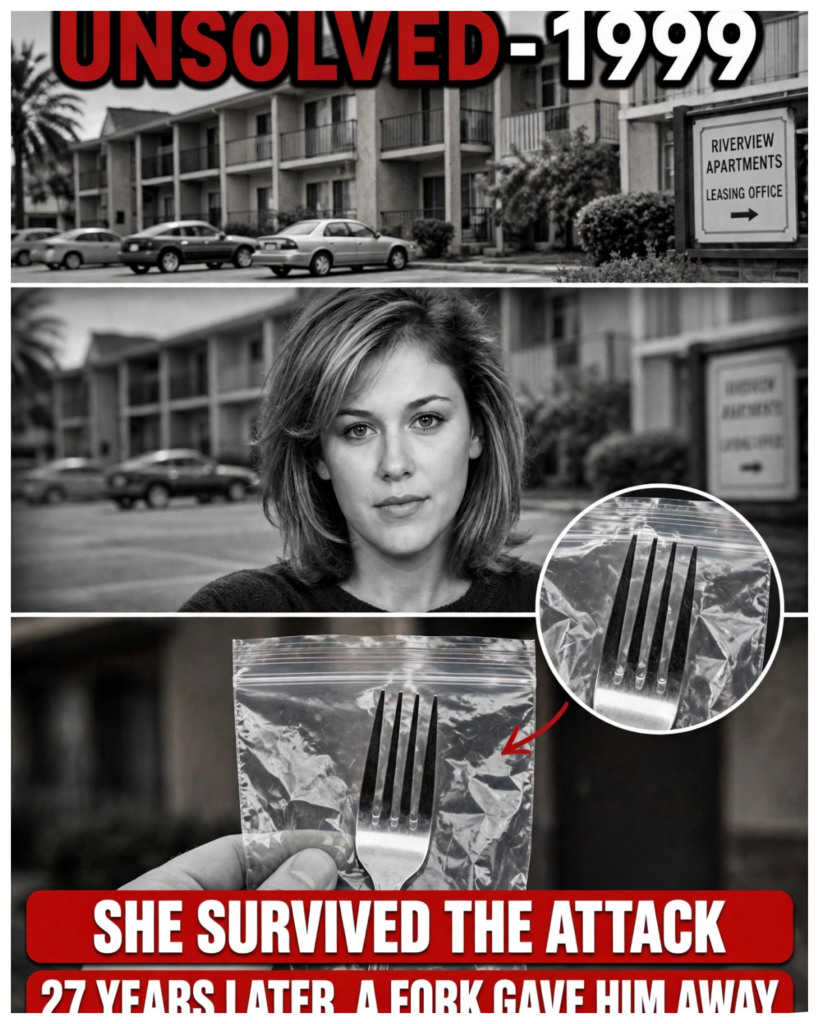
SHE LIVED LONG ENOUGH TO SEE HIM CAUGHT
The gunshot echoed through the building.
Sarah dropped to the floor.
For one terrible second, she believed she had been shot.
Then she heard someone shouting in the hallway.
Police!
Drop the weapon!
A second gunshot followed.
Glass shattered.
Footsteps thundered across the corridor.
Sarah crawled toward the bathroom door and pulled it closed behind her.
Her heart was beating so violently that she could barely hear anything else.
Then came another voice.
Sarah?
It was Detective Olivia Grant.
Sarah, answer me!
I’m here!
The door opened.
Grant appeared in the doorway, holding her weapon with both hands.
She looked at Sarah.
Are you hurt?
Sarah shook her head.
No.
Grant lowered her weapon slightly.
The man had escaped through a service corridor.
Two officers were injured during the confrontation, but neither was in life-threatening condition.
The person who had fired the weapon had not been identified.
Sarah looked at the broken window.
Was it him?
Grant nodded.
We believe so.
Then she noticed something on the floor.
A small leather wallet.
It had fallen near the window.
Sarah stared at it.
She recognized the shape.
The same type of wallet the attacker had shown her in 1999.
Grant carefully picked it up.
Inside was a metal badge.
It was not a genuine police badge.
But beneath the metal plate was a photograph.
The photograph showed a younger man.
A man with a scar near his right eyebrow.
The name printed beneath it was:
DANIEL MERCER.
For twenty-seven years, Sarah had wondered who had been hiding behind the fake badge.
Now she finally had a name.
But the discovery also raised another question.
Why had Mercer returned in person?
Why had he risked exposing himself?
And why had he been willing to attack Sarah again after all these years?
The answer was inside the wallet.
A folded piece of paper was tucked behind the photograph.
It contained a list of dates.
The first was October 18, 1999.
The second was November 2007.
The third was March 2014.
And the fourth was October 2026.
Beside each date was a name.
Sarah Mitchell.
Laura Bennett.
Michael Turner.
Sarah’s name appeared again beside the final date.
Grant stared at the paper.
This wasn’t just a threat.
It was a schedule.
Someone had been tracking the people connected to the original crime.
And Sarah was apparently the last person on the list.
The Man Behind the Identity
The following morning, Detective Grant assembled the cold-case team.
They reviewed everything.
The 1999 attack.
The missing gas station recording.
The disappearance of Paul Bennett.
The fake police identification.
The unexplained death of the real Michael Turner.
The disappearance of Laura Bennett.
The financial records.
The cassette tape.
And the man who had lived as Sarah’s husband for fifteen years.
His real name was Daniel Mercer.
He had been born in Ohio in 1962.
His childhood records were incomplete.
His mother had died when he was young.
His father had been arrested several times and eventually disappeared.
Mercer had left school early.
By his early twenties, he had developed a talent for impersonation and document fraud.
He could imitate signatures.
He could memorize personal details.
He understood how to exploit gaps in official records.
He had worked briefly as a security consultant before meeting Daniel Cross.
Cross had been impressed by his ability to solve problems quietly.
Mercer became the person Cross called when an employee threatened to expose financial misconduct.
At first, the work involved intimidation.
Then it became something darker.
Investigators believed Mercer had helped Cross create false companies, conceal payments, and silence people who knew too much.
Mark Reynolds was one of the men hired to carry out the physical threats.
But Mercer was different.
He planned.
He researched.
He assumed identities.
And he knew how to disappear.
The real Michael Turner had become a problem in 1998.
He had worked as a mechanic near one of Cross’s construction properties.
He discovered that several company vehicles were being used to transport stolen materials.
He confronted Cross.
Instead of reporting him, Cross offered him money.
Michael refused.
The real Michael Turner disappeared shortly afterward.
Investigators believed Mercer and Reynolds had intercepted him on Old Bay Road.
The vehicle was recovered.
Blood was found inside.
But no body was ever located.
Mercer then assumed Turner’s identity.
He used the name to open accounts, obtain documents, and create a new personal history.
When Sarah entered his life, he was already using the identity.
She had no reason to suspect anything.
He was kind.
He was patient.
He helped with Ethan.
He never appeared threatening.
And he knew exactly how to make a frightened woman feel safe.
The investigators now believed he had approached Sarah deliberately after the 1999 attack.
His assignment was simple.
Stay close.
Learn whether she planned to testify.
And make sure she believed the danger had passed.
But Mercer had underestimated one thing.
Sarah’s memory.
She had never forgotten the man’s voice.
And after twenty-seven years, she had finally recognized it.
The Real Story of October 1999
Detective Grant wanted to understand why Daniel Cross had been so desperate to silence Sarah.
The answer came from Paul Bennett’s sister.
Laura had left behind a diary.
It was discovered in a storage box that her family had kept for years.
The diary contained several entries describing her brother’s employment at Cross Construction.
Paul had discovered that the company was purchasing materials through false suppliers.
The invoices were inflated.
The payments were redirected.
Some of the money was being used to purchase abandoned properties.
Other payments went to people who did not appear to exist.
Paul had copied the records.
He intended to take them to the authorities.
But before he could do so, he was confronted by Daniel Cross and Mark Reynolds.
Sarah witnessed the confrontation at the gas station.
She did not know what she had seen.
But she had seen enough to become dangerous.
The missing security recording contained the clearest evidence of the assault.
And Paul Bennett was the only person who could confirm the full story.
The investigation now suggested that Paul had been taken away from the gas station and held at an industrial property.
He was never seen again.
The exact circumstances of his disappearance remained uncertain.
Laura had continued searching for him.
She believed her brother had been murdered.
She also believed that someone inside the police department had helped Cross.
In 2007, Laura contacted a former employee who claimed to possess documents proving the company’s financial crimes.
She arranged to meet him at a roadside motel.
She never returned home.
The investigators now suspected Mercer had been involved in her disappearance.
But the team needed more than a diary.
They needed physical evidence.
And they needed to find Mark Reynolds.
The Witness Who Finally Spoke
Mark Reynolds had disappeared from the rented house.
But investigators discovered that he had contacted an old associate shortly before the failed arrest.
The associate was George Miller, the former bookkeeper who had already provided financial records.
George had received a telephone call from an unknown number.
The caller had asked him to destroy any documents connected to Daniel Cross.
George refused.
The caller threatened his family.
George contacted the police.
He also provided the number.
The cold-case unit traced the call to a temporary telephone registered near a marina.
A search of the area revealed an abandoned vehicle.
Inside was a small notebook.
The notebook contained names, dates, and locations.
It also included a handwritten message:
Mercer wants the original tape.
Grant immediately understood.
The cassette discovered inside the house near the St. Johns River was not the only recording.
There was an original.
And Mercer wanted it.
Investigators searched the marina and located a storage locker rented under another false identity.
Inside were boxes of old documents.
Some belonged to Daniel Cross.
Others belonged to people who had worked for him.
There were photographs of construction sites.
Copies of bank statements.
A collection of driver’s licenses.
And a small envelope marked:
PAUL BENNETT — FINAL RECORDING.
The envelope contained a cassette tape.
It was badly damaged.
But the audio laboratory managed to recover most of its contents.
A man’s voice could be heard.
It was Paul Bennett.
He sounded frightened.
He said he had discovered that Cross Construction was using false invoices to move money through several companies.
He also said he had evidence of an illegal disposal operation at an abandoned industrial property.
Then he named two men.
Daniel Cross.
And Daniel Mercer.
The recording ended with Paul saying:
If anything happens to me, look at the property near the old river road.
That’s where they keep the real records.
Grant immediately sent a team to the location.
The property had been abandoned for decades.
A metal gate stood at the entrance.
The building was partially collapsed.
Investigators searched the main warehouse.
They found old machinery, broken furniture, and piles of construction debris.
But behind a sealed interior wall was a small office.
Inside were filing cabinets.
Most were empty.
One contained documents that appeared to be connected to Cross Construction.
Another held several photographs.
The final drawer contained a small collection of personal belongings.
A wallet.
A watch.
A set of keys.
And a driver’s license belonging to Paul Bennett.
Sarah was shown the recovered photograph.
She recognized the man immediately.
It was the same person she had seen at the gas station in 1999.
Paul Bennett had been there.
And now his belongings had been found inside the abandoned warehouse.
The discovery did not conclusively establish what had happened to him.
But it gave investigators a location to examine for additional evidence.
They brought in forensic specialists.
The search continued for several days.
Then a technician discovered something beneath the concrete floor.
A section of the foundation had been disturbed.
The material beneath it contained objects that appeared to have been buried deliberately.
The team stopped work and called the forensic unit.
What they recovered would finally connect the missing people to the same location.
But the identification process would take time.
The Letter from Michael
While the warehouse investigation continued, Sarah received a package from Ohio.
It had been sent by Rebecca Turner.
Inside was a letter.
Rebecca explained that she had been going through her brother’s old belongings after the investigation reopened.
She had discovered an envelope hidden inside a family Bible.
It contained a handwritten note from Michael.
The letter was dated September 1998.
It was addressed to Rebecca.
He wrote that he had discovered something disturbing about a company he had been working near.
He mentioned Daniel Cross.
He mentioned a man named Mercer.
And he wrote that he was afraid someone had been following him.
The final paragraph read:
If I disappear, don’t believe anyone who tells you I left voluntarily. I haven’t done anything wrong. I only want the truth to come out.
Rebecca had never seen the letter before.
She had kept it safe.
Now she wanted Sarah to have a copy.
Sarah read the words slowly.
The real Michael Turner had been a victim long before she met the man who stole his identity.
She thought about the life she had shared with the false Michael.
The birthday parties.
The family vacations.
The quiet evenings.
The way he had comforted Ethan after nightmares.
Were any of those moments genuine?
She called Rebecca.
They spoke for almost an hour.
At the end of the conversation, Rebecca said something Sarah would never forget.
My brother never got to have the life he wanted.
You gave his name a life.
Sarah began crying.
I wish I could give it back.
Rebecca’s voice softened.
You can’t.
But you can make sure the man who stole it never gets to use it again.
For the first time, Sarah understood that the investigation was no longer only about her.
It was about the real Michael.
About Paul.
About Laura.
About everyone whose name had been erased.
And about the families who had spent years waiting for answers.
The Second Fire
The warehouse investigation produced enough evidence for prosecutors to seek additional warrants.
But Daniel Mercer was still missing.
Then, late one evening, a fire broke out at the rented house near the St. Johns River.
Firefighters arrived within minutes.
The building was already burning.
A neighbor reported seeing a man leave through the back gate.
He was carrying a metal case.
The man entered a vehicle and drove away.
Investigators arrived after the fire was extinguished.
Most of the house was destroyed.
But the hidden compartment beneath the desk remained partially intact.
Inside was a small metal box.
The box contained several photographs.
One showed Mark Reynolds.
Another showed Daniel Cross.
A third showed Sarah holding Ethan outside their home in 1999.
The final photograph was different.
It showed a woman sitting in a chair inside a room.
Her hands were tied.
Her face was partially turned away.
Sarah was not in the photograph.
It was Laura Bennett.
On the back was a date.
November 2007.
Grant stared at the image.
For years, Laura’s family had believed she might have left voluntarily.
Now investigators had evidence suggesting she had been held against her will.
The photograph also contained a reflection in a window.
A man stood behind the camera.
His face was partly visible.
But the reflection showed a distinctive scar.
The same scar Sarah had described.
Mark Reynolds.
The evidence suggested that Reynolds had been present during Laura’s captivity.
It also suggested that Daniel Mercer had known about it.
Grant immediately contacted Laura’s family.
Her mother had died years earlier.
Her brother Paul was still missing.
But a cousin named Angela had been searching for her since 2007.
When Grant showed her the photograph, Angela collapsed into tears.
That’s Laura.
I know her hands.
I know that bracelet.
Grant asked whether she could identify the room.
Angela shook her head.
But then she noticed something in the background.
A calendar.
The month was visible.
November.
And beneath it was a small handwritten word.
Jacksonville.
Investigators began searching properties connected to Mercer in that area.
They found three.
One had been sold.
Another had been demolished.
The third was a small building near an old railway line.
It had been registered to a company associated with Daniel Cross.
A search warrant was issued.
Inside, investigators found an empty room.
There was a chair.
A broken lamp.
A metal cabinet.
And a small piece of fabric caught beneath a floorboard.
The laboratory identified the material as consistent with clothing Laura had been wearing in a photograph taken shortly before her disappearance.
The discovery suggested that she had been inside the building.
But there was no sign of her.
No remains.
No personal belongings.
Nothing that could conclusively establish whether she was alive or dead.
Grant refused to close the search.
She knew the difference between finding evidence of a crime and finding the person who had disappeared.
She wanted Laura found.
And she wanted the families to know the truth.
The Man Who Called Himself Michael
The break came from a traffic stop.
A patrol officer in northern Florida stopped a vehicle for a broken tail light.
The driver produced a license bearing the name Michael Turner.
The officer noticed that the photograph did not match the driver’s appearance.
He asked the man to step out.
The driver became agitated.
He attempted to leave.
The officer called for assistance.
The man was detained.
Fingerprint analysis revealed his identity.
Daniel Mercer.
The same man who had lived with Sarah.
The same man who had used Michael Turner’s name.
The same man connected to the false police identity.
He was arrested without serious injury.
When investigators searched his vehicle, they found a metal case.
Inside were several documents.
A collection of old photographs.
And a small notebook containing the names of people connected to Daniel Cross.
Sarah’s name appeared repeatedly.
Beside it was a final handwritten note:
She survived. I should have finished it in 1999.
The investigators also found a photograph of the real Michael Turner.
It was dated September 1998.
On the back, Mercer had written:
Identity acquired.
The evidence strongly suggested that Mercer had taken Michael’s identity after the real man disappeared.
But prosecutors still needed to establish the details of the original crime.
They needed to determine whether Mercer had participated in Michael’s disappearance, the attack on Sarah, and Laura’s abduction.
The arrest was a major breakthrough.
It was not the end.
Sarah Faces the Man She Married
Sarah was informed of Mercer’s arrest.
She asked to see him.
Grant warned her that the meeting could be emotionally difficult.
Sarah insisted.
She had spent twenty-seven years imagining the moment when she might finally look into the eyes of the man who had destroyed her life.
Now she wanted to know whether she could face him without fear.
The meeting took place in a secure interview room.
Mercer entered wearing a plain shirt and handcuffs.
His hair was gray.
His face had aged.
But Sarah recognized him immediately.
For a moment, neither spoke.
Then Mercer smiled faintly.
Sarah.
She did not answer.
He sat down.
You look different.
Sarah looked at him.
You look exactly the same.
He glanced at the detective.
Can we speak privately?
No, Sarah answered.
You don’t get anything private from me anymore.
Mercer leaned back.
You shouldn’t have come.
Sarah’s voice was steady.
I came because I want to hear you say your real name.
He looked at her.
Daniel Mercer.
Say it again.
Daniel Mercer.
Not Michael Turner?
He said nothing.
Sarah placed a photograph on the table.
It showed the real Michael standing with his sister.
You stole his life.
Mercer looked at the photograph.
He seemed almost bored.
People disappear every day.
Sarah’s expression hardened.
He had a sister.
He had a family.
He had a future.
You took all of it.
Mercer shrugged.
You don’t understand what happened.
Then explain it.
He stared at her for several seconds.
Finally, he spoke.
Daniel Cross was a powerful man.
He had enemies.
He had people who wanted his money.
He needed someone who could solve problems.
I was that person.
Sarah leaned forward.
Was Michael Turner one of those problems?
Mercer looked away.
Sarah repeated the question.
Did you kill him?
I didn’t say that.
Did you?
The detective intervened.
We have evidence connecting you to his disappearance.
Mercer smiled.
Then prove it.
Sarah’s hands trembled.
She wanted to reach across the table.
She wanted to demand an answer.
But she remembered the years she had spent trying to escape him.
She refused to let him control her again.
She stood.
You know what I remember most?
Mercer looked up.
I remember you teaching Ethan how to ride a bicycle.
I remember you carrying him when he was sick.
I remember you telling me that I didn’t have to be afraid anymore.
Her voice broke.
I believed you.
For a moment, something changed in his expression.
Then he looked away.
Sarah continued.
You didn’t just steal a name.
You stole years of my life.
You made my son love a man who didn’t exist.
You let me bury a husband who wasn’t even real.
She wiped her eyes.
And you thought I would spend the rest of my life being afraid of you.
Mercer said nothing.
Sarah leaned closer.
I survived you.
And now everyone knows your name.
She turned and walked out.
For the first time in twenty-seven years, she did not look back.
The Evidence That Broke the Case
The prosecution’s case developed over several months.
Investigators combined the recovered documents, audio recordings, financial records, witness statements, and forensic evidence.
The gas station owner, who had originally claimed the security system malfunctioned, admitted that Daniel Cross had paid him to remove the recording.
He said he had been threatened.
He had feared losing his business.
He had kept a copy of the original footage in a private storage box.
The footage was old and damaged.
But the laboratory recovered enough images to show Daniel Cross, Mark Reynolds, and Paul Bennett near the pickup truck.
The recording also captured Sarah’s vehicle leaving the station.
It confirmed that she had been present.
The owner explained that he had received a telephone call the following morning.
The caller identified himself as a police officer.
He told the owner to destroy the recording.
The voice was later compared with the surviving audio of Daniel Mercer.
The results supported the identification.
The false officer had been Mercer.
The same man who had entered Sarah’s house.
The same man who had used the name Michael Turner.
The prosecution also recovered financial records showing payments from Cross Construction to companies controlled by Mercer and Reynolds.
Several payments were made shortly before the disappearances.
Others were made afterward.
The records established a pattern of concealment.
But the most important evidence came from the warehouse.
Forensic investigators recovered biological material from the disturbed concrete foundation.
The laboratory identified human remains.
DNA analysis established a connection to Paul Bennett’s family.
Paul’s disappearance was no longer simply a missing-person case.
His remains had been found.
The family was notified.
His sister’s diary and the recovered recording helped establish why he had been targeted.
The investigators also recovered evidence connected to the real Michael Turner.
The remains beneath the warehouse were not all from one person.
Additional testing was required.
But the discovery provided the strongest evidence yet that Mercer and Reynolds had been involved in multiple disappearances.
The cold-case unit continued examining the material.
Then a forensic specialist made a discovery.
A small fragment of fabric recovered from the warehouse contained a label.
The label belonged to a clothing manufacturer.
The same brand appeared on a receipt found among Michael Turner’s personal effects.
The laboratory compared the fragment with a photograph of Michael wearing the same jacket.
The result was consistent.
It was not enough by itself to establish identity.
But combined with the blood evidence from his vehicle, the financial records, and the recovered documents, it strengthened the case that Michael had been taken to the warehouse.
The prosecution now had a coherent timeline.
Mercer had assumed Michael’s identity after the original disappearance.
He had then used that identity to approach Sarah.
And he had remained close to her because Daniel Cross wanted to know whether she would expose the events at the gas station.
The fake badge had not been an improvised trick.
It was part of a carefully planned operation.
Mark Reynolds Finally Talks
Daniel Mercer refused to cooperate.
He denied involvement in the disappearances.
He claimed the documents had been planted.
He said the recordings were fabricated.
He insisted he had never attacked Sarah.
But Mark Reynolds was still missing.
The investigators knew that finding him was essential.
They traced his financial activity through several old accounts.
One account had received a small deposit every year since 2000.
The payments came from a business connected to Daniel Cross.
The most recent deposit had been made in 2025.
The account was linked to a rural property near the Georgia border.
A surveillance team was sent to the location.
The property appeared abandoned.
But investigators noticed fresh tire marks.
They waited.
On the second evening, a vehicle arrived.
The driver stepped out.
He was older, thinner, and walked with a slight limp.
But the scar near his cheek was unmistakable.
Mark Reynolds.
Officers approached.
He attempted to flee through the back of the property.
He was arrested after a brief struggle.
During questioning, Reynolds initially denied knowing Mercer.
Then investigators showed him the photographs.
They showed him the recovered badge.
They played the audio recording.
They presented the financial transfers.
Finally, they showed him a photograph of Paul Bennett’s recovered belongings.
Reynolds looked down.
He asked for a lawyer.
But before the interview ended, he made one statement.
Daniel Mercer was the one who planned everything.
The detective asked what he meant.
Reynolds said Mercer had created the false identities.
He had arranged the payments.
He had selected the locations.
He had decided who needed to be silenced.
Reynolds claimed he had been hired to intimidate people, not kill them.
Investigators did not accept that explanation without further evidence.
But he agreed to provide information in exchange for consideration from prosecutors.
He described the night Sarah was attacked.
He admitted driving to her house with Mercer.
He said Mercer had entered the home using the false badge.
He claimed he had waited outside.
When Sarah escaped, he heard the struggle.
He also admitted helping start the fire to destroy evidence.
The detective asked why he had not followed Sarah.
Reynolds looked at the table.
Because Mercer told me she wouldn’t survive.
But she did.
Reynolds nodded.
And that’s why everything went wrong.
He then provided information about Laura Bennett.
He claimed she had discovered records connecting Daniel Cross to the warehouse.
She had been taken to the Jacksonville property.
He said he had seen her there.
But he insisted he had not been involved in her disappearance afterward.
Investigators asked where she was.
Reynolds refused to answer.
He said only that Mercer knew.
The detective pressed him.
Is she alive?
Reynolds looked up.
I don’t know.
Then he added:
But if she’s alive, Mercer knows where to find her.
The Search for Laura
The search for Laura Bennett became the most urgent part of the investigation.
Her family had waited nineteen years.
Her brother Paul was dead.
Her mother had died without knowing what happened.
Her cousin Angela had kept photographs, letters, and birthday cards.
She had never stopped hoping Laura might return.
Investigators searched every property connected to Mercer.
They examined the warehouse.
They searched the house near the river.
They reviewed old rental agreements and utility records.
They found a storage unit registered under another false identity.
Inside were women’s clothing, old photographs, and personal belongings.
One item was a bracelet.
Angela identified it as Laura’s.
The discovery suggested that Laura had been inside the storage unit at some point.
But it did not establish when.
A second item was a folded note.
It contained a telephone number and a short message:
If I get out, call Angela.
The note had been written in Laura’s handwriting.
Investigators traced the number.
It belonged to a telephone exchange that had been disconnected in 2008.
But the old service records contained an address.
A small property outside Jacksonville.
The building had been demolished.
The land was now covered by trees and weeds.
Investigators searched the property with ground-penetrating equipment.
They found an old concrete foundation.
Beneath it was a sealed storage compartment.
Inside were several personal belongings.
A photograph of Laura with her brother.
A small notebook.
And a letter addressed to Angela.
The letter had never been mailed.
It was dated December 2007.
Laura wrote that she was frightened.
She said she had been told that her brother was dead.
She did not believe it.
She described a man who called himself Michael.
She said he had visited her twice.
And she wrote that he had offered to help her disappear if she stopped asking questions.
The letter ended with a sentence that broke Angela’s heart.
If I don’t come home, please remember that I tried to find Paul.
Angela held the letter against her chest.
For nineteen years, she had wondered whether Laura had abandoned her family.
Now she knew that Laura had been trying to uncover the truth.
But the letter did not reveal whether she was alive.
Investigators continued searching.
Then a retired nurse contacted the cold-case unit.
She had worked at a small private medical facility near Jacksonville in 2008.
She remembered a woman who had been brought in under a false name.
The woman had a wrist injury.
She rarely spoke.
A man had visited her regularly.
He introduced himself as her husband.
The nurse remembered that the woman once asked to use the telephone.
When the man refused, she became frightened.
The nurse had not reported the incident.
She believed it was a private family matter.
When shown a photograph of Laura, she recognized her.
The nurse provided the facility’s old patient records.
Most had been destroyed.
But a handwritten admission note survived.
It contained the false name used by the patient.
The name was Laura Mercer.
The man who had signed the admission form was listed as Michael Turner.
The real identity of the man was now clear.
Daniel Mercer had been using the name Michael Turner while controlling Laura’s movements.
The nurse remembered one more thing.
The woman had been transferred to another facility after several weeks.
The destination was written in the file.
A small rehabilitation center in northern Florida.
The center had closed in 2010.
Its records had been transferred to a state archive.
Investigators requested the records immediately.
A patient with Laura’s description had been admitted.
But she had been discharged under another name.
The discharge form contained a signature.
It was not Daniel Mercer’s.
It belonged to a woman named Evelyn Hart.
The team traced Evelyn.
She was alive.
And she had a story to tell.
The Woman Who Helped Laura Escape
Evelyn Hart had worked as a nurse at the rehabilitation center.
She remembered Laura.
She remembered the fear in her eyes.
And she remembered the man who called himself her husband.
He had insisted on controlling every conversation.
He answered questions for her.
He refused to let her speak privately.
Evelyn had suspected something was wrong.
One evening, she found Laura crying in the bathroom.
Laura told her that the man was not her husband.
She said he had taken her against her will.
She begged Evelyn to help her.
Evelyn was frightened.
She knew the man had money and connections.
But she also knew she could not ignore what Laura had told her.
She contacted a former colleague who helped her arrange a safe transfer.
Laura was discharged under a different identity.
Evelyn gave her a small amount of money.
She also gave her the telephone number of a women’s support organization.
Laura disappeared the following morning.
Evelyn never heard from her again.
For years, she wondered whether Laura had survived.
She had kept the discharge papers because she feared the man might return.
Now she handed them to Detective Grant.
The papers contained a forwarding address.
It was in another state.
The cold-case unit contacted authorities there.
The address belonged to a small apartment building.
The building manager remembered an older woman who had lived there for several years.
She had used the name Helen Carter.
She rarely received visitors.
She worked part-time at a library.
She had no social media accounts.
And she had moved away in 2019.
The investigators searched employment records.
They found a woman with the same name working at a small community library in another city.
The photograph was old.
The woman was now older.
But the facial features matched Laura Bennett.
Detective Grant called Angela.
We may have found your cousin.
Angela began crying.
Is she alive?
We believe so.
The next step was to confirm her identity.
The Reunion
Laura Bennett was found living in a modest apartment in North Carolina.
She was sixty-one years old.
She had gray hair.
She wore glasses.
And she had spent nearly two decades trying to live without being found.
When Detective Grant arrived, Laura initially refused to open the door.
She had learned not to trust strangers.
Grant explained the investigation.
She showed Laura photographs of her brother.
She showed her the recovered letter.
Then she mentioned Angela.
Laura’s expression changed.
Is she alive?
Yes.
Does she know?
She knows we’re looking for you.
Laura began crying.
She opened the door.
The interview lasted several hours.
Laura explained that Daniel Mercer had approached her in 2007.
He claimed he could help her find information about Paul.
At first, she believed him.
Then he began asking questions about the documents her brother had kept.
He took her to the Jacksonville property.
He told her that Paul had been involved in something dangerous.
He said that if she continued asking questions, she would disappear too.
Laura tried to escape.
She was held in several locations.
She was eventually taken to the rehabilitation center after suffering an injury.
Evelyn Hart helped her get away.
Laura had been too frightened to contact her family.
She believed Mercer would find them if she did.
She had changed her name.
She had moved repeatedly.
She had tried to build a life without leaving a trail.
When she heard about Daniel Cross’s death, she considered returning.
But she was afraid the people who had worked for him were still watching.
She never knew that Sarah had survived.
She never knew the investigation had reopened.
And she had no idea that Mercer had continued using Michael Turner’s identity.
Laura agreed to provide a statement.
She also agreed to meet Angela.
The reunion took place in a quiet room at the cold-case office.
Angela entered first.
She looked at Laura.
For a moment, neither moved.
Then Angela whispered:
You came back.
Laura began crying.
I tried.
Angela crossed the room and embraced her.
They held each other for several minutes.
There were no dramatic speeches.
No perfect words.
Only two women who had lost nineteen years and finally had the chance to hold each other again.
Sarah watched from the doorway.
She understood something important.
The case was no longer just about catching a criminal.
It was about giving people back the truth.
The Trial Begins
Daniel Mercer was charged with multiple offenses connected to the disappearances, false identities, fraud, and the attack on Sarah.
Mark Reynolds also faced charges.
The prosecution built its case around the surviving evidence.
The fake badge.
The gas station recording.
The financial records.
The warehouse discoveries.
The recovered audio.
The witness statements.
The false identity documents.
And the testimony of Laura Bennett.
Sarah agreed to testify.
She knew the courtroom would be difficult.
She knew she would have to describe the night of the attack.
She would have to explain how the man entered her home.
How he threatened her son.
How she escaped through the rain.
And how she had spent years believing she was safe while living beside the person who had helped arrange the attack.
But she was ready.
Before the trial, Ethan visited her.
He found her sitting in the living room, reviewing her statement.
You don’t have to do this if it hurts too much.
Sarah looked at him.
I know.
Then why are you doing it?
Because I want the truth to be part of the record.
Not a rumor.
Not a story people can dismiss.
The truth.
Ethan hugged her.
Whatever happens, I’m proud of you.
Sarah smiled.
I was always proud of you.
He laughed softly.
Even when I was four and refused to eat vegetables?
Especially then.
For a moment, they were simply mother and son.
Not a witness and a victim.
Not a family connected to a cold case.
Just two people who had survived something terrible.
Sarah Takes the Stand
The courtroom was crowded.
Reporters filled the back rows.
Several families connected to the investigation sat together.
Daniel Mercer entered wearing a dark suit.
He looked older.
He appeared calm.
He did not look at Sarah.
The prosecutor asked her to describe the night of October 18, 1999.
Sarah began slowly.
She explained that she had stopped at the gas station after work.
She described seeing Daniel Cross arguing with Paul Bennett.
She described the pickup truck.
The second man.
The assault.
And the moment she realized someone had noticed her watching.
Then she described the knock at her door.
The false badge.
The fake name.
The attack.
The fire.
Her escape with Ethan.
She spoke for several hours.
At one point, the prosecutor showed her a photograph of the recovered badge wallet.
Sarah looked at it.
Her hands trembled.
Is this the object you remember seeing?
Yes.
How do you know?
Because I remember the way he held it.
He wanted me to see the badge.
He wanted me to believe he had authority.
The prosecutor asked what she remembered about the man.
Sarah looked directly at Mercer.
His voice.
His eyes.
The way he stood in my kitchen.
I remembered him for twenty-seven years.
The prosecutor asked whether she recognized the defendant.
Sarah nodded.
Yes.
Is he the man who entered your home?
Yes.
Is he the man who later lived with you under the name Michael Turner?
Sarah paused.
Then she answered.
Yes.
A silence spread across the courtroom.
The prosecutor asked whether she had known his real identity.
No.
When did you learn it?
In 2026.
What was your reaction?
Sarah looked at Mercer.
I realized that the man I had trusted with my life had been part of the reason I nearly lost it.
The prosecutor asked whether she wanted to say anything directly to the defendant.
The judge allowed a brief response.
Sarah turned toward him.
For years, I thought the worst thing you did was try to kill me.
But it wasn’t.
The worst thing was making me believe I was safe.
You let my son call you family.
You let me build a home with you.
You took another man’s name and used it to hide from what you had done.
Then you watched me live with the consequences.
She swallowed.
I survived the night you tried to destroy my life.
And I survived the years you spent pretending to be someone else.
You don’t get to decide who I am anymore.
Mercer looked down.
For the first time, he appeared uncomfortable.
The Defense Tries to Break the Story
Mercer’s defense attorney challenged the reliability of the old evidence.
He argued that the gas station recording was too damaged to establish identity.
He questioned whether Sarah’s memory could remain accurate after twenty-seven years.
He suggested that the false badge could have belonged to someone else.
He argued that the financial records did not prove Mercer had committed murder.
The defense also questioned Laura’s testimony.
They suggested she had invented details to explain her disappearance.
But the prosecution had prepared.
The audio recordings were supported by forensic analysis.
The financial records were linked to accounts Mercer controlled.
The false identity documents were recovered from his property.
The gas station owner confirmed that the recording had been deliberately removed.
And the former nurse confirmed that Laura had been held under a false identity.
The prosecution also presented testimony from Rebecca Turner.
She described her brother.
She identified his photographs.
She explained that the man who had lived as Michael Turner was not her brother.
She told the jury about the letter he had written before disappearing.
When she finished, she looked toward Mercer.
My brother wanted to tell the truth.
You made sure he never got the chance.
The courtroom fell silent.
The Final Recording
The most important moment came near the end of the trial.
The prosecution played the recovered recording from Daniel Cross’s office.
The jury heard Cross instructing Mercer to remain close to Sarah.
They heard Mercer ask what should happen if she spoke.
They heard Cross explain that nobody would believe her.
Then the recording captured Mercer’s statement:
I was there.
The prosecution explained that the voice had been compared with other verified recordings.
The forensic examiner testified that the voice was consistent with Mercer’s.
The defense objected.
The judge allowed the recording to remain in evidence.
Then the prosecution played the final section.
Cross’s voice was clear.
Michael is already gone.
A pause followed.
Then Mercer’s voice:
I was there.
Sarah closed her eyes.
She had waited twenty-seven years to hear someone acknowledge what she had suspected.
The real Michael Turner had not simply walked away.
Someone had taken him.
Someone had stolen his identity.
And the man who had lived as her husband had been present.
The prosecution rested.
The jury deliberated.
For Sarah, the waiting was almost unbearable.
She had spent decades waiting for a telephone call.
Waiting for a detective.
Waiting for a letter.
Waiting for someone to believe her.
Now she was waiting for twelve strangers to decide whether the evidence was enough.
The Verdict
After several hours, the jury returned.
The courtroom rose.
The foreperson stood.
The verdict was read.
Daniel Mercer was found guilty on the principal charges supported by the evidence, including offenses connected to the attack on Sarah, identity fraud, and his involvement in the criminal conspiracy surrounding the disappearances.
The jury also found him responsible for the crimes established through the recovered evidence and testimony.
Mark Reynolds was convicted on charges related to his role in the attack, evidence destruction, and the conspiracy.
The courtroom remained quiet.
Sarah did not cheer.
She did not smile.
She simply closed her eyes.
Ethan held her hand.
For the first time in twenty-seven years, she knew the man who had attacked her could no longer walk into another home wearing a false badge.
He could no longer use another person’s name to hide.
He could no longer call her and threaten her.
He could no longer stand outside her window.
The judge imposed lengthy prison sentences.
The court also acknowledged the harm caused to the families of the missing and the people whose identities had been stolen.
Sarah listened.
But her thoughts were somewhere else.
She was remembering a four-year-old boy running through the rain in her arms.
She was remembering the neighbor who had opened the door.
She was remembering the years she had spent rebuilding a life.
And she was remembering the woman she had been before the attack.
She wanted that woman back.
She knew she could not have her.
But she could finally stop living as though the next knock on the door might destroy everything.
The Last Question
After the verdict, Sarah met Detective Grant outside the courthouse.
Grant congratulated her.
Sarah thanked her.
Then she asked about Michael Turner.
The real Michael.
Had investigators established exactly what happened to him?
Grant explained that the evidence strongly connected him to the warehouse and the men involved.
But the identification of the recovered remains had taken time.
The forensic team had now completed additional testing.
A DNA profile from the recovered material was consistent with Rebecca Turner’s family.
The identification was confirmed.
The remains belonged to Michael Turner.
Rebecca was notified.
The family arranged a funeral.
Sarah asked whether she could attend.
Rebecca agreed.
The service was small.
There were no reporters.
No cameras.
Only family members and a few people who had helped uncover the truth.
Sarah stood near Rebecca.
She placed a white flower beside the photograph of Michael.
She had never known the real man.
But she felt she owed him something.
I’m sorry, she whispered.
I’m sorry someone stole your name.
Rebecca placed a hand on her shoulder.
You didn’t know.
You were another person he hurt.
Sarah nodded.
I know.
But I still wish things had been different.
Rebecca looked at the photograph.
So do I.
They stood together in silence.
For years, Michael Turner had existed only as a missing name in an old file.
Now he had a grave.
A photograph.
A family who could finally mourn him.
And a sister who no longer had to wonder whether he had chosen to disappear.
What Happened to Paul and Laura?
The case also brought answers to the Bennett family.
Paul’s remains had been recovered from the warehouse.
The identification allowed his family to arrange a proper burial.
Laura attended.
She stood beside her brother’s grave for a long time.
She had spent nineteen years wondering whether she would ever see him again.
Now she finally had the truth.
She placed a photograph of the two of them on the headstone.
It showed them as children.
Paul was laughing.
Laura was holding a birthday cake.
She touched the photograph.
I found you, she whispered.
I wish I could have brought you home.
Angela stood beside her.
You did what you could.
Laura shook her head.
I should have found him sooner.
Angela took her hand.
You survived.
That’s what matters now.
Laura looked toward the grave.
For a long time, she had believed that surviving meant forgetting.
Now she understood that survival could also mean telling the truth.
She agreed to speak publicly about what happened.
Not because she wanted attention.
But because she wanted other families to understand that people who disappear are not always choosing to leave.
Sometimes they are being silenced.
Sometimes the people who should protect them are the ones they need protection from.
And sometimes the truth takes decades to emerge.
But it can still emerge.
The Fire That No Longer Haunted Her
Several months after the trial, Sarah returned to Florida.
She visited the site where her old house had once stood.
The original building was gone.
A new family lived nearby.
The street looked peaceful.
Children rode bicycles.
A dog barked behind a fence.
Someone had planted flowers along the sidewalk.
Sarah stood near the curb.
She could almost see the old house.
The kitchen window.
The hallway.
The back door through which she had escaped carrying Ethan.
She remembered the flames.
She remembered the rain.
And she remembered thinking that she would never feel safe again.
Ethan stood beside her.
Are you okay?
Sarah nodded.
I think so.
He looked toward the property.
Is this where it happened?
Yes.
He took her hand.
You don’t have to stay.
I know.
They remained there for a few minutes.
Then Sarah noticed something.
A small girl was drawing with chalk on the sidewalk.
She was about the same age Ethan had been in 1999.
The child looked up and smiled.
Sarah smiled back.
For a moment, she saw her own son as he had been.
Small.
Frightened.
Holding tightly to her hand.
She realized that the fire had taken her home.
The attack had taken her sense of safety.
And the years of deception had taken her trust.
But they had not taken her ability to love.
They had not taken her son.
And they had not taken the future she had built.
Sarah turned away from the property.
She was no longer walking away from danger.
She was walking toward the rest of her life.
The Letter She Finally Wrote
A year after the verdict, Sarah wrote a letter to her younger self.
She did not intend to publish it.
She wrote it for the woman who had opened the door in 1999.
The woman who had trusted the badge.
The woman who had run barefoot through the rain.
The woman who had spent years wondering whether she had made the wrong decision.
The letter read:
Dear Sarah,
I know you’re frightened.
I know you think the world has become a place where nobody can be trusted.
I know you believe that the fire has taken everything from you.
But listen to me.
You will survive.
You will raise your son.
You will laugh again.
You will build a home where the windows are not covered and the doors are not locked because you are afraid of the past.
You will discover that being brave does not mean never being frightened.
It means continuing even when fear follows you.
You will make mistakes. You will trust someone who does not deserve your trust. You will lose years you can never recover.
But none of those things will make what happened your fault.
You did not cause the attack.
You did not invite the deception.
And you did not fail because it took twenty-seven years to uncover the truth.
You survived.
And one day, you will stand in a courtroom and hear the man who hurt you held accountable.
You will look at him without lowering your eyes.
You will walk out of that building with your son beside you.
And you will finally understand that he never owned your life.
With love,
The woman you became.
Sarah folded the letter.
She placed it inside the same wooden box where she kept the old photographs from 1999.
But this time, she added something new.
A photograph of herself and Ethan outside the courthouse.
They were smiling.
Not because the past had disappeared.
But because it no longer controlled their future.
Twenty-Seven Years Later, the Door Was Finally Closed
On the anniversary of the attack, Sarah and Ethan gathered with their family.
There was no dramatic ceremony.
No newspaper headline.
No television crew.
Just dinner, laughter, and the sound of her granddaughter running through the living room.
At one point, the little girl asked why her grandmother always checked the front door before going to bed.
Sarah smiled.
It’s an old habit.
Are you scared?
Sarah considered the question.
Then she answered honestly.
I used to be.
Her granddaughter climbed onto the sofa beside her.
Are you scared now?
Sarah looked toward the window.
Outside, the evening was quiet.
The rain had stopped.
A porch light illuminated the garden.
She thought about the man who had once stood outside her bedroom window.
She thought about the false badge.
The fire.
The years of silence.
Then she looked at the child beside her.
No, sweetheart.
Not anymore.
That night, after everyone had gone home, Sarah stood at the front door.
She checked the lock once.
Then she turned off the hallway light.
She did not check it again.
For twenty-seven years, she had believed the story of her life was defined by the night a stranger entered her home.
But that was never the whole story.
The real story was what happened afterward.
A mother who refused to let her son be taken from her.
A woman who rebuilt her life after betrayal.
A sister who never stopped searching.
A witness who refused to disappear.
And a truth that survived even when the people responsible tried to bury it.
Daniel Mercer had stolen a man’s identity.
He had used a fake badge to gain entry.
He had hidden behind money, silence, and false names.
He had tried to make Sarah believe that the world would never know what he had done.
But he had made one mistake.
He had underestimated the woman who survived.
Twenty-seven years after the attack, Sarah stood outside the courthouse and watched him being led away.
She had not needed revenge.
She had needed the truth.
And she had lived long enough to see it.
The man who once entered her home wearing a fake badge would spend the rest of his life answering for the crimes he had hidden behind it.
And Sarah Mitchell would never again mistake silence for safety.