On Sunday, July 31st, 1960, a school teacher from Las Vegas named Russell Allen was out in the Arizona desert with his family looking for rocks for his garden.
They were in Yavapai County near the small mining town of Congress along a dry creek bed called Sand Wash off Alamo Road.
It was high summer in the Arizona desert, a landscape of sand, gravel, and scrub.
In the sand of the wash, Alan found a small body partly buried.
It was a little girl.
She was wearing shorts and a blouse that buttoned up the front.
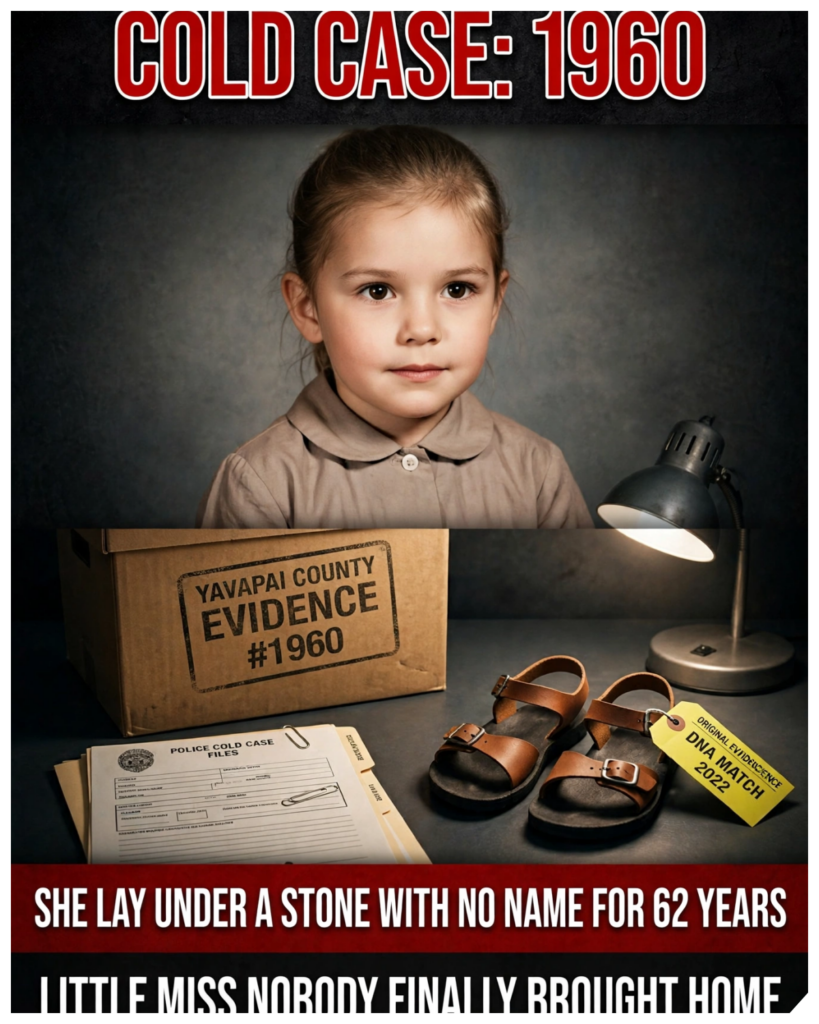
On her feet were a pair of adult-sized rubber sandals that someone had cut down to fit a child and fastened with leather straps.
Her fingernails and toenails were painted bright red.
Nobody in Yavapai County knew who she was.
She carried nothing that identified her.
The doctors who examined her could not say how she died.
The sheriff’s office could not say where she came from.
Within days, the town of Prescott took up a collection to give her a funeral because nobody else had come forward to claim her.
They buried her under a headstone that said she was Little Miss Nobody.
10 days before Russell Allen found her, and nearly 500 m to the east, a 4-year-old girl had been taken from the alley behind her family’s home in Alamagordo, New Mexico.
Witnesses saw a man and a woman in a dark green sedan offer her candy and new clothes.
When she refused, the woman got out of the car, grabbed her by the arm, and pulled her inside.
Then the car drove away.
Her name was Sharon Lee Gyos.
In 1960, investigators looked at the girl in the Arizona desert and wondered whether she might be Sharon.
Then they decided she was not.
The FBI compared footprints.
Doctors decided the child was older than Sharon.
The two cases were separated, and they stayed separated for 62 years.
For 62 years, a family in New Mexico wondered where their little girl was.
For 62 years, a little girl lay under a stone in Prescott with no name on it.
And the two were never put together.
It would take a forensic team that dug up her grave, a DNA lab in Texas, a half-brother living in Germany, and strangers on the internet who raised the money for the final test in less than a day.
In March 2022, investigators in Arizona stood in front of cameras and announced that little miss nobody had a name.
But a name was only half of the answer.
Who were the man and woman in the green car?
What happened to Sharon in the 10 days between that alley in Alamagordo and that wash in Arizona?
And why her?
Those questions are still open today.
This is the story of Sharon Lee Gyos, the town that buried a stranger’s child as its own, and the 62 years it took to bring her home.
If you want to know not only who she was, but how the answer stayed out of reach for six decades, and what investigators are still trying to find, stay with me.
And if you are new here, subscribe to the Cold Record.
We go back into the files that were left unfinished and we follow them as far as the evidence goes.
To understand who was taken that July afternoon, you have to begin in Alamagordo.
In 1960, Alamagordo was a small desert city in the Tularosa basin of southern New Mexico, home to around 21,000 people.
To the east, the Sacramento mountains rose above town.
To the west lay the white gypsum dunes of white sands.
Just outside the city was Hollowman Air Force Base where the military tested rockets and aircraft.
In 1954, an Air Force doctor named John Paul Stap rode a rocket powered sled down a track at Hollowman to more than 630 m an hour to study what the human body could survive.
In 1960 itself, the base was training chimpanzees for the space program.
One of them, a chimp named Ham, would be launched into space the following January.
About 60 mi to the northwest lay the Trinity site, where the first atomic bomb had been tested in 1945.
Alamagordo was a place where the government did some of its most advanced work.
But for a 4-year-old like Sharon, the world was a crowded house, her cousins, and the streets around it.
Sharon Lee Gyos was born there on September 6th, 1955.
In July 1960, she was 4 years old, about 2 months away from her fth birthday.
Her mother was Guadalupe Gyos, who worked as a maid at a local motel.
Sharon’s father was a soldier who had left when she was a baby.
She never knew him.
Sharon had an older sister, Ramona, and an older brother, John.
They lived in a crowded house on Virginia Avenue with their grandmother and other relatives.
In all, there were about six more family members under that roof, including four other children between the ages of 5 and 15.
It was a poor household, but a full one.
Within the family, Sharon had a nickname.
They called her Lagua, a Spanish word for a fair-skinned or light-haired girl, because her complexion was lighter than her siblings.
Decades later, her nephew, Ray Chavez, would describe her the way his family had always described her to him.
She was feisty, he said.
Happy golucky.
She loved playing with her cousins, and she loved running errands to the local grocery store.
Chavez was born in 1965, 5 years after his aunt disappeared.
He never met her.
His mother was Sharon’s older sister, Ramona, who was 15 the summer Sharon was taken.
Everything he knew about Sharon came from the stories his family told and from the silence that followed her for the rest of their lives.
In the summer of 1960, there was no national system for reporting missing children.
The FBI’s National Crime Information Center, the computer network that would one day let a police officer in one state check a missing person report from another, would not exist until 1967.
Amber alerts would not exist for another 36 years.
When a child disappeared, local police could put up roadblocks, send teletype messages to other departments, and hope.
Beyond that, the family depended on the newspapers and on luck.
The roads of the Southwest made that harder.
In 1960, the interstate highway system was only four years old and far from finished.
Most long-d distanceance travel still ran on two-lane federal highways through small towns and long stretches of empty desert with gas stations and motor courts spaced miles apart.
A car could cross from New Mexico into Arizona and disappear into a landscape where there were few people to notice it and no cameras, toll booths, or records of who had passed.
What happened to Sharon did not begin on the day she was taken.
It began 4 days earlier.
On Sunday, July 17th, 1960, Sharon and her mother went to church.
After the service, people noticed a couple in a dark green sedan.
There were two children with them.
The woman approached members of the congregation and asked questions, probing questions about Sharon and her mother.
In the days that followed, Sharon’s family noticed a change in her.
The girl who loved running to the grocery store no longer wanted to go.
She became nervous and wary.
When she saw a green car, she grew upset and asked her relatives to carry her past it.
Around July 19th, a woman knocked on the door of a neighbor of the Gyos family.
She asked for the family’s address.
She asked whether they had a little girl.
She asked how many children were in the house.
And she asked about the family’s finances.
She said she wanted to offer Sharon’s mother a job.
No one in the family knew who the woman was.
Looking back, it is hard to read those days as anything other than what they were.
Someone was watching Sharon, learning where she lived, and learning who would be around to protect her.
A neighbor named Helen Gonzalez later said she had seen a matching dark green car at the spot where Sharon would be taken on the Sunday before the abduction.
Shortly before the abduction itself, an 11-year-old girl named Dolores Bodiel saw the same car outside the GGO’s home.
A woman inside it was staring at the house.
Dolores’s 16-year-old sister, Mary Louu, saw the woman staring, too.
On Thursday, July 21st, 1960, at about 3:00 in the afternoon, Sharon was outside playing in the alley behind the house on Virginia Avenue with two of her cousins.
One of them was 5 years old.
The other was 11.
By some accounts, Sharon was barefoot.
A dark green sedan pulled up.
Witnesses later described it as dirty and old, probably a 1951 or 1952 Dodge or Plymouth.
A man was at the wheel with a woman beside him.
Some witnesses believed there were children in the car as well, including a little boy with freckles.
The couple called out to the children.
They offered Sharon candy.
They offered her new clothes.
All she had to do was get in the car.
Sharon’s cousin, Vicky Craig, was the 5-year-old playing with her in the alley that day.
More than six decades later, she still remembered the car pulling up and the people inside talking about candy.
Sharon refused to get in.
The woman opened her door, climbed out, grabbed Sharon by the arm, and forced her into the car.
Then the sedan sped away, heading west onto Fifth Street.
The cousins ran to tell their mother, and the family called the police at once.
Within an hour, roadblocks went up, including at the border between New Mexico and Texas.
Officers checked cars heading out of the area.
The green sedan was never stopped.
The witnesses gave the police what descriptions they could.
The woman was short and heavy set with dirty blonde hair and glasses, probably in her 30s.
The man was fair-skinned and thin with a long nose and straight sandy hair.
The Alamagordo police quickly considered the possibility of a kidnapping for ransom and just as quickly set it aside.
The Gygo’s family was poor.
There was no money to demand and no demand ever came.
Investigators looked into the family’s relatives and acquaintances.
By July 28th, a week after the abduction, they had found nothing to suggest that anyone the family knew was involved.
The couple in the green car had simply driven into Alamagordo, taken a 4-year-old girl, and driven out again.
Guadalupe Gyos had lost her youngest child to people she had never met for a reason no one could explain.
The police had descriptions of the couple and their car, but no names, no license plate, and no idea which way they had gone after the roadblocks.
10 days after Sharon was taken on July 31st, Russell Allen walked into Sandwash near Congress, Arizona, Congress sat in the desert of Yavapai County about 30 mi from the town of Wikcinberg in rough country between Phoenix and Prescat.
Highway 93 passed nearby.
Alamo Road branched off into the desert and the wash where the girl was found lay a short distance from the highway.
In 1960, Highway 93 was a main route between Phoenix and Las Vegas, and beyond it, the roads to Nevada and California.
Whoever left the child in the wash may simply have been passing through, heading northwest.
Nobody knows, but it was the kind of road a family on a long drive west might take, and the kind of place where a car could stop for a few minutes without anyone noticing.
Alan and his family had come looking for rocks.
Instead, they found a child in a shallow grave.
Yavapai County deputies came out to the wash.
They found the child partly buried in the sand.
They found some of her clothing nearby, and they found a rusted pocketk knife that might have had blood stains on it.
Whether that knife had anything to do with her death was never established.
The ground around the wash held other signs.
Tire tracks showed that a vehicle had left the highway and turned around.
Investigators found two sets of footprints.
One belonged to an adult.
The other might have been the child’s own.
They also came to believe that whoever buried her had started digging in two other places before settling on the spot where she was found.
The clothing, the pocketk knife, and casts of the footprints were sent to the FBI laboratory in Washington DC.
In 1960, the FBI lab was one of the few places in the country equipped to examine physical evidence in detail.
It could compare fibers, analyze soil, and match shoe and tire impressions.
It could not tell investigators who a person was from the material of their body.
The autopsy was performed at the Whitmer Funeral Home.
The pathologist estimated that the girl was white, probably between 5 and 7 years old, between 3 and 1/2 and 4 1/2 ft tall, and between 50 and 60 lb.
She had brown hair, which might have been dyed auburn.
Her baby teeth were all in place and in good condition.
She had been dead for 1 to two weeks in the summer heat of the Arizona desert.
That was long enough for decomposition to make many findings impossible.
The pathologist found no stab wounds and no broken bones.
None of her clothing had knife holes.
The autopsy report described her remains as charred, as if someone had tried to burn her at around the time of her death.
The doctors could not determine how she died.
Because of where and how she had been found, her death was ruled a homicide.
A medical examiner can classify a death as a homicide, even when the exact cause cannot be found.
The manner of death, the circumstances matters as much as the mechanism.
A young child does not end up in a shallow grave in the desert, possibly burned by accident, or by natural causes.
Someone put her there.
That should have been enough to raise a question.
A 4-year-old had been abducted in New Mexico on July 21st.
10 days later, the body of a young girl was found buried in the Arizona desert.
A child who had died 1 to 2 weeks earlier.
The distance between the two places was nearly 500 m.
It was a long drive in 1960, but it could be done in a day.
Investigators did ask the question.
On August 2nd, 1960, a Yavapai County under sheriff told reporters that it was possible the body was that of the missing New Mexico girl, but he added they could not be sure.
The clothing did not settle the question.
10 days had passed and the couple who took Sharon had offered her new clothes.
Whatever she wore when she was taken could easily have been changed.
Then the doubt set in.
The pathologists estimate put the child’s age between 5 and 7.
Police announced that the girl in the wash was about seven, older than Sharon.
In Washington, the FBI compared the footprints and other evidence and ruled out Sharon as the child in the desert.
With that, the link was broken.
The child in Arizona was not Sharon Lee Gyos.
The authorities said she was someone else, someone no one had reported missing.
Years later, after DNA had shown that the 1960 conclusion was wrong, Yavapai County Sheriff’s Lieutenant Tom Boltz would say that investigators had made their decisions based on the evidence they had at the time.
Age estimates from decomposed remains were far less reliable in 1960 than they would later become.
A child who had lain that long in the summer desert and possibly burned was very difficult to examine.
Decades later, a new forensic examination would lower the estimated age to between three and six years old, most likely about three and a half feet tall.
That fit Sharon.
In 1960, the estimate did not.
The reason has to do with how children’s ages are estimated from their remains.
Today, the most reliable method for a young child is the teeth.
Children’s baby teeth and the adult teeth forming beneath them develop on a wellocumented schedule, and a forensic dentist reading X-rays of the jaw can often narrow a child’s age to within a year or so.
Height and weight, by contrast, vary widely from child to child and can be badly distorted by decomposition.
A tall 4-year-old and a small 7-year-old can measure almost the same.
In 1960, the pathologist’s estimate leaned on measurements that were far less precise than they appeared, and that estimate helped close the door on Sharon.
The footprint comparison carried similar risks.
Sharon may have been barefoot when she was taken.
The girl found in the desert wore cut down adult sandals.
Any comparison between a footprint in the sand and a little girl’s known shoe size or her footprints at home involved a great deal of uncertainty.
In 1960 though, the FBI’s conclusion carried enormous weight and few people would have thought to question it.
In Yavapai County, the investigation went forward as if the child had come from nowhere.
The man who led it was LH Johnson, known to everyone as Red.
Investigators sent out an all points bulletin.
They interviewed people with records of crimes against children.
Letters, phone calls, and telegrams arrived from across the country from people who thought they might know who she was or what had happened to her.
One theory was that the girl belonged to a family of transients, people who moved from place to place and might not report a missing child.
In early August 1960, investigators questioned a family named Davidson for more than an hour.
Their alibis checked out and they were released.
Meanwhile, the people of Yavapai County faced a question no one wanted to answer.
What do you do with a child no one has claimed?
The answer at first was the county’s Poppers cemetery known as Boot Hill.
Children and adults with no family and no money were buried there without ceremony.
A Prescott radio announcer named Dave Paladin decided that was not good enough.
He went on the air and started a fundraising campaign.
People in Prescott and across Yavapai County responded.
They raised enough money to buy her a casket, a plot in a proper cemetery, and a funeral.
By then, the town had given her a name.
They called her Little Miss Nobody.
On August 10th, 1960, 10 days after she was found, the funeral was held at the Congregational Church in Prescott.
Dr.
Charles Franklin Parker led the service.
More than 70 people came.
Not one of them knew her.
They came because a child had died alone, far [clears throat] from anyone who loved her, and they did not want her to be buried that way.
Prescott was a small city in 1960 with about 13,000 people.
It had been the capital of the Arizona territory before statehood and still had the feel of an old western town with a courthouse square shaded by elm trees and a street of old saloons across from it.
Most of the mourers that day had read about the girl in the newspaper or heard about her on the radio.
For many of them, the funeral was simply the right thing to do.
On her small casket was a placard.
It read, “God’s little child.
Date of birth unknown.
Date of death unknown.”
In his eulogy, Parker spoke about the questions that had no answers.
“We may never know the wise and wherefors,” he said.
He predicted that her identity would never be known.
She was buried at Mountain View Cemetery in Prescott.
Her headstone bore the name the town had given her and a line from the Gospel of Matthew.
Blessed are the pure in heart.
500 m away, the Gygo’s family in Alamagordo kept waiting for news of Chiron.
As far as the authorities were concerned, the child being buried in Prescott was not her.
The search for the couple in the green sedan continued in New Mexico, but it had little to work with.
Without a license plate, the car was one of thousands of aging green sedans on the roads of the Southwest.
Without names, the descriptions of the couple fit thousands of people.
The leads grew thinner each month.
In Arizona, investigators did not give up on Little Miss Nobody either.
In March 1961, they looked at a possible connection to another case.
In Virginia, the body of a girl named Caroline Dudley had been found on February 9th, 1961.
Her four-year-old sister, Deborah Jane Dudley, was missing.
Their parents would later be charged in both girls deaths.
Investigators wondered whether the child in the Arizona wash could be Deborah.
The lead did not produce an identification.
On August 8th, 1961, nearly a year after the funeral, Yavapai County Sheriff Jim Kramer went back to the wash with a film crew.
He filmed the site where the child had been found.
He showed the cut down sandals and other evidence to the press, hoping someone somewhere would recognize them.
Somewhere, he said, there is someone who has the answer that we have been looking for.
The televised appeal produced nothing significant.
Sheriff Kramer and Deputy County Attorney George Ireland searched hundreds of miles of desert from the air and on the ground, looking for anything that might explain where she had come from.
They found nothing.
The years went by.
In Prescott, Little Miss Nobody remained part of the town’s memory, the child it had buried as its own.
In Alamagordo, Sharon Lee Gyos became a missing child who had never come home and a name the family carried in silence.
Red Johnson, the investigator who had led the case in 1960, went on to become police chief in Peoria, Arizona.
He never forgot the girl in the wash.
In 1976, 16 years after he had stood in that desert, he told a reporter, “16 years later, I still think about her.”
The family in Alamagordo grew older.
Sharon’s brother and sister grew up.
Her sister Ramona had children of her own.
Ray Chavez, Ramona’s son, grew up hearing about the aunt he had never met.
He would later say that what happened to Sharon shaped his family’s lives.
They became overprotective of their children.
They could not forget that a little girl had been taken from their own alley in the middle of the afternoon while other children watched.
Sharon’s mother, Guadalupe, lived for more than 50 years after her daughter was taken.
She died of natural causes in 2011 at the age of 87, never knowing what had happened to Sharon.
Sharon’s sister, Ramona, Ray’s mother, also died without an answer, as did Sharon’s grandmother.
What makes this case so painful is not only that the answer was missing.
It is that in a sense the answer had been found in 1960.
The child in the desert was Sharon.
She had been found 10 days after she was taken.
Her body had been examined, photographed, measured, and buried with care and with love by a community that wanted to give her dignity.
And the one thing that might have reunited her with her family, a correct identification, was made impossible by the forensic limits of the time.
It was not that no one looked.
It was that the tools they had pointed them in the wrong direction.
If you have stayed with Sharon’s story this far and you want to see how a sheriff’s office, a national center for missing children, and a DNA lab in Texas finally brought her name back, this is a good moment to subscribe to the cold record.
Because the next part of this story begins with an unusual decision to find out who little Miss Nobody was, investigators first had to dig up her grave.
By the early 2000s, DNA had transformed how unidentified remains were investigated.
In 2007, the US government launched the National Missing and Unidentified Persons System, known as Namos, a public database where investigators and families could compare missing persons reports with unidentified remains from across the country.
For the first time, a detective in Arizona and a family in New Mexico could see each other’s cases on the same screen.
The need for such a system was enormous.
The National Institute of Justice has estimated that about 4,400 unidentified bodies are recovered in the United States every year and that about 1,000 of them remain unidentified after a year.
Over decades, those numbers added up to tens of thousands of people buried without names, many of them in the same kind of unmarked or numbered graves that Prescott had refused to give Little Miss Nobody.
In 2013, the Yavapai County Sheriff’s Office reached out to the National Center for Missing and Exploited Children for help with the case of Little Miss Nobody.
The center, usually known by its initials, Neckmech, had just created a forensic services unit dedicated to identifying unknown children.
Little Miss Nobody, became one of its cases.
NCME sent help in stages.
In 2015, it sent a member of Team Atom, its group of retired law enforcement investigators with experience in missing children cases to assist with the exumation of the child’s remains from Mountain View Cemetery.
The program carries the name of Adam Walsh, a 6-year-old boy who was abducted from a department store in Hollywood, Florida in 1981 and murdered.
His father, John Walsh, went on to campaign for the laws and the national center that decades later would help bring Sharon home.
In 1960, none of that existed.
There was no national clearing house for missing children, no hotline, and no agency whose job was to connect a missing girl in one state with an unidentified girl in another.
Every case like Sharon’s depended on whether one local police department happened to read another’s bulletin and whether the details looked close enough to follow up.
The team is named after Adam Walsh, the six-year-old boy abducted and murdered in Florida in 1981, whose parents went on to help found Mechmeck itself.
It was a delicate decision.
The town had buried her with care, and she had rested in Prescott for 55 years.
But without new samples, there was no way to test her DNA with modern methods.
The remains were carefully removed and examined.
In 2016, Neckmech arranged for a forensic odontologist, a dental specialist, to examine her teeth.
That same year, one of Enamech’s forensic artists created a three-dimensional facial reconstruction, an image of what the child might have looked like in life.
A later forensic examination in 2018 produced a new estimate of her age between 3 and 6, not 5 to 7, not seven, younger.
The reconstruction was released to the public and shared on Name and Necme social media pages.
Investigators hoped someone would see the face and recognize it.
Forensic facial reconstruction starts with the skull.
Artists use known averages for the thickness of soft tissue at dozens of points on the face, which vary with age, sex, and ancestry and build up the features layer by layer.
The result is an approximation, not a photograph.
For a young child whose features are still developing, it is even harder.
In this case, it produced no identification, but it brought new attention to a case that had been quiet for decades.
Her DNA profile was entered into Namos and into mech systems.
Investigators also developed a DNA profile that was eventually uploaded to Kotus, the FBI’s national DNA database.
COTUS can match a profile to relatives only when those relatives are in the system, and the database consists mostly of people with criminal convictions or arrests.
No close relative of the child turned up.
Sharon’s case had never been completely forgotten either.
A 4-year-old abducted in 1960, 10 days before the discovery and a few hundred miles away, was an obvious possibility.
But the evidence of 1960 had ruled her out, and the DNA work of the 2010s could not yet prove otherwise.
In 2019, with help from an FBI liaison, NickM collected DNA from a half-brother of Sharons who was living in Germany.
His DNA was uploaded to the Consumer Genealogy Service, Family Tree DNA.
Other relatives also gave samples.
The older forms of testing though could not produce a conclusive answer.
Part of the problem was the kind of DNA that could be recovered.
Remains that are old, burned, or badly degraded often yield only mitochondrial DNA.
A small set of genetic material found outside the nucleus of the cell.
Mitochondrial DNA is passed down almost unchanged from a mother to all of her children.
That makes it useful for confirming a maternal family line, but it cannot tell one person from another within that line.
A brother, a sister, a cousin, and a great aunt on the mother’s side can all share the same mitochondrial profile.
And so can many unrelated people with a common maternal ancestor centuries back.
To identify a specific child with certainty, investigators needed nuclear DNA, the much richer genetic code inherited from both parents.
Getting enough of it from remains buried for more than 50 years was the challenge.
Then in 2021, the Yavapai County Sheriff’s Office partnered with a laboratory in the Woodlands, Texas, called Aram.
Aram had been founded on a simple idea, traditional forensic DNA testing, the kind stored in Cotus looks at about 20 specific locations on the genome.
That is enough to confirm that two samples came from the same person, but not enough to work out distant family relationships.
Author used a technique called forensic grade genome sequencing, which reads hundreds of thousands of genetic markers.
With that much information, a lab can compare an unknown person’s DNA with the DNA of possible relatives, even distant ones, and estimate how closely they are related.
It was also designed for the kind of samples that defeat traditional testing.
Old bones, degraded tissue, tiny amounts of material, remains that had been buried for more than half a century and that may have been burned before burial were exactly the kind of challenge was built for.
But testing costs money.
In January 2022, the sheriff’s office committed $1,000 toward the cost and asked the public to help raise the remaining $4,000 through DNA solves, a crowdfunding platform runs for cases like this.
The money was raised in less than 24 hours.
But Kristen Middleman, Aram’s chief business development officer, later said the speed of that response showed how much people wanted to find the answer.
Strangers who had never been to Prescott or Alamagordo, who had never heard of Sharon Lee Gyos, paid for the test that would give a little girl back her name.
Crowdfunding forensic testing is a recent development, and it reflects a hard reality.
Most sheriff’s offices and police departments have limited budgets, and unidentified remains from decades ago rarely rise to the top of the list.
A few thousand can be the difference between a case that is solved and one that sits in storage for another generation.
Platforms like DNA Solves let members of the public pay for that testing directly, case by case.
In Sharon’s case, the public responded faster than anyone expected.
Received the case around the end of 2021.
[clears throat] The lab had been founded in 2018 by David and Christristen Middleman and within a few years it had become one of the leading labs in the country for identifying unknown remains and solving cold cases with genetic genealogy.
In the lab, technicians extracted DNA from the remains and sequenced it.
Middleman would later describe the result as almost indistinguishable from a profile taken from fresh DNA.
Despite everything the remains had been through.
Then the lab compared that profile with the DNA of Sharon’s relatives.
The comparison is called kinship analysis.
Full siblings share about half of their DNA.
Half siblings, who have one parent in common, share about a quarter.
By measuring how much DNA the remains shared with Sharon’s living relatives, the lab could test whether the child from the wash fit in Sharon’s family tree, exactly where Sharon should be.
In February 2022, Oram returned the answer to the Yavapai County Sheriff’s Office.
The child buried as Little Miss Nobody was Sharon Lee Gayos.
The lab described the identification as certain.
The sheriff’s office did not announce it right away.
First, investigators reached out to Sharon’s family.
Her mother had died 11 years earlier.
Her grandmother was gone, but her nephew Ray Chavez and other relatives were still waiting for the news that their family had wanted for 62 years.
On Tuesday, March 15th, 2022, the Yavapai County Sheriff’s Office held a press conference.
Sheriff David Rhodess announced that the girl found in Sandash on July 31st, 1960 had been identified as Sharon Lee Gyos of Alamagordo, New Mexico, who was abducted 10 days earlier at the age of four.
It was the oldest cold case the sheriff’s office had ever resolved.
For Nackmech, it was the oldest identification its forensic services unit had ever made.
Ansley Carter, a forensic case manager there, called it a major milestone.
Carol Schweitzer, who supervised the unit, said that despite many defeats, the goal of identifying the victim never ceased.
Sheriff Rhodess said Sharon would no longer need to be referred to as Little Miss Nobody.
He went further.
I hope he said, “We never hear that name again.”
Ray Chavez stood at the podium and spoke for his family.
He had never met his aunt.
He had come to honor his mother and his grandmother who had both died without knowing what happened to Sharon.
“We as the family want to say thank you,” he said.
“It’s still sinking in.”
He described his aunt the way his family always had, feisty and happy golucky, a little girl who loved to play outside with her cousins.
And he thanked the people of Prescott, who had given his aunt a funeral and a resting place for six decades when her own family could not.
Thank you, he said, for keeping my aunt safe and never forgetting her.
Then he asked the question that his family had carried for 62 years.
Speaking to whoever had taken her, he asked, “Why?
Why choose her?”
No one in the room could answer him.
Sharon’s identification came in the same year as another historic one.
In December 2022, police in Philadelphia announced that the boy in the box, a child found dead in a cardboard box in 1957 and unidentified for 65 years, was Joseph Augustus Zerelli, who was 4 years old when he died.
Like Sharon, he had been buried by strangers who cared enough to give him a grave.
Like Sharon, he was finally named by genetic genealogy.
And like Sharon, the person responsible for his death has never been identified.
The two cases show both the power and the limit of what DNA can do.
It can restore a name after more than half a century.
It can return a child to their family and tell a community who it buried.
But a name tells you who the victim was.
It does not tell you who killed them.
For that, investigators still need witnesses, documents, and people willing to talk.
The Yavapai County Sheriff’s Office was clear that the identification was not the end of the case.
Lieutenant Tom Bolt said investigators wanted to identify the people who took her.
Sheriff Rhodess said Sharon’s cousins, the children who had been with her that afternoon in 1960, and who were now in their 60s and 70s, had provided new leads.
The investigation into who abducted Sharon, what happened to her in the 10 days after she was taken, and how she died remained open.
7 months later, Sharon went home.
The family decided where she should rest.
In October 2022, Sharon Lee Gyos was rearied at St.
Francis Depala Catholic Church in Tulosa, New Mexico, about 13 mi north of Alamagordo.
She was laid to rest in the same grave as her mother and her grandmother.
Ray Chavez spoke to reporters that day.
He said he would never have thought that after so many years this could happen.
We are overjoyed, he said, that this was able to happen.
He said he wished his mother and grandmother could have been there.
It was a sad occasion, he said, but it was really a happy occasion for the family.
Vicky Craig, Sharon’s cousin, the 5-year-old who had been with her in the alley, was there, too.
She was glad, she said, that Sharon was home and that it was coming to a close.
Sharon’s great niece, Samantha Bot, put it simply.
It was something, she said, that affected the whole family for a long time.
There is something about this case that sets it apart from almost every other cold case.
Most cold cases begin with a known victim and an unknown killer.
This one began with two mysteries that were really one.
A family had a name with no body.
A town had a body with no name.
For 62 years, both of them looked for the missing half.
And both of them were only 500 m apart.
The forensic science of 1960 kept them apart.
An age estimate based on remains that had spent up to two weeks in the summer desert put the child at 5 to 7 or seven.
An FBI comparison of footprints and other evidence ruled Sharon out.
There was no DNA testing, no national database of missing children, and no computer that could have flagged the two cases side by side.
Each agency did its job with the tools it had, and the tools got it wrong.
The identification in 2022 did not happen because of one breakthrough.
It happened because of a chain of people who refused to let the case end.
Russell Allen, who stopped and reported what he found.
Red Johnson, who was still thinking about her 16 years later.
Sheriff Jim Kramer, who filmed the scene and pleaded for help on television.
Dave Paladin and the people of Prescott, who made sure she was buried in a proper grave.
The detectives in Yavapai County who reached out to Nekmmeck in 2013, the forensic specialists who exumed her, examined her teeth, and sculpted her face, a half-brother in Germany who gave his DNA, and thousands of strangers who covered the cost of the final test overnight.
And yet, the hardest questions remain.
Who were the man and the woman in the green car?
The descriptions from 1960 are all investigators have to go on.
A short, heavy set woman with glasses and dirty blonde hair, probably in her 30s.
A thin, fair man with a long nose and sandy hair.
A dark green Dodge or Plymouth from the early 1950s.
Possibly two children in the car with them, including a boy with freckles.
If that couple was in their 30s in 1960, they would be in their 90s or older today, if they are still alive at all.
Most likely, they are not.
But the children in the car are a different matter.
A boy who was 5 or 10 years old in 1960 would be in his 70s or early 80s now.
If he is alive, he may remember a summer road trip through New Mexico in Arizona and a little girl who was in the car for a while and then was not.
Whether that freckle-faced boy is still alive is one of the questions that remains open.
What happened during those 10 days?
This is perhaps the most painful question of all.
Sharon was taken on the afternoon of July 21 and found on July 31st.
By the pathologist’s estimate, death had come between 1 and 2 weeks before the discovery.
It is possible that Sharon was killed soon after she was taken, perhaps on the long drive west.
It is also possible that she was kept alive for days.
Nobody knows why was she taken.
The couple did not ask for ransom.
They did not target a wealthy family.
They approached Sharon’s church and a neighbor asked about the family’s money and its children and offered a job.
Then they offered Sharon candy and new clothes.
The cut down sandals and the painted nails may suggest that someone dressed her and changed her appearance after she was taken.
Whether the couple wanted a child to keep, to sell, or to harm, investigators have never been able to say.
And how did she die?
The autopsy in 1960 could not determine the cause.
There were no stab wounds, no broken bones.
The remains were burned.
Without new evidence, the cause of death may never be known.
These questions are why the case is still open.
Crimes like this one are rarer than many people believe.
Most missing children in the United States are runaways or are taken by a family member, usually in a custody dispute.
Federal research on what investigators call stereotypical kidnappings, where a stranger or slight acquaintance takes a child, keeps them overnight, or moves them a long distance, and intends to keep them or kill them, has estimated only about 115 such cases in a single year nationwide.
Cases involving a man and woman acting together are rarer still, and very few begin the way Sharons did, with days of watching, questions at a church and a neighbor’s door, and a stranger asking about a family’s finances.
That pattern suggests a plan, not an impulse.
In Yavapai County, it remains a homicide investigation.
Anyone with information about a dark green 1951 or 1952 Dodge or Plymouth sedan in Alamagordo in July 1960, about a couple traveling west with children that summer, or about a little girl who was with them, is asked to contact the Yavapai County Sheriff’s Office.
In the case of the cousins, investigators have a rare resource.
Most witnesses to a 1960 crime have died, but the children who were playing with Sharon in the alley that afternoon were five and 11 years old.
In 2022, they were still alive, and they had been there.
Memories from early childhood are fragile, and six decades can blur even the most vivid ones.
Still a detail that seemed meaningless to a child in 1960.
A word the woman said something about the car, the direction it turned, might take on new meaning now that investigators know where Sharon was found.
The investigation faces obstacles that DNA cannot solve.
Vehicle registration records from 1960 were kept on paper by state, and many have long since been discarded.
Motel registers, gas station receipts, and the memories of people who worked along those highways are mostly gone.
Unless someone who knew the couple comes forward, or a family discovers something among an old relative’s belongings, the people in the green car may never be named.
But cases this old have been solved before through a letter found in an attic, a deathbed confession, or a relative who finally decided to speak.
That is why the sheriff’s office keeps asking.
The case of Sharon Lee Gyos leaves lessons that reach far beyond Prescott and Alamagordo.
The first lesson is about how a mistake can last for a lifetime.
In 1960, investigators asked the right question.
They wondered whether the girl in the desert was Sharon.
Then forensic estimates that seemed reliable told them no and they accepted it.
That decision kept a family from their daughter for 62 years.
Age estimates, footprint comparisons, and other forms of evidence that once carried great weight are far less certain than they appeared.
When a case seems to fit, and science says it does not, it is worth asking whether the science could be wrong.
The second lesson is about the value of a grave.
Prescott could have buried her on Boot Hill without a ceremony.
Instead, a radio announcer and a whole community gave her a casket, a funeral, a headstone, and a plot in a cemetery.
Because she was buried with care, her remains could be found again, exumed, and examined decades later.
If she had been cremated or placed in an unmarked Poppers grave, the DNA that identified her might have been lost forever.
The kindness of strangers in 1960 made the science of 2022 possible.
The third lesson is about how far DNA science has come and how much it still depends on people.
In 1960, there was no DNA testing at all.
In the 2010s, older methods could not settle the question.
In 2022, a lab in Texas could pull a nearly complete genetic profile from bones that had been in the ground for six decades.
But the lab could only do its work because someone paid for it.
The test cost about $5,000.
Crowdfunding raised most of it in a single day.
Across the United States, thousands of unidentified people are still waiting for the same kind of test.
There is a lesson here, too, about the public.
In 1961, Sheriff Jim Kramer went on television and asked for help, and the appeal brought nothing.
60 years later, a sheriff’s office posted a request for $4,000 online, and people across the country answered within a day.
The difference was not that people cared more in 2022.
People in Prescott cared deeply in 1960.
The difference was that in 2022, caring could be turned directly into evidence.
The fourth lesson is about the families left behind.
Sharon’s mother lived for 51 years after her daughter was taken and died not knowing.
Her grandmother died not knowing.
Sharon’s nephew, who was born after she disappeared, grew up in a family shaped by a little girl he never met.
When the answer finally came, it came to the generations who had inherited the loss, not the ones who suffered it first.
And the last lesson is about the name.
For six decades, she was known only by a name a grieving town gave her, a name that meant she belonged to no one.
Little Miss Nobody was a name of kindness.
But it was also a name of failure.
It meant that the system that was supposed to bring her home had not done its job.
When Sheriff Rhodess said he hoped never to hear it again, he was saying something important.
Every unidentified person has a name.
Finding it is not the end of the story.
It is where the story finally begins.
Sharon Lee Gyos was 4 years old.
She was 2 months short of her fifth birthday.
She lived in a crowded loving house on Virginia Avenue in Alamagordo with her mother, her brother and sister, her grandmother, and her cousins.
Her family called her Laera.
She was feisty and happy golucky.
She liked to run errands to the grocery store and she loved playing outside with her cousins in the alley behind the house.
On a summer afternoon in July 1960, two strangers offered her candy and new clothes.
She said no.
She did exactly what a child is supposed to do.
They took her anyway.
She should have turned five that September.
She should have started school, grown up in that crowded house, had children of her own, and grown old in the Tularosa basin under the Sacramento mountains near the people who loved her.
She would have turned 71 this year.
For 62 years, she was buried under the wrong name in a town she never knew, by people who never knew her, who loved her anyway.
Now she rests in Tulosa beside her mother and her grandmother under her own name.
The people who took her may never be found, but they did not get the last word.
Sharon Lee Gyos is not nobody.
She never was.
This is the cold record.
We return to the cases history left open, and we stay with them until the trail runs out.
If Sharon’s story stays with you, subscribe and share it.
Another file.


