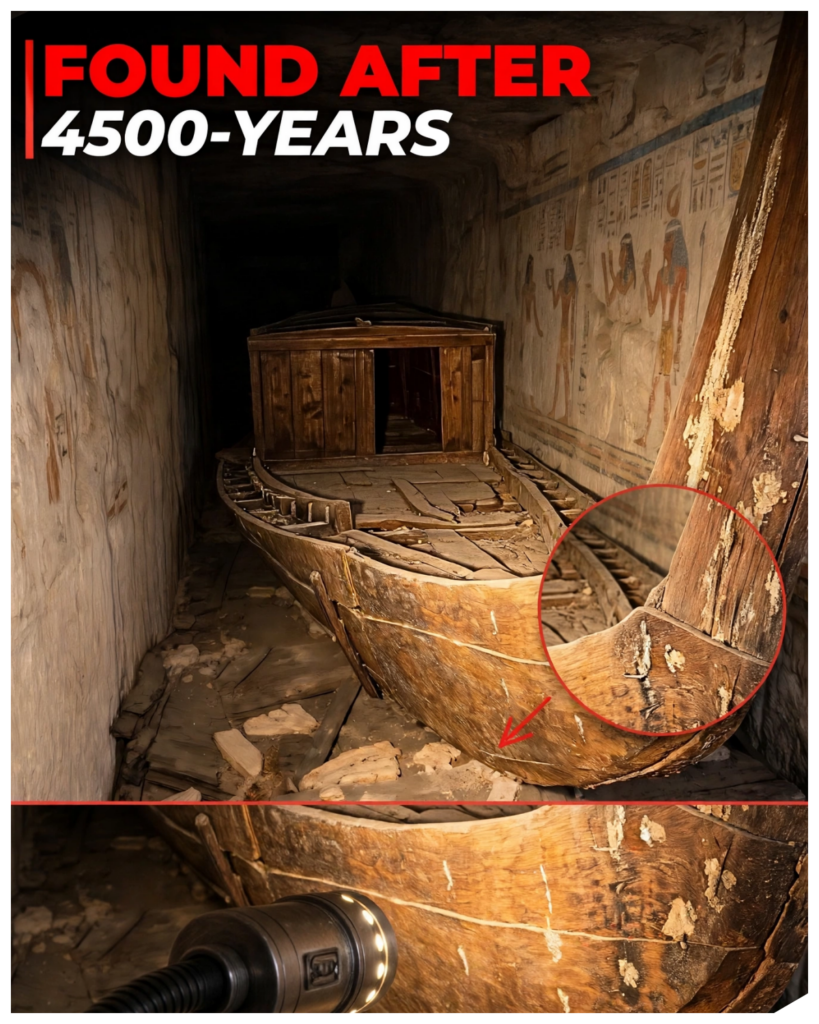
Beside the Great Pyramid, a small camera looked beneath a covering of limestone.
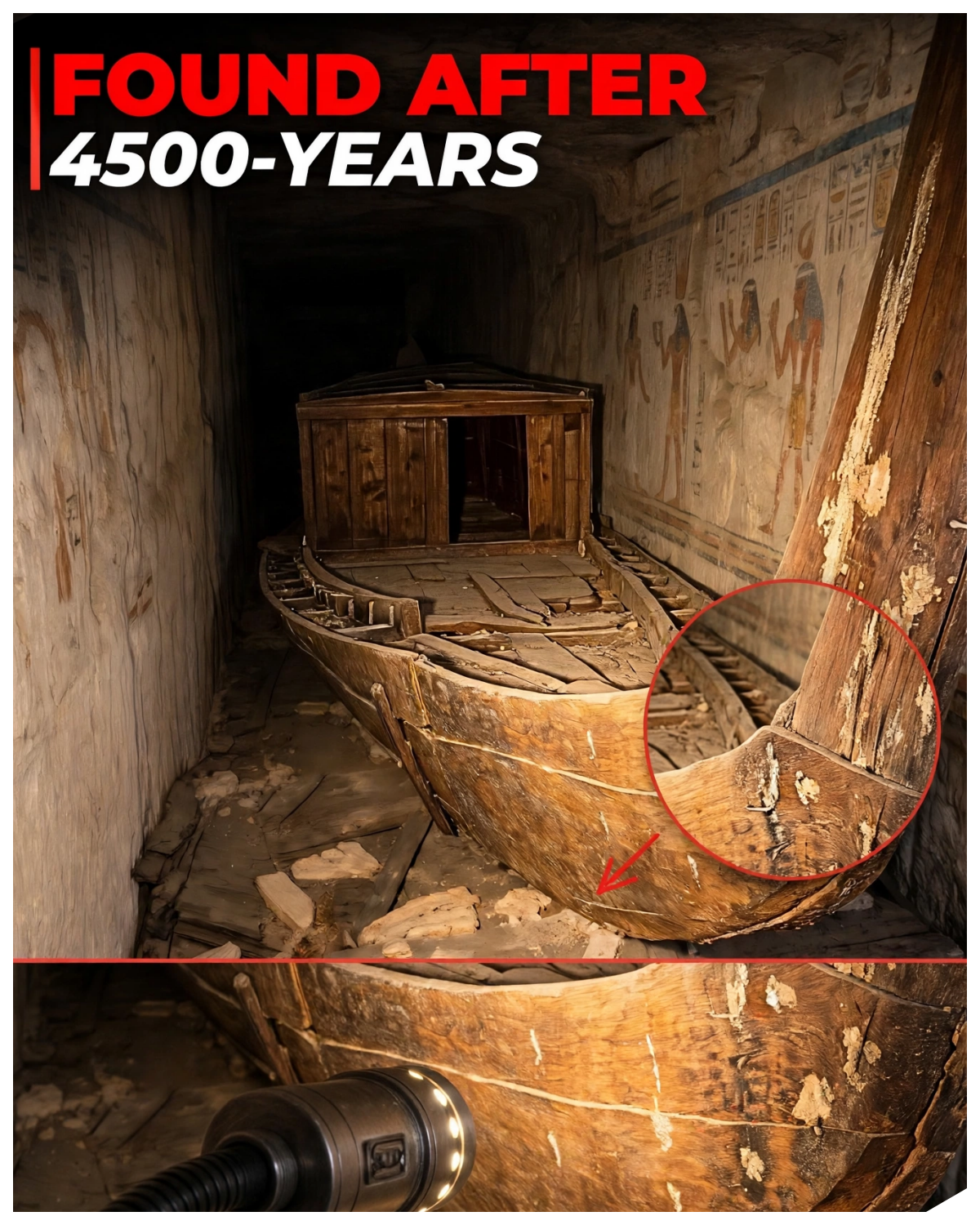
On the monitor were wooden beams, remains of a vessel buried for more than 4,000 years.
But the camera could show only part of what survived.
To understand the boat, archaeologists would have to bring its pieces out of the ground.
In 1954, archaeologists identified two sealed boat pits along the southern side of Kufu’s Great Pyramid at Giza.
Kufu ruled Egypt during the fourth dynasty around 4,500 years ago.
Both pits lay outside the pyramid structure.
The first yielded a dismantled vessel that specialists reconstructed separately.
The second remained sealed, preserving another boat from the same royal complex.
Scholars have proposed that these vessels served in Kufu’s funeral or were intended to carry him through the afterlife.
Their exact purpose remains debated.
For the second boat, direct examination would begin through a narrow opening, allowing investigators to inspect its contents while leaving the stone covering in place.
A camera examination took place in 1987, offering access to the second pit without removing its stone covering.
21 years later, Egyptian Japanese investigations resumed with a further inspection.
In 2008, these were separate examinations rather than a single expedition.
Archaeologist Sakuji Yoshimura of Waseda University led the Japanese archaeological work, collaborating with Egyptian specialists.
Their task was to document the buried material and assess its condition before attempting a much larger intervention.
In the documented [music] 2008 inspection, a probe passed through an opening beneath the limestone covering and transmitted standard definition images to a monitor.
Inside lay dismantled wooden components, beams and portions of timber joints could be identified.
An assembled ship did not stand beneath the stones.
That distinction shaped what the inspection could answer.
The camera confirmed surviving material and gave researchers a limited view of its arrangement.
It could not provide a complete inventory or test the strength of individual pieces.
A timber could retain a recognizable outline while its internal structure had weakened over centuries.
Appearance alone could not settle the practical question of recovery.
The image established that wood survived.
It could not establish whether that wood could survive being moved.
In 2010, the Egyptian Japanese team began preparing the site at Giza for excavation.
Equipment, access, and the planned opening had to be organized before the limestone covering could be removed.
The expedition’s brief report records this preparation separately from the work of exposing the boat.
In 2011, workers lifted the limestone cover stones, opening the pit for direct examination.
Beneath them, wooden components lay stacked within the burial space.
Removing the stone covering gave the team access to the exposed material, but the timbers still remained in the pit.
Opening the burial and recovering its contents were separate operations.
During 2012, further assessment and wood sampling continued.
Small samples allowed specialists to investigate the material and inform conservation decisions before larger scale recovery.
The exposed components also needed to be documented in their buried positions, preserving evidence of their arrangement before removal changed it.
What the camera had shown was only the uppermost view.
The excavation would reveal how much lay beneath it.
By July 2021, the Egyptian Japanese team had recovered nearly 1,700 wooden pieces from 13 layers within the second boat pit.
Jaika’s report recorded the scale of a deposit that had taken years to expose and recover.
13 layers described the arrangement encountered during excavation.
That number does not establish 13 building campaigns, 13 voyages, or 13 separate occasions when the boat was dismantled.
Those claims would require evidence that the layer count alone cannot provide.
Successive exposure allowed archaeologists to record material previously concealed by the wood above it.
As recovery proceeded, the team could document the deposit through its depth rather than judge its extent from a single exposed surface.
The resulting inventory gave a measurable answer to how much wood had survived.
Nearly 1,700 pieces also needs careful reading.
A recovered piece is not necessarily an intact original boat component.
Fragmentation means that several pieces may once have belonged to one timber.
The total measures the recovered material.
It does not supply an original parts list.
Among that material were shaped planks and beams with surviving joints that preserved evidence of Egyptian woodworking.
Their contours and worked surfaces offered clues to how builders prepared timber for a vessel.
Recorded joint details could help researchers compare components, but recognizing a joint did not automatically identify its matching piece or its position in a hull.
The excavation had turned a restricted glimpse into a substantial body of physical evidence.
The camera had captured only a fraction of it.
Now, the records had to preserve two kinds of information together.
Each piece’s place in the buried deposit and the construction details that might help establish its relationship to other timbers.
Conservators had to establish how each timber could be handled without breaking it.
The surviving wood could no longer be expected to carry the loads it had borne when the vessel was built.
Even lifting a plank placed stresses on material weakened during burial.
Documented condition assessments guided recovery.
Specialists examined the wood’s preservation and used that evidence to decide where support was needed before moving it.
A recognizable component still required careful handling along its length.
Holding one end could leave the rest vulnerable to bending or fracture.
Supportive backing and lifting cradles help distribute weight, reducing the strain concentrated on any one area.
These supports allowed the team to move fragile material while limiting the load carried by the ancient wood itself.
Recovery therefore depended on conservation as much as excavation.
Each piece needed sufficient protection to [music] leave its resting place and remain available for further study and eventual reconstruction.
After initial conservation, specialists packed the supported timbers in custom crates using foam padding and wooden frames to protect [music] them during transport.
Climate controlled containers carried the material from Giza to the Grand Egyptian Museum’s conservation center.
Packing extended the protection provided during recovery through the move to a new working environment.
By July 2021, 1,343 pieces had reached the museum.
This was an interim transfer count, not the total recovered from the pit.
It recorded how much material had arrived for the next stage of treatment, while other pieces remained on site or in conservation.
At the museum, the Grand Egyptian Museum conservation team took responsibility for continued preservation and preparation.
The components still required controlled storage and further treatment before they could be considered ready for assembly.
The boat reached the museum as separate components.
Its next journey would happen without leaving the gallery.
Researchers compare the components measurements with their recorded positions to assess where each might belong.
Pieces buried close together offer a starting point for comparison, though proximity alone cannot establish their original relationship within the vessel.
Length, curvature, and worked surfaces help narrow the possibilities.
Scanning and digital modeling support this process by recording shapes and allowing comparisons without repeatedly [music] handling fragile wood.
Any proposed fit still has to agree with the surviving material.
Kufu’s first boat offers another reference for understanding construction methods and the arrangement of a wooden hull.
It cannot serve as an identical blueprint.
The second vessel must be reconstructed from its own evidence.
The records [music] therefore guide which relationships can be tested where they leave a join or an assembly sequence uncertain.
That uncertainty remains part of the [music] reconstruction rather than being filled by resemblance alone.
In December 2025, public reassembly of Kufu’s second boat began at the Grand Egyptian Museum.
Conservators started installing the treated wooden components on a metal support frame, bringing the reconstruction into a space where visitors could observe the work.
The frame carries the original timber during installation and holds it in position as assembly proceeds.
Its modern structure provides support beneath the ancient components, allowing them to take their places without making the wood carry the reconstructed vessel’s weight.
Conservators handle and position the timbers, including floor components.
As the boat gradually takes shape, this is the reconstruction of the second boat itself using material recovered from its burial pit.
The public presentation makes the act of assembly part of the museum experience.
Visitors can observe the conservators at work while the vessel is still incomplete.
Each installed component becomes part of a growing physical structure supported throughout by the frame beneath it.
On October 3rd, 2026, Daily News Egypt reported that 16 restored floor components of Kufu’s second boat had been installed at the Grand Egyptian Museum.
Further work was continuing.
The vessel remained unfinished.
That figure records a specific achievement, restored components placed in the reconstruction.
It does not describe a completed floor or establish how much of the entire vessel has been assembled.
Nor does it provide a completion date.
The report gives a firm measure of progress while leaving the remaining work open.
For visitors observing the reconstruction, the original wood is beginning to show its relationships at the scale of a vessel.
Separate components now occupy positions together, making part of the boat’s arrangement physically visible.
The spaces still awaiting timber belong to an assembly that is continuing to grow.
The museum presentation therefore remains a working reconstruction with conservation and installation continuing in public.
Its present achievement is tangible and limited.
16 restored floor components installed and more work ahead.
Kufu’s second boat is taking shape, while the care required to rebuild it remains visible alongside the wood itself.
At the Grand Egyptian Museum, visitors now watch archaeology unfold.
The unfinished boat makes room for something essential, honest uncertainty.
Keeping that uncertainty visible lets future evidence change the picture.
Preserving the past means leaving its unanswered questions open.
Subscribe for more evidence-led journeys into Egypt and the ancient world.


