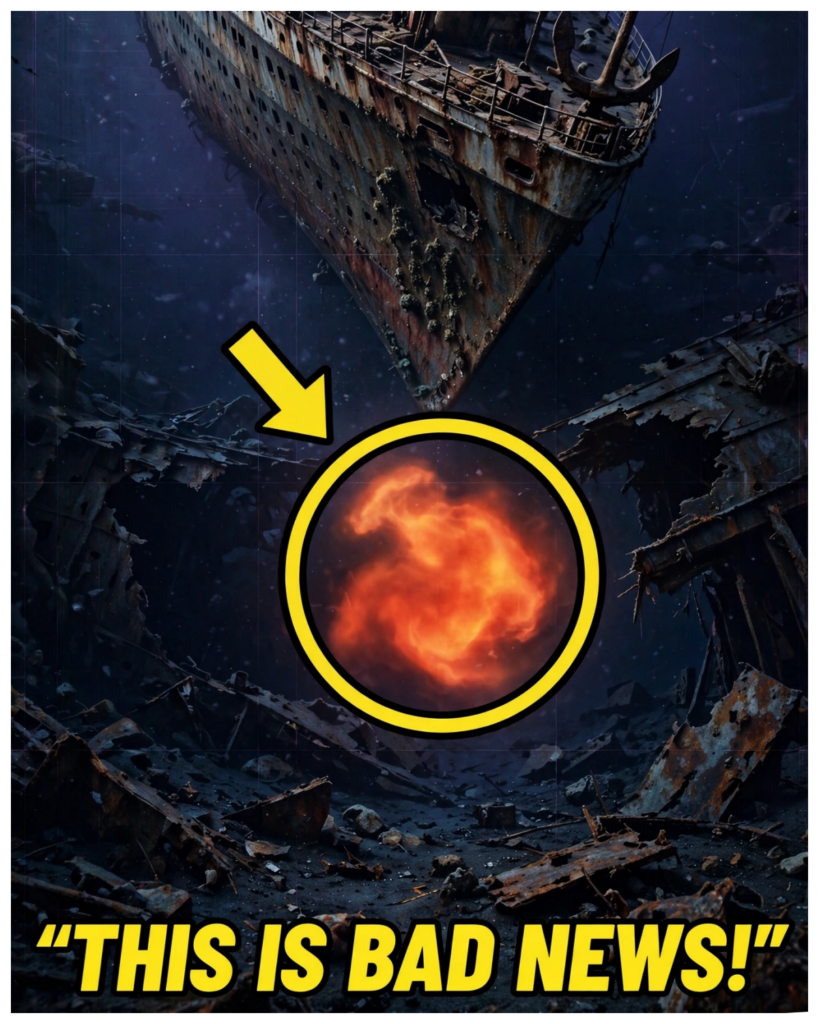
12,500 ft down in the North Atlantic, there is a staircase with no stairs.
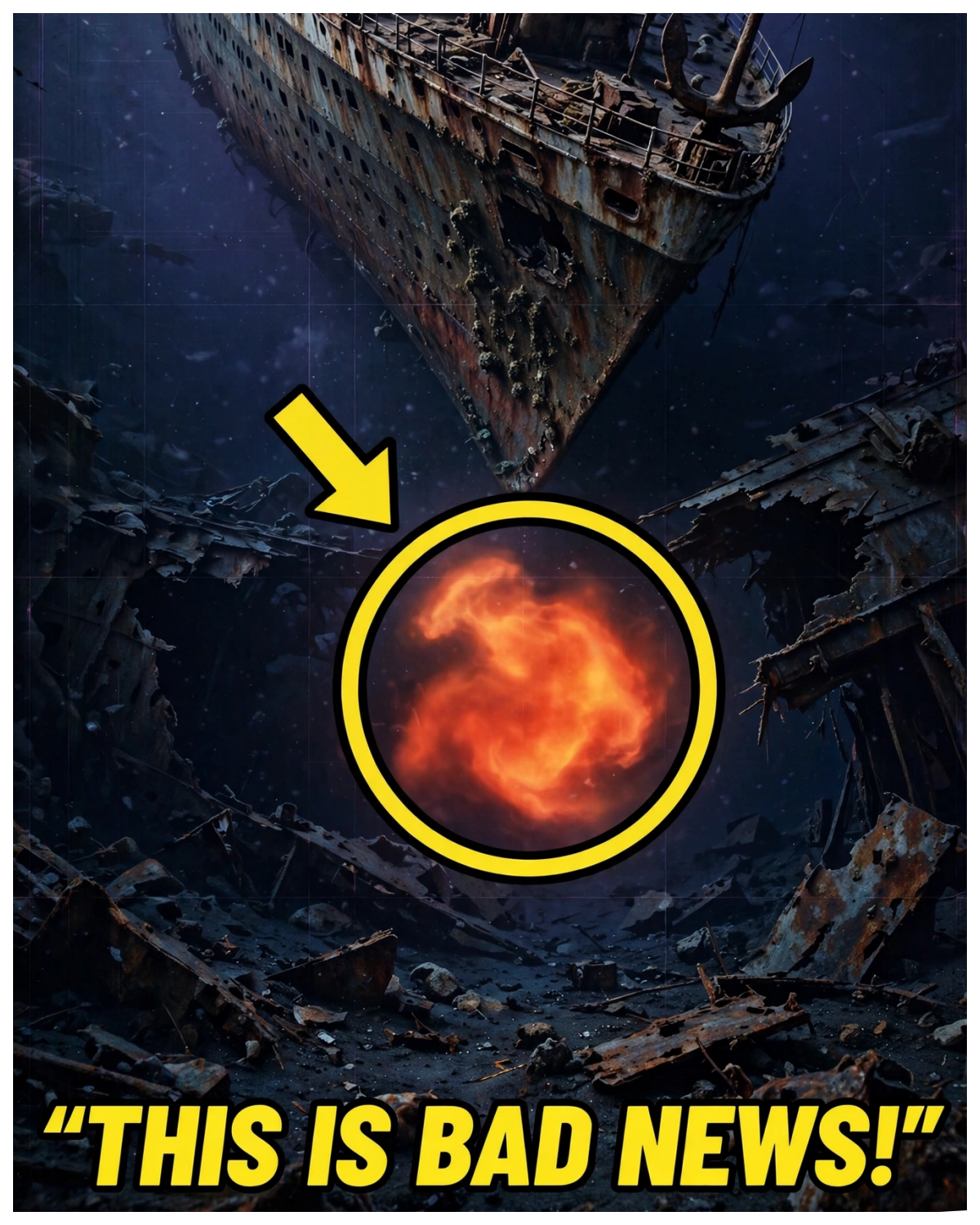
They told us the Titanic was a wreck.
Rust, mud, a shape in the dark.
But a wreck is something you look at from the outside.
And for most of the last century, that is all anyone could do.
Then somebody built a robot small enough to fit through a doorway, hung it on a thread of glass fiber, and flew it down that staircase into the rooms where 1,500 people spent their last night alive.
The cameras came back with a light fixture still hanging from its wires, a bowler hat in its closet, a glass of water half full, standing on a wash stand exactly where somebody set it down before going up to see what the noise was about.
And the most frightening thing those cameras found was not a body.
In more than a hundred dives inside and around this ship, nobody has ever filmed one.
What they filmed instead, over and over in the mud and in the corridors, is pairs of shoes lying together, toes pointing the same way.
Hold on to that because by the end of this, you will understand why those shoes are harder to look at than anything a horror writer could invent.
Welcome to Vestage Discovery.
I want to show you exactly what those robots saw deck by deck.
Why the people who have spent the most time inside this ship still argue about what is down there and why the quietest thing they found is the one that will stay with you.
Forget the version with the sealed doors.
The real one is stranger and worse.
Start with the place because the place is the whole problem.
The Titanic lies 3 km and 800 m below the surface, about 600 km off Newfoundland.
Sunlight gives up a few hundred meters down.
At the wreck, the water sits one degree above freezing, and the pressure is roughly 380 times what you are feeling right now.
Nearly 6,000 lb on every square inch of your body from every direction at once.
No diver can go there.
A man’s submersible can, but a submersible is the size of a small van, and it takes 2 and 1/2 hours just to fall that far.
So, from 1985, when Robert Ballard’s cameras found the bow, humans could circle the ship, but not enter it.
The Titanic was a locked house, and we were standing in the garden.
The way in was always the same hole.
On the boat deck, between the first and second funnels, there used to be a glass dome over the grand staircase.
The dome is gone.
What is left is an opening about 40 ft across, like a well dropped into the top of the ship.
Whatever was going to go inside the Titanic was going to go down that well.
The first thing to go down the well was about the size of a lawn mower, and it was called Jason Jr.
In the summer of 1986, Ballard came back with the submersible Alvin and a small robot built at Woods Hole as an experiment in deep sea fiber optics.
Jason Junior rode down strapped to the front of Alvin where the sample basket used to be tethered by about 60 m of cable and a pilot named Martin Bowen flew it from inside the sub with a hand controller watching a screen the size of a paperback.
They parked Alvin on the boat deck beside the opening and Bowen eased the robot over the edge and down into the dark.
What he found was that the staircase itself no longer existed.
The oak that first class passengers had walked down to dinner had been eaten.
Not rotted, eaten by wood boring creatures that settle on anything wooden on the deep sea floor and take it apart fiber by fiber.
The brass fittings, the iron supports, the shape of the landings were all still there.
The stairs were gone.
Jason Junior descended through the space where they had been, deck by deck, and the rust it stirred from the walls closed the visibility down to almost nothing.
Then, in one of the firstass rooms off the staircase, the camera found something hanging in the water.
A crystal light fixture still attached to the ceiling by its own wiring with a small deep sea coral growing out of it like a plant in a pot.
That photograph went around the world.
It was the first proof that the inside of the Titanic was still in some sense furnished.
Jason Jr.
Saw other things on that trip.
Through a window on the boat deck, a pommel horse which told the team they were looking into the gymnasium.
On a wall near the senior officer’s quarters, a small plaque still legible after 74 years.
Authorized personnel only.
I mention the sign because of what it tells you about the whole story.
The Titanic did not simply sink.
It kept its signs, its doors, its rules.
The ship is still telling you where you are allowed to go.
And for the next 15 years, the answer for anything bigger than a lawn mower was not very far.
To go deeper, you needed something smaller, braver, and attached to a much longer thread.
The robots that finally went deep into the Titanic were named after the Blues Brothers.
Jake and Lwood were built for James Cameron’s expedition of 2001, designed by his brother Mike.
They were small enough to ride on the outside of a Russian mere submersible, and each paid out a thin fiber optic line as it went, hundreds of meters of it, so that the picture traveled from the camera in the ship to the pilot in the sub through a strand of glass.
Their lamps had to be dimmed and angled because the first rule inside this wreck is that light is the enemy.
Too much of it pointed the wrong way and the silt that coats every surface rises into the beam like smoke and you are blind for an hour.
Over three expeditions, Cameron made 33 dives, averaging 14 hours each.
By 2005, the robots had filmed about 65% of the interior spaces that still exist.
What they brought back is the footage people mean when they say the Titanic is terrifying.
The Turkish bath.
Picture what you expect, a crushed black cave.
What the camera shows is blue and green ceramic tiles framed in teik.
The teak lounge chairs upturned but whole and a dome overhead still carrying its gold leaf.
It looks less like a wreck than like a spa that closed for the night and never reopened.
The firstass stateaterooms with their brass beds standing where the carpenters bolted them, the mattresses long gone, the frames gleaming when the light hits.
In the cabin of Henry Harper, a passenger who survived the sinking, his bowler hat is still on the shelf of his closet.
In the cabin of Edith Russell on a deck, the mirror in her wash stand still gives back the robot’s light.
On another wash stand sits a glass decanter beside a drinking glass, and the glass appears to be half full.
Somebody poured a drink and went up on deck, and the drink is still there.
In the suite of Isidor and Ida Strauss, the couple who refused to be separated and went into the water together, a gilded clock still sits on the mahogany mantelpiece.
The reception rooms keep their tall leaded windows and their carved panels, some with the original white paint.
Chandeliers hang.
Hallways run off into the dark with their doors open.
And then there is the Maronei room, the wireless cabin where Jack Phillips and Harold Bride sat and tapped out the distress call.
The equipment is still there.
The knife switches on the panel are still in the positions the two men left them in because they stayed at that panel until the water came through the door.
Philillips died that night.
Bride survived.
The Carpathia heard them, and the 712 people it picked up at dawn owed their lives in a direct line to those switches.
You can film a hat in a closet and feel the hair rise on your arms.
But the ship was keeping something quieter than any of that.
And it was not inside the rooms.
It was outside in the mud.
There are no bones at the Titanic.
Not one has ever been found.
That sounds impossible.
So, here is the arithmetic.
More than 1,500 people died in the water in the early hours of April 15th, 1912.
In the weeks afterward, ships sent out from Halifax recovered fewer than 340 bodies.
The rest, well over a thousand people, went down with the ship or drifted away from it.
And that is the last anyone saw of them.
So when the robots started going inside, everybody waited for the moment.
Nearly 40 years of dives, thousands of hours of video, and the moment never came.
Cameron has said it plainly.
In 33 dives, he has seen zero human remains.
What he has seen, what every expedition has seen is this.
Pairs of shoes lying together in the silt on the seafloor around the ship and in the debris field between the two halves.
The way shoes lie when somebody is wearing them.
A pair of boots, heels together, toes apart.
A woman’s shoe beside another woman’s shoe.
In one of the most quoted photographs from the site taken in 2004, there is a coat laid out in the mud with a pair of boots at the bottom of it.
And the coat and the boots are arranged in a shape you recognize before you want to.
Here is the chemistry because the chemistry is the horror.
The deep North Atlantic is starved of calcium.
And the explanation Ballard and others have given is that over the decades it drew the calcium out of the bones until there was nothing left to find.
The flesh went to the animals.
What survived was anything tanned, leather, and above all shoe leather because the tanning chemicals poisoned the creatures that would otherwise eat it.
So the shoes stayed.
Each pair marks the exact place where a person came to rest, lay down, and disappeared.
Ballard understood this on his second expedition and took nothing from the site.
And the serious expeditions since have kept to his rule.
You do not touch the shoes and you do not take anything from where they lie.
Those are graves.
The headstone is a boot.
When that 2004 photograph was first published, it was cropped.
Later, the American government’s ocean agency released the whole image, and its chief maritime archaeologist, James Delgado, looked at the coat and the boots and said, “There are people inside.”
Not as a figure of speech.
He meant that in the mud under that coat, something of a person may still be present.
Cameron, who has looked longer and closer than anyone alive, says, “No, clothing and shoes, nothing more.”
So the people who know this wreck best disagree about whether the dead are still there in any physical sense.
That is the honest state of the science.
It is also why there is no secret chamber footage of bodies in this story and why you should distrust any video that says there is.
If the Titanic had given up a skeleton, you would know because it would be the most argued over image of the century.
But there is one child from this ship whose body was found, and his story tells you everything the shoes cannot.
On April 21st, 1912, a cable ship called the Mai Bennett pulled a small boy out of the Atlantic, and nobody on board could say who he was.
He was fair-haired, about 2 years old, in a gray coat with fur at the collar and a pair of brown leather shoes.
His was the fourth body the crew recovered.
They took him back to Halifax and because no one claimed him, the sailors of the Mai Bennett paid for his funeral and his headstone themselves.
They buried him in Fairview Lawn Cemetery under three words, the unknown child.
For nearly a century, that was that.
Then in 2001, researchers opened the grave and recovered enough to attempt a genetic identification.
The first answer announced in 2002 was wrong.
A 13-month-old Finnish boy named Ano Panola.
It took another five years and a far deeper reading of the genetic code to correct it.
The child in the grave was Sydney Leslie Goodwin, 19 months old from Milksham in Wiltshire, England.
His shoes helped settle it.
A Halifax police sergeant had kept them in his desk for decades rather than see them burned with the other unclaimed clothing, and they were too large for a 13-month-old.
Sydney was traveling in third class with his parents, Frederick and Augusta and his five older brothers and sisters.
The family was moving to Niagara Falls where Frederick had a job waiting at a power station.
All eight of them died.
Sydney’s was the only body recovered.
Now go back to the seafloor to the pairs of shoes in the mud.
You have one name for one pair.
Multiply it by a thousand.
Every pair down there is a Sydney or a Frederick or an Augusta who was never pulled out of the water, never given a stone, never found by anyone until a robot’s light passed over them for 3 seconds in 1986 or 2004 or 2024 and moved on.
That is what the footage is.
It is not terrifying because something jumps out of the dark.
It is terrifying because nothing does.
If this is the kind of history you want more of, the kind that is still down there in the cold with its laces tied, subscribe before you forget, because it is exactly what this channel goes looking for.
The wreck has also been a witness, and it has already overturned a verdict.
In 1912, the British inquiry into the sinking concluded that the ship went down in one piece.
Survivors, including a 17-year-old named Jack Theer, who watched from the water, said it broke in two.
The inquiry preferred the officers.
The survivors were told politely that they had been mistaken.
Then Ballard found the bow and the stern 600 m apart, and that was the end of that argument.
But the robots and the mapping surveys since, especially the full sonar map of the site made in 2010 and the photographic scan of 2022, have told the second half of the story, the half nobody expected.
The bow is in remarkable shape.
It flooded completely before it went under.
So it fell through 2 and 1/2 miles of water as a sealed water-filled shape, glided down and drove itself into the mud up to the anchors.
That is why the Turkish bath still has its tiles.
The stern is another matter.
The stern went down with air still trapped inside it.
And as the pressure climbed, that air was crushed and the decks folded down onto each other like a stack of plates.
The stern did not sink.
It imploded.
And the kitchens, the secondass cabins, and the thirdass births at the back of the ship were pressed into a few meters of steel.
Nobody will ever fly a robot through them.
There is nothing to fly through.
So, when a video promises you furniture piled against a bulkhead by a surge of water or a line of shoes pointing toward a doorway, be careful.
The real pattern is crudder and more final than that.
One half of the ship kept its rooms.
The other half lost them entirely.
The debris field between the halves is where the small things are because the small things fell out when the ship tore open.
Stacks of plates that landed in order and are still stacked because the wooden cabinet around them rotted away and left the china standing.
Champagne bottles, dozens of them, some still cked and upright in the mud.
Leather bags with their clasps closed, which when they were brought up in the late 1980s and 1990s, turned out to have papers inside that could still be read.
And a safe, a real one, the assistant purses safe, lifted by a French expedition in 1987 and opened in front of television cameras in Paris with the actor Telly Sealis as host and an audience waiting to see jewels.
Inside was a leather satchel, banknotes, coins, a bracelet with the name Amy on it in diamonds, a watch.
The broadcast was called tasteless at the time and has been called worse since.
It is also the moment the modern argument about this wreck began because the robots did something nobody planned for.
They made the Titanic reachable.
And the moment a grave is reachable, someone will ask what we are allowed to take from it.
More than 5,000 objects have been lifted from the Titanic and not one of them has come from inside the hole.
That is the line the law drew and it is worth understanding.
One company holds the salvage rights and over the years its expeditions have recovered roughly 5,500 artifacts from the debris field.
Plates, jewelry, clothing, a 15-tonon piece of the hull itself.
The hull, the rooms, the places where the shoes lie have stayed off limits by a mix of law, treaty, and a kind of unwritten agreement among the people who go down there.
In 2012, when the wreck turned 100, it came under the protection of the United Nations Convention on Underwater Heritage.
In 2019, an agreement between Britain and the United States came into force to control who may enter it.
That agreement was tested almost at once.
In 2020, the salvage company won permission from an American court to cut into the roof of the Maronei room and lift out the wireless set, the one with the switches still in position.
The American government fought it on the grounds that the hull is a grave site and that opening it would disturb whatever is left of the people inside.
The plan was postponed by the pandemic.
Then in June of 2023, a privately built submersible carrying five people down to the wreck imploded on the way, killing everyone aboard, including a Frenchman named Paul Naru, who had dived to the Titanic more than 30 times.
After that, nobody was in a hurry to cut anything open.
Here is the pressure on the other side of the argument.
The Titanic is dissolving.
Iron eatating bacteria discovered on the wreck and named after it are turning the hull into the rust icicles you see hanging from every rail.
In 2019, a dive found that the officer’s quarters had collapsed and the captain’s bathtub, one of the most photographed objects on the ship, had vanished from view.
In the summer of 2024, the first expedition to the site in 14 years, came back with 2 million images.
And with the news that a section of the railing on the bow, the railing from the famous photographs, the railing from the film, had fallen off into the mud.
It was standing in 2022.
Now it is not.
Estimates for how long the ship has left run from a few decades to not many more, and every expert agrees on the direction.
So the people who want to document everything now are not being morbid.
They are being realistic.
And the people who want the ship left alone are not being sentimental.
They are standing in a cemetery.
Both of them are right and the Titanic does not care because it is leaving either way.
Now, about the title of this video, the footage is terrifying.
I said I would tell you why, and the reason has nothing to do with sealed doors.
The Titanic is terrifying because it is ordinary.
That is what the robots found.
And it is the thing to carry away from all of it.
Not a monster, not a mystery with a locked door, a glass of water on a washand, a hat on a shelf, a clock on a mantelpiece that stopped at some moment in the early hours of April 15th and has not been wound since.
The dead on this ship were not characters.
They were people who had put their shoes on that morning.
The ship kept their shoes.
And here is the limit of all of it.
About a third of the interior has never been filmed, and much of it never will be because it is buried in the mud under the bow or crushed flat in the stern.
The thirdass cabins where families like the Goodwin slept are somewhere in that darkness.
No robot will ever reach them.
The sealed rooms are real.
They are just sealed by the ship itself, not by anyone’s decision.
And that, if you think about it, is a more honest kind of sealed.
So, we are left with the questions the debris field keeps asking.
Who decides what may be taken from a grave with no fence around it in water that belongs to no country?
Is a photograph of a coat and a pair of boots a scientific record or an intrusion?
When the last rust icle falls and the hull is a stain on the sea floor, will the 5,000 objects in museums be the Titanic?
Or will the shoes which nobody is allowed to lift and which will be the last things to go?
There is no clean answer and you should distrust anyone who offers one.
What I can tell you is that the ship has been remarkably honest with us.
It gave up its secrets in the order we were ready for them.
First the bow, then the staircase, then the runes, then the shoes.
And it has kept back exactly one thing, which is the people.
And perhaps that is the ship’s decision to make.
The robots are not finished.
Smaller ones are coming.
Better cameras and models of the wreck so complete you will be able to walk through them from your kitchen.
They will show us more rooms.
They will not show us a body.
And if you have followed this far, you understand that is not a disappointment.
It is the point.
If you want to be in the room the next time something comes back up out of the dark, subscribe and tell me in the comments which image from this ship stays with you.
For me, it has always been the glass.
Somebody poured that water and then they went up to see what the noise was.