We have a unique uh gold bell that we find in the excavation.
The Lord roars from Zion.
He utters his voice from Jerusalem.
[music] [bell] Sea levels and prolonged drought.
The [music] Middle East is warming almost.
Beneath Jerusalem streets, ancient stones are bringing a forgotten world into view.
A pilgrimage road traces the ascent from Siloam toward the Temple Mount, helping us picture the journey to worship.
Nearby, a tiny golden bell still rings after roughly 2,000 years, inviting comparison with the priestly garments described in Exodus.
A silver shekele carries the story into the final years of the second temple, preserving ancient Hebrew lettering and the image of a chalice.
From footsteps to sound to symbols, these discoveries offer different glimpses of the same ancient city.
What do they reveal about the Jerusalem described in scripture?
Subscribe as we explore their stories and biblical connections.
Share your thoughts in the comments and let us know what stands out to you.
Beneath Jerusalem streets, ancient stone steps are revealing a journey once made by people seeking God.
The road climbs from Siloam toward the Temple Mount, tracing the route pilgrims followed during the second temple period.
Above it, the modern city continues its daily life.
Below, the excavated stones bring an older Jerusalem into view [music] where the approach to worship began long before reaching the temple gates.
The journey started in the area of Siloam.
Pilgrims bathed for ritual purification before ascending toward the temple.
The surviving steps give that preparation a physical setting, a descent toward water followed by a climb toward the place of worship.
For Christians reflecting on this ancient practice, the sequence offers a reminder to approach God with attention and reverence.
The historical custom and our spiritual reflection are distinct, but the connection invites us to examine our hearts.
Siloam carries another connection for readers of the Gospel of John.
In chapter 9, Jesus sends a man born blind to wash there and the man returns able to see.
Yet the precise location deserves care.
Archaeologists [snorts] distinguish the large excavated reservoir from a possible pool near the tunnel outlet within the same complex.
That detail gives us a clearer understanding of the landscape while keeping an unresolved question open.
From there, the road rises northward.
Its incline makes the biblical language of going up to Jerusalem easier to understand.
The ascent [music] demanded effort.
Worshippers moved through the city toward a destination that held deep [music] religious meaning.
Following the stones today helps us picture that movement connecting the preparations at Siloam with the final approach to the temple.
Along the route, coins, weights, and pottery fragments reveal the practical life surrounding the pilgrimage.
Shops served people obtaining supplies associated with offerings.
Goods were measured, purchases were made, and commerce continued beside the movement of worshippers.
These small discoveries give the street its human dimension.
The road shows where people traveled.
The objects help explain what happened along the way.
Farther uphill, a raised stone feature offers another glimpse of public life.
It [snorts] has been interpreted as a possible place where speakers could address people in the street.
Its setting naturally brings Jesus to mind, but the evidence does not establish that he preached there.
We can explore the world surrounding his ministry without claiming to identify his exact footsteps.
Near the southwestern corner of the temple mount, pilgrims continued toward the southern steps and entrances.
[music] Ritual baths nearby offered another opportunity for purification.
Here Psalm 122:12 gives the ascent emotional depth, expressing joy at going to the house of the Lord and standing within Jerusalem’s gates.
The passage and the landscape help us understand each other more clearly.
Together, they bring preparation, movement, and devotion into focus.
For believers, the road invites reflection on seeking God with purpose.
Beneath the pilgrimage road near the Temple Mount, archaeologists uncovered a small golden bell in an ancient drainage channel.
After roughly 2,000 years underground, it can still ring.
The discovery takes our exploration beyond the stones pilgrims climbed and toward the garments worn in the world of temple worship.
For archaeologist Eli Shukrron, who discovered the bell, that connection is especially powerful.
He identifies it as a bell from the robe of the high priest [music] and believes it once stood within the temple itself.
His interpretation gives this small object extraordinary significance.
Something associated with sacred service may have survived beneath the very landscape where that service took place.
Shukran recalled that he did not immediately recognize the object when it was found.
He held it, examined it, and then heard a sound.
That sound revealed its function.
The discovery was more than a piece of gold recovered from the earth.
It was a bell whose ability to ring had endured, allowing people today to hear an object made in ancient Jerusalem.
The biblical connection comes from Exodus 28-335.
The passage describes golden bells alternating with pomegranates made from colored yarn around the hem of Aaron’s robe.
Their sound would be heard when he entered the holy place to minister [music] and when he came out.
Within this description, the bells belonged to clothing prepared for the responsibilities of priestly service.
This is the passage Shukrron turned to when considering the find.
He connects the bell with the high priest moving along the pilgrimage road near the temple.
In his understanding, the object offers a material link to that priestly presence.
Yet the circumstances of its loss remain unknown.
The excavation does not reveal when it became detached or how it entered the drainage channel.
Another representative of the Israel Antiquities Authority, Rebecca, [music] expresses the identification more cautiously.
She acknowledges that the bell may have belonged to the high priest while also allowing that it could have adorned the clothing of a wealthy person.
There is no identifying inscription naming its owner.
Shukran’s conviction and Rebecca’s caution therefore need to remain distinct within the story.
That uncertainty does not erase the discovery’s importance.
It tells us how to understand it responsibly.
The bell is a surviving artifact.
[music] Its connection to the high priest is an interpretation supported by comparison with scripture and its archaeological setting.
We can explore that connection closely without presenting ownership as something all the specialists have established.
The clothing described in Exodus also deserves careful attention.
It should not automatically be treated as the outfit worn inside the holy of holies on Yamapour.
Since Leviticus 16:4 specifies linen garments for that ritual, keeping these descriptions clear helps us understand priestly service rather than combining different ceremonies into one imagined scene.
For believers, the bell invites reflection on the reverence surrounding worship.
Scripture gives careful attention to the garments and conduct of those entrusted with service.
Hearing this ancient object makes that distant world feel closer even while its owner remains unidentified.
The sound survives.
The complete story does not.
The pilgrimage road shows how people approached the temple.
The golden bell invites us to consider the garments associated with worship.
Now a silver shekele discovered during excavations in Jerusalem brings another part of that world into focus.
The money people carried and the responsibilities woven into their religious life.
On its surface are ancient Hebrew letters and the image of a chalice.
Small as it is, the coin preserves details that survived long after the world around it changed.
Its lettering helps researchers investigate its origin and historical setting.
Its imagery offers another clue to the identity and values of the community that produced it.
The shekele is associated with the period of the Jewish war against Rome before the destruction of the second temple.
Although its exact year remains unconfirmed, this connection places it against a powerful historical backdrop.
Jerusalem faced conflict and uncertainty.
While its people continued to live within a city shaped by the temple, that [snorts] setting gives the silver a significance beyond its monetary value.
A coin belongs to everyday life, [music] passing through transactions and carrying symbols that people recognize.
Here, the surviving letters and chalice bring us closer to an ancient society whose commerce, religious devotion, and public identity existed side by side.
The chalice especially draws our attention.
Vessels appear throughout biblical [music] descriptions of worship, making the image compelling in Jerusalem’s setting.
Its precise symbolism requires further evidence.
However, the design alone cannot establish that this particular coin was used in a temple ceremony.
Its broader connection with worship leads us to Exodus 30 to 13:16.
God instructs those counted in the census to contribute half a shekele for the service of the tabernacle.
[music] Rich and poor were to give the same amount.
Each person shared in a responsibility that supported the community’s sacred service.
In that passage, the shekele refers to a unit of weight rather than a minted coin like the excavated artifact.
The instruction belongs to an earlier period, but it introduces a theme that remains meaningful.
Material resources could be dedicated to the service of God.
Matthew 17 24:27 brings this subject into the ministry of Jesus.
Collectors ask Peter whether his teacher pays the temple tax.
Jesus then directs Peter to retrieve a coin from the mouth of a fish and use it to pay for them both.
Money becomes part of a conversation about belonging, freedom, and fulfilling an obligation.
The discovered shekele has no established connection to that specific payment.
Still, the gospel account helps us understand why money belongs in this exploration.
Worship took place within a world of practical needs, contributions, and daily decisions.
For us, these passages invite reflection on how we use what we possess.
Giving can express responsibility, generosity, and care.
Devotion becomes visible through choices that reach beyond words.
Together, the road, the bell, and the shekele reveal three dimensions of Jerusalem’s past.
The approach to worship, a possible connection to priestly clothing, and the material life surrounding the temple.
Each discovery adds something distinct.
Through them, we can picture more clearly the historical world described in scripture and consider how faith shaped ordinary life just as it continues to shape ours today.
Jerusalem’s story continues beneath an unsettled sky.
The city that draws our eyes toward ancient stones also reminds us how quickly daily life can change.
Jerusalem’s ancient stones hold the heat as the air grows heavy over the city.
Temperatures climb into the upper 30s while the Jordan Valley faces even harsher conditions.
Then the sky darkens.
Strong winds interrupt the oppressive stillness and thunder rolls across the landscape.
The shift from intense heat to stormy weather brings a different kind of pressure, reminding us how quickly familiar surroundings can change.
Farther south, Beersa faces another concern.
Polluted air.
Alongside the heat, poor air quality raises questions about public health, especially for people already vulnerable to breathing difficulties.
These conditions deserve attention because their effects reach beyond dramatic skies into ordinary homes and daily routines.
What is driving this sequence?
Heat, changing air masses, [music] and airborne particles are factors worth investigating.
But measurements and dated weather reports are needed to explain the events accurately.
A striking scene alone cannot establish its cause.
For Christians, such uncertainty invites reflection on Matthew 24.
Jesus spoke about troubled times while teaching his followers to resist deception and remain watchful.
His words direct us toward steady faith, prayer, and care for others when circumstances feel unstable.
We can take changing weather seriously while keeping our spiritual conclusions measured.
Our response begins with protecting those at risk, seeking reliable information, and examining our own hearts.
When the air becomes difficult to breathe and the horizon darkens, faith calls us to act with compassion.
Hold firmly to Christ and remember that hope does not depend on the weather staying calm around us.
After the changing weather over Jerusalem, a smaller detail draws our attention.
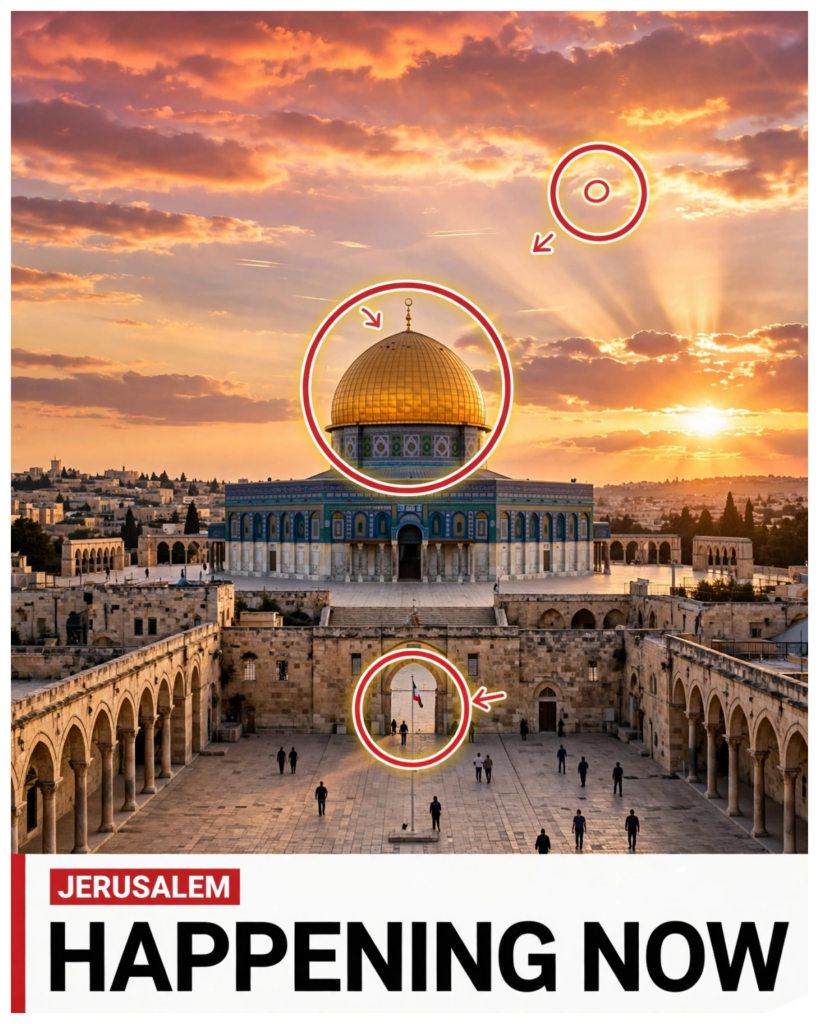
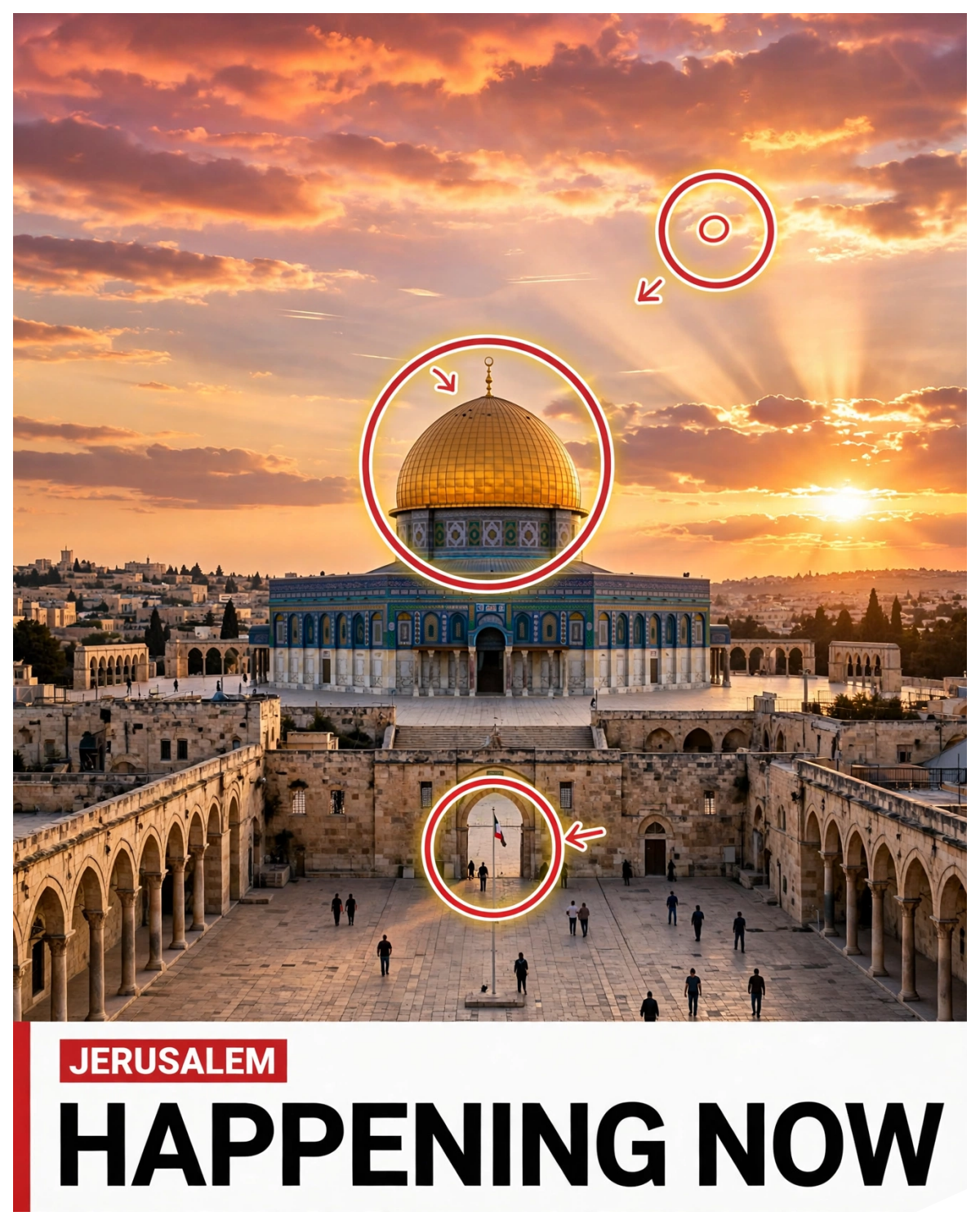
A point of light reported near the Mount of Olives.
In the footage described, it appears near the summit, shifts position, and disappears into the darkness.
Then it becomes visible elsewhere in the frame.
The movement invites curiosity, [music] but the recording leaves its source unresolved.
What exactly are we seeing above this hillside?
The question becomes more compelling because of the location.
The Mount of Olives belongs to the biblical account of Jesus’s ascension, a place Christians associate with farewell and the promise of reunion.
That history gives the scene emotional meaning before we know what produced the light.
Understanding the image requires examining the original recording.
Camera movement, an aerial device, or visual effects could influence its appearance.
These remain possibilities to investigate.
The point of light itself is insufficient evidence of anything.
Acts 1 offers a deeper reason to consider this hillside.
As the disciples watch Jesus ascend, they receive the promise that he will return.
They then leave the Mount of Olives, return to Jerusalem, and gather in prayer.
Their expectation continues within a shared life with responsibilities still before them.
This gives our reflection a different focus.
How hope shapes the time between a promise and its fulfillment.
For us, waiting for Christ can give greater purpose to the present.
There are relationships to mend, commitments to honor, and people to love.
The promise of his return invites us to consider the lives we are building today.
The light remains unexplained.
Yet, the biblical story associated with this place leaves a [music] lasting thought.
Hope reaches toward the future while giving meaning to what we do now in the ordinary days entrusted to us.
The light near the Mount of Olives leaves us wondering what appeared in the night.
Another account [music] takes us into Jerusalem’s morning where a bird reportedly set a church bell ringing.
A vulture is described perched beside the bell rope.
It pulls the rope several times, sending the sound across the awakening streets.
The scene catches our attention because a bell, usually rung by human hands, is being moved by an unexpected visitor.
The bird may have been curious about the rope or reacting to its movement.
The recording and location need confirmation and the behavior alone does not show a spiritual purpose.
The sound nevertheless brings Joel 2:1 to mind.
The passage calls for a trumpet to be blown in Zion and an alarm sounded on God’s holy mountain.
It urges the people to pay attention to the seriousness of the day of the Lord.
This incident does not prove that Joel’s prophecy is being fulfilled.
It offers a simple connection for reflection.
A sound interrupts ordinary life [music] and makes us pause.
Later in the chapter, God calls the people to return to him with their whole hearts.
That invitation turns our attention inward.
We may hear scripture often yet give little thought to whether our actions reflect its teaching.
Are we making time to examine our lives before God?
An honest response can begin with admitting a wrong, asking forgiveness, or addressing something we have neglected.
The meaning of this reflection lies in that response.
A bell sounds for a moment.
The decision to return to God can shape what we do afterward.
After the sound of the church bell, our attention returns to Saloam, where images presented as showing red water raise a different question.
The reddish appearance is striking at a place associated with biblical history.
Before describing it as a confirmed event, however, the location, recording date, and actual color need verification.
If the water has changed, testing is needed [music] to identify the cause.
Algae, minerals, sediment, or contamination are possibilities to investigate.
For readers of scripture, red water may bring revelation to mind.
The passages describe different visions.
In Revelation 8 to8:9, during the trumpet judgments, a third of the sea becomes blood, and a third of its living creatures die.
In Revelation 16:3, [music] 4, the second and third bowls turn the sea, rivers, and springs into blood.
Every living creature in the sea dies.
These descriptions go far beyond water, appearing red in an image.
The resemblance in color cannot establish that the water is blood or that these judgments are being fulfilled at Siloam.
The connection therefore belongs to biblical reflection.
Revelation presents judgment as serious and consequential.
Its imagery invites us to consider our accountability before God.
While the cause of the waters appearance remains a separate question.
From the reddish water at Sylum, our exploration moves toward the Dead Sea, where another described scene combines white plumes with an orange glow.
In the account provided, white smoke rises from crevices near the shore.
Beneath it, an orange substance appears to flow down the rocks, resembling molten material.
Where it reaches the water, foam and white vapor are described.
The contrast between the pale plumes and glowing flow gives the scene its unusual appearance.
Yet appearance cannot identify the substance.
Its composition, temperature, and source remain unknown.
The location and original recording also need verification before this is presented as a confirmed event.
Calling it lava, a chemical reaction, or a supernatural occurrence would go beyond the available information.
The image of rising smoke brings Genesis 19 to mind.
After the destruction of Sodom and Gomorrah, Abraham looks toward the region and sees smoke rising like smoke from a furnace.
The resemblance offers a visual connection to the passage.
It does not establish that this scene comes from those ancient cities or represents another divine judgment.
For reflection, an important detail appears earlier in the chapter.
Genesis 19:16 describes the Lord showing mercy to Lot as he [music] hesitates with the messengers taking him and his family by the hand and leading them out.
That detail gives this section a distinct focus.
Mercy reaches someone who is slow to respond.
The story invites us to consider the changes we know we need to make but continue postponing.
Repentance can begin with accepting correction and taking a necessary step toward change.
The strange material still requires investigation.
The biblical reflection rests on the passage itself where the seriousness of judgment stands alongside an act of mercy toward people who hesitate when urged to leave danger behind.
The orange glow near the Dead Sea leaves questions about an unidentified [music] substance.
Near Jerusalem, the next described scene brings us to a more immediate danger.
Flames twisting upward from an active fire.
Columns of fire rise and rotate above burning ground.
Embers and burning fragments turn within the swirling air, giving the flames a fierce shifting shape.
Their appearance draws attention, but the danger extends beyond the visible columns.
As winds change direction, smoke, ash, and heat can move into surrounding areas.
A position that appears clear may become difficult to escape.
Watching from a distance offers only a limited view of conditions on the ground where visibility and access can change quickly.
The description resembles a fire world.
Though identifying the particular event requires verified footage and its location.
Whatever the classification, the focus belongs on the people exposed to the fire and those working to contain it.
This scene invites reflection through Galatians 6:2, which calls believers to carry one another’s burdens.
Here, the biblical connection concerns our response to suffering.
A dangerous fire can place needs before a community, safety, shelter, supplies, and support for those whose lives have been disrupted.
Prayer gives us a way to bring those people before God.
Carrying their burdens also asks us to consider what help we can responsibly provide.
That may mean supporting trusted relief efforts, offering assistance requested by affected neighbors, or sharing confirmed information rather than alarming rumors.
The flames remind us how quickly ordinary security can be disturbed.
Galatians directs that awareness toward shared responsibility.
For anyone able to help, compassion becomes meaningful through actions suited to the need.
We do not have to understand every movement of the fire to recognize that people facing danger deserve care, dignity, [music] and support throughout the difficult days ahead.
After the swirling fire outside Jerusalem, our attention moves inside damaged churches where reports describe crosses remaining relatively intact among burned furnishings.
Several churches are said to have caught fire within a short period.
The causes remain undetermined and the available information does not establish a connection between the incidents.
Woodwork, fabrics, and walls reportedly sustained damage while some crosses appeared to suffer comparatively little harm.
That contrast can be moving.
A familiar symbol of faith stands within a place whose appearance has changed dramatically.
Yet, its condition requires careful examination.
Materials respond differently to heat, and an object’s position, shielding, and duration of exposure can affect how much damage it sustains.
These factors must be considered before describing its survival as a miracle.
The image offers a thoughtful connection to 1 Corinthians 3:13.
Paul uses fire to describe the testing of each person’s work.
In the surrounding passage, he identifies Jesus Christ as the foundation and considers the quality of what people build upon it.
Paul is speaking about the work built on that foundation rather than explaining why an object survives a church fire.
His imagery gives our reflection a separate focus, the lasting value of what we do.
A life of faith takes shape through choices, commitments, and service.
Some efforts gain attention quickly.
Others happen quietly through honest work, consistent teaching, and commitments kept when recognition is absent.
The passage asks us to consider the quality of that work.
Are we building carefully upon Christ or allowing appearances to become our measure of success?
The surviving crosses remain physical objects whose condition needs explanation.
Scripture directs us towards something we can examine personally.
The foundation and substance of our work.
[music] Trials can reveal what we have built, inviting us to invest in what has enduring value.
Jerusalem is more than an ancient city preserved in stone.
Across the biblical story, it becomes a place where human ambition, divine promises, judgment, restoration, worship, suffering, and hope repeatedly meet.
Generations have walked its hills, rebuilt its walls, prayed within its boundaries, fought over its future, and looked toward it with expectation.
Yet the significance of Jerusalem cannot be understood merely through kings, battles, ruins, or archaeological remains.
Its deepest importance comes from the extraordinary role it plays throughout scripture.
From Abraham to David, from Solomon to the prophets, and eventually from the ministry of Jesus to the Christian hope of restoration, Jerusalem stands almost like a witness, watching the biblical narrative unfold.
Long before Jerusalem became Israel’s political and spiritual center, the landscape itself helped shape its destiny.
The ancient settlement developed among rugged hills, valleys, and natural defenses.
Water was essential to survival, and access to the Guihan Spring made the Eastern Ridge especially valuable to early inhabitants.
What eventually became one of history’s most famous cities began on a comparatively small piece of land.
Its humble beginning creates a striking contrast with the enormous religious significance Jerusalem would later acquire.
Great biblical stories often begin this way.
Something apparently small becomes the setting for events whose influence reaches far beyond its original boundaries.
One of the earliest biblical connections with the region appears in the story of Abraham.
After rescuing Lot, Abram encountered Melkisedc, king of Salem and priest of God most high.
The meeting is brief, yet its importance echoes far beyond Genesis.
Melkchisedc blessed Abram and Abram gave him a tenth of what he possessed.
Later biblical writers returned to this mysterious priest king [music] when discussing priesthood and divine purpose.
Whether every geographical question surrounding ancient Salem can be answered with certainty or not.
The biblical tradition establishes an early connection between the region and themes that would later define Jerusalem.
Kingship, worship, blessing, sacrifice, and faith.
[music] Abraham’s journey toward the region of Mariah deepens that connection.
Genesis [music] describes the extraordinary test in which Abraham was commanded to take Isaac to a mountain designated by God.
At the decisive moment, Isaac was spared and another sacrifice was provided.
Centuries afterward, the biblical narrative identifies Mount Mariah with the place where Solomon constructed the temple.
This creates a profound theological connection.
The location associated with Abraham’s obedience eventually became associated with Israel’s national worship.
Across different generations, the same landscape carried different chapters of one developing story.
Jerusalem did not immediately belong to Israel.
During the period following the conquest of Canaan, the city remained connected with the Jebusites [music] and was known as Jibus.
Its transformation came during the reign of David.
After becoming king, David captured the stronghold and established Jerusalem [music] as his capital.
This was not simply another military victory.
The decision reshaped the political and religious geography of Israel.
Jerusalem became known as the city of David and developed into the center of royal authority.
David then made a decision that gave the city even greater spiritual importance.
He brought the ark of the covenant to Jerusalem.
The ark represented the covenant relationship between God and Israel and carried memories stretching back to Moses and the wilderness.
Bringing it into Jerusalem connected the royal city with Israel’s worship.
Political authority and sacred memory now occupied the same center.
Jerusalem was no longer significant merely because a king lived there.
It increasingly became the place toward which Israel’s spiritual attention was directed.
Near the end of David’s reign, another important event prepared the way for what followed.
David acquired the threshing floor of Arana, the Jebusite, and built an altar there.
His son Solomon would later [music] construct the temple in Jerusalem, giving permanent architectural expression to a vision that had been developing during David’s reign.
The temple became one of the defining institutions of ancient Israel.
Sacrifice, prayer, festivals, priestly service, and national identity became deeply connected with this sanctuary.
Yet, the Bible does not present the temple as a magical guarantee that Jerusalem could never suffer.
This is essential to understanding the city’s story.
[music] Magnificent buildings did not replace obedience.
Religious ceremonies could not substitute for justice, faithfulness, humility, and genuine devotion.
The prophets repeatedly confronted the dangerous assumption that possessing sacred institutions automatically protected a society from the consequences of corruption.
Jerusalem was holy because of its relationship with God, not because stone walls possessed independent spiritual power.
Solomon’s Jerusalem nevertheless represented an extraordinary period of development.
The city expanded, defensive structures were strengthened, [music] royal buildings appeared, and the temple dominated its religious identity.
Pilgrims would eventually associate Jerusalem with worship and national celebration.
[music] Songs of ascent expressed the emotional experience of approaching the city.
Jerusalem became a destination, a symbol, and a shared spiritual [music] reference point.
After Solomon, however, political unity fractured, the kingdom divided, regional powers rose, and Jerusalem increasingly existed beneath the shadow of conflict.
Foreign armies threatened its security.
Kings [music] strengthened walls and towers while the population expanded into previously undeveloped areas.
The city’s physical growth reflected both prosperity and danger.
More people required additional defenses and geopolitical pressure forced rulers to think constantly about survival.
One of the most remarkable engineering responses to that vulnerability came during the reign of Hezekiah.
Jerusalem depended heavily upon water, and an enemy surrounding the city [music] could turn that dependence into a deadly weakness.
A tunnel was therefore cut through rock to redirect water from the Guhan spring toward a protected location within the city.
The achievement reveals something easily overlooked when [music] reading ancient history.
Biblical Jerusalem was not merely a stage for sermons and ceremonies.
It was [music] a functioning city whose inhabitants faced practical problems involving water, fortifications, food, warfare, construction, and survival.
The Assyrian threat during Hezekiah’s reign also produced one of Jerusalem’s most dramatic biblical episodes.
Assyria had become a terrifying imperial power, and its military expansion had devastated surrounding territories.
Jerusalem appeared vulnerable.
The biblical account emphasizes Hezekiah’s dependence upon God during this [music] crisis.
The story became another example of a recurring biblical theme.
Human security appears fragile, while faith is tested precisely when circumstances seem impossible.
But Jerusalem’s later history also demonstrates that deliverance in one generation does not eliminate accountability in another.
The prophets warned Judah repeatedly about idolatry, injustice, rebellion, and spiritual hypocrisy.
Their messages were often uncomfortable because [music] they challenged the belief that religious identity alone could protect the nation.
Eventually, Babylonian pressure intensified.
Jerusalem suffered successive blows before the catastrophe of 586 [music] BC when Babylonian forces destroyed the city and the temple.
The destruction must have been almost unimaginable to those whose religious identity was centered there.
Walls that represented security were [music] broken.
Buildings associated with kings disappeared.
The temple that had shaped generations of worship was burned.
Many people were displaced.
The crisis raised painful questions.
Had the promises failed?
Had Jerusalem lost its place forever?
How could worship continue when the sanctuary was gone?
Biblical faith responded not by denying the disaster, but by interpreting it through judgment, repentance, remembrance, and hope.
Lament became part of worship.
The loss of Jerusalem demonstrated that scripture was willing to confront national tragedy without pretending that faith prevented suffering.
At the same time, prophetic promises looked beyond destruction toward restoration.
Judgment was serious, but it was not presented as the final word.
When Persian power replaced Babylonian dominance, a new chapter opened.
Groups of exiles returned to Jerusalem and the process of rebuilding began.
Restoration did not happen instantly.
The returning community faced [music] damaged infrastructure, political opposition, economic difficulty, [music] and spiritual discouragement.
Yet, an altar was restored, worship resumed, and eventually the temple was rebuilt.
The restoration narratives reveal an important contrast with Solomon’s age.
Earlier, Jerusalem had been associated with royal wealth and national strength.
Postexilic Jerusalem began again amid weakness.
Its people had to rebuild while carrying memories of what had been lost.
Their experience demonstrates that biblical restoration does not always mean returning to the exact conditions of the past.
Sometimes restoration begins with limited resources, unfinished walls, and uncertain circumstances.
[music] Ezra became associated with spiritual renewal and renewed attention to God’s law.
Nehemiah later became central to the rebuilding of Jerusalem’s walls.
His story combines prayer with organization, leadership, vigilance, and practical work.
Opposition did not disappear simply because the project had religious significance.
The builders had to persevere through intimidation and resistance.
Jerusalem’s walls, therefore, came to represent more than masonry.
Their reconstruction became a sign that a scattered community was recovering identity and order.
Centuries passed and Jerusalem entered new political eras.
Henistic rulers competed for control of the region and cultural pressures created new conflicts over identity and worship.
Eventually, Roman authority reshaped the political environment.
Under Herod the Great, Jerusalem experienced extensive construction.
Herod enlarged and transformed the Temple Mount complex, creating a monumental setting that would have impressed [music] visitors approaching the city.
The Jerusalem encountered by Jesus was therefore a city layered with memory.
Abraham, David, Solomon, Hezekiah, prophets, [music] exiles, priests, foreign rulers, and rebuilding communities all belong to its past.
Every hill carried associations.
Every major sacred location existed within a history already centuries old.
When Jesus entered Jerusalem, he was entering not an empty religious backdrop, but the center of a story generations had inherited.
The Gospels place several significant moments of Jesus ministry within this environment.
At the pool of Bethesda, Jesus encountered a man who had suffered for many years and restored him.
The event focused attention not merely on physical healing, but on authority, compassion, and the meaning of Sabbath.
Elsewhere, Jesus sent a blind man to wash at the pool of Siloam.
Once again, an ordinary location within Jerusalem became the setting for a larger question about spiritual sight.
As the final week of Jesus’ earthly ministry approached, Jerusalem became the central stage of the gospel narrative.
Jesus traveled from the direction of the Mount of Olives and entered the city.
While crowds responded with celebration, the moment carried unmistakable expectations of kingship.
Yet the kind of kingdom Jesus proclaimed did not fit neatly within ordinary political ambitions.
His actions in the temple sharpened the confrontation.
Jesus challenged practices associated with commerce in the sacred precincts and taught openly.
The temple built as a place of worship became the setting for questions about authority, sincerity, judgment, and covenant faithfulness.
Once again, Jerusalem’s physical structures pointed beyond themselves.
A magnificent sanctuary could still become the location where the condition of the human heart was exposed.
The Mount of Olives also became closely connected with Jesus teaching about future events, vigilance, judgment, and faithfulness.
His words have inspired generations of Christians to think seriously about the future.
Yet those teachings repeatedly direct attention toward readiness [music] rather than sensational speculation.
The central challenge is not to transform every unusual event into proof that a prophetic timetable has reached its [music] final minute.
The challenge is to remain faithful, awake, discerning, and prepared.
During Passover, Jesus shared a final meal with his disciples.
The city was crowded with pilgrims.
Yet within that enormous religious gathering, a small group sat together around a table.
Bread and wine acquired profound significance as Jesus spoke about his body and blood.
What appeared to be a private meal became foundational to Christian worship across the world.
After the meal, Jesus and [music] his disciples went toward Gethsemane near the Mount of Olives.
There the atmosphere changed from fellowship to anguish.
Jesus prayed while his disciples struggled to remain awake.
The garden became a place of surrender before arrest.
Soon afterward, Jesus was taken into [music] custody and brought before religious and political authorities.
Jerusalem now became the setting for the darkest part of the gospel account.
Jesus was interrogated, mocked, condemned, and led [music] outside the city for crucifixion.
Christianity does not treat the cross merely as an unfortunate ending to the life of a teacher.
It stands at the center of the message of salvation.
The apparent defeat of Jesus becomes within Christian theology the place where sin, forgiveness, sacrifice, justice, mercy, [music] and reconciliation meet.
His burial introduced silence after violence.
A tomb was sealed and those who [music] had followed him faced grief and uncertainty.
Yet the gospel narrative does not end with the grave.
The resurrection transforms Jerusalem once again.
The city associated with rejection and crucifixion also becomes connected with the proclamation that Jesus had risen.
The mount of olives later appears in the account of the ascension.
After appearing to his followers, Jesus ascended and his disciples were left with a promise concerning his return.
Jerusalem therefore became connected not only with memory but also with expectation.
The biblical story points backward to what God has done [music] while simultaneously directing believers toward what has not yet been completed.
This tension is one reason Jerusalem continues to capture Christian attention.
Archaeological discoveries, ancient walls, tunnels, pools, inscriptions, burial places, and ruined structures can illuminate historical settings and help modern readers understand the physical world of scripture.
Archaeology can reveal how people built, traveled, [music] defended cities, stored water, buried the dead, and organized communities.
But responsible faith does not require every discovery to become a miracle or every unexplained object to become prophetic evidence.
The same caution applies when unusual events occur around Jerusalem today.
Storms, fires, earthquakes, lights in the sky, geological changes, or other striking phenomena can naturally remind believers of biblical imagery.
Reflection is legitimate.
Certainty without evidence is different.
[music] A mysterious light is not automatically a supernatural sign.
A natural disaster does not by itself establish the fulfillment of a particular prophecy.
A surviving religious object after a fire should not immediately be declared miraculous without [music] examining materials, location, heat exposure, and other physical factors.
Scripture itself gives believers a deeper standard.
Jesus repeatedly emphasized [music] faithfulness, repentance, endurance, love, and readiness.
The prophets called people back to justice and genuine devotion.
The apostles taught communities to remain steadfast during uncertainty.
These themes are more durable than sensational interpretation because they remain relevant whether an unusual event proves extraordinary or completely natural.
Jerusalem therefore asks a question far more personal than whether the next strange phenomenon is prophetic.
What foundation supports our lives when everything [music] familiar becomes unstable?
Jerusalem saw walls rise and fall.
It witnessed temples built, destroyed, and rebuilt.
Empires arrived, believing their power would last.
Yet, those empires eventually disappeared.
Generations celebrated victories that seemed permanent, only to discover how quickly [music] circumstances could change.
The city’s history warns against placing ultimate confidence in structures, wealth, political power, military strength, or human reputation.
All of these can change.
The biblical narrative repeatedly [music] redirects attention toward God as the foundation that does not depend upon temporary human circumstances.
For Christians, Jerusalem also directs attention toward Jesus.
His footsteps through the city connect biblical geography with the heart of the gospel.
The road from the Mount of Olives toward Jerusalem, the temple courts, the places associated with healing, the Passover meal, Gethsemane, the crucifixion, the tomb, the resurrection, and the ascension together form a spiritual journey from expectation through suffering toward hope.
Perhaps this is why Jerusalem continues to stir such powerful emotions.
Its stones seem to carry memory, but the biblical message refuses to leave those memories trapped in the past.
Abraham’s faith asks whether we trust God when the path is difficult.
David’s story asks where true kingship comes from.
Solomon’s temple asks what genuine worship means.
The prophets ask whether outward religion is accompanied by righteousness.
The exile asks what remains when familiar foundations disappear.
Nehemiah asks whether broken things can be rebuilt.
The ministry of Jesus asks the most decisive question of all.
What will we do with the one who entered Jerusalem knowing what awaited him?
The answer cannot ultimately be found by staring only at ancient stones.
Jerusalem matters because its history points beyond geography.
[music] Scripture turns the city into a mirror in which humanity can see ambition, failure, repentance, courage, suffering, restoration, and hope.
Modern discoveries may continue to reveal new details about ancient Jerusalem.
Researchers may uncover additional walls, pottery, inscriptions, roads, water systems, or structures.
Scientific analysis may revise dates and challenge older interpretations.
Some discoveries will strengthen existing historical reconstructions while others will create new debates.
That process should not frighten faith.
Careful investigation and spiritual reflection do not have to be enemies.
What matters is maintaining the distinction between evidence and interpretation.
Archaeology can establish certain physical realities.
Historical research can reconstruct [music] probable contexts.
Scripture provides theological meaning within its own message.
Responsible storytelling respects each [music] category instead of forcing one to prove what it cannot establish.
Jerusalem remains extraordinary precisely because its real history is already powerful enough.
It does not need invented mysteries to become meaningful.
Its ancient water systems testify to human ingenuity.
Its destroyed walls testify to the fragility of civilizations.
Its rebuilt structures testify to persistence.
Its sacred places preserve memories that have shaped billions of people.
And its biblical story continues to challenge every generation to examine what it believes.
When Christians look toward Jerusalem, therefore the most important response is not fear.
It is watchfulness grounded in faith.
Biblical watchfulness is not panic.
Whenever the sky changes color or whenever the earth trembles, it is a life prepared to remain faithful regardless of what happens.
It means refusing to allow uncertainty to replace truth and refusing to allow fascination with signs to overshadow the one toward whom scripture points.
Jerusalem [music] has survived conquest, destruction, rebuilding, political transformation, and centuries of conflict.
Its landscape has changed repeatedly, yet its spiritual influence has continued across [music] generations.
That endurance gives the city a unique place within the biblical imagination.
And perhaps Jerusalem’s greatest message is ultimately simple.
Stones can fall, walls can break, temples can be destroyed, kingdoms can disappear, human certainty can vanish overnight.
But the biblical story continues to point beyond everything temporary toward God.
That is why Jerusalem should not merely make us ask what might happen next.
It should make us ask who we are becoming now.
Are we building on something permanent?
Are we awake spiritually?
Are we pursuing truth rather than spectacle?
Are we prepared to remain faithful when circumstances become uncertain?
From Abraham looking toward Mariah to David establishing his city.
From Solomon raising the temple to exiles, mourning its destruction, from returning communities, rebuilding ruined walls, to Jesus walking toward Jerusalem, the city carries a story stretching across generations.
Its history contains glory and grief, worship and rebellion, destruction and restoration.
[music] Yet for the Christian reader, the final emphasis is hope.
Jerusalem reminds us that destruction does not necessarily have the final word.
The exile was followed by return.
Broken walls were rebuilt.
[music] Despair was answered by restoration.
The cross was followed by resurrection.
The ascension was accompanied by a promise.
So when the ancient city appears again in headlines, discoveries, photographs or extraordinary footage, perhaps the first question should not be, “Is this the final sign?”
Perhaps a better question is, “What does scripture ask of us while we wait?”
The answer has remained remarkably consistent across Jerusalem’s long biblical story.
Remain faithful.
Seek truth.
Practice justice.
Remember God’s works.
Refuse deception, endure hardship, love one another, and keep hope alive.
The stones of Jerusalem preserve the traces of people who lived thousands of years before us.
Their kingdoms have passed away.
Their houses have become archaeological layers.
Their streets lie beneath newer streets.
Yet the questions they faced remain strangely familiar.
What can truly be trusted?
What survives when everything else is shaken?
And where does hope remain when human strength reaches its limit?
For the biblical story, Jerusalem continually points beyond itself toward [music] the same answer, not toward the permanence of stone, but toward the faithfulness of God.
The second coming of Jesus Christ has remained one of the most powerful hopes within Christianity for nearly 2,000 years.
From the earliest believers who gathered after the resurrection to Christians living in the modern world, the promise that Christ will return has shaped worship, preaching, prayer, and the way believers understand the future.
Yet, the subject has also generated fear, speculation, predictions, and disagreement.
Some people associate the [music] second coming almost entirely with catastrophe, while others approach it as a complicated puzzle filled with symbols and dates.
The biblical message, however, places the return of Christ within a much broader story.
It is not merely about the ending of the present world.
It is about the completion of God’s work of salvation, [music] the defeat of evil, the resurrection of the dead, the restoration of creation, and the reunion of Christ with those who belong to him.
The first coming of Jesus was marked by humility.
According to the gospel accounts, he entered the world as a child and lived among ordinary people.
He taught in villages and cities, walked beside fishermen, welcomed those rejected by society, healed the sick, confronted religious hypocrisy, and spoke about the kingdom of God.
His earthly ministry eventually led him to Jerusalem where he was arrested, crucified, and buried.
The Christian message declares that the grave did not hold him.
Jesus rose from the dead and later ascended into heaven.
His departure, however, was never described as the end of the story.
Before leaving his disciples, [music] Jesus gave them a promise that he would return.
That promise gives Christian [music] faith a future direction.
Believers do not only look backward toward Bethlehem, the cross, and the empty tomb.
They also [music] look forward.
Christianity therefore exists between two great moments.
What Christ has already accomplished and what he has promised to complete.
The second coming belongs to this expectation.
It represents the moment when the unfinished consequences of sin, death, injustice, and separation finally face their conclusion.
The New Testament presents the return of Christ as more than an invisible spiritual change.
The language surrounding it is public, dramatic, and unmistakable.
[music] Acts describes the disciples watching Jesus ascend into heaven before being told that he would return.
The gospels speak of the son of man appearing with power and glory.
Revelation declares that his coming will be seen.
These descriptions have led many Christians to understand the second coming as an actual event that will not depend upon secret knowledge possessed by a small group.
This is especially important because religious history contains repeated claims [music] that Christ has already returned secretly or that a particular leader represents his promised appearance.
Jesus himself warned his followers that false messiahs and deceptive claims would arise.
Such warnings suggest that fascination with prophecy must always be accompanied by discernment.
Believers are not called to accept every dramatic [music] claim simply because it uses biblical language.
The visible character of Christ’s return also changes how unusual events should be interpreted.
Natural disasters, strange lights in the sky, political upheaval, wars, unusual weather, and astronomical events can understandably remind Christians of prophetic passages.
[music] Scripture itself contains dramatic imagery involving the heavens, the earth, kingdoms, conflict, and judgment.
Yet, an unusual event does not automatically prove that a specific prophecy has reached its final fulfillment.
Christians [music] can take biblical warnings seriously while also remaining careful about claims that go beyond available evidence.
One of the clearest statements Jesus made about his return concerns something humanity does not know.
He taught that the exact day and hour are not revealed to human beings.
This limitation has enormous significance.
It means that biblical expectation and date prediction [music] are not the same thing.
Christians are instructed to remain ready, but scripture does not give them permission to confidently announce [music] an exact calendar date.
History demonstrates why this distinction matters.
Different individuals and movements have attempted to calculate the return of Christ using biblical numbers, historical [music] patterns, calendars, wars, political events, and astronomical phenomena.
Some predictions attracted large numbers of followers.
People changed their plans, [music] sold property, abandoned occupations, or reorganized their lives because they believed they knew exactly when the event would occur.
When the predicted day passed without the expected outcome, disappointment followed.
The failure of such predictions offers an important lesson.
Sincerity does not guarantee correct interpretation.
A person may genuinely love scripture while misunderstanding a passage.
A preacher may have deep religious conviction while still reaching an incorrect conclusion.
This is why humility is especially necessary when discussing prophecy.
The more mysterious the subject, the more careful the interpreter should become.
Jesus shifted attention [music] away from prediction and toward preparation.
His parables repeatedly emphasized watchfulness, responsibility, and faithfulness.
One of the most familiar examples is the story of 10 young women waiting for a [music] bridegroom.
All expected his arrival, but only some were adequately prepared for the delay.
The central problem was not that the others denied the bridegroom would come.
They simply failed to remain ready.
The story reveals something important about Christian waiting.
Readiness is not created at the final second.
It develops over time.
If a person’s relationship with God exists only when fear becomes intense, that relationship may not survive delay.
Jesus therefore teaches a form of faith that remains steady even when the expected moment does not arrive as quickly as people imagine.
The wedding imagery also changes the emotional meaning of the second coming.
A wedding is usually connected with joy, anticipation, and reunion rather than terror.
For those who trust Christ, his return is not merely the arrival of judgment.
It is the arrival of someone they love and have been waiting to see.
This personal dimension appears clearly in the words Jesus spoke to his disciples shortly before his death.
He told them not to allow their hearts to remain troubled and explained that [music] he was going to prepare a place for them.
He then promised to return and [music] take them to be with him.
The emphasis is deeply relational.
Jesus does not merely promise a better system or a transformed society.
He promises his presence.
The Christian hope of eternity is therefore not simply about escaping suffering.
It is about restored relationship with God.
Eternal life is not portrayed only as endless time.
[music] It is life lived fully within God’s presence, free from the separation created by sin and death.
This helps explain [music] why resurrection is so closely connected with the second coming.
Paul addressed believers who were grieving people who had died.
Rather than dismissing their grief, he directed them toward the future resurrection.
According to his teaching, those who died in Christ would not be forgotten when Jesus returned.
Death would not prevent them from participating in God’s promised future.
The significance of this teaching becomes clearer when we consider how deeply death shapes human life.
Families experience separation.
Parents bury loved ones.
Friends disappear from daily life.
Every generation eventually confronts mortality.
Wealth, education, medicine, and technology can improve life and sometimes extend it, but none can permanently defeat death.
The resurrection hope, therefore, represents one of Christianity’s most radical claims.
The grave appears final from the human perspective.
But the gospel declares that it is not final from God’s perspective.
Christ’s own resurrection becomes the foundation for the promise that death itself will ultimately be overcome.
This explains why Christians facing difficult historical circumstances have often drawn strength from the second coming.
Believers living under persecution did not always expect their immediate circumstances [music] to improve.
Christians enduring disease, war, displacement, poverty, [music] or political oppression often had little control over their environment.
Yet, the promise [music] of Christ’s return gave them a horizon beyond present suffering.
Such hope should not lead Christians to ignore problems in the present.
Jesus’s teachings about preparation [music] are closely connected with responsibility.
In his parables, servants are expected to continue their work while [music] waiting for their master.
People are judged according to how they treated others, used what had been entrusted to them, and responded to human need.
Waiting for Christ, therefore, does not mean withdrawing from the world.
It means living responsibly within it.
A person who expects to meet Christ should have greater reason to value truth, mercy, justice, generosity, and compassion.
Prophecy should make believers more faithful in ordinary life, not less concerned about it.
The book of Revelation contributes some of the [music] most powerful imagery associated with the second coming.
Because Revelation contains symbolic visions, it has attracted enormous attention throughout Christian history.
Readers encounter beasts, trumpets, seals, heavenly worship, conflict, judgment, crowns, angels, [music] and dramatic scenes involving heaven and earth.
These images are memorable, but they can become distracting if separated from the central purpose of the book.
Revelation begins by presenting itself as a revelation of Jesus Christ.
That opening provides an important interpretive center.
The book is not primarily about monsters, disasters, or secret codes.
It is about Christ and the ultimate triumph of God’s purposes.
One of Revelation’s most striking visions portrays [music] Jesus as a victorious king.
He is associated with faithfulness, truth, authority, [music] and righteous judgment.
Many crowns symbolize supreme rule.
Heavenly armies accompany him and the language communicates complete victory over opposition to God.
Such imagery should be understood within the symbolic style of revelation.
Christians have long disagreed about the precise interpretation of many details, but the broad message remains clear.
Evil is powerful but not permanent.
Human kingdoms can dominate history for a time yet none becomes eternal.
This would have carried particular meaning for early Christians living under Roman authority.
Rome appeared extraordinarily powerful.
Its armies controlled enormous territories.
Its political institutions seemed permanent.
And its cities displayed wealth and military strength.
Small Christian communities could easily feel insignificant within such a world.
[music] Revelation offered another perspective.
Earthly powers may appear permanent to those living beneath them, but every human empire remains temporary.
History repeatedly confirms this pattern.
Civilizations that once controlled vast territories eventually declined.
Political systems that seemed untouchable disappeared.
Powerful rulers became names in history books.
The second coming places all human power inside a larger story.
For Christians, no government, empire, military force, [music] economic system, technology, or ideology possesses ultimate authority.
That belief can provide hope, but it should not become an excuse for careless political speculation.
Christians have repeatedly made mistakes by [music] identifying specific contemporary leaders or nations too confidently with prophetic symbols.
The same caution applies to disasters.
Jesus spoke about wars, earthquakes, deception, persecution, and instability.
Yet, he also warned his followers not to become easily alarmed.
Both parts of his teaching need to remain together.
Awareness does not require panic.
Every generation has experienced events that felt unprecedented.
Ancient cities were destroyed by earthquakes.
Plagues killed enormous populations.
Wars devastated nations.
Economies collapsed.
Famines displaced communities.
Religious conflicts brought persecution.
People living through those events often wondered whether they were witnessing the final days of history.
Their experiences remind modern believers that dramatic [music] events alone do not provide a reliable prophetic calendar.
They may remind humanity of its vulnerability and of Jesus’s call to remain prepared, but they do not necessarily reveal the exact moment of his return.
The 19th century Advent movement provides an instructive historical example.
William Miller studied biblical prophecy intensely and concluded that the return of Christ should be understood as a literal event.
His teaching attracted many people who became deeply interested in the second coming.
Yet efforts were eventually made to identify a specific period for Christ’s [music] return, producing expectations that were not fulfilled.
The disappointment that followed became a powerful warning against date setting.
At the same time, the experience led some believers to return to scripture and examine their assumptions more carefully.
This illustrates an important principle.
Mistakes can become opportunities for deeper study when people are willing to admit them.
The lesson extends beyond one movement.
Christians should always distinguish between scripture itself and interpretations of scripture.
The Bible may be regarded as authoritative while a person’s [music] explanation of it remains open to correction.
This distinction is particularly important today because information travels faster than at any earlier period in human history.
A dramatic prophecy video [music] can spread across multiple platforms within hours.
A strange photograph can reach millions of people before its origin is investigated.
Old footage can be presented as a current event.
Artificially generated images can appear convincing.
A natural phenomenon may be described as supernatural long before experts examine it.
Believers who care about biblical truth should therefore care equally about factual truth.
Sharing misinformation simply because it appears to support prophecy does not strengthen Christian witness.
The warning of Jesus against deception should encourage believers to verify claims rather than immediately accept them.
Preparation for Christ’s return is much quieter than sensational predictions.
It begins in the daily relationship between the believer and God.
Prayer becomes one way that relationship develops.
Through prayer, people express gratitude, [music] confess sin, seek wisdom, intercede for others, and bring fears before God.
Bible study is equally important.
Scripture should not be opened only when people want to find a verse connected with a dramatic event.
Regular reading allows believers to understand the larger biblical story and prevents isolated passages from being manipulated.
Context matters.
A verse taken out of its literary and [music] historical setting can be made to say almost anything.
Careful reading requires [music] attention to what comes before and after a passage, the audience being addressed, and the larger theological message.
Christian community also contributes to preparation.
The New Testament [music] consistently portrays believers gathering together.
They worship, teach, pray, [music] encourage, correct, and serve one another.
Isolation can make people vulnerable to extreme ideas because there is no community to challenge assumptions.
Yet attending church alone is not enough.
Jesus repeatedly criticized outward religion that lacked inward transformation.
A person can participate in religious activities while remaining proud, dishonest, bitter, or indifferent to suffering.
Readiness therefore concerns character.
The important questions are often ordinary.
Do we tell the truth when lying would be easier?
Do we forgive people who hurt us?
Do we use influence responsibly?
Do we care about people who cannot repay us?
Do we show compassion to the vulnerable?
Do we remain faithful when no one is watching?
These questions may reveal more about spiritual preparation than the ability to explain every symbol in Revelation.
Grace remains central to this preparation.
Some Christians become frightened when they hear about the second [music] coming because they imagine that salvation depends upon achieving flawless behavior before Jesus appears.
The New Testament presents a different foundation.
Humanity is described as sinful and unable to save itself.
[music] Salvation is offered through Christ.
This does not make obedience meaningless.
Instead, it changes its purpose.
Christians do not obey in order to purchase salvation.
They seek to live faithfully because they have received [music] grace.
The difference is profound.
Fear says, “I must become perfect so that God will accept me.”
Grace says, “God has offered mercy through Christ.
Therefore, I want my life to reflect that relationship.”
This understanding also changes the meaning of judgment.
Judgment is often viewed only negatively, but justice is necessary in a world where people suffer because of evil.
If cruelty never receives an answer, if oppression continues forever, and if victims are permanently forgotten, then injustice wins.
Biblical judgment declares that human choices matter.
Violence matters, [music] exploitation matters, dishonesty matters, but repentance, mercy, forgiveness, and restoration [music] also matter.
The return of Christ therefore brings together justice and hope.
Revelation ultimately moves beyond conflict toward renewal.
Its closing vision is not simply one of destruction.
It describes a future in which death, sorrow, and separation no longer dominate human existence.
[music] This means the Christian understanding of the end is fundamentally different from simple annihilation.
The end of the present broken order opens the way for restoration.
That is why the second coming should ultimately produce hope rather than constant terror.
It speaks to the grieving person who wonders whether death has permanently taken someone away.
It speaks to the oppressed person who wonders whether injustice will always succeed.
It speaks to the believer who feels overwhelmed by the instability of the world.
The promise [music] does not say that life will always be easy before Christ returns.
It says that suffering is not the final chapter.
The challenge for Christians is to live faithfully during an unknown period of waiting.
This uncertainty may itself serve a purpose.
If people knew that Christ would return exactly 100 years from now, many might decide that preparation could wait.
If they knew he would appear tomorrow afternoon, temporary fear might produce temporary religious behavior.
By leaving the time unknown, Jesus removes the possibility of living [music] by countdown.
Faithfulness must become a way of life.
The servant works because the work matters.
The believer prays because relationship with God matters.
A Christian chooses truth because truth matters.
A person forgives because grace matters.
This is a deeper form of readiness than watching calendars.
The second coming therefore raises a question that reaches beyond prophecy.
What kind of person are we becoming while we wait?
It is easy to become fascinated with events in the sky, wars between nations, unusual natural phenomena, political developments, and archaeological discoveries.
These things can be interesting [music] and sometimes important, but none should replace the central call of Jesus.
Watchfulness means keeping faith alive.
It means resisting deception.
It means knowing scripture.
It means caring about truth.
It means loving God and loving others.
It means recognizing that human [music] life is temporary while God’s promises reach beyond it.
Perhaps the greatest mistake would be to spend years trying to identify the final sign while ignoring the spiritual condition of our own lives.
A person could understand complicated theories about revelation and still refuse to forgive a family member.
Someone could watch prophecy videos every day while neglecting prayer.
A preacher could speak constantly about the return of Jesus while treating people without compassion.
Biblical knowledge without transformed character misses the point of readiness.
The second coming is not given merely to satisfy curiosity about tomorrow.
It changes the meaning of today.
If Christ will return, then the way we live now matters.
If resurrection is real, then death is not ultimate.


