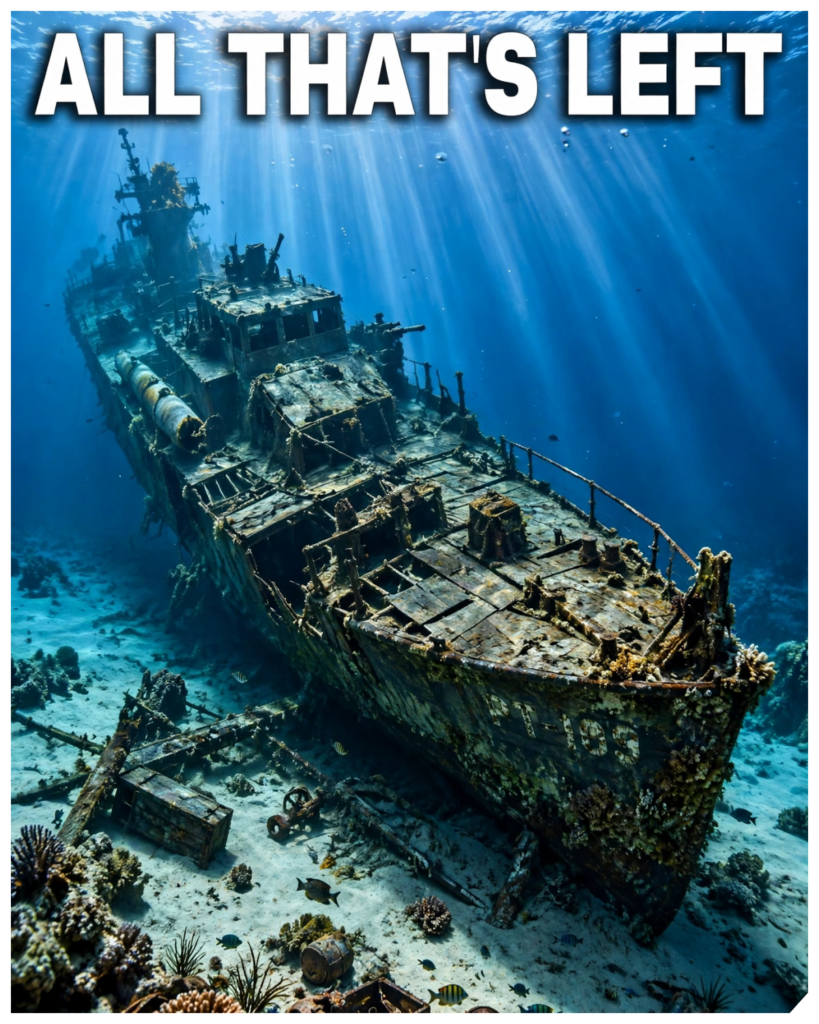
THEY FOUND JFK’S PT-109 AFTER 59 YEARS — THE HAUNTING REMAINS OF A WARSHIP THAT CHANGED HISTORY
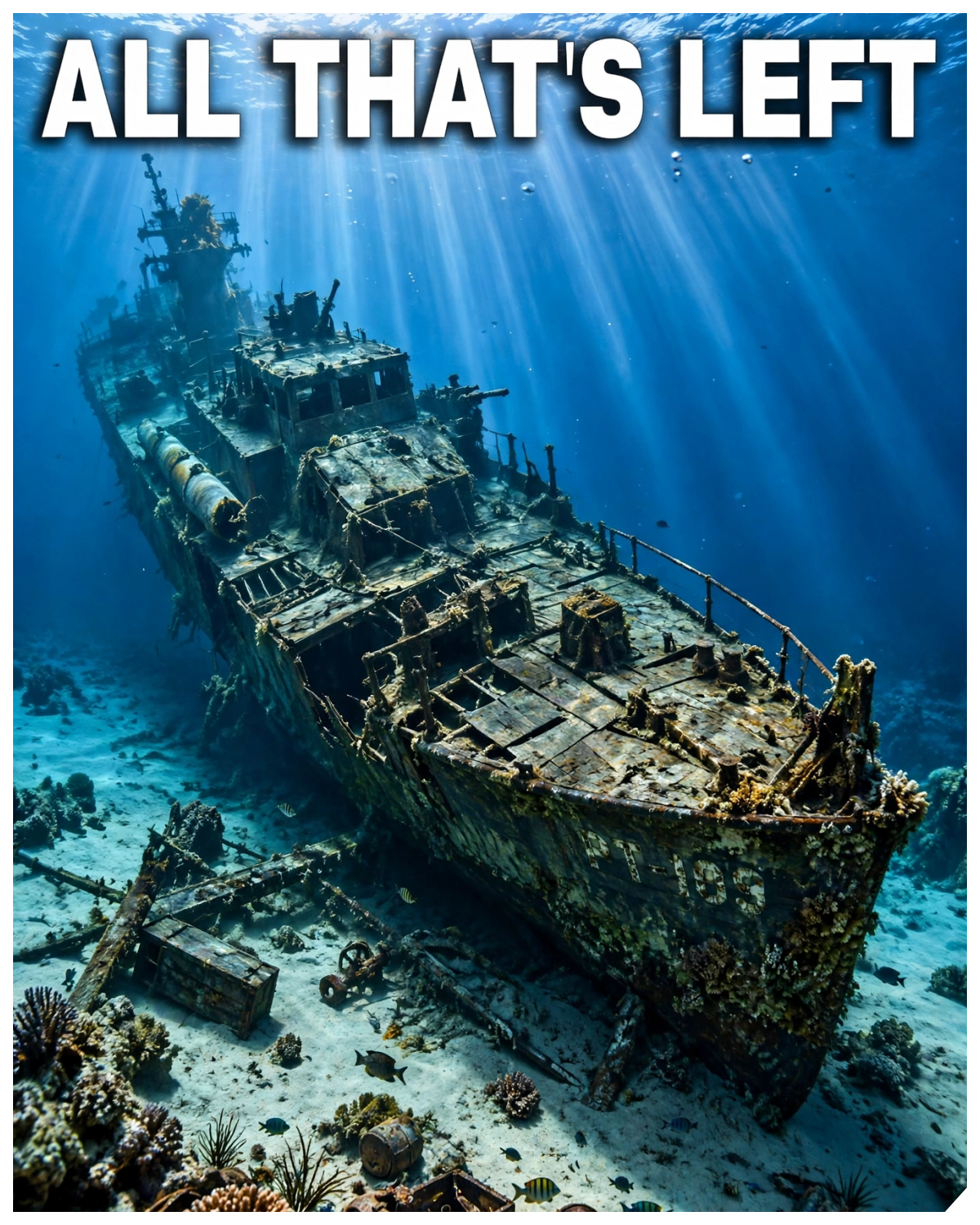
At approximately two o’clock in the morning on August 2, 1943, the darkness of the South Pacific concealed a disaster that would eventually become part of American presidential history.
A small American patrol boat was moving through the waters near the Solomon Islands when a Japanese destroyer suddenly appeared.
A collision followed with devastating force.
The wooden patrol torpedo boat, known as PT-109, was struck by the much larger Japanese destroyer Amagiri.
Within moments, the American vessel was torn apart, its crew thrown into the water, and burning fuel spreading across the sea.
At the center of the catastrophe was a 26-year-old naval officer named John F.
Kennedy.
He had not yet become a senator, a presidential candidate, or the 35th president of the United States.
He was a young officer responsible for the lives of the men serving under his command.
And in the darkness of that August night, his decisions would help determine whether any of them survived.
The collision killed two members of the crew, Andrew Jackson Kirksey and Harold William Marney.
The remaining survivors struggled to stay together as the damaged boat drifted in the water.
Kennedy, who had suffered a serious back injury, helped organize the survivors and assist those who were badly hurt.
One of the injured men was Patrick Henry McMahon, an engineer who had suffered severe burns.
Kennedy helped tow him through the water, using the strap of his life jacket between his teeth.
The surviving crew eventually abandoned the wreckage and made their way toward a small island.
For the men who had escaped the collision, the immediate danger had passed, but survival was far from guaranteed.
They were stranded in a region where Japanese forces operated nearby, and the surrounding islands offered little certainty of food, fresh water, or rescue.
Their ordeal had only begun.
The story of what followed would become one of the most widely remembered episodes of Kennedy’s military service.
But for decades, another part of the story remained hidden beneath the sea.
What had happened to the boat itself?
Where had its broken sections settled?
And after nearly six decades of salt water, shifting sand, marine organisms, and powerful currents, would anything recognizable remain?
Those questions eventually attracted one of the most famous explorers in the world.
Robert Ballard, the oceanographer best known for discovering the wreck of the Titanic in 1985, began investigating the location of PT-109.
The challenge was formidable.
The Solomon Islands region contained numerous underwater obstacles, including rocks, ridges, shifting sediment, and remnants of other wartime vessels.
Historical records provided clues, but the precise location of the wreckage was not as simple to establish as marking a point on a map.
The boat had broken apart during the collision.
Its forward section had continued drifting before eventually sinking, while the stern was believed to have gone down nearer the point of impact.
That meant the wreckage could be scattered across a considerable area of seabed.
Ballard’s team began scanning the search zone using sonar.
Instead of immediately revealing the lost boat, the equipment returned thousands of potential targets.
Some were rocks.
Others were underwater formations or debris from different vessels.
The images were difficult to interpret because the seabed itself was constantly changing.
Sand moved with the currents, burying some objects while exposing others.
A piece of metal visible one day might disappear beneath sediment later.
The team initially concentrated on locating the stern, whose approximate sinking location was known.
But the search produced no decisive result.
With time running short, Ballard made a critical decision.
Rather than continue searching for the stern, he redirected the expedition toward the bow.
It was a calculated risk.
The forward section had drifted before sinking, making its final position less certain.
Yet the change in strategy opened the way to a discovery that would soon capture international attention.
The expedition narrowed its search area and identified a promising sonar target.
Underwater robotic vehicles were then sent down to examine the object.
The vehicles, known as Little Hercules and Argus, carried cameras and lighting equipment that allowed the team to inspect the seabed from the research vessel above.
The operators watched the images as the machines moved through the deep water.
What appeared on their screens was not a complete wooden boat resting neatly on the ocean floor.
Instead, they found fragments whose significance depended on careful identification.
There was a torpedo.
There was a damaged torpedo-launching tube.
Nearby lay a mechanical component used to position the tube for firing.
These objects were heavily affected by their underwater environment.
Coral and rust covered portions of the metal.
Sand surrounded the wreckage.
The wooden hull, which had once carried the crew through dangerous wartime patrols, was not visible as a recognizable vessel.
Yet the objects provided an extraordinary set of clues.
The torpedo and launching tube were consistent with equipment used on American patrol torpedo boats during World War II.
The location also matched historical accounts of PT-109’s final movements.
Naval records indicated that no other American PT boat had been lost in the search area.
The mechanical component beside the tube provided another important detail.
Its position was consistent with the arrangement found on a patrol torpedo boat.
Each clue strengthened the case that Ballard’s team had found the missing vessel.
The final assessment required specialists familiar with naval weapons and historical records.
The expedition’s footage was reviewed by experts connected with the U.S.
Naval Historical Center.
Because the team had deliberately avoided removing artifacts from the site, the identification could not rely on bringing a unique object to the surface and examining it in a laboratory.
Instead, investigators considered the location, equipment, and surrounding evidence together.
Their conclusion was cautious but significant.
The wreckage appeared to be PT-109.
The discovery was announced in July 2002, nearly 59 years after the collision.
For historians and Kennedy enthusiasts, it represented the physical rediscovery of a vessel that had already become a symbol of courage, endurance, and political history.
Yet the discovery also raised a more unsettling question.
If the expedition had found the boat, why was there so little left?
The answer lay partly in the materials used to construct PT-109.
Like many American patrol torpedo boats of the period, it was built primarily from wood, including mahogany, with plywood used in several structural sections.
The vessel had been designed for speed.
At approximately 80 feet long, it carried powerful engines that allowed it to move rapidly across the water.
Its three Packard engines produced substantial horsepower, making the boat a fast and agile weapon against larger enemy vessels.
But the qualities that made PT-109 effective during wartime did not guarantee its survival on the seabed.
Wood deteriorates in the marine environment.
Marine organisms can bore into wooden structures, weakening them over time.
Strong currents can move sand across the wreckage, exposing one section while burying another.
The boat had also suffered a catastrophic collision before it sank, meaning that much of its structure may already have been crushed, split, or separated.
After almost six decades underwater, the remaining evidence was concentrated in the more durable components.
Metal objects such as torpedo tubes, engines, and fuel-system parts were more likely to survive than the wooden hull around them.
Ballard’s team also detected a larger object beneath the seabed using sonar.
The signal suggested that additional material might remain buried under the sand, including part of the forward section.
The evidence could not reveal every detail of the hidden structure, but it indicated that the visible fragments might represent only a portion of what lay below.
The stern presented a different problem.
It was believed to have sunk near the collision site, several miles north of where the bow was located.
However, the violence of the impact may have destroyed much of that section.
The expedition did not establish that an intact stern remained there, and Ballard eventually abandoned the search for it.
The team had achieved its main objective without recovering the entire vessel.
And that was exactly how Ballard wanted the discovery to remain.
The wreck was not treated as a treasure waiting to be raised.
It was a historic site connected to a wartime tragedy in which two men lost their lives.
The expedition’s purpose was to document the remains, not to dismantle them.
The decision reflected a principle that has become increasingly important in underwater archaeology: discovering a wreck does not automatically mean removing it from its resting place.
Some sites contain objects of enormous historical value.
Others are associated with human loss and deserve particular respect.
PT-109 belonged to both categories.
Its remains could help researchers understand the vessel and its final hours, but the site also marked the end of a boat whose crew had faced a desperate struggle to survive.
For Ballard, leaving the wreck undisturbed preserved that connection between the physical remains and the events they represented.
Meanwhile, the story of the survivors had already become part of American history.
After reaching the island, Kennedy and his men continued trying to attract the attention of friendly forces.
Food and fresh water were limited.
The survivors needed help, but moving openly through the area carried risks because Japanese forces operated nearby.
Local Solomon Islanders played a crucial role in their eventual rescue.
Among those who helped were Biuku Gasa and Eroni Kumana, who assisted in carrying information to Allied personnel.
Kennedy famously carved a message onto a coconut shell, explaining that eleven men were alive and requesting assistance.
The message was carried to an Australian coastwatcher, who helped coordinate the rescue.
On August 8, the surviving crew members were brought to safety aboard another American patrol torpedo boat, PT-157.
The rescue ended six days of uncertainty.
Kennedy later received the Navy and Marine Corps Medal for his actions, along with the Purple Heart for his wartime injuries.
His service aboard PT-109 became an important part of his public identity as he entered politics.
During his presidency, references to the boat continued to appear in the culture surrounding him.
The vessel became more than a military craft.
It became a symbol of a dramatic episode that connected a young naval officer to the man who would later occupy the White House.
That legacy also explains why the discovery of its remains attracted so much attention in 2002.
The expedition had not found a pristine time capsule.
It had not recovered an entire patrol boat with its deck, cabin, and equipment preserved exactly as they had appeared in 1943.
What it found was more modest and, in some ways, more powerful.
A damaged torpedo.
A corroded launching tube.
A mechanical component resting beside it.
Additional material that may have remained buried under shifting sand.
These fragments were enough to connect a physical location on the ocean floor with one of the most famous naval survival stories in American history.
They showed that the boat had not vanished completely.
But they also revealed the limits of what archaeology could recover after decades of environmental change.
The discovery did not answer every question about the final moments of PT-109.
It did not reveal the complete shape of the wreck or establish exactly how much of the wooden hull remained beneath the sediment.
And it did not locate every section of the vessel.
What it provided was a carefully documented link between historical accounts and physical evidence.
More than eight decades after the collision, PT-109 remains a reminder that history is not preserved only in photographs, official reports, or the memories of survivors.
Sometimes it survives in fragments hidden beneath the sea.
Those fragments may be corroded, buried, and almost unrecognizable.
Yet when their location and details are understood, they can illuminate events that shaped the lives of individuals and the course of public history.
The wreck of PT-109 was never brought back to the surface as a complete vessel.
Its remains were left where the ocean had carried them, preserving the site as a quiet memorial to the two sailors who died and to the crew members who fought to survive.
In 2002, the world finally learned where the boat’s forward wreckage rested.
The discovery gave historians a rare opportunity to look directly at the material remains of a defining moment in John F.
Kennedy’s life.
But the deepest significance of the find was not the amount of metal that survived.
It was the connection between those fragments and the men who had once depended on that small wooden boat in the darkness of the Pacific.
Nearly 59 years after PT-109 disappeared beneath the waves, its remains told a story that no headline could fully capture.
The ship was broken.
Much of its wooden structure had likely disappeared.
The stern remained unlocated.
And the surviving metal lay partly buried beneath the shifting seabed.
Yet the wreck was no longer lost to history.
It had been found, identified with careful qualifications, and left undisturbed.
Somewhere beneath the waters of the Solomon Islands, the remnants of PT-109 continue to rest in darkness, preserving a final connection to the night that changed the lives of its crew and helped shape the public legend of a future American president.


